Compress
your air costs
Roy Brooks
MSOE IplantE
Technical Development Officer
British Compressed AirSociety
©CrownCopyright
FirstPublished1994
Last Reprint2001
Thisguide updatesandreplacesaprevious
publicationfromthe CarbonTrust,
GPG126 Compressingaircosts.
Publishedinthe UKFebruary2005
© Queen’sPrinterandControllerof HMSO
Insist on BCAS- BeCompliant And Safe
ReducingEnergyConsumption
from Compressed Air Usage
Produced by the British Compressed Air Society.
www.bcas.org.uk
www.bcas.org
http://www.bcas.org.uk/article/reducing-
energy-consumption-whitepaper-33.aspx
Compressed air can typically account for 10% of an
industrial company’s electricity bill and for some
sectors it can equate to far more.
It therefore makes sense to take targeted action and
make your system more efficient.
Reducing compressed air waste will:
Save energy and costs
Improve reliability and productivity
Calculating the System’s Annual Cost.
• Option 1.
On & Off load running time when there is no demand for air.
Then you can estimate the energy consumptionof each
compressor.
• Option 2
A temporary more accurate and cost effective solution is to
install a data logging system over a period of at least seven
days.
• Option 3
To obtain actual electrical consumptionof the compressor(s)
in kilowatt hours (kWh) can be obtained by sub-metering the
compressorhouse.
Take a system approach
• A 75kW compressor operating at 7 bar.
• 2 shift pattern – 5 day week - 80 hours per week
• It is on load for 65% of the production time, which is 2,704 hours per year.
• The motor is assumed to be 90% efficient.
• Energy consumption of the compressor whilst on load =
• (75 ÷ 0.9) x 0.65 x 2,704 = 146,466 kWh/year
• There is also energy consumption from the offload running, assuming for a screw compressor
that a part-loaded running draws 25% of the full load power:
• (75 ÷ 0.9) x 0.35 x 0.25 x 1,456 = 10,616 kWh / year
• Total energy consumption of the compressor = 157,082 kWh
• For unit electricity of £0.12/kWh, the annual energy cost is £18,849.
• If production time is 8,320 hours per year, (346 days) this increases to £37,699/year.
A Costed Example
Energy efficiency - technology
Establish your current consumption
Purchase energy efficient options & matching
them to your requirements
 https://www.gov.uk/guidance/energy-technology-list
 variable speed devices – if demand is truly
varying
Seek expert advice for major investments
 e.g. heat recovery
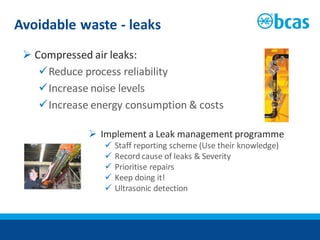
Avoidable waste - leaks
 Compressed air leaks:
Reduce process reliability
Increase noise levels
Increase energy consumption & costs
 Implement a Leak management programme
 Staff reporting scheme (Use their knowledge)
 Record cause of leaks & Severity
 Prioritise repairs
 Keep doing it!
 Ultrasonic detection
Examples of Severe Bad
Practice
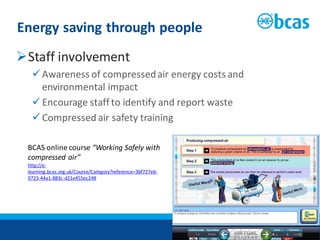
Energy saving through people
Staff involvement
 Awareness of compressedair energy costs and
environmental impact
 Encourage staff to identify and report waste
 Compressed air safety training
BCAS online course “Working Safely with
compressed air”
http://e-
learning.bcas.org.uk/Course/Category?reference=3bf727eb-
9723-44a1-883c-d21e455ec248
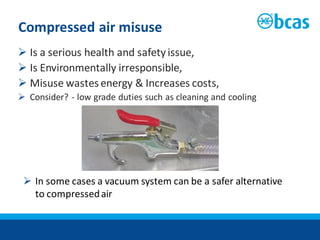
Compressed air misuse
 Is a serious health and safetyissue,
 Is Environmentally irresponsible,
 Misuse wastes energy & Increases costs,
 Consider? - low grade duties such as cleaning and cooling
 In some cases a vacuum system can be a safer alternative
to compressedair
Energy is a business issue
Business requirements for compressed air systems:
Safety
Reliability / consistency
Productivity
….delivered cost effectively
Compressed air safety
Know your responsibilities
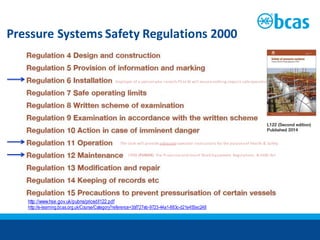
Pressure Systems Safety Regulations 2000
HSE guidance
http://www.hse.gov.uk/pubns/indg261.pdf
Pressure Systems Safety Regulations 2000
http://www.hse.gov.uk/pubns/priced/l122.pdf
http://e-learning.bcas.org.uk/Course/Category?reference=3bf727eb-9723-44a1-883c-d21e455ec248
1998 (PUWER) The Provision and Useof Work Equipment Regulations & HSW Act
The User will provideadequateoperator instructions for the purposeof Health & Safety
Employer of a person who installsPS atW will ensurenothingimpairs safeoperation
Choosing your supplier
When choosing your supplier for installation &
maintenance, check for:
 evidence of manufacturer training (Portfolio)
 SKILLcard / Safety Passport
 use of bona-fide products
 safety and compliance knowledge
 adherence to good industry practice
• BCAS Installation Guide
• BCAS Pressure & Leak Testing guide
• BCAS factsheets for EU compliance
BCAS products & services
Training Courses
Good industry practice guides
Industry & legislative updates
Interpretation/clarification of regulations
Myth busting
Answers you can't find on Google
www.bcas.org.uk
Summary
Take a “system” approach - http://www.bcas.org.uk/media/download.aspx?MediaId=15
Train your people
Safety, energy efficiency and reliability are
related
Measure to manage and prove savings
Choose suppliers that follow good industry
practice
www.bcas.org.uk
training@bcas.org.uk – technical@bcas.org.uk –
Dipcam@bcas.org.uk – Roy@bcas.org.uk

Compressing your Air Costs

  • 1.
    Compress your air costs RoyBrooks MSOE IplantE Technical Development Officer British Compressed AirSociety
  • 2.
    ©CrownCopyright FirstPublished1994 Last Reprint2001 Thisguide updatesandreplacesaprevious publicationfromtheCarbonTrust, GPG126 Compressingaircosts. Publishedinthe UKFebruary2005 © Queen’sPrinterandControllerof HMSO
  • 4.
    Insist on BCAS-BeCompliant And Safe ReducingEnergyConsumption from Compressed Air Usage Produced by the British Compressed Air Society. www.bcas.org.uk www.bcas.org http://www.bcas.org.uk/article/reducing- energy-consumption-whitepaper-33.aspx
  • 6.
    Compressed air cantypically account for 10% of an industrial company’s electricity bill and for some sectors it can equate to far more. It therefore makes sense to take targeted action and make your system more efficient. Reducing compressed air waste will: Save energy and costs Improve reliability and productivity
  • 7.
    Calculating the System’sAnnual Cost. • Option 1. On & Off load running time when there is no demand for air. Then you can estimate the energy consumptionof each compressor. • Option 2 A temporary more accurate and cost effective solution is to install a data logging system over a period of at least seven days. • Option 3 To obtain actual electrical consumptionof the compressor(s) in kilowatt hours (kWh) can be obtained by sub-metering the compressorhouse. Take a system approach
  • 8.
    • A 75kWcompressor operating at 7 bar. • 2 shift pattern – 5 day week - 80 hours per week • It is on load for 65% of the production time, which is 2,704 hours per year. • The motor is assumed to be 90% efficient. • Energy consumption of the compressor whilst on load = • (75 ÷ 0.9) x 0.65 x 2,704 = 146,466 kWh/year • There is also energy consumption from the offload running, assuming for a screw compressor that a part-loaded running draws 25% of the full load power: • (75 ÷ 0.9) x 0.35 x 0.25 x 1,456 = 10,616 kWh / year • Total energy consumption of the compressor = 157,082 kWh • For unit electricity of £0.12/kWh, the annual energy cost is £18,849. • If production time is 8,320 hours per year, (346 days) this increases to £37,699/year. A Costed Example
  • 9.
    Energy efficiency -technology Establish your current consumption Purchase energy efficient options & matching them to your requirements  https://www.gov.uk/guidance/energy-technology-list  variable speed devices – if demand is truly varying Seek expert advice for major investments  e.g. heat recovery
  • 10.
    Avoidable waste -leaks  Compressed air leaks: Reduce process reliability Increase noise levels Increase energy consumption & costs  Implement a Leak management programme  Staff reporting scheme (Use their knowledge)  Record cause of leaks & Severity  Prioritise repairs  Keep doing it!  Ultrasonic detection
  • 11.
    Examples of SevereBad Practice
  • 12.
    Energy saving throughpeople Staff involvement  Awareness of compressedair energy costs and environmental impact  Encourage staff to identify and report waste  Compressed air safety training BCAS online course “Working Safely with compressed air” http://e- learning.bcas.org.uk/Course/Category?reference=3bf727eb- 9723-44a1-883c-d21e455ec248
  • 13.
    Compressed air misuse Is a serious health and safetyissue,  Is Environmentally irresponsible,  Misuse wastes energy & Increases costs,  Consider? - low grade duties such as cleaning and cooling  In some cases a vacuum system can be a safer alternative to compressedair
  • 14.
    Energy is abusiness issue Business requirements for compressed air systems: Safety Reliability / consistency Productivity ….delivered cost effectively
  • 15.
    Compressed air safety Knowyour responsibilities Pressure Systems Safety Regulations 2000
  • 16.
  • 17.
    Pressure Systems SafetyRegulations 2000 http://www.hse.gov.uk/pubns/priced/l122.pdf http://e-learning.bcas.org.uk/Course/Category?reference=3bf727eb-9723-44a1-883c-d21e455ec248 1998 (PUWER) The Provision and Useof Work Equipment Regulations & HSW Act The User will provideadequateoperator instructions for the purposeof Health & Safety Employer of a person who installsPS atW will ensurenothingimpairs safeoperation
  • 18.
    Choosing your supplier Whenchoosing your supplier for installation & maintenance, check for:  evidence of manufacturer training (Portfolio)  SKILLcard / Safety Passport  use of bona-fide products  safety and compliance knowledge  adherence to good industry practice • BCAS Installation Guide • BCAS Pressure & Leak Testing guide • BCAS factsheets for EU compliance
  • 19.
    BCAS products &services Training Courses Good industry practice guides Industry & legislative updates Interpretation/clarification of regulations Myth busting Answers you can't find on Google www.bcas.org.uk
  • 20.
    Summary Take a “system”approach - http://www.bcas.org.uk/media/download.aspx?MediaId=15 Train your people Safety, energy efficiency and reliability are related Measure to manage and prove savings Choose suppliers that follow good industry practice www.bcas.org.uk training@bcas.org.uk – technical@bcas.org.uk – Dipcam@bcas.org.uk – Roy@bcas.org.uk