Reinforcement technique in composites
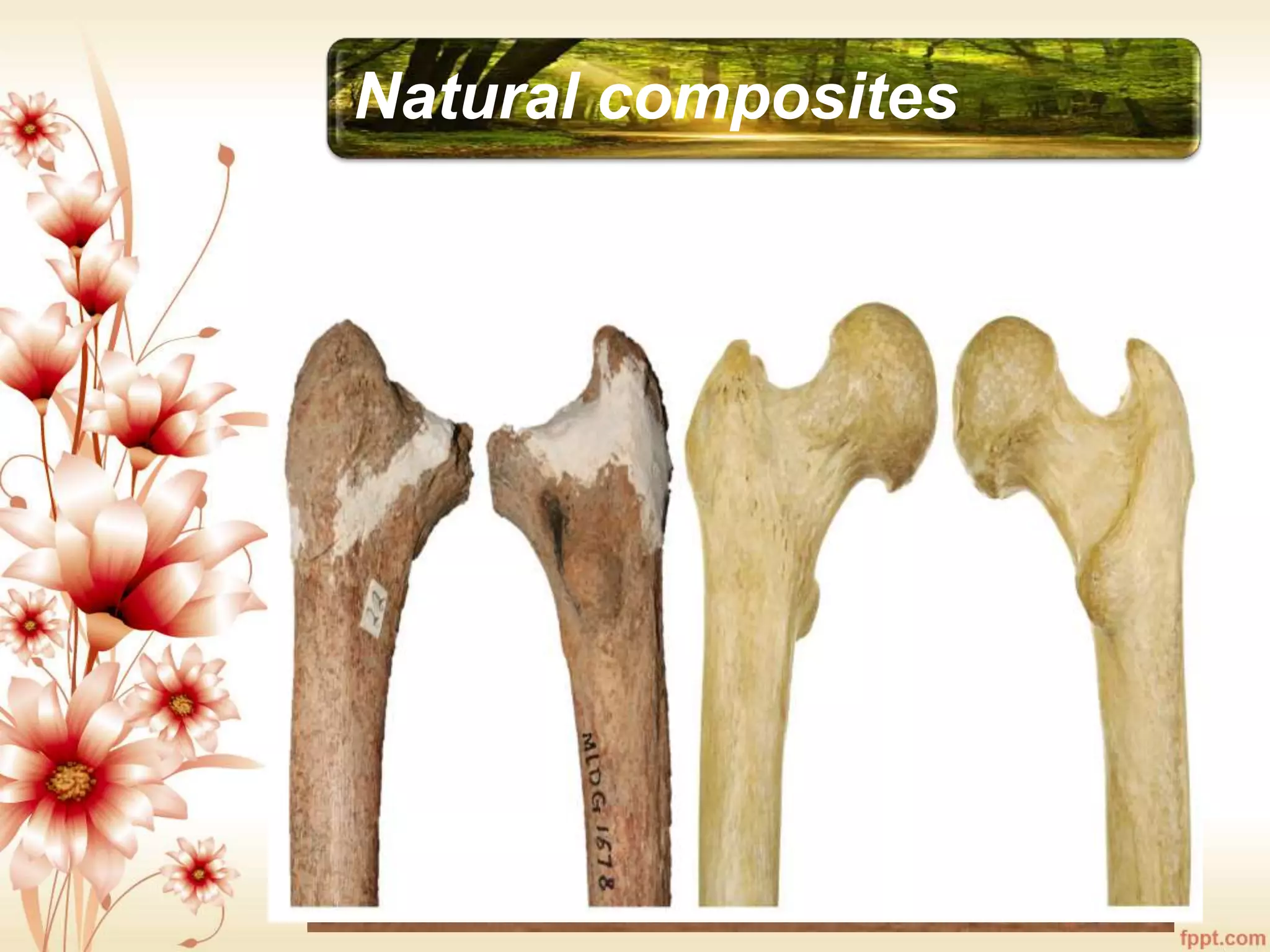
Natural composites
Introduction
• A composite material can be
defined as an unique or better
combination of two or more
chemically distinct materials
that results in improve the
properties over the individual
components
• It consist of one or more
discontinous phase or
reinforcing phase in form of
fibers,particles,whiskers or
lamellae that embedded in a
continuous phase or matrix
phase in form of
polymer,metal or ceramic
So why use composites
 It provides high strength and stiffness to weight ratio
 High creep resistance
 Weight reduction
 Stand up well to corrosion and oxidation
 Possible to make unique properties according to
requirements
 Can be moulded into any shape
 Durable and higher flexibity
 High tensile strength at elevated temperature
 Fatigue resistance and higher toughness
Matrix phase
• It is the primary or continuous phase and surrounds
the reinforcements
• Usually matrix are ductile or tough material
Functions
 Binds or holds the reinforcements together and
mechanically supporting the reinforcements
 Matrix shares or transfers the applied load with the
secondary phase for strengthening the composite
 Protect the reinforcement from surface damage
 Build up the bulk form of composite
 Prevents the propagation of brittle cracks
Matrix phase(con’t)
Matrix
Metal matrix
composites
Ceramic
matrix
composites
Polymer
matrix
composites
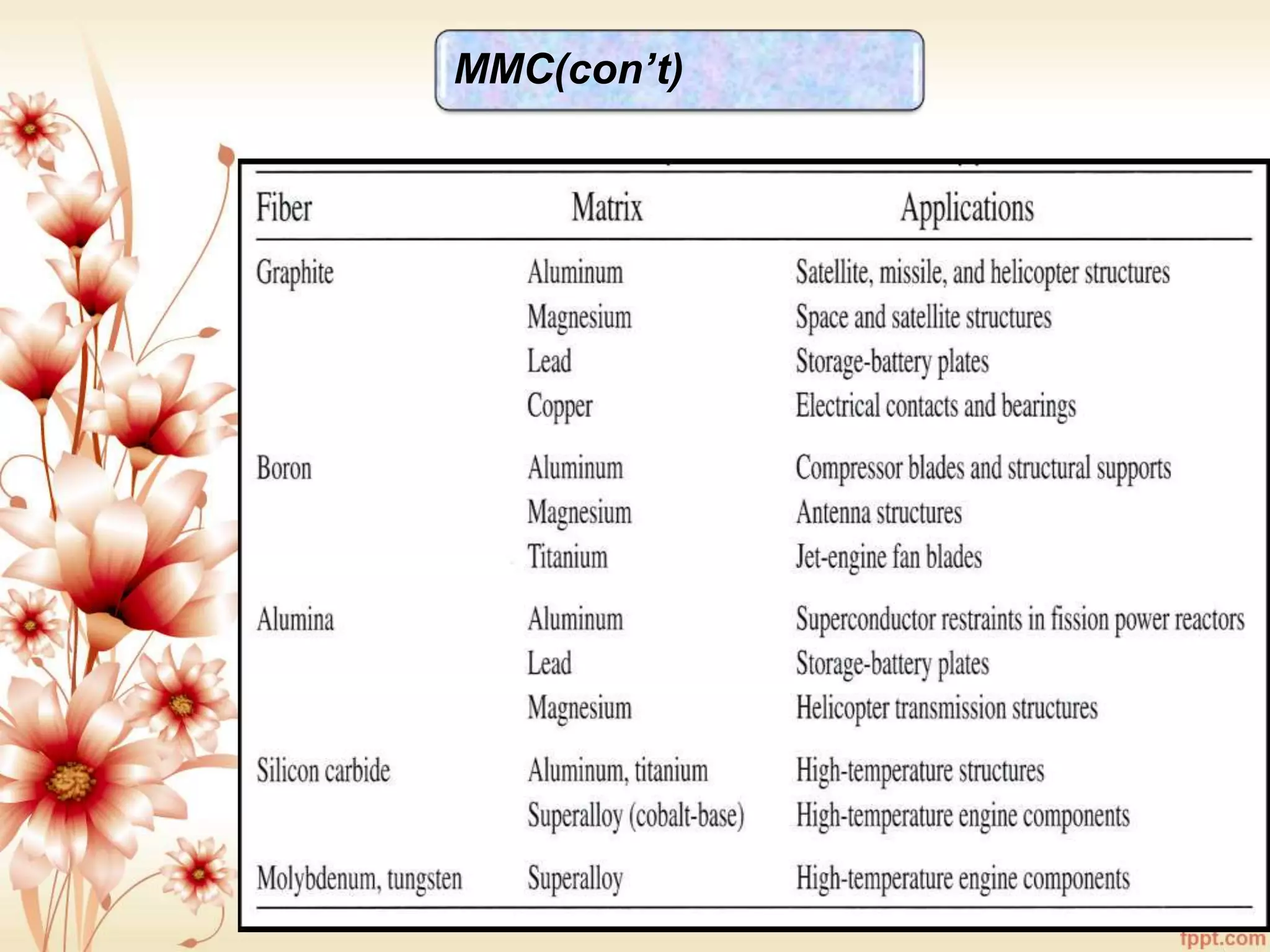
MMC
• It contains particulates,whiskers , ceramics or
fibers act as reinforcement phase that dispersed in
a metal matrix.
• Advantages
• High strength and stiff due to strong reinforcement
and matrix bonding
• Higher operating temperature
• Non-flammability
• Greater resistance to degradation by organic acid
• Enhancement of modulus
• Production and Application
MMC(con’t)
PMC
• It consisting of a polymer resin as a matrix that
combined with a fibrous reinforcing phase
• Matrix is relatively soft and flexible
• Cheaper and easy to fabrication
• Reinforcement mainly bear the load
• Thermosetting PMC
• Thermoplastic PMC
• Limitation
• Low maximum working temperature
• Sensitive to radiation,moisture and chemicals
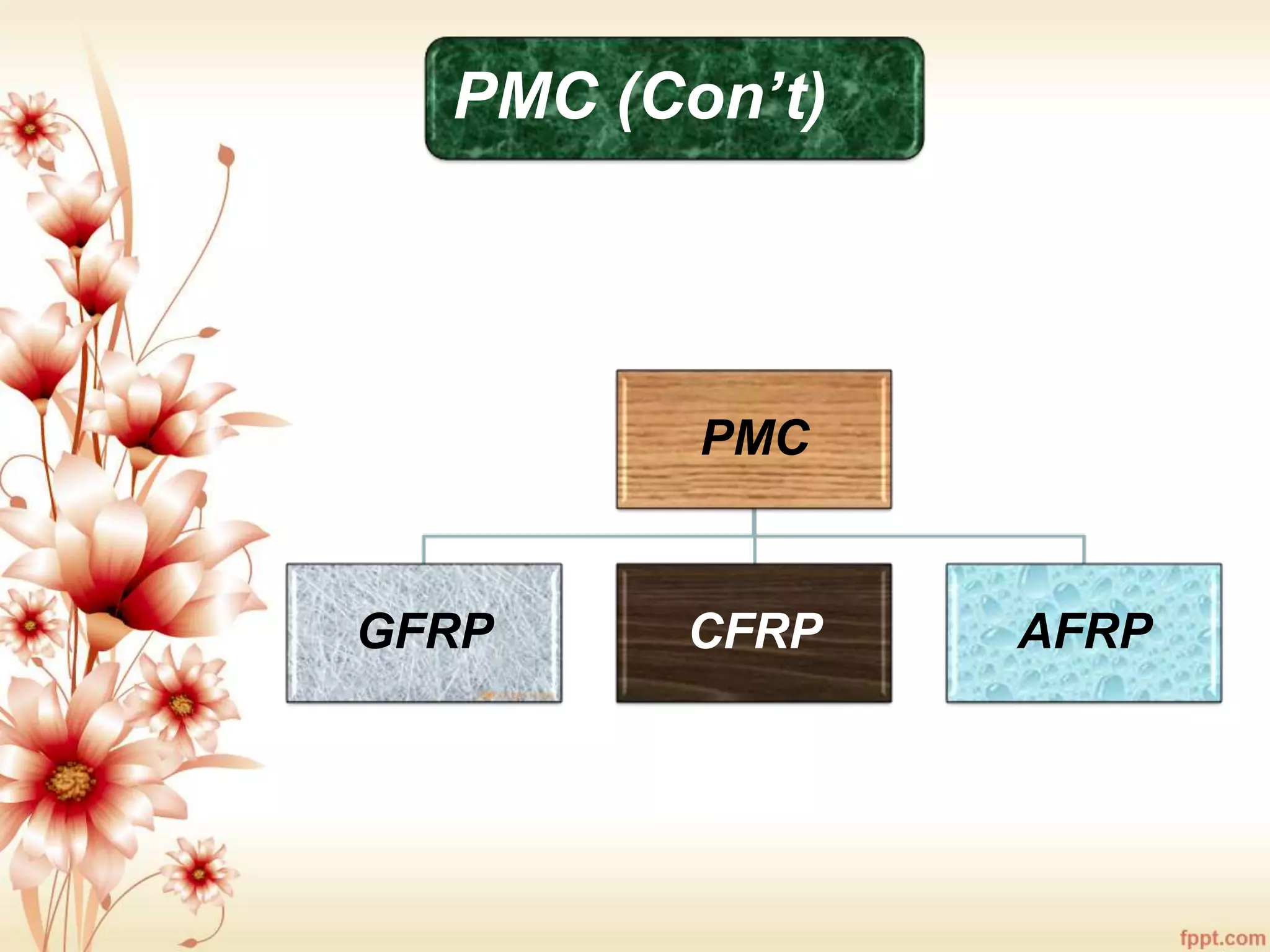
PMC (Con’t)
PMC
GFRP CFRP AFRP
CMC
• Continuous phase is ceramics in form of
oxides,carbides,nitrides,borides ,glasses or silicates and
the reinforcements used are Sic, BN,ZrO2 or C in form
of fibres,whiskers or particulates .
• Corrosion and oxidation resistance
• Can be use in higher temperature than metal and
polymers
• Processing
• Example and Application
Reinforcements
• A reinforcements is the strong
and stiff integral component
which is incorporated into the
matrix to achieve desired
properties
• They have low ductility
• It is the dispersed phase which
normally bears the majority of
stress
• Having low density
• Strengthening mechanism
depends strongly on the
geometry of the reinforcement
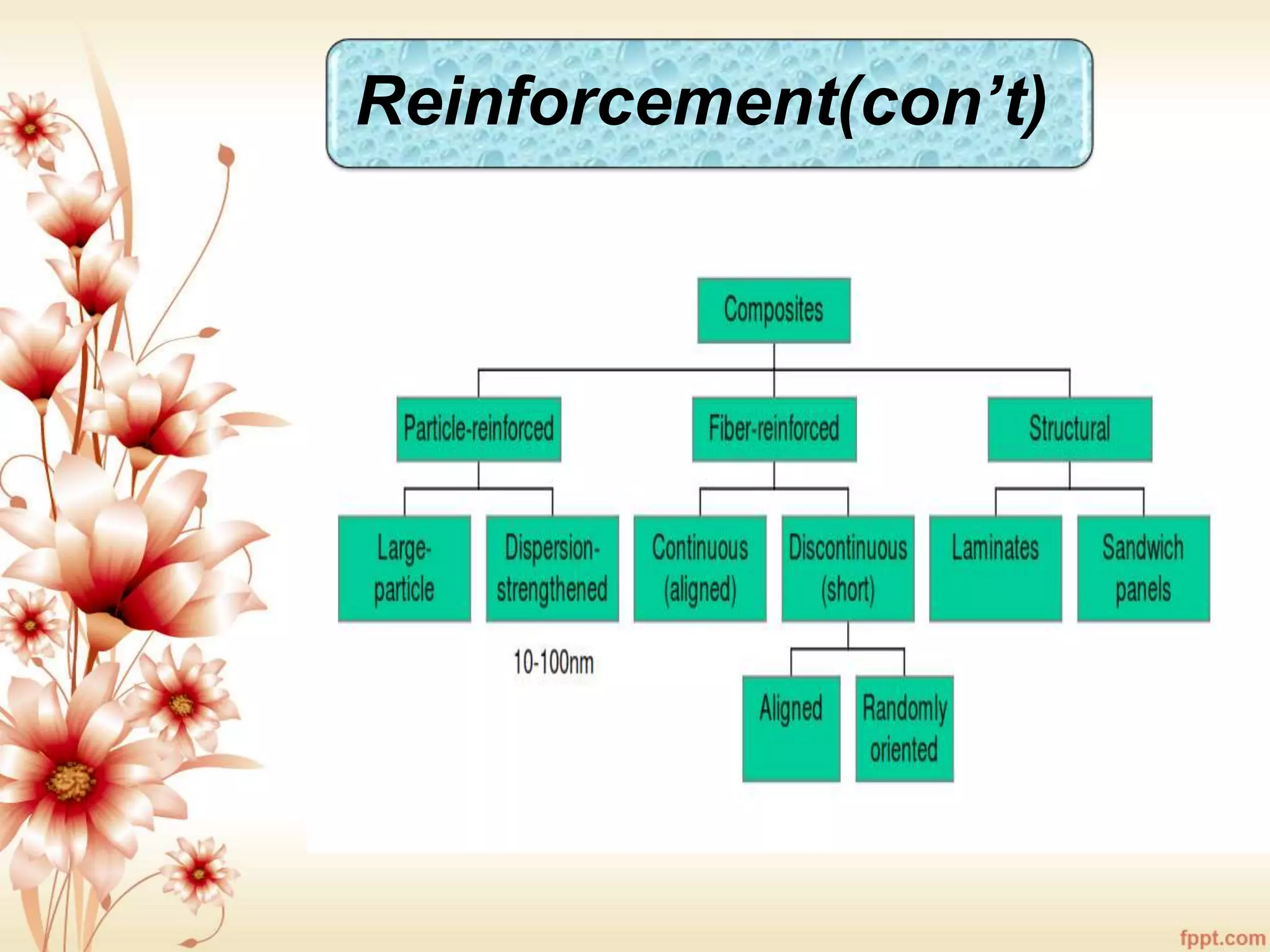
Reinforcement(con’t)
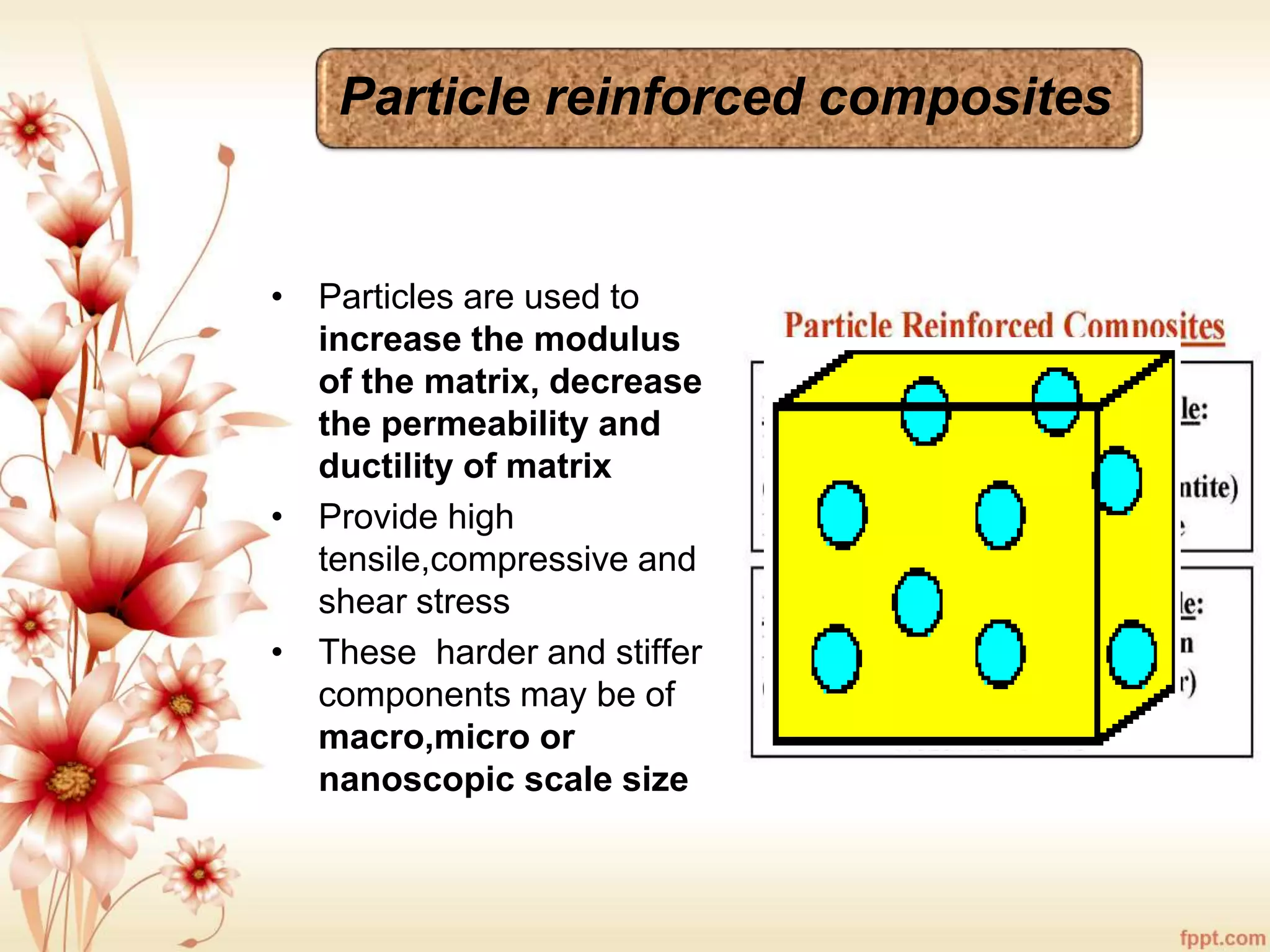
Particle reinforced composites
• Particles are used to
increase the modulus
of the matrix, decrease
the permeability and
ductility of matrix
• Provide high
tensile,compressive and
shear stress
• These harder and stiffer
components may be of
macro,micro or
nanoscopic scale size
Particle reinforcement(con’t)
• Large particle
Interaction between
particles and matrix
are not on the atomic
or molecular level
Example- concrete
The volume fraction of
the two phase
influences the
mechanical behavior
Particle reinforced
composite(con’t)
Dispersion strengthened
composites-
Strengthening of materials by
dispersion of very small hard
particles (0.1 to 100 nm) uniformly
within load-bearing matrix
Plastic deformation is restricted
Tensile strength and hardness
improved
Strengthening is retained at
elevated temperature
Fiber reinforced composites
• The dispersed
phase in fiber form
• High strength to
weight and
modulus to weight
ratio
• Low specific
gravity and high
fatigue
resistance
Fiber reinforced composite(con’t)
• Continuous fibers- When fiber lengths greater
than the critical length
• Highly effective in strengthening the material
• Discontinuous fibers- When fiber lengths
shorter than the critical length
• Having modulus and tensile strength 50-70% of their
continuous counterparts
• Cheaper and easy to fabricate into complicated
shapes
• Random fibers- These ate discrete or chopped
fibers
• Isotropic and cheaper
• Aligned fibers- provide higher strength
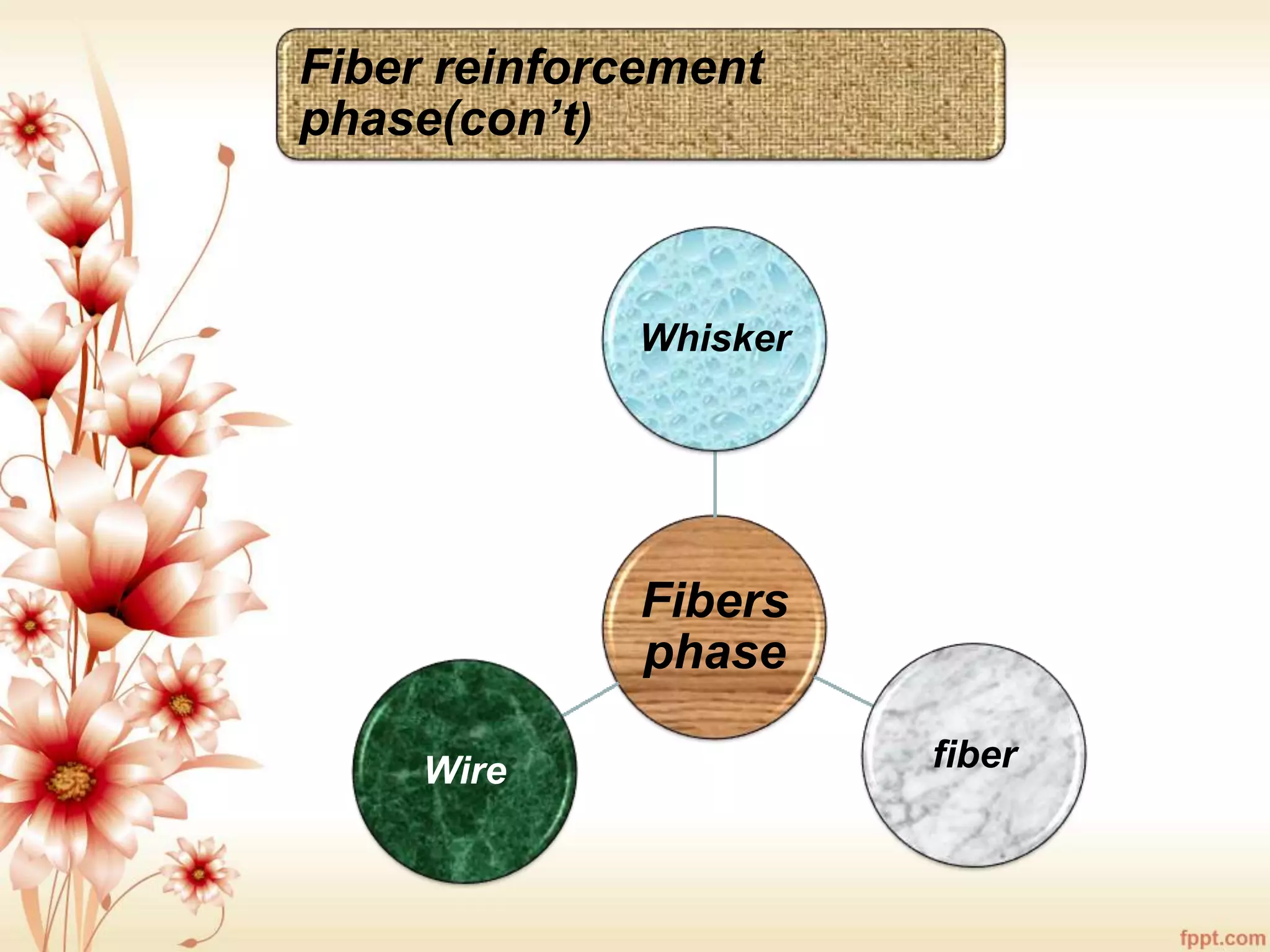
Fiber reinforcement
phase(con’t)
Fibers
phase
Whisker
fiberWire
Structural composites
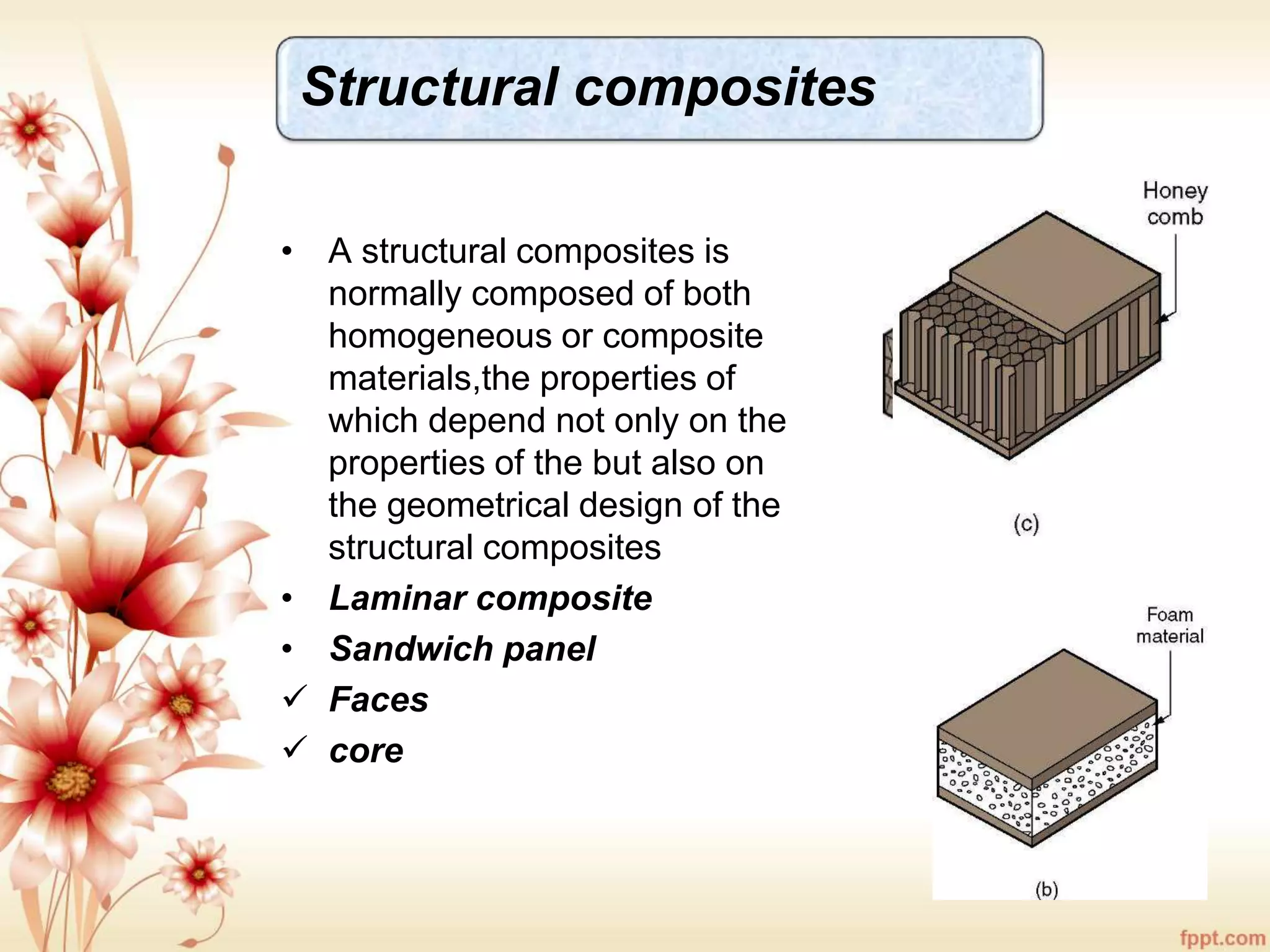
• A structural composites is
normally composed of both
homogeneous or composite
materials,the properties of
which depend not only on the
properties of the but also on
the geometrical design of the
structural composites
• Laminar composite
• Sandwich panel
 Faces
 core
Structural composites(con’t)
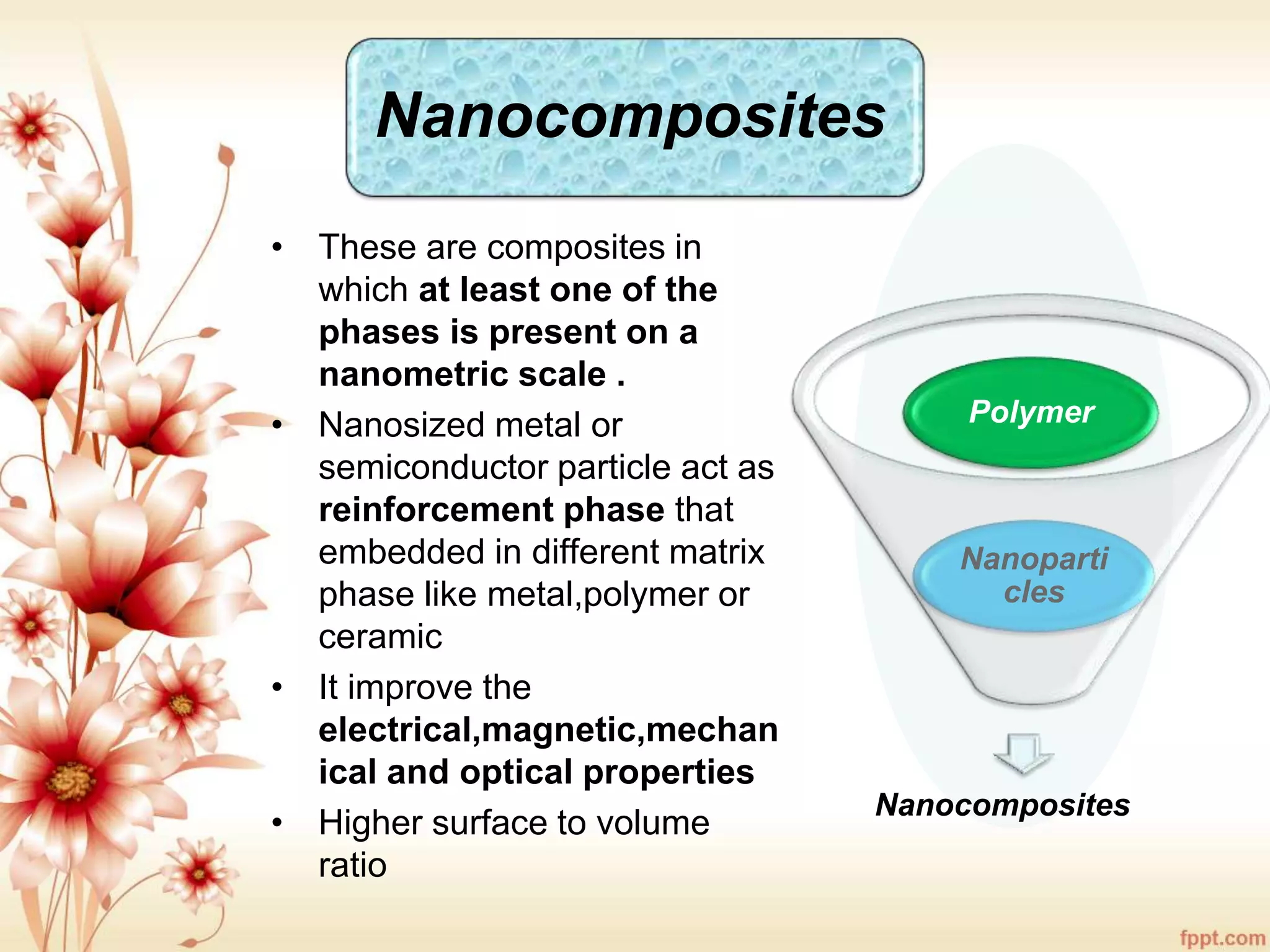
Nanocomposites
• These are composites in
which at least one of the
phases is present on a
nanometric scale .
• Nanosized metal or
semiconductor particle act as
reinforcement phase that
embedded in different matrix
phase like metal,polymer or
ceramic
• It improve the
electrical,magnetic,mechan
ical and optical properties
• Higher surface to volume
ratio
Nanocomposites
Nanoparti
cles
Polymer
Limitations
• Repair can be difficult
• Operating temperature can be an issue for
polymeric matrix
• Fabrication difficulties
• Expensive
• Manufacturing method for shaping
composite material is time consuming
• Physical properties of most of composites
are anisotropic
Conclusion
Composite anup

Composite anup

  • 1.
  • 2.
  • 3.
    Introduction • A compositematerial can be defined as an unique or better combination of two or more chemically distinct materials that results in improve the properties over the individual components • It consist of one or more discontinous phase or reinforcing phase in form of fibers,particles,whiskers or lamellae that embedded in a continuous phase or matrix phase in form of polymer,metal or ceramic
  • 5.
    So why usecomposites  It provides high strength and stiffness to weight ratio  High creep resistance  Weight reduction  Stand up well to corrosion and oxidation  Possible to make unique properties according to requirements  Can be moulded into any shape  Durable and higher flexibity  High tensile strength at elevated temperature  Fatigue resistance and higher toughness
  • 6.
    Matrix phase • Itis the primary or continuous phase and surrounds the reinforcements • Usually matrix are ductile or tough material Functions  Binds or holds the reinforcements together and mechanically supporting the reinforcements  Matrix shares or transfers the applied load with the secondary phase for strengthening the composite  Protect the reinforcement from surface damage  Build up the bulk form of composite  Prevents the propagation of brittle cracks
  • 7.
  • 8.
    MMC • It containsparticulates,whiskers , ceramics or fibers act as reinforcement phase that dispersed in a metal matrix. • Advantages • High strength and stiff due to strong reinforcement and matrix bonding • Higher operating temperature • Non-flammability • Greater resistance to degradation by organic acid • Enhancement of modulus • Production and Application
  • 9.
  • 10.
    PMC • It consistingof a polymer resin as a matrix that combined with a fibrous reinforcing phase • Matrix is relatively soft and flexible • Cheaper and easy to fabrication • Reinforcement mainly bear the load • Thermosetting PMC • Thermoplastic PMC • Limitation • Low maximum working temperature • Sensitive to radiation,moisture and chemicals
  • 11.
  • 12.
    CMC • Continuous phaseis ceramics in form of oxides,carbides,nitrides,borides ,glasses or silicates and the reinforcements used are Sic, BN,ZrO2 or C in form of fibres,whiskers or particulates . • Corrosion and oxidation resistance • Can be use in higher temperature than metal and polymers • Processing • Example and Application
  • 13.
    Reinforcements • A reinforcementsis the strong and stiff integral component which is incorporated into the matrix to achieve desired properties • They have low ductility • It is the dispersed phase which normally bears the majority of stress • Having low density • Strengthening mechanism depends strongly on the geometry of the reinforcement
  • 14.
  • 15.
    Particle reinforced composites •Particles are used to increase the modulus of the matrix, decrease the permeability and ductility of matrix • Provide high tensile,compressive and shear stress • These harder and stiffer components may be of macro,micro or nanoscopic scale size
  • 16.
    Particle reinforcement(con’t) • Largeparticle Interaction between particles and matrix are not on the atomic or molecular level Example- concrete The volume fraction of the two phase influences the mechanical behavior
  • 17.
    Particle reinforced composite(con’t) Dispersion strengthened composites- Strengtheningof materials by dispersion of very small hard particles (0.1 to 100 nm) uniformly within load-bearing matrix Plastic deformation is restricted Tensile strength and hardness improved Strengthening is retained at elevated temperature
  • 18.
    Fiber reinforced composites •The dispersed phase in fiber form • High strength to weight and modulus to weight ratio • Low specific gravity and high fatigue resistance
  • 19.
    Fiber reinforced composite(con’t) •Continuous fibers- When fiber lengths greater than the critical length • Highly effective in strengthening the material • Discontinuous fibers- When fiber lengths shorter than the critical length • Having modulus and tensile strength 50-70% of their continuous counterparts • Cheaper and easy to fabricate into complicated shapes • Random fibers- These ate discrete or chopped fibers • Isotropic and cheaper • Aligned fibers- provide higher strength
  • 20.
  • 21.
    Structural composites • Astructural composites is normally composed of both homogeneous or composite materials,the properties of which depend not only on the properties of the but also on the geometrical design of the structural composites • Laminar composite • Sandwich panel  Faces  core
  • 22.
  • 23.
    Nanocomposites • These arecomposites in which at least one of the phases is present on a nanometric scale . • Nanosized metal or semiconductor particle act as reinforcement phase that embedded in different matrix phase like metal,polymer or ceramic • It improve the electrical,magnetic,mechan ical and optical properties • Higher surface to volume ratio Nanocomposites Nanoparti cles Polymer
  • 24.
    Limitations • Repair canbe difficult • Operating temperature can be an issue for polymeric matrix • Fabrication difficulties • Expensive • Manufacturing method for shaping composite material is time consuming • Physical properties of most of composites are anisotropic
  • 29.