Completing the Square Factoring “unfactorable” 2 nd  degree trinomials Don Simmons © D. T. Simmons, 2009
Completing the Square We have learned earlier that a perfect square trinomial can always be factored. Therefore, if we have a trinomial we cannot factor using integers, we can change it in such a way that we are dealing with a perfect square trinomial. © D. T. Simmons, 2009
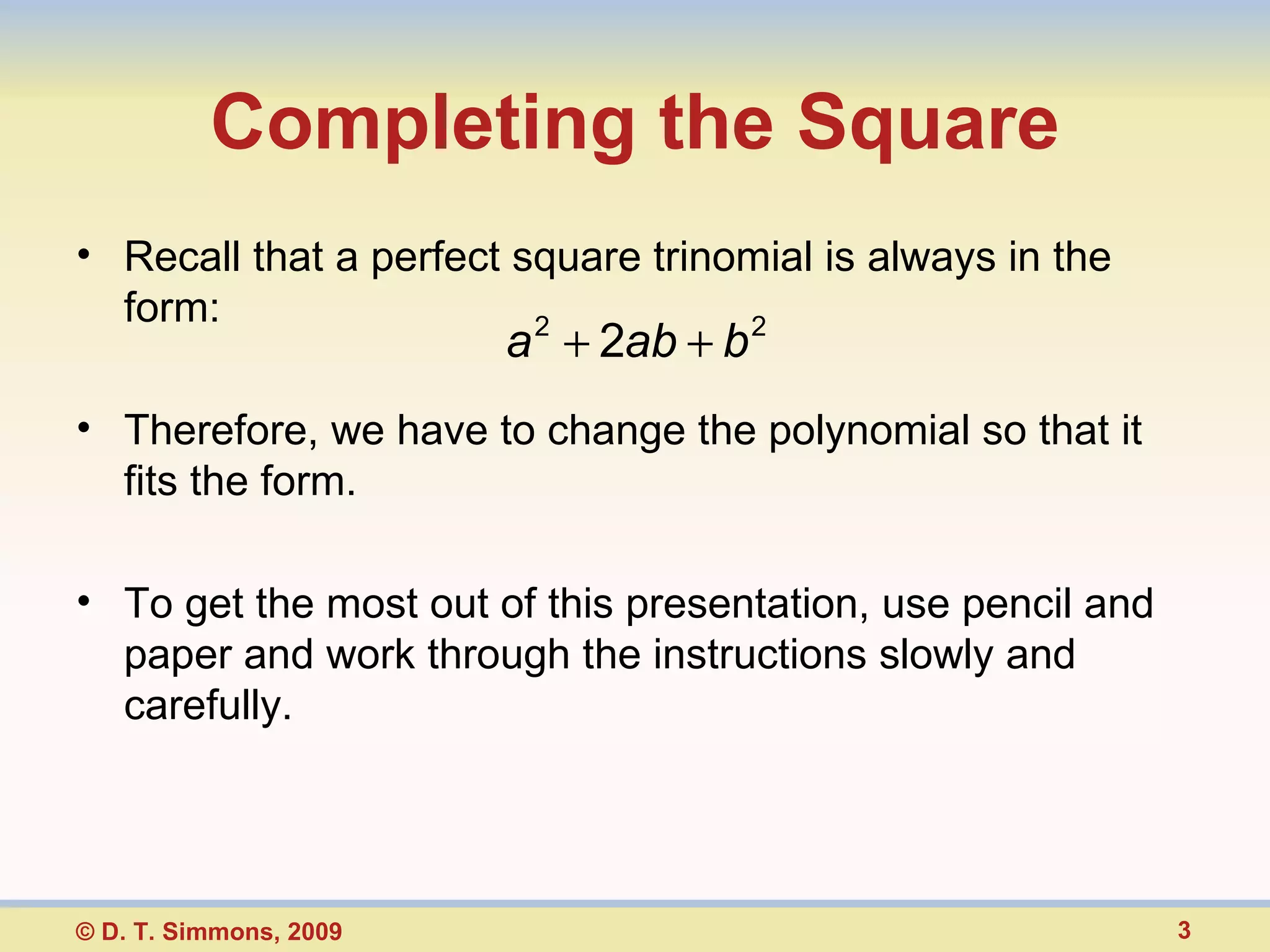
Completing the Square Recall that a perfect square trinomial is always in the form:  Therefore, we have to change the polynomial so that it fits the form. To get the most out of this presentation, use pencil and paper and work through the instructions slowly and carefully. © D. T. Simmons, 2009
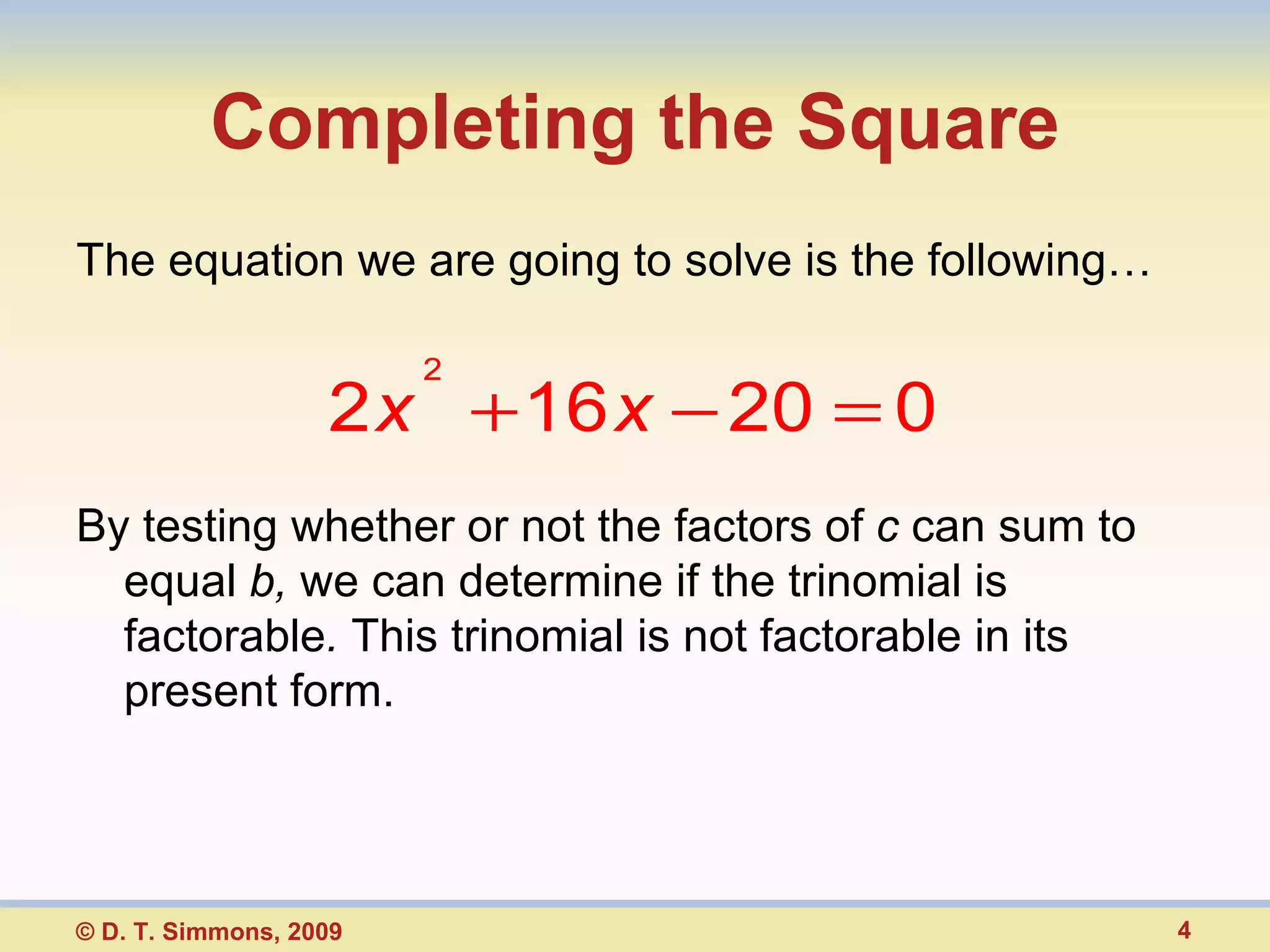
Completing the Square The equation we are going to solve is the following… By testing whether or not the factors of  c  can sum to equal  b,  we can determine if the trinomial is factorable .  This trinomial is not factorable in its present form. © D. T. Simmons, 2009
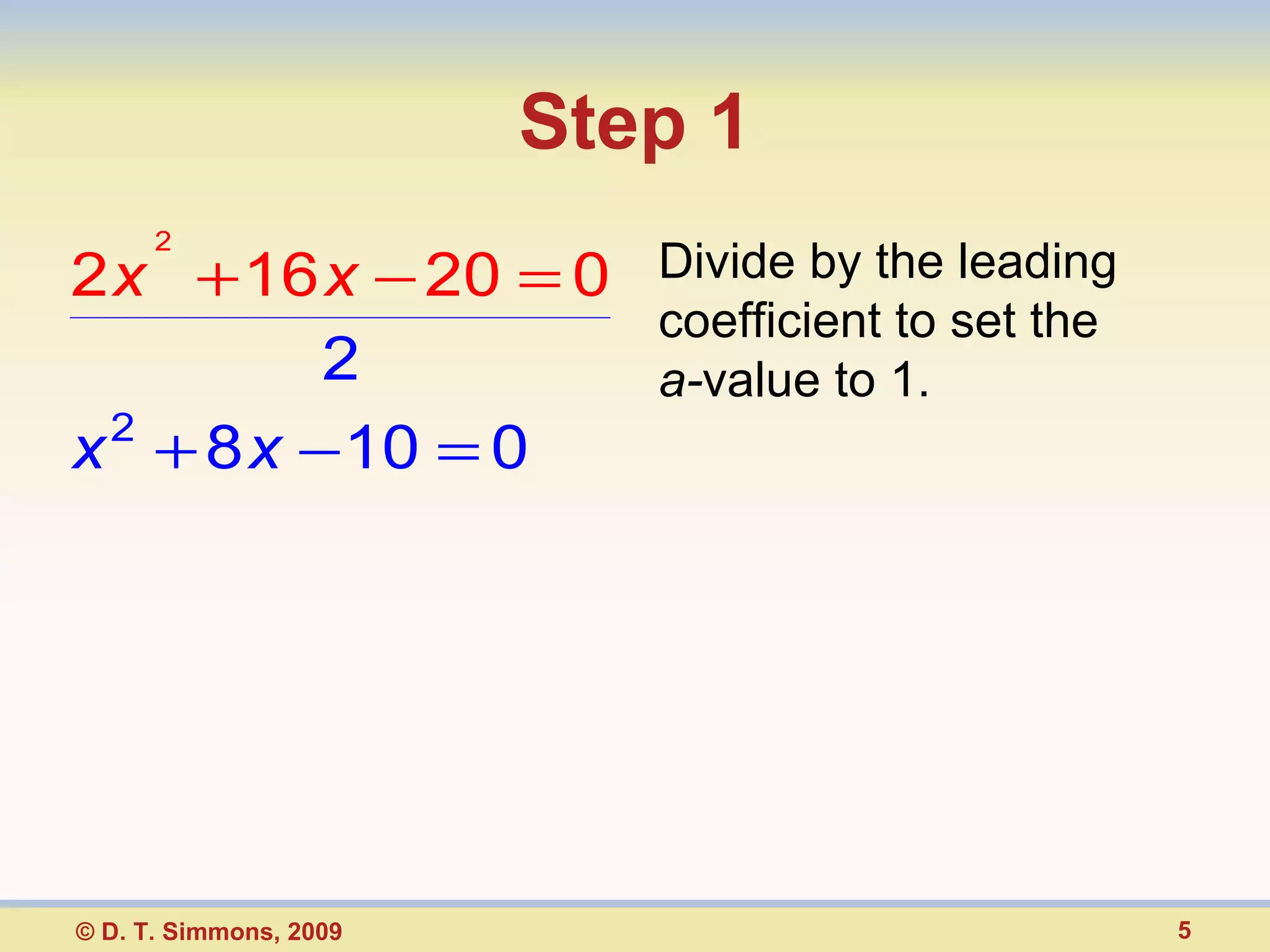
Step 1 Divide by the leading coefficient to set the  a- value to 1. © D. T. Simmons, 2009
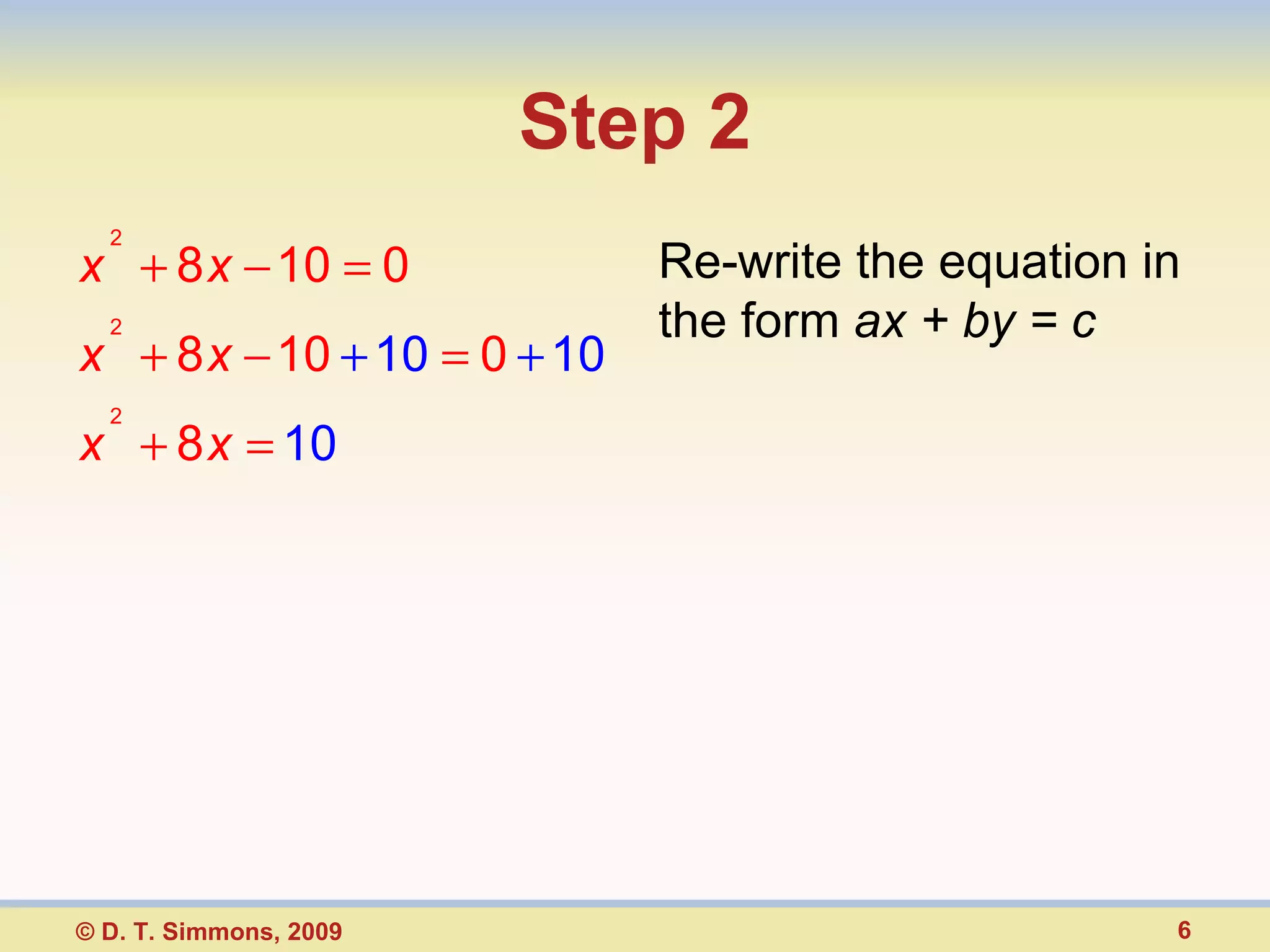
Step 2 Re-write the equation in the form  ax + by = c © D. T. Simmons, 2009
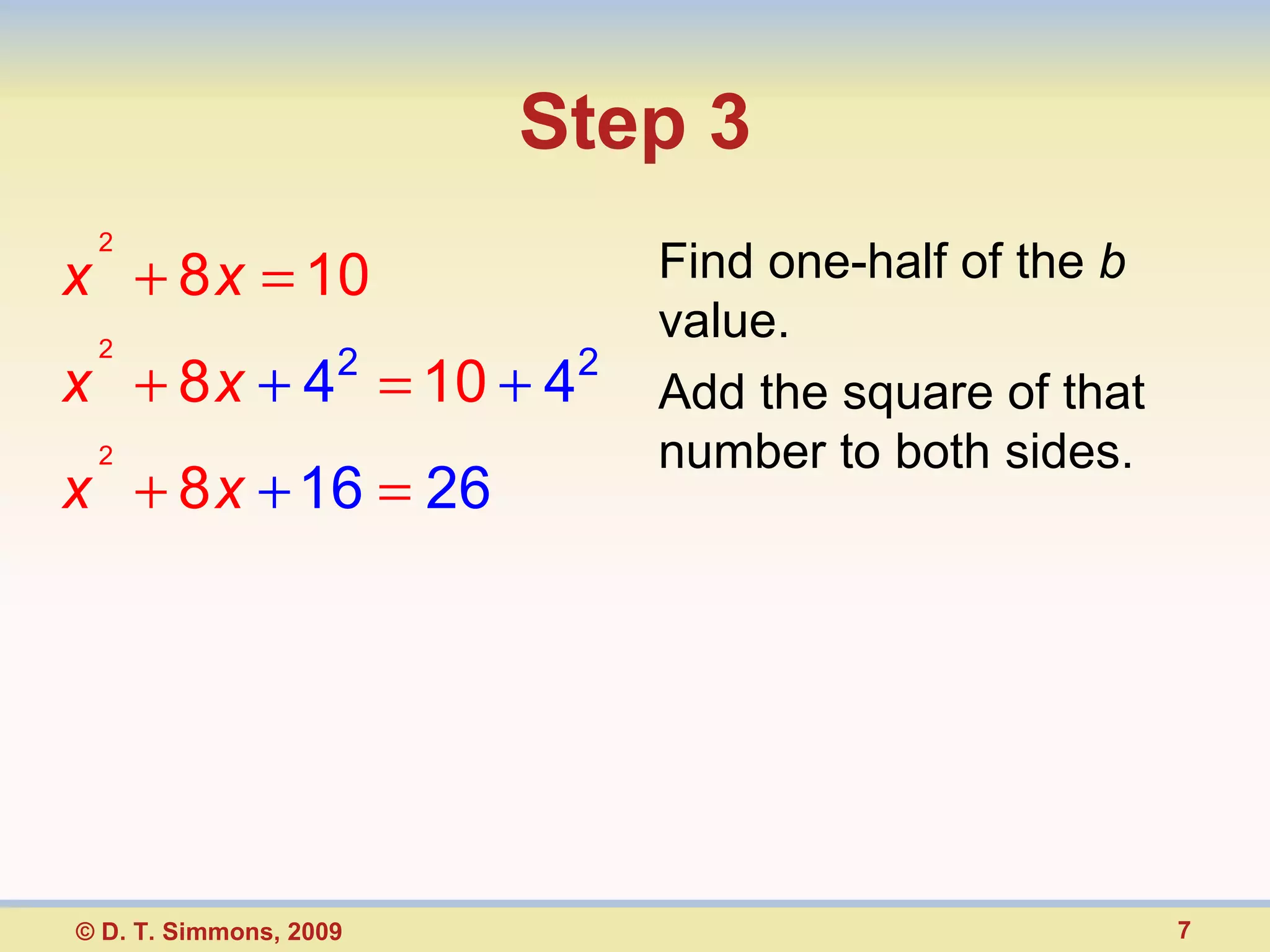
Step 3 Find one-half of the  b  value.  Add the square of that number to both sides. © D. T. Simmons, 2009
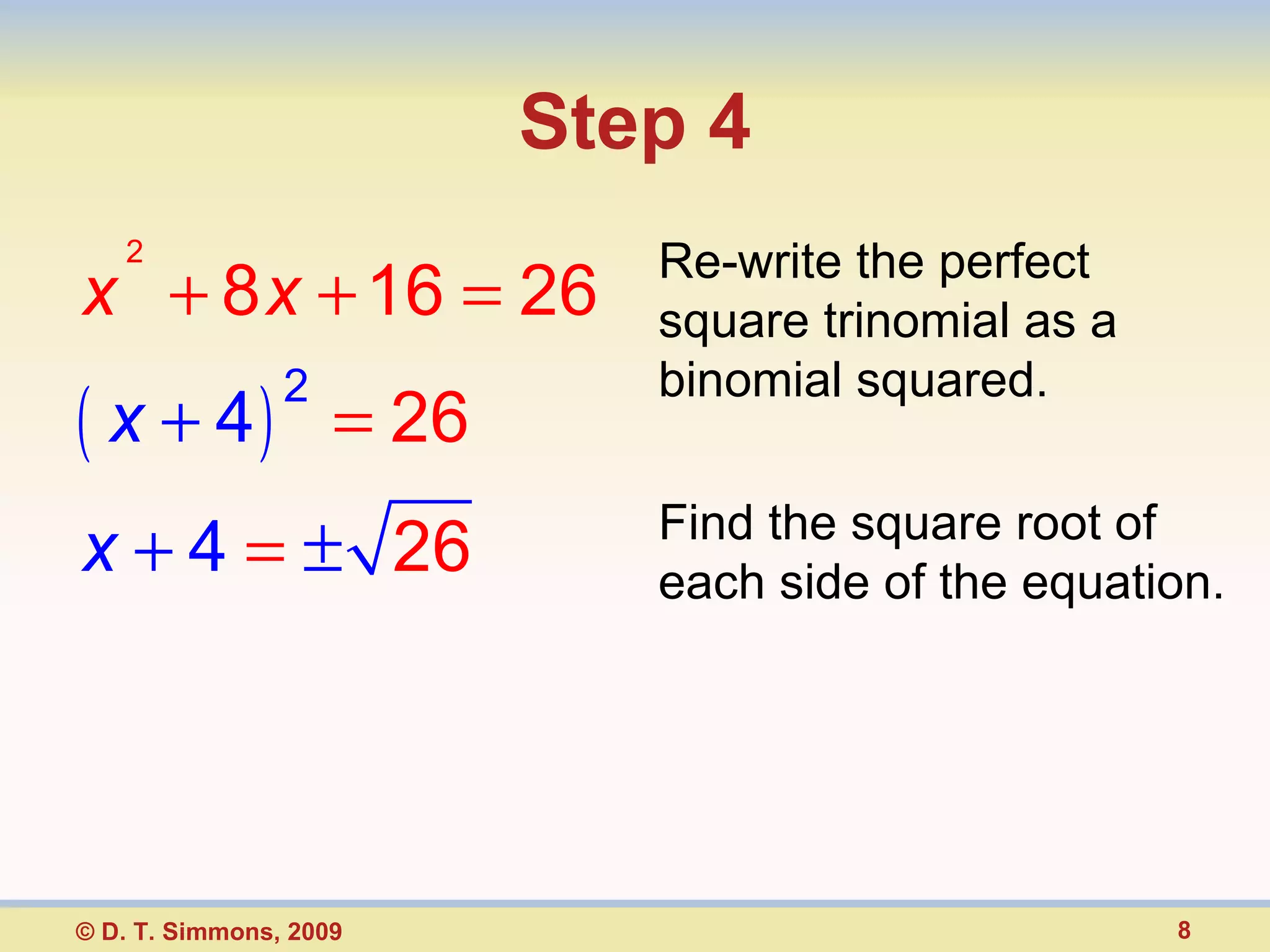
Step 4 Re-write the perfect square trinomial as a binomial squared. Find the square root of each side of the equation. © D. T. Simmons, 2009
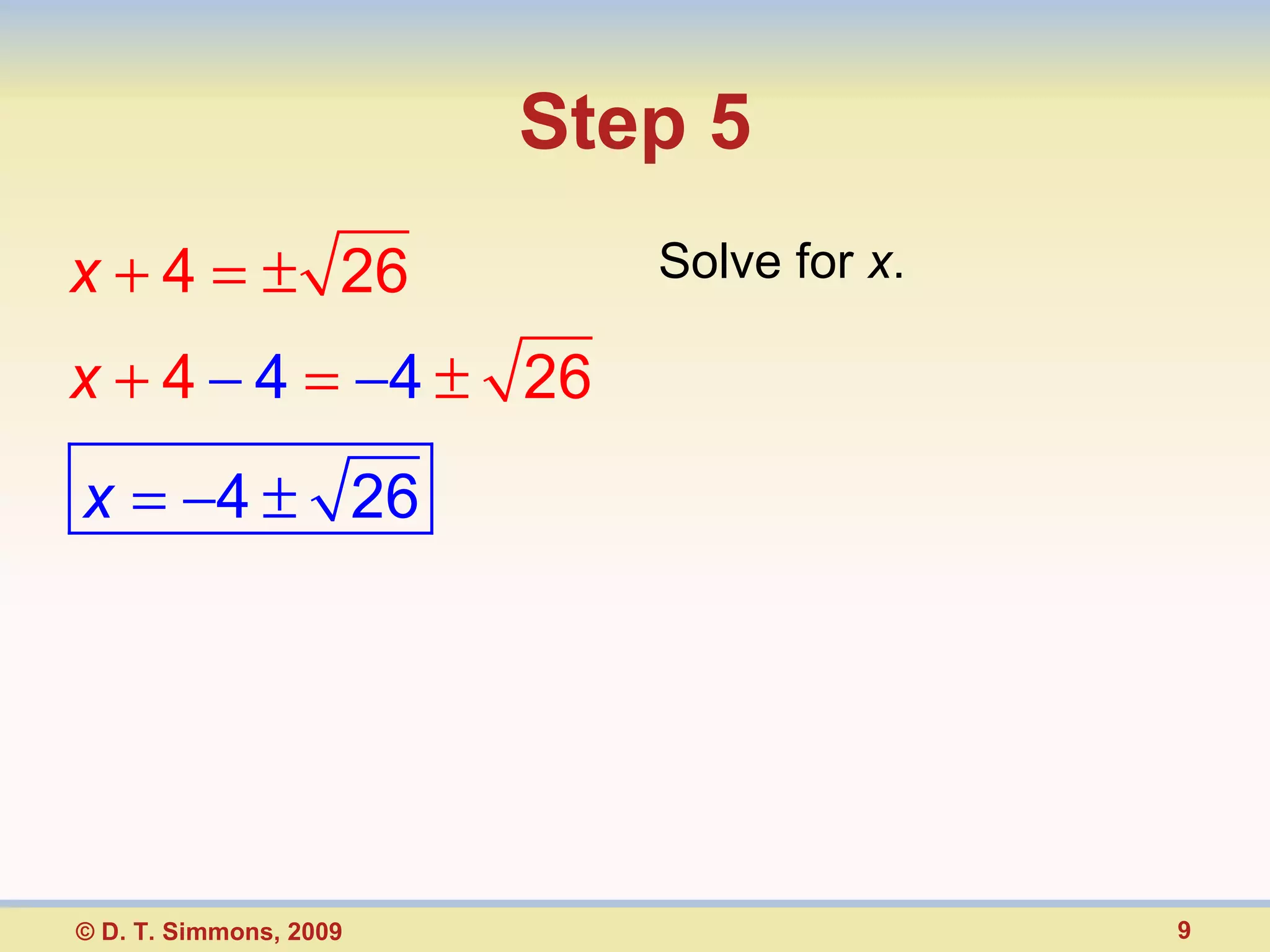
Step 5 Solve for  x . © D. T. Simmons, 2009
Try it. You’ll like it! That’s all folks! © D. T. Simmons, 2009

Completing the square

  • 1.
    Completing the SquareFactoring “unfactorable” 2 nd degree trinomials Don Simmons © D. T. Simmons, 2009
  • 2.
    Completing the SquareWe have learned earlier that a perfect square trinomial can always be factored. Therefore, if we have a trinomial we cannot factor using integers, we can change it in such a way that we are dealing with a perfect square trinomial. © D. T. Simmons, 2009
  • 3.
    Completing the SquareRecall that a perfect square trinomial is always in the form: Therefore, we have to change the polynomial so that it fits the form. To get the most out of this presentation, use pencil and paper and work through the instructions slowly and carefully. © D. T. Simmons, 2009
  • 4.
    Completing the SquareThe equation we are going to solve is the following… By testing whether or not the factors of c can sum to equal b, we can determine if the trinomial is factorable . This trinomial is not factorable in its present form. © D. T. Simmons, 2009
  • 5.
    Step 1 Divideby the leading coefficient to set the a- value to 1. © D. T. Simmons, 2009
  • 6.
    Step 2 Re-writethe equation in the form ax + by = c © D. T. Simmons, 2009
  • 7.
    Step 3 Findone-half of the b value. Add the square of that number to both sides. © D. T. Simmons, 2009
  • 8.
    Step 4 Re-writethe perfect square trinomial as a binomial squared. Find the square root of each side of the equation. © D. T. Simmons, 2009
  • 9.
    Step 5 Solvefor x . © D. T. Simmons, 2009
  • 10.
    Try it. You’lllike it! That’s all folks! © D. T. Simmons, 2009