From Whence
        The Quadratic Formula?

                        Don Simmons


© D. T. Simmons, 2009                 1
Deriving the Quadratic Formula
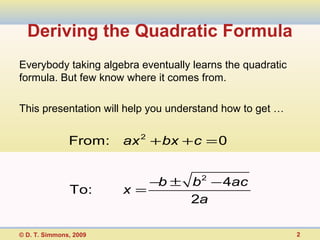
Everybody taking algebra eventually learns the quadratic
formula. But few know where it comes from.

This presentation will help you understand how to get …


               From:    ax 2 + bx + c = 0


                           −b ± b 2 − 4ac
               To:      x=
                                2a

© D. T. Simmons, 2009                                      2
Deriving the Quadratic Formula
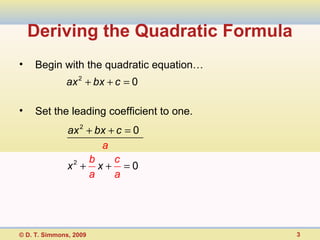
•    Begin with the quadratic equation…
              ax 2 + bx + c = 0

•    Set the leading coefficient to one.
               ax 2 + bx + c = 0
                       a
                    b     c
               x + x+ =0
                2

                    a     a


© D. T. Simmons, 2009                      3
Deriving the Quadratic Formula
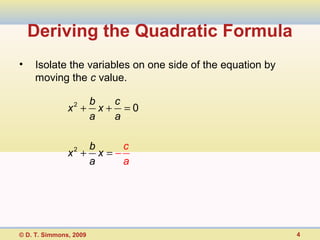
•    Isolate the variables on one side of the equation by
     moving the c value.

                  b  c
               x + x+ =0
                 2

                  a  a

                        b     c
               x2 +       x=−
                        a     a


© D. T. Simmons, 2009                                       4
Deriving the Quadratic Formula
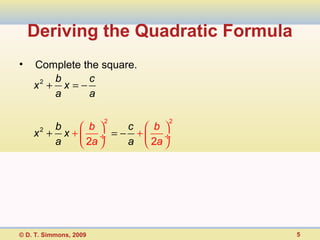
•   Complete the square.
        b      c
    x2 + x = −
        a      a

                        2     2
           b     b   c  b 
    x2 +     x + ÷ = − + ÷
           a     2a  a  2a 


© D. T. Simmons, 2009                5
Deriving the Quadratic Formula
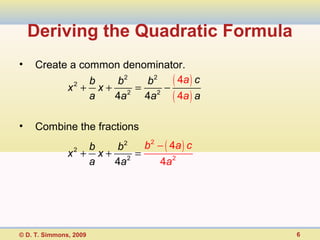
•    Create a common denominator.
                b   b2   b 2 ( 4a ) c
           x2 + x + 2 = 2 −
                a  4a    4a   ( 4a ) a

•    Combine the fractions
                   b   b2   b 2 − ( 4a ) c
               x2 + x + 2 =
                   a   4a       4a 2


© D. T. Simmons, 2009                        6
Deriving the Quadratic Formula
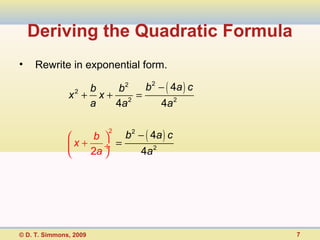
•    Rewrite in exponential form.

                   b   b2   b 2 − ( 4a ) c
               x2 + x + 2 =
                   a   4a       4a 2

                            b 2 − ( 4a ) c
                         2
                     b 
                x + 2a ÷ =
                              4a 2


© D. T. Simmons, 2009                        7
Deriving the Quadratic Formula
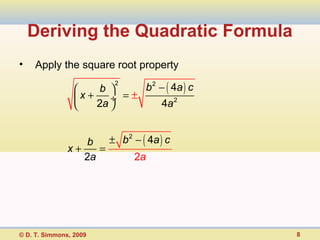
•    Apply the square root property

                                b 2 − ( 4a ) c
                          2
                       b 
                  x + 2a ÷ = ±     4a 2
                         


                   b     ± b 2 − ( 4a ) c
               x+    =
                  2a           2a


© D. T. Simmons, 2009                            8
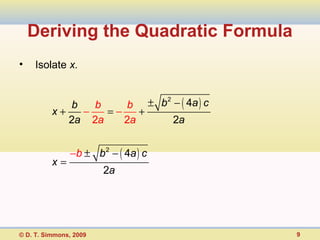
Deriving the Quadratic Formula
•    Isolate x.


                       b ± b − ( 4a ) c
                            2
              b   b
          x+    −   =−    +
             2a 2a     2a     2a


               −b ± b 2 − ( 4a ) c
          x=
                        2a


© D. T. Simmons, 2009                     9
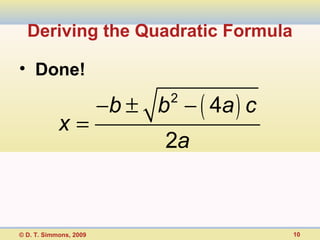
Deriving the Quadratic Formula

• Done!

                        −b ± b − ( 4a ) c
                               2

            x=
                               2a


© D. T. Simmons, 2009                       10

Deriving the quadratic formula

  • 1.
    From Whence The Quadratic Formula? Don Simmons © D. T. Simmons, 2009 1
  • 2.
    Deriving the QuadraticFormula Everybody taking algebra eventually learns the quadratic formula. But few know where it comes from. This presentation will help you understand how to get … From: ax 2 + bx + c = 0 −b ± b 2 − 4ac To: x= 2a © D. T. Simmons, 2009 2
  • 3.
    Deriving the QuadraticFormula • Begin with the quadratic equation… ax 2 + bx + c = 0 • Set the leading coefficient to one. ax 2 + bx + c = 0 a b c x + x+ =0 2 a a © D. T. Simmons, 2009 3
  • 4.
    Deriving the QuadraticFormula • Isolate the variables on one side of the equation by moving the c value. b c x + x+ =0 2 a a b c x2 + x=− a a © D. T. Simmons, 2009 4
  • 5.
    Deriving the QuadraticFormula • Complete the square. b c x2 + x = − a a 2 2 b  b  c  b  x2 + x + ÷ = − + ÷ a  2a  a  2a  © D. T. Simmons, 2009 5
  • 6.
    Deriving the QuadraticFormula • Create a common denominator. b b2 b 2 ( 4a ) c x2 + x + 2 = 2 − a 4a 4a ( 4a ) a • Combine the fractions b b2 b 2 − ( 4a ) c x2 + x + 2 = a 4a 4a 2 © D. T. Simmons, 2009 6
  • 7.
    Deriving the QuadraticFormula • Rewrite in exponential form. b b2 b 2 − ( 4a ) c x2 + x + 2 = a 4a 4a 2 b 2 − ( 4a ) c 2  b   x + 2a ÷ =   4a 2 © D. T. Simmons, 2009 7
  • 8.
    Deriving the QuadraticFormula • Apply the square root property b 2 − ( 4a ) c 2  b   x + 2a ÷ = ± 4a 2   b ± b 2 − ( 4a ) c x+ = 2a 2a © D. T. Simmons, 2009 8
  • 9.
    Deriving the QuadraticFormula • Isolate x. b ± b − ( 4a ) c 2 b b x+ − =− + 2a 2a 2a 2a −b ± b 2 − ( 4a ) c x= 2a © D. T. Simmons, 2009 9
  • 10.
    Deriving the QuadraticFormula • Done! −b ± b − ( 4a ) c 2 x= 2a © D. T. Simmons, 2009 10