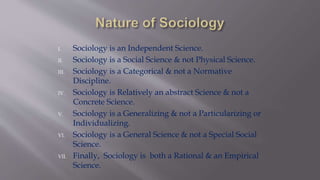
I. Sociology is an Independent Science.
II. Sociology is a Social Science & not Physical Science.
III. Sociology is a Categorical & not a Normative
Discipline.
IV. Sociology is Relatively an abstract Science & not a
Concrete Science.
V. Sociology is a Generalizing & not a Particularizing or
Individualizing.
VI. Sociology is a General Science & not a Special Social
Science.
VII. Finally, Sociology is both a Rational & an Empirical
Science.
Science refer to the logical, systematic methods
by which knowledge is obtained and to be the actual body of
knowledge produced by these methods.
Science is a social institution and a way to produce
knowledge.
A Science is a body of organized verified
knowledge which has been secured through scientific
investigation.
• Science is the no-ethical
•The Scientist has no techniques
•Knowledge attained by him is instrumental
•Science is the knowledge and method of investigation
•Object world is quite different from the Subject world.
•Based on unbiased investigation
•Its Self critical
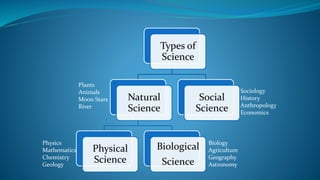
Types of
Science
Natural
Science
Physical
Science
Biological
Science
Social
Science
Plants
Animals
Moon Stars
River
Physics
Mathematics
Chemistry
Geology
Biology
Agriculture
Geography
Astronomy
Sociology
History
Anthropology
Economics
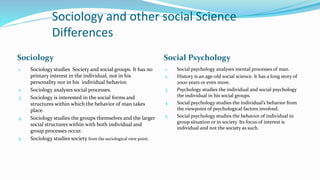
Sociology and other social Science
Differences
Sociology Social Psychology
1. Sociology studies Society and social groups. It has no
primary interest in the individual, not in his
personality nor in his individual behavior.
2. Sociology analyses social processes.
3. Sociology is interested in the social forms and
structures within which the behavior of man takes
place.
4. Sociology studies the groups themselves and the larger
social structures within with both individual and
group processes occur.
5. Sociology studies society from the sociological view point.
1. Social psychology analyses mental processes of man.
2. History is an age-old social science. It has a long story of
2000 years or even more.
3. Psychology studies the individual and social psychology
the individual in his social groups.
4. Social psychology studies the individual’s behavior from
the viewpoint of psychological factors involved.
5. Social psychology studies the behavior of individual in
group situation or in society. Its focus of interest is
individual and not the society as such.
 Sociology deals with social event .
 All human relation fall in the study of
sociology.
 Sociology is the study of structure,
function and problems of human group.
 The social science research centre Punjab University.
Rural Development Academy Peshawar.
Central statistical office Karachi.
Family Planning Association Lahore.
Institute of social and cultural studies Punjab University.
Rural Sociology Department Agriculture University
Faisalabad.
Sociology department Sargodha/ Gujrat University.
Conclusion
1. Social action can be done by one or more
persons.
2. Social action influences others.
3. Social action is performed in face of some social
situation.
4. Social action has its relationship with some social
system in the way that the actors are
interdependent upon one another.
1. The actor
it is that individual who perform an act. The actor can be one or
more persons.
2. The goal
it is the aim or objective for which the action was done. Without
goal, an action is futile and baseless.
3. Social situation
The actor perform his role in presence of some social situation.
While a social situation is a continuously occurring group event
spread in space and time. The Social situation instigates the actor
to action. To control the situation he does an act. Therefore, a
social situation is an agent of social action. Social situation has
two types two types-controllable and uncontrollable.
4. Normative orientation.
The social action is performed on some social pattern, custom.
All these forms are called norms of society. The pattern on which
the social action is done is called norm.
5, Energy.
A social action request energy for its performance. Physical
energy and training are essential for an act.
A Group is called Social when an interaction
interplays among its participants,
Social interaction is the basic condition of
social group
It’s a foundation of society and culture.
Human is the product of group
Life is done by cooperation among various
groups.
It’s a study of structure & function of human
group.
Sociology is the study of Human groups.
Social groups is the basic factor in all social
functions, structure, institutions, & systems
Culture
Culture
Characteristics
Culture is Learnt
Culture is Social
Culture is Shared
Culture is Transmissive
Culture is Continuous and cumulative
Culture is consistent and integrated
Culture is dynamic and adaptive
Culture is gratifying
Culture is varies from Society
Culture is Super organic and ideational
Culture
Ethnocentrism
Every Culture considers
itself superior to other
cultures
‫عصبیت‬
Social Values
and Beliefs
Chapter 11
Liaqat Hussain
SOCIAL VALUES
Introduction
• Values belief and religion all the three are
interrelated concepts.
• According to DURKEIM, “ a religion is a unified
system of beliefs and practices related to sacred
things”
• Values are a part in study of social norms.
• Values are “the conception of the good which
influence selection from available end, means and
modes of actions,”
SOCIAL VALUES
Definition
• H.m.Johnson: “Values are general standards and may be
regarded as higher order norms”
• Perter Sorslay: “Values are general conception of “the
good” ideas about the kind of ends that people should
pursue throughout their lives and throughout the many
different activities in shuich they engage.”
• M.Haralambos: “ a value is abelife that something is
good and worhwhile. It dfines what is woth having and
worh striving for”
SOCIAL VALUES
Functions
I. Values provides goals or ends for the members to aim
for,
II. Values provide for stabilities and uniformities in group
interaction, hence create sense of belongingness
among people who shared commonly.
III. Values bring legitimacy to the rules that govern specific
activities.
IV. Value help to bring about some kind of adjustment
between different sets of rules.
V. Values differentiate between right and wrong and what
is desirable and undesirable.
SOCIAL VALUES
and Norms
I. Values is related to social norms.
II. The protection of values is made by the norms.
III. The human behavior is directed by the norms.
IV. Norms are the guides of human behavior and the
behavior is directed towards value.
Human
behavior
Values
Social
norms
Hinduism
Sanatan is Sanskrit name and its comes
from Sant, Sants or Sofi, the term Sanatana
Dharma can be roughly translated to mean
"the natural, ancient and eternal way."
(‫دھرم‬ ‫)سناتن‬
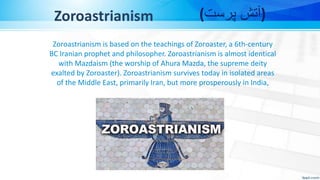
Zoroastrianism
Zoroastrianism is based on the teachings of Zoroaster, a 6th-century
BC Iranian prophet and philosopher. Zoroastrianism is almost identical
with Mazdaism (the worship of Ahura Mazda, the supreme deity
exalted by Zoroaster). Zoroastrianism survives today in isolated areas
of the Middle East, primarily Iran, but more prosperously in India,
(‫پرست‬ ‫)آتش‬
Socialization
Liaqat Hussain
and
Personality
Chapter
12
Socialization
1. Cultural Conditioning
2. Personal-Social Learning
3. Individual as a Cocial Product
Methods
Socialization
1. Converts human from biological to social being.
2. It contributes in personality development.
3. It helps to become disciplined.
4. It helps to performs different roles.
5. It establishes knowledge and skills.
6. It contributes in the stability of social order.
7. It transmits culture from on generation to orhter.
8. It creates right aspiration in social life.
Functions
Educational Institutions
Chapter 19
Liaqat Hussain
Introduction
Aim of the Education is
To provide Equipment and technique
To meeting various needs of life
Shape our attitude
Prepare us for behaving in a certain manner
We can realize the social goals
Education socializes and individual
into a useful member of society.
Educational
Institutions
Schools
Colleges
Madarsas
Universities
Technical Institutions
Vocational Institutions
Medical colleges
Educational Boards
Educational
Types
Formal Education:
it is taken from school, collages,
universities and other formal educational
Institution
Informal Education:
it is taken from family, community and
society with no hard and fast rules and
regulations.
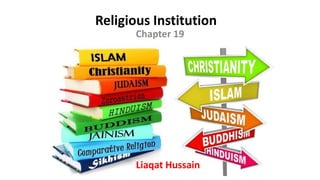
Religious Institution
Chapter 19
Liaqat Hussain
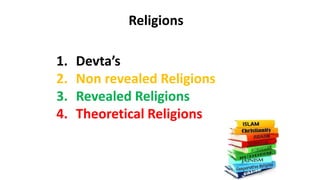
Religions
1. Devta’s
2. Non revealed Religions
3. Revealed Religions
4. Theoretical Religions
Religious Institution
Definition
Durkheim: Religion the unified system
of beliefs and practices related to sacred
things, that is to say things set apart and
forbidden and unite people into a moral
community.
Religious Institution
Functions
Remove fear and anxiety.
Relation between man and universe.
 Relation between man and God.
Judgment of right and wrong.
Presentation of values.
Creates Purity and Cleanliness.
Socializing institution.
Crates Social Solidarity.
Relates man and woman.
Religious Institution
Functions
Remove fear and anxiety.
Relation between man and universe.
 Relation between man and God.
Judgment of right and wrong.
Presentation of values.
Creates Purity and Cleanliness.
Socializing institution.
Crates Social Solidarity.
Relates man and woman.
Economic Institution
Chapter 21
Liaqat Hussain
Economic Institution
Major Economic Institutions
1. Agriculture farming.
2. Chemical fertilizer and its supplying agencies.
3. Irrigation systems.
4. Harvesting of crops.
5. Land tenure system.
6. Agriculture Department.
7. Production store and supplying agencies.
8. Agriculture sale departments.
Economic Institution
Functions of Economic Institution
1. Social Stratification.
2. Power and Authority.
3. Interdependence of other Institutions.
4. Socialization
5. Need Satisfaction.
6. Income generation and Employment.
7. Division of Labor and specialization.
8. Provision of Funds.
Political Institution
Chapter 22
Liaqat Hussain
Political Institution
Introduction
Political Institution is universal in all the societies
of the world. To maintain law and order in
society, a political government is required
Political Institution
Definition
“Distribution system of power and authority which is used to
maintain social order is called political institution.”
JohnJ.Maccionis: “Politics or polity is the social institution that
distributes power, sets a society’s agenda and makes decisions.”
Marg orie Hogan: “Political Institution is a complex of social
norms and rules that serves to maintain social order to exercise
power to compel conformity to the existing system of authority
and to provide the means for changes in the legal or
administrative System.”
Political Institution
The State
Iman Ghazali: “a state comes into being when the
people get into conflicts and there is need of a law, of a
judge and a ruler to enforce the whole system,”
Gillin and Gillin: “the state is the sovereign political
organization of the individuals occupying a definite
territory.”:
Political Institution
Elements of state
1. An independent political organization,
2. A number of people loving there in , and
3. A fixed geographical area.
Political Institution
Functions if state and Government
1. Institutionalization of Norms
2. The Decision of Conflicts
3. The Enforcement of Norms
4. The Defence of the Society
Political Institution
The function of Law
1. Social Order
2. Right and duties
3. Cooperation
4. Authority
5. Morality
Social Structure & Social
Integration
Chapter 24 Liaqat Hussain
Social Structure & Social Integration
Introduction
Human society is composed of
• individuals,
• groups,
• institutions,
• norms,
• social roles,
• social classes,
• strata, culture,
• organization.
Social Structure & Social Integration
Introduction
An Institution is composed of
• individuals,
• Groups of people
• Social norms for defining relations among people,
• Social roles and status of the people who fulfill the activities of the
institution.
• Social organization among the individuals and their functions,
• Social class and strata are established
• by differentiation of status achieved
• through different roles and
• A cultural need is fulfilled by every institution
• for which it was established.
Social Structure & Social Integration
Introduction
From this analysis of social institution, we can say that an
institution
A. An organized social group,
B. A part of social system in the whole society, and
C. Structured on the basis of social relations as defined by
the cultural norms.
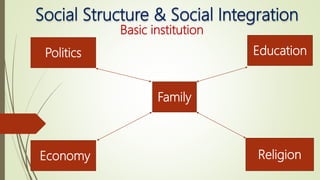
Social Structure & Social Integration
Basic institution
Family
Education
Religion
Politics
Economy

Complete course Over view fall 2016 Maju

  • 6.
    I. Sociology isan Independent Science. II. Sociology is a Social Science & not Physical Science. III. Sociology is a Categorical & not a Normative Discipline. IV. Sociology is Relatively an abstract Science & not a Concrete Science. V. Sociology is a Generalizing & not a Particularizing or Individualizing. VI. Sociology is a General Science & not a Special Social Science. VII. Finally, Sociology is both a Rational & an Empirical Science.
  • 8.
    Science refer tothe logical, systematic methods by which knowledge is obtained and to be the actual body of knowledge produced by these methods. Science is a social institution and a way to produce knowledge. A Science is a body of organized verified knowledge which has been secured through scientific investigation.
  • 9.
    • Science isthe no-ethical •The Scientist has no techniques •Knowledge attained by him is instrumental •Science is the knowledge and method of investigation •Object world is quite different from the Subject world. •Based on unbiased investigation •Its Self critical
  • 10.
  • 11.
    Sociology and othersocial Science Differences Sociology Social Psychology 1. Sociology studies Society and social groups. It has no primary interest in the individual, not in his personality nor in his individual behavior. 2. Sociology analyses social processes. 3. Sociology is interested in the social forms and structures within which the behavior of man takes place. 4. Sociology studies the groups themselves and the larger social structures within with both individual and group processes occur. 5. Sociology studies society from the sociological view point. 1. Social psychology analyses mental processes of man. 2. History is an age-old social science. It has a long story of 2000 years or even more. 3. Psychology studies the individual and social psychology the individual in his social groups. 4. Social psychology studies the individual’s behavior from the viewpoint of psychological factors involved. 5. Social psychology studies the behavior of individual in group situation or in society. Its focus of interest is individual and not the society as such.
  • 13.
     Sociology dealswith social event .  All human relation fall in the study of sociology.  Sociology is the study of structure, function and problems of human group.
  • 14.
     The socialscience research centre Punjab University. Rural Development Academy Peshawar. Central statistical office Karachi. Family Planning Association Lahore. Institute of social and cultural studies Punjab University. Rural Sociology Department Agriculture University Faisalabad. Sociology department Sargodha/ Gujrat University.
  • 16.
    Conclusion 1. Social actioncan be done by one or more persons. 2. Social action influences others. 3. Social action is performed in face of some social situation. 4. Social action has its relationship with some social system in the way that the actors are interdependent upon one another.
  • 17.
    1. The actor itis that individual who perform an act. The actor can be one or more persons. 2. The goal it is the aim or objective for which the action was done. Without goal, an action is futile and baseless. 3. Social situation The actor perform his role in presence of some social situation. While a social situation is a continuously occurring group event spread in space and time. The Social situation instigates the actor to action. To control the situation he does an act. Therefore, a social situation is an agent of social action. Social situation has two types two types-controllable and uncontrollable.
  • 18.
    4. Normative orientation. Thesocial action is performed on some social pattern, custom. All these forms are called norms of society. The pattern on which the social action is done is called norm. 5, Energy. A social action request energy for its performance. Physical energy and training are essential for an act.
  • 19.
    A Group iscalled Social when an interaction interplays among its participants, Social interaction is the basic condition of social group
  • 20.
    It’s a foundationof society and culture. Human is the product of group Life is done by cooperation among various groups.
  • 21.
    It’s a studyof structure & function of human group. Sociology is the study of Human groups. Social groups is the basic factor in all social functions, structure, institutions, & systems
  • 22.
  • 23.
    Culture Characteristics Culture is Learnt Cultureis Social Culture is Shared Culture is Transmissive Culture is Continuous and cumulative Culture is consistent and integrated Culture is dynamic and adaptive Culture is gratifying Culture is varies from Society Culture is Super organic and ideational
  • 24.
    Culture Ethnocentrism Every Culture considers itselfsuperior to other cultures ‫عصبیت‬
  • 25.
  • 26.
    SOCIAL VALUES Introduction • Valuesbelief and religion all the three are interrelated concepts. • According to DURKEIM, “ a religion is a unified system of beliefs and practices related to sacred things” • Values are a part in study of social norms. • Values are “the conception of the good which influence selection from available end, means and modes of actions,”
  • 27.
    SOCIAL VALUES Definition • H.m.Johnson:“Values are general standards and may be regarded as higher order norms” • Perter Sorslay: “Values are general conception of “the good” ideas about the kind of ends that people should pursue throughout their lives and throughout the many different activities in shuich they engage.” • M.Haralambos: “ a value is abelife that something is good and worhwhile. It dfines what is woth having and worh striving for”
  • 28.
    SOCIAL VALUES Functions I. Valuesprovides goals or ends for the members to aim for, II. Values provide for stabilities and uniformities in group interaction, hence create sense of belongingness among people who shared commonly. III. Values bring legitimacy to the rules that govern specific activities. IV. Value help to bring about some kind of adjustment between different sets of rules. V. Values differentiate between right and wrong and what is desirable and undesirable.
  • 29.
    SOCIAL VALUES and Norms I.Values is related to social norms. II. The protection of values is made by the norms. III. The human behavior is directed by the norms. IV. Norms are the guides of human behavior and the behavior is directed towards value. Human behavior Values Social norms
  • 30.
    Hinduism Sanatan is Sanskritname and its comes from Sant, Sants or Sofi, the term Sanatana Dharma can be roughly translated to mean "the natural, ancient and eternal way." (‫دھرم‬ ‫)سناتن‬
  • 31.
    Zoroastrianism Zoroastrianism is basedon the teachings of Zoroaster, a 6th-century BC Iranian prophet and philosopher. Zoroastrianism is almost identical with Mazdaism (the worship of Ahura Mazda, the supreme deity exalted by Zoroaster). Zoroastrianism survives today in isolated areas of the Middle East, primarily Iran, but more prosperously in India, (‫پرست‬ ‫)آتش‬
  • 32.
  • 33.
    Socialization 1. Cultural Conditioning 2.Personal-Social Learning 3. Individual as a Cocial Product Methods
  • 34.
    Socialization 1. Converts humanfrom biological to social being. 2. It contributes in personality development. 3. It helps to become disciplined. 4. It helps to performs different roles. 5. It establishes knowledge and skills. 6. It contributes in the stability of social order. 7. It transmits culture from on generation to orhter. 8. It creates right aspiration in social life. Functions
  • 35.
  • 36.
    Introduction Aim of theEducation is To provide Equipment and technique To meeting various needs of life Shape our attitude Prepare us for behaving in a certain manner We can realize the social goals Education socializes and individual into a useful member of society.
  • 37.
  • 38.
    Educational Types Formal Education: it istaken from school, collages, universities and other formal educational Institution Informal Education: it is taken from family, community and society with no hard and fast rules and regulations.
  • 39.
  • 40.
    Religions 1. Devta’s 2. Nonrevealed Religions 3. Revealed Religions 4. Theoretical Religions
  • 41.
    Religious Institution Definition Durkheim: Religionthe unified system of beliefs and practices related to sacred things, that is to say things set apart and forbidden and unite people into a moral community.
  • 42.
    Religious Institution Functions Remove fearand anxiety. Relation between man and universe.  Relation between man and God. Judgment of right and wrong. Presentation of values. Creates Purity and Cleanliness. Socializing institution. Crates Social Solidarity. Relates man and woman.
  • 43.
    Religious Institution Functions Remove fearand anxiety. Relation between man and universe.  Relation between man and God. Judgment of right and wrong. Presentation of values. Creates Purity and Cleanliness. Socializing institution. Crates Social Solidarity. Relates man and woman.
  • 44.
  • 45.
    Economic Institution Major EconomicInstitutions 1. Agriculture farming. 2. Chemical fertilizer and its supplying agencies. 3. Irrigation systems. 4. Harvesting of crops. 5. Land tenure system. 6. Agriculture Department. 7. Production store and supplying agencies. 8. Agriculture sale departments.
  • 46.
    Economic Institution Functions ofEconomic Institution 1. Social Stratification. 2. Power and Authority. 3. Interdependence of other Institutions. 4. Socialization 5. Need Satisfaction. 6. Income generation and Employment. 7. Division of Labor and specialization. 8. Provision of Funds.
  • 47.
  • 48.
    Political Institution Introduction Political Institutionis universal in all the societies of the world. To maintain law and order in society, a political government is required
  • 49.
    Political Institution Definition “Distribution systemof power and authority which is used to maintain social order is called political institution.” JohnJ.Maccionis: “Politics or polity is the social institution that distributes power, sets a society’s agenda and makes decisions.” Marg orie Hogan: “Political Institution is a complex of social norms and rules that serves to maintain social order to exercise power to compel conformity to the existing system of authority and to provide the means for changes in the legal or administrative System.”
  • 50.
    Political Institution The State ImanGhazali: “a state comes into being when the people get into conflicts and there is need of a law, of a judge and a ruler to enforce the whole system,” Gillin and Gillin: “the state is the sovereign political organization of the individuals occupying a definite territory.”:
  • 51.
    Political Institution Elements ofstate 1. An independent political organization, 2. A number of people loving there in , and 3. A fixed geographical area.
  • 52.
    Political Institution Functions ifstate and Government 1. Institutionalization of Norms 2. The Decision of Conflicts 3. The Enforcement of Norms 4. The Defence of the Society
  • 53.
    Political Institution The functionof Law 1. Social Order 2. Right and duties 3. Cooperation 4. Authority 5. Morality
  • 54.
    Social Structure &Social Integration Chapter 24 Liaqat Hussain
  • 55.
    Social Structure &Social Integration Introduction Human society is composed of • individuals, • groups, • institutions, • norms, • social roles, • social classes, • strata, culture, • organization.
  • 56.
    Social Structure &Social Integration Introduction An Institution is composed of • individuals, • Groups of people • Social norms for defining relations among people, • Social roles and status of the people who fulfill the activities of the institution. • Social organization among the individuals and their functions, • Social class and strata are established • by differentiation of status achieved • through different roles and • A cultural need is fulfilled by every institution • for which it was established.
  • 57.
    Social Structure &Social Integration Introduction From this analysis of social institution, we can say that an institution A. An organized social group, B. A part of social system in the whole society, and C. Structured on the basis of social relations as defined by the cultural norms.
  • 58.
    Social Structure &Social Integration Basic institution Family Education Religion Politics Economy