COMPLEMENT
SYSTEM IN FISH
PRESESNTED BY : ANJALI BALA NAIK
DEPARTMENT OF FISH PATHOLOGY AND HEALTH MANAGEMENT
FISHERIES COLLEGE AND RESEARCH INSTITUTE
TAMILNADU DR J. JAYALALITHAA FISHERIES UNIVERSITY
INTRODUCTION
The study of fish complement ,began in 1960,s- in cartilagenous fish and 1970,s in
teleosts.
The complement defensive system consists of 35 soluble proteins and membrane bound
proteins and cell receptors that plays a critical role in the host defence by interacting with
component of both innate and acquired immunity.
Characteristics of different complement system:
• More heat liable
• Lower reaction temperature
• Difficulty in preservation
• species/group specific
• High antimicrobial action
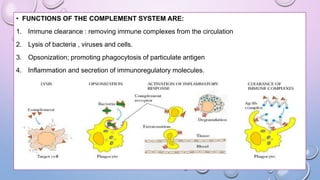
• FUNCTIONS OF THE COMPLEMENT SYSTEM ARE:
1. Immune clearance : removing immune complexes from the circulation
2. Lysis of bacteria , viruses and cells.
3. Opsonization; promoting phagocytosis of particulate antigen
4. Inflammation and secretion of immunoregulatory molecules.
COMPLEMENT COMPONENT
• Complement component are made up of proteins and glycoprotein produced in
the liver in an inactive form (zymogen). These zymogens circulate in the serum
as proenzymes which is functionally inactive.
• Activation is induced by the proteolytic cleavage.
• Constitute 5% of serum globulin fractions.
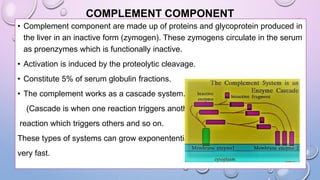
• The complement works as a cascade system.
(Cascade is when one reaction triggers another
reaction which triggers others and so on.
These types of systems can grow exponententially
very fast.
• Designated by numbers(C1-C9), by letters symbols, or by trivial names (factor-
D).
• The complement fragment interact with one another to form functional complexes
and these complexes having enzymatic activity are written by a bar over the
symbol or number (e.g- C4b2a3b).
• Complement proteins are often designated by an uppercase letter C and are
inactive until they are split into products(e.g.C1)
• When the products split they become active . The active products are usually
designated with a lower case a(smaller fragments) or b(larger
fragments) (e.g . C1a and C2b).
• the larger fragments binds to the target near the site of the activation and the
smaller fragments diffuse from the site and can initiate localized inflammatory
response by binding to specific receptors.
• The complement components isolated in teleost are C1q, C1r, C1s, MBL,
MASP, Bf, C2, C3, C4, C5, C6,C7, C8, C9 and factor D.
• The shark or the cartilagenous fish contains the classical and alternative
pathway.
• In cyclostomes, cytolytic activity of the complement is absent in serum and has
only alternative pathway of C3 activation.
• Like mammals fish also has both the pathways.
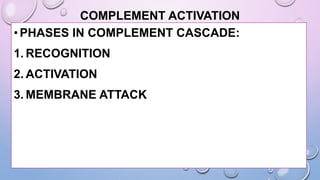
COMPLEMENT ACTIVATION
•PHASES IN COMPLEMENT CASCADE:
1. RECOGNITION
2. ACTIVATION
3. MEMBRANE ATTACK
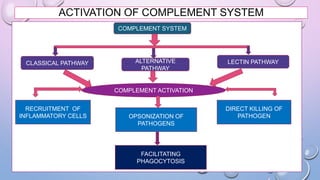
ACTIVATION OF COMPLEMENT SYSTEM
COMPLEMENT SYSTEM
CLASSICAL PATHWAY ALTERNATIVE
PATHWAY
LECTIN PATHWAY
RECRUITMENT OF
INFLAMMATORY CELLS
FACILITATING
PHAGOCYTOSIS
DIRECT KILLING OF
PATHOGENOPSONIZATION OF
PATHOGENS
COMPLEMENT ACTIVATION
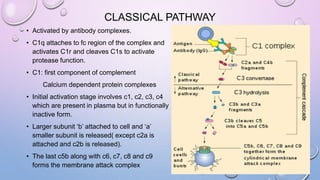
CLASSICAL PATHWAY
• Activated by antibody complexes.
• C1q attaches to fc region of the complex and
activates C1r and cleaves C1s to activate
protease function.
• C1: first component of complement
Calcium dependent protein complexes
• Initial activation stage involves c1, c2, c3, c4
which are present in plasma but in functionally
inactive form.
• Larger subunit ‘b’ attached to cell and ‘a’
smaller subunit is released( except c2a is
attached and c2b is released).
• The last c5b along with c6, c7, c8 and c9
forms the membrane attack complex
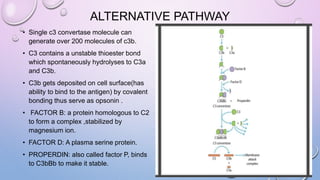
ALTERNATIVE PATHWAY
• Single c3 convertase molecule can
generate over 200 molecules of c3b.
• C3 contains a unstable thioester bond
which spontaneously hydrolyses to C3a
and C3b.
• C3b gets deposited on cell surface(has
ability to bind to the antigen) by covalent
bonding thus serve as opsonin .
• FACTOR B: a protein homologous to C2
to form a complex ,stabilized by
magnesium ion.
• FACTOR D: A plasma serine protein.
• PROPERDIN: also called factor P, binds
to C3bBb to make it stable.
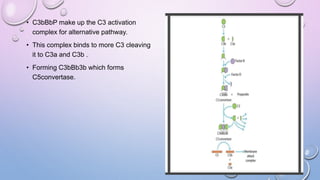
• C3bBbP make up the C3 activation
complex for alternative pathway.
• This complex binds to more C3 cleaving
it to C3a and C3b .
• Forming C3bBb3b which forms
C5convertase.
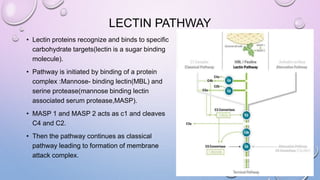
LECTIN PATHWAY
• Lectin proteins recognize and binds to specific
carbohydrate targets(lectin is a sugar binding
molecule).
• Pathway is initiated by binding of a protein
complex :Mannose- binding lectin(MBL) and
serine protease(mannose binding lectin
associated serum protease,MASP).
• MASP 1 and MASP 2 acts as c1 and cleaves
C4 and C2.
• Then the pathway continues as classical
pathway leading to formation of membrane
attack complex.
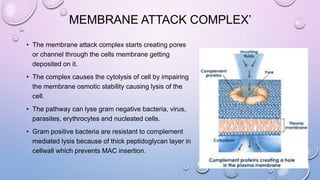
MEMBRANE ATTACK COMPLEX’
• The membrane attack complex starts creating pores
or channel through the cells membrane getting
deposited on it.
• The complex causes the cytolysis of cell by impairing
the membrane osmotic stability causing lysis of the
cell.
• The pathway can lyse gram negative bacteria, virus,
parasites, erythrocytes and nucleated cells.
• Gram positive bacteria are resistant to complement
mediated lysis because of thick peptidoglycan layer in
cellwall which prevents MAC insertion.
BIOLOGICAL EFFECTS OF COMPLEMENT
SYSTEM
• OPSONIZATION:C3b and C1q enhance phagocytosis.
• ANAPHYLATOXIN: C5a, C4a, C5a ;causes degranulation of mast cells
these are smaller complement fragments generated during complement
activation by cleavage called anaphylatoxins.
These anaphylatoxins induce smooth muscles contractions and increase vascular permeability
resulting in influxes of fluid carrying antibody and phagocytes to the site of antigen entry.
• CHEMOTAXIS: C5a and C5, 6, 7 complex attracts neutrophils.
• ENHANCEMENT OF ANTIBODY PRODUCTION: binding of C3b to its receptors on the surface
of activated Bcells enhance antibody production.
THANK YOU

Complementary system

  • 1.
    COMPLEMENT SYSTEM IN FISH PRESESNTEDBY : ANJALI BALA NAIK DEPARTMENT OF FISH PATHOLOGY AND HEALTH MANAGEMENT FISHERIES COLLEGE AND RESEARCH INSTITUTE TAMILNADU DR J. JAYALALITHAA FISHERIES UNIVERSITY
  • 2.
    INTRODUCTION The study offish complement ,began in 1960,s- in cartilagenous fish and 1970,s in teleosts. The complement defensive system consists of 35 soluble proteins and membrane bound proteins and cell receptors that plays a critical role in the host defence by interacting with component of both innate and acquired immunity. Characteristics of different complement system: • More heat liable • Lower reaction temperature • Difficulty in preservation • species/group specific • High antimicrobial action
  • 3.
    • FUNCTIONS OFTHE COMPLEMENT SYSTEM ARE: 1. Immune clearance : removing immune complexes from the circulation 2. Lysis of bacteria , viruses and cells. 3. Opsonization; promoting phagocytosis of particulate antigen 4. Inflammation and secretion of immunoregulatory molecules.
  • 4.
    COMPLEMENT COMPONENT • Complementcomponent are made up of proteins and glycoprotein produced in the liver in an inactive form (zymogen). These zymogens circulate in the serum as proenzymes which is functionally inactive. • Activation is induced by the proteolytic cleavage. • Constitute 5% of serum globulin fractions. • The complement works as a cascade system. (Cascade is when one reaction triggers another reaction which triggers others and so on. These types of systems can grow exponententially very fast.
  • 5.
    • Designated bynumbers(C1-C9), by letters symbols, or by trivial names (factor- D). • The complement fragment interact with one another to form functional complexes and these complexes having enzymatic activity are written by a bar over the symbol or number (e.g- C4b2a3b). • Complement proteins are often designated by an uppercase letter C and are inactive until they are split into products(e.g.C1) • When the products split they become active . The active products are usually designated with a lower case a(smaller fragments) or b(larger fragments) (e.g . C1a and C2b). • the larger fragments binds to the target near the site of the activation and the smaller fragments diffuse from the site and can initiate localized inflammatory response by binding to specific receptors.
  • 6.
    • The complementcomponents isolated in teleost are C1q, C1r, C1s, MBL, MASP, Bf, C2, C3, C4, C5, C6,C7, C8, C9 and factor D. • The shark or the cartilagenous fish contains the classical and alternative pathway. • In cyclostomes, cytolytic activity of the complement is absent in serum and has only alternative pathway of C3 activation. • Like mammals fish also has both the pathways.
  • 7.
    COMPLEMENT ACTIVATION •PHASES INCOMPLEMENT CASCADE: 1. RECOGNITION 2. ACTIVATION 3. MEMBRANE ATTACK
  • 8.
    ACTIVATION OF COMPLEMENTSYSTEM COMPLEMENT SYSTEM CLASSICAL PATHWAY ALTERNATIVE PATHWAY LECTIN PATHWAY RECRUITMENT OF INFLAMMATORY CELLS FACILITATING PHAGOCYTOSIS DIRECT KILLING OF PATHOGENOPSONIZATION OF PATHOGENS COMPLEMENT ACTIVATION
  • 9.
    CLASSICAL PATHWAY • Activatedby antibody complexes. • C1q attaches to fc region of the complex and activates C1r and cleaves C1s to activate protease function. • C1: first component of complement Calcium dependent protein complexes • Initial activation stage involves c1, c2, c3, c4 which are present in plasma but in functionally inactive form. • Larger subunit ‘b’ attached to cell and ‘a’ smaller subunit is released( except c2a is attached and c2b is released). • The last c5b along with c6, c7, c8 and c9 forms the membrane attack complex
  • 10.
    ALTERNATIVE PATHWAY • Singlec3 convertase molecule can generate over 200 molecules of c3b. • C3 contains a unstable thioester bond which spontaneously hydrolyses to C3a and C3b. • C3b gets deposited on cell surface(has ability to bind to the antigen) by covalent bonding thus serve as opsonin . • FACTOR B: a protein homologous to C2 to form a complex ,stabilized by magnesium ion. • FACTOR D: A plasma serine protein. • PROPERDIN: also called factor P, binds to C3bBb to make it stable.
  • 11.
    • C3bBbP makeup the C3 activation complex for alternative pathway. • This complex binds to more C3 cleaving it to C3a and C3b . • Forming C3bBb3b which forms C5convertase.
  • 12.
    LECTIN PATHWAY • Lectinproteins recognize and binds to specific carbohydrate targets(lectin is a sugar binding molecule). • Pathway is initiated by binding of a protein complex :Mannose- binding lectin(MBL) and serine protease(mannose binding lectin associated serum protease,MASP). • MASP 1 and MASP 2 acts as c1 and cleaves C4 and C2. • Then the pathway continues as classical pathway leading to formation of membrane attack complex.
  • 13.
    MEMBRANE ATTACK COMPLEX’ •The membrane attack complex starts creating pores or channel through the cells membrane getting deposited on it. • The complex causes the cytolysis of cell by impairing the membrane osmotic stability causing lysis of the cell. • The pathway can lyse gram negative bacteria, virus, parasites, erythrocytes and nucleated cells. • Gram positive bacteria are resistant to complement mediated lysis because of thick peptidoglycan layer in cellwall which prevents MAC insertion.
  • 14.
    BIOLOGICAL EFFECTS OFCOMPLEMENT SYSTEM • OPSONIZATION:C3b and C1q enhance phagocytosis. • ANAPHYLATOXIN: C5a, C4a, C5a ;causes degranulation of mast cells these are smaller complement fragments generated during complement activation by cleavage called anaphylatoxins. These anaphylatoxins induce smooth muscles contractions and increase vascular permeability resulting in influxes of fluid carrying antibody and phagocytes to the site of antigen entry. • CHEMOTAXIS: C5a and C5, 6, 7 complex attracts neutrophils. • ENHANCEMENT OF ANTIBODY PRODUCTION: binding of C3b to its receptors on the surface of activated Bcells enhance antibody production.
  • 15.