COMPLEMENT SYSTEM
Dr. PEETAM SINGH, MD
Assistant Professor
Department of Microbiology
09/05/2023
Learning objectives
Definitions
Classical, alternate and lectin pathway
Role of complement
Complement deficiencies
COMPLEMENT
• Represents:
A group of proteins normally found in serum
In inactive form
Augment the immune responses when activated
• Constitute about 5% of normal serum proteins
• Their level does not increase following infection or
vaccination
COMPLEMENT SYSTEM
• Complement system comprises of about 30
serum proteins grouped into:
Complement components
Properdin system
Regulatory proteins
NOMENCLATURE OF COMPLEMENTS
• Complement components are named by numerals
• There are nine components: C1 to C9
• C1 has three subunits: C1q, C1r and C1s
• Properdin system and the regulatory proteins are
named by letter symbols, e.g., Factor-B
SYNTHESIS OF COMPLEMENT
• Liver: Major site of synthesis of complement proteins
• Minor sites include:
Blood monocytes
Tissue macrophages
Epithelial cells of GIT and genitourinary tract
COMPLEMENT ACTIVATION
• All complement proteins are synthesized in inactive
form (zymogens)
• Activated by proteolysis
• Have two unequal fragments (large & small)
Larger fragment: Usually designated as ‘b’ (e.g. C3b)
Smaller fragment: Designated as ‘a’ (e.g. C3a)
An exception is C2a which is larger fragment
• During proteolysis, smaller fragment is removed
exposing the active site on the larger fragment
• The larger fragment participates in the cascade
reaction of complement pathway
• The smaller fragment diffuses away to mediate
other functions
CASCADE REACTION
Fragments of complements interact in a definite
sequential manner with a cascade like effect, which
leads to formation of complex
Such complex having enzymatic activity is
designated by putting a bar over the number or
symbol (e.g. C 3bBb)
COMPLEMENT PATHWAYS
1. Classical pathway:
 Antibody dependent pathway
 Triggered by the antigen antibody complex formation
2. Alternative pathway:
 Antibody independent pathway
 Triggered by the antigen directly
3. Lectin pathway:
 Recently described pathway
 Resembles classical pathway but antibody independent
STAGES OF COMPLEMENT ACTIVATION
• There are four stages in the activation of any of
the complement pathways
Initiation of the pathway
Formation of C3 convertase
Formation of C5 convertase
Formation of MAC
(Membrane Attack Complex)
Different in all the 3
pathways
Identical in all the 3
pathways
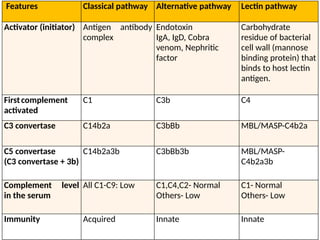
Features Classical pathway Alternative pathway Lectin pathway
Activator (initiator) Antigen antibody
complex
Endotoxin
IgA, IgD, Cobra
venom, Nephritic
factor
Carbohydrate
residue of bacterial
cell wall (mannose
binding protein) that
binds to host lectin
antigen.
Firstcomplement
activated
C1 C3b C4
C3 convertase C14b2a C3bBb MBL/MASP-C4b2a
C5 convertase
(C3 convertase + 3b)
C14b2a3b C3bBb3b MBL/MASP-
C4b2a3b
Complement level
in the serum
All C1-C9: Low C1,C4,C2- Normal
Others- Low
C1- Normal
Others- Low
Immunity Acquired Innate Innate
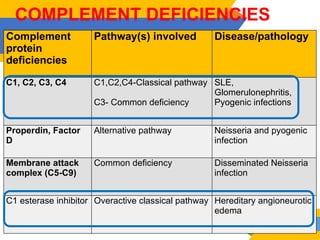
COMPLEMENT DEFICIENCIES
Complement
protein
deficiencies
Pathway(s) involved Disease/pathology
C1, C2, C3, C4 C1,C2,C4-Classical pathway
C3- Common deficiency
SLE,
Glomerulonephritis,
Pyogenic infections
Properdin, Factor
D
Alternative pathway Neisseria and pyogenic
infection
Membrane attack
complex (C5-C9)
Common deficiency Disseminated Neisseria
infection
C1 esterase inhibitor Overactive classical pathway Hereditary angioneurotic
edema
THANK
YOU

Complement-System-mbbs 2023513820160.pptx

  • 1.
    COMPLEMENT SYSTEM Dr. PEETAMSINGH, MD Assistant Professor Department of Microbiology 09/05/2023
  • 2.
    Learning objectives Definitions Classical, alternateand lectin pathway Role of complement Complement deficiencies
  • 3.
    COMPLEMENT • Represents: A groupof proteins normally found in serum In inactive form Augment the immune responses when activated • Constitute about 5% of normal serum proteins • Their level does not increase following infection or vaccination
  • 4.
    COMPLEMENT SYSTEM • Complementsystem comprises of about 30 serum proteins grouped into: Complement components Properdin system Regulatory proteins
  • 5.
    NOMENCLATURE OF COMPLEMENTS •Complement components are named by numerals • There are nine components: C1 to C9 • C1 has three subunits: C1q, C1r and C1s • Properdin system and the regulatory proteins are named by letter symbols, e.g., Factor-B
  • 6.
    SYNTHESIS OF COMPLEMENT •Liver: Major site of synthesis of complement proteins • Minor sites include: Blood monocytes Tissue macrophages Epithelial cells of GIT and genitourinary tract
  • 7.
    COMPLEMENT ACTIVATION • Allcomplement proteins are synthesized in inactive form (zymogens) • Activated by proteolysis • Have two unequal fragments (large & small) Larger fragment: Usually designated as ‘b’ (e.g. C3b) Smaller fragment: Designated as ‘a’ (e.g. C3a) An exception is C2a which is larger fragment
  • 8.
    • During proteolysis,smaller fragment is removed exposing the active site on the larger fragment • The larger fragment participates in the cascade reaction of complement pathway • The smaller fragment diffuses away to mediate other functions
  • 9.
    CASCADE REACTION Fragments ofcomplements interact in a definite sequential manner with a cascade like effect, which leads to formation of complex Such complex having enzymatic activity is designated by putting a bar over the number or symbol (e.g. C 3bBb)
  • 10.
    COMPLEMENT PATHWAYS 1. Classicalpathway:  Antibody dependent pathway  Triggered by the antigen antibody complex formation 2. Alternative pathway:  Antibody independent pathway  Triggered by the antigen directly 3. Lectin pathway:  Recently described pathway  Resembles classical pathway but antibody independent
  • 11.
    STAGES OF COMPLEMENTACTIVATION • There are four stages in the activation of any of the complement pathways Initiation of the pathway Formation of C3 convertase Formation of C5 convertase Formation of MAC (Membrane Attack Complex) Different in all the 3 pathways Identical in all the 3 pathways
  • 15.
    Features Classical pathwayAlternative pathway Lectin pathway Activator (initiator) Antigen antibody complex Endotoxin IgA, IgD, Cobra venom, Nephritic factor Carbohydrate residue of bacterial cell wall (mannose binding protein) that binds to host lectin antigen. Firstcomplement activated C1 C3b C4 C3 convertase C14b2a C3bBb MBL/MASP-C4b2a C5 convertase (C3 convertase + 3b) C14b2a3b C3bBb3b MBL/MASP- C4b2a3b Complement level in the serum All C1-C9: Low C1,C4,C2- Normal Others- Low C1- Normal Others- Low Immunity Acquired Innate Innate
  • 17.
    COMPLEMENT DEFICIENCIES Complement protein deficiencies Pathway(s) involvedDisease/pathology C1, C2, C3, C4 C1,C2,C4-Classical pathway C3- Common deficiency SLE, Glomerulonephritis, Pyogenic infections Properdin, Factor D Alternative pathway Neisseria and pyogenic infection Membrane attack complex (C5-C9) Common deficiency Disseminated Neisseria infection C1 esterase inhibitor Overactive classical pathway Hereditary angioneurotic edema
  • 18.