Comparison of TSP Algorithms
Project for
Models in Facilities Planning and
Materials Handling
December 1998
Participants:
Byung-In Kim
Jae-Ik Shim
Min Zhang
Executive Summary
Our purpose in this term project is to implement heuristic algorithms and
compare and evaluate their respective computational efficiency. Included in this
model are greedy, 2-opt, greedy 2-opt, 3-opt, greedy 3-opt, genetic algorithm,
simulated annealing, and neural network approach and their improvement
versions. The problem size can be adjusted from 2-node up to 10,000-node.
Therefore, these algorithms can be evaluated in a wide spectrum of situations.
We implemented above heuristic algorithms. The conclusion that is derived
from this project is for small-size TSP (n≤50), greedy 2-opt algorithm performs
pretty well, i.e high optimality vs. little computational time. The neural
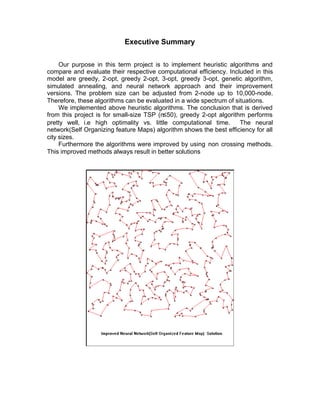
network(Self Organizing feature Maps) algorithm shows the best efficiency for all
city sizes.
Furthermore the algorithms were improved by using non crossing methods.
This improved methods always result in better solutions
Table of Content
1. Introduction
2. Description of Algorithms
A. Greedy
B. 2-Opt
C. Greedy 2-Opt
D. 3-Opt
E. Greedy 3-Opt
F. Genetic
G. Simulated Annealing
H. Neural Network
3. Improvement of Algorithms
4. Simulation Results and Analysis
5. Conclusion
6. Reference
Appendix (Programming Code)
1. Introduction
The Travelling Salesman Problem (TSP) is a deceptively simple
combinatorial problem. It can be stated very simply: A salesman spends his time
visiting N cities (or nodes) cyclically. In one tour he visits each city just once, and
finishes up where he started. In what order should he visit them to minimize the
distance traveled? TSP is applied in many different places such as warehousing,
material handling and facility planning.
Although optimal algorithms exist for solving the TSP, like the IP
formulation, industrial engineers have realized that it is computationally infeasible
to obtain the optimal solution to TSP. And it has been proved that for large-size
TSP, it is almost impossible to generate an optimal solution within a reasonable
amount of time. Heuristics, instead of optimal algorithms, are extensively used to
solved such problems. People conceived many heuristic algorithms to get near-
optimal solutions. Among them, there are greedy, 2-opt, 3-opt, simulated
annealing, genetic algorithms, neural network approach, etc. But their efficiencies
vary from case to case, from size to size.
The algorithms can be implemented by using Visual C++. From these
program the results are attained and the results of each algorithms can be
compared. These algorithms can be improved by using the non-crossing method
which is explained in “Improvement Algorithm”. The comparison of the results
shows the optimality of each algorithm varies with the problem size.
2. Description of Algorithms
The heuristic algorithms for TSP can be classified as
1. Construction Algorithms;
2. Improvement Algorithms; and
3. Hybrid Algorithms.
Construction algorithms are those in which the tour is constructed by
including points in the tours, usually one at a time, until a complete tour is
developed. In improvement algorithms, a given initial solution is improved, if
possible, by transposing two or more points in the initial tour. With regard to
improvement algorithms, two strategies are possible. We may either consider all
possible exchanges and choose the one that results in the greatest savings and
continue this process until no further reduction is possible; or as soon as a
savings is available, we may make the exchange and examine other possible
exchanges and keep the process until we cannot improve the solutions any
further. In our project, the former are 2-opt and 3-opt algorithms; and the latter
are greedy 2-opt and greedy 3-opt algorithms. Hybrid algorithms use a
construction algorithms to obtain an initial solution and then improve it using an
improvement algorithm. In our project, simulated annealing and neural network
fall into this category.
A. Greedy Algorithm
Greedy algorithm is the simplest improvement algorithm. It starts with the
departure Node 1. Then the algorithm calculates all the distances to other n-1
nodes. Go to the next closest node. Take the current node as the departing
node, and select the next nearest node from the remaining n-2 nodes. The
process continues until all the nodes are visited once and only once then back to
Node 1. When the algorithm is terminated, the sequence is returned as the best
tour; and its associated OFV is the final solution. The advantage of this algorithm
is its simplicity to understand and implement. Sometime, it may lead to a very
good solution when the problem size is small. Also, because this algorithm does
not entail any exchange of nodes, it saves considerably much computational
time.
For the C++ code for greedy algorithm, please refer to the Appendix.
B. 2-Opt Algorithm
For n nodes in the TSP problem, the 2-Opt algorithm consists of three
steps:
Step 1 Let S be the initial solution provided by the user and z its objective
function value (In our model, we use greedy algorithm to setup the initial solution
and objective function value.). Set S*=s, z*=z, i=1 and j=i+1=2.
Step 2 Consider the exchange results in a solution S’ that has OFV z’<z*,
set z*=z’ and S*=S’. If j<n repeat step 2; otherwise set i=i+1 and j=i+1. If i<n,
repeat step 2; otherwise go to step 3.
Step 3 If S≠S*, set S=S*, z=z*, i=1, j=i+1=2 and go to step 2. Otherwise,
output S* as the best solution and terminate the process.
Observe that the 2-opt algorithm considers only pairwise exchange.
Initially, the algorithm considers transposition of Nodes 1 and 2. If the resulting
solution’s OFV is smaller than that of the initial solution, it is stored as a
candidate for future consideration. If not, it is discarded and the algorithm
considers transposing of Nodes 1 and 3. If this exchange generates a better
solution, it is stored as a candidate for future consideration; if not, it is discarded.
Thus, whenever a better solution is found, the algorithm discards the previous
best solution. This procedure continues until all the pairwise exchanges are
considered. Because each node can be exchanged with n-1 other nodes and
there are n nodes in total, there are n(n-1)/2 different exchanges. These n(n-1)/2
exchanges are considered in step 2. The solution retained at the end of step 2 is
the one that provides the most improvement in the OFV. Starting with this as the
new solution, the algorithm repeats step 2 to find another better solution. At some
stage, no improvement in the current best solution is possible, and then the
algorithm terminates. The remaining solution is returned to the user as the best
one.
For the C++ code for 2-opt algorithm, please refer to the Appendix.
C. Greedy 2-Opt Algorithm
The greedy 2-Opt algorithm is a variant of 2-opt algorithm. It also consists
of three steps:
Step 1 Let S be the initial solution provided by the user and z its objective
function value (In our model, we use greedy algorithm to setup the initial solution
and objective function value.). Set S*=s, z*=z, i=1 and j=i+1=2.
Step 2 Transpose Node i and Node j, i<j. Compare the resulting OFV z
with z*. If z ≥ z* and j<n, set j=j+1 and repeat step 2; Otherwise go to step 3.
Step 3 If z<z*, set S*=S, z*=z, i=1, j=i+1=2 and go to step 2. If z ≥ z* and
j=n, set i=i+1, j=j+1 and repeat step 2. Otherwise, output S* as the best solution
and terminate the process.
Like the 2-Opt algorithm, greedy 2-opt algorithm also considers pairwise
exchanges. Initially, it considers transposing Nodes 1 and 2. If the resulting OFV
is less than the previous one, two nodes are immediately transposed. If not, the
algorithm will go on to Node 3 and evaluate the exchange, and so on until find
the improvement. If Nodes 1 and 2 are transposed, the algorithm will take it as an
initial solution and repeat the algorithm until it is impossible to improve the
solution any further. Greedy 2-opt algorithm makes the exchange permanent
whenever an improvement is found and thus consumes less computational time
than 2-Opt algorithm. On the other hand, greedy 2-opt produces slightly worse
solutions than 2-Opt algorithm.
For the C++ code for greedy 2-opt algorithm, please refer to the Appendix.
D. 3-Opt Algorithm
The 3-Opt algorithm is similar to the 2-opt algorithm except that it
considers transposing two nodes at a time. There are two possible ways of
transposition.: i->j->k->i
and j->k->i->j. Let’s just consider the first transposition. The steps involved are
Step 1. Let S be the initial solution and z its OFV. Set
S*=S,z*=z,i=1,j=i+1 and k=j+1.
Step 2. Consider transposing Nodes i, j, k in “i->j->k->i” fashion. If the
resulting solution S’ has a smaller z’<z*, set z*=z’ and S*=S’. If k<n, set k=k+1.
Otherwise, set j=j+1. If j<n-1, set k=j+1. Otherwise, set i=i+1, j=j+1 and k=j+1. If
i<n-2, repeat step 2. Otherwise go to step 3.
Step 3 If S≠S*, set S=S*, z=z*, i=1, j=i+1,k=j+1 and go to step 2.
Otherwise, output S* as the best solution and terminate the process.
For the C++ code for 3-Opt algorithm, please refer to the Appendix.
E. Greedy 3-Opt Algorithm
Like the greedy 2-opt algorithm, greedy 3-opt algorithm also makes the 3-
node exchange permanent whenever its resulting OFV is better than the current
OFV and repeats the algorithm with the new transposition as the initial solution.
Let’s just consider the “i->j->k->i” transposition again. The steps involved are:
Step 1 Let S be the initial solution provided by the user and z its objective
function value (In our model, we use greedy algorithm to setup the initial solution
and objective function value.). Set S*=S,z*=z,i=1,j=i+1 and k=j+1.
Step 2. Consider transposing Nodes i, j, k in “i->j->k->i” fashion. If the
resulting solution S’ has a smaller z’<z*, set z*=z’ and S*=S’. If k<n, set k=k+1.
Otherwise, set j=j+1. If j<n-1, set k=j+1. Otherwise, set i=i+1, j=j+1 and k=j+1. If
i<n-2, repeat step 2. Otherwise go to step 3.
Step 3 If z<z*, set S*=S, z*=z, i=1, j=i+1=2, k=j+1 and go to step 2. If z ≥ z*
and k=n, set i=i+1, j=j+1, and repeat step 2. . If z ≥ z* and j=n-1, set i=i+1, and
repeat step 2. Otherwise, output S* as the best solution and terminate the
process
The advantage of greedy 3-Opt algorithm over 3-Opt algorithm is once
again less computational time due to its less thorough search in the network.
For the C++ code for greedy 3-Opt algorithm, please refer to the
Appendix.
F. Genetic Algorithm
As the name implies, this algorithm gets its idea from genetics. The
algorithm works this way.
Step 0 Obtain the maximum number of individuals in the population P and
the maximum number of generations G from the user, generate P solutions for
the first generation’s population randomly, and represent each solution as a
string. Set generation counter Ngen=1.
Step 1 Determine the fitness of each solution in the current generation’s
population and record the string that has the best fitness.
Step 2 Generate solutions for the next generation’s population as follows:
1. Retain 0.1P of the solutions with the best fitness in the previous
population.
2. Generate 0.89P solutions via mating, and
3. Select 0.01P solutions from the previous population randomly and
mutate them.
Step 3 Update Ngen= Ngen+1. If Ngen≤G, go to Step 1. Otherwise stop.
In our project, we used the two-point crossover method, given two parent
chromosomes {x1,x2,….xn} and {y1,y2,…,yn}, two integers r and s are randomly
selected, such that 1 ≤ r ≤ s ≤ n. And the genes in positions r to s of one parent
are swapped with those of the other to get two offsprings as follows.
{x1, x2,…, xr-1, yr, yr+1,…, ys, xs+1, xs+2,…, xn}
{y1, y2,…, yr-1, xr, xr+1,…, xs, ys+1, ys+2,…, yn}
Either both or the better of the two offspring is then included in the new
population. This mutation procedure is repeated until the required number of
offspring is generated. To avoid generating infeasible solutions, we also used the
partially matched crossover method. Set t=r, and swaps genes xt and yt if xt≠yt in
the first parent x={x1, x2,…, xr-1, xr, xr+1,…, xs, xs+1, xs+2,…, xn}. This swapping is
done for t=r through s, one by one, and then we have a feasible offspring. The
same is done for y={y1, y2,…, yr-1, yr, yr+1,…, ys, ys+1, ys+2,…, yn}. Because the
partially matched crossover method always swaps genes within a parent,
feasible offspring are obtained.
Therefore, our model uses mutation to generate a population by swapping
any two randomly selected genes.
For the C++ code for genetic algorithm, please refer to the Appendix.
H. Simulated Annealing
The basic idea of simulated annealing(SA) is from the statistical
mechanics and is motivated by an analogy of behavior of physical systems in the
presents of a heat bath. This algorithm obtains better final solutions by gradually
going from one solution to the next. The main difference of SA from the 2-opt or
3-opt algorithm is that the local optimization algorithm is often restrict their search
for the optimal solution in a downhill direction which mean that the initial solution
is changed only if it results in a decrease in the OFV. The temperature refers to
the state through which the simulated annealing algorithm passes in its search
for a better solution. Starting with an initial temperature, we move to the next
temperature only when we have reached a frozen state. When a frozen state is
reached, the temperature is reduced by a cooling factor r, and the procedure is
repeated until a certain predetermined number of temperature steps have been
performed.
Step 0 Set S = initial feasible solution
z = corresponding OFV
T = initial temperature = 1; r = cooling factor = 0.9
ITEMP = number of times the temperature T is decreased = 0
NLIMIT = maximum number of new solutions to be accepted at
each temperature = 10n
NOVER = maximum number of solutions evaluated at each
temperature = 100n
Step 1 Repeat step 2 NOVER times or until the number of successful new
solutions is equal to NLIMIT
Step2 Pick a pair of machines randomly and exchange their positions. If the
exchange of the position of the two machines results in the overlapping of
some other pairs of cities, appropriately modify the coordinates of the
center of the concerned machines to ensure no overlapping. If the
resulting solution S* has OFV <= z, set S* = S and z = corresponding
OFV. Otherwise, compute delta = difference between z and the OFV of
the solution S*. and set S*=S with a probability e-delta/T
.
Step 3 Set T = rT and ITEMP = ITEMP + 1. If ITEMP <= 100, go to step 1;
otherwise stop.
For the C++ code for simulated annealing algorithm, please refer to the
Appendix.
G. Neural Network(Self Organizing Feature Maps)
First, randomly pick up any city in the network as the initial loop. The
number of nodes N on the loop grows subsequently according to a node creation
process. (see below). At each processing step, a city i is surveyed. One complete
iteration takes M (number of total cities to be visited) sequential steps, for i=1 to
i=M, thus picking every city once in a preset order. A gain parameter is used
which decreases between two complete iterations. Several iterations are needed
to go from the high gain value to the low one giving the final result.
Surveying the city i comprises the following steps:
Step 1. Find the node jc which is closed to city i.
Step 2. Move node jc and its neighbors on the ring towards city i.
The distance each node will move is determined by a function f(G,n) where G is
the gain parameter (its initial is set 10 in our model), and n is the distance
measured along the loop between nodes j and jc.
n=inf (j- jc (mod N), jc -j(mod N))
Every node j is moved from current position to a new one.
The function f is defined to be
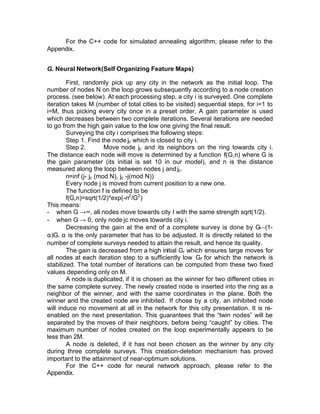
f(G,n)=sqrt(1/2)*exp(-n2
/G2
)
This means:
- when G →∞, all nodes move towards city I with the same strength sqrt(1/2).
- when G → 0, only node jc moves towards city i.
Decreasing the gain at the end of a complete survey is done by G←(1-
α)G. α is the only parameter that has to be adjusted. It is directly related to the
number of complete surveys needed to attain the result, and hence its quality.
The gain is decreased from a high initial Gi which ensures large moves for
all nodes at each iteration step to a sufficiently low Gf for which the network is
stabilized. The total number of iterations can be computed from these two fixed
values depending only on M.
A node is duplicated, if it is chosen as the winner for two different cities in
the same complete survey. The newly created node is inserted into the ring as a
neighbor of the winner, and with the same coordinates in the plane. Both the
winner and the created node are inhibited. If chose by a city, an inhibited node
will induce no movement at all in the network for this city presentation. It is re-
enabled on the next presentation. This guarantees that the “twin nodes” will be
separated by the moves of their neighbors, before being “caught” by cities. The
maximum number of nodes created on the loop experimentally appears to be
less than 2M.
A node is deleted, if it has not been chosen as the winner by any city
during three complete surveys. This creation-deletion mechanism has proved
important to the attainment of near-optimum solutions.
For the C++ code for neural network approach, please refer to the
Appendix.
3. Improvement of Algorithms
In the initial implementation of these 8 algorithms, it is found that these
algorithms do not eliminate the crossing of routes. Of course, these crossings of
routes lengthen the total distance of travel in TSP. We improved these algorithms
by getting rid of these crossings.
The process is as follows.
First, obtain the solution with any of the preceding algorithms. Second,
pick up the segment between Node 1 and Node 2, check any other segment
against the 1-2 segment to see if these 2 segments intersect each other. If not,
pick up the segment 2-3, and check consequent segment against segment 2-3. If
the intersection is found for any two distinct segments, re-route the loop. And the
process is continued sequentially throughout the network.
The mathematical implementation of both checking and re-routing is as
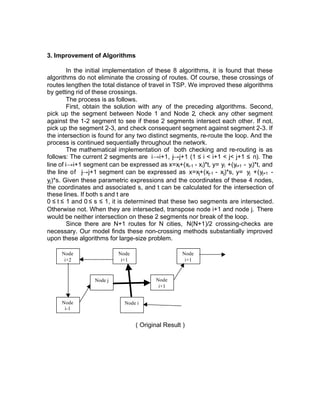
follows: The current 2 segments are i→i+1, j→j+1 (1 ≤ i < i+1 < j< j+1 ≤ n). The
line of i→i+1 segment can be expressed as x=xi+(xi-1 - xi)*t, y= yi +(yi+1 - yi)*t, and
the line of j→j+1 segment can be expressed as x=xj+(xj-1 - xj)*s, y= yj +(yj+1 -
yj)*s. Given these parametric expressions and the coordinates of these 4 nodes,
the coordinates and associated s, and t can be calculated for the intersection of
these lines. If both s and t are
0 ≤ t ≤ 1 and 0 ≤ s ≤ 1, it is determined that these two segments are intersected.
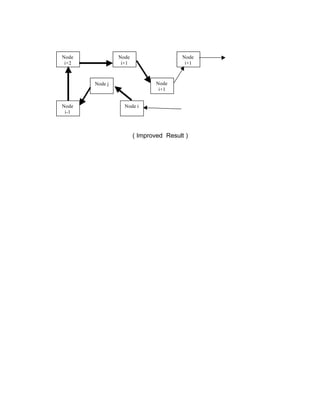
Otherwise not. When they are intersected, transpose node i+1 and node j. There
would be neither intersection on these 2 segments nor break of the loop.
Since there are N+1 routes for N cities, N(N+1)/2 crossing-checks are
necessary. Our model finds these non-crossing methods substantially improved
upon these algorithms for large-size problem.
( Original Result )
Node
j+1
Node j
Node i
Node
i+1
Node
j+1
Node
i+2
Node
j-1
( Improved Result )
Node
j+1
Node j
Node i
Node
i+1
Node
j+1
Node
i+2
Node
j-1
4. Implementation & Analysis
We implemented above algorithms by using Microsoft Visual C++ 5.0( with MFC
library ). The main menu and windows are followed. <TSP menu> is menu for
solving TSP by using several algorithms and <TSP Result View> is menu for
viewing the results.
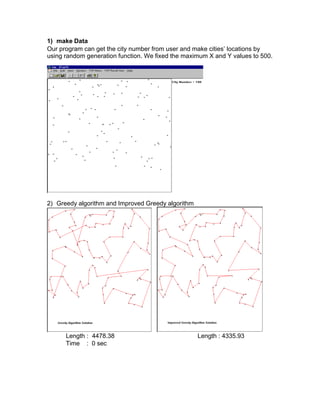
1) make Data
Our program can get the city number from user and make cities’ locations by
using random generation function. We fixed the maximum X and Y values to 500.
2) Greedy algorithm and Improved Greedy algorithm
Length : 4478.38 Length : 4335.93
Time : 0 sec
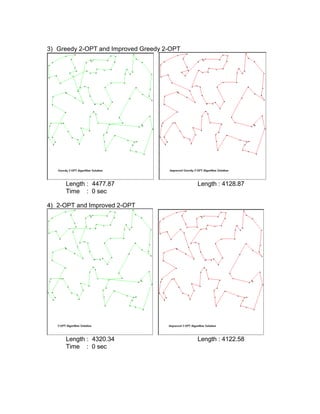
3) Greedy 2-OPT and Improved Greedy 2-OPT
Length : 4477.87 Length : 4128.87
Time : 0 sec
4) 2-OPT and Improved 2-OPT
Length : 4320.34 Length : 4122.58
Time : 0 sec
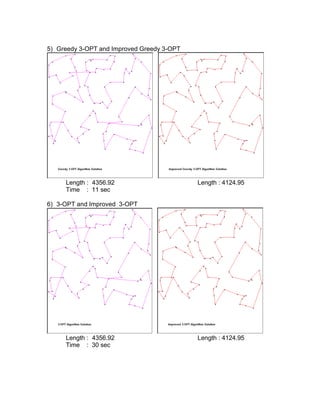
5) Greedy 3-OPT and Improved Greedy 3-OPT
Length : 4356.92 Length : 4124.95
Time : 11 sec
6) 3-OPT and Improved 3-OPT
Length : 4356.92 Length : 4124.95
Time : 30 sec
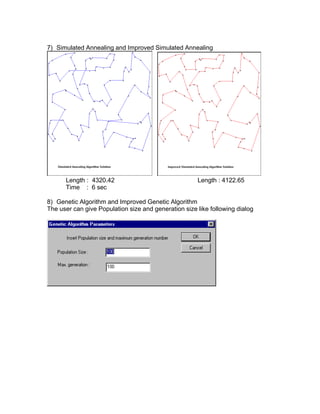
7) Simulated Annealing and Improved Simulated Annealing
Length : 4320.42 Length : 4122.65
Time : 6 sec
8) Genetic Algorithm and Improved Genetic Algorithm
The user can give Population size and generation size like following dialog
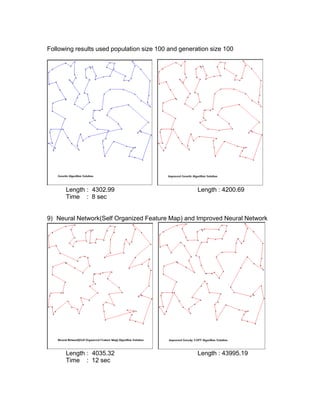
Following results used population size 100 and generation size 100
Length : 4302.99 Length : 4200.69
Time : 8 sec
9) Neural Network(Self Organized Feature Map) and Improved Neural Network
Length : 4035.32 Length : 43995.19
Time : 12 sec
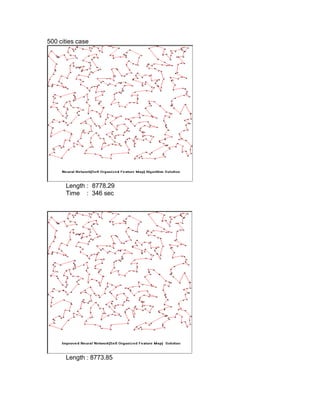
500 cities case
Length : 8778.29
Time : 346 sec
Length : 8773.85
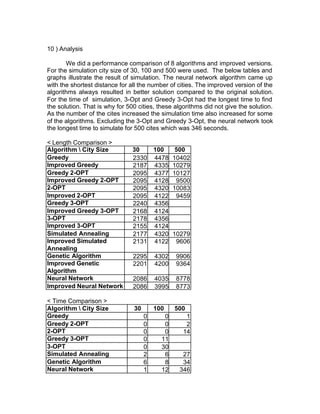
10 ) Analysis
We did a performance comparison of 8 algorithms and improved versions.
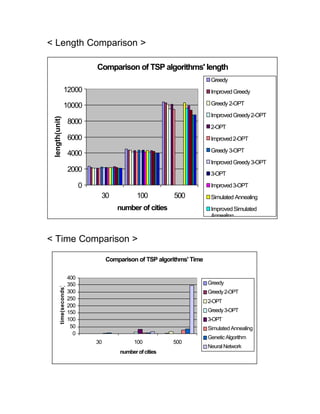
For the simulation city size of 30, 100 and 500 were used. The below tables and
graphs illustrate the result of simulation. The neural network algorithm came up
with the shortest distance for all the number of cities. The improved version of the
algorithms always resulted in better solution compared to the original solution.
For the time of simulation, 3-Opt and Greedy 3-Opt had the longest time to find
the solution. That is why for 500 cities, these algorithms did not give the solution.
As the number of the cites increased the simulation time also increased for some
of the algorithms. Excluding the 3-Opt and Greedy 3-Opt, the neural network took
the longest time to simulate for 500 cites which was 346 seconds.
< Length Comparison >
Algorithm  City Size 30 100 500
Greedy 2330 4478 10402
Improved Greedy 2187 4335 10279
Greedy 2-OPT 2095 4377 10127
Improved Greedy 2-OPT 2095 4128 9500
2-OPT 2095 4320 10083
Improved 2-OPT 2095 4122 9459
Greedy 3-OPT 2240 4356
Improved Greedy 3-OPT 2168 4124
3-OPT 2178 4356
Improved 3-OPT 2155 4124
Simulated Annealing 2177 4320 10279
Improved Simulated
Annealing
2131 4122 9606
Genetic Algorithm 2295 4302 9906
Improved Genetic
Algorithm
2201 4200 9364
Neural Network 2086 4035 8778
Improved Neural Network 2086 3995 8773
< Time Comparison >
Algorithm  City Size 30 100 500
Greedy 0 0 1
Greedy 2-OPT 0 0 2
2-OPT 0 0 14
Greedy 3-OPT 0 11
3-OPT 0 30
Simulated Annealing 2 6 27
Genetic Algorithm 6 8 34
Neural Network 1 12 346
< Length Comparison >
< Time Comparison >
Comparison of TSP algorithms' length
0
2000
4000
6000
8000
10000
12000
30 100 500
number of cities
length(unit)
Greedy
ImprovedGreedy
Greedy 2-OPT
ImprovedGreedy2-OPT
2-OPT
Improved2-OPT
Greedy 3-OPT
ImprovedGreedy3-OPT
3-OPT
Improved3-OPT
Simulated Annealing
ImprovedSimulated
Annealing
Comparison of TSP algorithms' Time
0
50
100
150
200
250
300
350
400
30 100 500
numberofcities
time(seconds)
Greedy
Greedy2-OPT
2-OPT
Greedy3-OPT
3-OPT
Simulated Annealing
Genetic Algorithm
Neural Network
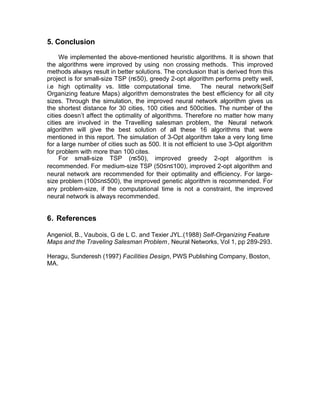
5. Conclusion
We implemented the above-mentioned heuristic algorithms. It is shown that
the algorithms were improved by using non crossing methods. This improved
methods always result in better solutions. The conclusion that is derived from this
project is for small-size TSP (n≤50), greedy 2-opt algorithm performs pretty well,
i.e high optimality vs. little computational time. The neural network(Self
Organizing feature Maps) algorithm demonstrates the best efficiency for all city
sizes. Through the simulation, the improved neural network algorithm gives us
the shortest distance for 30 cities, 100 cities and 500cities. The number of the
cities doesn’t affect the optimality of algorithms. Therefore no matter how many
cities are involved in the Travelling salesman problem, the Neural network
algorithm will give the best solution of all these 16 algorithms that were
mentioned in this report. The simulation of 3-Opt algorithm take a very long time
for a large number of cities such as 500. It is not efficient to use 3-Opt algorithm
for problem with more than 100 cites.
For small-size TSP (n≤50), improved greedy 2-opt algorithm is
recommended. For medium-size TSP (50≤n≤100), improved 2-opt algorithm and
neural network are recommended for their optimality and efficiency. For large-
size problem (100≤n≤500), the improved genetic algorithm is recommended. For
any problem-size, if the computational time is not a constraint, the improved
neural network is always recommended.
6. References
Angeniol, B., Vaubois, G de L C. and Texier JYL.(1988) Self-Organizing Feature
Maps and the Traveling Salesman Problem, Neural Networks, Vol 1, pp 289-293.
Heragu, Sunderesh (1997) Facilities Design, PWS Publishing Company, Boston,
MA.

Comparison of tsp algorithms

  • 1.
    Comparison of TSPAlgorithms Project for Models in Facilities Planning and Materials Handling December 1998 Participants: Byung-In Kim Jae-Ik Shim Min Zhang
  • 2.
    Executive Summary Our purposein this term project is to implement heuristic algorithms and compare and evaluate their respective computational efficiency. Included in this model are greedy, 2-opt, greedy 2-opt, 3-opt, greedy 3-opt, genetic algorithm, simulated annealing, and neural network approach and their improvement versions. The problem size can be adjusted from 2-node up to 10,000-node. Therefore, these algorithms can be evaluated in a wide spectrum of situations. We implemented above heuristic algorithms. The conclusion that is derived from this project is for small-size TSP (n≤50), greedy 2-opt algorithm performs pretty well, i.e high optimality vs. little computational time. The neural network(Self Organizing feature Maps) algorithm shows the best efficiency for all city sizes. Furthermore the algorithms were improved by using non crossing methods. This improved methods always result in better solutions
  • 3.
    Table of Content 1.Introduction 2. Description of Algorithms A. Greedy B. 2-Opt C. Greedy 2-Opt D. 3-Opt E. Greedy 3-Opt F. Genetic G. Simulated Annealing H. Neural Network 3. Improvement of Algorithms 4. Simulation Results and Analysis 5. Conclusion 6. Reference Appendix (Programming Code)
  • 4.
    1. Introduction The TravellingSalesman Problem (TSP) is a deceptively simple combinatorial problem. It can be stated very simply: A salesman spends his time visiting N cities (or nodes) cyclically. In one tour he visits each city just once, and finishes up where he started. In what order should he visit them to minimize the distance traveled? TSP is applied in many different places such as warehousing, material handling and facility planning. Although optimal algorithms exist for solving the TSP, like the IP formulation, industrial engineers have realized that it is computationally infeasible to obtain the optimal solution to TSP. And it has been proved that for large-size TSP, it is almost impossible to generate an optimal solution within a reasonable amount of time. Heuristics, instead of optimal algorithms, are extensively used to solved such problems. People conceived many heuristic algorithms to get near- optimal solutions. Among them, there are greedy, 2-opt, 3-opt, simulated annealing, genetic algorithms, neural network approach, etc. But their efficiencies vary from case to case, from size to size. The algorithms can be implemented by using Visual C++. From these program the results are attained and the results of each algorithms can be compared. These algorithms can be improved by using the non-crossing method which is explained in “Improvement Algorithm”. The comparison of the results shows the optimality of each algorithm varies with the problem size. 2. Description of Algorithms The heuristic algorithms for TSP can be classified as 1. Construction Algorithms; 2. Improvement Algorithms; and 3. Hybrid Algorithms. Construction algorithms are those in which the tour is constructed by including points in the tours, usually one at a time, until a complete tour is developed. In improvement algorithms, a given initial solution is improved, if possible, by transposing two or more points in the initial tour. With regard to improvement algorithms, two strategies are possible. We may either consider all possible exchanges and choose the one that results in the greatest savings and continue this process until no further reduction is possible; or as soon as a savings is available, we may make the exchange and examine other possible exchanges and keep the process until we cannot improve the solutions any further. In our project, the former are 2-opt and 3-opt algorithms; and the latter are greedy 2-opt and greedy 3-opt algorithms. Hybrid algorithms use a construction algorithms to obtain an initial solution and then improve it using an improvement algorithm. In our project, simulated annealing and neural network fall into this category.
  • 5.
    A. Greedy Algorithm Greedyalgorithm is the simplest improvement algorithm. It starts with the departure Node 1. Then the algorithm calculates all the distances to other n-1 nodes. Go to the next closest node. Take the current node as the departing node, and select the next nearest node from the remaining n-2 nodes. The process continues until all the nodes are visited once and only once then back to Node 1. When the algorithm is terminated, the sequence is returned as the best tour; and its associated OFV is the final solution. The advantage of this algorithm is its simplicity to understand and implement. Sometime, it may lead to a very good solution when the problem size is small. Also, because this algorithm does not entail any exchange of nodes, it saves considerably much computational time. For the C++ code for greedy algorithm, please refer to the Appendix. B. 2-Opt Algorithm For n nodes in the TSP problem, the 2-Opt algorithm consists of three steps: Step 1 Let S be the initial solution provided by the user and z its objective function value (In our model, we use greedy algorithm to setup the initial solution and objective function value.). Set S*=s, z*=z, i=1 and j=i+1=2. Step 2 Consider the exchange results in a solution S’ that has OFV z’<z*, set z*=z’ and S*=S’. If j<n repeat step 2; otherwise set i=i+1 and j=i+1. If i<n, repeat step 2; otherwise go to step 3. Step 3 If S≠S*, set S=S*, z=z*, i=1, j=i+1=2 and go to step 2. Otherwise, output S* as the best solution and terminate the process. Observe that the 2-opt algorithm considers only pairwise exchange. Initially, the algorithm considers transposition of Nodes 1 and 2. If the resulting solution’s OFV is smaller than that of the initial solution, it is stored as a candidate for future consideration. If not, it is discarded and the algorithm considers transposing of Nodes 1 and 3. If this exchange generates a better solution, it is stored as a candidate for future consideration; if not, it is discarded. Thus, whenever a better solution is found, the algorithm discards the previous best solution. This procedure continues until all the pairwise exchanges are considered. Because each node can be exchanged with n-1 other nodes and there are n nodes in total, there are n(n-1)/2 different exchanges. These n(n-1)/2 exchanges are considered in step 2. The solution retained at the end of step 2 is the one that provides the most improvement in the OFV. Starting with this as the new solution, the algorithm repeats step 2 to find another better solution. At some stage, no improvement in the current best solution is possible, and then the algorithm terminates. The remaining solution is returned to the user as the best one. For the C++ code for 2-opt algorithm, please refer to the Appendix.
  • 6.
    C. Greedy 2-OptAlgorithm The greedy 2-Opt algorithm is a variant of 2-opt algorithm. It also consists of three steps: Step 1 Let S be the initial solution provided by the user and z its objective function value (In our model, we use greedy algorithm to setup the initial solution and objective function value.). Set S*=s, z*=z, i=1 and j=i+1=2. Step 2 Transpose Node i and Node j, i<j. Compare the resulting OFV z with z*. If z ≥ z* and j<n, set j=j+1 and repeat step 2; Otherwise go to step 3. Step 3 If z<z*, set S*=S, z*=z, i=1, j=i+1=2 and go to step 2. If z ≥ z* and j=n, set i=i+1, j=j+1 and repeat step 2. Otherwise, output S* as the best solution and terminate the process. Like the 2-Opt algorithm, greedy 2-opt algorithm also considers pairwise exchanges. Initially, it considers transposing Nodes 1 and 2. If the resulting OFV is less than the previous one, two nodes are immediately transposed. If not, the algorithm will go on to Node 3 and evaluate the exchange, and so on until find the improvement. If Nodes 1 and 2 are transposed, the algorithm will take it as an initial solution and repeat the algorithm until it is impossible to improve the solution any further. Greedy 2-opt algorithm makes the exchange permanent whenever an improvement is found and thus consumes less computational time than 2-Opt algorithm. On the other hand, greedy 2-opt produces slightly worse solutions than 2-Opt algorithm. For the C++ code for greedy 2-opt algorithm, please refer to the Appendix. D. 3-Opt Algorithm The 3-Opt algorithm is similar to the 2-opt algorithm except that it considers transposing two nodes at a time. There are two possible ways of transposition.: i->j->k->i and j->k->i->j. Let’s just consider the first transposition. The steps involved are Step 1. Let S be the initial solution and z its OFV. Set S*=S,z*=z,i=1,j=i+1 and k=j+1. Step 2. Consider transposing Nodes i, j, k in “i->j->k->i” fashion. If the resulting solution S’ has a smaller z’<z*, set z*=z’ and S*=S’. If k<n, set k=k+1. Otherwise, set j=j+1. If j<n-1, set k=j+1. Otherwise, set i=i+1, j=j+1 and k=j+1. If i<n-2, repeat step 2. Otherwise go to step 3. Step 3 If S≠S*, set S=S*, z=z*, i=1, j=i+1,k=j+1 and go to step 2. Otherwise, output S* as the best solution and terminate the process. For the C++ code for 3-Opt algorithm, please refer to the Appendix. E. Greedy 3-Opt Algorithm Like the greedy 2-opt algorithm, greedy 3-opt algorithm also makes the 3- node exchange permanent whenever its resulting OFV is better than the current
  • 7.
    OFV and repeatsthe algorithm with the new transposition as the initial solution. Let’s just consider the “i->j->k->i” transposition again. The steps involved are: Step 1 Let S be the initial solution provided by the user and z its objective function value (In our model, we use greedy algorithm to setup the initial solution and objective function value.). Set S*=S,z*=z,i=1,j=i+1 and k=j+1. Step 2. Consider transposing Nodes i, j, k in “i->j->k->i” fashion. If the resulting solution S’ has a smaller z’<z*, set z*=z’ and S*=S’. If k<n, set k=k+1. Otherwise, set j=j+1. If j<n-1, set k=j+1. Otherwise, set i=i+1, j=j+1 and k=j+1. If i<n-2, repeat step 2. Otherwise go to step 3. Step 3 If z<z*, set S*=S, z*=z, i=1, j=i+1=2, k=j+1 and go to step 2. If z ≥ z* and k=n, set i=i+1, j=j+1, and repeat step 2. . If z ≥ z* and j=n-1, set i=i+1, and repeat step 2. Otherwise, output S* as the best solution and terminate the process The advantage of greedy 3-Opt algorithm over 3-Opt algorithm is once again less computational time due to its less thorough search in the network. For the C++ code for greedy 3-Opt algorithm, please refer to the Appendix. F. Genetic Algorithm As the name implies, this algorithm gets its idea from genetics. The algorithm works this way. Step 0 Obtain the maximum number of individuals in the population P and the maximum number of generations G from the user, generate P solutions for the first generation’s population randomly, and represent each solution as a string. Set generation counter Ngen=1. Step 1 Determine the fitness of each solution in the current generation’s population and record the string that has the best fitness. Step 2 Generate solutions for the next generation’s population as follows: 1. Retain 0.1P of the solutions with the best fitness in the previous population. 2. Generate 0.89P solutions via mating, and 3. Select 0.01P solutions from the previous population randomly and mutate them. Step 3 Update Ngen= Ngen+1. If Ngen≤G, go to Step 1. Otherwise stop. In our project, we used the two-point crossover method, given two parent chromosomes {x1,x2,….xn} and {y1,y2,…,yn}, two integers r and s are randomly selected, such that 1 ≤ r ≤ s ≤ n. And the genes in positions r to s of one parent are swapped with those of the other to get two offsprings as follows. {x1, x2,…, xr-1, yr, yr+1,…, ys, xs+1, xs+2,…, xn} {y1, y2,…, yr-1, xr, xr+1,…, xs, ys+1, ys+2,…, yn} Either both or the better of the two offspring is then included in the new population. This mutation procedure is repeated until the required number of offspring is generated. To avoid generating infeasible solutions, we also used the
  • 8.
    partially matched crossovermethod. Set t=r, and swaps genes xt and yt if xt≠yt in the first parent x={x1, x2,…, xr-1, xr, xr+1,…, xs, xs+1, xs+2,…, xn}. This swapping is done for t=r through s, one by one, and then we have a feasible offspring. The same is done for y={y1, y2,…, yr-1, yr, yr+1,…, ys, ys+1, ys+2,…, yn}. Because the partially matched crossover method always swaps genes within a parent, feasible offspring are obtained. Therefore, our model uses mutation to generate a population by swapping any two randomly selected genes. For the C++ code for genetic algorithm, please refer to the Appendix. H. Simulated Annealing The basic idea of simulated annealing(SA) is from the statistical mechanics and is motivated by an analogy of behavior of physical systems in the presents of a heat bath. This algorithm obtains better final solutions by gradually going from one solution to the next. The main difference of SA from the 2-opt or 3-opt algorithm is that the local optimization algorithm is often restrict their search for the optimal solution in a downhill direction which mean that the initial solution is changed only if it results in a decrease in the OFV. The temperature refers to the state through which the simulated annealing algorithm passes in its search for a better solution. Starting with an initial temperature, we move to the next temperature only when we have reached a frozen state. When a frozen state is reached, the temperature is reduced by a cooling factor r, and the procedure is repeated until a certain predetermined number of temperature steps have been performed. Step 0 Set S = initial feasible solution z = corresponding OFV T = initial temperature = 1; r = cooling factor = 0.9 ITEMP = number of times the temperature T is decreased = 0 NLIMIT = maximum number of new solutions to be accepted at each temperature = 10n NOVER = maximum number of solutions evaluated at each temperature = 100n Step 1 Repeat step 2 NOVER times or until the number of successful new solutions is equal to NLIMIT Step2 Pick a pair of machines randomly and exchange their positions. If the exchange of the position of the two machines results in the overlapping of some other pairs of cities, appropriately modify the coordinates of the center of the concerned machines to ensure no overlapping. If the resulting solution S* has OFV <= z, set S* = S and z = corresponding OFV. Otherwise, compute delta = difference between z and the OFV of the solution S*. and set S*=S with a probability e-delta/T . Step 3 Set T = rT and ITEMP = ITEMP + 1. If ITEMP <= 100, go to step 1; otherwise stop.
  • 9.
    For the C++code for simulated annealing algorithm, please refer to the Appendix. G. Neural Network(Self Organizing Feature Maps) First, randomly pick up any city in the network as the initial loop. The number of nodes N on the loop grows subsequently according to a node creation process. (see below). At each processing step, a city i is surveyed. One complete iteration takes M (number of total cities to be visited) sequential steps, for i=1 to i=M, thus picking every city once in a preset order. A gain parameter is used which decreases between two complete iterations. Several iterations are needed to go from the high gain value to the low one giving the final result. Surveying the city i comprises the following steps: Step 1. Find the node jc which is closed to city i. Step 2. Move node jc and its neighbors on the ring towards city i. The distance each node will move is determined by a function f(G,n) where G is the gain parameter (its initial is set 10 in our model), and n is the distance measured along the loop between nodes j and jc. n=inf (j- jc (mod N), jc -j(mod N)) Every node j is moved from current position to a new one. The function f is defined to be f(G,n)=sqrt(1/2)*exp(-n2 /G2 ) This means: - when G →∞, all nodes move towards city I with the same strength sqrt(1/2). - when G → 0, only node jc moves towards city i. Decreasing the gain at the end of a complete survey is done by G←(1- α)G. α is the only parameter that has to be adjusted. It is directly related to the number of complete surveys needed to attain the result, and hence its quality. The gain is decreased from a high initial Gi which ensures large moves for all nodes at each iteration step to a sufficiently low Gf for which the network is stabilized. The total number of iterations can be computed from these two fixed values depending only on M. A node is duplicated, if it is chosen as the winner for two different cities in the same complete survey. The newly created node is inserted into the ring as a neighbor of the winner, and with the same coordinates in the plane. Both the winner and the created node are inhibited. If chose by a city, an inhibited node will induce no movement at all in the network for this city presentation. It is re- enabled on the next presentation. This guarantees that the “twin nodes” will be separated by the moves of their neighbors, before being “caught” by cities. The maximum number of nodes created on the loop experimentally appears to be less than 2M. A node is deleted, if it has not been chosen as the winner by any city during three complete surveys. This creation-deletion mechanism has proved important to the attainment of near-optimum solutions. For the C++ code for neural network approach, please refer to the Appendix.
  • 10.
    3. Improvement ofAlgorithms In the initial implementation of these 8 algorithms, it is found that these algorithms do not eliminate the crossing of routes. Of course, these crossings of routes lengthen the total distance of travel in TSP. We improved these algorithms by getting rid of these crossings. The process is as follows. First, obtain the solution with any of the preceding algorithms. Second, pick up the segment between Node 1 and Node 2, check any other segment against the 1-2 segment to see if these 2 segments intersect each other. If not, pick up the segment 2-3, and check consequent segment against segment 2-3. If the intersection is found for any two distinct segments, re-route the loop. And the process is continued sequentially throughout the network. The mathematical implementation of both checking and re-routing is as follows: The current 2 segments are i→i+1, j→j+1 (1 ≤ i < i+1 < j< j+1 ≤ n). The line of i→i+1 segment can be expressed as x=xi+(xi-1 - xi)*t, y= yi +(yi+1 - yi)*t, and the line of j→j+1 segment can be expressed as x=xj+(xj-1 - xj)*s, y= yj +(yj+1 - yj)*s. Given these parametric expressions and the coordinates of these 4 nodes, the coordinates and associated s, and t can be calculated for the intersection of these lines. If both s and t are 0 ≤ t ≤ 1 and 0 ≤ s ≤ 1, it is determined that these two segments are intersected. Otherwise not. When they are intersected, transpose node i+1 and node j. There would be neither intersection on these 2 segments nor break of the loop. Since there are N+1 routes for N cities, N(N+1)/2 crossing-checks are necessary. Our model finds these non-crossing methods substantially improved upon these algorithms for large-size problem. ( Original Result ) Node j+1 Node j Node i Node i+1 Node j+1 Node i+2 Node j-1
  • 11.
    ( Improved Result) Node j+1 Node j Node i Node i+1 Node j+1 Node i+2 Node j-1
  • 12.
    4. Implementation &Analysis We implemented above algorithms by using Microsoft Visual C++ 5.0( with MFC library ). The main menu and windows are followed. <TSP menu> is menu for solving TSP by using several algorithms and <TSP Result View> is menu for viewing the results.
  • 13.
    1) make Data Ourprogram can get the city number from user and make cities’ locations by using random generation function. We fixed the maximum X and Y values to 500. 2) Greedy algorithm and Improved Greedy algorithm Length : 4478.38 Length : 4335.93 Time : 0 sec
  • 14.
    3) Greedy 2-OPTand Improved Greedy 2-OPT Length : 4477.87 Length : 4128.87 Time : 0 sec 4) 2-OPT and Improved 2-OPT Length : 4320.34 Length : 4122.58 Time : 0 sec
  • 15.
    5) Greedy 3-OPTand Improved Greedy 3-OPT Length : 4356.92 Length : 4124.95 Time : 11 sec 6) 3-OPT and Improved 3-OPT Length : 4356.92 Length : 4124.95 Time : 30 sec
  • 16.
    7) Simulated Annealingand Improved Simulated Annealing Length : 4320.42 Length : 4122.65 Time : 6 sec 8) Genetic Algorithm and Improved Genetic Algorithm The user can give Population size and generation size like following dialog
  • 17.
    Following results usedpopulation size 100 and generation size 100 Length : 4302.99 Length : 4200.69 Time : 8 sec 9) Neural Network(Self Organized Feature Map) and Improved Neural Network Length : 4035.32 Length : 43995.19 Time : 12 sec
  • 18.
    500 cities case Length: 8778.29 Time : 346 sec Length : 8773.85
  • 19.
    10 ) Analysis Wedid a performance comparison of 8 algorithms and improved versions. For the simulation city size of 30, 100 and 500 were used. The below tables and graphs illustrate the result of simulation. The neural network algorithm came up with the shortest distance for all the number of cities. The improved version of the algorithms always resulted in better solution compared to the original solution. For the time of simulation, 3-Opt and Greedy 3-Opt had the longest time to find the solution. That is why for 500 cities, these algorithms did not give the solution. As the number of the cites increased the simulation time also increased for some of the algorithms. Excluding the 3-Opt and Greedy 3-Opt, the neural network took the longest time to simulate for 500 cites which was 346 seconds. < Length Comparison > Algorithm City Size 30 100 500 Greedy 2330 4478 10402 Improved Greedy 2187 4335 10279 Greedy 2-OPT 2095 4377 10127 Improved Greedy 2-OPT 2095 4128 9500 2-OPT 2095 4320 10083 Improved 2-OPT 2095 4122 9459 Greedy 3-OPT 2240 4356 Improved Greedy 3-OPT 2168 4124 3-OPT 2178 4356 Improved 3-OPT 2155 4124 Simulated Annealing 2177 4320 10279 Improved Simulated Annealing 2131 4122 9606 Genetic Algorithm 2295 4302 9906 Improved Genetic Algorithm 2201 4200 9364 Neural Network 2086 4035 8778 Improved Neural Network 2086 3995 8773 < Time Comparison > Algorithm City Size 30 100 500 Greedy 0 0 1 Greedy 2-OPT 0 0 2 2-OPT 0 0 14 Greedy 3-OPT 0 11 3-OPT 0 30 Simulated Annealing 2 6 27 Genetic Algorithm 6 8 34 Neural Network 1 12 346
  • 20.
    < Length Comparison> < Time Comparison > Comparison of TSP algorithms' length 0 2000 4000 6000 8000 10000 12000 30 100 500 number of cities length(unit) Greedy ImprovedGreedy Greedy 2-OPT ImprovedGreedy2-OPT 2-OPT Improved2-OPT Greedy 3-OPT ImprovedGreedy3-OPT 3-OPT Improved3-OPT Simulated Annealing ImprovedSimulated Annealing Comparison of TSP algorithms' Time 0 50 100 150 200 250 300 350 400 30 100 500 numberofcities time(seconds) Greedy Greedy2-OPT 2-OPT Greedy3-OPT 3-OPT Simulated Annealing Genetic Algorithm Neural Network
  • 21.
    5. Conclusion We implementedthe above-mentioned heuristic algorithms. It is shown that the algorithms were improved by using non crossing methods. This improved methods always result in better solutions. The conclusion that is derived from this project is for small-size TSP (n≤50), greedy 2-opt algorithm performs pretty well, i.e high optimality vs. little computational time. The neural network(Self Organizing feature Maps) algorithm demonstrates the best efficiency for all city sizes. Through the simulation, the improved neural network algorithm gives us the shortest distance for 30 cities, 100 cities and 500cities. The number of the cities doesn’t affect the optimality of algorithms. Therefore no matter how many cities are involved in the Travelling salesman problem, the Neural network algorithm will give the best solution of all these 16 algorithms that were mentioned in this report. The simulation of 3-Opt algorithm take a very long time for a large number of cities such as 500. It is not efficient to use 3-Opt algorithm for problem with more than 100 cites. For small-size TSP (n≤50), improved greedy 2-opt algorithm is recommended. For medium-size TSP (50≤n≤100), improved 2-opt algorithm and neural network are recommended for their optimality and efficiency. For large- size problem (100≤n≤500), the improved genetic algorithm is recommended. For any problem-size, if the computational time is not a constraint, the improved neural network is always recommended. 6. References Angeniol, B., Vaubois, G de L C. and Texier JYL.(1988) Self-Organizing Feature Maps and the Traveling Salesman Problem, Neural Networks, Vol 1, pp 289-293. Heragu, Sunderesh (1997) Facilities Design, PWS Publishing Company, Boston, MA.