International Research Journal of Engineering and Technology (IRJET) e-ISSN: 2395-0056
Volume: 09 Issue: 10 | Oct 2022 www.irjet.net p-ISSN: 2395-0072
© 2022, IRJET | Impact Factor value: 7.529 | ISO 9001:2008 Certified Journal | Page 315
Comparison of Seismic Analysis of Multistorey Building Resting on
Sloped Ground with Different Slope Angles and Shear Wall Using
ETABS
Abhishek B R1, Savan R G Basavaraj2
1PG Student, Structural Engineering, Bapuji Institute of Engineering Technology, Davangere, Karnataka, India.
2Assistant Professor, Dept. of Civil Engineering, Bapuji Institute of Engineering Technology, Davangere, Karnataka,
India.
---------------------------------------------------------------------***---------------------------------------------------------------------
Abstract - As India is the second most populous country in
the world, it is increasingly becoming difficult to find areas
to live as there is congestion of space in large cities. This
pushes us to construct buildings on hilly regions as well,
which causescertain challenges for construction. This study
examines the examination of various structure for different
sloping degrees like 0,10,20,30 degrees. The analysis is
performed for Mysoreregion which falls in Seismic Zone II
according to Indian Standards using Response Spectrum
Method of Analysis. The shear wall being excellent lateral
load resisting member, we have used the same in the study
to find the behaviour of the structures. The shear wall
positions play a major role in how much of lateral load is
resisted. We have used RCC shear wall for the study. Then
comparison is made between various parameters like Story
Drift, Displacements, Shear Force for different buildings to
conclude about the considered structures in ETABS through
Response Spectrum Method of Analysis. We analyse and
compare the structure to finalize how slope as a factor,
influences the behaviour of buildings. This study helps to
understand the behaviour of structures in sloped ground
using shear wall.
Key Words: conventional slab, inclination, ETABS,
Response spectrum analysis, drift ratio, displacement,
shear wall, seismic zone.
1. INTRODUCTION
1.1 General
Due to the lack of level ground in large cities,
development on sloping soil (landslides) is becoming
more and more common. Due to the challenges
experienced during the implementation of projects, both
for the structureand the soil, this has posed a significant
issue for structuralengineers with regard to the design of
structures. In India, there are no guidelines or restrictions
on building on sloped ground. However, landslides are a
common natural hazard that pose a threat akin to an
earthquake all across the planet. People may be put in
danger if a massive amount of earth moves quickly and
causes significant damage to buildings. Additionally, there
is a need to create multi-story structuresdue to the rapid
population expansion in various Indian cities.
Additionally, building on sloping soil (landslides) is
becoming increasingly common, mostly because there aren't
enough level building sites available. However, a number of
research in this field have been conducted recently.
1.2 Sloped Ground
Building on steeper slopes can be difficult, and this kind
of construction is tightly regulated by regional authorities,
who differ just as much as regional soil types do. The "cut
and fill" approach or the use of stilts are the two ways to
construct a home on a sloped lot. The term "cut and fill"
describes the act of levelling the ground for the foundation
by either removing soil, adding more soil, or doing both. To
"fill" the plot and level it out, soil can be hauled in.
Alternatively, it can be dug ("cut") from the slope and either
trucked away or used to provide retaining walls for the
house. Cutting and filling can result in building costs that are
many times higher than those for a residence on a level site,
depending on the gradient, the soil, and other elements.
Instead of digging into the slope, which requires lifting
the house onto wooden or steel columns, employing stilts is
an option. In addition to being far more affordable than cut
and fill, this approach can expand the range of possible home
placement options, such as constructing out over trees or
water. Homes built on slopes of up to 50% are not
unheard of, but the price of the intricate foundation
systems neededto support them is frequently higher than the
price of a home built entirely on flat ground.
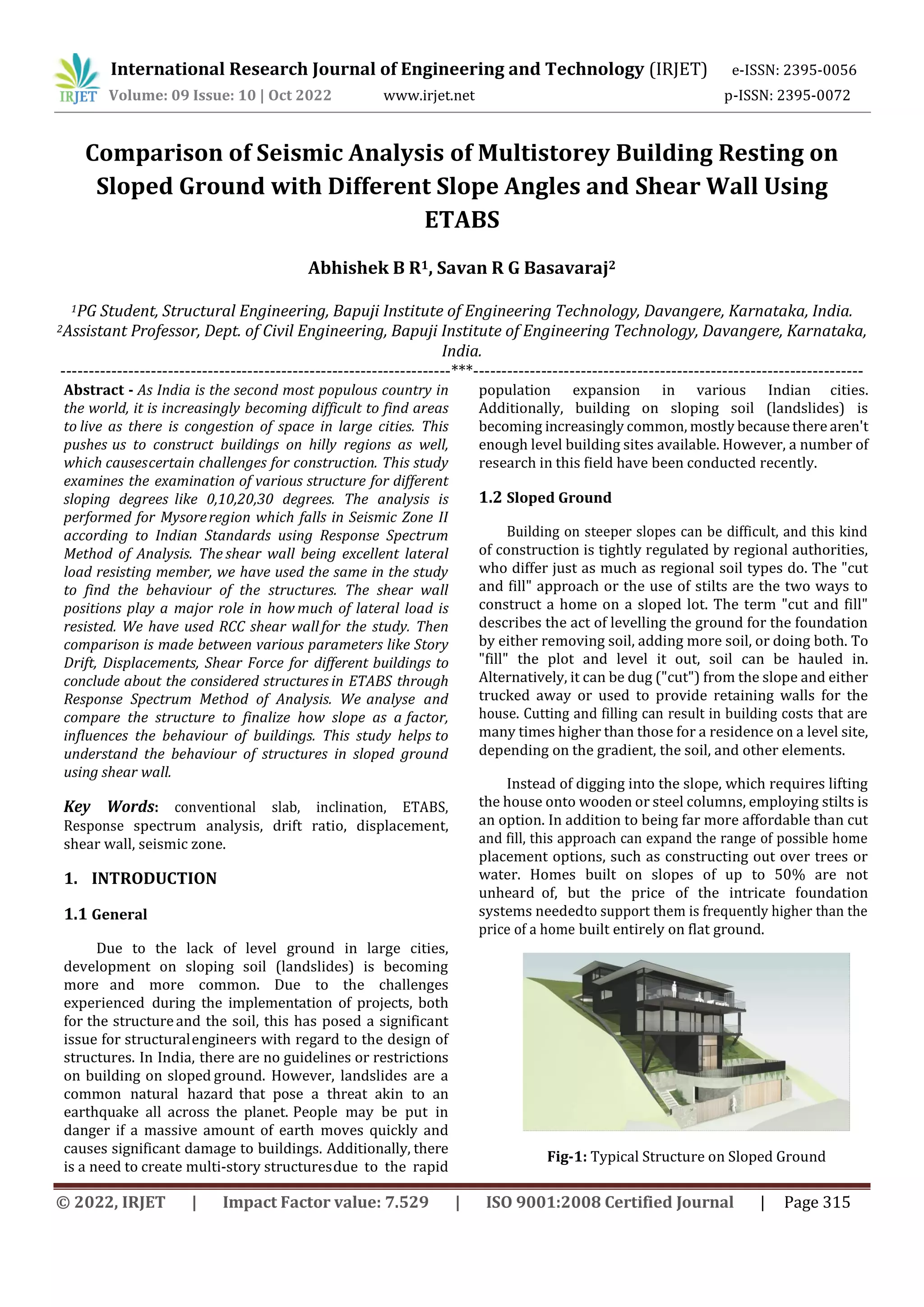
Fig-1: Typical Structure on Sloped Ground
International Research Journal of Engineering and Technology (IRJET) e-ISSN: 2395-0056
Volume: 09 Issue: 10 | Oct 2022 www.irjet.net p-ISSN: 2395-0072
© 2022, IRJET | Impact Factor value: 7.529 | ISO 9001:2008 Certified Journal | Page 316
1.3 Shear Wall
Shear walls play a crucial role in huge, high-rise, or
structures located in seismically active or windy regions.
In most cases, concrete or masonry are used to build
shear walls. Steel braced frames, which can be very
successful at resolving lateral forces but may be more
expensive, can alsoresist shear forces. Shear walls can be
put in place around the outside of buildings, or they can
form a shear core, which is a group of shear walls that is
usually located in the middle of a building and encloses a
stairway or lift shaft. Because the shear wall functions as
one element, lateral pressures often cause rotating forces
that produce compression forces at one corner and tension
forces at the opposite. This "couple" reverses when the
lateral force is applied from the opposingdirection, so both
sides of the shear wall must be able to handle both sorts
of forces.
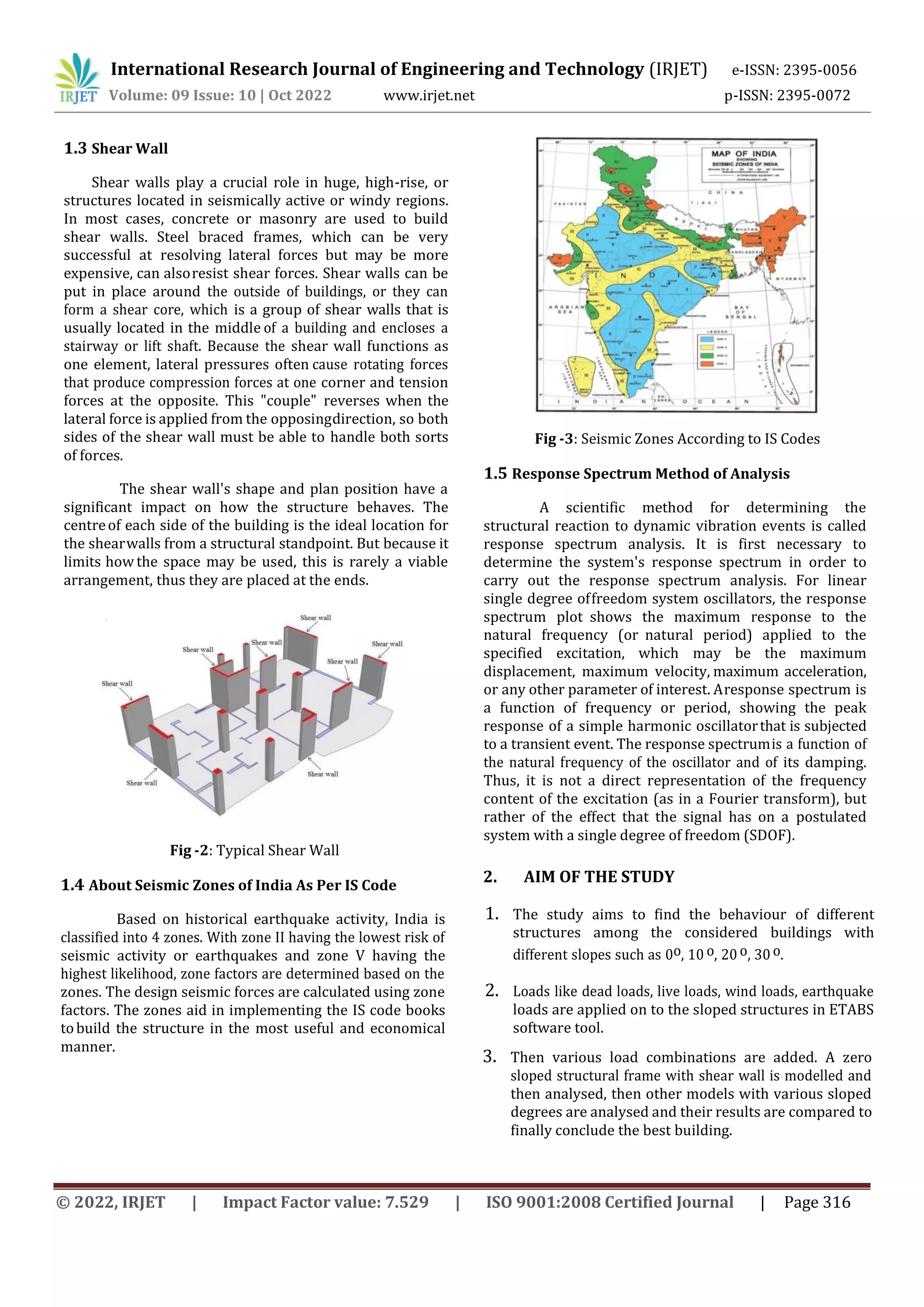
The shear wall's shape and plan position have a
significant impact on how the structure behaves. The
centreof each side of the building is the ideal location for
the shearwalls from a structural standpoint. But because it
limits how the space may be used, this is rarely a viable
arrangement, thus they are placed at the ends.
Fig -2: Typical Shear Wall
1.4 About Seismic Zones of India As Per IS Code
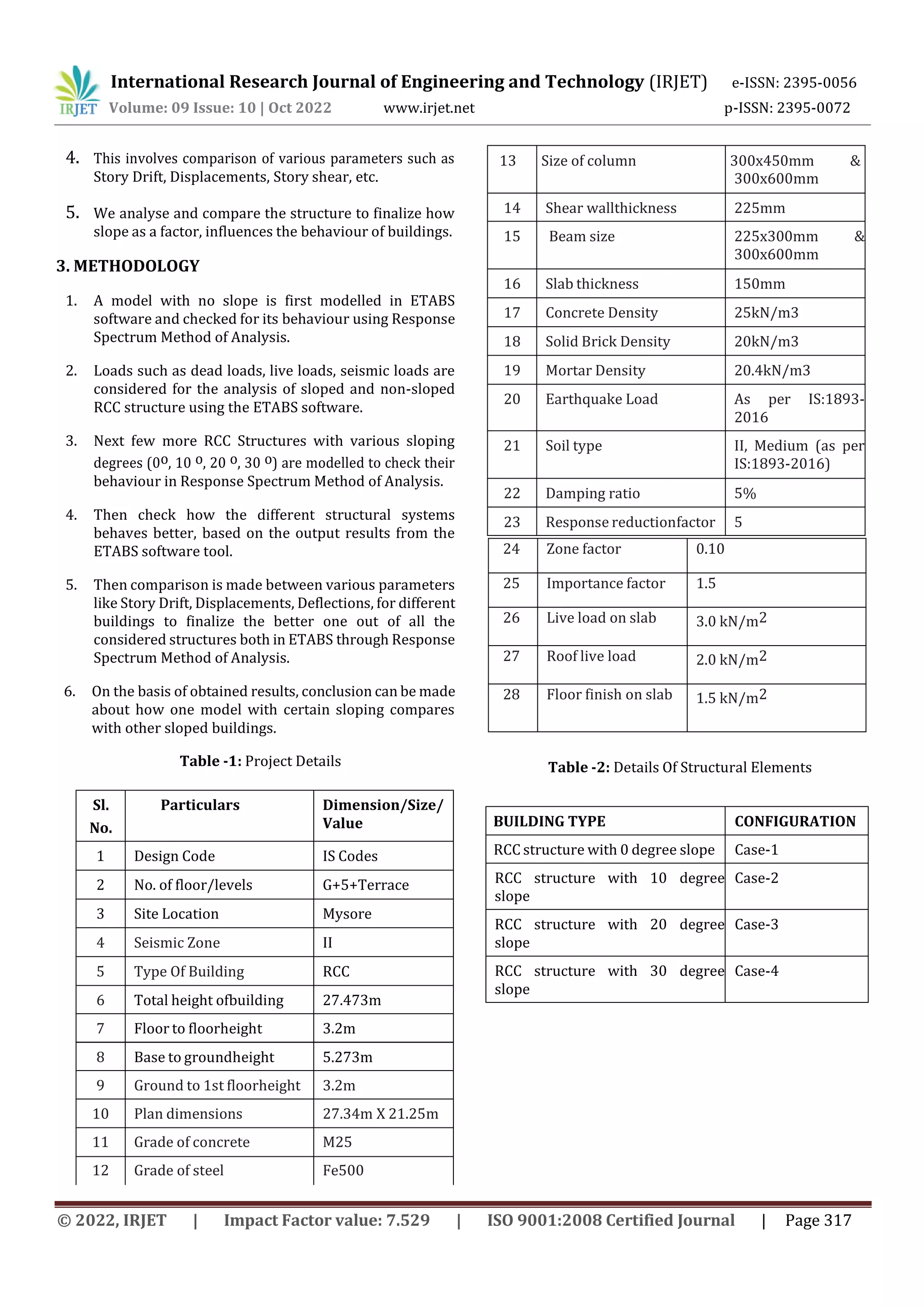
Based on historical earthquake activity, India is
classified into 4 zones. With zone II having the lowest risk of
seismic activity or earthquakes and zone V having the
highest likelihood, zone factors are determined based on the
zones. The design seismic forces are calculated using zone
factors. The zones aid in implementing the IS code books
tobuild the structure in the most useful and economical
manner.
Fig -3: Seismic Zones According to IS Codes
1.5 Response Spectrum Method of Analysis
A scientific method for determining the
structural reaction to dynamic vibration events is called
response spectrum analysis. It is first necessary to
determine the system's response spectrum in order to
carry out the response spectrum analysis. For linear
single degree offreedom system oscillators, the response
spectrum plot shows the maximum response to the
natural frequency (or natural period) applied to the
specified excitation, which may be the maximum
displacement, maximum velocity, maximum acceleration,
or any other parameter of interest. Aresponse spectrum is
a function of frequency or period, showing the peak
response of a simple harmonic oscillatorthat is subjected
to a transient event. The response spectrumis a function of
the natural frequency of the oscillator and of its damping.
Thus, it is not a direct representation of the frequency
content of the excitation (as in a Fourier transform), but
rather of the effect that the signal has on a postulated
system with a single degree of freedom (SDOF).
2. AIM OF THE STUDY
1. The study aims to find the behaviour of different
structures among the considered buildings with
different slopes such as 0o, 10 o, 20 o, 30 o.
2. Loads like dead loads, live loads, wind loads, earthquake
loads are applied on to the sloped structures in ETABS
software tool.
3. Then various load combinations are added. A zero
sloped structural frame with shear wall is modelled and
then analysed, then other models with various sloped
degrees are analysed and their results are compared to
finally conclude the best building.
International Research Journal of Engineering and Technology (IRJET) e-ISSN: 2395-0056
Volume: 09 Issue: 10 | Oct 2022 www.irjet.net p-ISSN: 2395-0072
© 2022, IRJET | Impact Factor value: 7.529 | ISO 9001:2008 Certified Journal | Page 317
4. This involves comparison of various parameters such as
Story Drift, Displacements, Story shear, etc.
5. We analyse and compare the structure to finalize how
slope as a factor, influences the behaviour of buildings.
3. METHODOLOGY
1. A model with no slope is first modelled in ETABS
software and checked for its behaviour using Response
Spectrum Method of Analysis.
2. Loads such as dead loads, live loads, seismic loads are
considered for the analysis of sloped and non-sloped
RCC structure using the ETABS software.
3. Next few more RCC Structures with various sloping
degrees (0o, 10 o, 20 o, 30 o) are modelled to check their
behaviour in Response Spectrum Method of Analysis.
4. Then check how the different structural systems
behaves better, based on the output results from the
ETABS software tool.
5. Then comparison is made between various parameters
like Story Drift, Displacements, Deflections, for different
buildings to finalize the better one out of all the
considered structures both in ETABS through Response
Spectrum Method of Analysis.
6. On the basis of obtained results, conclusion can be made
about how one model with certain sloping compares
with other sloped buildings.
Table -1: Project Details
300x600mm
14 Shear wallthickness 225mm
15 Beam size 225x300mm &
300x600mm
16 Slab thickness 150mm
17 Concrete Density 25kN/m3
18 Solid Brick Density 20kN/m3
19 Mortar Density 20.4kN/m3
20 Earthquake Load As per IS:1893-
2016
21 Soil type II, Medium (as per
IS:1893-2016)
22 Damping ratio 5%
23 Response reductionfactor 5
Sl.
No.
Particulars Dimension/Size/
Value
1 Design Code IS Codes
2 No. of floor/levels G+5+Terrace
3 Site Location Mysore
4 Seismic Zone II
5 Type Of Building RCC
6 Total height ofbuilding 27.473m
7 Floor to floorheight 3.2m
8 Base to groundheight 5.273m
9 Ground to 1st floorheight 3.2m
10 Plan dimensions 27.34m X 21.25m
11 Grade of concrete M25
12 Grade of steel Fe500
13 Size of column 300x450mm &
24 Zone factor 0.10
25 Importance factor 1.5
26 Live load on slab 3.0 kN/m2
27 Roof live load 2.0 kN/m2
28 Floor finish on slab 1.5 kN/m2
Table -2: Details Of Structural Elements
BUILDING TYPE CONFIGURATION
RCC structure with 0 degree slope Case-1
RCC structure with 10 degree
RCC structure with 20 degree
slope
Case-3
RCC structure with 30 degree
slope
Case-4
Case-2
slope
International Research Journal of Engineering and Technology (IRJET) e-ISSN: 2395-0056
Volume: 09 Issue: 10 | Oct 2022 www.irjet.net p-ISSN: 2395-0072
© 2022, IRJET | Impact Factor value: 7.529 | ISO 9001:2008 Certified Journal | Page 318
Fig -4: Architectural Plan of the Structure for all different
sloped grounds
Fig -5: Structure with 0 degree slope
Fig -6: Structure with 10 degree slope
Fig -7: Structure with 20 degree slope
Fig -8: Structure with 30 degree slope
4. RESULTS COMPARISON OF ALL CASES
4.1 Storey Displacement
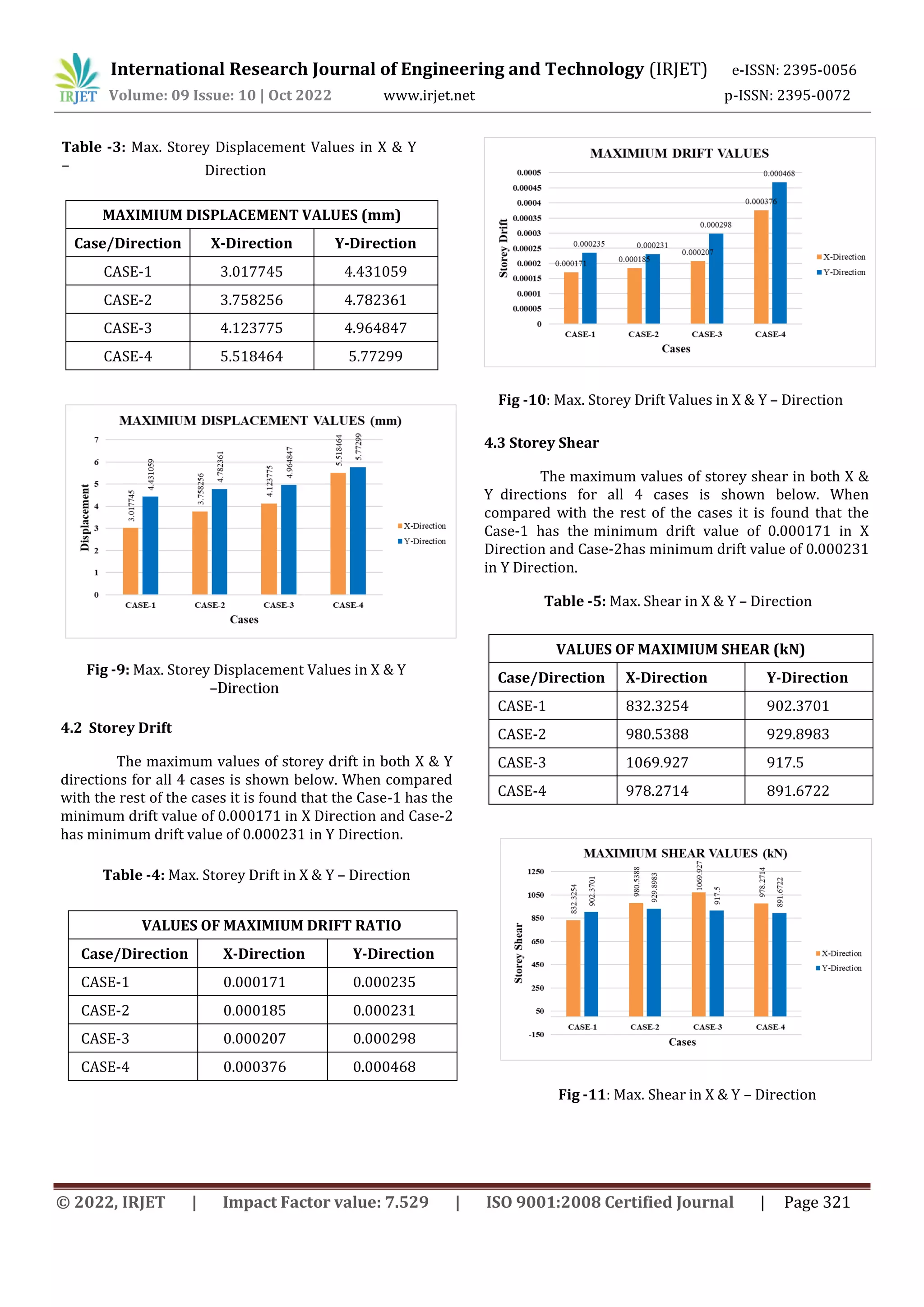
The maximum values of storey displacement in both
X & Y directions for all 4 cases is shown below.
Whencompared with the rest of the cases it is found
that the Case- 1 has the minimum displacement values.
3.017745mm & 4.431059mm in X & Y – Directions are
the values of Case-1.
International Research Journal of Engineering and Technology (IRJET) e-ISSN: 2395-0056
Volume: 09 Issue: 10 | Oct 2022 www.irjet.net p-ISSN: 2395-0072
© 2022, IRJET | Impact Factor value: 7.529 | ISO 9001:2008 Certified Journal | Page 321
MAXIMIUM DISPLACEMENT VALUES (mm)
Case/Direction X-Direction Y-Direction
CASE-1 3.017745 4.431059
CASE-2 3.758256 4.782361
CASE-3 4.123775 4.964847
CASE-4 5.518464 5.77299
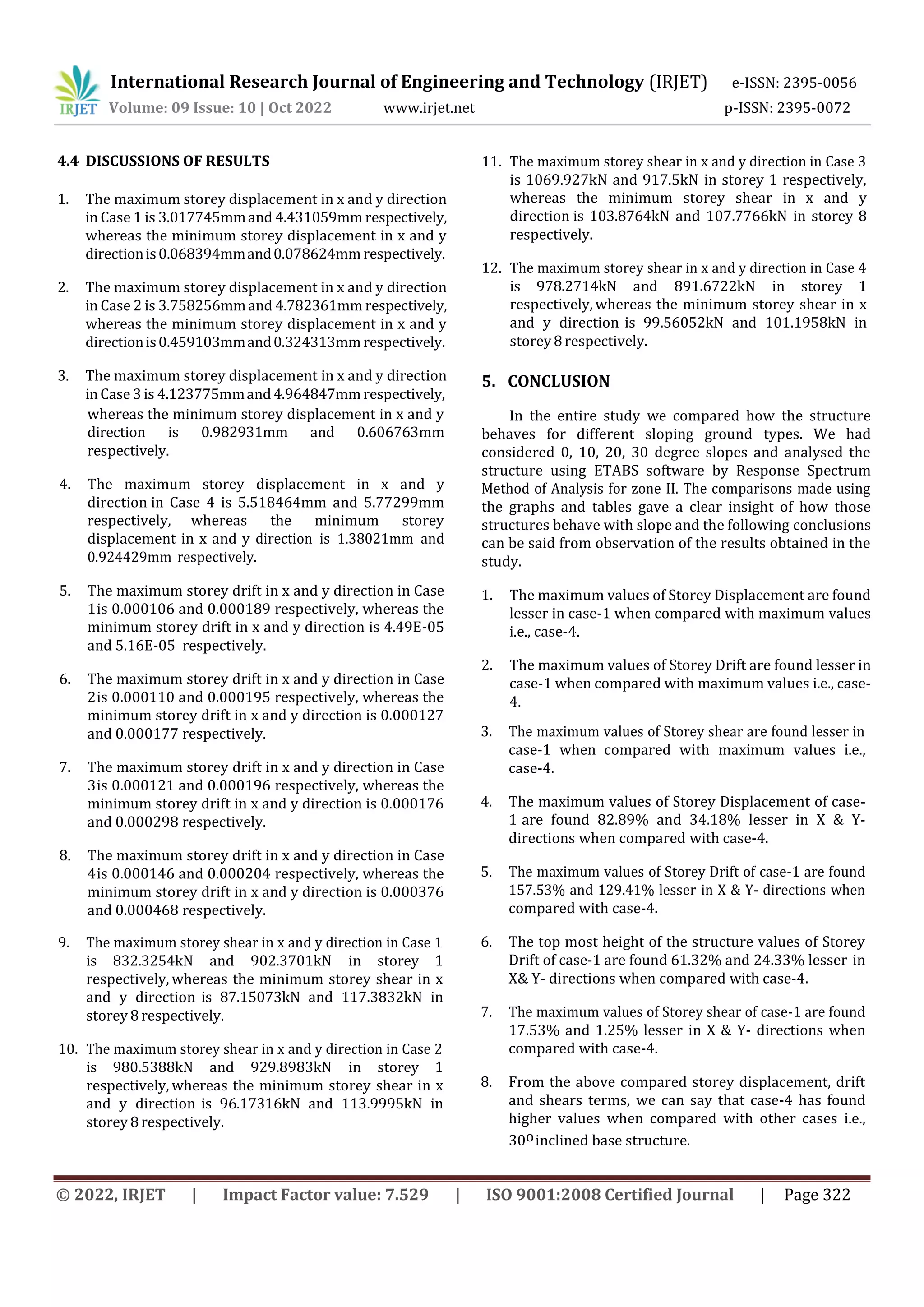
The maximum values of storey drift in both X & Y
directions for all 4 cases is shown below. When compared
with the rest of the cases it is found that the Case-1 has the
minimum drift value of 0.000171 in X Direction and Case-2
has minimum drift value of 0.000231 in Y Direction.
Table -4: Max. Storey Drift in X & Y – Direction
VALUES OF MAXIMIUM DRIFT RATIO
Case/Direction X-Direction Y-Direction
CASE-1 0.000171 0.000235
CASE-2 0.000185 0.000231
CASE-3 0.000207 0.000298
CASE-4 0.000376 0.000468
Direction
Table -3: Max. Storey Displacement Values in X & Y
–
4.2 Storey Drift
Fig -9: Max. Storey Displacement Values in X & Y
–Direction
Fig -10: Max. Storey Drift Values in X & Y – Direction
4.3 Storey Shear
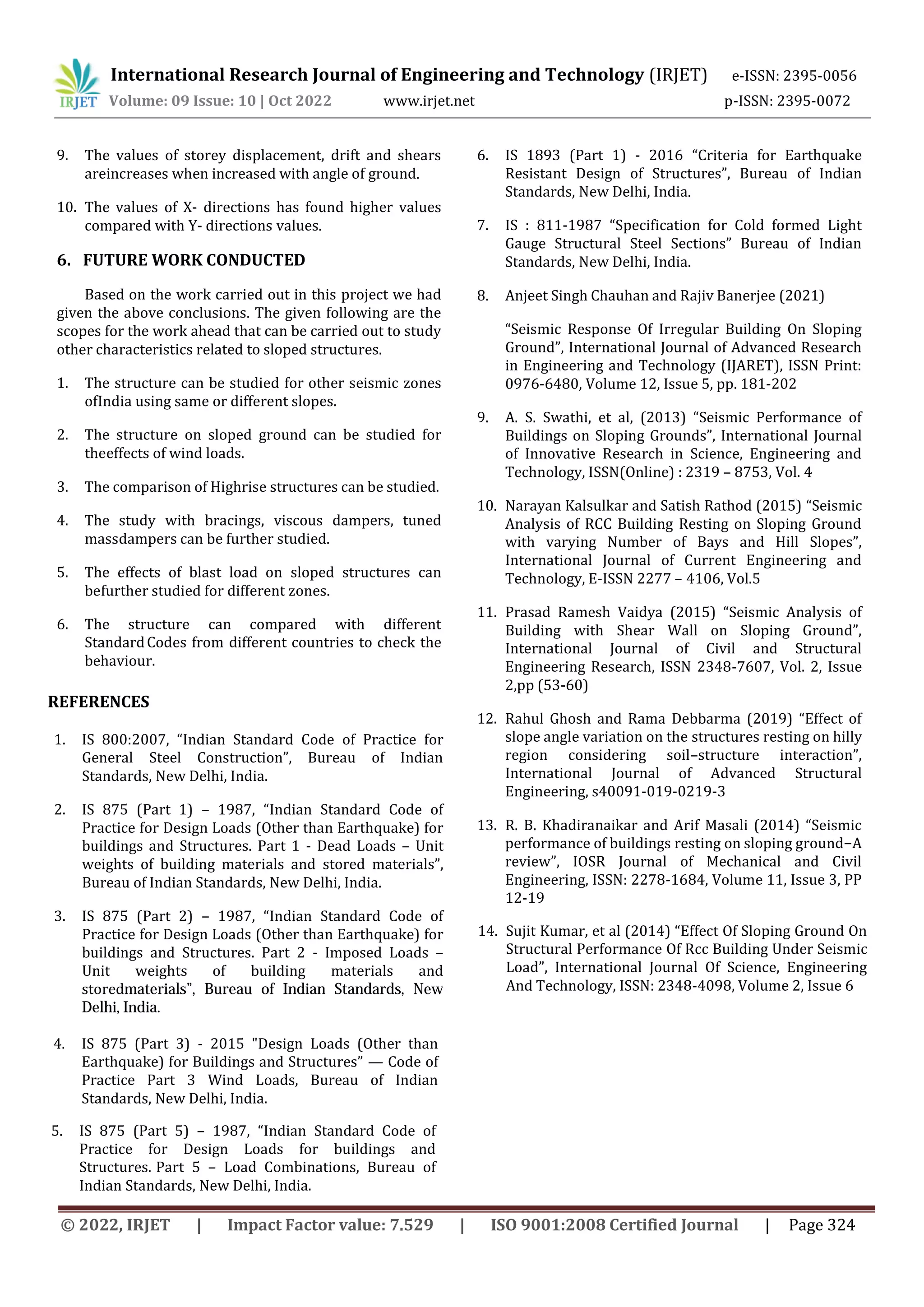
The maximum values of storey shear in both X &
Y directions for all 4 cases is shown below. When
compared with the rest of the cases it is found that the
Case-1 has the minimum drift value of 0.000171 in X
Direction and Case-2has minimum drift value of 0.000231
in Y Direction.
Table -5: Max. Shear in X & Y – Direction
VALUES OF MAXIMIUM SHEAR (kN)
Case/Direction X-Direction Y-Direction
CASE-1 832.3254 902.3701
CASE-2 980.5388 929.8983
CASE-3 1069.927 917.5
CASE-4 978.2714 891.6722
Fig -11: Max. Shear in X & Y – Direction
International Research Journal of Engineering and Technology (IRJET) e-ISSN: 2395-0056
Volume: 09 Issue: 10 | Oct 2022 www.irjet.net p-ISSN: 2395-0072
© 2022, IRJET | Impact Factor value: 7.529 | ISO 9001:2008 Certified Journal | Page 322
4.4 DISCUSSIONS OF RESULTS
1. The maximum storey displacement in x and y direction
in Case 1 is 3.017745mmand 4.431059mm respectively,
whereas the minimum storey displacement in x and y
directionis0.068394mmand0.078624mmrespectively.
2. The maximum storey displacement in x and y direction
in Case 2 is 3.758256mmand 4.782361mm respectively,
whereas the minimum storey displacement in x and y
directionis0.459103mmand0.324313mmrespectively.
3. The maximum storey displacement in x and y direction
inCase 3 is 4.123775mmand4.964847mmrespectively,
whereas the minimum storey displacement in x and y
direction is 0.982931mm and 0.606763mm
respectively.
4. The maximum storey displacement in x and y
direction in Case 4 is 5.518464mm and 5.77299mm
respectively, whereas the minimum storey
displacement in x and y direction is 1.38021mm and
0.924429mm respectively.
5. The maximum storey drift in x and y direction in Case
1is 0.000106 and 0.000189 respectively, whereas the
minimum storey drift in x and y direction is 4.49E-05
and 5.16E-05 respectively.
6. The maximum storey drift in x and y direction in Case
2is 0.000110 and 0.000195 respectively, whereas the
minimum storey drift in x and y direction is 0.000127
and 0.000177 respectively.
7. The maximum storey drift in x and y direction in Case
3is 0.000121 and 0.000196 respectively, whereas the
minimum storey drift in x and y direction is 0.000176
and 0.000298 respectively.
8. The maximum storey drift in x and y direction in Case
4is 0.000146 and 0.000204 respectively, whereas the
minimum storey drift in x and y direction is 0.000376
and 0.000468 respectively.
9. The maximum storey shear in x and y direction in Case 1
is 832.3254kN and 902.3701kN in storey 1
respectively, whereas the minimum storey shear in x
and y direction is 87.15073kN and 117.3832kN in
storey 8respectively.
10. The maximum storey shear in x and y direction in Case 2
is 980.5388kN and 929.8983kN in storey 1
respectively, whereas the minimum storey shear in x
and y direction is 96.17316kN and 113.9995kN in
storey 8respectively.
11. The maximum storey shear in x and y direction in Case 3
is 1069.927kN and 917.5kN in storey 1 respectively,
whereas the minimum storey shear in x and y
direction is 103.8764kN and 107.7766kN in storey 8
respectively.
12. The maximum storey shear in x and y direction in Case 4
is 978.2714kN and 891.6722kN in storey 1
respectively, whereas the minimum storey shear in x
and y direction is 99.56052kN and 101.1958kN in
storey8respectively.
5. CONCLUSION
In the entire study we compared how the structure
behaves for different sloping ground types. We had
considered 0, 10, 20, 30 degree slopes and analysed the
structure using ETABS software by Response Spectrum
Method of Analysis for zone II. The comparisons made using
the graphs and tables gave a clear insight of how those
structures behave with slope and the following conclusions
can be said from observation of the results obtained in the
study.
1. The maximum values of Storey Displacement are found
lesser in case-1 when compared with maximum values
i.e., case-4.
2. The maximum values of Storey Drift are found lesser in
case-1 when compared with maximum values i.e., case-
4.
3. The maximum values of Storey shear are found lesser in
case-1 when compared with maximum values i.e.,
case-4.
4. The maximum values of Storey Displacement of case-
1 are found 82.89% and 34.18% lesser in X & Y-
directions when compared with case-4.
5. The maximum values of Storey Drift of case-1 are found
157.53% and 129.41% lesser in X & Y- directions when
compared with case-4.
6. The top most height of the structure values of Storey
Drift of case-1 are found 61.32% and 24.33% lesser in
X& Y- directions when compared with case-4.
7. The maximum values of Storey shear of case-1 are found
17.53% and 1.25% lesser in X & Y- directions when
compared with case-4.
8. From the above compared storey displacement, drift
and shears terms, we can say that case-4 has found
higher values when compared with other cases i.e.,
30oinclined base structure.
International Research Journal of Engineering and Technology (IRJET) e-ISSN: 2395-0056
Volume: 09 Issue: 10 | Oct 2022 www.irjet.net p-ISSN: 2395-0072
© 2022, IRJET | Impact Factor value: 7.529 | ISO 9001:2008 Certified Journal | Page 324
9. The values of storey displacement, drift and shears
areincreases when increased with angle of ground.
10. The values of X- directions has found higher values
compared with Y- directions values.
6. FUTURE WORK CONDUCTED
Based on the work carried out in this project we had
given the above conclusions. The given following are the
scopes for the work ahead that can be carried out to study
other characteristics related to sloped structures.
1. The structure can be studied for other seismic zones
ofIndia using same or different slopes.
2. The structure on sloped ground can be studied for
theeffects of wind loads.
3. The comparison of Highrise structures can be studied.
4. The study with bracings, viscous dampers, tuned
massdampers can be further studied.
5. The effects of blast load on sloped structures can
befurther studied for different zones.
6. The structure can compared with different
StandardCodes from different countries to check the
behaviour.
REFERENCES
1. IS 800:2007, “Indian Standard Code of Practice for
General Steel Construction”, Bureau of Indian
Standards, New Delhi, India.
2. IS 875 (Part 1) – 1987, “Indian Standard Code of
Practice for Design Loads (Other than Earthquake) for
buildings and Structures. Part 1 - Dead Loads – Unit
weights of building materials and stored materials”,
Bureau of Indian Standards, New Delhi, India.
3. IS 875 (Part 2) – 1987, “Indian Standard Code of
Practice for Design Loads (Other than Earthquake) for
buildings and Structures. Part 2 - Imposed Loads –
Unit weights of building materials and
storedmaterials”, Bureau of Indian Standards, New
Delhi, India.
4. IS 875 (Part 3) - 2015 "Design Loads (Other than
Earthquake) for Buildings and Structures” — Code of
Practice Part 3 Wind Loads, Bureau of Indian
Standards, New Delhi, India.
5. IS 875 (Part 5) – 1987, “Indian Standard Code of
Practice for Design Loads for buildings and
Structures. Part 5 – Load Combinations, Bureau of
Indian Standards, New Delhi, India.
6. IS 1893 (Part 1) - 2016 “Criteria for Earthquake
Resistant Design of Structures”, Bureau of Indian
Standards, New Delhi, India.
7. IS : 811-1987 “Specification for Cold formed Light
Gauge Structural Steel Sections” Bureau of Indian
Standards, New Delhi, India.
8. Anjeet Singh Chauhan and Rajiv Banerjee (2021)
“Seismic Response Of Irregular Building On Sloping
Ground”, International Journal of Advanced Research
in Engineering and Technology (IJARET), ISSN Print:
0976-6480, Volume 12, Issue 5, pp. 181-202
9. A. S. Swathi, et al, (2013) “Seismic Performance of
Buildings on Sloping Grounds”, International Journal
of Innovative Research in Science, Engineering and
Technology, ISSN(Online) : 2319 – 8753, Vol. 4
10. Narayan Kalsulkar and Satish Rathod (2015) “Seismic
Analysis of RCC Building Resting on Sloping Ground
with varying Number of Bays and Hill Slopes”,
International Journal of Current Engineering and
Technology, E-ISSN 2277 – 4106, Vol.5
11. Prasad Ramesh Vaidya (2015) “Seismic Analysis of
Building with Shear Wall on Sloping Ground”,
International Journal of Civil and Structural
Engineering Research, ISSN 2348-7607, Vol. 2, Issue
2,pp (53-60)
12. Rahul Ghosh and Rama Debbarma (2019) “Effect of
slope angle variation on the structures resting on hilly
region considering soil–structure interaction”,
International Journal of Advanced Structural
Engineering, s40091-019-0219-3
13. R. B. Khadiranaikar and Arif Masali (2014) “Seismic
performance of buildings resting on sloping ground−A
review”, IOSR Journal of Mechanical and Civil
Engineering, ISSN: 2278-1684, Volume 11, Issue 3, PP
12-19
14. Sujit Kumar, et al (2014) “Effect Of Sloping Ground On
Structural Performance Of Rcc Building Under Seismic
Load”, International Journal Of Science, Engineering
And Technology, ISSN: 2348-4098, Volume 2, Issue 6

Comparison of Seismic Analysis of Multistorey Building Resting on Sloped Ground with Different Slope Angles and Shear Wall Using ETABS

  • 1.
    International Research Journalof Engineering and Technology (IRJET) e-ISSN: 2395-0056 Volume: 09 Issue: 10 | Oct 2022 www.irjet.net p-ISSN: 2395-0072 © 2022, IRJET | Impact Factor value: 7.529 | ISO 9001:2008 Certified Journal | Page 315 Comparison of Seismic Analysis of Multistorey Building Resting on Sloped Ground with Different Slope Angles and Shear Wall Using ETABS Abhishek B R1, Savan R G Basavaraj2 1PG Student, Structural Engineering, Bapuji Institute of Engineering Technology, Davangere, Karnataka, India. 2Assistant Professor, Dept. of Civil Engineering, Bapuji Institute of Engineering Technology, Davangere, Karnataka, India. ---------------------------------------------------------------------***--------------------------------------------------------------------- Abstract - As India is the second most populous country in the world, it is increasingly becoming difficult to find areas to live as there is congestion of space in large cities. This pushes us to construct buildings on hilly regions as well, which causescertain challenges for construction. This study examines the examination of various structure for different sloping degrees like 0,10,20,30 degrees. The analysis is performed for Mysoreregion which falls in Seismic Zone II according to Indian Standards using Response Spectrum Method of Analysis. The shear wall being excellent lateral load resisting member, we have used the same in the study to find the behaviour of the structures. The shear wall positions play a major role in how much of lateral load is resisted. We have used RCC shear wall for the study. Then comparison is made between various parameters like Story Drift, Displacements, Shear Force for different buildings to conclude about the considered structures in ETABS through Response Spectrum Method of Analysis. We analyse and compare the structure to finalize how slope as a factor, influences the behaviour of buildings. This study helps to understand the behaviour of structures in sloped ground using shear wall. Key Words: conventional slab, inclination, ETABS, Response spectrum analysis, drift ratio, displacement, shear wall, seismic zone. 1. INTRODUCTION 1.1 General Due to the lack of level ground in large cities, development on sloping soil (landslides) is becoming more and more common. Due to the challenges experienced during the implementation of projects, both for the structureand the soil, this has posed a significant issue for structuralengineers with regard to the design of structures. In India, there are no guidelines or restrictions on building on sloped ground. However, landslides are a common natural hazard that pose a threat akin to an earthquake all across the planet. People may be put in danger if a massive amount of earth moves quickly and causes significant damage to buildings. Additionally, there is a need to create multi-story structuresdue to the rapid population expansion in various Indian cities. Additionally, building on sloping soil (landslides) is becoming increasingly common, mostly because there aren't enough level building sites available. However, a number of research in this field have been conducted recently. 1.2 Sloped Ground Building on steeper slopes can be difficult, and this kind of construction is tightly regulated by regional authorities, who differ just as much as regional soil types do. The "cut and fill" approach or the use of stilts are the two ways to construct a home on a sloped lot. The term "cut and fill" describes the act of levelling the ground for the foundation by either removing soil, adding more soil, or doing both. To "fill" the plot and level it out, soil can be hauled in. Alternatively, it can be dug ("cut") from the slope and either trucked away or used to provide retaining walls for the house. Cutting and filling can result in building costs that are many times higher than those for a residence on a level site, depending on the gradient, the soil, and other elements. Instead of digging into the slope, which requires lifting the house onto wooden or steel columns, employing stilts is an option. In addition to being far more affordable than cut and fill, this approach can expand the range of possible home placement options, such as constructing out over trees or water. Homes built on slopes of up to 50% are not unheard of, but the price of the intricate foundation systems neededto support them is frequently higher than the price of a home built entirely on flat ground. Fig-1: Typical Structure on Sloped Ground
  • 2.
    International Research Journalof Engineering and Technology (IRJET) e-ISSN: 2395-0056 Volume: 09 Issue: 10 | Oct 2022 www.irjet.net p-ISSN: 2395-0072 © 2022, IRJET | Impact Factor value: 7.529 | ISO 9001:2008 Certified Journal | Page 316 1.3 Shear Wall Shear walls play a crucial role in huge, high-rise, or structures located in seismically active or windy regions. In most cases, concrete or masonry are used to build shear walls. Steel braced frames, which can be very successful at resolving lateral forces but may be more expensive, can alsoresist shear forces. Shear walls can be put in place around the outside of buildings, or they can form a shear core, which is a group of shear walls that is usually located in the middle of a building and encloses a stairway or lift shaft. Because the shear wall functions as one element, lateral pressures often cause rotating forces that produce compression forces at one corner and tension forces at the opposite. This "couple" reverses when the lateral force is applied from the opposingdirection, so both sides of the shear wall must be able to handle both sorts of forces. The shear wall's shape and plan position have a significant impact on how the structure behaves. The centreof each side of the building is the ideal location for the shearwalls from a structural standpoint. But because it limits how the space may be used, this is rarely a viable arrangement, thus they are placed at the ends. Fig -2: Typical Shear Wall 1.4 About Seismic Zones of India As Per IS Code Based on historical earthquake activity, India is classified into 4 zones. With zone II having the lowest risk of seismic activity or earthquakes and zone V having the highest likelihood, zone factors are determined based on the zones. The design seismic forces are calculated using zone factors. The zones aid in implementing the IS code books tobuild the structure in the most useful and economical manner. Fig -3: Seismic Zones According to IS Codes 1.5 Response Spectrum Method of Analysis A scientific method for determining the structural reaction to dynamic vibration events is called response spectrum analysis. It is first necessary to determine the system's response spectrum in order to carry out the response spectrum analysis. For linear single degree offreedom system oscillators, the response spectrum plot shows the maximum response to the natural frequency (or natural period) applied to the specified excitation, which may be the maximum displacement, maximum velocity, maximum acceleration, or any other parameter of interest. Aresponse spectrum is a function of frequency or period, showing the peak response of a simple harmonic oscillatorthat is subjected to a transient event. The response spectrumis a function of the natural frequency of the oscillator and of its damping. Thus, it is not a direct representation of the frequency content of the excitation (as in a Fourier transform), but rather of the effect that the signal has on a postulated system with a single degree of freedom (SDOF). 2. AIM OF THE STUDY 1. The study aims to find the behaviour of different structures among the considered buildings with different slopes such as 0o, 10 o, 20 o, 30 o. 2. Loads like dead loads, live loads, wind loads, earthquake loads are applied on to the sloped structures in ETABS software tool. 3. Then various load combinations are added. A zero sloped structural frame with shear wall is modelled and then analysed, then other models with various sloped degrees are analysed and their results are compared to finally conclude the best building.
  • 3.
    International Research Journalof Engineering and Technology (IRJET) e-ISSN: 2395-0056 Volume: 09 Issue: 10 | Oct 2022 www.irjet.net p-ISSN: 2395-0072 © 2022, IRJET | Impact Factor value: 7.529 | ISO 9001:2008 Certified Journal | Page 317 4. This involves comparison of various parameters such as Story Drift, Displacements, Story shear, etc. 5. We analyse and compare the structure to finalize how slope as a factor, influences the behaviour of buildings. 3. METHODOLOGY 1. A model with no slope is first modelled in ETABS software and checked for its behaviour using Response Spectrum Method of Analysis. 2. Loads such as dead loads, live loads, seismic loads are considered for the analysis of sloped and non-sloped RCC structure using the ETABS software. 3. Next few more RCC Structures with various sloping degrees (0o, 10 o, 20 o, 30 o) are modelled to check their behaviour in Response Spectrum Method of Analysis. 4. Then check how the different structural systems behaves better, based on the output results from the ETABS software tool. 5. Then comparison is made between various parameters like Story Drift, Displacements, Deflections, for different buildings to finalize the better one out of all the considered structures both in ETABS through Response Spectrum Method of Analysis. 6. On the basis of obtained results, conclusion can be made about how one model with certain sloping compares with other sloped buildings. Table -1: Project Details 300x600mm 14 Shear wallthickness 225mm 15 Beam size 225x300mm & 300x600mm 16 Slab thickness 150mm 17 Concrete Density 25kN/m3 18 Solid Brick Density 20kN/m3 19 Mortar Density 20.4kN/m3 20 Earthquake Load As per IS:1893- 2016 21 Soil type II, Medium (as per IS:1893-2016) 22 Damping ratio 5% 23 Response reductionfactor 5 Sl. No. Particulars Dimension/Size/ Value 1 Design Code IS Codes 2 No. of floor/levels G+5+Terrace 3 Site Location Mysore 4 Seismic Zone II 5 Type Of Building RCC 6 Total height ofbuilding 27.473m 7 Floor to floorheight 3.2m 8 Base to groundheight 5.273m 9 Ground to 1st floorheight 3.2m 10 Plan dimensions 27.34m X 21.25m 11 Grade of concrete M25 12 Grade of steel Fe500 13 Size of column 300x450mm & 24 Zone factor 0.10 25 Importance factor 1.5 26 Live load on slab 3.0 kN/m2 27 Roof live load 2.0 kN/m2 28 Floor finish on slab 1.5 kN/m2 Table -2: Details Of Structural Elements BUILDING TYPE CONFIGURATION RCC structure with 0 degree slope Case-1 RCC structure with 10 degree RCC structure with 20 degree slope Case-3 RCC structure with 30 degree slope Case-4 Case-2 slope
  • 4.
    International Research Journalof Engineering and Technology (IRJET) e-ISSN: 2395-0056 Volume: 09 Issue: 10 | Oct 2022 www.irjet.net p-ISSN: 2395-0072 © 2022, IRJET | Impact Factor value: 7.529 | ISO 9001:2008 Certified Journal | Page 318 Fig -4: Architectural Plan of the Structure for all different sloped grounds Fig -5: Structure with 0 degree slope Fig -6: Structure with 10 degree slope Fig -7: Structure with 20 degree slope Fig -8: Structure with 30 degree slope 4. RESULTS COMPARISON OF ALL CASES 4.1 Storey Displacement The maximum values of storey displacement in both X & Y directions for all 4 cases is shown below. Whencompared with the rest of the cases it is found that the Case- 1 has the minimum displacement values. 3.017745mm & 4.431059mm in X & Y – Directions are the values of Case-1.
  • 5.
    International Research Journalof Engineering and Technology (IRJET) e-ISSN: 2395-0056 Volume: 09 Issue: 10 | Oct 2022 www.irjet.net p-ISSN: 2395-0072 © 2022, IRJET | Impact Factor value: 7.529 | ISO 9001:2008 Certified Journal | Page 321 MAXIMIUM DISPLACEMENT VALUES (mm) Case/Direction X-Direction Y-Direction CASE-1 3.017745 4.431059 CASE-2 3.758256 4.782361 CASE-3 4.123775 4.964847 CASE-4 5.518464 5.77299 The maximum values of storey drift in both X & Y directions for all 4 cases is shown below. When compared with the rest of the cases it is found that the Case-1 has the minimum drift value of 0.000171 in X Direction and Case-2 has minimum drift value of 0.000231 in Y Direction. Table -4: Max. Storey Drift in X & Y – Direction VALUES OF MAXIMIUM DRIFT RATIO Case/Direction X-Direction Y-Direction CASE-1 0.000171 0.000235 CASE-2 0.000185 0.000231 CASE-3 0.000207 0.000298 CASE-4 0.000376 0.000468 Direction Table -3: Max. Storey Displacement Values in X & Y – 4.2 Storey Drift Fig -9: Max. Storey Displacement Values in X & Y –Direction Fig -10: Max. Storey Drift Values in X & Y – Direction 4.3 Storey Shear The maximum values of storey shear in both X & Y directions for all 4 cases is shown below. When compared with the rest of the cases it is found that the Case-1 has the minimum drift value of 0.000171 in X Direction and Case-2has minimum drift value of 0.000231 in Y Direction. Table -5: Max. Shear in X & Y – Direction VALUES OF MAXIMIUM SHEAR (kN) Case/Direction X-Direction Y-Direction CASE-1 832.3254 902.3701 CASE-2 980.5388 929.8983 CASE-3 1069.927 917.5 CASE-4 978.2714 891.6722 Fig -11: Max. Shear in X & Y – Direction
  • 6.
    International Research Journalof Engineering and Technology (IRJET) e-ISSN: 2395-0056 Volume: 09 Issue: 10 | Oct 2022 www.irjet.net p-ISSN: 2395-0072 © 2022, IRJET | Impact Factor value: 7.529 | ISO 9001:2008 Certified Journal | Page 322 4.4 DISCUSSIONS OF RESULTS 1. The maximum storey displacement in x and y direction in Case 1 is 3.017745mmand 4.431059mm respectively, whereas the minimum storey displacement in x and y directionis0.068394mmand0.078624mmrespectively. 2. The maximum storey displacement in x and y direction in Case 2 is 3.758256mmand 4.782361mm respectively, whereas the minimum storey displacement in x and y directionis0.459103mmand0.324313mmrespectively. 3. The maximum storey displacement in x and y direction inCase 3 is 4.123775mmand4.964847mmrespectively, whereas the minimum storey displacement in x and y direction is 0.982931mm and 0.606763mm respectively. 4. The maximum storey displacement in x and y direction in Case 4 is 5.518464mm and 5.77299mm respectively, whereas the minimum storey displacement in x and y direction is 1.38021mm and 0.924429mm respectively. 5. The maximum storey drift in x and y direction in Case 1is 0.000106 and 0.000189 respectively, whereas the minimum storey drift in x and y direction is 4.49E-05 and 5.16E-05 respectively. 6. The maximum storey drift in x and y direction in Case 2is 0.000110 and 0.000195 respectively, whereas the minimum storey drift in x and y direction is 0.000127 and 0.000177 respectively. 7. The maximum storey drift in x and y direction in Case 3is 0.000121 and 0.000196 respectively, whereas the minimum storey drift in x and y direction is 0.000176 and 0.000298 respectively. 8. The maximum storey drift in x and y direction in Case 4is 0.000146 and 0.000204 respectively, whereas the minimum storey drift in x and y direction is 0.000376 and 0.000468 respectively. 9. The maximum storey shear in x and y direction in Case 1 is 832.3254kN and 902.3701kN in storey 1 respectively, whereas the minimum storey shear in x and y direction is 87.15073kN and 117.3832kN in storey 8respectively. 10. The maximum storey shear in x and y direction in Case 2 is 980.5388kN and 929.8983kN in storey 1 respectively, whereas the minimum storey shear in x and y direction is 96.17316kN and 113.9995kN in storey 8respectively. 11. The maximum storey shear in x and y direction in Case 3 is 1069.927kN and 917.5kN in storey 1 respectively, whereas the minimum storey shear in x and y direction is 103.8764kN and 107.7766kN in storey 8 respectively. 12. The maximum storey shear in x and y direction in Case 4 is 978.2714kN and 891.6722kN in storey 1 respectively, whereas the minimum storey shear in x and y direction is 99.56052kN and 101.1958kN in storey8respectively. 5. CONCLUSION In the entire study we compared how the structure behaves for different sloping ground types. We had considered 0, 10, 20, 30 degree slopes and analysed the structure using ETABS software by Response Spectrum Method of Analysis for zone II. The comparisons made using the graphs and tables gave a clear insight of how those structures behave with slope and the following conclusions can be said from observation of the results obtained in the study. 1. The maximum values of Storey Displacement are found lesser in case-1 when compared with maximum values i.e., case-4. 2. The maximum values of Storey Drift are found lesser in case-1 when compared with maximum values i.e., case- 4. 3. The maximum values of Storey shear are found lesser in case-1 when compared with maximum values i.e., case-4. 4. The maximum values of Storey Displacement of case- 1 are found 82.89% and 34.18% lesser in X & Y- directions when compared with case-4. 5. The maximum values of Storey Drift of case-1 are found 157.53% and 129.41% lesser in X & Y- directions when compared with case-4. 6. The top most height of the structure values of Storey Drift of case-1 are found 61.32% and 24.33% lesser in X& Y- directions when compared with case-4. 7. The maximum values of Storey shear of case-1 are found 17.53% and 1.25% lesser in X & Y- directions when compared with case-4. 8. From the above compared storey displacement, drift and shears terms, we can say that case-4 has found higher values when compared with other cases i.e., 30oinclined base structure.
  • 7.
    International Research Journalof Engineering and Technology (IRJET) e-ISSN: 2395-0056 Volume: 09 Issue: 10 | Oct 2022 www.irjet.net p-ISSN: 2395-0072 © 2022, IRJET | Impact Factor value: 7.529 | ISO 9001:2008 Certified Journal | Page 324 9. The values of storey displacement, drift and shears areincreases when increased with angle of ground. 10. The values of X- directions has found higher values compared with Y- directions values. 6. FUTURE WORK CONDUCTED Based on the work carried out in this project we had given the above conclusions. The given following are the scopes for the work ahead that can be carried out to study other characteristics related to sloped structures. 1. The structure can be studied for other seismic zones ofIndia using same or different slopes. 2. The structure on sloped ground can be studied for theeffects of wind loads. 3. The comparison of Highrise structures can be studied. 4. The study with bracings, viscous dampers, tuned massdampers can be further studied. 5. The effects of blast load on sloped structures can befurther studied for different zones. 6. The structure can compared with different StandardCodes from different countries to check the behaviour. REFERENCES 1. IS 800:2007, “Indian Standard Code of Practice for General Steel Construction”, Bureau of Indian Standards, New Delhi, India. 2. IS 875 (Part 1) – 1987, “Indian Standard Code of Practice for Design Loads (Other than Earthquake) for buildings and Structures. Part 1 - Dead Loads – Unit weights of building materials and stored materials”, Bureau of Indian Standards, New Delhi, India. 3. IS 875 (Part 2) – 1987, “Indian Standard Code of Practice for Design Loads (Other than Earthquake) for buildings and Structures. Part 2 - Imposed Loads – Unit weights of building materials and storedmaterials”, Bureau of Indian Standards, New Delhi, India. 4. IS 875 (Part 3) - 2015 "Design Loads (Other than Earthquake) for Buildings and Structures” — Code of Practice Part 3 Wind Loads, Bureau of Indian Standards, New Delhi, India. 5. IS 875 (Part 5) – 1987, “Indian Standard Code of Practice for Design Loads for buildings and Structures. Part 5 – Load Combinations, Bureau of Indian Standards, New Delhi, India. 6. IS 1893 (Part 1) - 2016 “Criteria for Earthquake Resistant Design of Structures”, Bureau of Indian Standards, New Delhi, India. 7. IS : 811-1987 “Specification for Cold formed Light Gauge Structural Steel Sections” Bureau of Indian Standards, New Delhi, India. 8. Anjeet Singh Chauhan and Rajiv Banerjee (2021) “Seismic Response Of Irregular Building On Sloping Ground”, International Journal of Advanced Research in Engineering and Technology (IJARET), ISSN Print: 0976-6480, Volume 12, Issue 5, pp. 181-202 9. A. S. Swathi, et al, (2013) “Seismic Performance of Buildings on Sloping Grounds”, International Journal of Innovative Research in Science, Engineering and Technology, ISSN(Online) : 2319 – 8753, Vol. 4 10. Narayan Kalsulkar and Satish Rathod (2015) “Seismic Analysis of RCC Building Resting on Sloping Ground with varying Number of Bays and Hill Slopes”, International Journal of Current Engineering and Technology, E-ISSN 2277 – 4106, Vol.5 11. Prasad Ramesh Vaidya (2015) “Seismic Analysis of Building with Shear Wall on Sloping Ground”, International Journal of Civil and Structural Engineering Research, ISSN 2348-7607, Vol. 2, Issue 2,pp (53-60) 12. Rahul Ghosh and Rama Debbarma (2019) “Effect of slope angle variation on the structures resting on hilly region considering soil–structure interaction”, International Journal of Advanced Structural Engineering, s40091-019-0219-3 13. R. B. Khadiranaikar and Arif Masali (2014) “Seismic performance of buildings resting on sloping ground−A review”, IOSR Journal of Mechanical and Civil Engineering, ISSN: 2278-1684, Volume 11, Issue 3, PP 12-19 14. Sujit Kumar, et al (2014) “Effect Of Sloping Ground On Structural Performance Of Rcc Building Under Seismic Load”, International Journal Of Science, Engineering And Technology, ISSN: 2348-4098, Volume 2, Issue 6