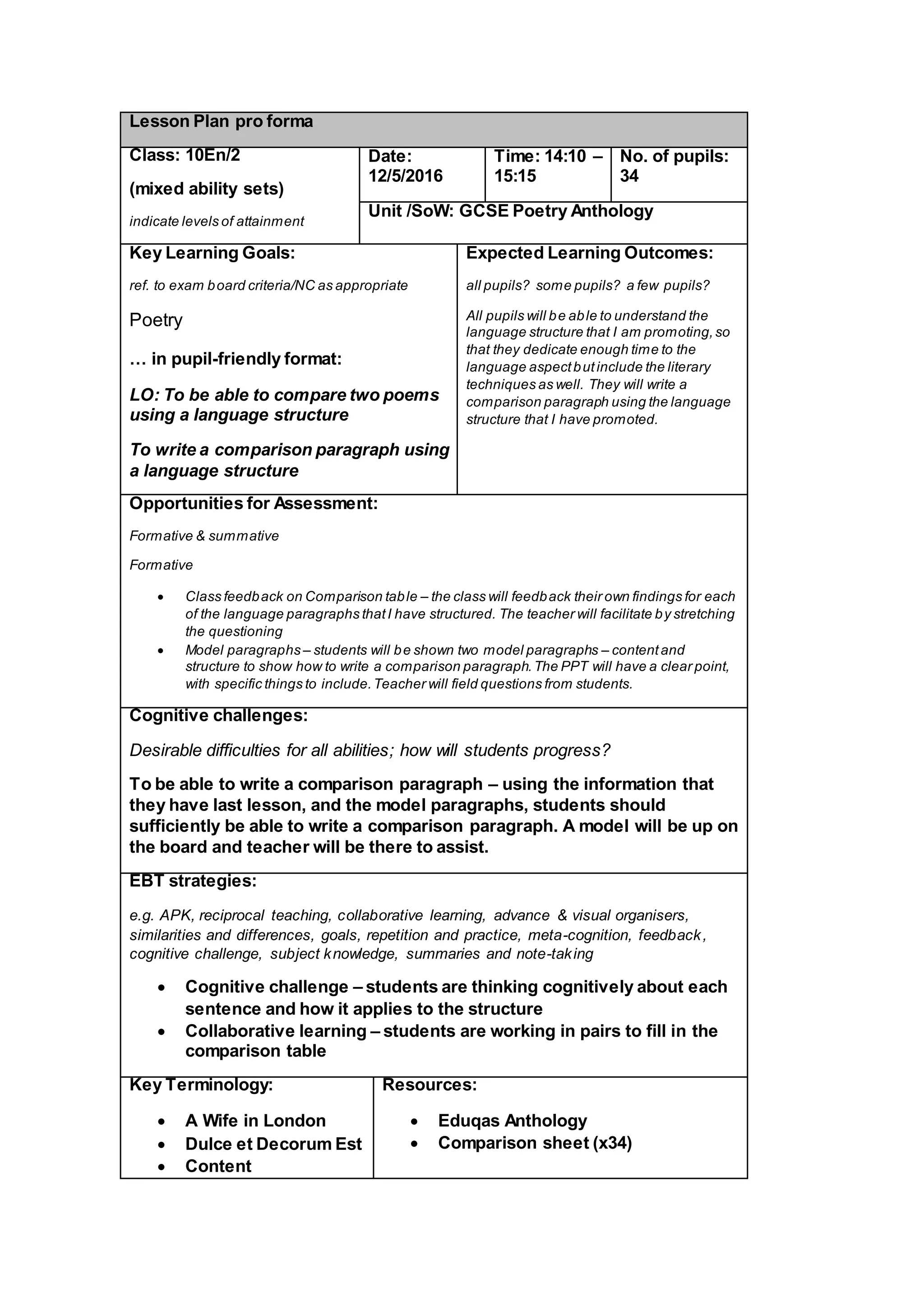
Lesson Plan pro forma
Class: 10En/2
(mixed ability sets)
indicate levels of attainment
Date:
12/5/2016
Time: 14:10 –
15:15
No. of pupils:
34
Unit /SoW: GCSE Poetry Anthology
Key Learning Goals:
ref. to exam board criteria/NC as appropriate
Poetry
… in pupil-friendly format:
LO: To be able to compare two poems
using a language structure
To write a comparison paragraph using
a language structure
Expected Learning Outcomes:
all pupils? some pupils? a few pupils?
All pupils will be able to understand the
language structure that I am promoting,so
that they dedicate enough time to the
language aspectbutinclude the literary
techniques as well. They will write a
comparison paragraph using the language
structure that I have promoted.
Opportunities for Assessment:
Formative & summative
Formative
 Class feedback on Comparison table – the class will feedback their own findings for each
of the language paragraphs thatI have structured. The teacher will facilitate by stretching
the questioning
 Model paragraphs – students will be shown two model paragraphs – contentand
structure to show how to write a comparison paragraph.The PPT will have a clear point,
with specific things to include.Teacher will field questions from students.
Cognitive challenges:
Desirable difficulties for all abilities; how will students progress?
To be able to write a comparison paragraph – using the information that
they have last lesson, and the model paragraphs, students should
sufficiently be able to write a comparison paragraph. A model will be up on
the board and teacher will be there to assist.
EBT strategies:
e.g. APK, reciprocal teaching, collaborative learning, advance & visual organisers,
similarities and differences, goals, repetition and practice, meta-cognition, feedback,
cognitive challenge, subject knowledge, summaries and note-taking
 Cognitive challenge – students are thinking cognitively about each
sentence and how it applies to the structure
 Collaborative learning – students are working in pairs to fill in the
comparison table
Key Terminology:
 A Wife in London
 Dulce et Decorum Est
 Content
Resources:
 Eduqas Anthology
 Comparison sheet (x34)
 Structure/rhyme
scheme
 Sentence structure
 Lexis
 Phonology
 Orthography
Homework and practice:
N/A
Comparison of poetry Part two 12.5.2016 plan

Comparison of poetry Part two 12.5.2016 plan

  • 1.
    Lesson Plan proforma Class: 10En/2 (mixed ability sets) indicate levels of attainment Date: 12/5/2016 Time: 14:10 – 15:15 No. of pupils: 34 Unit /SoW: GCSE Poetry Anthology Key Learning Goals: ref. to exam board criteria/NC as appropriate Poetry … in pupil-friendly format: LO: To be able to compare two poems using a language structure To write a comparison paragraph using a language structure Expected Learning Outcomes: all pupils? some pupils? a few pupils? All pupils will be able to understand the language structure that I am promoting,so that they dedicate enough time to the language aspectbutinclude the literary techniques as well. They will write a comparison paragraph using the language structure that I have promoted. Opportunities for Assessment: Formative & summative Formative  Class feedback on Comparison table – the class will feedback their own findings for each of the language paragraphs thatI have structured. The teacher will facilitate by stretching the questioning  Model paragraphs – students will be shown two model paragraphs – contentand structure to show how to write a comparison paragraph.The PPT will have a clear point, with specific things to include.Teacher will field questions from students. Cognitive challenges: Desirable difficulties for all abilities; how will students progress? To be able to write a comparison paragraph – using the information that they have last lesson, and the model paragraphs, students should sufficiently be able to write a comparison paragraph. A model will be up on the board and teacher will be there to assist. EBT strategies: e.g. APK, reciprocal teaching, collaborative learning, advance & visual organisers, similarities and differences, goals, repetition and practice, meta-cognition, feedback, cognitive challenge, subject knowledge, summaries and note-taking  Cognitive challenge – students are thinking cognitively about each sentence and how it applies to the structure  Collaborative learning – students are working in pairs to fill in the comparison table Key Terminology:  A Wife in London  Dulce et Decorum Est  Content Resources:  Eduqas Anthology  Comparison sheet (x34)
  • 2.
     Structure/rhyme scheme  Sentencestructure  Lexis  Phonology  Orthography Homework and practice: N/A