International Journal on Soft Computing, Artificial Intelligence and Applications (IJSCAI), Vol.3, No. 3/4, November 2014 
COMPARING OF SWITCHING FREQUENCY ON VECTOR 
CONTROLLED ASYNCHRONOUS MOTOR 
Yılmaz Korkmaz1, Fatih Korkmaz2, Ismail Topaloglu2, Hayati Mamur2 
1 Faculty of Technology, Department of Electrical-Electronic Engineering, 
Gazi University, Ankara, Turkey 
2 Faculty of Engineering, Department of Electrical-Electronic Engineering, 
Çankırı Karatekin University, Çankırı, Turkey 
ABSTRACT 
Nowadays, asynchronous motors have wide range use in many industrial applications. Field oriented 
control (FOC) and direct torque control (DTC) are commonly used methods in high performance vector 
control for asynchronous motors. Therefore, it is very important to identify clearly advantages and 
disadvantages of both systems in the selection of appropriate control methods for many industrial 
applications. This paper aims to present a new and different perspective regarding the comparison of the 
switching behaviours on the FOC and the DTC drivers. For this purpose, the experimental studies have 
been carried out to compare the inverter switching frequencies and torque responses of the asynchronous 
motor in the FOC and the DTC systems under different working conditions. The dSPACE 1103 controller 
board was programmed with Matlab/Simulink software. As expected, the experimental studies showed that 
the FOC controlled motors has a lessened torque ripple. On the other hand, the FOC controlled motor 
switching frequency has about 65-75% more than the DTC controlled under both loaded and unloaded 
working conditions. 
KEYWORDS 
Asynchronous motor; vector control; motor drives; switching frequency 
1. INTRODUCTION 
For many years, asynchronous motors have wide range use in industrial applications due to its 
simple and robust structure and low costs when compared with dc motors. Furthermore, we have 
better high performance control options now due to development of power electronics in the last 
few decades. There are two noted control methods in high performance control of asynchronous 
motors named as: FOC and DTC. 
Blaschke proposed the FOC in the 1970s. The FOC was unique and only option that we had on 
asynchronous motors high performance control until 1980s that the DTC was introduced by 
Takahashi. Since that day, there have been continual discussions and questions about that: Which 
one has the best performance on asynchronous motors vector control? [1-3]. 
The main idea of vector control methods is the control of motor flux and torque components 
separately like DC motors. The main difference between two methods is that the FOC controls by 
a rotor or stator field orientation, while the DTC controls by a stator field observation [4]. So, the 
structural differences in the both control methods are that the FOC uses park transformation, more 
machine parameters, and current regulators, while the DTC uses Clarke transformation, less 
DOI :10.5121/ijscai.2014.3402 19
International Journal on Soft Computing, Artificial Intelligence and Applications (IJSCAI), Vol.3, No. 3/4, November 2014 
machine parameters, and any current regulators. Thus, comparative studies between the two 
methods show that the DTC is simplicity, a fast dynamic response, and robust against to 
parameter changes. Despite all these advantages, the DTC also has some handicaps: the most 
important of them being high torque and current ripples. Evidently, all users have to take into 
account all these advantages and disadvantages when deciding on which method they will use on 
designed system [5]. There are some comparative studies regarding both comparison of both the 
methods, which address the motors speed and torque behaviours. Thanks to this research, it is 
now known that despite a high torque ripple, the DTC has a fast dynamic response [6-7]. 
In this paper, a new and different perspective has been presented regarding the comparison of the 
FOC and the DTC drivers. The voltage source inverter switching frequencies has been compared 
on both the FOC and the DTC systems. There is no doubt about the importance of switching 
frequency on power electronic systems because its directly affects switching losses and it means 
also affects indirectly the efficiency of the drivers. Experimental studies have been carried out to 
compare switching frequencies and the dSpace 1103 controller board has been programmed with 
Matlab/Simulink. 
20 
2. FOC AND DTC METHODS 
The FOC is mostly used to control the speed of the motor, not control of the moment, due to its 
low level sensitivity [8]. 
In the FOC, the parameters of the motor have to be turned in a d-q reference frame, which 
consider turns in a synchronous speed (park transformation). Thus, the position of the rotor flux 
has to be well determined for the success of transformation. In the determining the process of the 
rotor flux position two basic approaches are used. 
Using of flux sensors is the first approach to determine the rotor flux position while to measure 
the rotor position with an incremental encoder and calculate the angle between the axis of the 
rotor and the flux, is the second one. Eq. 1 and Eq. 2, describes the calculation of the stator 
current d-q components. 


* 
T L 
  
  
2 
qs L 


= 
r 
m 
e 
r 
p 
i 
* 
* 2 
3 
l 
(1) 
r 
m 
ds L 
i 
* 
* l 
= (2) 
* 
qs i and * 
ds i are the stator current d-q components reference values, * 
r l is the rotor flux reference 
value, and m L is the mutual inductance, r L is rotor inductance and p is motor pole pairs value 
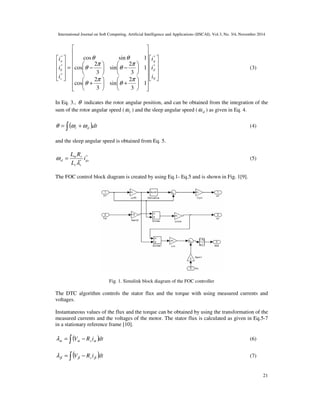
in these equations. The stator three phase currents obtained by using the transformation matrix 
which is given in Eq. 3.
International Journal on Soft Computing, Artificial Intelligence and Applications (IJSCAI), Vol.3, No. 3/4, November 2014 
21
i 
i
−  
 
+  


+ 


= −
i 


i 
 
* 
q 
* 
0 
* 
a 
* 
b 
* 
1 
2 
2 
3 
sin 
2 
2 
3 
cos 
1 
3 
sin 
3 
cos 
cos sin 1 
i 
i 
d 
c 
p 
q 
p 
q 
p 
q 
p 
q 
q q 
(3) 
In Eq. 3., q indicates the rotor angular position, and can be obtained from the integration of the 
sum of the rotor angular speed ( r w ) and the sleep angular speed ( sl w ) as given in Eq. 4. 
( )dt r sl q = 
 w +w . (4) 
and the sleep angular speed is obtained from Eq. 5. 
* 
L R 
l 
m r 
w = (5) 
sl i 
* qs 
L 
r r 
The FOC control block diagram is created by using Eq.1- Eq.5 and is shown in Fig. 1[9]. 
Fig. 1. Simulink block diagram of the FOC controller 
The DTC algorithm controls the stator flux and the torque with using measured currents and 
voltages. 
Instantaneous values of the flux and the torque can be obtained by using the transformation of the 
measured currents and the voltages of the motor. The stator flux is calculated as given in Eq.5-7 
in a stationary reference frame [10]. 
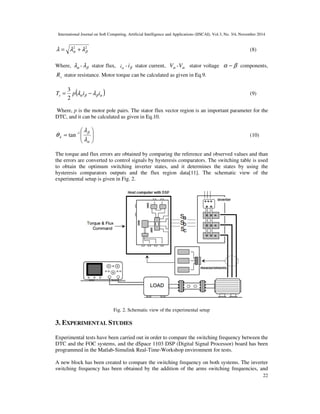
(V R i )dt s = 
 − a a a l (6) 
(V R i )dt s = 
 − b b b l (7)
International Journal on Soft Computing, Artificial Intelligence and Applications (IJSCAI), Vol.3, No. 3/4, November 2014 
22 
2 2 
a b l = l +l (8) 
Where, a l - b l stator flux, a i - b i stator current, a V - a V stator voltage a − b components, 
s R stator resistance. Motor torque can be calculated as given in Eq.9. 
3 
( ) a b b a T p l i l i e = − 
2 
(9) 
Where, p is the motor pole pairs. The stator flux vector region is an important parameter for the 
DTC, and it can be calculated as given in Eq.10. 
 
  
q 1 tan (10) 


l 
l l 
 
= − 
b 
a 
The torque and flux errors are obtained by comparing the reference and observed values and than 
the errors are converted to control signals by hysteresis comparators. The switching table is used 
to obtain the optimum switching inverter states, and it determines the states by using the 
hysteresis comparators outputs and the flux region data[11]. The schematic view of the 
experimental setup is given in Fig. 2. 
Fig. 2. Schematic view of the experimental setup 
3. EXPERIMENTAL STUDIES 
Experimental tests have been carried out in order to compare the switching frequency between the 
DTC and the FOC systems, and the dSpace 1103 DSP (Digital Signal Processor) board has been 
programmed in the Matlab-Simulink Real-Time-Workshop environment for tests. 
A new block has been created to compare the switching frequency on both systems. The inverter 
switching frequency has been obtained by the addition of the arms switching frequencies, and
International Journal on Soft Computing, Artificial Intelligence and Applications (IJSCAI), Vol.3, No. 3/4, November 2014 
then dividing the total by three. However, especially in the DTC, the switching frequency has a 
wide range, so the average switching frequency has been calculated with a different sampling 
time (100 ms) in the frequency measurement block to obtain healthy comparable results. 
The results of the experimental tests obtained in this study are for the asynchronous motor of 4 
kW and the parameters of the motor, and the experiments are as given below. The motor model is 
implemented for the DTC and the FOC methods on the Matlab/Simulink. Different load ranges 
have been applied to the asynchronous motor to compare the switching frequencies. The DTC and 
the FOC systems have been tested at under no load and loaded (10 N.m.) conditions. The 
parameters of the three-phase asynchronous motor, in the SI units: P=4 kW, U=380 V, I=8.2 A, 
cos=0.85, 1425 rpm, f=50 Hz, Rs =7.2 . 
23 
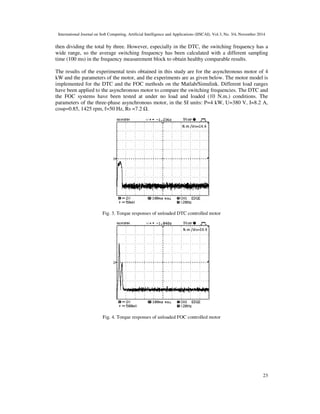
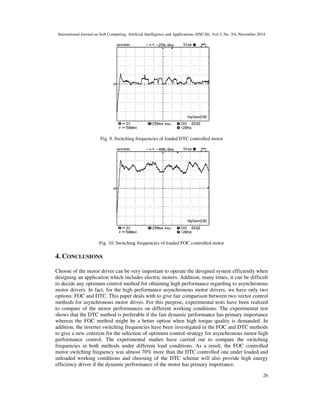
Fig. 3. Torque responses of unloaded DTC controlled motor 
Fig. 4. Torque responses of unloaded FOC controlled motor
International Journal on Soft Computing, Artificial Intelligence and Applications (IJSCAI), Vol.3, No. 3/4, November 2014 
24 
Fig. 5. Switching frequencies of unloaded DTC controlled motor 
Fig. 6. Switching frequencies of unloaded FOC controlled motor 
In the first group of the tests, the motor has been operated as unloaded working conditions. The 
motor speed has been set up to 1500 rpm for all experimental tests. The moment and switching 
frequency data, which has been calculated within the Simulink blocks, have been obtained by 
using the digital-analogue converters of the dSPACE 1103 controller board. The torque response 
curves of the motor for the both systems have been given in Figure 3 and Figure 4 for unloaded 
working conditions. As expected, it can be clearly seen that the DTC has much torque ripples 
when compared FOC. 
Figure 5 and Figure 6 show change on the switching frequencies of the motor for both systems. 
The switching frequency of the DTC controlled motor has nearly 900 Hz, while the FOC 
controlled motor has 1400 Hz. Therefore, it can be stated that the FOC controlled motor 
switching frequency has 65% more than the DTC controlled one. 
In the second part of tests, the motor has been operated under loaded (10Nm) conditions and 
torque and the switching frequency curves of these tests have been given in following figures.

Comparing of switching frequency on vector controlled asynchronous motor

  • 1.
    International Journal onSoft Computing, Artificial Intelligence and Applications (IJSCAI), Vol.3, No. 3/4, November 2014 COMPARING OF SWITCHING FREQUENCY ON VECTOR CONTROLLED ASYNCHRONOUS MOTOR Yılmaz Korkmaz1, Fatih Korkmaz2, Ismail Topaloglu2, Hayati Mamur2 1 Faculty of Technology, Department of Electrical-Electronic Engineering, Gazi University, Ankara, Turkey 2 Faculty of Engineering, Department of Electrical-Electronic Engineering, Çankırı Karatekin University, Çankırı, Turkey ABSTRACT Nowadays, asynchronous motors have wide range use in many industrial applications. Field oriented control (FOC) and direct torque control (DTC) are commonly used methods in high performance vector control for asynchronous motors. Therefore, it is very important to identify clearly advantages and disadvantages of both systems in the selection of appropriate control methods for many industrial applications. This paper aims to present a new and different perspective regarding the comparison of the switching behaviours on the FOC and the DTC drivers. For this purpose, the experimental studies have been carried out to compare the inverter switching frequencies and torque responses of the asynchronous motor in the FOC and the DTC systems under different working conditions. The dSPACE 1103 controller board was programmed with Matlab/Simulink software. As expected, the experimental studies showed that the FOC controlled motors has a lessened torque ripple. On the other hand, the FOC controlled motor switching frequency has about 65-75% more than the DTC controlled under both loaded and unloaded working conditions. KEYWORDS Asynchronous motor; vector control; motor drives; switching frequency 1. INTRODUCTION For many years, asynchronous motors have wide range use in industrial applications due to its simple and robust structure and low costs when compared with dc motors. Furthermore, we have better high performance control options now due to development of power electronics in the last few decades. There are two noted control methods in high performance control of asynchronous motors named as: FOC and DTC. Blaschke proposed the FOC in the 1970s. The FOC was unique and only option that we had on asynchronous motors high performance control until 1980s that the DTC was introduced by Takahashi. Since that day, there have been continual discussions and questions about that: Which one has the best performance on asynchronous motors vector control? [1-3]. The main idea of vector control methods is the control of motor flux and torque components separately like DC motors. The main difference between two methods is that the FOC controls by a rotor or stator field orientation, while the DTC controls by a stator field observation [4]. So, the structural differences in the both control methods are that the FOC uses park transformation, more machine parameters, and current regulators, while the DTC uses Clarke transformation, less DOI :10.5121/ijscai.2014.3402 19
  • 2.
    International Journal onSoft Computing, Artificial Intelligence and Applications (IJSCAI), Vol.3, No. 3/4, November 2014 machine parameters, and any current regulators. Thus, comparative studies between the two methods show that the DTC is simplicity, a fast dynamic response, and robust against to parameter changes. Despite all these advantages, the DTC also has some handicaps: the most important of them being high torque and current ripples. Evidently, all users have to take into account all these advantages and disadvantages when deciding on which method they will use on designed system [5]. There are some comparative studies regarding both comparison of both the methods, which address the motors speed and torque behaviours. Thanks to this research, it is now known that despite a high torque ripple, the DTC has a fast dynamic response [6-7]. In this paper, a new and different perspective has been presented regarding the comparison of the FOC and the DTC drivers. The voltage source inverter switching frequencies has been compared on both the FOC and the DTC systems. There is no doubt about the importance of switching frequency on power electronic systems because its directly affects switching losses and it means also affects indirectly the efficiency of the drivers. Experimental studies have been carried out to compare switching frequencies and the dSpace 1103 controller board has been programmed with Matlab/Simulink. 20 2. FOC AND DTC METHODS The FOC is mostly used to control the speed of the motor, not control of the moment, due to its low level sensitivity [8]. In the FOC, the parameters of the motor have to be turned in a d-q reference frame, which consider turns in a synchronous speed (park transformation). Thus, the position of the rotor flux has to be well determined for the success of transformation. In the determining the process of the rotor flux position two basic approaches are used. Using of flux sensors is the first approach to determine the rotor flux position while to measure the rotor position with an incremental encoder and calculate the angle between the axis of the rotor and the flux, is the second one. Eq. 1 and Eq. 2, describes the calculation of the stator current d-q components. * T L 2 qs L = r m e r p i * * 2 3 l (1) r m ds L i * * l = (2) * qs i and * ds i are the stator current d-q components reference values, * r l is the rotor flux reference value, and m L is the mutual inductance, r L is rotor inductance and p is motor pole pairs value in these equations. The stator three phase currents obtained by using the transformation matrix which is given in Eq. 3.
  • 3.
    International Journal onSoft Computing, Artificial Intelligence and Applications (IJSCAI), Vol.3, No. 3/4, November 2014 21
  • 4.
  • 5.
    + + = −
  • 6.
    i i * q * 0 * a * b * 1 2 2 3 sin 2 2 3 cos 1 3 sin 3 cos cos sin 1 i i d c p q p q p q p q q q (3) In Eq. 3., q indicates the rotor angular position, and can be obtained from the integration of the sum of the rotor angular speed ( r w ) and the sleep angular speed ( sl w ) as given in Eq. 4. ( )dt r sl q = w +w . (4) and the sleep angular speed is obtained from Eq. 5. * L R l m r w = (5) sl i * qs L r r The FOC control block diagram is created by using Eq.1- Eq.5 and is shown in Fig. 1[9]. Fig. 1. Simulink block diagram of the FOC controller The DTC algorithm controls the stator flux and the torque with using measured currents and voltages. Instantaneous values of the flux and the torque can be obtained by using the transformation of the measured currents and the voltages of the motor. The stator flux is calculated as given in Eq.5-7 in a stationary reference frame [10]. (V R i )dt s = − a a a l (6) (V R i )dt s = − b b b l (7)
  • 7.
    International Journal onSoft Computing, Artificial Intelligence and Applications (IJSCAI), Vol.3, No. 3/4, November 2014 22 2 2 a b l = l +l (8) Where, a l - b l stator flux, a i - b i stator current, a V - a V stator voltage a − b components, s R stator resistance. Motor torque can be calculated as given in Eq.9. 3 ( ) a b b a T p l i l i e = − 2 (9) Where, p is the motor pole pairs. The stator flux vector region is an important parameter for the DTC, and it can be calculated as given in Eq.10. q 1 tan (10) l l l = − b a The torque and flux errors are obtained by comparing the reference and observed values and than the errors are converted to control signals by hysteresis comparators. The switching table is used to obtain the optimum switching inverter states, and it determines the states by using the hysteresis comparators outputs and the flux region data[11]. The schematic view of the experimental setup is given in Fig. 2. Fig. 2. Schematic view of the experimental setup 3. EXPERIMENTAL STUDIES Experimental tests have been carried out in order to compare the switching frequency between the DTC and the FOC systems, and the dSpace 1103 DSP (Digital Signal Processor) board has been programmed in the Matlab-Simulink Real-Time-Workshop environment for tests. A new block has been created to compare the switching frequency on both systems. The inverter switching frequency has been obtained by the addition of the arms switching frequencies, and
  • 8.
    International Journal onSoft Computing, Artificial Intelligence and Applications (IJSCAI), Vol.3, No. 3/4, November 2014 then dividing the total by three. However, especially in the DTC, the switching frequency has a wide range, so the average switching frequency has been calculated with a different sampling time (100 ms) in the frequency measurement block to obtain healthy comparable results. The results of the experimental tests obtained in this study are for the asynchronous motor of 4 kW and the parameters of the motor, and the experiments are as given below. The motor model is implemented for the DTC and the FOC methods on the Matlab/Simulink. Different load ranges have been applied to the asynchronous motor to compare the switching frequencies. The DTC and the FOC systems have been tested at under no load and loaded (10 N.m.) conditions. The parameters of the three-phase asynchronous motor, in the SI units: P=4 kW, U=380 V, I=8.2 A, cos=0.85, 1425 rpm, f=50 Hz, Rs =7.2 . 23 Fig. 3. Torque responses of unloaded DTC controlled motor Fig. 4. Torque responses of unloaded FOC controlled motor
  • 9.
    International Journal onSoft Computing, Artificial Intelligence and Applications (IJSCAI), Vol.3, No. 3/4, November 2014 24 Fig. 5. Switching frequencies of unloaded DTC controlled motor Fig. 6. Switching frequencies of unloaded FOC controlled motor In the first group of the tests, the motor has been operated as unloaded working conditions. The motor speed has been set up to 1500 rpm for all experimental tests. The moment and switching frequency data, which has been calculated within the Simulink blocks, have been obtained by using the digital-analogue converters of the dSPACE 1103 controller board. The torque response curves of the motor for the both systems have been given in Figure 3 and Figure 4 for unloaded working conditions. As expected, it can be clearly seen that the DTC has much torque ripples when compared FOC. Figure 5 and Figure 6 show change on the switching frequencies of the motor for both systems. The switching frequency of the DTC controlled motor has nearly 900 Hz, while the FOC controlled motor has 1400 Hz. Therefore, it can be stated that the FOC controlled motor switching frequency has 65% more than the DTC controlled one. In the second part of tests, the motor has been operated under loaded (10Nm) conditions and torque and the switching frequency curves of these tests have been given in following figures.