Types of Interview
Joana Correia de Barros
2014
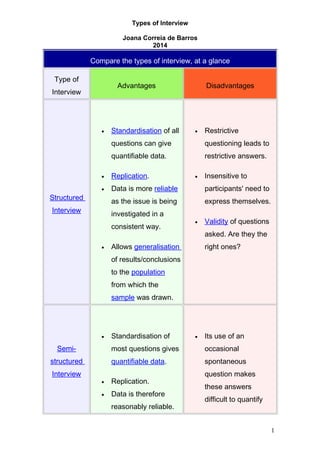
Compare the types of interview, at a glance
Type of
Interview
Advantages Disadvantages
Structured
Interview
• Standardisation of all
questions can give
quantifiable data.
• Replication.
• Data is more reliable
as the issue is being
investigated in a
consistent way.
• Allows generalisation
of results/conclusions
to the population
from which the
sample was drawn.
• Restrictive
questioning leads to
restrictive answers.
• Insensitive to
participants' need to
express themselves.
• Validity of questions
asked. Are they the
right ones?
Semi-
structured
Interview
• Standardisation of
most questions gives
quantifiable data.
• Replication.
• Data is therefore
reasonably reliable.
• Its use of an
occasional
spontaneous
question makes
these answers
difficult to quantify
1
Types of Interview
Joana Correia de Barros
2014
• Ability to ask some
spontaneous
questions is sensitive
to participants need
to express
themselves.
and analyse.
• Spontaneous
questions asked of
some and not of
others can be seen
as unfair, especially
in personnel
selection.
Clinical
Interview
• Flexible, responsive
and sensitive to
participants.
• Preparation of core
questions should
ensure validity.
• Core questions and
responses should be
reliable and analysed
easily.
• Difficult to replicate.
• As a result an
inability to generalise
your findings to a
wider population.
• Possible interviewer
bias in their use of
leading spontaneous
questions.
Unstructured
Interview
• Flexible, responsive
and sensitive to
participants.
• Difficult to replicate.
• As a result, an
inability to generalise
2
Types of Interview
Joana Correia de Barros
2014
• Relaxed and natural
for those taking part.
• Highly detailed and
ecologically valid
qualitative data.
your findings to a
wider population.
• Possible interviewer
bias in 'selective' use
of leading, and
spontaneous
questions.
3

Types of interview

  • 1.
    Types of Interview JoanaCorreia de Barros 2014 Compare the types of interview, at a glance Type of Interview Advantages Disadvantages Structured Interview • Standardisation of all questions can give quantifiable data. • Replication. • Data is more reliable as the issue is being investigated in a consistent way. • Allows generalisation of results/conclusions to the population from which the sample was drawn. • Restrictive questioning leads to restrictive answers. • Insensitive to participants' need to express themselves. • Validity of questions asked. Are they the right ones? Semi- structured Interview • Standardisation of most questions gives quantifiable data. • Replication. • Data is therefore reasonably reliable. • Its use of an occasional spontaneous question makes these answers difficult to quantify 1
  • 2.
    Types of Interview JoanaCorreia de Barros 2014 • Ability to ask some spontaneous questions is sensitive to participants need to express themselves. and analyse. • Spontaneous questions asked of some and not of others can be seen as unfair, especially in personnel selection. Clinical Interview • Flexible, responsive and sensitive to participants. • Preparation of core questions should ensure validity. • Core questions and responses should be reliable and analysed easily. • Difficult to replicate. • As a result an inability to generalise your findings to a wider population. • Possible interviewer bias in their use of leading spontaneous questions. Unstructured Interview • Flexible, responsive and sensitive to participants. • Difficult to replicate. • As a result, an inability to generalise 2
  • 3.
    Types of Interview JoanaCorreia de Barros 2014 • Relaxed and natural for those taking part. • Highly detailed and ecologically valid qualitative data. your findings to a wider population. • Possible interviewer bias in 'selective' use of leading, and spontaneous questions. 3