Community organizing
 
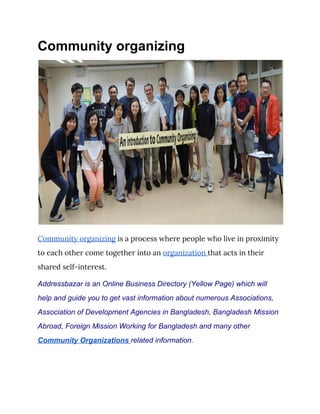
Community organizing​ is a process where people who live in proximity 
to each other come together into an ​organization ​that acts in their 
shared self-interest. 
Addressbazar is an Online Business Directory (Yellow Page) which will
help and guide you to get vast information about numerous Associations,
Association of Development Agencies in Bangladesh, Bangladesh Mission
Abroad, Foreign Mission Working for Bangladesh and many other
Community Organizations​ ​related information.
Unlike those who promote more-consensual community building, 
community organizers​ generally assume that social change necessarily 
involves conflict and social struggle in order to generate collective 
power for the powerless. Community organizing has as a core goal the 
generation of durable power for an organization representing the 
community​, allowing it to influence key decision-makers on a range of 
issues over time. In the ideal, for example, this can get 
community-organizing groups a place at the table before important 
decisions are made. Community organizers work with and develop new 
local leaders, facilitating coalitions and assisting in the development of 
campaigns. A central goal of organizing is the development of a robust, 
organized, local democracy bringing community members together 
across differences to fight together for the interests of the community. 
Characteristics
Organized community ​groups attempt to influence government, 
corporations, and institutions, seek to increase direct representation 
within decision-making bodies, and foster social reform more generally. 
Where negotiations fail, these organizations quickly seek to inform 
others outside of the organization of the issues being addressed and 
expose or pressure the decision-makers through a variety of means, 
including picketing, boycotting, sit-ins, petitioning, and electoral 
politics. Organizing groups often seek out issues they know will 
generate controversy and conflict, this allows them to draw in and 
educate participants, build commitment, and establish a reputation for 
winning. Thus, community organizing is predominantly focused on 
more than just resolving specific issues. In fact, specific issues are often 
vehicles for other organizational agendas as much as they end in 
themselves. 
 
Community organizers​ generally seek to build groups that are 
democratic in governance, open and accessible to community 
members, and concerned with the general health of a specific interest 
group, rather than the community as a whole. Organizing seeks to 
broadly empower community members, with the end goal of 
"distributing" power more equally throughout the community. 
The four basic types of community organizing are grassroots or 
"door-knocking" organizing, faith-based ​community organizing​ (FBCO), 
broad-based and coalition building. Political campaigns often claim that 
their door-to-door operations are in fact an effort to organize the 
community, though often these operations are focused exclusively on 
voter identification and turnout. 
FBCOs and many grassroots organizing models are built on the work of 
Saul Alinsky, discussed below, from the 1930s into the 1970s. 
Grassroots action
Grassroots organizing ​builds community groups from scratch, 
developing new leadership where none existed and organizing the 
unorganized. It is a values based process where people are brought 
together to act in the interest of their communities and the common 
good. Networks of community organizations that employ this method 
and support local organizing groups include National People's Action 
and ACORN. 
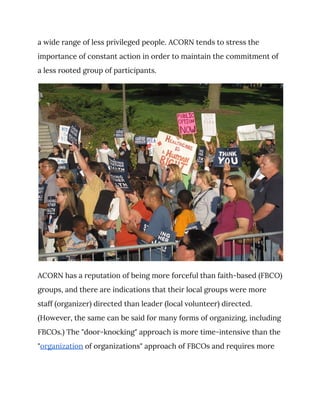
"Door knocking" grassroots organizations like ACORN organize poor 
and working-class members recruiting members one by one in the 
community. Because they go door-to-door, they are able to reach 
beyond established organizations and the "churched" to bring together 
a wide range of less privileged people. ACORN tends to stress the 
importance of constant action in order to maintain the commitment of 
a less rooted group of participants. 
 
ACORN has a reputation of being more forceful than faith-based (FBCO) 
groups, and there are indications that their local groups were more 
staff (organizer) directed than leader (local volunteer) directed. 
(However, the same can be said for many forms of organizing, including 
FBCOs.) The "door-knocking" approach is more time-intensive than the 
"​organization​ of organizations" approach of FBCOs and requires more 
organizers who, partly as a result, can be lower paid with more 
turnover. 
Unlike existing FBCO national "umbrella" and other grassroots 
organizations, ACORN maints a centralized national agenda, and exerts 
some centralized control over local organizations. Because ACORN USA 
was a 501(c)4 organization under the tax code, it was able to participate 
directly in election activities, but contributions to it were not tax 
exempt. 
Faith-based
Faith-based ​community organizing​ (FBCO), also known as 
Congregation-based Community Organizing, is a methodology for 
developing power and relationships throughout a community of 
institutions: today mostly congregations, but these can also include 
unions, neighborhood associations, and other groups. Progressive and 
centrist FBCO organizations join together around basic values derived 
from common aspects of their faith instead of around strict dogmas. 
There are now at least 180 FBCOs in the US as well as in South Africa, 
England, Germany, and other nations. Local FBCO organizations are 
often linked through organizing networks such as the Industrial Areas 
Foundation, Gamaliel Foundation, PICO National Network, and Direct 
Action and Research Training Center (DART). In the United States 
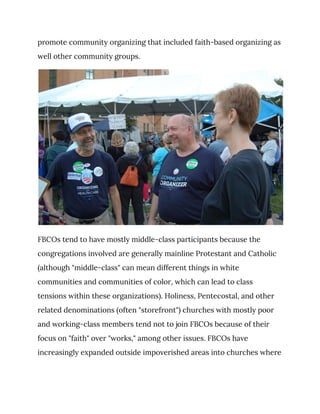
starting in 2001, the Bush Administration launched a department to 
promote community organizing that included faith-based organizing as 
well other community groups. 
 
FBCOs tend to have mostly middle-class participants because the 
congregations involved are generally mainline Protestant and Catholic 
(although "middle-class" can mean different things in white 
communities and communities of color, which can lead to class 
tensions within these organizations). Holiness, Pentecostal, and other 
related denominations (often "storefront") churches with mostly poor 
and working-class members tend not to join FBCOs because of their 
focus on "faith" over "works," among other issues. FBCOs have 
increasingly expanded outside impoverished areas into churches where 
middle-class professionals predominate in an effort to expand their 
power to contest inequality. 
Because of their "organization of organizations" approach, FBCOs can 
organize large numbers of members with a relatively small number of 
organizers that generally are better paid and more professionalized 
than those in "door-knocking" groups like ACORN. 
FBCOs focus on the long-term development of a culture and common 
language of ​organizing ​and on the development of relational ties 
between members. They are more stable during fallow periods than 
grassroots groups because of the continuing existence of member 
churches. 
FBCOs are 501(c)3 organizations. Contributions to them are tax exempt. 
As a result, while they can conduct campaigns over "issues" they cannot 
promote the election of specific individuals. 
Broad-based
Broad-based organizations​ intentionally recruit member institutions 
that are both secular and religious. Congregations, synagogues, temples 
and mosques are joined by public schools, non-profits, and labor and 
professional associations. Organizations of the Industrial Areas 
Foundation are explicitly broad-based and dues-based. Dues-based 
membership allows IAF organizations to maintain their independence; 
organizations are politically non-partisan and do not pursue or accept 
government funding. Broad-based organizations aim to teach 
institutional leaders how to build relationships of trust across racial, 
faith, economic and geographic lines through individual, face-to-face 
meetings. Other goals include internally strengthening the member 
institutions by developing the skills and capacities of their leaders and 
creating a vehicle for ordinary families to participate in the political 
process. The Industrial Areas Foundation sees itself as a "university of 
public life" teaching citizens the democratic process in the fullest 
sense. 
Power versus protest
While ​community organizing​ groups often engage in protest actions 
designed to force powerful groups to respond to their demands, 
protest is only one aspect of the activity of organizing groups. To the 
extent that groups' actions generate a sense in the larger community 
that they have "power," they are often able to engage with and 
influence powerful groups through dialogue, backed up by a history of 
successful protest-based campaigns. Similar to the way unions gain 
recognition as the representatives of workers for a particular business, 
community organizing groups can gain recognition as key 
representatives of particular communities. In this way, representatives 
of ​community organizing​ groups are often able to bring key 
government officials or corporate leaders to the table without engaging 
in "actions" because of their reputation. As Alinsky said, "the first rule of 
power tactics" is that "power is not only what you have but what the 
enemy thinks you have.” The development of durable "power" and 
influence is a key aim of community organizing. 
 
"Rights-based" community organizing, in which municipal governments 
are used to exercise community power, was first experimented with by 
the Community Environmental Legal Defense Fund (CELDF.org) in 
Pennsylvania, beginning in 2002. Community groups are organized to 
influence municipal governments to enact local ordinances. These 
ordinances challenge preemptive state and federal laws that forbid 
local governments from prohibiting corporate activities deemed 
harmful by community residents. The ordinances are drafted 
specifically to assert the rights of "human and natural communities," 
and include provisions that deny the legal concepts of "corporate 
personhood," and "corporate rights." Since 2006 they have been drafted 
to include the recognition of legally enforceable rights for "natural 
communities and ecosystems." 
Although this type of ​community organizing​ focuses on the adoption of 
local laws, the intent is to demonstrate the use of governing authority 
to protect community rights and expose the misuse of governing 
authority to benefit corporations. As such, the adoption of rights-based 
municipal ordinances is not a legal strategy, but an organizing strategy. 
Courts predictably deny the legal authority of municipalities to legislate 
in defiance of state and federal law. Corporations and government 
agencies that initiate legal actions to overturn these ordinances have 
been forced to argue in opposition to the community's right to make 
governing decisions on issues with harmful and direct local impact. 
The first rights-based municipal laws prohibited corporations from 
monopolizing horticulture (factory farming), and banned corporate 
waste dumping within municipal jurisdictions. More recent 
rights-based organizing, in Pennsylvania, New Hampshire, Maine, 
Virginia and California has prohibited corporate mining, large-scale 
water withdrawals and chemical trespass. A similar attempt was made 
by Denton, Texas to restrict fracking was initially successful, but then 
overturned and further legislation passed to prevent Texas 
communities from enacting similar bans. 
Political orientations
 
Community organizing is not solely the domain of progressive politics, 
as dozens of fundamentalist organizations are in operation, such as the 
Christian Coalition. However, the term "community organizing" 
generally refers to more progressive organizations, as evidenced, for 
example, by the reaction against community organizing in the 2008 US 
presidential election by Republicans and conservatives on the web and 
elsewhere. 
Fundraising
Organizing groups often struggle to find resources. They rarely receive 
funding from the government since their activities often seek to 
contest government policies. Foundations and others who usually fund 
service activities generally don't understand what organizing groups do 
or how they do it, or shy away from their contentious approaches. The 
constituency of progressive and centrist organizing groups is largely 
low- or middle- income, so they are generally unable to support 
themselves through dues. In search of resources, some organizing 
groups have accepted funding for direct service activities in the past. As 
noted below, this has frequently led these groups to drop their 
conflictual organizing activities, in part because these threatened 
funding for their "service" arms. 
Recent studies have shown, however, that funding for​ community 
organizing​ can produce large returns on investment ($512 in 
community benefits to $1 of Needmor funding, according to the 
Needmor Fund Study, $157 to 1 in New Mexico and $89 to 1 in North 
Carolina according to National Committee for Responsive Philanthropy 
studies) through legislation and agreements with corporations, among 
other sources, not including non-fiscal accomplishments. 

Community organizing

  • 1.
    Community organizing   Community organizing​is a process where people who live in proximity  to each other come together into an ​organization ​that acts in their  shared self-interest.  Addressbazar is an Online Business Directory (Yellow Page) which will help and guide you to get vast information about numerous Associations, Association of Development Agencies in Bangladesh, Bangladesh Mission Abroad, Foreign Mission Working for Bangladesh and many other Community Organizations​ ​related information.
  • 2.
    Unlike those whopromote more-consensual community building,  community organizers​ generally assume that social change necessarily  involves conflict and social struggle in order to generate collective  power for the powerless. Community organizing has as a core goal the  generation of durable power for an organization representing the  community​, allowing it to influence key decision-makers on a range of  issues over time. In the ideal, for example, this can get  community-organizing groups a place at the table before important  decisions are made. Community organizers work with and develop new  local leaders, facilitating coalitions and assisting in the development of  campaigns. A central goal of organizing is the development of a robust,  organized, local democracy bringing community members together  across differences to fight together for the interests of the community.  Characteristics Organized community ​groups attempt to influence government,  corporations, and institutions, seek to increase direct representation  within decision-making bodies, and foster social reform more generally.  Where negotiations fail, these organizations quickly seek to inform  others outside of the organization of the issues being addressed and  expose or pressure the decision-makers through a variety of means,  including picketing, boycotting, sit-ins, petitioning, and electoral  politics. Organizing groups often seek out issues they know will  generate controversy and conflict, this allows them to draw in and 
  • 3.
    educate participants, buildcommitment, and establish a reputation for  winning. Thus, community organizing is predominantly focused on  more than just resolving specific issues. In fact, specific issues are often  vehicles for other organizational agendas as much as they end in  themselves.    Community organizers​ generally seek to build groups that are  democratic in governance, open and accessible to community  members, and concerned with the general health of a specific interest  group, rather than the community as a whole. Organizing seeks to 
  • 4.
    broadly empower communitymembers, with the end goal of  "distributing" power more equally throughout the community.  The four basic types of community organizing are grassroots or  "door-knocking" organizing, faith-based ​community organizing​ (FBCO),  broad-based and coalition building. Political campaigns often claim that  their door-to-door operations are in fact an effort to organize the  community, though often these operations are focused exclusively on  voter identification and turnout.  FBCOs and many grassroots organizing models are built on the work of  Saul Alinsky, discussed below, from the 1930s into the 1970s.  Grassroots action Grassroots organizing ​builds community groups from scratch,  developing new leadership where none existed and organizing the  unorganized. It is a values based process where people are brought  together to act in the interest of their communities and the common  good. Networks of community organizations that employ this method  and support local organizing groups include National People's Action  and ACORN.  "Door knocking" grassroots organizations like ACORN organize poor  and working-class members recruiting members one by one in the  community. Because they go door-to-door, they are able to reach  beyond established organizations and the "churched" to bring together 
  • 5.
    a wide rangeof less privileged people. ACORN tends to stress the  importance of constant action in order to maintain the commitment of  a less rooted group of participants.    ACORN has a reputation of being more forceful than faith-based (FBCO)  groups, and there are indications that their local groups were more  staff (organizer) directed than leader (local volunteer) directed.  (However, the same can be said for many forms of organizing, including  FBCOs.) The "door-knocking" approach is more time-intensive than the  "​organization​ of organizations" approach of FBCOs and requires more 
  • 6.
    organizers who, partlyas a result, can be lower paid with more  turnover.  Unlike existing FBCO national "umbrella" and other grassroots  organizations, ACORN maints a centralized national agenda, and exerts  some centralized control over local organizations. Because ACORN USA  was a 501(c)4 organization under the tax code, it was able to participate  directly in election activities, but contributions to it were not tax  exempt.  Faith-based Faith-based ​community organizing​ (FBCO), also known as  Congregation-based Community Organizing, is a methodology for  developing power and relationships throughout a community of  institutions: today mostly congregations, but these can also include  unions, neighborhood associations, and other groups. Progressive and  centrist FBCO organizations join together around basic values derived  from common aspects of their faith instead of around strict dogmas.  There are now at least 180 FBCOs in the US as well as in South Africa,  England, Germany, and other nations. Local FBCO organizations are  often linked through organizing networks such as the Industrial Areas  Foundation, Gamaliel Foundation, PICO National Network, and Direct  Action and Research Training Center (DART). In the United States  starting in 2001, the Bush Administration launched a department to 
  • 7.
    promote community organizingthat included faith-based organizing as  well other community groups.    FBCOs tend to have mostly middle-class participants because the  congregations involved are generally mainline Protestant and Catholic  (although "middle-class" can mean different things in white  communities and communities of color, which can lead to class  tensions within these organizations). Holiness, Pentecostal, and other  related denominations (often "storefront") churches with mostly poor  and working-class members tend not to join FBCOs because of their  focus on "faith" over "works," among other issues. FBCOs have  increasingly expanded outside impoverished areas into churches where 
  • 8.
    middle-class professionals predominatein an effort to expand their  power to contest inequality.  Because of their "organization of organizations" approach, FBCOs can  organize large numbers of members with a relatively small number of  organizers that generally are better paid and more professionalized  than those in "door-knocking" groups like ACORN.  FBCOs focus on the long-term development of a culture and common  language of ​organizing ​and on the development of relational ties  between members. They are more stable during fallow periods than  grassroots groups because of the continuing existence of member  churches.  FBCOs are 501(c)3 organizations. Contributions to them are tax exempt.  As a result, while they can conduct campaigns over "issues" they cannot  promote the election of specific individuals.  Broad-based Broad-based organizations​ intentionally recruit member institutions  that are both secular and religious. Congregations, synagogues, temples  and mosques are joined by public schools, non-profits, and labor and  professional associations. Organizations of the Industrial Areas  Foundation are explicitly broad-based and dues-based. Dues-based  membership allows IAF organizations to maintain their independence;  organizations are politically non-partisan and do not pursue or accept 
  • 9.
    government funding. Broad-basedorganizations aim to teach  institutional leaders how to build relationships of trust across racial,  faith, economic and geographic lines through individual, face-to-face  meetings. Other goals include internally strengthening the member  institutions by developing the skills and capacities of their leaders and  creating a vehicle for ordinary families to participate in the political  process. The Industrial Areas Foundation sees itself as a "university of  public life" teaching citizens the democratic process in the fullest  sense.  Power versus protest While ​community organizing​ groups often engage in protest actions  designed to force powerful groups to respond to their demands,  protest is only one aspect of the activity of organizing groups. To the  extent that groups' actions generate a sense in the larger community  that they have "power," they are often able to engage with and  influence powerful groups through dialogue, backed up by a history of  successful protest-based campaigns. Similar to the way unions gain  recognition as the representatives of workers for a particular business,  community organizing groups can gain recognition as key  representatives of particular communities. In this way, representatives  of ​community organizing​ groups are often able to bring key  government officials or corporate leaders to the table without engaging  in "actions" because of their reputation. As Alinsky said, "the first rule of 
  • 10.
    power tactics" isthat "power is not only what you have but what the  enemy thinks you have.” The development of durable "power" and  influence is a key aim of community organizing.    "Rights-based" community organizing, in which municipal governments  are used to exercise community power, was first experimented with by  the Community Environmental Legal Defense Fund (CELDF.org) in  Pennsylvania, beginning in 2002. Community groups are organized to  influence municipal governments to enact local ordinances. These  ordinances challenge preemptive state and federal laws that forbid  local governments from prohibiting corporate activities deemed  harmful by community residents. The ordinances are drafted  specifically to assert the rights of "human and natural communities," 
  • 11.
    and include provisionsthat deny the legal concepts of "corporate  personhood," and "corporate rights." Since 2006 they have been drafted  to include the recognition of legally enforceable rights for "natural  communities and ecosystems."  Although this type of ​community organizing​ focuses on the adoption of  local laws, the intent is to demonstrate the use of governing authority  to protect community rights and expose the misuse of governing  authority to benefit corporations. As such, the adoption of rights-based  municipal ordinances is not a legal strategy, but an organizing strategy.  Courts predictably deny the legal authority of municipalities to legislate  in defiance of state and federal law. Corporations and government  agencies that initiate legal actions to overturn these ordinances have  been forced to argue in opposition to the community's right to make  governing decisions on issues with harmful and direct local impact.  The first rights-based municipal laws prohibited corporations from  monopolizing horticulture (factory farming), and banned corporate  waste dumping within municipal jurisdictions. More recent  rights-based organizing, in Pennsylvania, New Hampshire, Maine,  Virginia and California has prohibited corporate mining, large-scale  water withdrawals and chemical trespass. A similar attempt was made  by Denton, Texas to restrict fracking was initially successful, but then  overturned and further legislation passed to prevent Texas  communities from enacting similar bans. 
  • 12.
    Political orientations   Community organizingis not solely the domain of progressive politics,  as dozens of fundamentalist organizations are in operation, such as the  Christian Coalition. However, the term "community organizing"  generally refers to more progressive organizations, as evidenced, for  example, by the reaction against community organizing in the 2008 US  presidential election by Republicans and conservatives on the web and  elsewhere.  Fundraising Organizing groups often struggle to find resources. They rarely receive  funding from the government since their activities often seek to 
  • 13.
    contest government policies.Foundations and others who usually fund  service activities generally don't understand what organizing groups do  or how they do it, or shy away from their contentious approaches. The  constituency of progressive and centrist organizing groups is largely  low- or middle- income, so they are generally unable to support  themselves through dues. In search of resources, some organizing  groups have accepted funding for direct service activities in the past. As  noted below, this has frequently led these groups to drop their  conflictual organizing activities, in part because these threatened  funding for their "service" arms.  Recent studies have shown, however, that funding for​ community  organizing​ can produce large returns on investment ($512 in  community benefits to $1 of Needmor funding, according to the  Needmor Fund Study, $157 to 1 in New Mexico and $89 to 1 in North  Carolina according to National Committee for Responsive Philanthropy  studies) through legislation and agreements with corporations, among  other sources, not including non-fiscal accomplishments.