Improving Community
Integration after Traumatic
Brain Injury
Successful completion of this training meets one hour of the four hour annual
training requirement for Personal Attendant Services direct care staff as
provided through the WV TBI Waiver Program
Disclaimer
Information included in this presentation was
current at the time it was developed
Presentation materials are reviewed on an
annual basis
1
2014 West Virginia TBI Waiver Program direct care staff annual training
Author
MELODEE A HURSEY, MSW, LSW, CBIST
APS HEALTHCARE, INC.
TBI WAIVER PROGRAM PROVIDER EDUCATOR
Ms Hursey is a Certified Brain Injury Specialist Trainer through the Academy of Certified Brain Injury
Specialists and a West Virginia Licensed Social Worker. She has more than 17 years of brain injury
experience in a variety of areas including rehabilitation, waiver, support group facilitation, training,
and program development.
CONTACT INFORMATION:
mhursey@apshealthcare.com
304-964-9007
2
2014 West Virginia TBI Waiver Program direct care staff annual training
Learning Objectives
• Describe community integration in a comprehensive
way
• Describe two methods that can be used to help
persons with brain injury return to their home and
community
3
2014 West Virginia TBI Waiver Program direct care staff annual training
Overview of Traumatic Brain Injury
Traumatic Brain Injury (TBI) is
an insult to the brain not of a degenerative or
congenital nature caused by an external physical force,
that may produce a diminished or altered state of
consciousness resulting in an impairment of cognitive
abilities or physical functioning. It can also result in
the disturbance of behavioral or emotional
functioning, may be temporary or permanent and
cause partial or total functional disability or
psychosocial maladjustment.
National Head Injury Foundation
(now the Brain Injury Association of America)
4
2014 West Virginia TBI Waiver Program direct care staff annual training
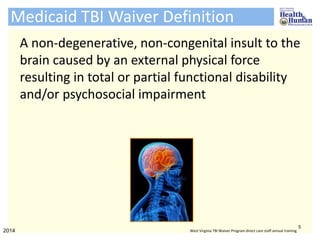
Medicaid TBI Waiver Definition
A non-degenerative, non-congenital insult to the
brain caused by an external physical force
resulting in total or partial functional disability
and/or psychosocial impairment
5
2014 West Virginia TBI Waiver Program direct care staff annual training
Overview of Traumatic Brain Injury
In 2010, about 2.5 million emergency department visits,
hospitalizations, or deaths were associated with TBI—
either alone or in combination with other injuries—in
the United States
Centers for Disease Control and Prevention
6
2014 West Virginia TBI Waiver Program direct care staff annual training
Overview of Traumatic Brain Injury
• Falls were the leading cause of TBI-related ED visits
for every age group
• Motor vehicle crashes were the leading cause of
hospitalizations for adolescents and young adults
ages 15-44 years
Centers for Disease Control and Prevention
7
2014 West Virginia TBI Waiver Program direct care staff annual training
Why the focus on Community Integration?
• Advances in acute care medicine means higher
survival rates after TBI
• Changes in the health care climate means shorter
rehabilitation stays or no rehabilitation at all
• People with TBI are being discharged with greater
disability
• People are being cared for in the community
8
2014 West Virginia TBI Waiver Program direct care staff annual training
What is Community Integration?
The opportunity to live in the community and be
valued for one's uniqueness and abilities, like
everyone else (Salzer, 2006)
9
2014 West Virginia TBI Waiver Program direct care staff annual training
What is Community Integration?
• Housing
• Employment
• Education
• Health Status
• Leisure/Recreation
• Spirituality/Religion
10
2014 West Virginia TBI Waiver Program direct care staff annual training
• Peer Support
• Valued Social Roles
(e.g., marriage,
parenting)
• Self-Determination
• Citizenship and Civic
Engagement
What is Community Integration?
• Independence
• Relationships
• Meaningful activities to engage in
“. . . having something to do, somewhere to live, and someone
to love” (Jacobs, 1993)
11
2014 West Virginia TBI Waiver Program direct care staff annual training
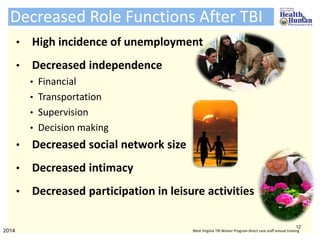
Decreased Role Functions After TBI
• High incidence of unemployment
• Decreased independence
• Financial
• Transportation
• Supervision
• Decision making
• Decreased social network size
• Decreased intimacy
• Decreased participation in leisure activities
12
2014 West Virginia TBI Waiver Program direct care staff annual training
Successful Community Integration Is
• ACTIVE participation in a broad range of community
involvement
• It is NOT a narrow series of opportunities such as
employment or independent living
13
2014 West Virginia TBI Waiver Program direct care staff annual training
Important Roles in Our Culture
OUR ROLES ARE SYMBOLS OF NORMALITY AND ALLOW US TO
FEEL PART OF THE LARGER COMMUNITY. THESE MIGHT
INCLUDE:
• Work
• Love
• Play (leisure and creative)
14
2014 West Virginia TBI Waiver Program direct care staff annual training
Social and Emotional Impact of TBI
• Decreased social network size and loss of pre-injury
friendships
• Loneliness
• Family often becomes the primary source of social
and leisure activity
• Close relationships with others is a key component of
community integration
• Decrease in these relationships is most often listed as
the reason for a lack of integration
15
2014 West Virginia TBI Waiver Program direct care staff annual training
Read this article
CLICK THE LINK BELOW TO GO TO THE CARRICK BRAIN
CENTER BLOG
HOW TO HELP TBI SUFFERERS NAVIGATE SOCIAL AND
LEISURE ACTIVITIES AFTER INJURY
16
2014 West Virginia TBI Waiver Program direct care staff annual training
Approaches to Successful Community Integration
• Take a comprehensive view of community integration
• What are the priorities, values, and interests of the person
• Include social and leisure interests
• Focus on personal choice & empowerment
• What the member does in the community is for THEM not
you
• Emphasize sustainability beyond the waiver program
• Support the person making new connections and
friendships that will continue even if they are not in the
waiver program
• Emphasize changing the environment to maximize
integration
• This includes the home AND the community
17
2014 West Virginia TBI Waiver Program direct care staff annual training
Improving Community Integration
• Increase family and community awareness of
community integration and brain injury
• Develop and use peer support programs
• Social activities
• Workplace
• Partner with community organizations to increase
understanding of TBI
18
2014 West Virginia TBI Waiver Program direct care staff annual training
Training Family Members as Paraprofessionals
• Family members often become the sole source of
support after a TBI
• Family members have first-hand knowledge of
functional needs and environmental obstacles
• Consistent carryover means a greater opportunity for
successful integration
19
2014 West Virginia TBI Waiver Program direct care staff annual training
Rosemary and Hugh Rawlins’ life was turned upside
down on April 13, 2002, when Hugh was hit by a car
while riding his bicycle.
Click on the link to one of Rosemary’s blog entries on
brainline.org to see how this family is a resource in
community integration.
http://www.brainline.org/content/2013/09/pebbles-
of-progress.html
Families as a Resource
20
2014 West Virginia TBI Waiver Program direct care staff annual training
• Differs from traditional peer mentor programs
• Primary purpose is to EXPAND the social network
rather than to provide other types of assistance
(e.g., providing education about TBI resources,
support in adjustment to disability, etc.)
Social Peer Mentors
21
2014 West Virginia TBI Waiver Program direct care staff annual training
• A friend
• A role model
• A resource
• Committed to making consistent, regular contact
NOT . . .
• A romantic partner
• Respite care or “sitter”
• A credit card or ATM
• A therapist
• Judge, moralist, or savior
A Social Peer Mentor is . . .
22
2014 West Virginia TBI Waiver Program direct care staff annual training
• Community integration should
• be defined in a comprehensive way
• address all aspects that are important to the
person
• Partner with organizations in the community
• to increase integration
• develop meaning for persons with injury
• Focus on increasing sustainability beyond the
waiver program
• Train/support
• Family members
• Social peer mentors
Summary
23
2014 West Virginia TBI Waiver Program direct care staff annual training
Additional Resources and Readings
YOU MAY WANT TO EXPLORE ADDITIONAL RESOURCES
TO EXPAND YOUR KNOWLEDGE BASE AND JOB SKILLS*
Here are just a few:
• brainline.org
• Brain Injury Association of America
• Centers for Disease Control and Prevention: TBI
• National Directory of Brain Injury Services
• National Resource Center for Traumatic Brain Injury
• TBI Services at Center for Excellence in Disabilities
1-877-724-8244 TBI@hsc.wvu.edu
24
2014 West Virginia TBI Waiver Program direct care staff annual training
*If you are seeking formal training please check with your employer to make sure the internet training
provider has been approved by APS Healthcare before you take the training
Next Steps
• To receive your certificate of successful completion
you must first pass the test and complete an online
evaluation
• A score of 70% or higher is required
• Once you have successfully completed this training
module you will receive an email with your certificate
of completion
• Click this link to go to the
test:http://tbi.cedwvu.org/trainings/community-
integration.php
25
2014 West Virginia TBI Waiver Program direct care staff annual training
Thank You for Your Thoughts
• Please click this link to go to the online evaluation
http://tbi.cedwvu.org/trainings/community-
integration.php
• Your thoughts and comments are very important to
us
THANK YOU!
26
2014 West Virginia TBI Waiver Program direct care staff annual training

Community Integration After TBI

  • 1.
    Improving Community Integration afterTraumatic Brain Injury Successful completion of this training meets one hour of the four hour annual training requirement for Personal Attendant Services direct care staff as provided through the WV TBI Waiver Program
  • 2.
    Disclaimer Information included inthis presentation was current at the time it was developed Presentation materials are reviewed on an annual basis 1 2014 West Virginia TBI Waiver Program direct care staff annual training
  • 3.
    Author MELODEE A HURSEY,MSW, LSW, CBIST APS HEALTHCARE, INC. TBI WAIVER PROGRAM PROVIDER EDUCATOR Ms Hursey is a Certified Brain Injury Specialist Trainer through the Academy of Certified Brain Injury Specialists and a West Virginia Licensed Social Worker. She has more than 17 years of brain injury experience in a variety of areas including rehabilitation, waiver, support group facilitation, training, and program development. CONTACT INFORMATION: mhursey@apshealthcare.com 304-964-9007 2 2014 West Virginia TBI Waiver Program direct care staff annual training
  • 4.
    Learning Objectives • Describecommunity integration in a comprehensive way • Describe two methods that can be used to help persons with brain injury return to their home and community 3 2014 West Virginia TBI Waiver Program direct care staff annual training
  • 5.
    Overview of TraumaticBrain Injury Traumatic Brain Injury (TBI) is an insult to the brain not of a degenerative or congenital nature caused by an external physical force, that may produce a diminished or altered state of consciousness resulting in an impairment of cognitive abilities or physical functioning. It can also result in the disturbance of behavioral or emotional functioning, may be temporary or permanent and cause partial or total functional disability or psychosocial maladjustment. National Head Injury Foundation (now the Brain Injury Association of America) 4 2014 West Virginia TBI Waiver Program direct care staff annual training
  • 6.
    Medicaid TBI WaiverDefinition A non-degenerative, non-congenital insult to the brain caused by an external physical force resulting in total or partial functional disability and/or psychosocial impairment 5 2014 West Virginia TBI Waiver Program direct care staff annual training
  • 7.
    Overview of TraumaticBrain Injury In 2010, about 2.5 million emergency department visits, hospitalizations, or deaths were associated with TBI— either alone or in combination with other injuries—in the United States Centers for Disease Control and Prevention 6 2014 West Virginia TBI Waiver Program direct care staff annual training
  • 8.
    Overview of TraumaticBrain Injury • Falls were the leading cause of TBI-related ED visits for every age group • Motor vehicle crashes were the leading cause of hospitalizations for adolescents and young adults ages 15-44 years Centers for Disease Control and Prevention 7 2014 West Virginia TBI Waiver Program direct care staff annual training
  • 9.
    Why the focuson Community Integration? • Advances in acute care medicine means higher survival rates after TBI • Changes in the health care climate means shorter rehabilitation stays or no rehabilitation at all • People with TBI are being discharged with greater disability • People are being cared for in the community 8 2014 West Virginia TBI Waiver Program direct care staff annual training
  • 10.
    What is CommunityIntegration? The opportunity to live in the community and be valued for one's uniqueness and abilities, like everyone else (Salzer, 2006) 9 2014 West Virginia TBI Waiver Program direct care staff annual training
  • 11.
    What is CommunityIntegration? • Housing • Employment • Education • Health Status • Leisure/Recreation • Spirituality/Religion 10 2014 West Virginia TBI Waiver Program direct care staff annual training • Peer Support • Valued Social Roles (e.g., marriage, parenting) • Self-Determination • Citizenship and Civic Engagement
  • 12.
    What is CommunityIntegration? • Independence • Relationships • Meaningful activities to engage in “. . . having something to do, somewhere to live, and someone to love” (Jacobs, 1993) 11 2014 West Virginia TBI Waiver Program direct care staff annual training
  • 13.
    Decreased Role FunctionsAfter TBI • High incidence of unemployment • Decreased independence • Financial • Transportation • Supervision • Decision making • Decreased social network size • Decreased intimacy • Decreased participation in leisure activities 12 2014 West Virginia TBI Waiver Program direct care staff annual training
  • 14.
    Successful Community IntegrationIs • ACTIVE participation in a broad range of community involvement • It is NOT a narrow series of opportunities such as employment or independent living 13 2014 West Virginia TBI Waiver Program direct care staff annual training
  • 15.
    Important Roles inOur Culture OUR ROLES ARE SYMBOLS OF NORMALITY AND ALLOW US TO FEEL PART OF THE LARGER COMMUNITY. THESE MIGHT INCLUDE: • Work • Love • Play (leisure and creative) 14 2014 West Virginia TBI Waiver Program direct care staff annual training
  • 16.
    Social and EmotionalImpact of TBI • Decreased social network size and loss of pre-injury friendships • Loneliness • Family often becomes the primary source of social and leisure activity • Close relationships with others is a key component of community integration • Decrease in these relationships is most often listed as the reason for a lack of integration 15 2014 West Virginia TBI Waiver Program direct care staff annual training
  • 17.
    Read this article CLICKTHE LINK BELOW TO GO TO THE CARRICK BRAIN CENTER BLOG HOW TO HELP TBI SUFFERERS NAVIGATE SOCIAL AND LEISURE ACTIVITIES AFTER INJURY 16 2014 West Virginia TBI Waiver Program direct care staff annual training
  • 18.
    Approaches to SuccessfulCommunity Integration • Take a comprehensive view of community integration • What are the priorities, values, and interests of the person • Include social and leisure interests • Focus on personal choice & empowerment • What the member does in the community is for THEM not you • Emphasize sustainability beyond the waiver program • Support the person making new connections and friendships that will continue even if they are not in the waiver program • Emphasize changing the environment to maximize integration • This includes the home AND the community 17 2014 West Virginia TBI Waiver Program direct care staff annual training
  • 19.
    Improving Community Integration •Increase family and community awareness of community integration and brain injury • Develop and use peer support programs • Social activities • Workplace • Partner with community organizations to increase understanding of TBI 18 2014 West Virginia TBI Waiver Program direct care staff annual training
  • 20.
    Training Family Membersas Paraprofessionals • Family members often become the sole source of support after a TBI • Family members have first-hand knowledge of functional needs and environmental obstacles • Consistent carryover means a greater opportunity for successful integration 19 2014 West Virginia TBI Waiver Program direct care staff annual training
  • 21.
    Rosemary and HughRawlins’ life was turned upside down on April 13, 2002, when Hugh was hit by a car while riding his bicycle. Click on the link to one of Rosemary’s blog entries on brainline.org to see how this family is a resource in community integration. http://www.brainline.org/content/2013/09/pebbles- of-progress.html Families as a Resource 20 2014 West Virginia TBI Waiver Program direct care staff annual training
  • 22.
    • Differs fromtraditional peer mentor programs • Primary purpose is to EXPAND the social network rather than to provide other types of assistance (e.g., providing education about TBI resources, support in adjustment to disability, etc.) Social Peer Mentors 21 2014 West Virginia TBI Waiver Program direct care staff annual training
  • 23.
    • A friend •A role model • A resource • Committed to making consistent, regular contact NOT . . . • A romantic partner • Respite care or “sitter” • A credit card or ATM • A therapist • Judge, moralist, or savior A Social Peer Mentor is . . . 22 2014 West Virginia TBI Waiver Program direct care staff annual training
  • 24.
    • Community integrationshould • be defined in a comprehensive way • address all aspects that are important to the person • Partner with organizations in the community • to increase integration • develop meaning for persons with injury • Focus on increasing sustainability beyond the waiver program • Train/support • Family members • Social peer mentors Summary 23 2014 West Virginia TBI Waiver Program direct care staff annual training
  • 25.
    Additional Resources andReadings YOU MAY WANT TO EXPLORE ADDITIONAL RESOURCES TO EXPAND YOUR KNOWLEDGE BASE AND JOB SKILLS* Here are just a few: • brainline.org • Brain Injury Association of America • Centers for Disease Control and Prevention: TBI • National Directory of Brain Injury Services • National Resource Center for Traumatic Brain Injury • TBI Services at Center for Excellence in Disabilities 1-877-724-8244 TBI@hsc.wvu.edu 24 2014 West Virginia TBI Waiver Program direct care staff annual training *If you are seeking formal training please check with your employer to make sure the internet training provider has been approved by APS Healthcare before you take the training
  • 26.
    Next Steps • Toreceive your certificate of successful completion you must first pass the test and complete an online evaluation • A score of 70% or higher is required • Once you have successfully completed this training module you will receive an email with your certificate of completion • Click this link to go to the test:http://tbi.cedwvu.org/trainings/community- integration.php 25 2014 West Virginia TBI Waiver Program direct care staff annual training
  • 27.
    Thank You forYour Thoughts • Please click this link to go to the online evaluation http://tbi.cedwvu.org/trainings/community- integration.php • Your thoughts and comments are very important to us THANK YOU! 26 2014 West Virginia TBI Waiver Program direct care staff annual training