Successful completion of this training meets one hour of the four hour annual training requirement
for Personal Attendant Services direct care staff as provided through the TBI Waiver Program
•

•

2013

Information included in this presentation was
current at the time it was developed.
Presentation materials are reviewed on an
annual basis.

West Virginia TBI Waiver Program direct care staff annual training

2
Christopher J George, MSW, LGSW, CBIS
Kaylynn Shepherd, LICSW, CBIS
Jeanette Motsch, MS, CBIS
Amanda M Wilson, M.A.
Ashley Young, CBIS
Traumatic Brain Injury Services at the Center for Excellence in
Disabilities

Contact information:
www.cedwvu.org/programs/tbi
Toll Free: 1-877-724-8244

2013

West Virginia TBI Waiver Program direct care staff annual training

3
Upon completion of this training participants
will be able to:
•

Define Traumatic Brain Injury (TBI)

•

Describe the basic anatomy of the brain

•

Identify three impairments as a result of Traumatic Brain
Injury (TBI)

2013

West Virginia TBI Waiver Program direct care staff annual training

4
Traumatic Brain Injury (TBI) is

an insult to the brain not of a degenerative or
congenital nature caused by an external physical
force, that may produce a diminished or altered state of
consciousness resulting in an impairment of cognitive
abilities or physical functioning. It can also result in the
disturbance of behavioral or emotional functioning, may
be temporary or permanent and cause partial or total
functional disability or psychosocial maladjustment

National Head Injury Foundation
(now the Brain Injury Association of America)

2013

West Virginia TBI Waiver Program direct care staff annual training

5
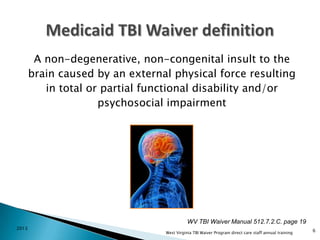
A non-degenerative, non-congenital insult to the
brain caused by an external physical force resulting
in total or partial functional disability and/or
psychosocial impairment

WV TBI Waiver Manual 512.7.2.C. page 19
2013

West Virginia TBI Waiver Program direct care staff annual training

6
•

•

Every 23 seconds, one person in the United
States sustains a traumatic brain injury
Each year, an estimated 1.7 million people
sustain a TBI
Centers for Disease Control and Prevention

2013

West Virginia TBI Waiver Program direct care staff annual training

7
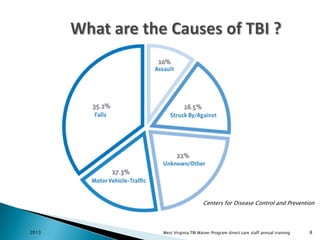
Centers for Disease Control and Prevention

2013

West Virginia TBI Waiver Program direct care staff annual training

8
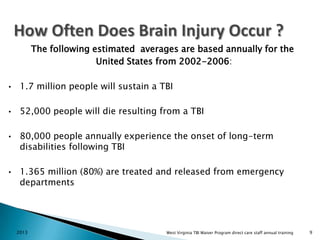
The following estimated averages are based annually for the
United States from 2002-2006:
•

1.7 million people will sustain a TBI

•

52,000 people will die resulting from a TBI

•

80,000 people annually experience the onset of long-term
disabilities following TBI

•

1.365 million (80%) are treated and released from emergency
departments

2013

West Virginia TBI Waiver Program direct care staff annual training

9
•

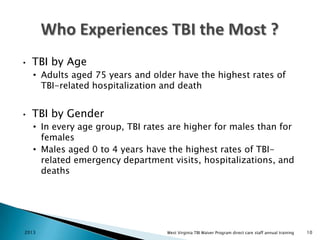
TBI by Age
• Adults aged 75 years and older have the highest rates of
TBI-related hospitalization and death

•

TBI by Gender
• In every age group, TBI rates are higher for males than for
females
• Males aged 0 to 4 years have the highest rates of TBIrelated emergency department visits, hospitalizations, and
deaths

2013

West Virginia TBI Waiver Program direct care staff annual training

10
Traumatic Brain Injury (TBI) is often referred to as
some of the following:
• The “Silent Epidemic”

• The “Signature Wound” of returning veterans
• Having your bell rung

2013

West Virginia TBI Waiver Program direct care staff annual training

11
Watch the following video
“Relearning Everything”

http://www.youtube.com/watch?v=-DXKS9uCIc0

2013

West Virginia TBI Waiver Program direct care staff annual training

12
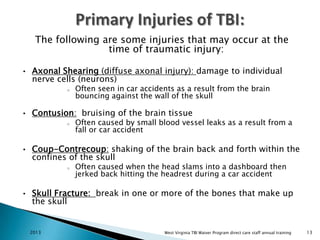
The following are some injuries that may occur at the
time of traumatic injury:
•

Axonal Shearing (diffuse axonal injury): damage to individual
nerve cells (neurons)
o

•

Contusion: bruising of the brain tissue
o

•

Often caused by small blood vessel leaks as a result from a
fall or car accident

Coup-Contrecoup: shaking of the brain back and forth within the
confines of the skull
o

•

Often seen in car accidents as a result from the brain
bouncing against the wall of the skull

Often caused when the head slams into a dashboard then
jerked back hitting the headrest during a car accident

Skull Fracture: break in one or more of the bones that make up
the skull

2013

West Virginia TBI Waiver Program direct care staff annual training

13
2013

West Virginia TBI Waiver Program direct care staff annual training

14
2013

West Virginia TBI Waiver Program direct care staff annual training

15
2013

West Virginia TBI Waiver Program direct care staff annual training

16
The following are some injuries that may occur after
the trauma:
•

Hematomas: Accumulation of blood or a collection of blood
trapped in the tissue of the brain.

•

Increased Intracranial Pressure: Pressure inside the skull that
builds as the brain swells.

•

Seizure Disorder: Disorderly discharge or electrical activity in
the nerve cells of the brain.

2013

West Virginia TBI Waiver Program direct care staff annual training

17
•

The Brain is comprised of nerve cells
o
Consistency similar to spaghetti

•

The Brain fits tightly within the skull
o
Surrounded by fluid called cerebrospinal

•

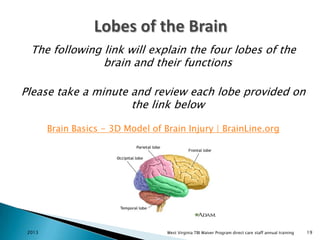
The Brain is divided into four lobes
o
Frontal
o
Occipital
o
Parietal
o
Temporal

2013

West Virginia TBI Waiver Program direct care staff annual training

18
The following link will explain the four lobes of the
brain and their functions
Please take a minute and review each lobe provided on
the link below
Brain Basics - 3D Model of Brain Injury | BrainLine.org

2013

West Virginia TBI Waiver Program direct care staff annual training

19
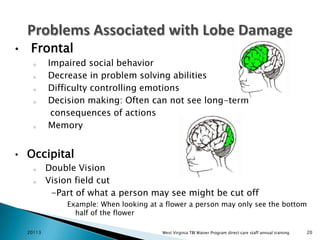
•

Frontal
o
o
o
o

o

•

Impaired social behavior
Decrease in problem solving abilities
Difficulty controlling emotions
Decision making: Often can not see long-term
consequences of actions
Memory

Occipital
o
o

Double Vision
Vision field cut
-Part of what a person may see might be cut off
Example: When looking at a flower a person may only see the bottom
half of the flower

20113

West Virginia TBI Waiver Program direct care staff annual training

20
•

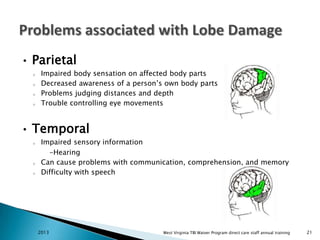
Parietal
o
o
o
o

•

Impaired body sensation on affected body parts
Decreased awareness of a person’s own body parts
Problems judging distances and depth
Trouble controlling eye movements

Temporal
o

o

o

Impaired sensory information
-Hearing
Can cause problems with communication, comprehension, and memory
Difficulty with speech

2013

West Virginia TBI Waiver Program direct care staff annual training

21
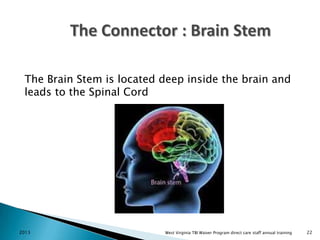
The Brain Stem is located deep inside the brain and
leads to the Spinal Cord

2013

West Virginia TBI Waiver Program direct care staff annual training

22
The Brain Stem controls many arousal and
basic life functions like the following:
•

Respiratory and Cardiac Centers
o
o
o

•

Breathing
Heart Rate
Swallowing

Autonomic Nervous System
o

o
o
o

Sweating
Blood Pressure
Digestion
Body Temperature

•

Reflexes to Seeing and Hearing

•

Ability to Sleep

2013

West Virginia TBI Waiver Program direct care staff annual training

23
When someone has experienced damage to the
brain stem they may experience
some of the following:
•

Dizziness and Nausea
o

May also be known as Vertigo

•

Insomnia

•

Difficulty swallowing
o

•

May also be known as Dysphagia

Difficulty with organization/perception of the
environment

2013

West Virginia TBI Waiver Program direct care staff annual training

24
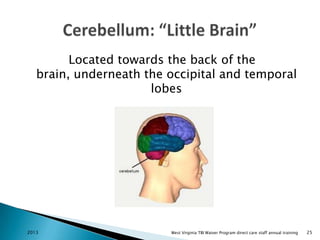
Located towards the back of the
brain, underneath the occipital and temporal
lobes

2013

West Virginia TBI Waiver Program direct care staff annual training

25
The Cerebellum is also known as “little brain”
because it controls many of the following:
•

Movement
o
o
o
o

Direction
Rate
Force
Steadiness

•

Muscle Tone

•

Posture

•

Hand/Eye Movement

2013

West Virginia TBI Waiver Program direct care staff annual training

26
When someone has experienced damage to the
cerebellum they may experience trouble with some
of the following:
•

Walking
o May appear “drunk” when walking

•

Balance

•

Fine Motor Movement

•

Coordination

2013

West Virginia TBI Waiver Program direct care staff annual training

27
•

Learning to work with those who have a
Traumatic Brain Injury (TBI) takes time

•

Recovery time will vary from person to person

•

Change and improvement can continue for
many years

•

Continued communication and consistency will
assist with the recovery process

2013

West Virginia TBI Waiver Program direct care staff annual training

28
U.S. Department of Health and Human Services
Centers for Disease Control and Prevention,

http://www.cdc.gov/TraumaticBrainInjury/
Brain Injury Association of America: The Essential Brain Injury
Guide 4.0. Academy of Certified Brain Injury Specialist (2009)
BrainLine

http://www.brainline.org

2013

West Virginia TBI Waiver Program direct care staff annual training

29
Here are some additional resources that you may want to explore:
•
•
•

TBI Survivors View
Centers for Disease Control and Prevention: TBI
Center for Excellence in Disabilities at West Virginia University

CDC Injury and Violence Prevention and Control
http://www.cdc.gov/injury/index.html
Shepherd Center Learning Connections
http://myvitalconnections.org/webmanuals.nsf/3478d43e5c5c8dcb
85256ae60061f897/1B910B089562F1EB85257164006D34A7

2013

West Virginia TBI Waiver Program direct care staff annual training

30
•

•

•

To receive your certificate of successful completion
you must first pass the test and complete an online
evaluation
A score of 80% or higher is required
Once you have successfully completed this training
module you will receive an email with your
certificate of completion

2013

West Virginia TBI Waiver Program direct care staff annual training

31
•

Please scroll down and take the test below.

•

Your thoughts and comments are very important to
us. You may submit by clicking the survey link
below.

Thank You!
2013

West Virginia TBI Waiver Program direct care staff annual training

32

Tbi overview

  • 1.
    Successful completion ofthis training meets one hour of the four hour annual training requirement for Personal Attendant Services direct care staff as provided through the TBI Waiver Program
  • 2.
    • • 2013 Information included inthis presentation was current at the time it was developed. Presentation materials are reviewed on an annual basis. West Virginia TBI Waiver Program direct care staff annual training 2
  • 3.
    Christopher J George,MSW, LGSW, CBIS Kaylynn Shepherd, LICSW, CBIS Jeanette Motsch, MS, CBIS Amanda M Wilson, M.A. Ashley Young, CBIS Traumatic Brain Injury Services at the Center for Excellence in Disabilities Contact information: www.cedwvu.org/programs/tbi Toll Free: 1-877-724-8244 2013 West Virginia TBI Waiver Program direct care staff annual training 3
  • 4.
    Upon completion ofthis training participants will be able to: • Define Traumatic Brain Injury (TBI) • Describe the basic anatomy of the brain • Identify three impairments as a result of Traumatic Brain Injury (TBI) 2013 West Virginia TBI Waiver Program direct care staff annual training 4
  • 5.
    Traumatic Brain Injury(TBI) is an insult to the brain not of a degenerative or congenital nature caused by an external physical force, that may produce a diminished or altered state of consciousness resulting in an impairment of cognitive abilities or physical functioning. It can also result in the disturbance of behavioral or emotional functioning, may be temporary or permanent and cause partial or total functional disability or psychosocial maladjustment National Head Injury Foundation (now the Brain Injury Association of America) 2013 West Virginia TBI Waiver Program direct care staff annual training 5
  • 6.
    A non-degenerative, non-congenitalinsult to the brain caused by an external physical force resulting in total or partial functional disability and/or psychosocial impairment WV TBI Waiver Manual 512.7.2.C. page 19 2013 West Virginia TBI Waiver Program direct care staff annual training 6
  • 7.
    • • Every 23 seconds,one person in the United States sustains a traumatic brain injury Each year, an estimated 1.7 million people sustain a TBI Centers for Disease Control and Prevention 2013 West Virginia TBI Waiver Program direct care staff annual training 7
  • 8.
    Centers for DiseaseControl and Prevention 2013 West Virginia TBI Waiver Program direct care staff annual training 8
  • 9.
    The following estimatedaverages are based annually for the United States from 2002-2006: • 1.7 million people will sustain a TBI • 52,000 people will die resulting from a TBI • 80,000 people annually experience the onset of long-term disabilities following TBI • 1.365 million (80%) are treated and released from emergency departments 2013 West Virginia TBI Waiver Program direct care staff annual training 9
  • 10.
    • TBI by Age •Adults aged 75 years and older have the highest rates of TBI-related hospitalization and death • TBI by Gender • In every age group, TBI rates are higher for males than for females • Males aged 0 to 4 years have the highest rates of TBIrelated emergency department visits, hospitalizations, and deaths 2013 West Virginia TBI Waiver Program direct care staff annual training 10
  • 11.
    Traumatic Brain Injury(TBI) is often referred to as some of the following: • The “Silent Epidemic” • The “Signature Wound” of returning veterans • Having your bell rung 2013 West Virginia TBI Waiver Program direct care staff annual training 11
  • 12.
    Watch the followingvideo “Relearning Everything” http://www.youtube.com/watch?v=-DXKS9uCIc0 2013 West Virginia TBI Waiver Program direct care staff annual training 12
  • 13.
    The following aresome injuries that may occur at the time of traumatic injury: • Axonal Shearing (diffuse axonal injury): damage to individual nerve cells (neurons) o • Contusion: bruising of the brain tissue o • Often caused by small blood vessel leaks as a result from a fall or car accident Coup-Contrecoup: shaking of the brain back and forth within the confines of the skull o • Often seen in car accidents as a result from the brain bouncing against the wall of the skull Often caused when the head slams into a dashboard then jerked back hitting the headrest during a car accident Skull Fracture: break in one or more of the bones that make up the skull 2013 West Virginia TBI Waiver Program direct care staff annual training 13
  • 14.
    2013 West Virginia TBIWaiver Program direct care staff annual training 14
  • 15.
    2013 West Virginia TBIWaiver Program direct care staff annual training 15
  • 16.
    2013 West Virginia TBIWaiver Program direct care staff annual training 16
  • 17.
    The following aresome injuries that may occur after the trauma: • Hematomas: Accumulation of blood or a collection of blood trapped in the tissue of the brain. • Increased Intracranial Pressure: Pressure inside the skull that builds as the brain swells. • Seizure Disorder: Disorderly discharge or electrical activity in the nerve cells of the brain. 2013 West Virginia TBI Waiver Program direct care staff annual training 17
  • 18.
    • The Brain iscomprised of nerve cells o Consistency similar to spaghetti • The Brain fits tightly within the skull o Surrounded by fluid called cerebrospinal • The Brain is divided into four lobes o Frontal o Occipital o Parietal o Temporal 2013 West Virginia TBI Waiver Program direct care staff annual training 18
  • 19.
    The following linkwill explain the four lobes of the brain and their functions Please take a minute and review each lobe provided on the link below Brain Basics - 3D Model of Brain Injury | BrainLine.org 2013 West Virginia TBI Waiver Program direct care staff annual training 19
  • 20.
    • Frontal o o o o o • Impaired social behavior Decreasein problem solving abilities Difficulty controlling emotions Decision making: Often can not see long-term consequences of actions Memory Occipital o o Double Vision Vision field cut -Part of what a person may see might be cut off Example: When looking at a flower a person may only see the bottom half of the flower 20113 West Virginia TBI Waiver Program direct care staff annual training 20
  • 21.
    • Parietal o o o o • Impaired body sensationon affected body parts Decreased awareness of a person’s own body parts Problems judging distances and depth Trouble controlling eye movements Temporal o o o Impaired sensory information -Hearing Can cause problems with communication, comprehension, and memory Difficulty with speech 2013 West Virginia TBI Waiver Program direct care staff annual training 21
  • 22.
    The Brain Stemis located deep inside the brain and leads to the Spinal Cord 2013 West Virginia TBI Waiver Program direct care staff annual training 22
  • 23.
    The Brain Stemcontrols many arousal and basic life functions like the following: • Respiratory and Cardiac Centers o o o • Breathing Heart Rate Swallowing Autonomic Nervous System o o o o Sweating Blood Pressure Digestion Body Temperature • Reflexes to Seeing and Hearing • Ability to Sleep 2013 West Virginia TBI Waiver Program direct care staff annual training 23
  • 24.
    When someone hasexperienced damage to the brain stem they may experience some of the following: • Dizziness and Nausea o May also be known as Vertigo • Insomnia • Difficulty swallowing o • May also be known as Dysphagia Difficulty with organization/perception of the environment 2013 West Virginia TBI Waiver Program direct care staff annual training 24
  • 25.
    Located towards theback of the brain, underneath the occipital and temporal lobes 2013 West Virginia TBI Waiver Program direct care staff annual training 25
  • 26.
    The Cerebellum isalso known as “little brain” because it controls many of the following: • Movement o o o o Direction Rate Force Steadiness • Muscle Tone • Posture • Hand/Eye Movement 2013 West Virginia TBI Waiver Program direct care staff annual training 26
  • 27.
    When someone hasexperienced damage to the cerebellum they may experience trouble with some of the following: • Walking o May appear “drunk” when walking • Balance • Fine Motor Movement • Coordination 2013 West Virginia TBI Waiver Program direct care staff annual training 27
  • 28.
    • Learning to workwith those who have a Traumatic Brain Injury (TBI) takes time • Recovery time will vary from person to person • Change and improvement can continue for many years • Continued communication and consistency will assist with the recovery process 2013 West Virginia TBI Waiver Program direct care staff annual training 28
  • 29.
    U.S. Department ofHealth and Human Services Centers for Disease Control and Prevention, http://www.cdc.gov/TraumaticBrainInjury/ Brain Injury Association of America: The Essential Brain Injury Guide 4.0. Academy of Certified Brain Injury Specialist (2009) BrainLine http://www.brainline.org 2013 West Virginia TBI Waiver Program direct care staff annual training 29
  • 30.
    Here are someadditional resources that you may want to explore: • • • TBI Survivors View Centers for Disease Control and Prevention: TBI Center for Excellence in Disabilities at West Virginia University CDC Injury and Violence Prevention and Control http://www.cdc.gov/injury/index.html Shepherd Center Learning Connections http://myvitalconnections.org/webmanuals.nsf/3478d43e5c5c8dcb 85256ae60061f897/1B910B089562F1EB85257164006D34A7 2013 West Virginia TBI Waiver Program direct care staff annual training 30
  • 31.
    • • • To receive yourcertificate of successful completion you must first pass the test and complete an online evaluation A score of 80% or higher is required Once you have successfully completed this training module you will receive an email with your certificate of completion 2013 West Virginia TBI Waiver Program direct care staff annual training 31
  • 32.
    • Please scroll downand take the test below. • Your thoughts and comments are very important to us. You may submit by clicking the survey link below. Thank You! 2013 West Virginia TBI Waiver Program direct care staff annual training 32