Communication: Tool for
Agribusiness Success
Presentation by Davis Opoku Ansah
Siri Communications
www.siricomms.com
• Communication skills are critical to all
aspects of business development.
• Whether you are considering a new
venture or are well down the road and
revising your business plan, the ability
to exchange and gather information,
perhaps in high-stakes crucial
conversations, and to express the
attributes of your value-added product or
service honestly and without bias, can
make or break your business.
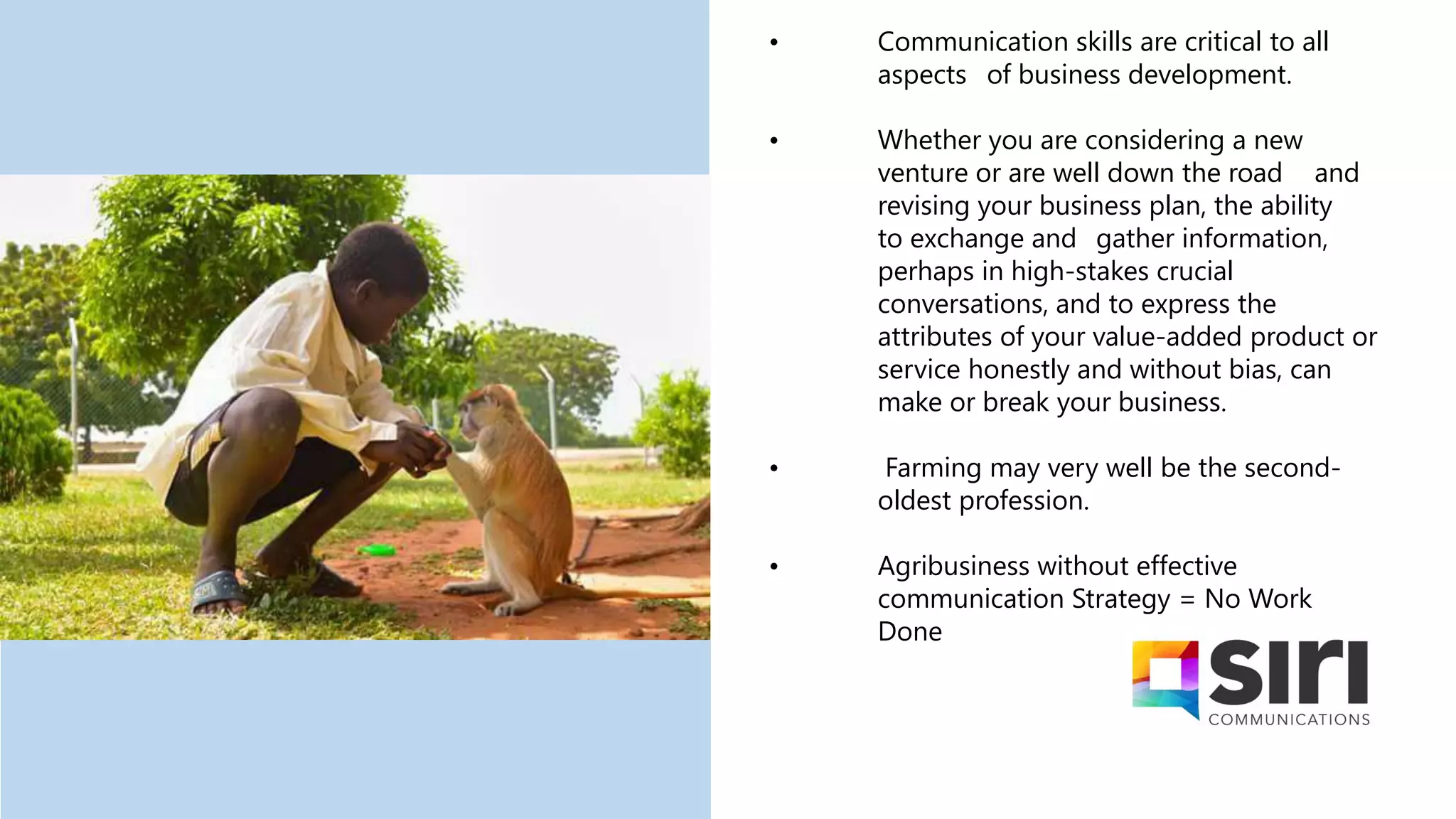
• Farming may very well be the second-
oldest profession.
• Agribusiness without effective
communication Strategy = No Work
Done
Digital Marketing- Social Media as a Tool
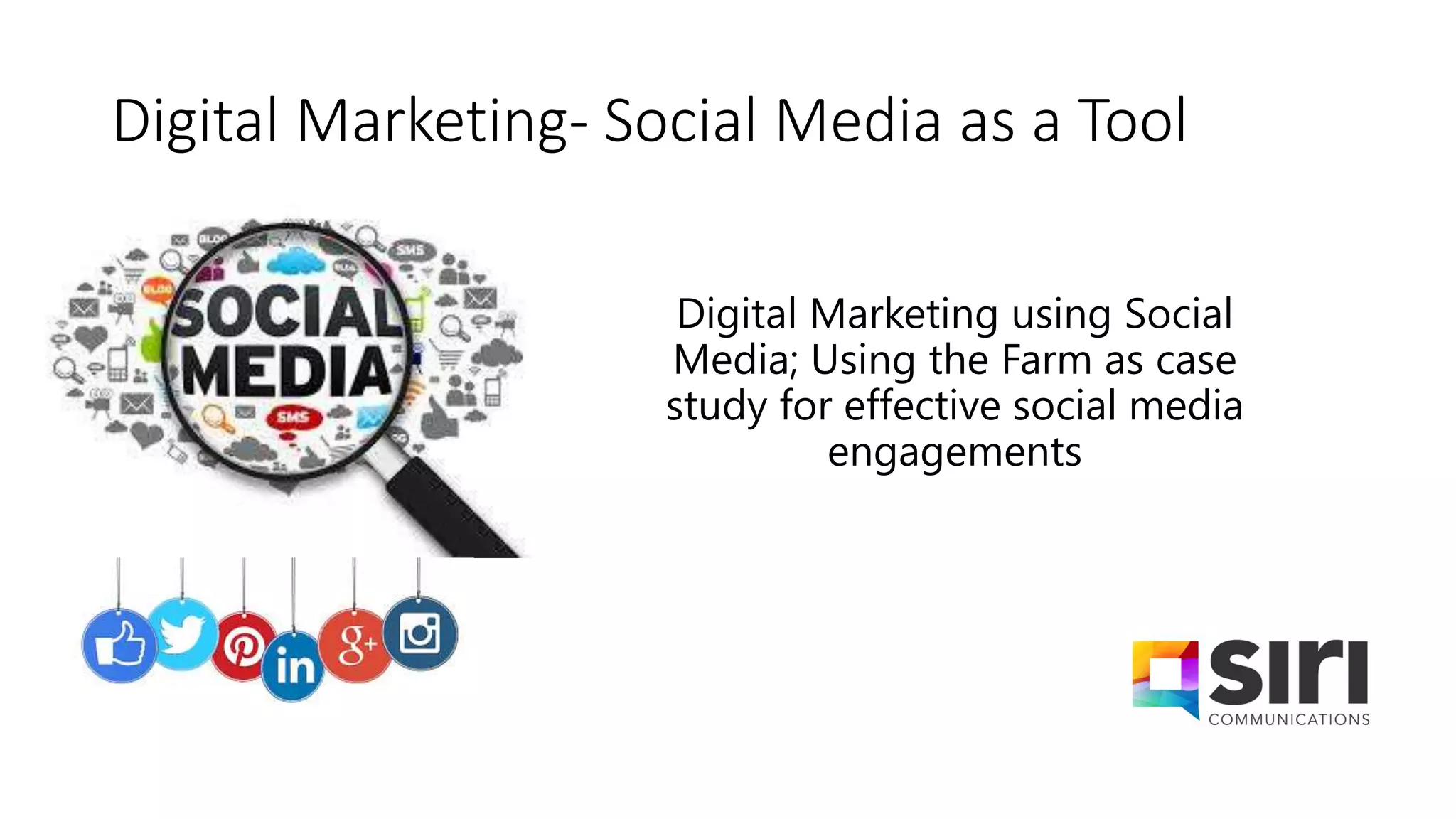
Digital Marketing using Social
Media; Using the Farm as case
study for effective social media
engagements
1. Pick Your Crops
• You don’t just cultivate whatever grows naturally on your
land. That’s called weeding, not farming. Farmers determine
what to grow based on expertise, market conditions, and
topography.
• In social media, it’s important to interact with customers
and prospects in real-time when relevant, but if you’re going
to create brand communities to facilitate those exchanges,
you can’t be everywhere. What’s right for your organization?
Facebook? LinkedIn? Twitter? A corporate blog? YouTube?
Instagram?
• You have to make a clear-headed decision about where
you’re going to deploy your social media resources.
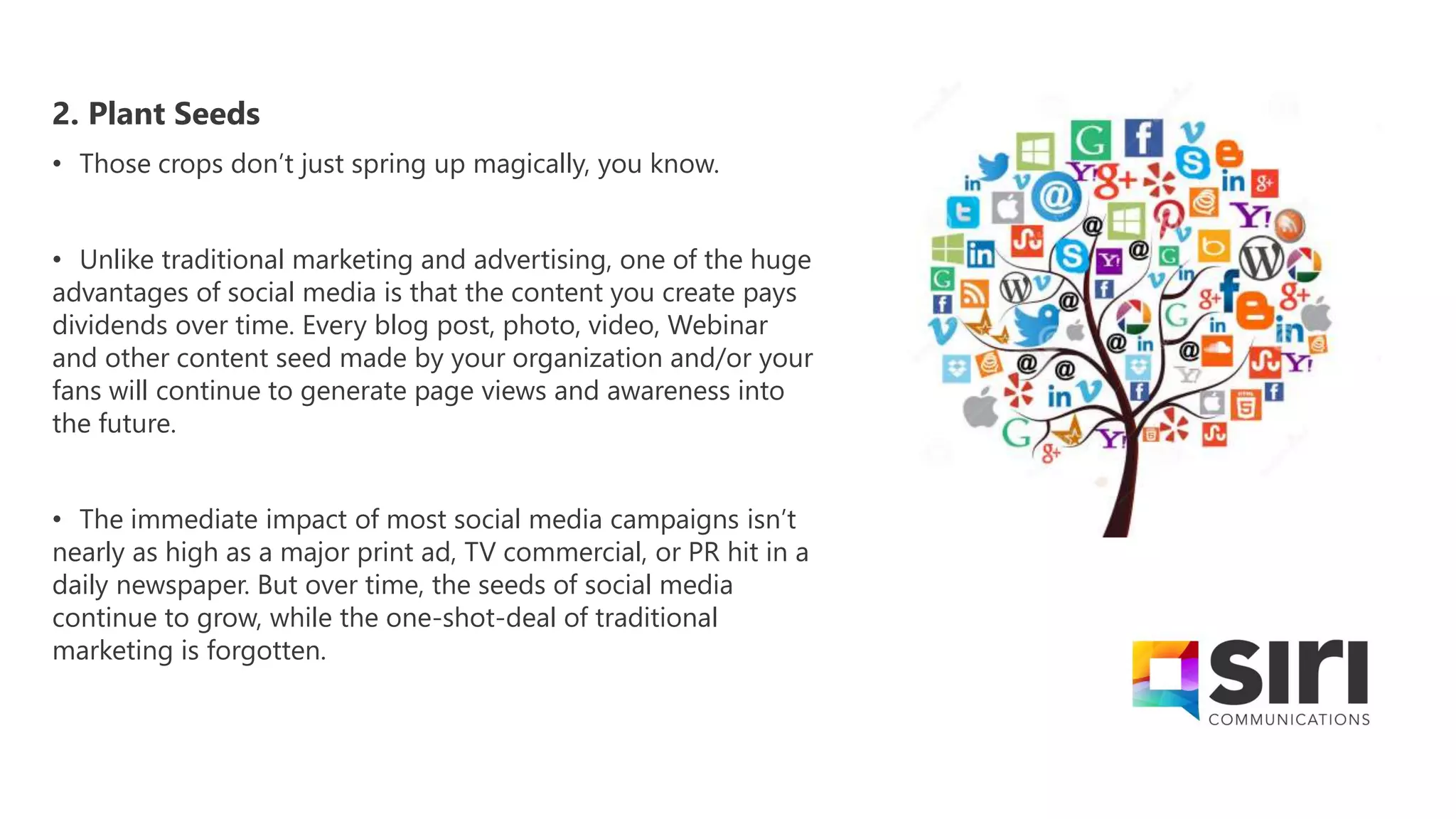
2. Plant Seeds
• Those crops don’t just spring up magically, you know.
• Unlike traditional marketing and advertising, one of the huge
advantages of social media is that the content you create pays
dividends over time. Every blog post, photo, video, Webinar
and other content seed made by your organization and/or your
fans will continue to generate page views and awareness into
the future.
• The immediate impact of most social media campaigns isn’t
nearly as high as a major print ad, TV commercial, or PR hit in a
daily newspaper. But over time, the seeds of social media
continue to grow, while the one-shot-deal of traditional
marketing is forgotten.
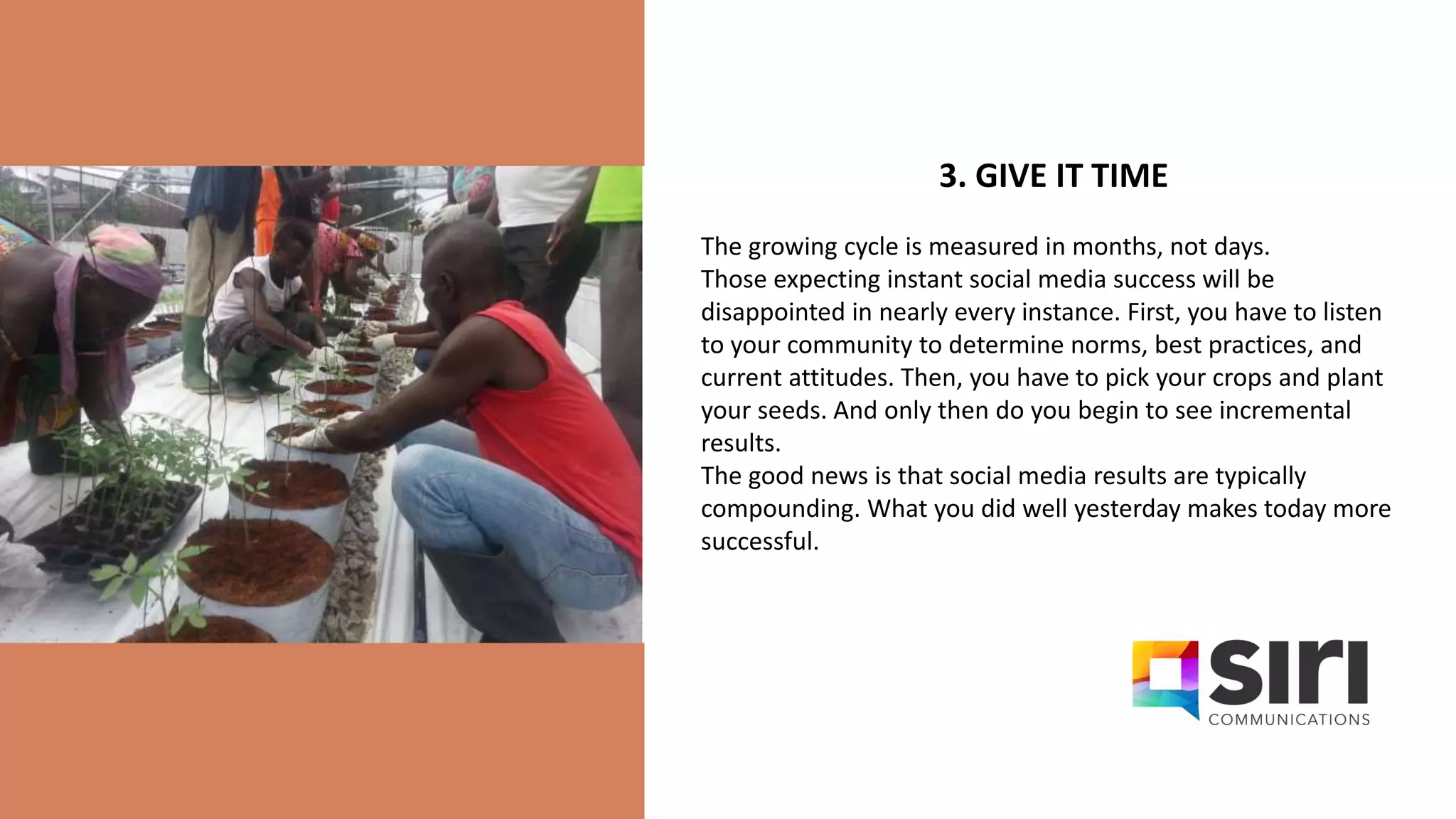
3. GIVE IT TIME
The growing cycle is measured in months, not days.
Those expecting instant social media success will be
disappointed in nearly every instance. First, you have to listen
to your community to determine norms, best practices, and
current attitudes. Then, you have to pick your crops and plant
your seeds. And only then do you begin to see incremental
results.
The good news is that social media results are typically
compounding. What you did well yesterday makes today more
successful.
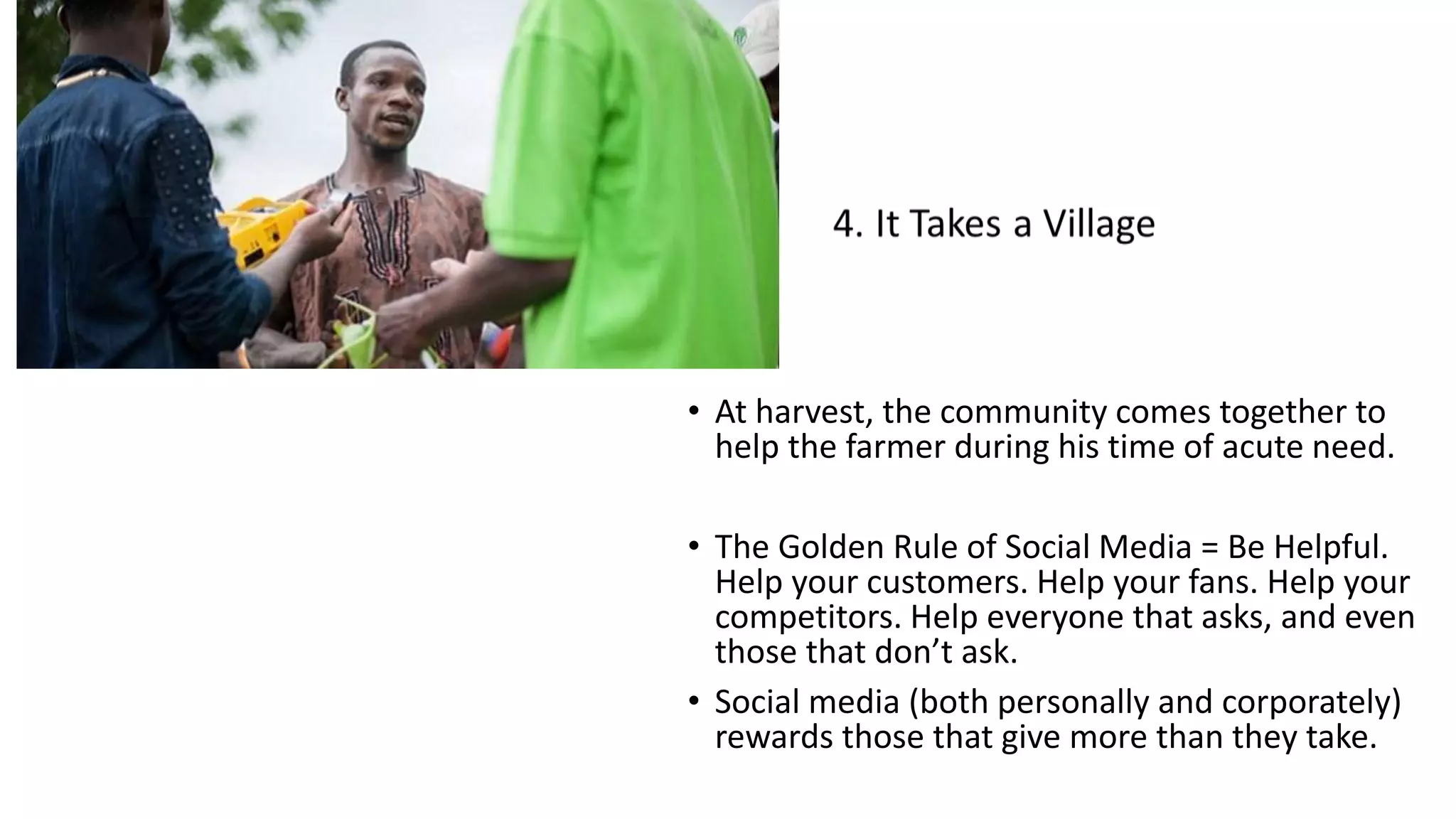
• At harvest, the community comes together to
help the farmer during his time of acute need.
• The Golden Rule of Social Media = Be Helpful.
Help your customers. Help your fans. Help your
competitors. Help everyone that asks, and even
those that don’t ask.
• Social media (both personally and corporately)
rewards those that give more than they take.
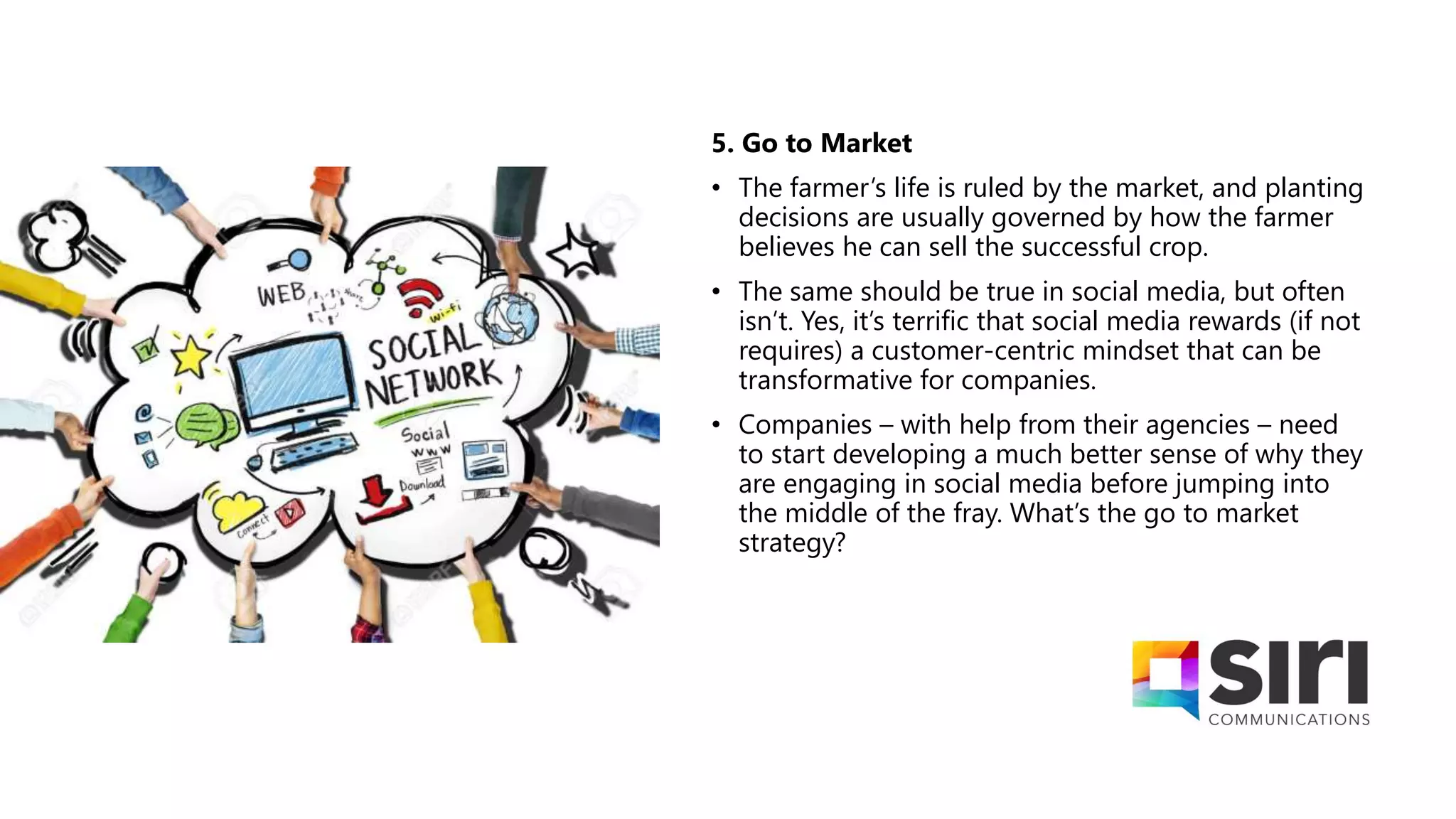
5. Go to Market
• The farmer’s life is ruled by the market, and planting
decisions are usually governed by how the farmer
believes he can sell the successful crop.
• The same should be true in social media, but often
isn’t. Yes, it’s terrific that social media rewards (if not
requires) a customer-centric mindset that can be
transformative for companies.
• Companies – with help from their agencies – need
to start developing a much better sense of why they
are engaging in social media before jumping into
the middle of the fray. What’s the go to market
strategy?
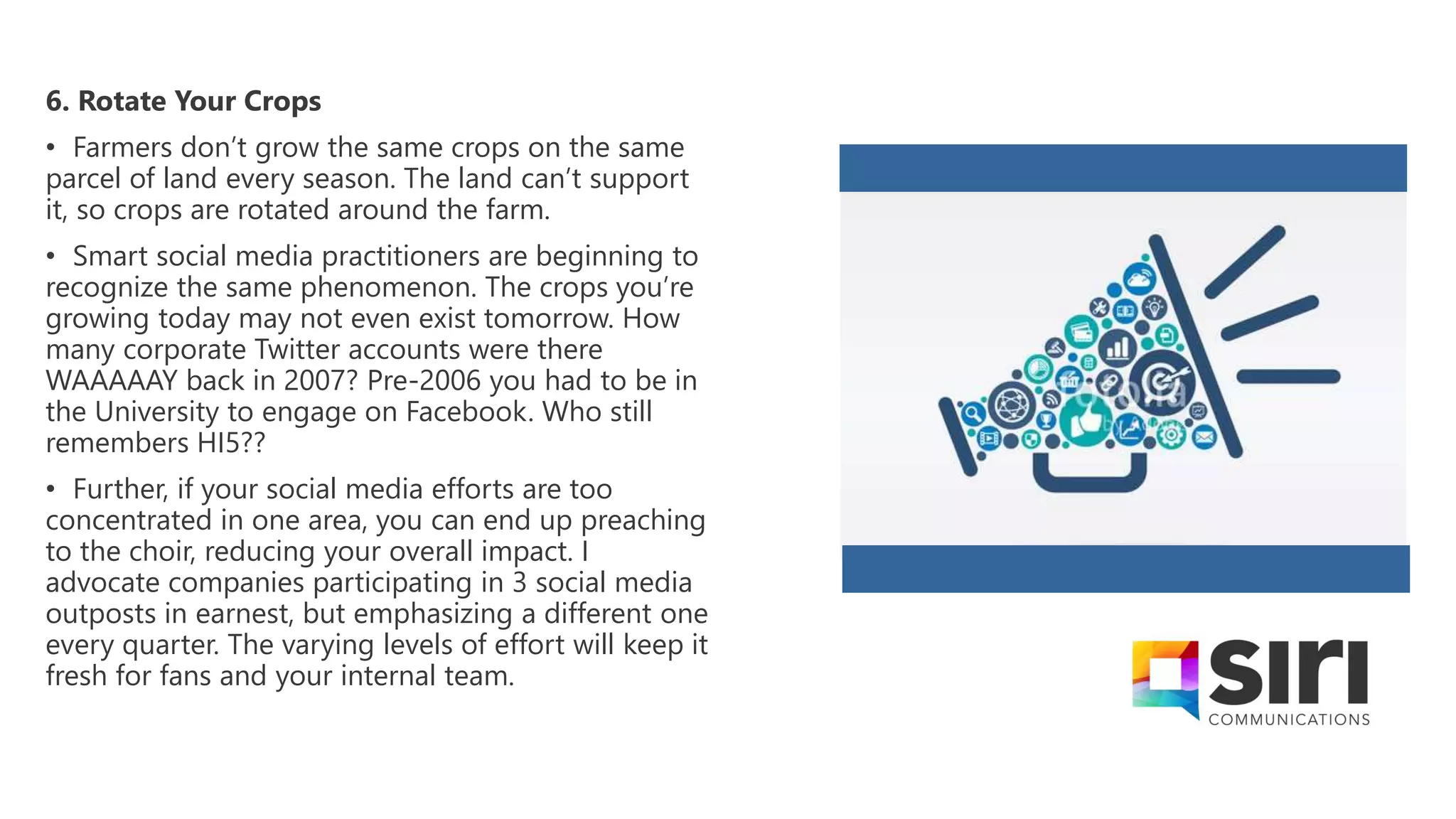
6. Rotate Your Crops
• Farmers don’t grow the same crops on the same
parcel of land every season. The land can’t support
it, so crops are rotated around the farm.
• Smart social media practitioners are beginning to
recognize the same phenomenon. The crops you’re
growing today may not even exist tomorrow. How
many corporate Twitter accounts were there
WAAAAAY back in 2007? Pre-2006 you had to be in
the University to engage on Facebook. Who still
remembers HI5??
• Further, if your social media efforts are too
concentrated in one area, you can end up preaching
to the choir, reducing your overall impact. I
advocate companies participating in 3 social media
outposts in earnest, but emphasizing a different one
every quarter. The varying levels of effort will keep it
fresh for fans and your internal team.
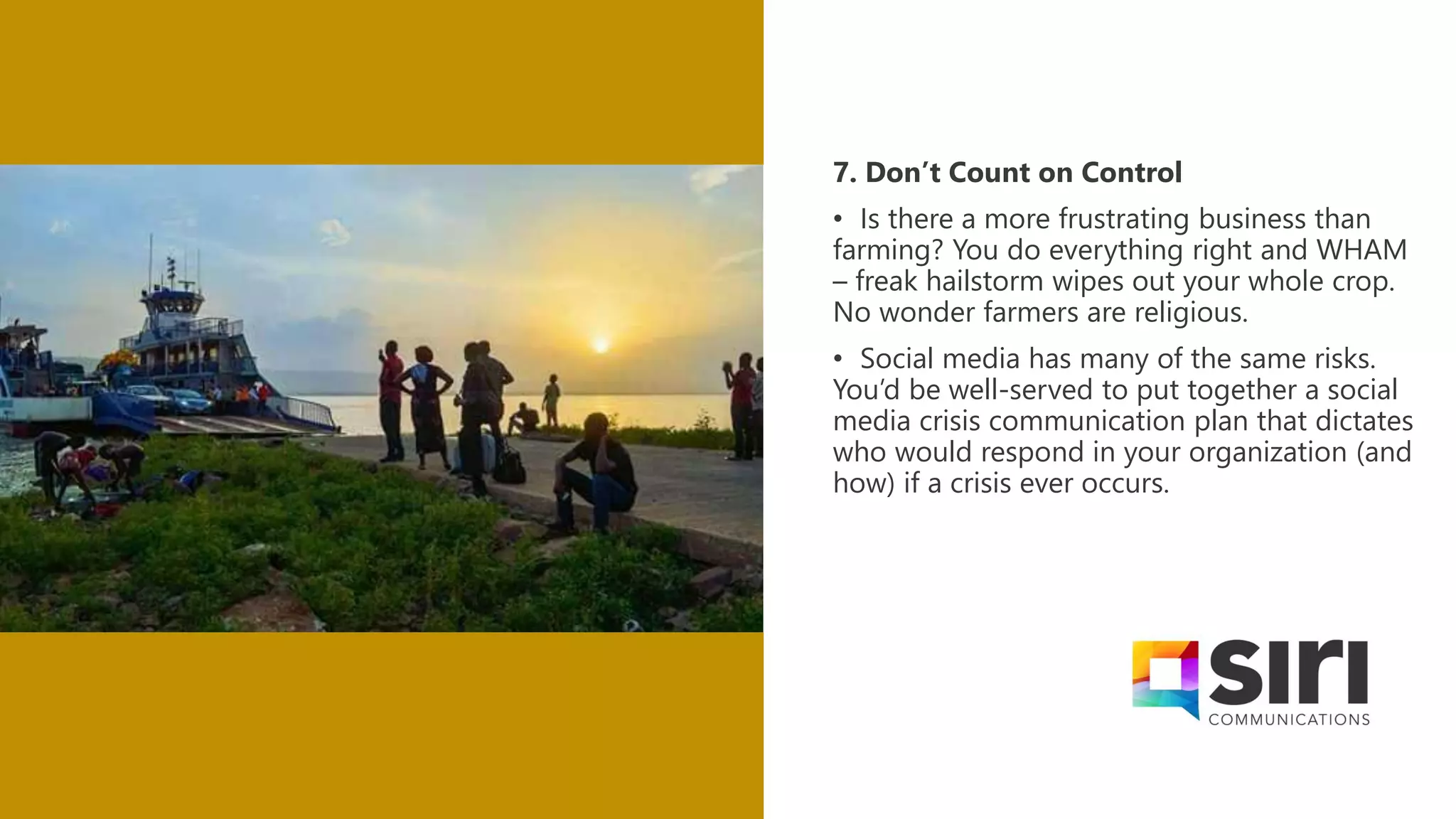
7. Don’t Count on Control
• Is there a more frustrating business than
farming? You do everything right and WHAM
– freak hailstorm wipes out your whole crop.
No wonder farmers are religious.
• Social media has many of the same risks.
You’d be well-served to put together a social
media crisis communication plan that dictates
who would respond in your organization (and
how) if a crisis ever occurs.
Communication_presentation

Communication_presentation

  • 1.
    Communication: Tool for AgribusinessSuccess Presentation by Davis Opoku Ansah Siri Communications www.siricomms.com
  • 2.
    • Communication skillsare critical to all aspects of business development. • Whether you are considering a new venture or are well down the road and revising your business plan, the ability to exchange and gather information, perhaps in high-stakes crucial conversations, and to express the attributes of your value-added product or service honestly and without bias, can make or break your business. • Farming may very well be the second- oldest profession. • Agribusiness without effective communication Strategy = No Work Done
  • 3.
    Digital Marketing- SocialMedia as a Tool Digital Marketing using Social Media; Using the Farm as case study for effective social media engagements
  • 4.
    1. Pick YourCrops • You don’t just cultivate whatever grows naturally on your land. That’s called weeding, not farming. Farmers determine what to grow based on expertise, market conditions, and topography. • In social media, it’s important to interact with customers and prospects in real-time when relevant, but if you’re going to create brand communities to facilitate those exchanges, you can’t be everywhere. What’s right for your organization? Facebook? LinkedIn? Twitter? A corporate blog? YouTube? Instagram? • You have to make a clear-headed decision about where you’re going to deploy your social media resources.
  • 5.
    2. Plant Seeds •Those crops don’t just spring up magically, you know. • Unlike traditional marketing and advertising, one of the huge advantages of social media is that the content you create pays dividends over time. Every blog post, photo, video, Webinar and other content seed made by your organization and/or your fans will continue to generate page views and awareness into the future. • The immediate impact of most social media campaigns isn’t nearly as high as a major print ad, TV commercial, or PR hit in a daily newspaper. But over time, the seeds of social media continue to grow, while the one-shot-deal of traditional marketing is forgotten.
  • 6.
    3. GIVE ITTIME The growing cycle is measured in months, not days. Those expecting instant social media success will be disappointed in nearly every instance. First, you have to listen to your community to determine norms, best practices, and current attitudes. Then, you have to pick your crops and plant your seeds. And only then do you begin to see incremental results. The good news is that social media results are typically compounding. What you did well yesterday makes today more successful.
  • 7.
    • At harvest,the community comes together to help the farmer during his time of acute need. • The Golden Rule of Social Media = Be Helpful. Help your customers. Help your fans. Help your competitors. Help everyone that asks, and even those that don’t ask. • Social media (both personally and corporately) rewards those that give more than they take.
  • 8.
    5. Go toMarket • The farmer’s life is ruled by the market, and planting decisions are usually governed by how the farmer believes he can sell the successful crop. • The same should be true in social media, but often isn’t. Yes, it’s terrific that social media rewards (if not requires) a customer-centric mindset that can be transformative for companies. • Companies – with help from their agencies – need to start developing a much better sense of why they are engaging in social media before jumping into the middle of the fray. What’s the go to market strategy?
  • 9.
    6. Rotate YourCrops • Farmers don’t grow the same crops on the same parcel of land every season. The land can’t support it, so crops are rotated around the farm. • Smart social media practitioners are beginning to recognize the same phenomenon. The crops you’re growing today may not even exist tomorrow. How many corporate Twitter accounts were there WAAAAAY back in 2007? Pre-2006 you had to be in the University to engage on Facebook. Who still remembers HI5?? • Further, if your social media efforts are too concentrated in one area, you can end up preaching to the choir, reducing your overall impact. I advocate companies participating in 3 social media outposts in earnest, but emphasizing a different one every quarter. The varying levels of effort will keep it fresh for fans and your internal team.
  • 10.
    7. Don’t Counton Control • Is there a more frustrating business than farming? You do everything right and WHAM – freak hailstorm wipes out your whole crop. No wonder farmers are religious. • Social media has many of the same risks. You’d be well-served to put together a social media crisis communication plan that dictates who would respond in your organization (and how) if a crisis ever occurs.