Communication Tools in a Moodle Course for Anglican Lay ReadersThreaded DiscussionsandDimdimDavid MacdonaldETEC 565 66A21 June 2009
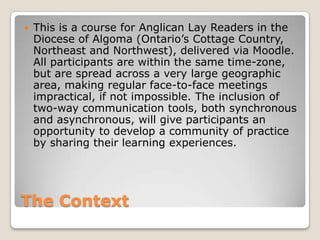
The ContextThis is a course for Anglican Lay Readers in the Diocese of Algoma (Ontario’s Cottage Country, Northeast and Northwest), delivered via Moodle. All participants are within the same time-zone, but are spread across a very large geographic area, making regular face-to-face meetings impractical, if not impossible. The inclusion of two-way communication tools, both synchronous and asynchronous, will give participants an opportunity to develop a community of practice by sharing their learning experiences.
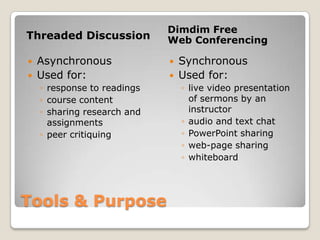
Tools & PurposeThreaded DiscussionDimdim FreeWeb ConferencingAsynchronousUsed for:response to readingscourse contentsharing research and assignmentspeer critiquingSynchronousUsed for:live video presentation of sermons by an instructoraudio and text chatPowerPoint sharingweb-page sharingwhiteboard
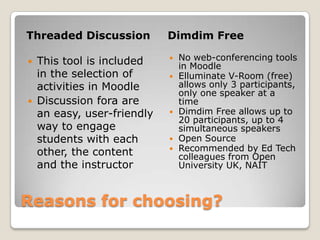
Reasons for choosing?Threaded DiscussionDimdim FreeThis tool is included in the selection of activities in MoodleDiscussion fora are an easy, user-friendly way to engage students with each other, the content and the instructorNo web-conferencing tools in MoodleElluminate V-Room (free) allows only 3 participants, only one speaker at a timeDimdim Free allows up to 20 participants, up to 4 simultaneous speakersOpen SourceRecommended by Ed Tech colleagues from Open University UK, NAIT
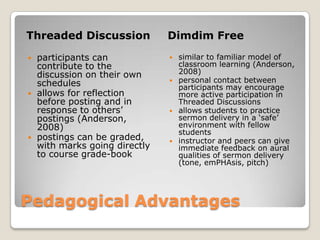
Pedagogical AdvantagesThreaded DiscussionDimdim Freeparticipants can contribute to the discussion on their own schedulesallows for reflection before posting and in response to others’ postings (Anderson, 2008)postings can be graded, with marks going directly to course grade-booksimilar to familiar model of classroom learning (Anderson, 2008)personal contact between participants may encourage more active participation in Threaded Discussionsallows students to practice sermon delivery in a ‘safe’ environment with fellow studentsinstructor and peers can give immediate feedback on aural qualities of sermon delivery (tone, emPHAsis, pitch)
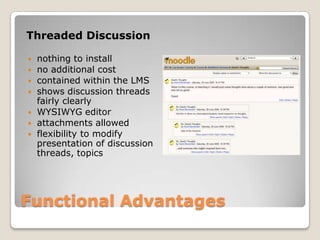
Functional AdvantagesThreaded Discussionnothing to installno additional costcontained within the LMSshows discussion threads fairly clearlyWYSIWYG editorattachments allowedflexibility to modify presentation of discussion threads, topics
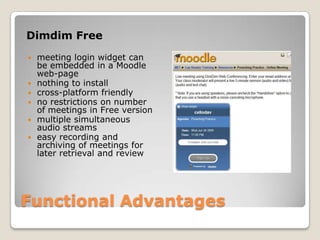
Functional AdvantagesDimdim Freemeeting login widget can be embedded in a Moodle web-pagenothing to installcross-platform friendlyno restrictions on number of meetings in Free versionmultiple simultaneous audio streamseasy recording and archiving of meetings for later retrieval and review
Functional LimitationsThreaded DiscussionDimdim Freesmiling sun-faces are a bit annoyingno capability to flag or bookmark messages of interest for later referenceonly able to edit messages for 30 minutes after postingdiscussion layout seems unpolished, not as professional as WebCT CE or Vistaonly host has video privileges (+1 participant in Pro) (Dimdim, 2009)sound quality suffers if using speakersnot always possible for all students to attend synchronously, especially if multiple time-zones are involved
Does the tool work?Threaded DiscussionDimdim Freemy experiences in the MET program and teaching online have proven the threaded discussion forum to be a robust, reliable vehicle for academic discourseI tested this tool with several family members in various locations and using Windows Vista and Mac OS Xapart from some audio issues on my end (my headset was fighting for USB bandwidth…), the service worked smoothlyI have scheduled a sample meeting, with an embedded “Sign In” widget in my Moodle course
Final Thoughts…The inclusion of threaded discussions in an online course is a “no-brainer”, yet it must be handled thoughtfully. There must be a pedagogically relevant purpose to each discussion, expectations for participation and behaviour must be explicit, and the instructor must be able to moderate effectively (Salmon, 2002).
… Final Thoughts cont’dRegarding Dimdim, thiswasn’t my first choice. Having used Wimba Classroom and Elluminate Live! on a number of occasions, my first impulse was to use Elluminate. However, Dimdim’s free service surpasses Elluminate’s handily, and I have yet to be impressed by Wimba’s offering. The software that powers Dimdim is also open source, and freely available to download. I would consider having my IT department install it on our own server, with customizations to allow more synchronous video streams, or even run the Dimdim Virtual Classroom version. The Virtual Classroom can also be run as an embedded module within Moodle and Claroline, all without the need for participants to download or install anything.
ReferencesAnderson, T. (2008). Teaching in an Online Learning Context. In Anderson, T. ed. The Theory and Practice of Online Learning 2nd ed. Athabasca, Alberta: Athabasca University.Dimdim. (2009). Dimdim: Web conferencing that just works. Retrieved 12 February 2009, from http://www.dimdim.com.Salmon, G. (2002). e-tivities: The key to active online learning. London: Kogan Page.

Communication Tools In A Moodle Course

  • 1.
    Communication Tools ina Moodle Course for Anglican Lay ReadersThreaded DiscussionsandDimdimDavid MacdonaldETEC 565 66A21 June 2009
  • 2.
    The ContextThis isa course for Anglican Lay Readers in the Diocese of Algoma (Ontario’s Cottage Country, Northeast and Northwest), delivered via Moodle. All participants are within the same time-zone, but are spread across a very large geographic area, making regular face-to-face meetings impractical, if not impossible. The inclusion of two-way communication tools, both synchronous and asynchronous, will give participants an opportunity to develop a community of practice by sharing their learning experiences.
  • 3.
    Tools & PurposeThreadedDiscussionDimdim FreeWeb ConferencingAsynchronousUsed for:response to readingscourse contentsharing research and assignmentspeer critiquingSynchronousUsed for:live video presentation of sermons by an instructoraudio and text chatPowerPoint sharingweb-page sharingwhiteboard
  • 4.
    Reasons for choosing?ThreadedDiscussionDimdim FreeThis tool is included in the selection of activities in MoodleDiscussion fora are an easy, user-friendly way to engage students with each other, the content and the instructorNo web-conferencing tools in MoodleElluminate V-Room (free) allows only 3 participants, only one speaker at a timeDimdim Free allows up to 20 participants, up to 4 simultaneous speakersOpen SourceRecommended by Ed Tech colleagues from Open University UK, NAIT
  • 5.
    Pedagogical AdvantagesThreaded DiscussionDimdimFreeparticipants can contribute to the discussion on their own schedulesallows for reflection before posting and in response to others’ postings (Anderson, 2008)postings can be graded, with marks going directly to course grade-booksimilar to familiar model of classroom learning (Anderson, 2008)personal contact between participants may encourage more active participation in Threaded Discussionsallows students to practice sermon delivery in a ‘safe’ environment with fellow studentsinstructor and peers can give immediate feedback on aural qualities of sermon delivery (tone, emPHAsis, pitch)
  • 6.
    Functional AdvantagesThreaded Discussionnothingto installno additional costcontained within the LMSshows discussion threads fairly clearlyWYSIWYG editorattachments allowedflexibility to modify presentation of discussion threads, topics
  • 7.
    Functional AdvantagesDimdim Freemeetinglogin widget can be embedded in a Moodle web-pagenothing to installcross-platform friendlyno restrictions on number of meetings in Free versionmultiple simultaneous audio streamseasy recording and archiving of meetings for later retrieval and review
  • 8.
    Functional LimitationsThreaded DiscussionDimdimFreesmiling sun-faces are a bit annoyingno capability to flag or bookmark messages of interest for later referenceonly able to edit messages for 30 minutes after postingdiscussion layout seems unpolished, not as professional as WebCT CE or Vistaonly host has video privileges (+1 participant in Pro) (Dimdim, 2009)sound quality suffers if using speakersnot always possible for all students to attend synchronously, especially if multiple time-zones are involved
  • 9.
    Does the toolwork?Threaded DiscussionDimdim Freemy experiences in the MET program and teaching online have proven the threaded discussion forum to be a robust, reliable vehicle for academic discourseI tested this tool with several family members in various locations and using Windows Vista and Mac OS Xapart from some audio issues on my end (my headset was fighting for USB bandwidth…), the service worked smoothlyI have scheduled a sample meeting, with an embedded “Sign In” widget in my Moodle course
  • 10.
    Final Thoughts…The inclusionof threaded discussions in an online course is a “no-brainer”, yet it must be handled thoughtfully. There must be a pedagogically relevant purpose to each discussion, expectations for participation and behaviour must be explicit, and the instructor must be able to moderate effectively (Salmon, 2002).
  • 11.
    … Final Thoughtscont’dRegarding Dimdim, thiswasn’t my first choice. Having used Wimba Classroom and Elluminate Live! on a number of occasions, my first impulse was to use Elluminate. However, Dimdim’s free service surpasses Elluminate’s handily, and I have yet to be impressed by Wimba’s offering. The software that powers Dimdim is also open source, and freely available to download. I would consider having my IT department install it on our own server, with customizations to allow more synchronous video streams, or even run the Dimdim Virtual Classroom version. The Virtual Classroom can also be run as an embedded module within Moodle and Claroline, all without the need for participants to download or install anything.
  • 12.
    ReferencesAnderson, T. (2008).Teaching in an Online Learning Context. In Anderson, T. ed. The Theory and Practice of Online Learning 2nd ed. Athabasca, Alberta: Athabasca University.Dimdim. (2009). Dimdim: Web conferencing that just works. Retrieved 12 February 2009, from http://www.dimdim.com.Salmon, G. (2002). e-tivities: The key to active online learning. London: Kogan Page.