What is all this communications stuff? David Phillips  FCIPR, FSNCR
What We Will Do Today Look back to see what how much we know about communicating Learn about different models for communication Look at the evolving communications landscape
Interacting Communication through books - Did you delight in pp 144-146 of  Exploring Public Relations  2006 (Tench & Yeomans)  and pp 20- 31  The Public Relations Handbook  2001 ( Theaker et al)?  Communication using experiences one to many - This slide show is available at Slideshare.net  ( http://www.slideshare.net/dphillips4363 ) Adding a bit of a symmetrical interaction,  noise and feedback - You can have cell phones on, blog, Twitter, and ask questions. One to one is not all bad with a bit of symmetrical influence - You can email me david.g.h.phillips (at) geemaildotcom or chat on Google Talk/Live Messenger.
History of Models Animals communicate – Humans communicate – what is the difference? If humans communicate why don’t we understand much about it? After 60,000 years of human evolution, Aristotle 2300 years ago thought of three models  Ethos – The nature and qualities of the communicator Logos – The nature, structure and content of the message (s) Pathos – The nature, feelings and thoughts of the audience.
Laswell’s theory Who says – what – to whom – with what – effect. Great for propagandists – all control – and limited in effect (McQuail & Windahl) – audiences have feelings to (and can turn a deaf ear) Shannon and Weaver explained how by adding  Noise  ( now extended to physical, cultural, intellectual, emotional) and  Feedback  (the receiver has a role too) we can see its not that simple.  The bank of England dropped interest rate 1.5% - did the message get through for student loans?
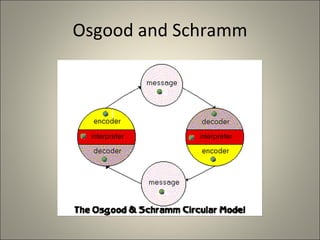
Osgood and Schramm
All too linear Assumption that communication is linear From someone to someone  Who could possibly be interested? What was the effect Should communication ‘do something’? A cognitive implication?
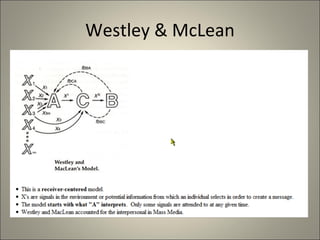
Westley & McLean
Context, society, experience and culture Communication uses ‘signs’ (Peirce, Saussure)  Pictures, words, movements etc. They have meanings My picture is not the same as your picture. My word means what it means to me not what it means to you (Fiske). Denotative   - dictionary definition, explication of a picture etc) Connotative  - experience of the sign – nice/nasty, fun/dull) Ambiguous   - signs with many meanings – fit (healthy)/fit (worth a snog)/fit (shoes that don’t)/ fit (a health problem) Polysemic  can be interpreted differently. Often leads to misunderstanding – ‘I was bombed in London’
The inquisitive human McQuail/Blumer & Katz Seeks diversion (from boring lectures) Looks for personal relationships (the social animal) Personal identity (the ‘badges’ that say ‘I’m me’ in the group or crowd Surveillance (where am I, opportunities, threats, what’s cool) McGuire Search for knowledge  Search for emotional reward Active or passive engagement Ambition to get educated (internalised)/ need to get a degree (external badge) Seeks gratification
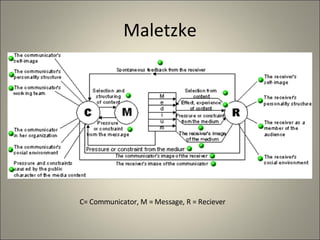
Maletzke C= Communicator, M = Message, R = Reciever
Mass media Does it work? It depends (friends & neighbours) Opinion Formers and agenda setters Two step flow (with ‘journalist’ in the middle) Agenda setters
Social Media Network effect One-2-one One-2-many Many-2-one Many-2-many Niche not mass communication The transition of mass media  (http://www.glamourmagazine.co.uk)
Lets try out the theory Facebook for the corporation Twitter for the newspaper YouTube for the University Computer Games for the teacher Mobile for the fashion industry Network or broadcast? Mass media or niche media?
What We Will Do Today Look back to see what how much we know about communicating Learn about different models for communication Look at the evolving communications landscape
What is all this communications stuff? David Phillips  FCIPR, FSNCR

Communication Theory2

  • 1.
    What is allthis communications stuff? David Phillips FCIPR, FSNCR
  • 2.
    What We WillDo Today Look back to see what how much we know about communicating Learn about different models for communication Look at the evolving communications landscape
  • 3.
    Interacting Communication throughbooks - Did you delight in pp 144-146 of Exploring Public Relations 2006 (Tench & Yeomans) and pp 20- 31 The Public Relations Handbook 2001 ( Theaker et al)? Communication using experiences one to many - This slide show is available at Slideshare.net ( http://www.slideshare.net/dphillips4363 ) Adding a bit of a symmetrical interaction, noise and feedback - You can have cell phones on, blog, Twitter, and ask questions. One to one is not all bad with a bit of symmetrical influence - You can email me david.g.h.phillips (at) geemaildotcom or chat on Google Talk/Live Messenger.
  • 4.
    History of ModelsAnimals communicate – Humans communicate – what is the difference? If humans communicate why don’t we understand much about it? After 60,000 years of human evolution, Aristotle 2300 years ago thought of three models Ethos – The nature and qualities of the communicator Logos – The nature, structure and content of the message (s) Pathos – The nature, feelings and thoughts of the audience.
  • 5.
    Laswell’s theory Whosays – what – to whom – with what – effect. Great for propagandists – all control – and limited in effect (McQuail & Windahl) – audiences have feelings to (and can turn a deaf ear) Shannon and Weaver explained how by adding Noise ( now extended to physical, cultural, intellectual, emotional) and Feedback (the receiver has a role too) we can see its not that simple. The bank of England dropped interest rate 1.5% - did the message get through for student loans?
  • 6.
  • 7.
    All too linearAssumption that communication is linear From someone to someone Who could possibly be interested? What was the effect Should communication ‘do something’? A cognitive implication?
  • 8.
  • 9.
    Context, society, experienceand culture Communication uses ‘signs’ (Peirce, Saussure) Pictures, words, movements etc. They have meanings My picture is not the same as your picture. My word means what it means to me not what it means to you (Fiske). Denotative - dictionary definition, explication of a picture etc) Connotative - experience of the sign – nice/nasty, fun/dull) Ambiguous - signs with many meanings – fit (healthy)/fit (worth a snog)/fit (shoes that don’t)/ fit (a health problem) Polysemic can be interpreted differently. Often leads to misunderstanding – ‘I was bombed in London’
  • 10.
    The inquisitive humanMcQuail/Blumer & Katz Seeks diversion (from boring lectures) Looks for personal relationships (the social animal) Personal identity (the ‘badges’ that say ‘I’m me’ in the group or crowd Surveillance (where am I, opportunities, threats, what’s cool) McGuire Search for knowledge Search for emotional reward Active or passive engagement Ambition to get educated (internalised)/ need to get a degree (external badge) Seeks gratification
  • 11.
    Maletzke C= Communicator,M = Message, R = Reciever
  • 12.
    Mass media Doesit work? It depends (friends & neighbours) Opinion Formers and agenda setters Two step flow (with ‘journalist’ in the middle) Agenda setters
  • 13.
    Social Media Networkeffect One-2-one One-2-many Many-2-one Many-2-many Niche not mass communication The transition of mass media (http://www.glamourmagazine.co.uk)
  • 14.
    Lets try outthe theory Facebook for the corporation Twitter for the newspaper YouTube for the University Computer Games for the teacher Mobile for the fashion industry Network or broadcast? Mass media or niche media?
  • 15.
    What We WillDo Today Look back to see what how much we know about communicating Learn about different models for communication Look at the evolving communications landscape
  • 16.
    What is allthis communications stuff? David Phillips FCIPR, FSNCR