COMMUNICATION PLAN
James T. Stephens Sr.
AET/560
March 21, 2016
Dr. Charity Jennings
PURPOSE
• Infuse
• Enable
• Impact
• Communicate
• Influence
• Inform
TED. (2016)
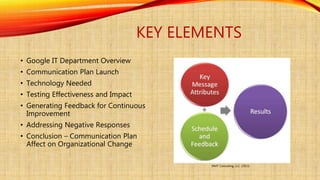
KEY ELEMENTS
• Google IT Department Overview
• Communication Plan Launch
• Technology Needed
• Testing Effectiveness and Impact
• Generating Feedback for Continuous
Improvement
• Addressing Negative Responses
• Conclusion – Communication Plan
Affect on Organizational Change
MMT Consulting, LLC. (2013)
GOOGLE IT DEPARTMENT CHANGE
OVERVIEW
• Improve services to valued customers
• Improve employee moral
• Improve department high absenteeism and
turnover rates
• Improve communication between department
managers and staff
• Enhance department working climate
• Build a culture of trust within department for
all employees
Google. (n. d.)
COMMUNICATION PLAN LAUNCH
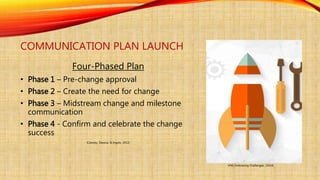
Four-Phased Plan
• Phase 1 – Pre-change approval
• Phase 2 – Create the need for change
• Phase 3 – Midstream change and milestone
communication
• Phase 4 - Confirm and celebrate the change
success
VNG Embracing Challenges. (2014)
(Cawsey, Deszca, & Ingols, 2012)
TECHNOLOGY NEEDED
• Computer and peripheral devices
• Tablets and/or notebooks
• Internet and Intranet
• Landline phones
• Cell phones
• Tele-conferencing
• Video-conferencing
• Email
• Instant messaging
Getty Images (2016)
TESTING EFFECTIVENESS AND IMPACT
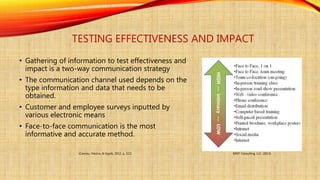
• Gathering of information to test effectiveness and
impact is a two-way communication strategy
• The communication channel used depends on the
type information and data that needs to be
obtained.
• Customer and employee surveys inputted by
various electronic means
• Face-to-face communication is the most
informative and accurate method.
MMT Consulting, LLC. (2013)(Cawsey, Deszca, & Ingols, 2012, p. 322)
GENERATING FEEDBACK FOR CONTINUOUS
IMPROVEMENT
• Hand-in-hand with determining change
effectiveness and impact
• Regularly scheduled meetings with IT
Department managers and staff.
• Regularly scheduled meetings with Google
senior management
• Employee on line surveys
• Customer solicitation and surveys
• During the entire change process
• On going
Dreamstime (2016)
ADDRESSING NEGATIVE RESPONSES
• To dispel rumors, gossip and horror stories about the
change, communicate messages that are:
• Clear
• Timely
• Candid
• Use face-to-face communication to:
• Increase positive reactions to change
• Lessen negative reactions to change
• Use peer opinion leaders to talk about the change
• Use senior management line authority to back up all change
communications
• Be repetitive in all communications
• Manage communication “noise”
(Cawsey, Deszca, & Ingols, 2012, p. 321)
Pinterest (2016)
CONCLUSION
COMMUNICATION PLAN AFFECT ON
ORGANIZATIONAL CHANGE
This communication plan will have a positive impact with the
changes it makes in the Google, Inc. IT Department. The most
notable changes are:
• Increased level of service and efficiency for existing and future
customers.
• Involvement of employees in the decision-making ideas
• Decreases in the absentee rate and turnover
• Effective Department management leadership that is conducive
to a climate of trust and collaboration
• Positive employee moral
• Effective communication between managers and staff
• Long term feedback
Mattsfactor (2016)
REFERENCES
• Cawsey, T. F., Deszca, G., & Ingols, C. (2012). Organizational Change (2nd ed.).
Retrieved from The University of Phoenix eBook Collection.
• Innovative Process Change. (2013). Retrieved from
http://processchange.blogspot.com/2010/07/elements-of-
communication-plan.html
• Spector, B. (2013). Implementing Organizational Change: Theory into
Practice (3rd ed.). Retrieved from The University of Phoenix eBook
Collection.
IMAGES
• Slide #2 - TED. (2016) Talks to help you find your purpose. [graphic image]. Retrieved
from https://www.ted.com/playlists/313/talks_to_help_you_find_your_pu
• Slide #3 -MMT Consulting, LLC. (2013) Elements of a communication plan. [graphic
image]. Retrieved from
http://processchange.blogspot.com/2010/07/elements-of-communication-
plan.html
• Slide #4 - Google. (n. d.) Google Logo. [graphic image]. Retrieved from
https://chrome.googleblog.com
• Slide #5 - VNG Embracing Challenges. (2014) Launching your mobile game.
[graphic image]. Retrieved from https://www.vng.com.vn/vn/tin-tuc-vng/chi-
tiet.tin-tuc-ogdc.cac-chien-luoc-can-thiet-cho-viec-ra-mat-th-nghiem-game-
mobile-c-a-ban.536.html
• Slide #6 - Getty Images (2016) Question Mark on Modern Technology &
Communication.[graphic image]. Retrieved from https:
http://www.gettyimages.com/detail/illustration/question-mark-on-modern-
technology- royalty-free-illustration/531046717
IMAGES
• Slide #7 - MMT Consulting, LLC. (2013) Elements of a communication plan. [graphic
image]. Retrieved from
http://processchange.blogspot.com/2010/07/elements-of-communication-
plan.html
• Slide #8 - Dreamstime (2016) Review Survey Feedback Opinion. [graphic
image]. Retrieved from
http://www.dreamstime.com/illustration/opinion.html
• Slide #9 - Pinterest (2016) 3D Smileys Wallpaper. [graphic image]. Retrieved
from https://www.pinterest.com/pin/319966748496906350/
• Slide #10 - Mattsfactor (2016) Non-verbal communication skills. [graphic image].
Retrieved from http://mattsfactor.com/skills/effective-communication-skills/

Communication Plan

  • 1.
    COMMUNICATION PLAN James T.Stephens Sr. AET/560 March 21, 2016 Dr. Charity Jennings
  • 2.
    PURPOSE • Infuse • Enable •Impact • Communicate • Influence • Inform TED. (2016)
  • 3.
    KEY ELEMENTS • GoogleIT Department Overview • Communication Plan Launch • Technology Needed • Testing Effectiveness and Impact • Generating Feedback for Continuous Improvement • Addressing Negative Responses • Conclusion – Communication Plan Affect on Organizational Change MMT Consulting, LLC. (2013)
  • 4.
    GOOGLE IT DEPARTMENTCHANGE OVERVIEW • Improve services to valued customers • Improve employee moral • Improve department high absenteeism and turnover rates • Improve communication between department managers and staff • Enhance department working climate • Build a culture of trust within department for all employees Google. (n. d.)
  • 5.
    COMMUNICATION PLAN LAUNCH Four-PhasedPlan • Phase 1 – Pre-change approval • Phase 2 – Create the need for change • Phase 3 – Midstream change and milestone communication • Phase 4 - Confirm and celebrate the change success VNG Embracing Challenges. (2014) (Cawsey, Deszca, & Ingols, 2012)
  • 6.
    TECHNOLOGY NEEDED • Computerand peripheral devices • Tablets and/or notebooks • Internet and Intranet • Landline phones • Cell phones • Tele-conferencing • Video-conferencing • Email • Instant messaging Getty Images (2016)
  • 7.
    TESTING EFFECTIVENESS ANDIMPACT • Gathering of information to test effectiveness and impact is a two-way communication strategy • The communication channel used depends on the type information and data that needs to be obtained. • Customer and employee surveys inputted by various electronic means • Face-to-face communication is the most informative and accurate method. MMT Consulting, LLC. (2013)(Cawsey, Deszca, & Ingols, 2012, p. 322)
  • 8.
    GENERATING FEEDBACK FORCONTINUOUS IMPROVEMENT • Hand-in-hand with determining change effectiveness and impact • Regularly scheduled meetings with IT Department managers and staff. • Regularly scheduled meetings with Google senior management • Employee on line surveys • Customer solicitation and surveys • During the entire change process • On going Dreamstime (2016)
  • 9.
    ADDRESSING NEGATIVE RESPONSES •To dispel rumors, gossip and horror stories about the change, communicate messages that are: • Clear • Timely • Candid • Use face-to-face communication to: • Increase positive reactions to change • Lessen negative reactions to change • Use peer opinion leaders to talk about the change • Use senior management line authority to back up all change communications • Be repetitive in all communications • Manage communication “noise” (Cawsey, Deszca, & Ingols, 2012, p. 321) Pinterest (2016)
  • 10.
    CONCLUSION COMMUNICATION PLAN AFFECTON ORGANIZATIONAL CHANGE This communication plan will have a positive impact with the changes it makes in the Google, Inc. IT Department. The most notable changes are: • Increased level of service and efficiency for existing and future customers. • Involvement of employees in the decision-making ideas • Decreases in the absentee rate and turnover • Effective Department management leadership that is conducive to a climate of trust and collaboration • Positive employee moral • Effective communication between managers and staff • Long term feedback Mattsfactor (2016)
  • 11.
    REFERENCES • Cawsey, T.F., Deszca, G., & Ingols, C. (2012). Organizational Change (2nd ed.). Retrieved from The University of Phoenix eBook Collection. • Innovative Process Change. (2013). Retrieved from http://processchange.blogspot.com/2010/07/elements-of- communication-plan.html • Spector, B. (2013). Implementing Organizational Change: Theory into Practice (3rd ed.). Retrieved from The University of Phoenix eBook Collection.
  • 12.
    IMAGES • Slide #2- TED. (2016) Talks to help you find your purpose. [graphic image]. Retrieved from https://www.ted.com/playlists/313/talks_to_help_you_find_your_pu • Slide #3 -MMT Consulting, LLC. (2013) Elements of a communication plan. [graphic image]. Retrieved from http://processchange.blogspot.com/2010/07/elements-of-communication- plan.html • Slide #4 - Google. (n. d.) Google Logo. [graphic image]. Retrieved from https://chrome.googleblog.com • Slide #5 - VNG Embracing Challenges. (2014) Launching your mobile game. [graphic image]. Retrieved from https://www.vng.com.vn/vn/tin-tuc-vng/chi- tiet.tin-tuc-ogdc.cac-chien-luoc-can-thiet-cho-viec-ra-mat-th-nghiem-game- mobile-c-a-ban.536.html • Slide #6 - Getty Images (2016) Question Mark on Modern Technology & Communication.[graphic image]. Retrieved from https: http://www.gettyimages.com/detail/illustration/question-mark-on-modern- technology- royalty-free-illustration/531046717
  • 13.
    IMAGES • Slide #7- MMT Consulting, LLC. (2013) Elements of a communication plan. [graphic image]. Retrieved from http://processchange.blogspot.com/2010/07/elements-of-communication- plan.html • Slide #8 - Dreamstime (2016) Review Survey Feedback Opinion. [graphic image]. Retrieved from http://www.dreamstime.com/illustration/opinion.html • Slide #9 - Pinterest (2016) 3D Smileys Wallpaper. [graphic image]. Retrieved from https://www.pinterest.com/pin/319966748496906350/ • Slide #10 - Mattsfactor (2016) Non-verbal communication skills. [graphic image]. Retrieved from http://mattsfactor.com/skills/effective-communication-skills/

Editor's Notes

  • #3 Communication plans have the purpose of: Infusing the need for change throughout the organization Enable employees to understand the impact of the change Communicates structural and job changes that influences how things are done Keep employees informed about the change progress (Cawsey, Deszca, & Ingols, 2012, p. 319).
  • #4 This presentation will examine the assessment, shared diagnosis, plan development, implementation, and end results of a strategic change in the IT department at Google, Inc. The key elements in implementing this change will also be discussed.
  • #5 There have been numerous complaints to senior managers in Google, Inc. about its IT department Level of service and inefficiency of the department has caused some customers to leave and do business with rival competitors Lack of employee involvement in the decision-making ideas/initiative process has caused moral to drop to unacceptable levels The IT department has the both the highest absentee rate and highest turnover within the company Department management leadership is ineffective and has caused a climate of distrust Lack of communication between managers and staff
  • #6 A communication plan has four phases: Phase 1 - Pre-change Approval. In this phase the Google senior management and other mangers will be convinced that change is needed in the IT department. Individuals that have the influence and authority to approve the needed change will be targeted (Cawsey, Deszca, & Ingols, 2012, p. 320). Correct timing is critical in this step to take advantage of the opportunity to get others involved in the change process. Phase 2 – Create the Need for Change. A formal communication program will be established with Google management that will create an awareness and understanding for the need for change as well as an articulate vision that clearly lays out specified steps of the change (Cawsey, Deszca, & Ingols, 2012, p. 320). The areas of change needed in the IT department that need to be addressed are: Level of service and inefficiency of the department has caused some customers to leave and do business with rival competitors Lack of employee involvement in the decision-making ideas/initiative process has caused moral to drop to unacceptable levels The IT department has the both the highest absentee rate and highest turnover within the company Department management leadership is ineffective and has caused a climate of distrust Lack of communication between managers and staff A strong and credible sense of urgency and enthusiasm for the change initiative needs to be conveyed, otherwise the initiative may not move forward (Cawsey, Deszca, & Ingols, 2012, p. 320). Shared diagnosis between management and all staff will able to assess, learn, create, develop, and review issues that are affecting the productivity of the IT Department and allows leaders and stakeholders to identify areas of strengths and areas of need within the IT Department. Phase 3 - Midstream Change and Milestone Communication. Once the change action plan has been implemented and starts to unfold, both Google management and the IT Department employees will “want to have specific information communicated to them about future plans and how things will operate (Cawsey, Deszca, & Ingols, 2012, p. 320). IT Department personnel will want to know what specific training they need to enhance their job performance. The change action plan incorporates the following elements: High absenteeism and turnover rates are addressed by conducting behavioral change theory training which will be calming and reassuring for all staff members of the need for change and the process in which change will be implemented. This training must be presented in manner so that the change process is made real to all staff members through the informal design process. IT Department staff will be informed that their attitude will be the driving force of company’s change but modeling will be displayed in management through positive attitudes regarding change. Each staff member will be encouraged to be passionate toward the change through behavior rewarding and skill building. IT Department management leadership will model how to effectively collaborate and the need for continuous learning for mastery and growth. Lack of communication will be addressed by establishing a system of direct communication to ensure all staff are aware of what is required from them and who their direct supervisor/coach is. This system will be set up through email, business newsletters and collaborative weekly meetings to discuss the focus for the week. Expectations for all IT Department managers and staff will be clearly and precisely laid out in writing to ensure service is sufficient and customers are satisfied. In this phase mangers and staff need to understand the progress being made in the change program. Mangers need to solicit feedback from the IT Department employees regarding the acceptance of the change initiative as well as what employee attitudes are regarding the change (Cawsey, Deszca, & Ingols, 2012, p. 321). Communication both upward and downward is essential during this phase. The importance of the new roles, structures and systems installed by the change in the IT Department need to be fully understood by both management and staff . Phase 4 – Confirm and Celebrate the Change Success. This phase is as important as the first three phases, however is usually undervalued. The Google IT Department managers and staff need to know the success of the change initiative. “The change experience as a whole needs to be discussed and any unfinished tasks identified. This is a period for to mark the progress of the change, reinforce commitment to it, and an opportunity for employees to “destress” (Cawsey, Deszca, & Ingols, 2012, p. 321).
  • #7  Power-point presentations demonstrate a series of strategies and methods for the change action plan will be used via Intranet sessions among the Google IT Department managers and staff during training meetings. These presentations will also be sent out via Internet to other Google upper management not able to attend the local IT Department training. Electronic bulletin boards, online surveys to sample awareness and opinions will all play a useful role in the communications strategy (Cawsey, Deszca, & Ingols, 2012, p. 321). Traditional face-to-face training as well as both coaching and mentoring will be vitally as important in implementing the change strategy within th IT Department.
  • #8 Gathering of information to test effectiveness and impact is a two-way communication strategy. “The gathering of information to determine the effectiveness and impact of the change is just as important as the change implementation itself (Cawsey, Deszca, & Ingols, 2012, p. 322). The communication channel used depends on the type information and data that needs to be obtained. Documentation of all Google IT Department training sessions, corporate and executive meetings, and monthly department meetings will help track progress of the change initiative and its impact (positive or negative) on customer service relations, staff performances, and companywide statistics. Conducting routine meetings will ensure all IT Department managers and staff have ample opportunities to communicate an concerns, questions, and/or suggestions about the change initiative. Creating conversation among the group gives Google employees the confidence to be able to voice their opinions without fear of scrutiny or repercussions, especially in order to receive the acknowledgement and credentials they have earned and deserve. Customer and employee surveys inputted by various electronic means. This feedback is vital in determining effectiveness and impact of the change initiative Face-to-face communication is the most informative and accurate method. Group face-to-face or one-on-one communication is probably the most efficient means of determining effectiveness and impact of change. John Change the change leader for this project will have to determine the level of intimacy needed to convey a true representation of the effectiveness of the change..  For example, bad news impacting a few individuals, such as an impending layoff should be conveyed with a HIGH level of intimacy (a face to face, 1 on 1 meeting would be a good idea).  Conversely if the message is public and being conveyed to millions of people, such as a press release, the intimacy requirement is LOW. ("Innovative Process Change", 2013).
  • #9 Generating feedback for continuous improvement goes hand-in-hand with testing the effectiveness and impact of the change initiative (which was discussed in the previous slide titled “Testing Effectiveness and Impact” Feedback is a simple and powerful tool that provides one of the most important opportunities for developing new competencies and skills among existing employees of any organization wanting to implement strategic renewal (Spector, 2013, p. 104). Constructive feedback can be generated by: Regularly scheduled meetings with IT Department managers and staff. Regularly scheduled meetings with Google senior management. Conducting employee on line surveys Soliciting customer input via face-to-face communication and/or by survey The feedback must occur from start to finish of the change initiative as well as be ongoing during the entire process. Feedback should also be collected on a periodic basis (as determined by Google senior management) well into the future after the change has been implemented to ensure that it is still “on track”
  • #10 By communicating, clear, timely, and candid messages about the nature and impact of the change to the Google IT Department, the change leader can dispel rumors, gossip and horror stories about the change (Cawsey, Deszca, & Ingols, 2012, p. 321). Face-to face communications is a most powerful tool when used by change leaders and upper management when addressing change. “Positive reactions tend to increase and negative reactions are lessened when people have an opportunity to hear from those in authority and ask them questions about the change and its impact” (Cawsey, Deszca, & Ingols, 2012, p. 321). Identify opinion leaders within the IT Department’s staff. “These individuals can be critical in persuading employees to a particular view” (Cawsey, Deszca, & Ingols, 2012, p. 322). The use of Google senior management line authority will be instrumental in quelling negative responses to the change. If the CEO of Google, Inc. says the change is good for the company and it’s employees, this message will “pack a punch” and get attention by all those affected by the change. “Some change agents believe it takes 15 to 20 repetitions before a message gets communicated effectively” (Cawsey, Deszca, & Ingols, 2012, p. 322). Communication noise happens sometimes when messages aren't received as the sender intends for a variety of reasons.  Make sure you have a plan for mitigating risks and resistance ("Innovative Process Change", 2013). Examples of communication noise are: ("Innovative Process Change", 2013). Technology glitches Personality conflicts Distrust Morale Resistance to messages Gossip Sudden illnesses Language / cultural differences External events Viral impacts
  • #11 The Google IT Departments’ ineffective leadership, inefficient services to customers, and poor morale among employee will be changed for the positive with the strategic renewal plan covered by this presentation. Google organizational leaders will be impressed when they notice positive increases in: Level of service and efficiency for existing and future customers. Involvement of employees in the decision-making ideas Decreases in the absentee rate and turnover Effective Department management leadership that is conducive to a climate of trust and collaboration Positive employee moral Effective communication between managers and staff Feedback well into the future after the change has been implemented to ensure that it is still “on track”