COMMUNICATION PLAN
LeRoy Hunt Jr.
AET 560
Professor Melanie Latin
January 5, 2016
How to Launch a
Communication
Plan
Launching a Communications Plan
Consists of Utilizing the Four Phases of a
Communication Plan:
• Pre Change Approval
• Creating the need for change
• Midstream change and milestone
communication
• Confirming/celebrating the change
success
(University of Phoenix, 2012, p. 319).
Utilizing Technology to Communicate the
Plan
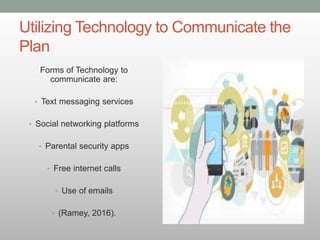
Forms of Technology to
communicate are:
• Text messaging services
• Social networking platforms
• Parental security apps
• Free internet calls
• Use of emails
• (Ramey, 2016).
Evaluating the Impact of Managements
Response to Organizational Change
According to "Can You Measure
Leadership?" (2017), “Leaders and
their response can be the criteria:
• “Culture of execution
• Core values
• Employee engagement”
(Key Talent).
Retrieving and Analyzing Feedback
According to Boundless (YYYY), "Sharing Feedback – Aside from
assessment metrics and objectives, good feedback also tends to
include qualitative thinking. It's not always as simple as rating an
individual's performance on a scale of 1-10. More often comments and
discussions are necessary for feedback to be useful. Any evaluation in
the workplace should have some outlet for this, be it 1-to-1 discussions
or more formal quarterly feedback sessions.” (Effective Evaluation in the
Workplace).
Managing Negativity Regarding Change
Common approaches have
developed to address negativity
regarding change such as:
• Provide appropriate rewards and
recognition to drive encouragement
and so people feel their contribution
is valued
• Provide opportunities that impact
the professionals job
• Communicate and present positive
expectations
• Treat people with fairness and
complicity
("Tips For Minimizing Workplace
Negativity", 2017).
Evaluating the Impact of the
Communication Plans Success
Concluding a Communications
Plan Consists of Utilizing the
Fourth and Final Phase:
• Confirming and celebrating the
change success
(University of Phoenix, 2012, p.
319).
References
• Boundless. (YYYY). Managing Up and Employee Feedback . Retrieved from
https://www.boundless.com/business/textbooks/boundless-business-textbook/human-resource-management-
12/performance-promotion-and-firing-79/managing-up-and-employee-feedback-382-3333/
• Can You Measure Leadership?. (2017). Retrieved from http://sloanreview.mit.edu/article/can-you-measure-
leadership/
• Ramey, K. (2016). USE OF TECHNOLOGY IN COMMUNICATION. Retrieved from
http://www.useoftechnology.com/technology-communication/
• Tips for Minimizing Workplace Negativity. (2017). Retrieved from https://www.thebalance.com/tips-for-minimizing-
workplace-negativity-1919384
• University of Phoenix. (2012). Organizational change An action-oriented toolkit . Retrieved from University of
Phoenix, AET/560 website.

Communication Plan Presentation

  • 1.
    COMMUNICATION PLAN LeRoy HuntJr. AET 560 Professor Melanie Latin January 5, 2016
  • 2.
    How to Launcha Communication Plan Launching a Communications Plan Consists of Utilizing the Four Phases of a Communication Plan: • Pre Change Approval • Creating the need for change • Midstream change and milestone communication • Confirming/celebrating the change success (University of Phoenix, 2012, p. 319).
  • 3.
    Utilizing Technology toCommunicate the Plan Forms of Technology to communicate are: • Text messaging services • Social networking platforms • Parental security apps • Free internet calls • Use of emails • (Ramey, 2016).
  • 4.
    Evaluating the Impactof Managements Response to Organizational Change According to "Can You Measure Leadership?" (2017), “Leaders and their response can be the criteria: • “Culture of execution • Core values • Employee engagement” (Key Talent).
  • 5.
    Retrieving and AnalyzingFeedback According to Boundless (YYYY), "Sharing Feedback – Aside from assessment metrics and objectives, good feedback also tends to include qualitative thinking. It's not always as simple as rating an individual's performance on a scale of 1-10. More often comments and discussions are necessary for feedback to be useful. Any evaluation in the workplace should have some outlet for this, be it 1-to-1 discussions or more formal quarterly feedback sessions.” (Effective Evaluation in the Workplace).
  • 6.
    Managing Negativity RegardingChange Common approaches have developed to address negativity regarding change such as: • Provide appropriate rewards and recognition to drive encouragement and so people feel their contribution is valued • Provide opportunities that impact the professionals job • Communicate and present positive expectations • Treat people with fairness and complicity ("Tips For Minimizing Workplace Negativity", 2017).
  • 7.
    Evaluating the Impactof the Communication Plans Success Concluding a Communications Plan Consists of Utilizing the Fourth and Final Phase: • Confirming and celebrating the change success (University of Phoenix, 2012, p. 319).
  • 8.
    References • Boundless. (YYYY).Managing Up and Employee Feedback . Retrieved from https://www.boundless.com/business/textbooks/boundless-business-textbook/human-resource-management- 12/performance-promotion-and-firing-79/managing-up-and-employee-feedback-382-3333/ • Can You Measure Leadership?. (2017). Retrieved from http://sloanreview.mit.edu/article/can-you-measure- leadership/ • Ramey, K. (2016). USE OF TECHNOLOGY IN COMMUNICATION. Retrieved from http://www.useoftechnology.com/technology-communication/ • Tips for Minimizing Workplace Negativity. (2017). Retrieved from https://www.thebalance.com/tips-for-minimizing- workplace-negativity-1919384 • University of Phoenix. (2012). Organizational change An action-oriented toolkit . Retrieved from University of Phoenix, AET/560 website.

Editor's Notes

  • #3 The first objective of creating a communication plan exist within simply gaining permission. This entails sharing the purpose and objectives of change and defining how that change will take place within the organization. There is also a need to inform stakeholders and administration what measurements will be used to monitor change. Lastly there is a need to define what success is defined as and how is that measured. Gaining this information allows for communicating change to have a more defined path.
  • #4 The current age of technology enables communication on an individual and massive level. However, to accomplish these goals communication takes place through two specific interfaces primarily. Communication takes place either through computers or smartphones. The technology enables information, responses, and various forms of feedback to be maintained in a private or public form. This information can also be encripted if necessary through these various devices.
  • #5 Measuring leadership is an important aspect of communicating change. Monitoring the leadership allows for an observation a more fluid action of measuring change. Notating the ability for leadership to enage, share organizational values, and achieve objectives communicated in the plan is necessary for success. According to "Can You Measure Leadership?" (2017), "Culture of execution. How well they deliver results through others and establish a “can-do” attitude that inspires their teams to meet goals despite challenges. Core values. How they go about achieving results, and whether they exemplify integrity, excellence, teamwork and commitment. Employee engagement. Feedback from the leaders’ teams on their competency, style and commitment to the company and the team. If work climate issues surface, leaders are expected to address them with action plans, log their progress throughout the year and utilize best practices for building commitment.” (Key Talent).
  • #6 The attainment of feedback is important to measuring the success of change within a communication plan. The attainment of feedback allows for insight to make viable corrections to address negativity, and resistance. It also allows for the observation of what measure are producing and where to place the resources of the organization to promote change. However, providing the means to gain the feedback is necessary as one specific instrument to gain feedback is not sufficient. Utilizing surveys, direct communication, and utilizing various forms of informal and formal measure are key to guiding the culture attached to the presumed success of the organization and its goals.
  • #7 Communicating and expecting a positive environment is the most effective means to manage negativity. According to "Tips For Minimizing Workplace Negativity" (2017), "The best way to combat workplace negativity is to keep it from occurring in the first place. These tips will help you minimize workplace negativity.” (Diagnose Workplace Negativity). A few of these tips are identified as providing rewards and simply recognizing desirable efforts and attitudes, and defining the framework for positive expectations of the organization. This is achieved by sharing the vision, mission statements, and values that guide the organizations efforts.
  • #8 Successfully completing the objectives outlined by the communication indicates a moment for celebration. However, it is important to measure the attitudes of the stakeholders and methods used to gain such success. While this is a time of celebration it is also a time of reflection. “This segment of the communication plan seeks to prepare the organization for the next change.” (University of Phoenix, 2012, p. 299). Change and the responses to change will forever be constant but, documenting how change was communicated in response contributes to the likely hood of future success.