Telegraph to Twitter

A Communication Revolution
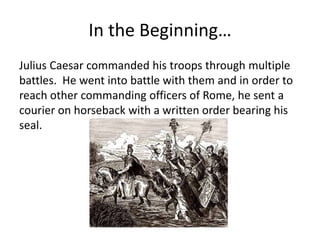
In the Beginning…
Julius Caesar commanded his troops through multiple
battles. He went into battle with them and in order to
reach other commanding officers of Rome, he sent a
courier on horseback with a written order bearing his
seal.
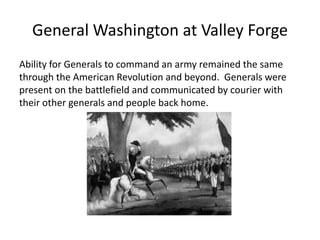
General Washington at Valley Forge
Ability for Generals to command an army remained the same
through the American Revolution and beyond. Generals were
present on the battlefield and communicated by courier with
their other generals and people back home.
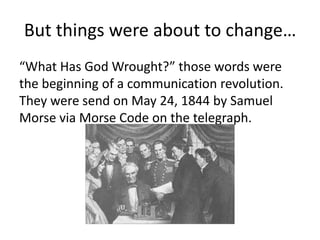
But things were about to change…
“What Has God Wrought?” those words were
the beginning of a communication revolution.
They were send on May 24, 1844 by Samuel
Morse via Morse Code on the telegraph.
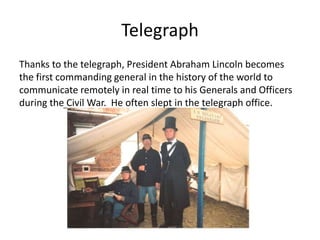
Telegraph
Thanks to the telegraph, President Abraham Lincoln becomes
the first commanding general in the history of the world to
communicate remotely in real time to his Generals and Officers
during the Civil War. He often slept in the telegraph office.
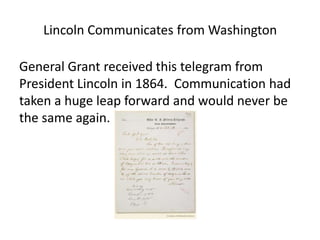
Lincoln Communicates from Washington

General Grant received this telegram from
President Lincoln in 1864. Communication had
taken a huge leap forward and would never be
the same again.
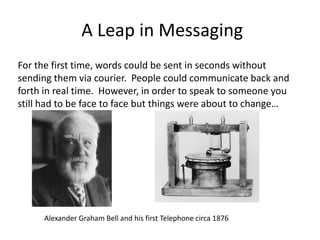
A Leap in Messaging
For the first time, words could be sent in seconds without
sending them via courier. People could communicate back and
forth in real time. However, in order to speak to someone you
still had to be face to face but things were about to change…


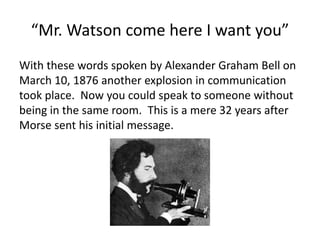
     Alexander Graham Bell and his first Telephone circa 1876
“Mr. Watson come here I want you”
With these words spoken by Alexander Graham Bell on
March 10, 1876 another explosion in communication
took place. Now you could speak to someone without
being in the same room. This is a mere 32 years after
Morse sent his initial message.
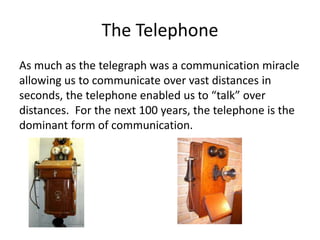
The Telephone
As much as the telegraph was a communication miracle
allowing us to communicate over vast distances in
seconds, the telephone enabled us to “talk” over
distances. For the next 100 years, the telephone is the
dominant form of communication.
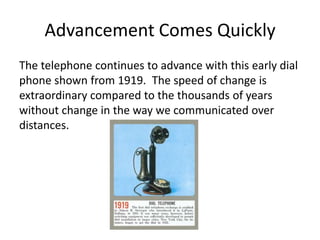
Advancement Comes Quickly
The telephone continues to advance with this early dial
phone shown from 1919. The speed of change is
extraordinary compared to the thousands of years
without change in the way we communicated over
distances.
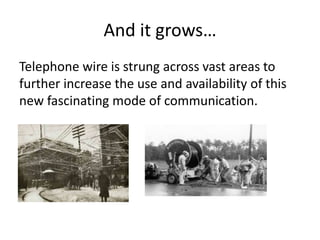
And it grows…
Telephone wire is strung across vast areas to
further increase the use and availability of this
new fascinating mode of communication.
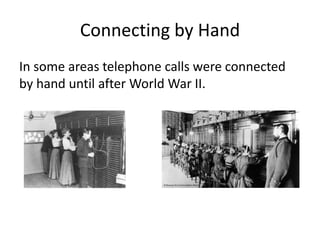
Connecting by Hand
In some areas telephone calls were connected
by hand until after World War II.
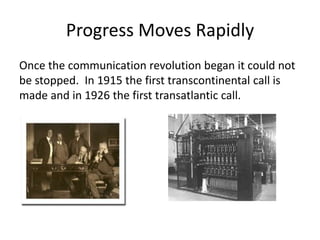
Progress Moves Rapidly
Once the communication revolution began it could not
be stopped. In 1915 the first transcontinental call is
made and in 1926 the first transatlantic call.
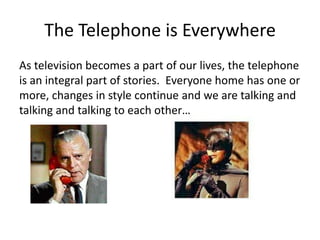
The Telephone is Everywhere
As television becomes a part of our lives, the telephone
is an integral part of stories. Everyone home has one or
more, changes in style continue and we are talking and
talking and talking to each other…
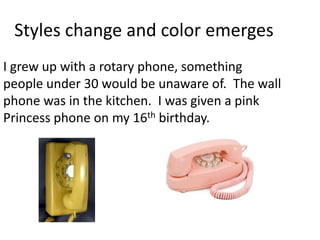
Styles change and color emerges
I grew up with a rotary phone, something
people under 30 would be unaware of. The wall
phone was in the kitchen. I was given a pink
Princess phone on my 16th birthday.
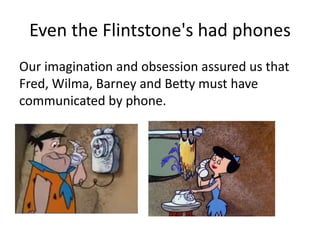
Even the Flintstone's had phones
Our imagination and obsession assured us that
Fred, Wilma, Barney and Betty must have
communicated by phone.
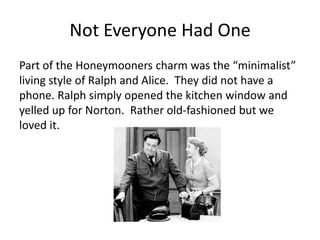
Not Everyone Had One
Part of the Honeymooners charm was the “minimalist”
living style of Ralph and Alice. They did not have a
phone. Ralph simply opened the kitchen window and
yelled up for Norton. Rather old-fashioned but we
loved it.
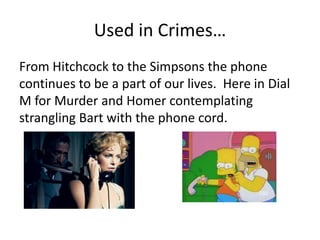
Used in Crimes…
From Hitchcock to the Simpsons the phone
continues to be a part of our lives. Here in Dial
M for Murder and Homer contemplating
strangling Bart with the phone cord.
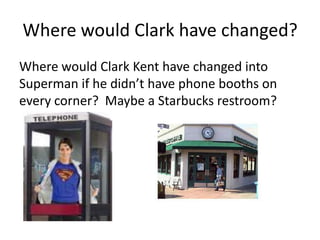
Where would Clark have changed?
Where would Clark Kent have changed into
Superman if he didn’t have phone booths on
every corner? Maybe a Starbucks restroom?
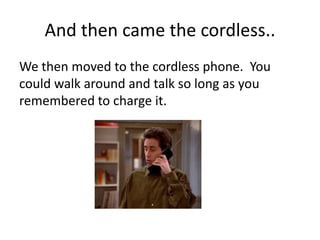
And then came the cordless..
We then moved to the cordless phone. You
could walk around and talk so long as you
remembered to charge it.
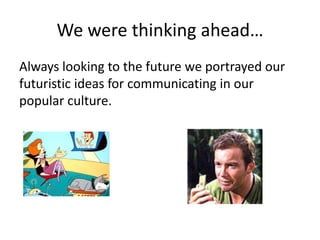
We were thinking ahead…
Always looking to the future we portrayed our
futuristic ideas for communicating in our
popular culture.
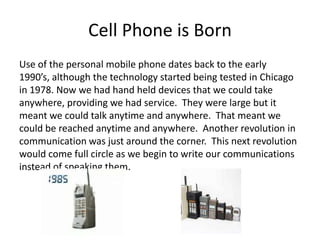
Cell Phone is Born
Use of the personal mobile phone dates back to the early
1990’s, although the technology started being tested in Chicago
in 1978. Now we had hand held devices that we could take
anywhere, providing we had service. They were large but it
meant we could talk anytime and anywhere. That meant we
could be reached anytime and anywhere. Another revolution in
communication was just around the corner. This next revolution
would come full circle as we begin to write our communications
instead of speaking them.
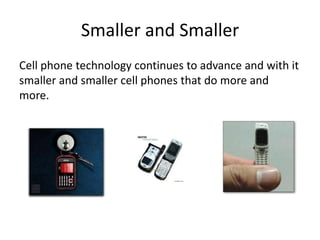
Smaller and Smaller
Cell phone technology continues to advance and with it
smaller and smaller cell phones that do more and
more.
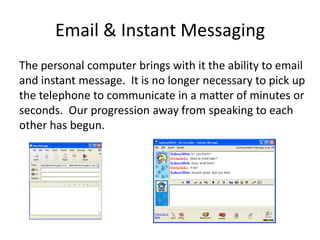
Email & Instant Messaging
The personal computer brings with it the ability to email
and instant message. It is no longer necessary to pick up
the telephone to communicate in a matter of minutes or
seconds. Our progression away from speaking to each
other has begun.
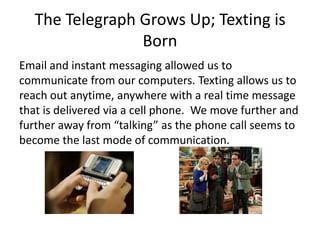
The Telegraph Grows Up; Texting is
                 Born
Email and instant messaging allowed us to
communicate from our computers. Texting allows us to
reach out anytime, anywhere with a real time message
that is delivered via a cell phone. We move further and
further away from “talking” as the phone call seems to
become the last mode of communication.
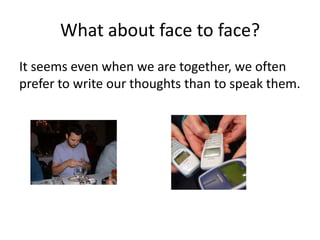
What about face to face?
It seems even when we are together, we often
prefer to write our thoughts than to speak them.
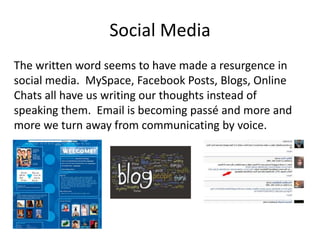
Social Media
The written word seems to have made a resurgence in
social media. MySpace, Facebook Posts, Blogs, Online
Chats all have us writing our thoughts instead of
speaking them. Email is becoming passé and more and
more we turn away from communicating by voice.
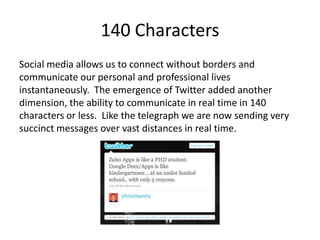
140 Characters
Social media allows us to connect without borders and
communicate our personal and professional lives
instantaneously. The emergence of Twitter added another
dimension, the ability to communicate in real time in 140
characters or less. Like the telegraph we are now sending very
succinct messages over vast distances in real time.
Written History
It is generally believed that the earliest writing was done in Mesopotamia around 3200 B.C.E. That
would mean that for over 5000 years man used the written word to communicate over distances, record
history and transact business. While the printing press, typewriter and computer added vast advances
to spreading the written word and literacy, they did not dramatically transform our personal
communications. The advent of the telegraph changed the way we could personally communicate over
large distances and in seconds. In the blink of an eye technology has taken us from the telegraph to
telephone to the cell phone to social media. I believe that along with this extraordinary transformation
we have evolved from a culture highly devoted to the spoken word thanks to the telephone to a revival
of the written word. This revival has become so obsessive that in many cases we are texting and
tweeting to people who are sitting at the same table with us. We even sit with each other and text and
tweet others instead of giving our attention to the person whom we are with. Twitter forces us to
communicate in 140 characters much the same way those communicating by telegram wanted to keep
messages short and to the point.
The return of the written word may have significant implications for history as each
blog, post, text, tweet, email, etc. is a living record of ordinary people going about their lives. That is
something that has often been sorely lacking in historical data.
While that is great for future historians, it begs the question of “what happened to spoken
conversation?”. The written word is not always the best form of communication especially when
dealing with sensitive issues and conflict.
The subtleties of expression and body language are no more clear with a Tweet than with a telegram.
How will we integrate our love of communicating instantly on little hand held devices with our need to
verbally express ourselves and socialize face to face? I suspect technology will provide the answer in
the blink of an eye.

Telegraph to Twitter

  • 1.
    Telegraph to Twitter ACommunication Revolution
  • 2.
    In the Beginning… JuliusCaesar commanded his troops through multiple battles. He went into battle with them and in order to reach other commanding officers of Rome, he sent a courier on horseback with a written order bearing his seal.
  • 3.
    General Washington atValley Forge Ability for Generals to command an army remained the same through the American Revolution and beyond. Generals were present on the battlefield and communicated by courier with their other generals and people back home.
  • 4.
    But things wereabout to change… “What Has God Wrought?” those words were the beginning of a communication revolution. They were send on May 24, 1844 by Samuel Morse via Morse Code on the telegraph.
  • 5.
    Telegraph Thanks to thetelegraph, President Abraham Lincoln becomes the first commanding general in the history of the world to communicate remotely in real time to his Generals and Officers during the Civil War. He often slept in the telegraph office.
  • 6.
    Lincoln Communicates fromWashington General Grant received this telegram from President Lincoln in 1864. Communication had taken a huge leap forward and would never be the same again.
  • 7.
    A Leap inMessaging For the first time, words could be sent in seconds without sending them via courier. People could communicate back and forth in real time. However, in order to speak to someone you still had to be face to face but things were about to change… Alexander Graham Bell and his first Telephone circa 1876
  • 8.
    “Mr. Watson comehere I want you” With these words spoken by Alexander Graham Bell on March 10, 1876 another explosion in communication took place. Now you could speak to someone without being in the same room. This is a mere 32 years after Morse sent his initial message.
  • 9.
    The Telephone As muchas the telegraph was a communication miracle allowing us to communicate over vast distances in seconds, the telephone enabled us to “talk” over distances. For the next 100 years, the telephone is the dominant form of communication.
  • 10.
    Advancement Comes Quickly Thetelephone continues to advance with this early dial phone shown from 1919. The speed of change is extraordinary compared to the thousands of years without change in the way we communicated over distances.
  • 11.
    And it grows… Telephonewire is strung across vast areas to further increase the use and availability of this new fascinating mode of communication.
  • 12.
    Connecting by Hand Insome areas telephone calls were connected by hand until after World War II.
  • 13.
    Progress Moves Rapidly Oncethe communication revolution began it could not be stopped. In 1915 the first transcontinental call is made and in 1926 the first transatlantic call.
  • 14.
    The Telephone isEverywhere As television becomes a part of our lives, the telephone is an integral part of stories. Everyone home has one or more, changes in style continue and we are talking and talking and talking to each other…
  • 15.
    Styles change andcolor emerges I grew up with a rotary phone, something people under 30 would be unaware of. The wall phone was in the kitchen. I was given a pink Princess phone on my 16th birthday.
  • 16.
    Even the Flintstone'shad phones Our imagination and obsession assured us that Fred, Wilma, Barney and Betty must have communicated by phone.
  • 17.
    Not Everyone HadOne Part of the Honeymooners charm was the “minimalist” living style of Ralph and Alice. They did not have a phone. Ralph simply opened the kitchen window and yelled up for Norton. Rather old-fashioned but we loved it.
  • 18.
    Used in Crimes… FromHitchcock to the Simpsons the phone continues to be a part of our lives. Here in Dial M for Murder and Homer contemplating strangling Bart with the phone cord.
  • 19.
    Where would Clarkhave changed? Where would Clark Kent have changed into Superman if he didn’t have phone booths on every corner? Maybe a Starbucks restroom?
  • 20.
    And then camethe cordless.. We then moved to the cordless phone. You could walk around and talk so long as you remembered to charge it.
  • 21.
    We were thinkingahead… Always looking to the future we portrayed our futuristic ideas for communicating in our popular culture.
  • 22.
    Cell Phone isBorn Use of the personal mobile phone dates back to the early 1990’s, although the technology started being tested in Chicago in 1978. Now we had hand held devices that we could take anywhere, providing we had service. They were large but it meant we could talk anytime and anywhere. That meant we could be reached anytime and anywhere. Another revolution in communication was just around the corner. This next revolution would come full circle as we begin to write our communications instead of speaking them.
  • 23.
    Smaller and Smaller Cellphone technology continues to advance and with it smaller and smaller cell phones that do more and more.
  • 24.
    Email & InstantMessaging The personal computer brings with it the ability to email and instant message. It is no longer necessary to pick up the telephone to communicate in a matter of minutes or seconds. Our progression away from speaking to each other has begun.
  • 25.
    The Telegraph GrowsUp; Texting is Born Email and instant messaging allowed us to communicate from our computers. Texting allows us to reach out anytime, anywhere with a real time message that is delivered via a cell phone. We move further and further away from “talking” as the phone call seems to become the last mode of communication.
  • 26.
    What about faceto face? It seems even when we are together, we often prefer to write our thoughts than to speak them.
  • 27.
    Social Media The writtenword seems to have made a resurgence in social media. MySpace, Facebook Posts, Blogs, Online Chats all have us writing our thoughts instead of speaking them. Email is becoming passé and more and more we turn away from communicating by voice.
  • 28.
    140 Characters Social mediaallows us to connect without borders and communicate our personal and professional lives instantaneously. The emergence of Twitter added another dimension, the ability to communicate in real time in 140 characters or less. Like the telegraph we are now sending very succinct messages over vast distances in real time.
  • 29.
    Written History It isgenerally believed that the earliest writing was done in Mesopotamia around 3200 B.C.E. That would mean that for over 5000 years man used the written word to communicate over distances, record history and transact business. While the printing press, typewriter and computer added vast advances to spreading the written word and literacy, they did not dramatically transform our personal communications. The advent of the telegraph changed the way we could personally communicate over large distances and in seconds. In the blink of an eye technology has taken us from the telegraph to telephone to the cell phone to social media. I believe that along with this extraordinary transformation we have evolved from a culture highly devoted to the spoken word thanks to the telephone to a revival of the written word. This revival has become so obsessive that in many cases we are texting and tweeting to people who are sitting at the same table with us. We even sit with each other and text and tweet others instead of giving our attention to the person whom we are with. Twitter forces us to communicate in 140 characters much the same way those communicating by telegram wanted to keep messages short and to the point. The return of the written word may have significant implications for history as each blog, post, text, tweet, email, etc. is a living record of ordinary people going about their lives. That is something that has often been sorely lacking in historical data. While that is great for future historians, it begs the question of “what happened to spoken conversation?”. The written word is not always the best form of communication especially when dealing with sensitive issues and conflict. The subtleties of expression and body language are no more clear with a Tweet than with a telegram. How will we integrate our love of communicating instantly on little hand held devices with our need to verbally express ourselves and socialize face to face? I suspect technology will provide the answer in the blink of an eye.