COMMUNICATION
FOR
LEADERSHIP
BY
Dr Mukul Mukherjee
COACHINGCOACHING
Developing employees in rderDeveloping employees in rder
to achieve business resultsto achieve business results
rather than micro-managingrather than micro-managing
their every movetheir every move
 Build trust
 Listen
 Develop the strength of each employee
 Endorse effort and growth
Making coaching behaviour
part of what you do
Making coaching behaviour
part of what you do(contd)
 Stop providing solution
 Stop making all decisions
 Create an environment where
people want to work with you
ASKING THE RIGHT
QUESTIONS
The two main approaches to
use are open and probe
questions
OPEN QUESTIONS
Open questions can be put in a ‘tell me’
form, such as :
 Tell me, why do you think that
happened ?
 Tell me, how did you handle that
situation ?
 Tell, how is this project going ?
 Tell me, what do you think your key
objectives are going to be next year ?
PROBE QUESTIONS
These seek specific information on
what has happened, and why. They
can :
Show interest and encouragement
by making supportive statements
followed by questions : ‘I see, and
then what ?’
Seek further information by asking
‘Why ?’, ‘Why not ?’ or ‘What do you
mean ?’
Explore attitudes : ‘To what extent
do you believe that …. ?’
Reflect views : ‘Have I got the right
impression ? Do you feel that …. ?’
PROBE QUESTIONS(contd)
LISTENING
Reviewing need to develop and
practise the art of listening
carefully. Good listeners :
Concentrate on the speaker, alert
at all times to the nuances of
what is being said
Respond quickly when appropriate,
but do not interrupt unnecessarily
Ask questions to clarify meaning
Comment as necessary on the
points made to demonstrate
understanding, but not at length.
LISTENING (contd)
Giving Feedback
Build feedback into the job
Provide feedback on actual events
Describe, don’t judge
Refer to specific behaviours
Ask questions
Get people to work things out
for themselves
Select key issues
Focus
Show understanding
Giving Feedback (contd)
COUNSELLING
Workplace counselling can be
defined as :
Any activity in the workplace where one
individual uses a set of skills and
techniques to help another individual to
take responsibility for and to manage
their own decision-making, whether it is
work related or personal.
Counselling Stages
The counselling process
consists of three stages :
Recognition and understanding
– recognising the existence of
problems and issues
Empowering – enabling
employees to recognise their
own problem or situation and
encouraging them to express it,
work out a solution and take
action to implement it
Counselling Stages (contd)
Resourcing – managing the
problem, which will include
deciding on any further help
individuals many need from
their managers, a specialist or
an outside resource.
Counselling Stages (contd)
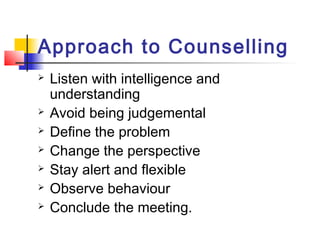
Approach to Counselling
 Listen with intelligence and
understanding
 Avoid being judgemental
 Define the problem
 Change the perspective
 Stay alert and flexible
 Observe behaviour
 Conclude the meeting.

Communication for leadership

  • 1.
  • 2.
    COACHINGCOACHING Developing employees inrderDeveloping employees in rder to achieve business resultsto achieve business results rather than micro-managingrather than micro-managing their every movetheir every move
  • 3.
     Build trust Listen  Develop the strength of each employee  Endorse effort and growth Making coaching behaviour part of what you do
  • 4.
    Making coaching behaviour partof what you do(contd)  Stop providing solution  Stop making all decisions  Create an environment where people want to work with you
  • 5.
    ASKING THE RIGHT QUESTIONS Thetwo main approaches to use are open and probe questions
  • 6.
    OPEN QUESTIONS Open questionscan be put in a ‘tell me’ form, such as :  Tell me, why do you think that happened ?  Tell me, how did you handle that situation ?  Tell, how is this project going ?  Tell me, what do you think your key objectives are going to be next year ?
  • 7.
    PROBE QUESTIONS These seekspecific information on what has happened, and why. They can : Show interest and encouragement by making supportive statements followed by questions : ‘I see, and then what ?’
  • 8.
    Seek further informationby asking ‘Why ?’, ‘Why not ?’ or ‘What do you mean ?’ Explore attitudes : ‘To what extent do you believe that …. ?’ Reflect views : ‘Have I got the right impression ? Do you feel that …. ?’ PROBE QUESTIONS(contd)
  • 9.
    LISTENING Reviewing need todevelop and practise the art of listening carefully. Good listeners : Concentrate on the speaker, alert at all times to the nuances of what is being said
  • 10.
    Respond quickly whenappropriate, but do not interrupt unnecessarily Ask questions to clarify meaning Comment as necessary on the points made to demonstrate understanding, but not at length. LISTENING (contd)
  • 11.
    Giving Feedback Build feedbackinto the job Provide feedback on actual events Describe, don’t judge Refer to specific behaviours Ask questions
  • 12.
    Get people towork things out for themselves Select key issues Focus Show understanding Giving Feedback (contd)
  • 13.
    COUNSELLING Workplace counselling canbe defined as : Any activity in the workplace where one individual uses a set of skills and techniques to help another individual to take responsibility for and to manage their own decision-making, whether it is work related or personal.
  • 14.
    Counselling Stages The counsellingprocess consists of three stages : Recognition and understanding – recognising the existence of problems and issues
  • 15.
    Empowering – enabling employeesto recognise their own problem or situation and encouraging them to express it, work out a solution and take action to implement it Counselling Stages (contd)
  • 16.
    Resourcing – managingthe problem, which will include deciding on any further help individuals many need from their managers, a specialist or an outside resource. Counselling Stages (contd)
  • 17.
    Approach to Counselling Listen with intelligence and understanding  Avoid being judgemental  Define the problem  Change the perspective  Stay alert and flexible  Observe behaviour  Conclude the meeting.