Why do I need a
communications
course?
Lecture 1
University of Alberta
ALES 204


                        1
Lecture Outline

1. Introduction

2. Why do you need a communications course?

3. All about ALES 204


                                              2
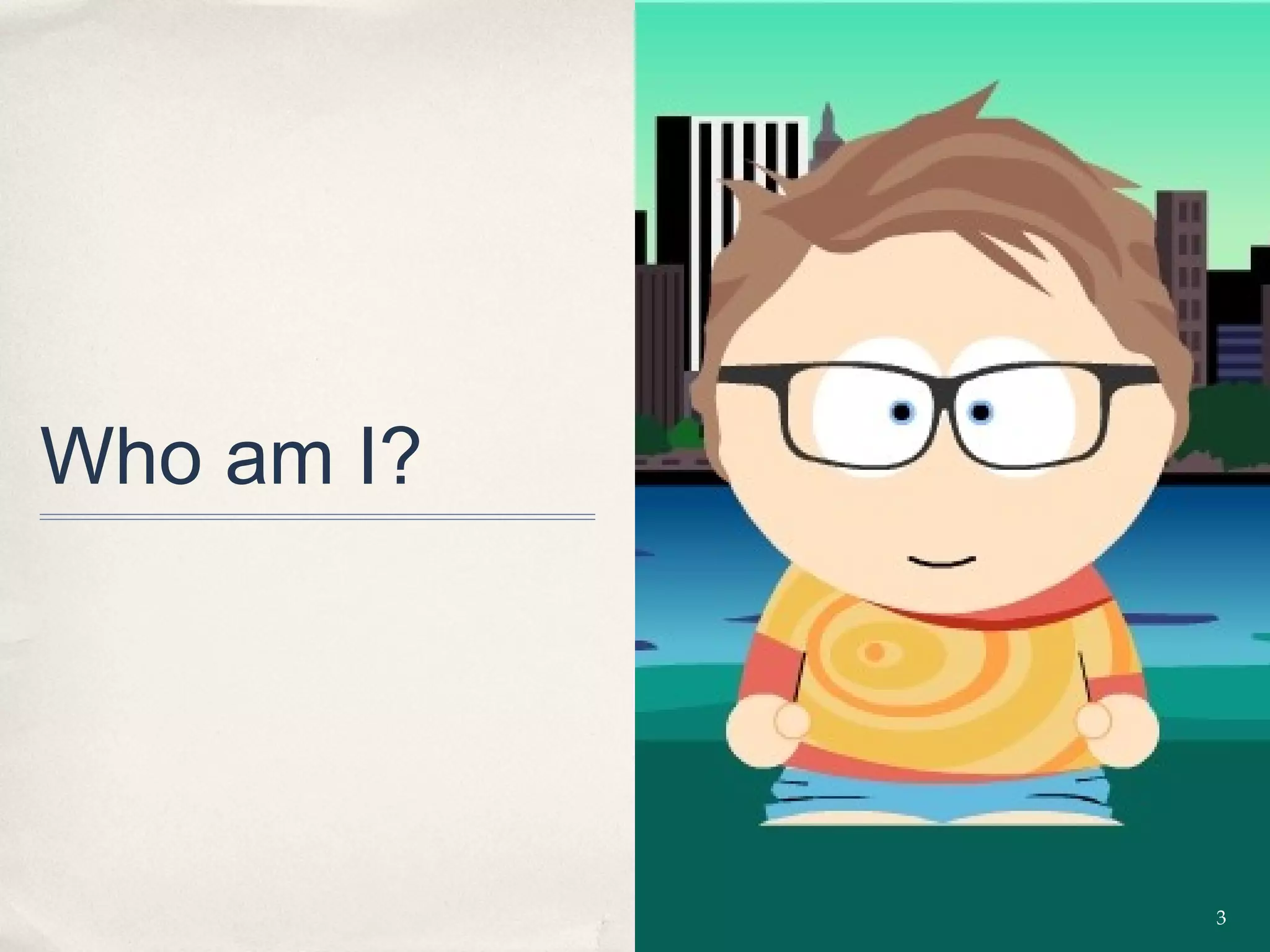
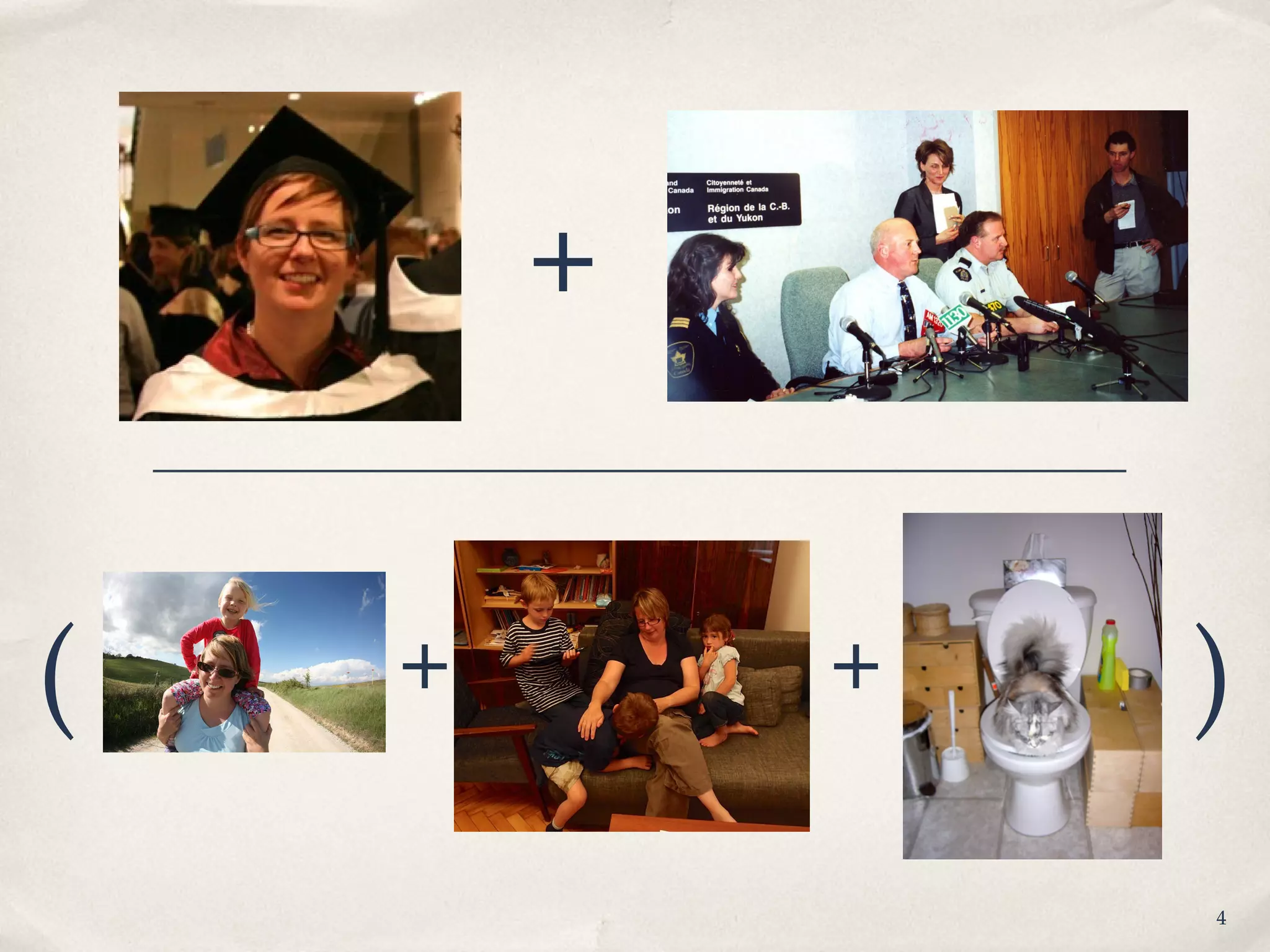
Who am I?


            3
+


(   +       +   )
                4
2. Why do you need a communications course?


                                              5
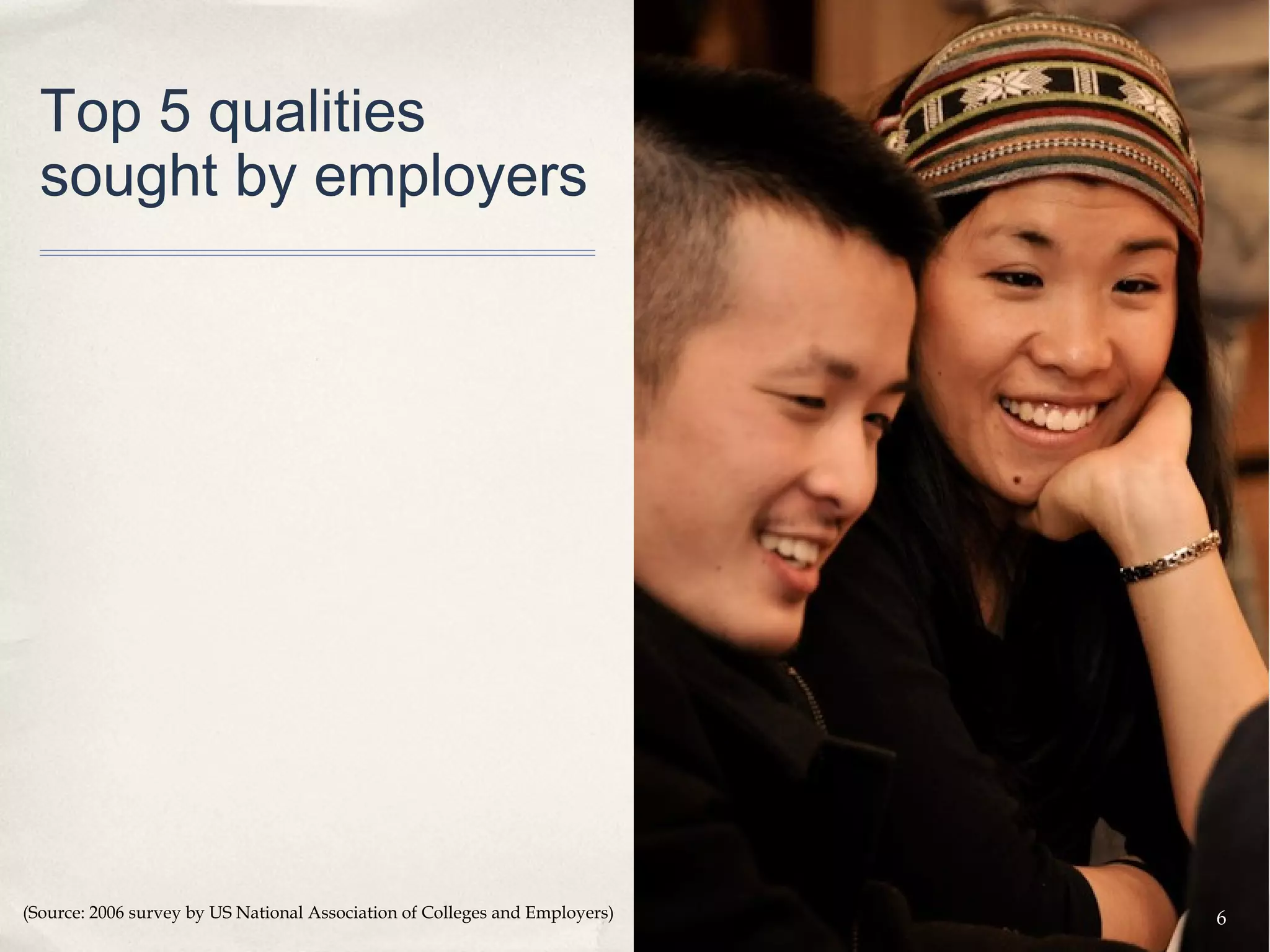
Top 5 qualities
  sought by employers


(Source: 2006 survey by US National Association of Colleges and Employers)   6
Top criteria for selecting employees


(Source: Graduate Outlook 2007, Graduate Careers Australia)

                                                              7
What are good communication skills
according to employers?

 Listening effectively
 Communicating accurately and concisely
 Effective oral communication
 Communicating pleasantly and professionally
 Effective written communication
 Asking good questions
 Communicating appropriately and professionally using social media
 (Source: Crawford et al. 2011)


                                                                     8
Most important abilities students are
NOT learning


   “[We need] more practice with public speaking”

   - Student


 (Source: Crawford et al. 2011)
                                                    9
Most important abilities students are
NOT learning


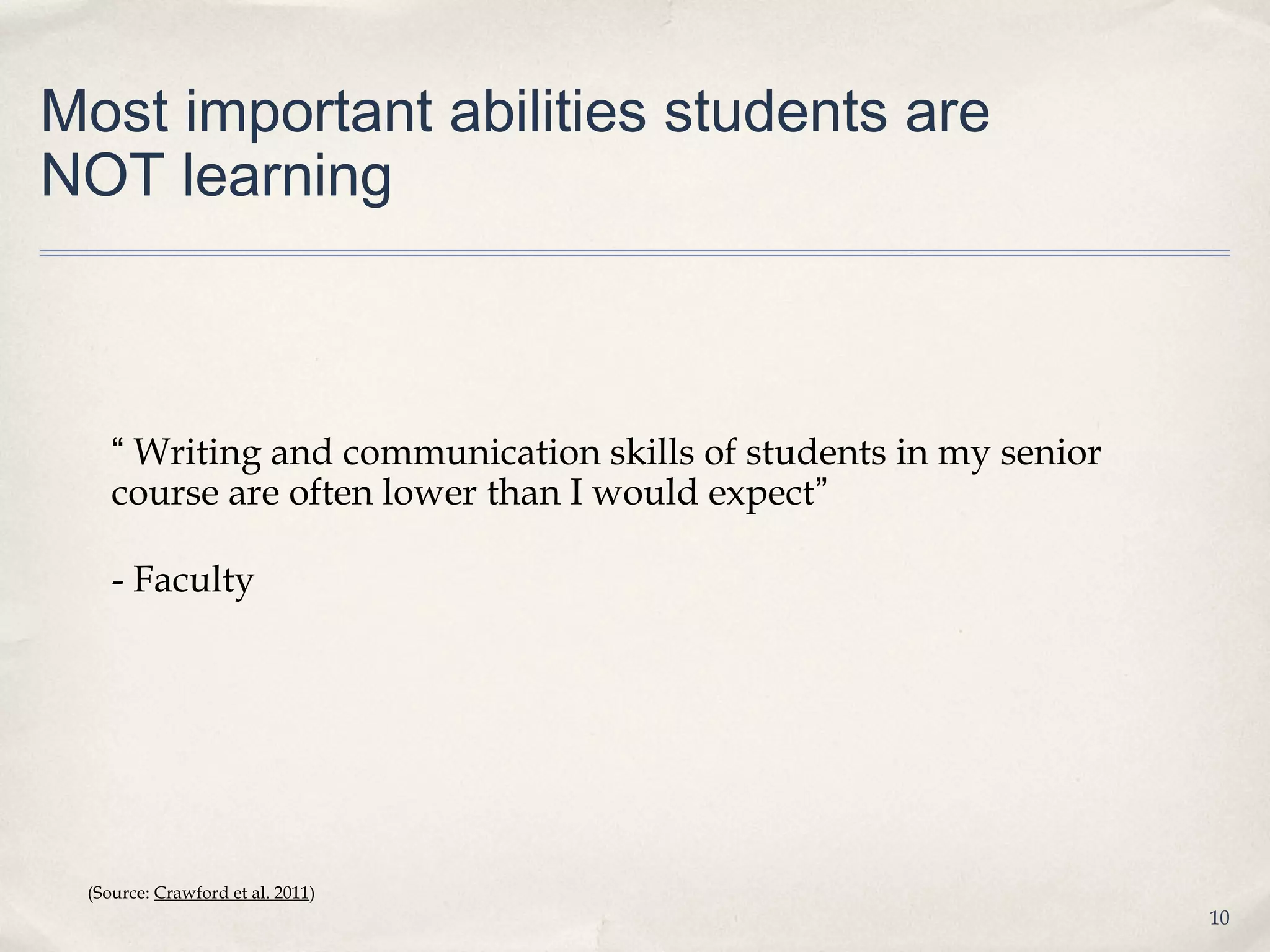
    “ Writing and communication skills of students in my senior
    course are often lower than I would expect”

    - Faculty


 (Source: Crawford et al. 2011)
                                                                  10
Most important abilities students are
NOT learning


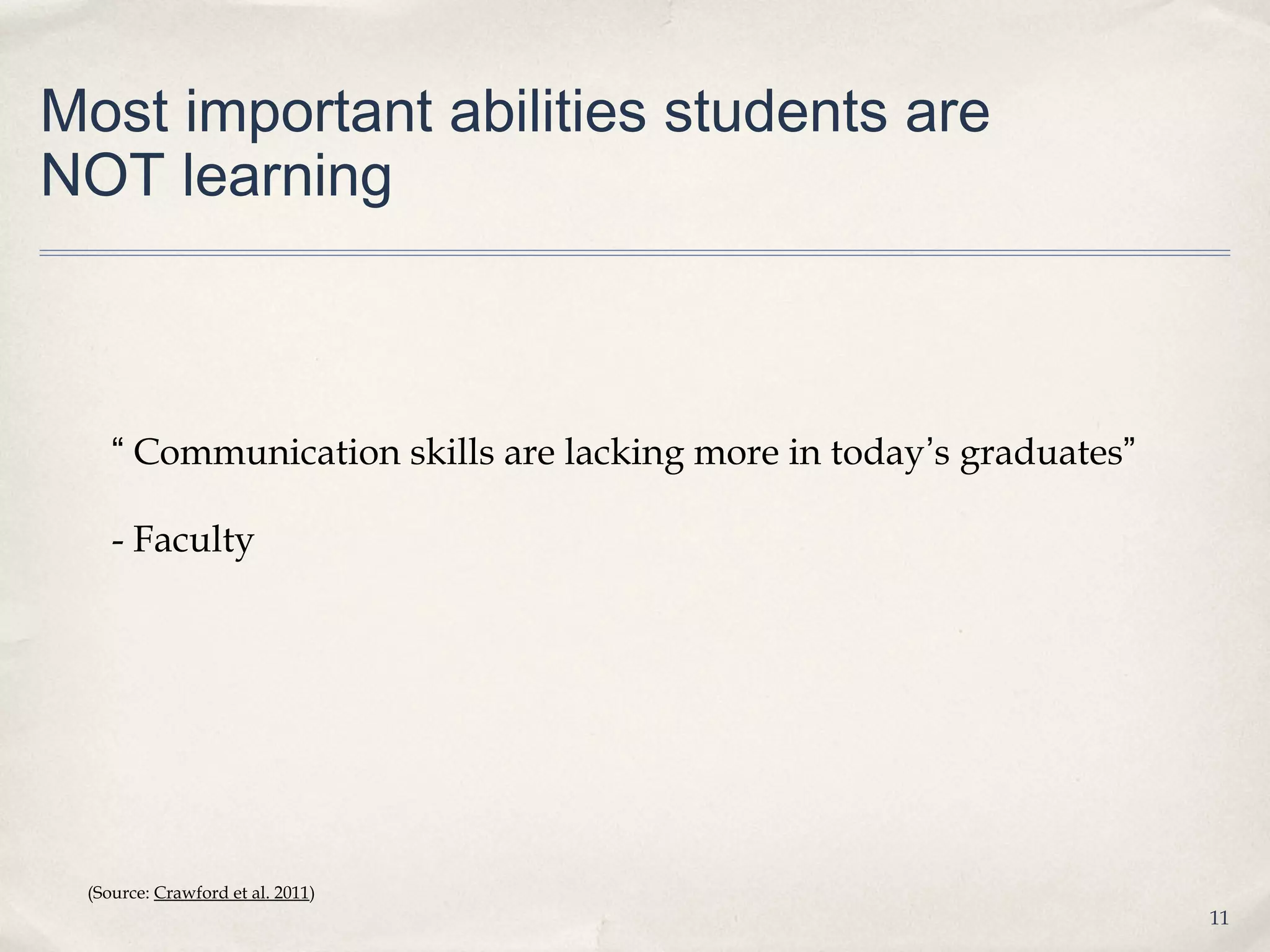
    “ Communication skills are lacking more in today’s graduates”

    - Faculty


 (Source: Crawford et al. 2011)
                                                                    11
Most important abilities students are
NOT learning


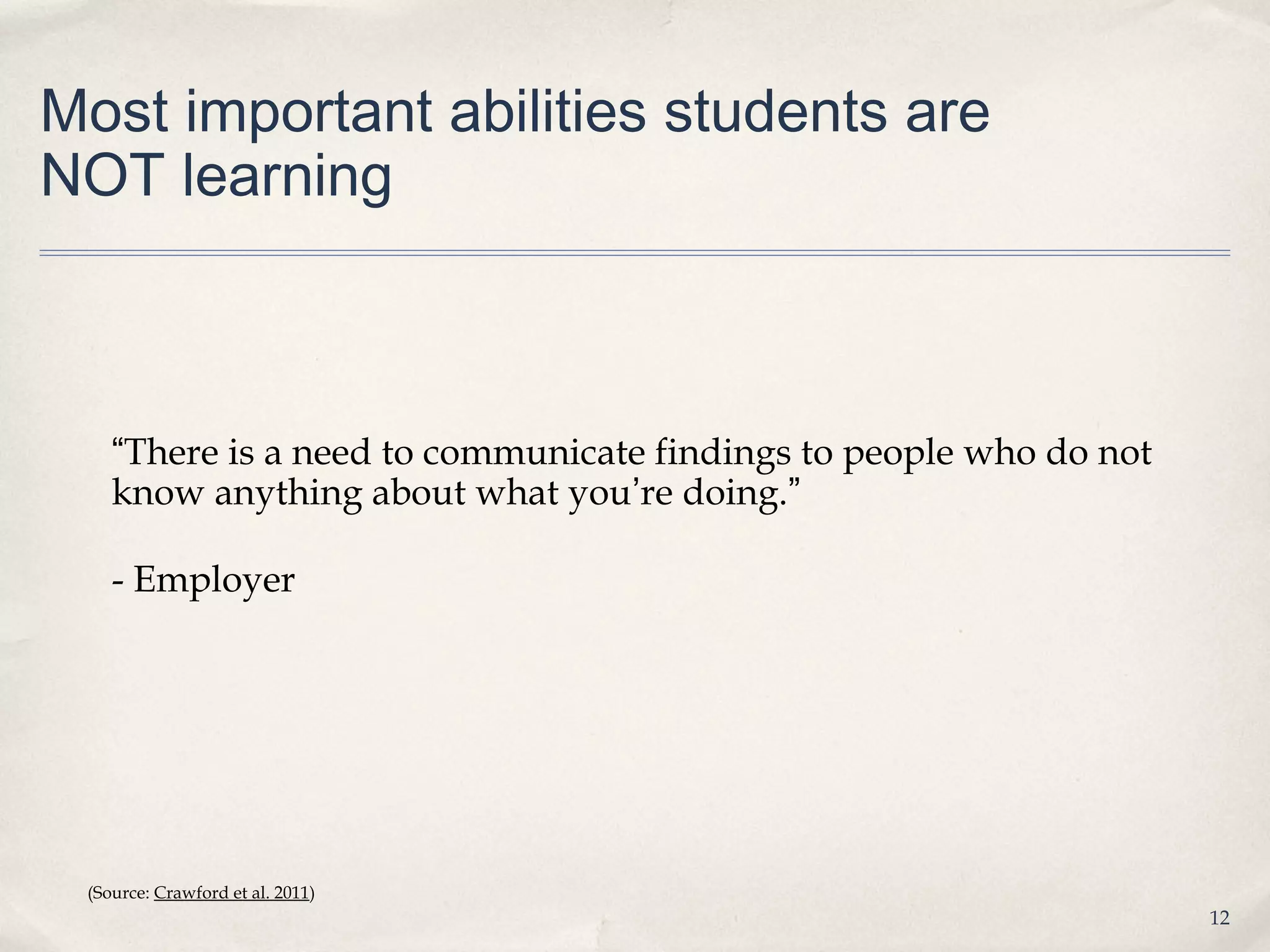
    “There is a need to communicate findings to people who do not
    know anything about what you’re doing.”

    - Employer


 (Source: Crawford et al. 2011)
                                                                    12
What does this mean for you?


                               13
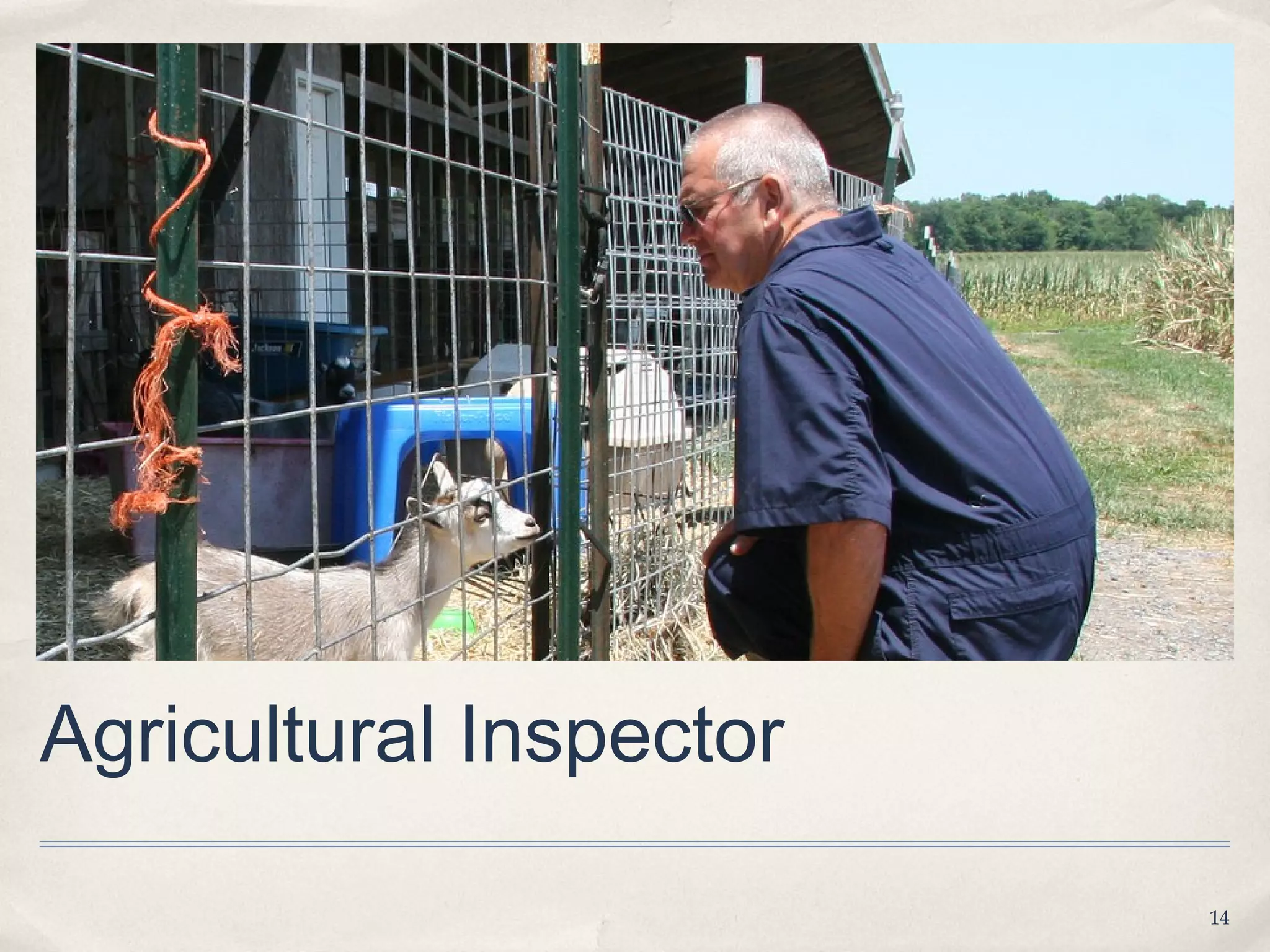
Agricultural Inspector

                         14
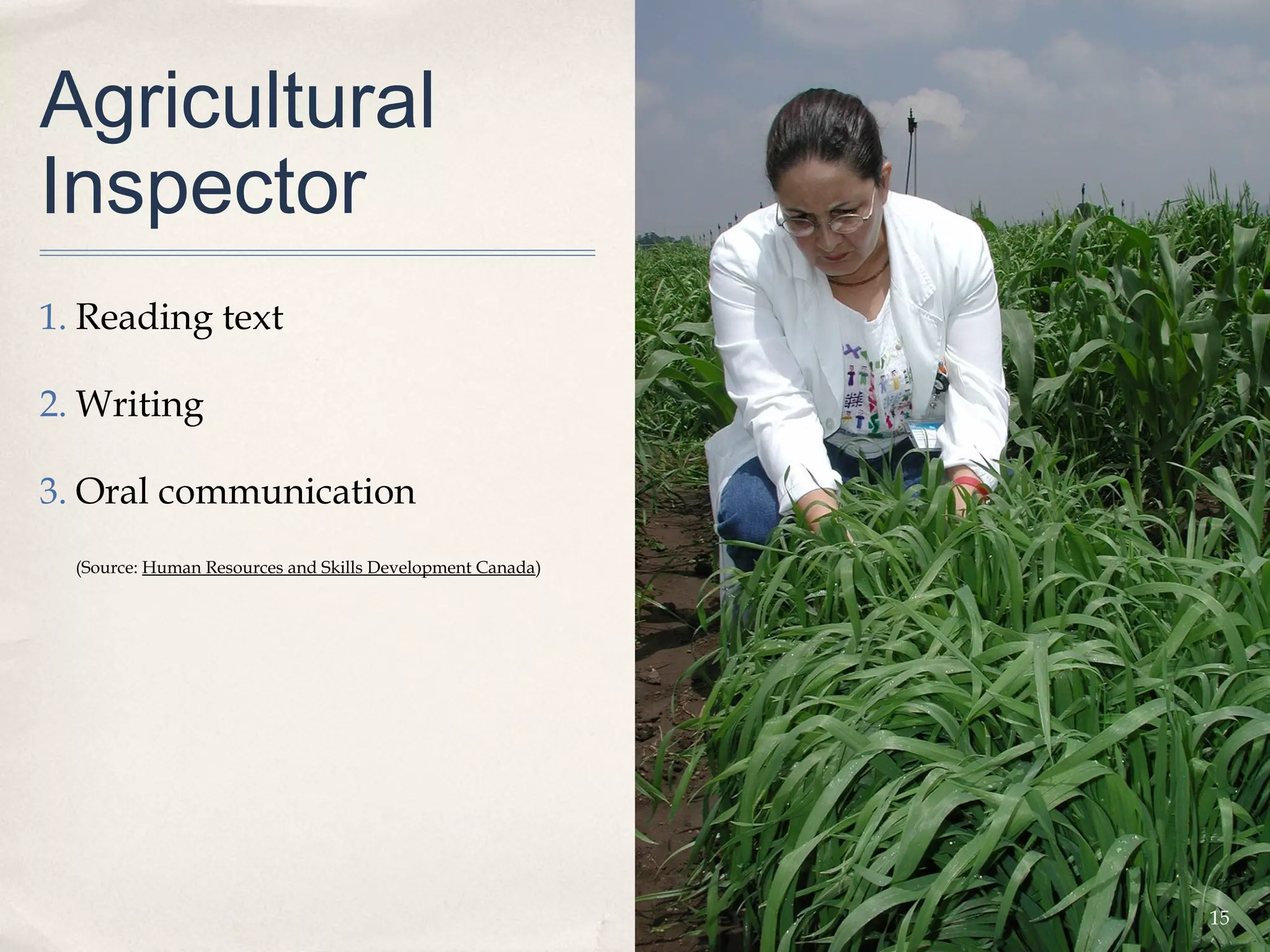
Agricultural
Inspector
1. Reading text

2. Writing

3. Oral communication
  (Source: Human Resources and Skills Development Canada)


                                                            15
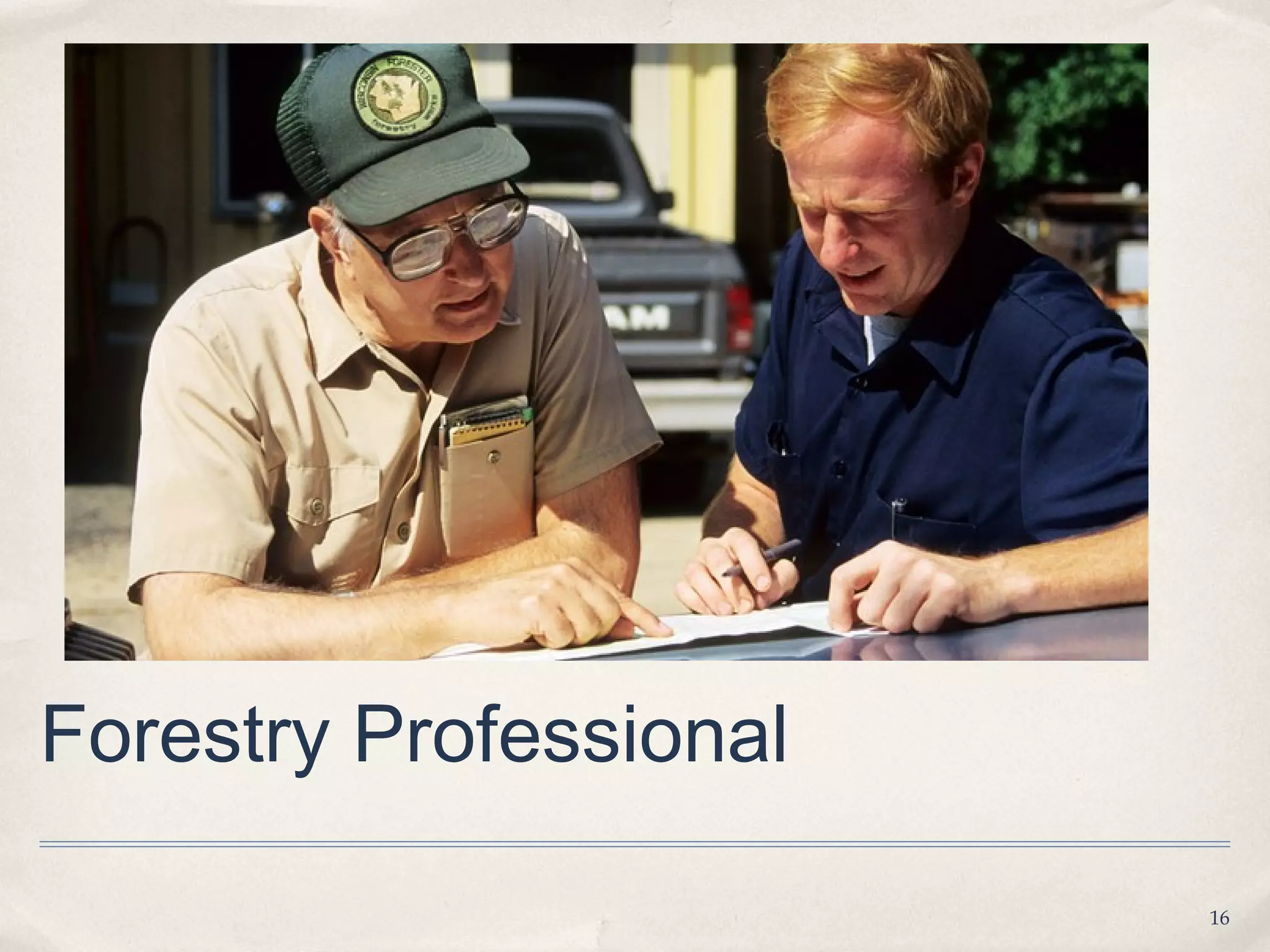
Forestry Professional

                        16
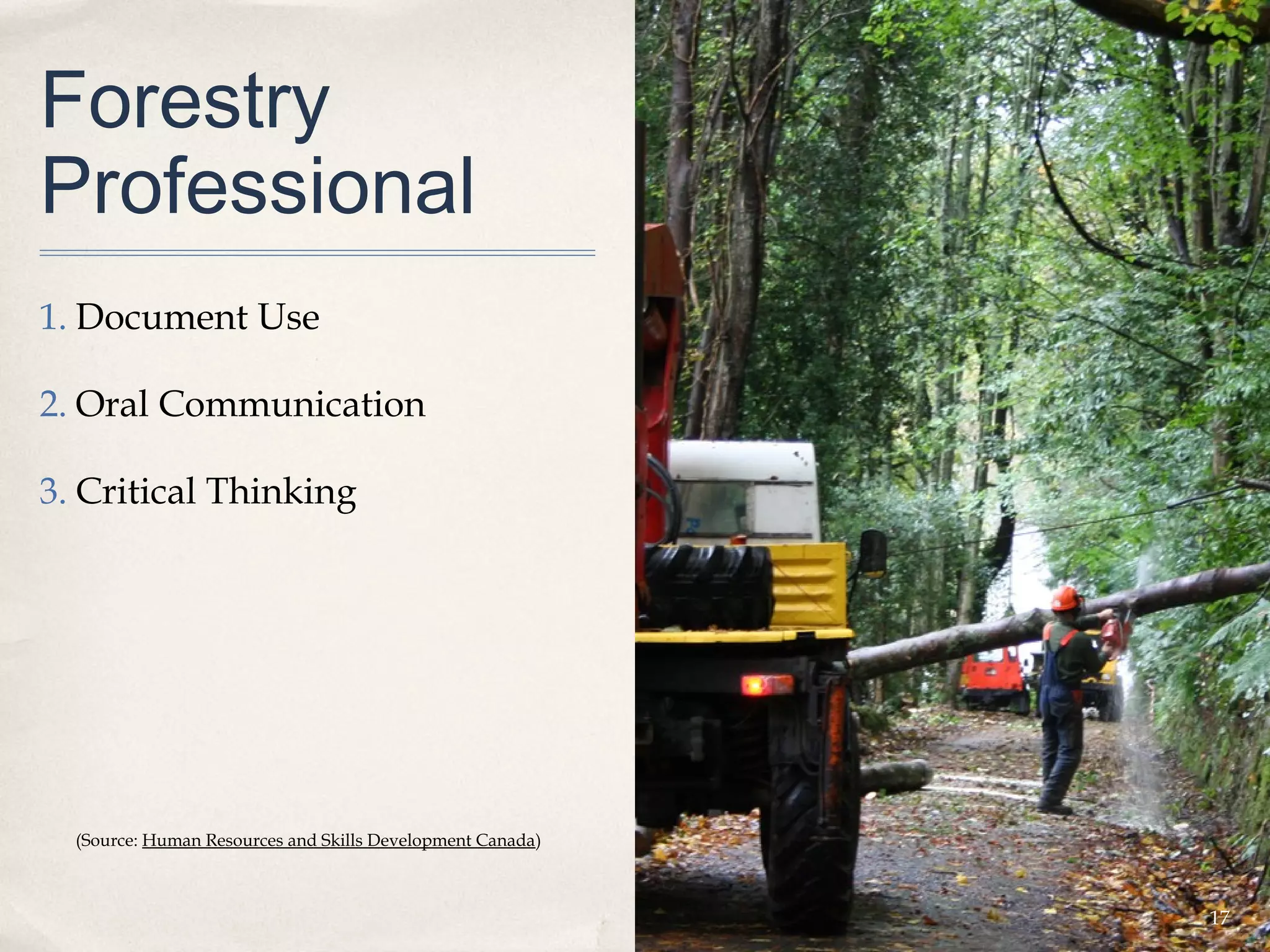
Forestry
Professional
1. Document Use

2. Oral Communication

3. Critical Thinking


  (Source: Human Resources and Skills Development Canada)


                                                            17
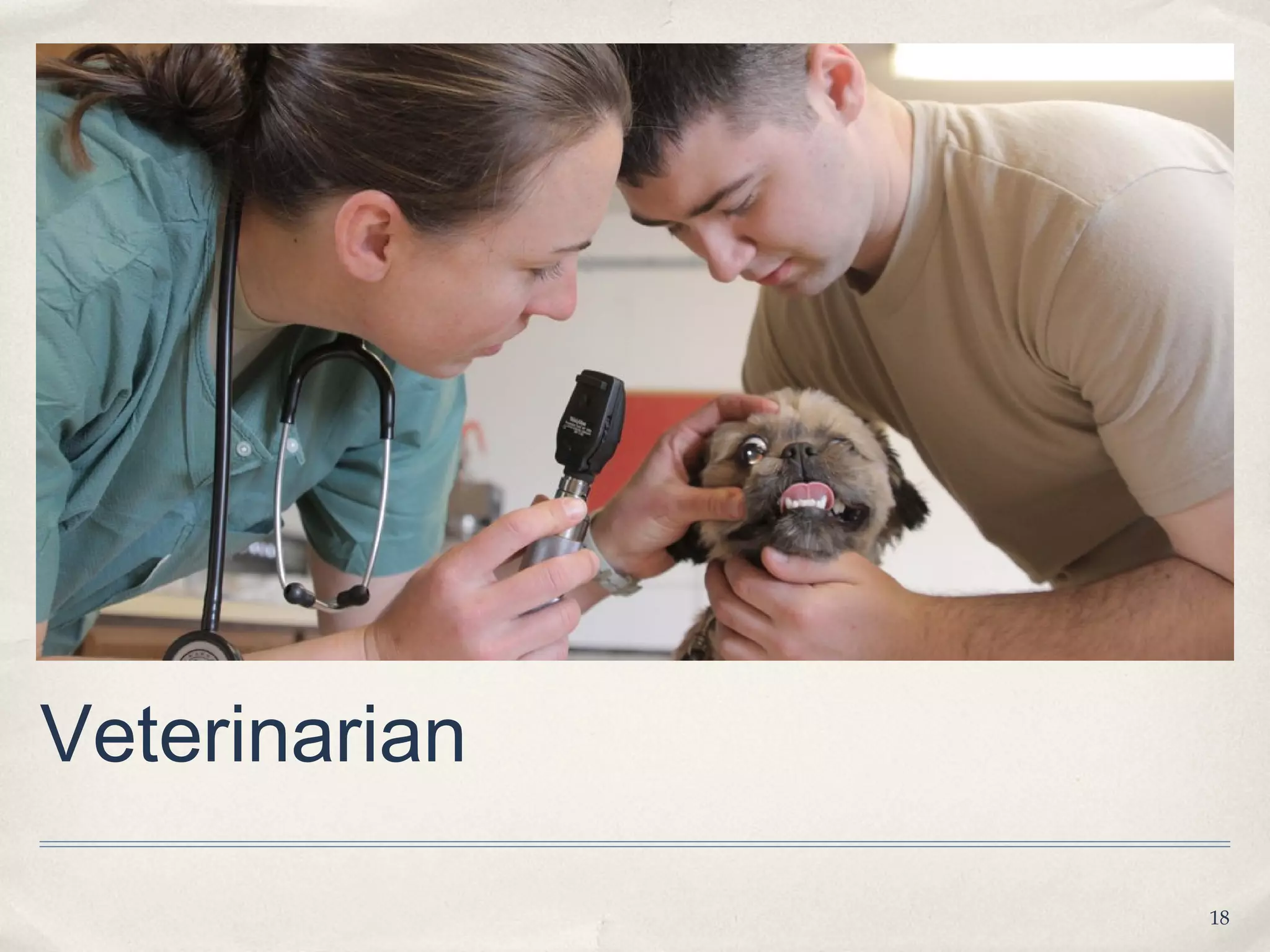
Veterinarian

               18
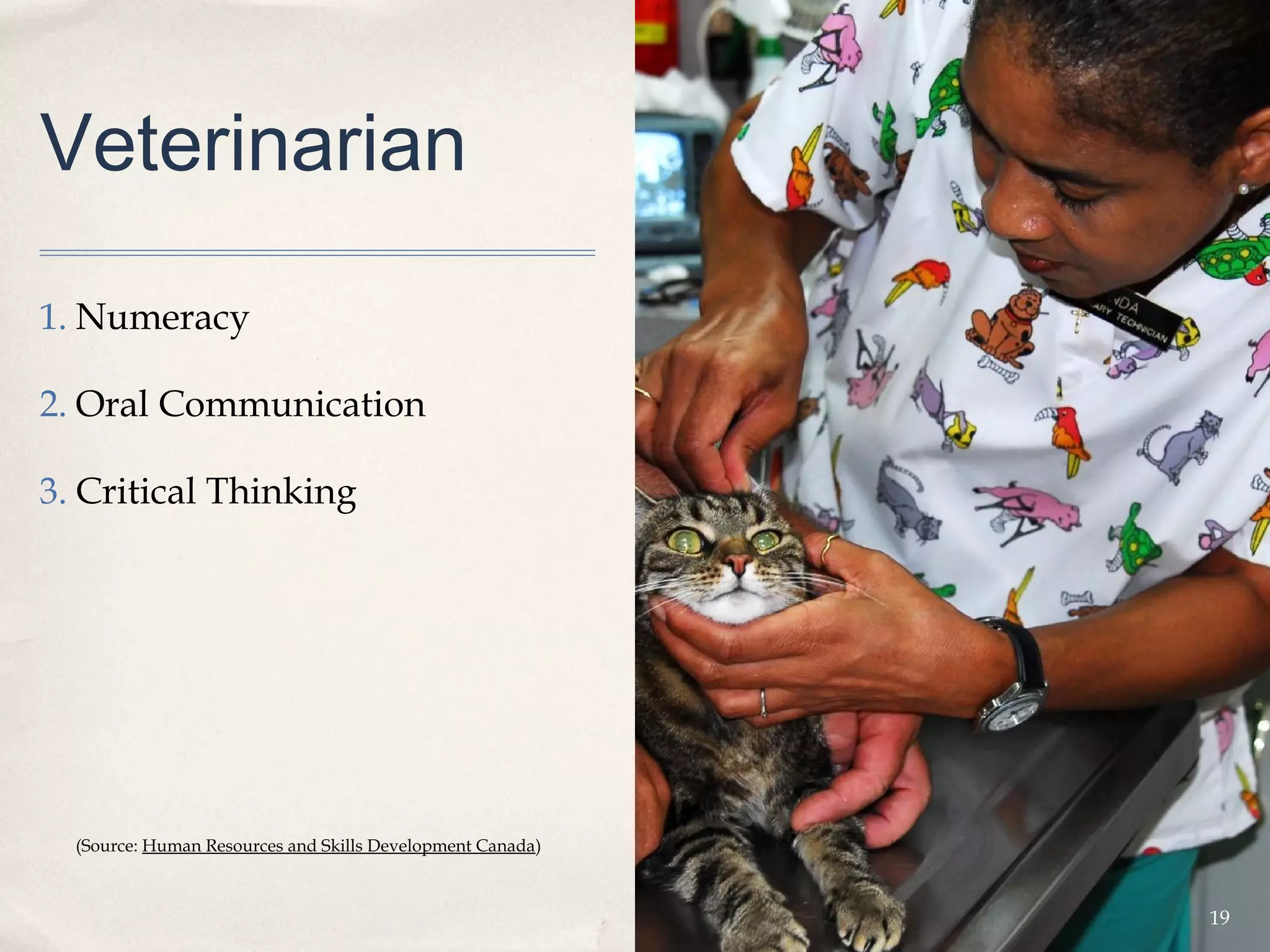
Veterinarian

1. Numeracy

2. Oral Communication

3. Critical Thinking


  (Source: Human Resources and Skills Development Canada)


                                                            19
3. About ALES 204


                    20
Where we are going


                     21
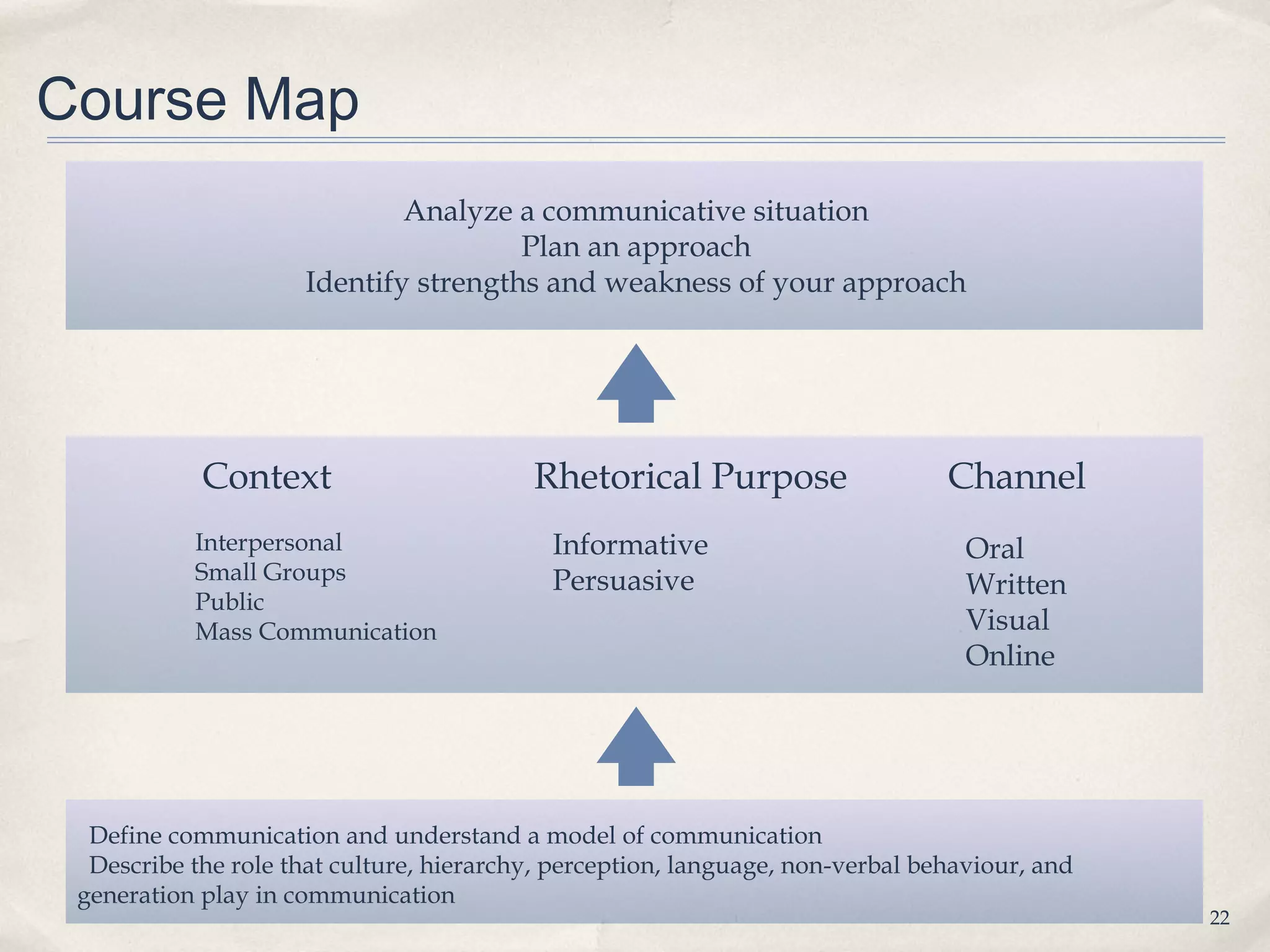
Course Map
                             Analyze a communicative situation
                                      Plan an approach
                     Identify strengths and weakness of your approach


            Context                       Rhetorical Purpose                    Channel
           Interpersonal                    Informative                           Oral
           Small Groups                     Persuasive                            Written
           Public
           Mass Communication                                                     Visual
                                                                                  Online


  Define communication and understand a model of communication
  Describe the role that culture, hierarchy, perception, language, non-verbal behaviour, and
 generation play in communication
                                                                                               22
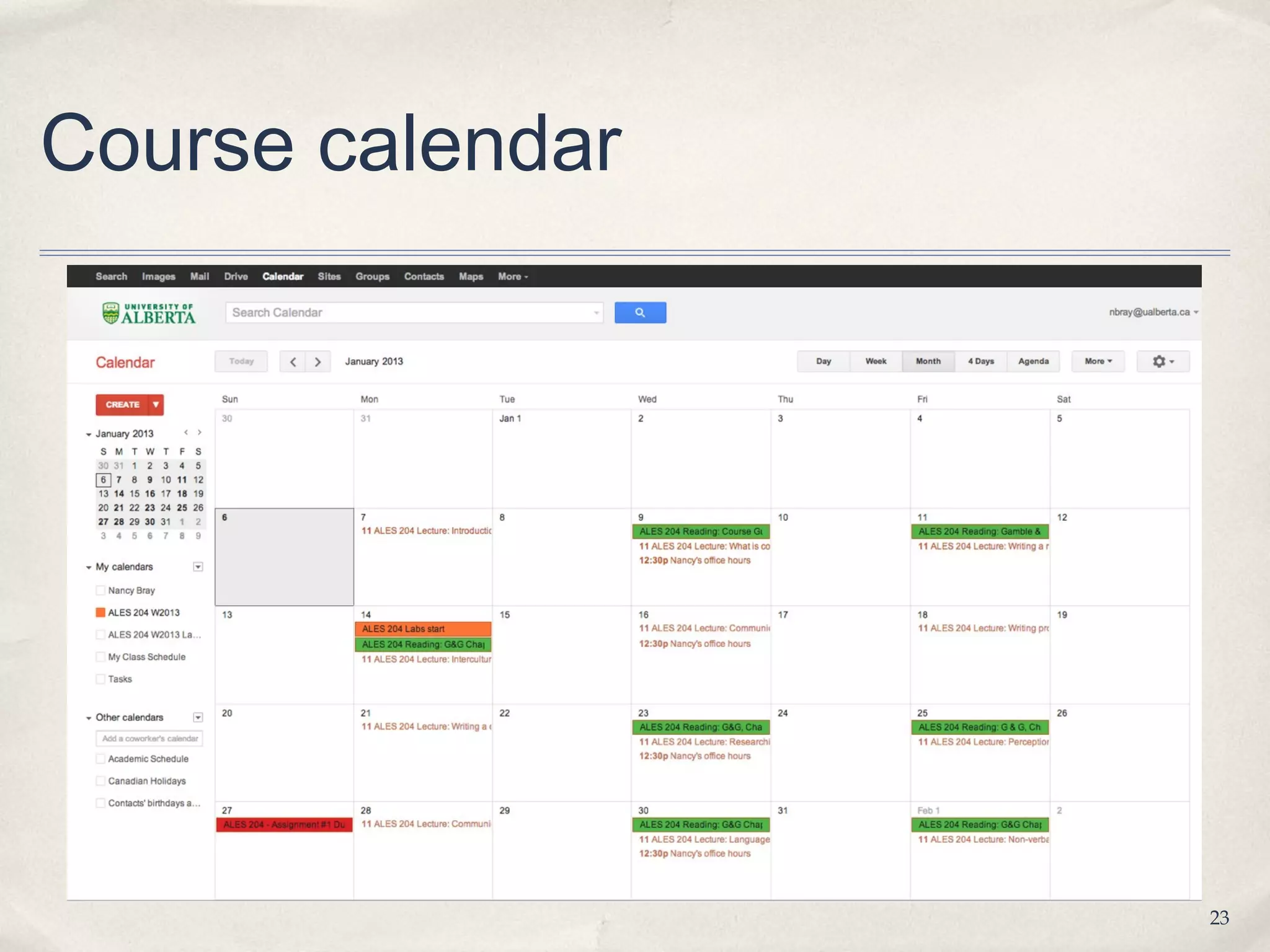
Course calendar


                  23
Calendar

You can add the calendar to your Google calendar

Calendar e-mail address is:
ualberta.ca_a29f62e8hblli17lgqpcljj15k@group.calendar.google.com


                                                                   24
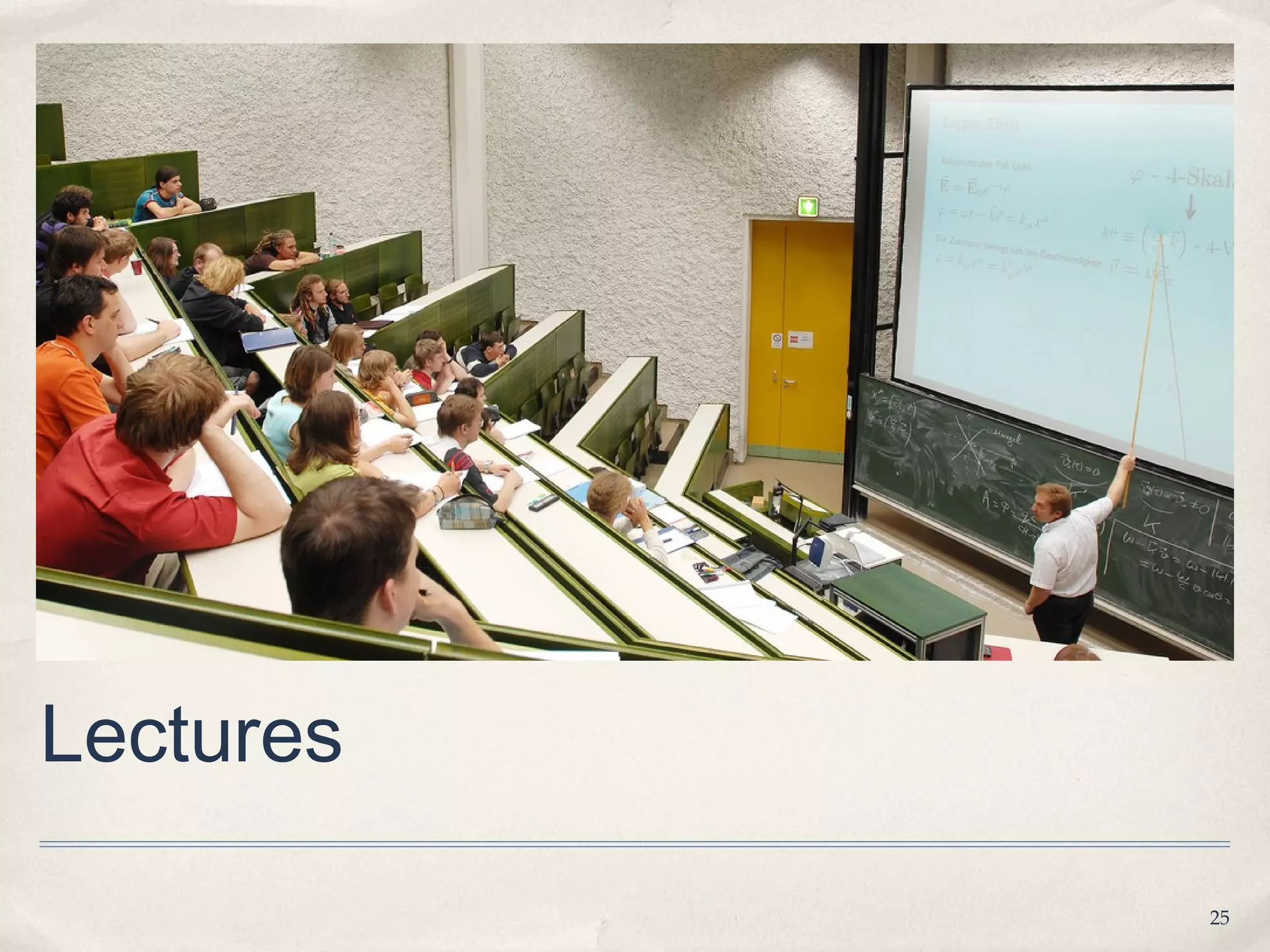
Lectures

           25
Lectures


           26
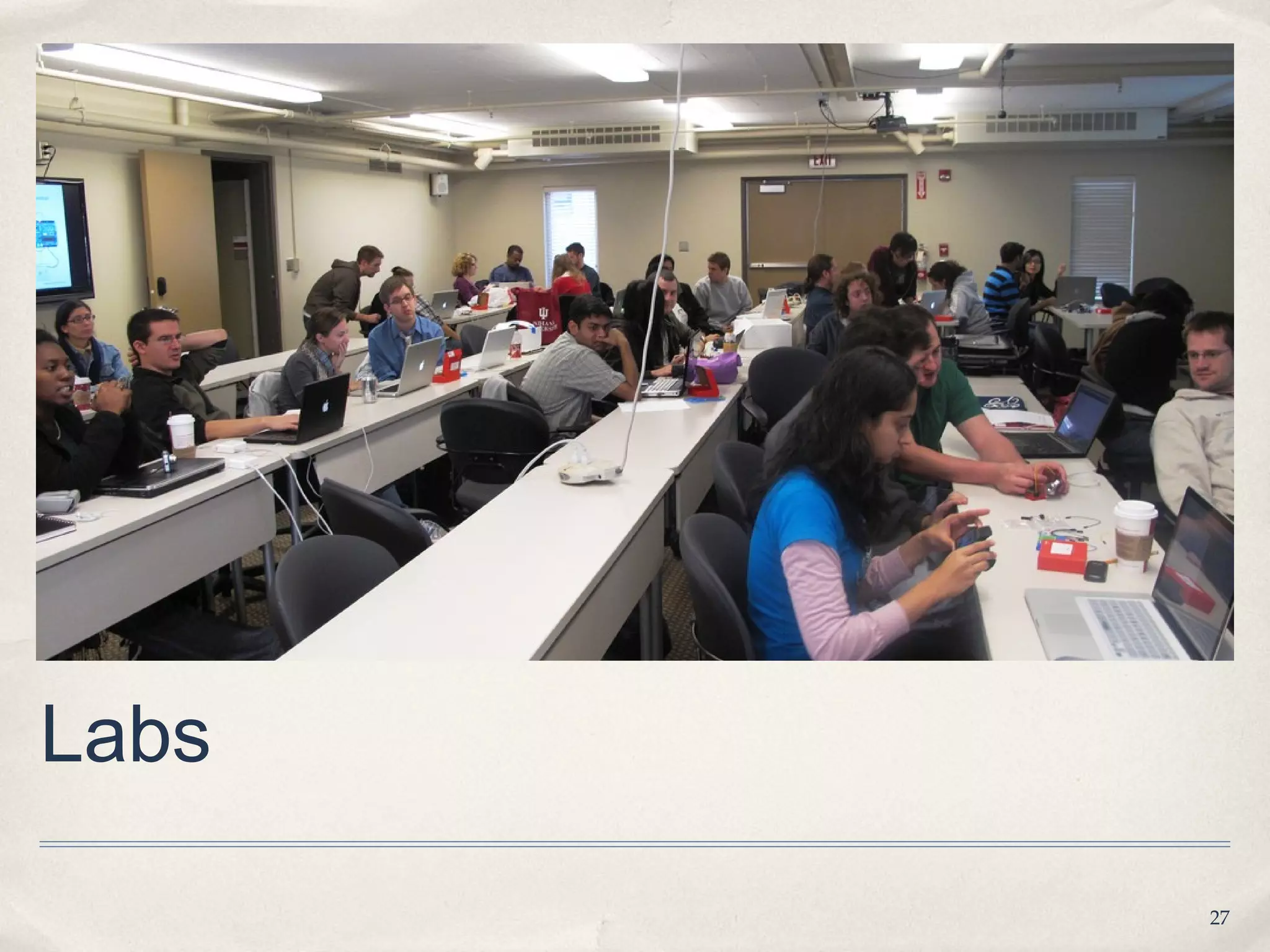
Labs

       27
Labs


       28
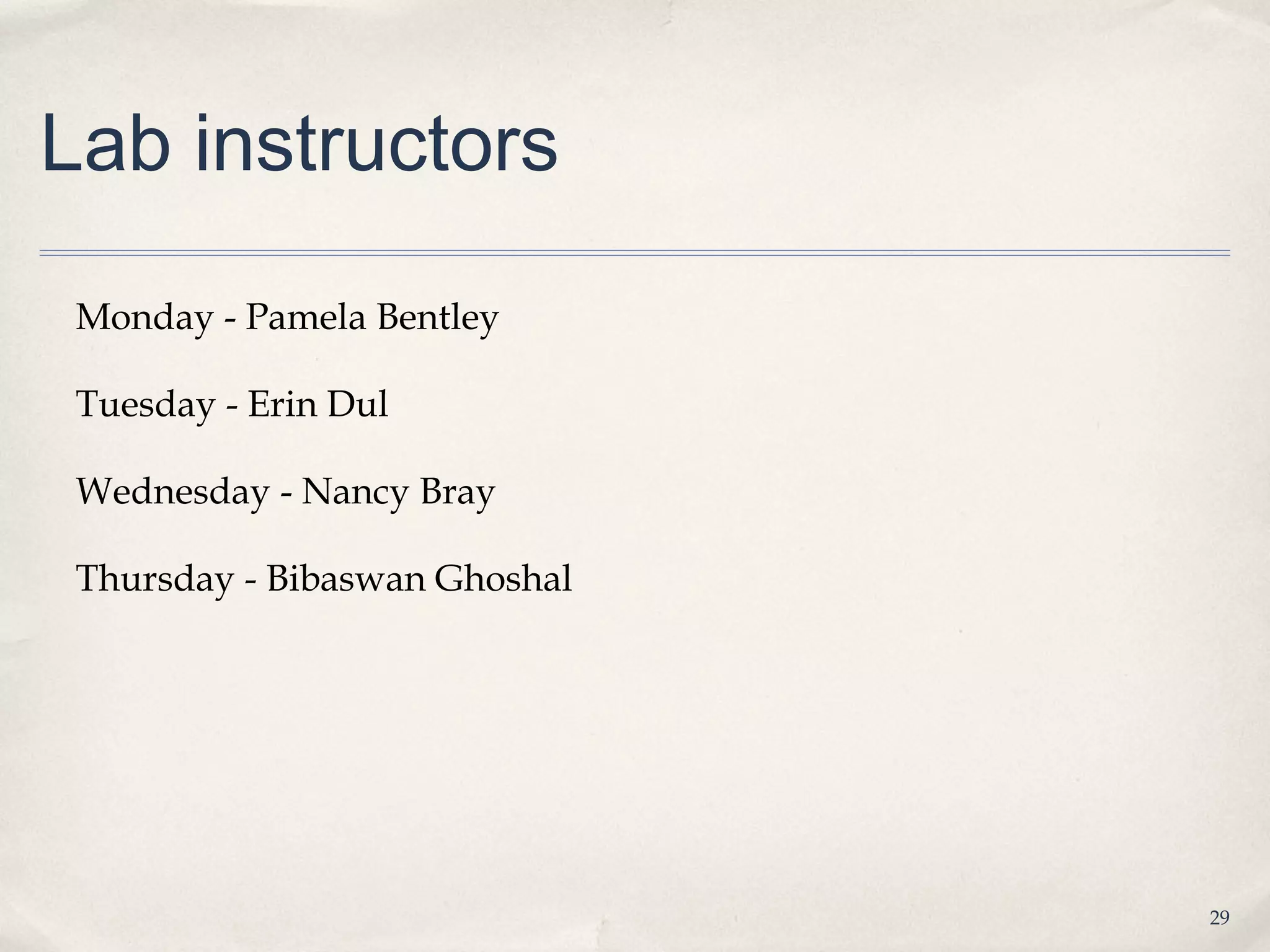
Lab instructors

 Monday - Pamela Bentley

 Tuesday - Erin Dul

 Wednesday - Nancy Bray

 Thursday - Bibaswan Ghoshal


                               29
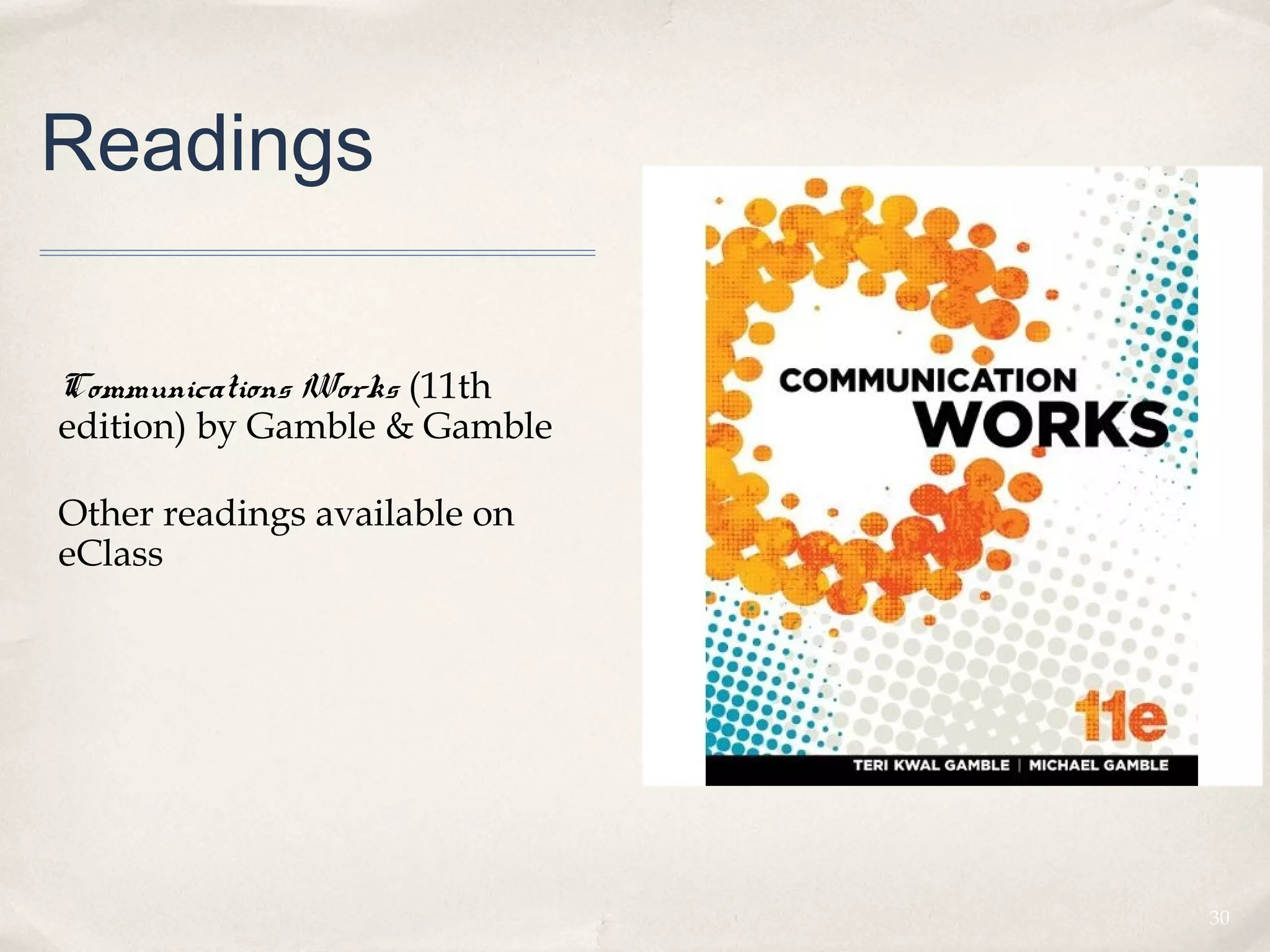
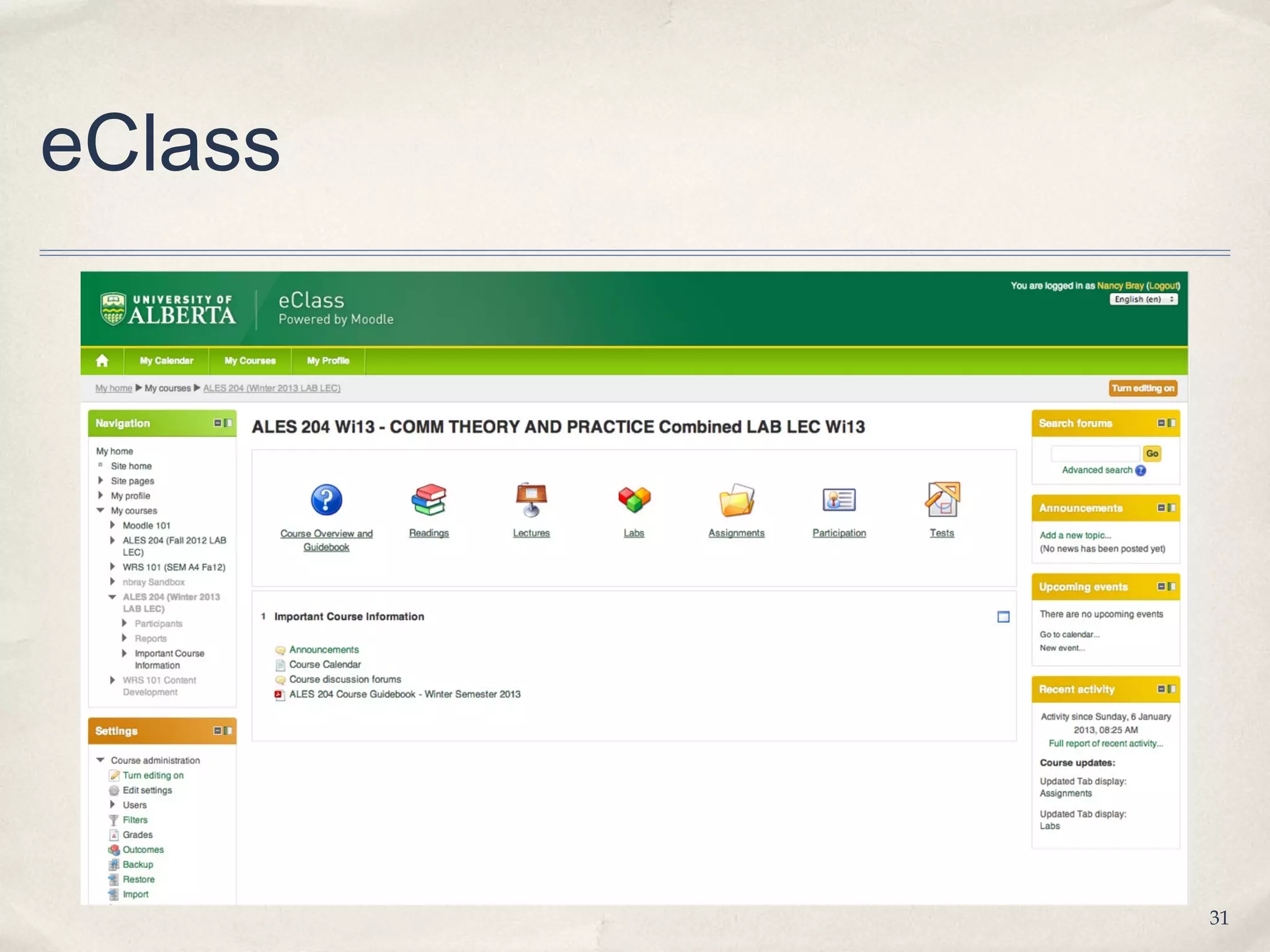
Readings

Communications Works (11th
edition) by Gamble & Gamble

Other readings available on
eClass


                              30
eClass


         31
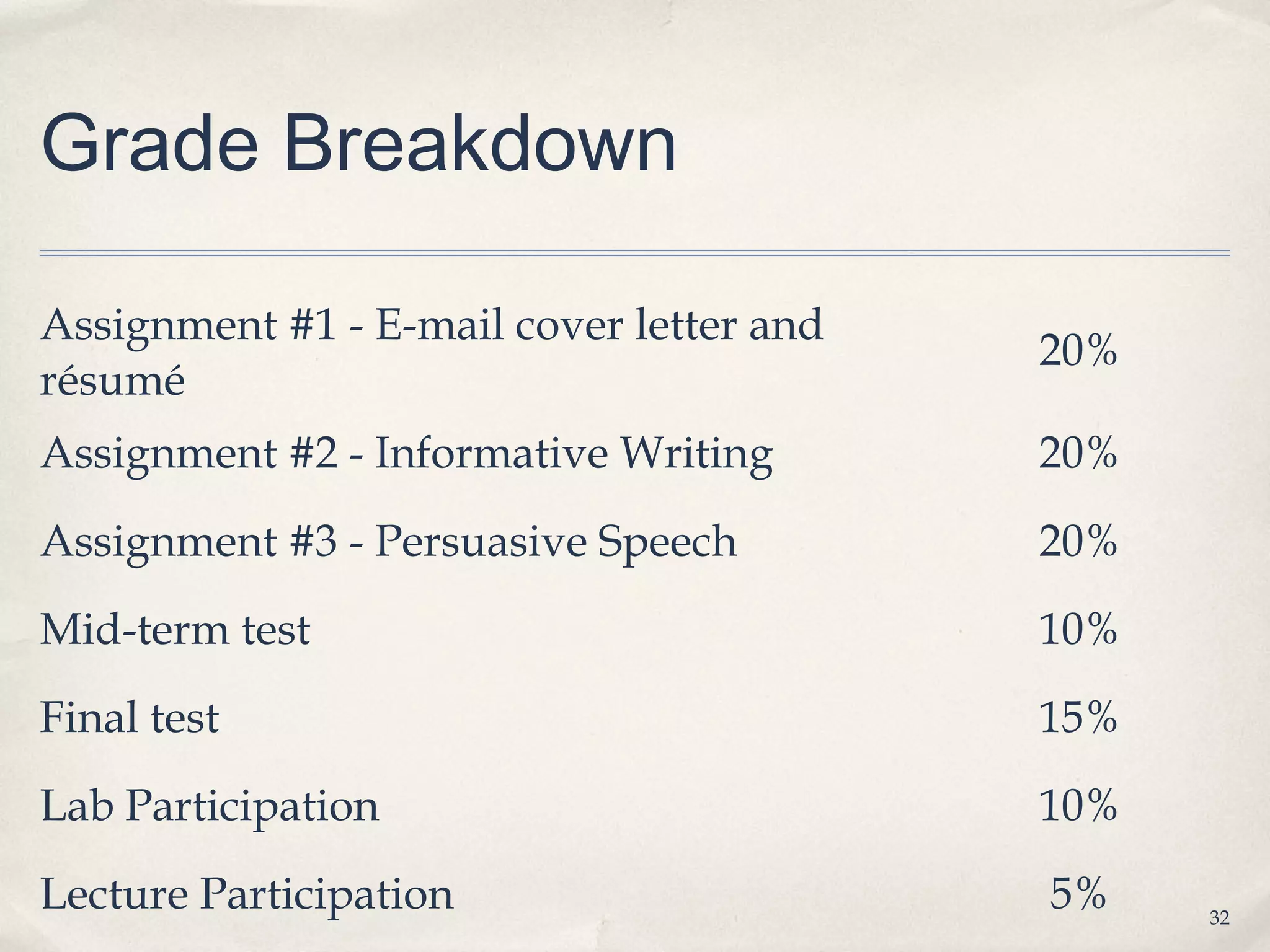
Grade Breakdown

Assignment #1 - E-mail cover letter and
                                          20%
résumé
Assignment #2 - Informative Writing       20%
Assignment #3 - Persuasive Speech         20%
Mid-term test                             10%
Final test                                15%
Lab Participation                         10%
Lecture Participation                     5%    32
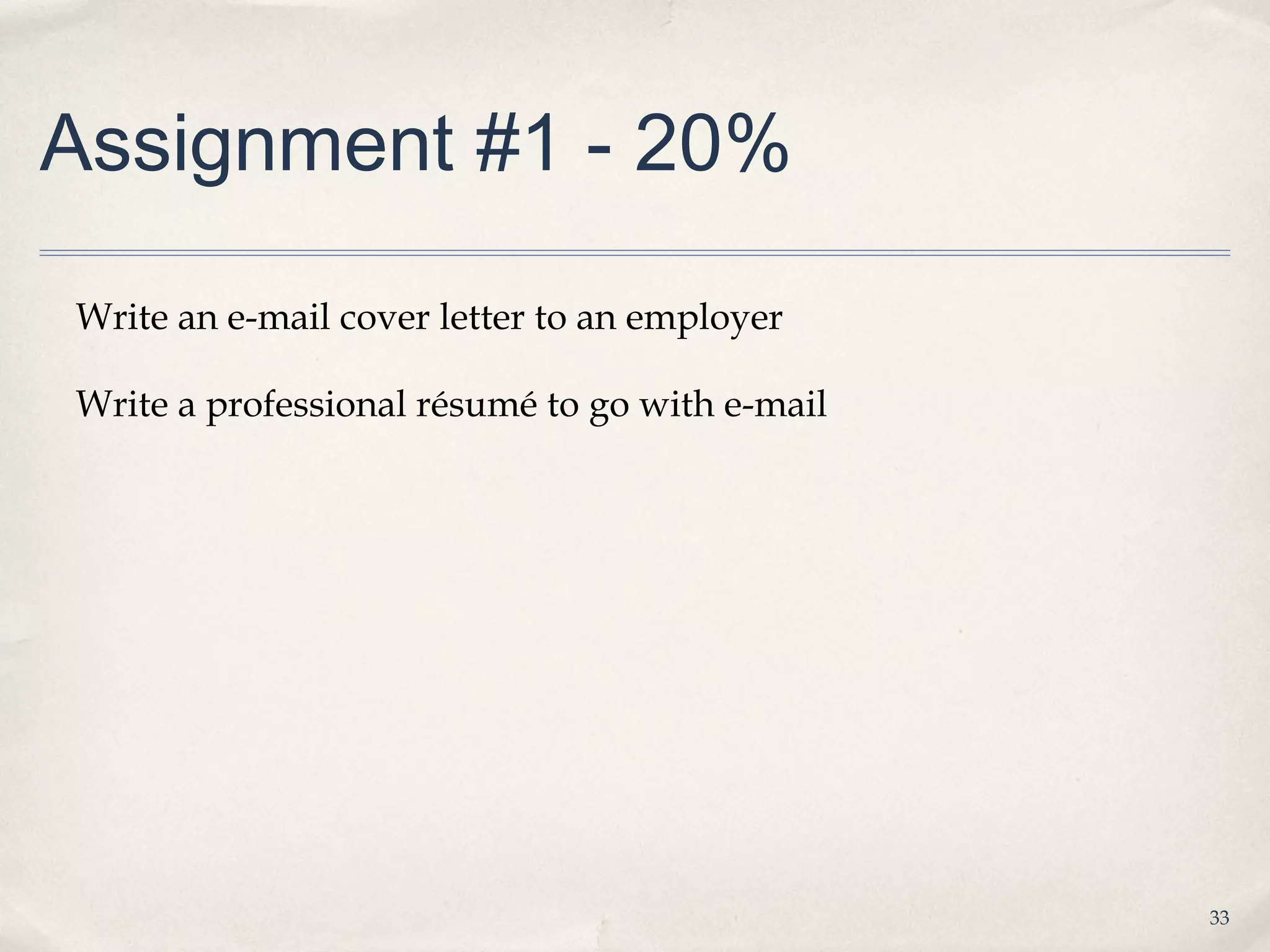
Assignment #1 - 20%

Write an e-mail cover letter to an employer

Write a professional résumé to go with e-mail


                                                33
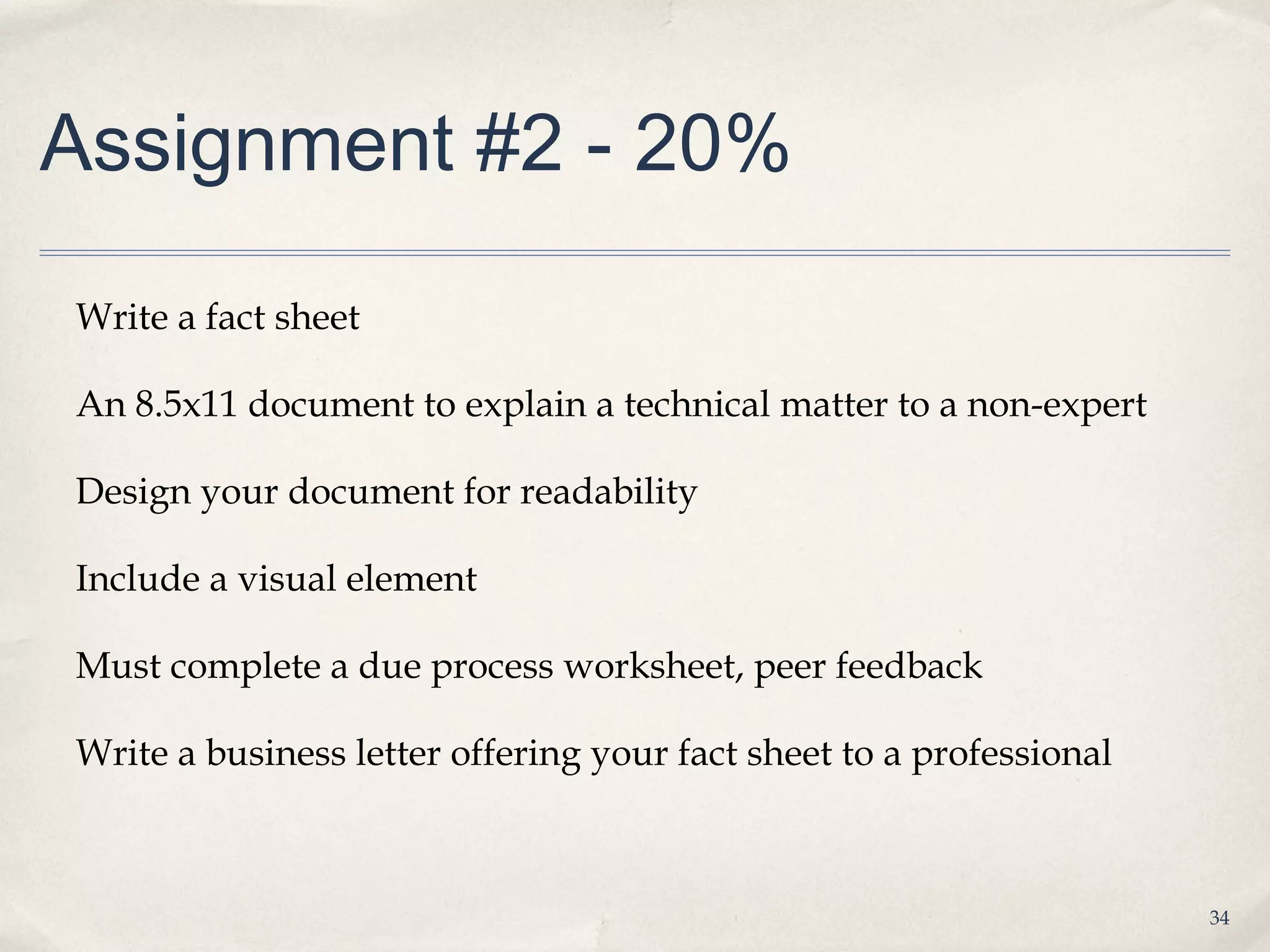
Assignment #2 - 20%

Write a fact sheet

An 8.5x11 document to explain a technical matter to a non-expert

Design your document for readability

Include a visual element

Must complete a due process worksheet, peer feedback

Write a business letter offering your fact sheet to a professional


                                                                     34
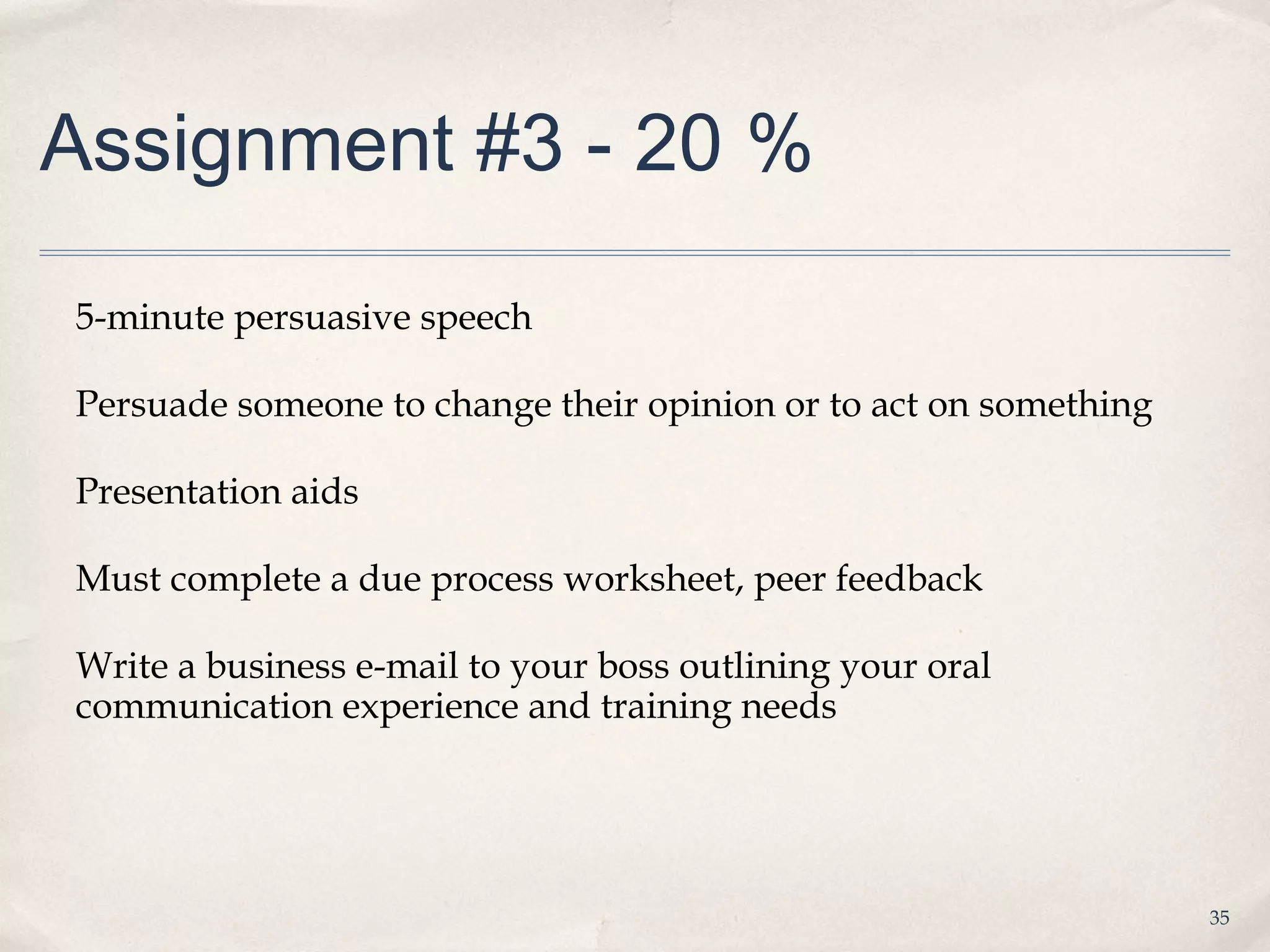
Assignment #3 - 20 %

5-minute persuasive speech

Persuade someone to change their opinion or to act on something

Presentation aids

Must complete a due process worksheet, peer feedback

Write a business e-mail to your boss outlining your oral
communication experience and training needs


                                                                  35
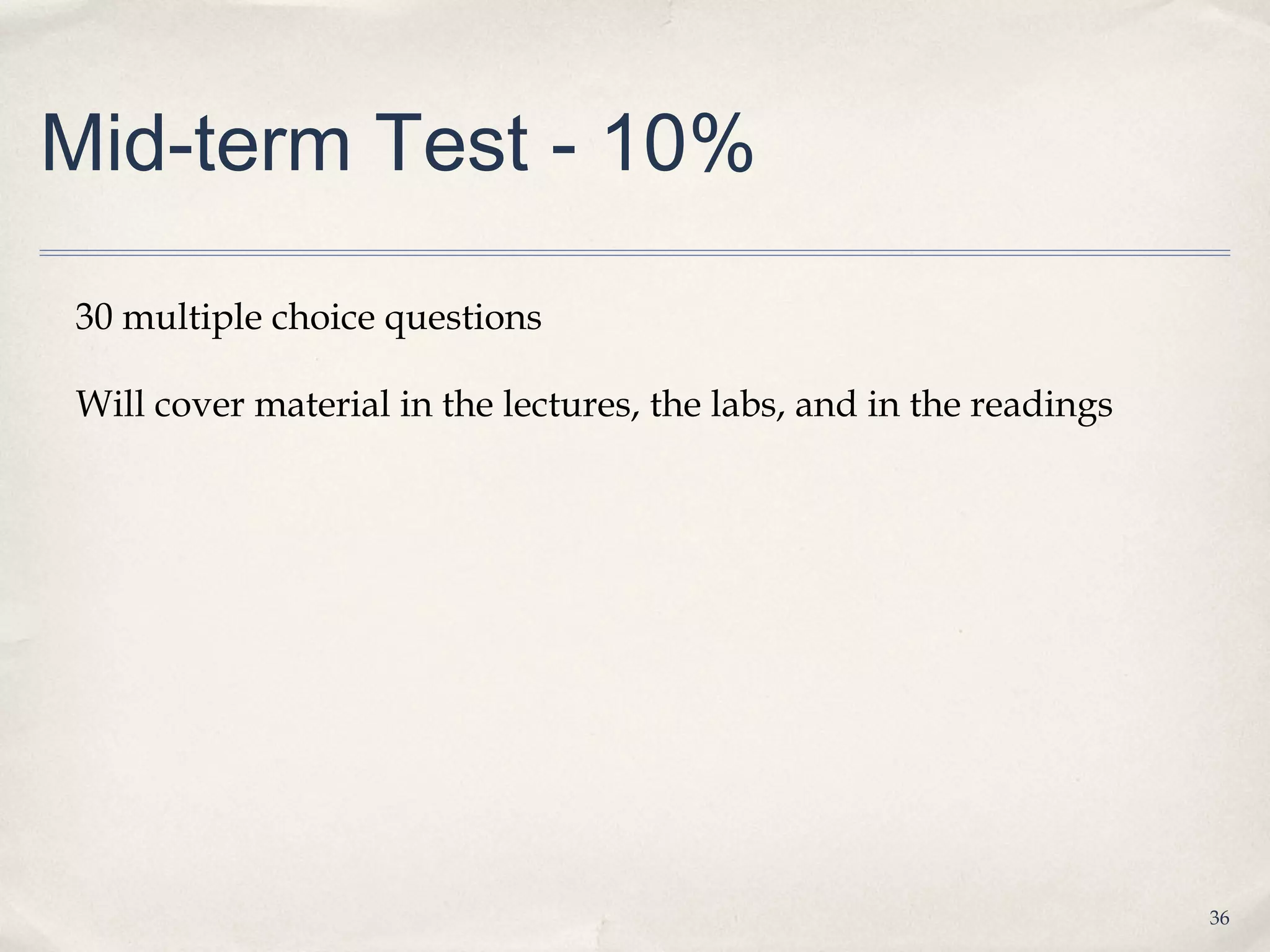
Mid-term Test - 10%

30 multiple choice questions

Will cover material in the lectures, the labs, and in the readings


                                                                     36
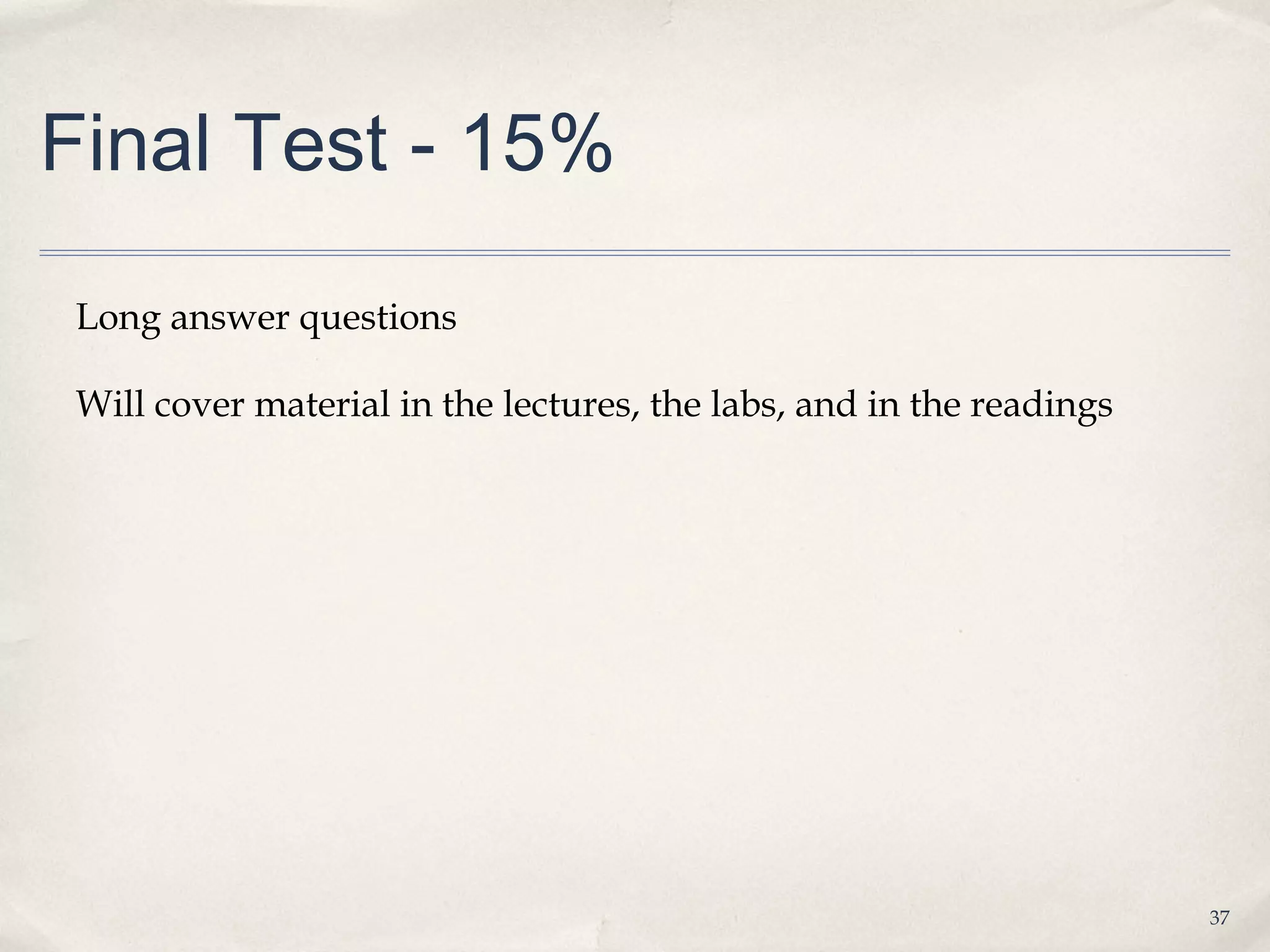
Final Test - 15%

Long answer questions

Will cover material in the lectures, the labs, and in the readings


                                                                     37
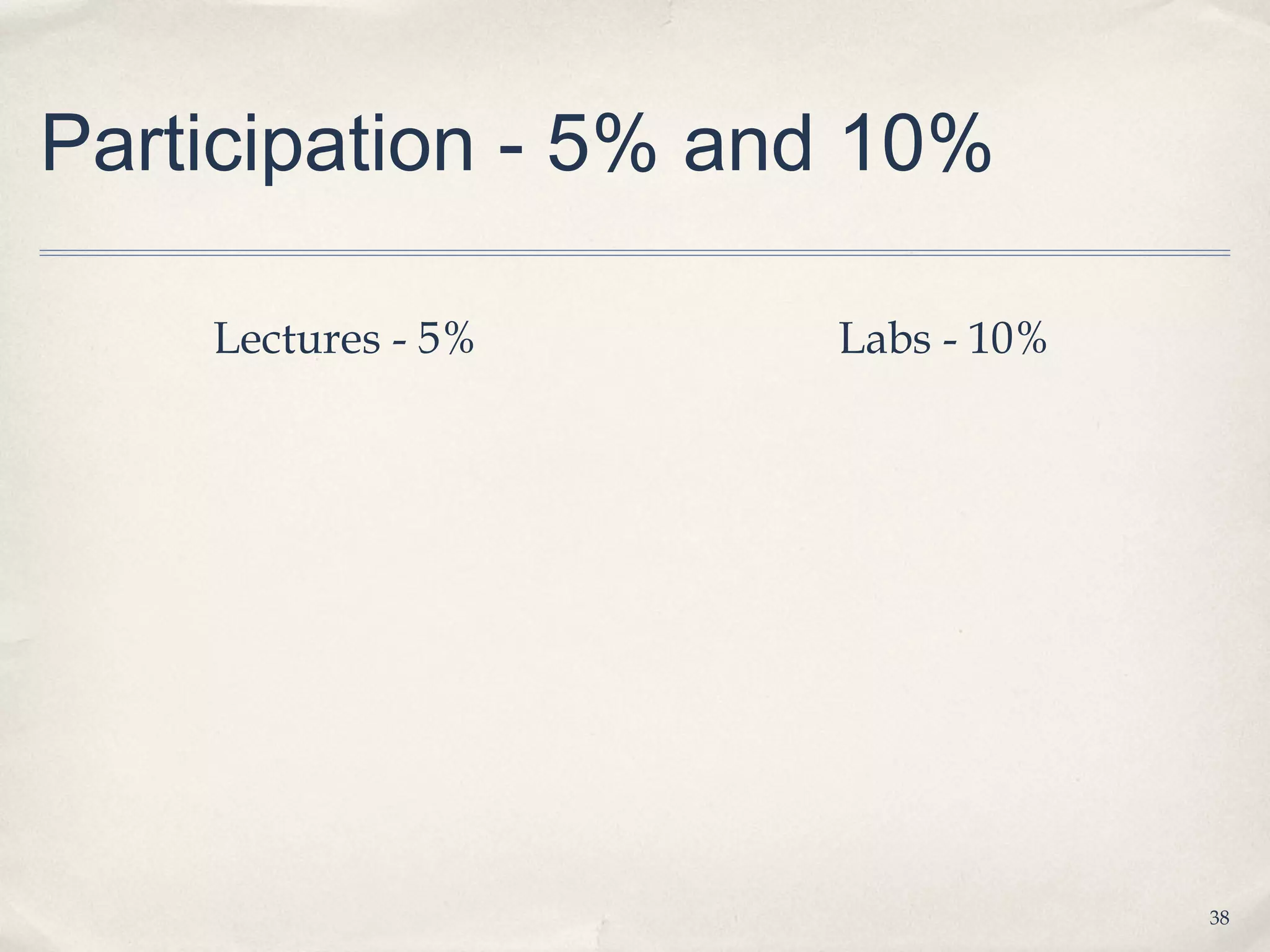
Participation - 5% and 10%

    Lectures - 5%    Labs - 10%


                                  38
Participation

     What to do!   What not to do!


                                     39
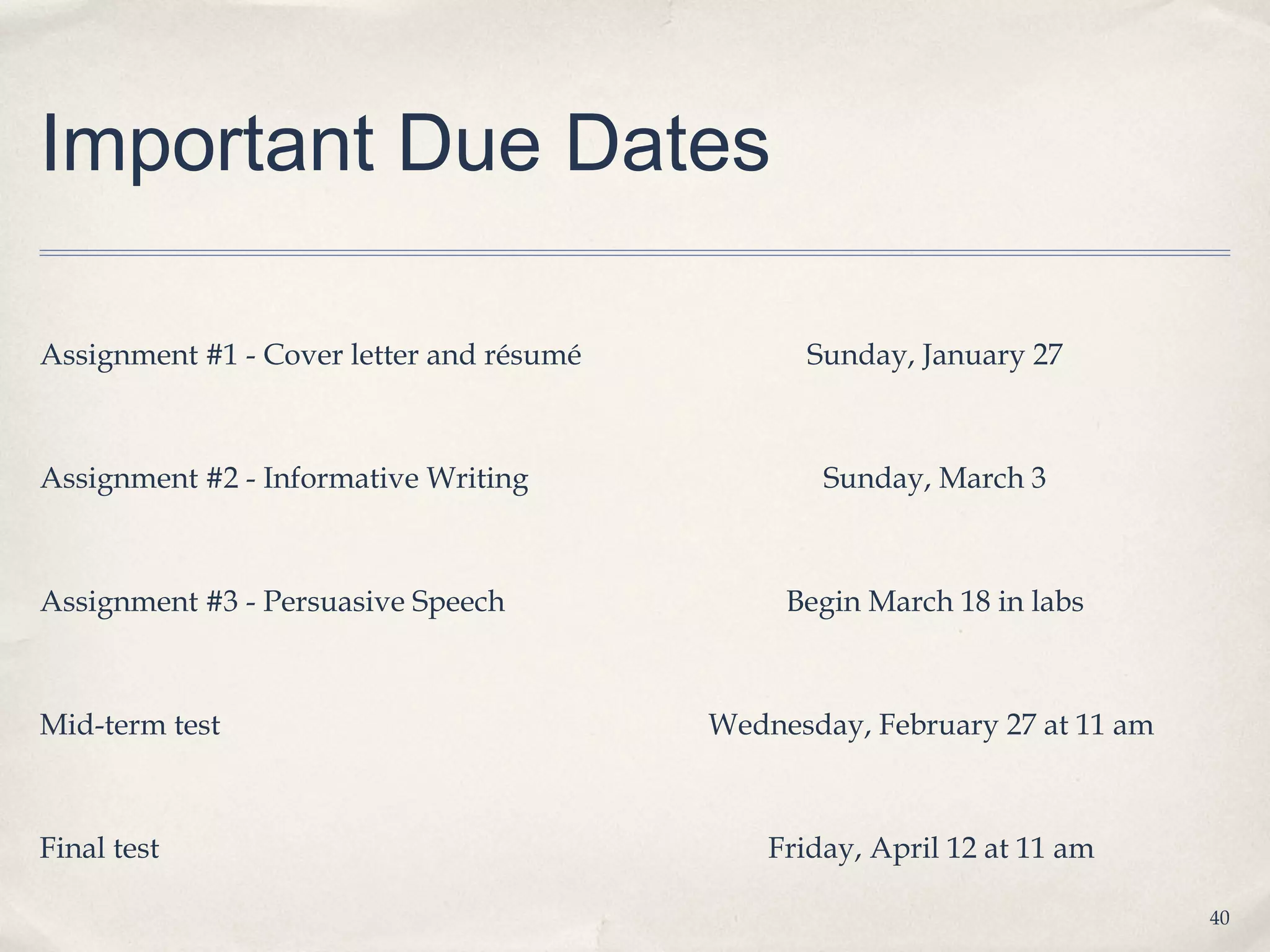
Important Due Dates

Assignment #1 - Cover letter and résumé         Sunday, January 27


Assignment #2 - Informative Writing               Sunday, March 3


Assignment #3 - Persuasive Speech              Begin March 18 in labs


Mid-term test                             Wednesday, February 27 at 11 am


Final test                                    Friday, April 12 at 11 am

                                                                            40
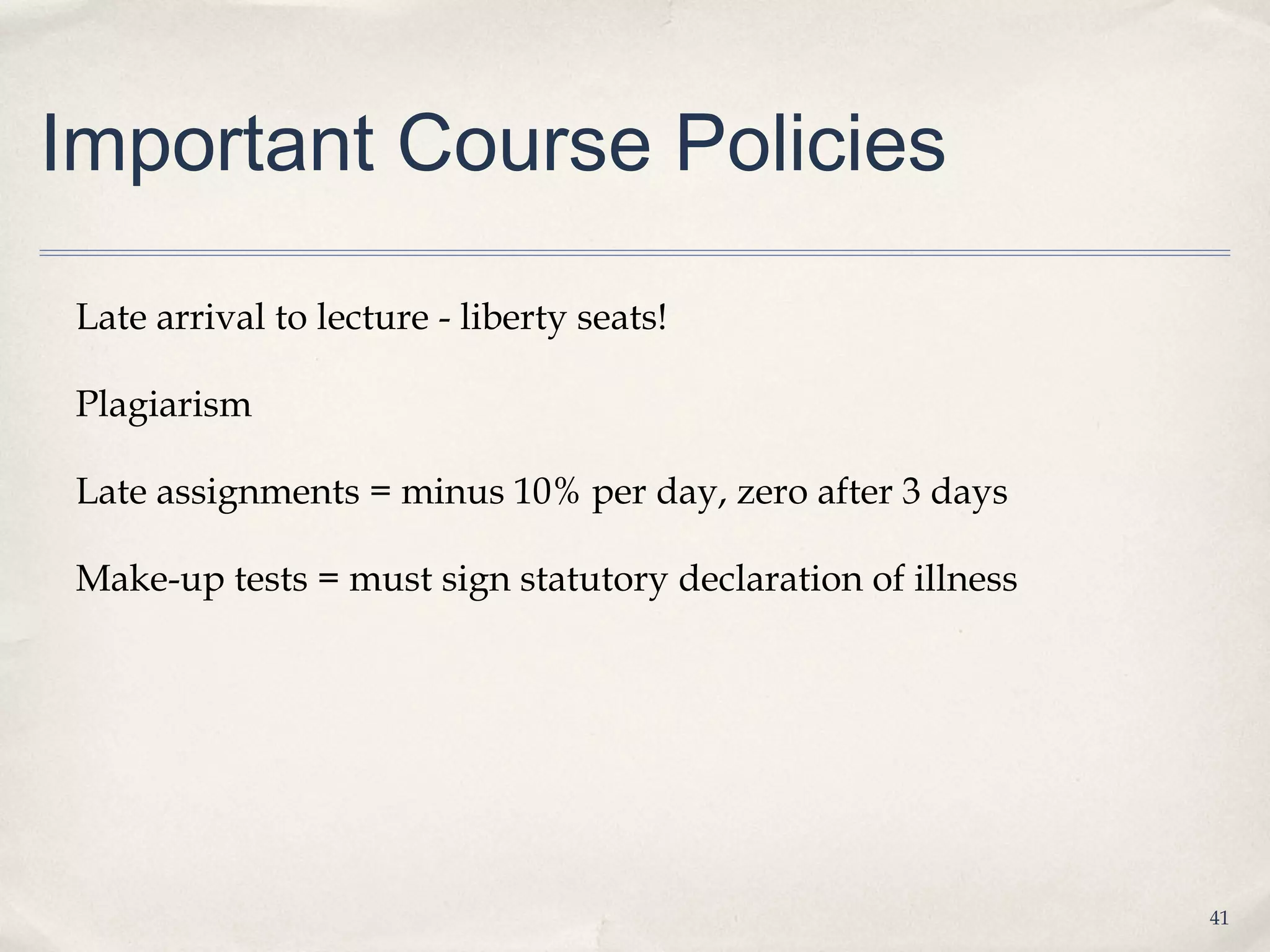
Important Course Policies

Late arrival to lecture - liberty seats!

Plagiarism

Late assignments = minus 10% per day, zero after 3 days

Make-up tests = must sign statutory declaration of illness


                                                             41
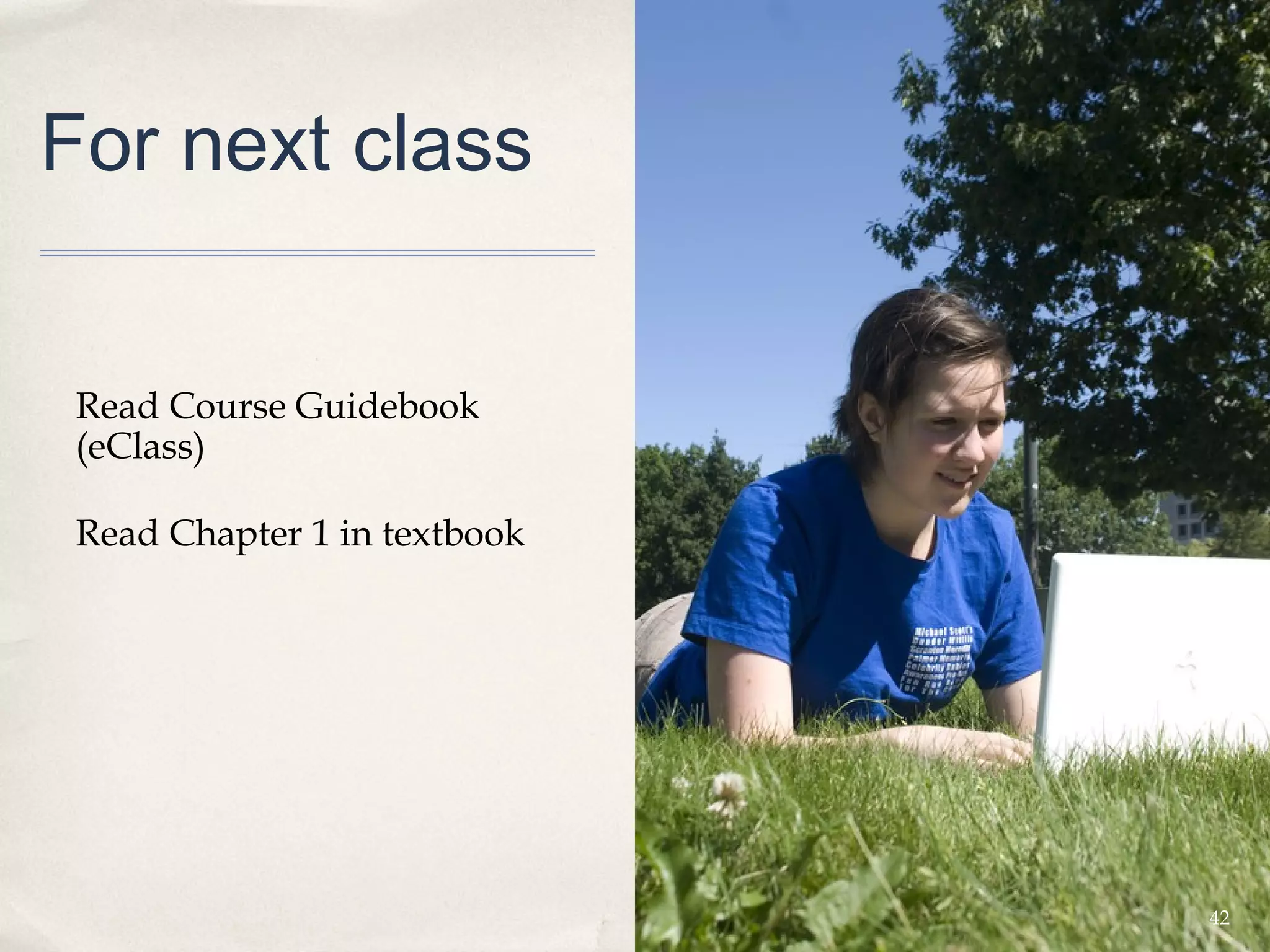
For next class


 Read Course Guidebook
 (eClass)

 Read Chapter 1 in textbook


                              42
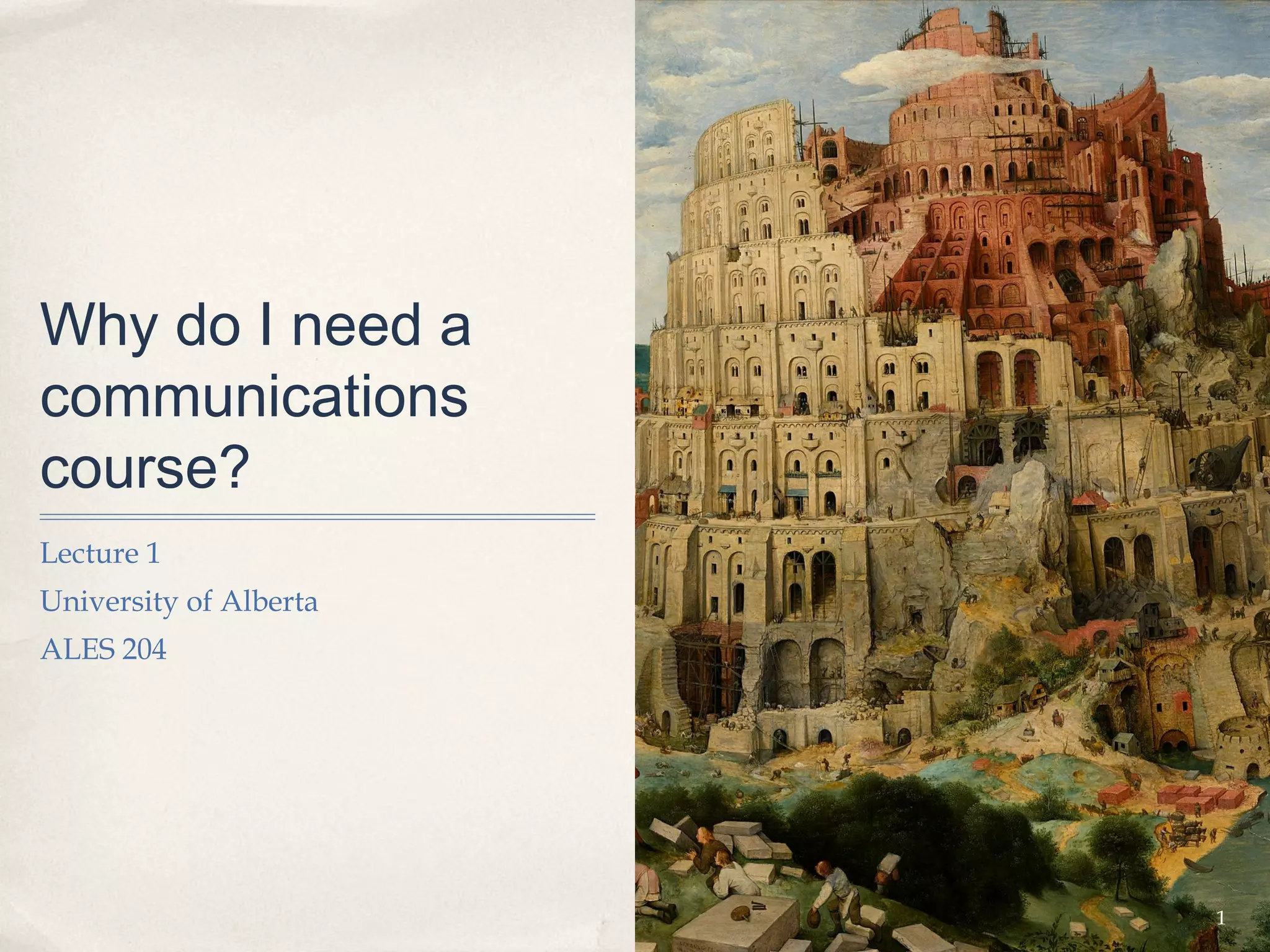
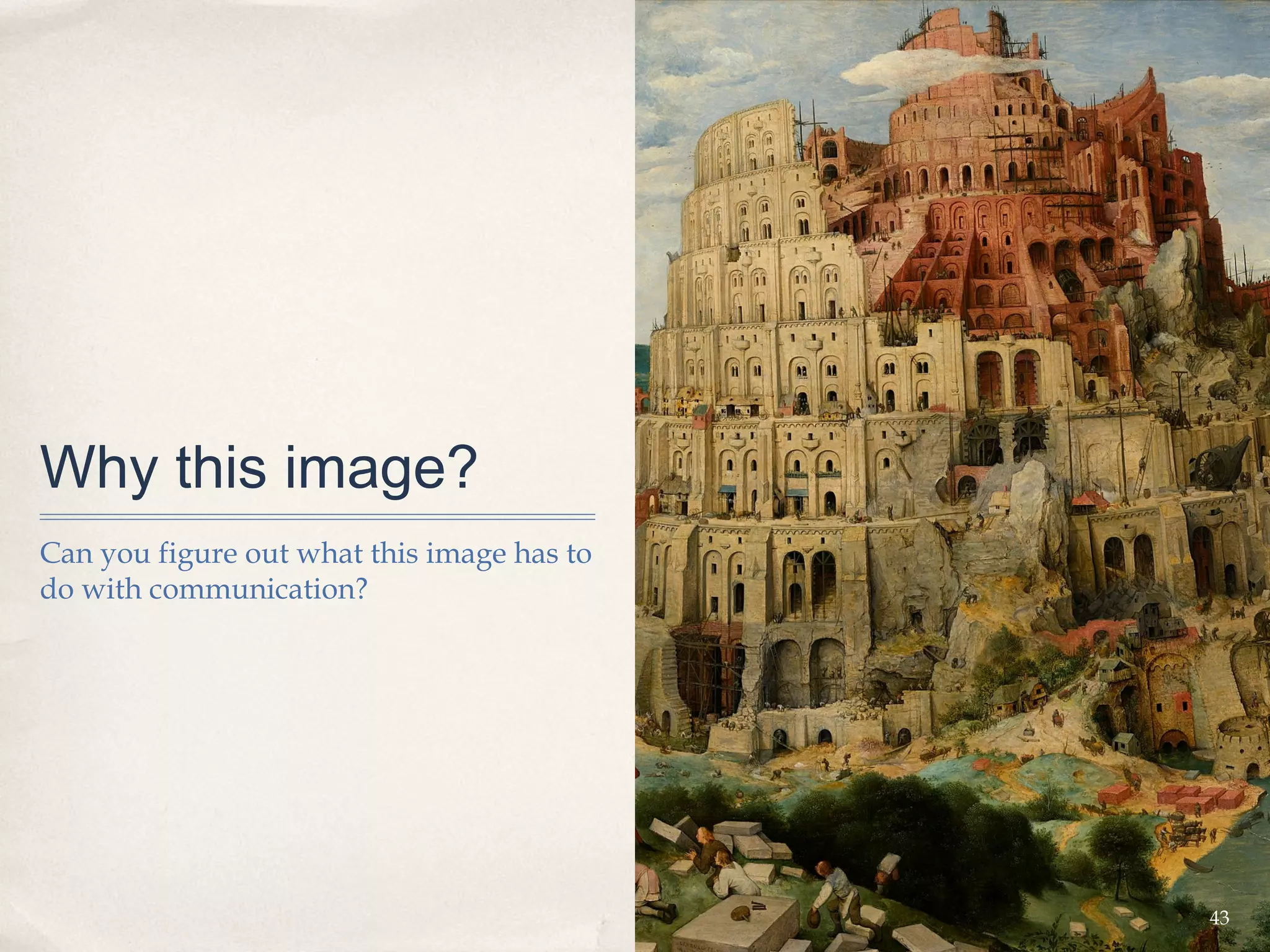
Why this image?
Can you figure out what this image has to
do with communication?


                                            43
Photo Credits
Slide 1 - The Tower of Babel by Peter Bruegel the Elder. From Wikicommons
Slide 2 - South Park figure from http://www.sp-studio.de/
Slide 3 - Conversation by Ame Otako from flickr
Slide 6 - Ag Inspector by agriculturede from flickr
Slide 7 - Ag Inspector by CIMMYT from flickr
Slide 8 - Forester by WI Dept of Natural Resources from flickr
Slide 9 - Forestry by the poss from flickr
Slide 10 - Vet by Army Medicine from flickr
Slide 11 - Vet by scott* from flickr
Slide 18 - Lecture by uniinnsbruck from flickr
Slide 19 - Lecture hall by sholeh!! from flickr
Slide 20 - Classroom by Lynn Dombrowski from flickr
Slide 21 - Students studying from UBC Library from flickr
Slide 27 - Student studying in grass from UBC Library from flickr
Slide 28 - The Tower of Babel by Peter Bruegel the Elder. From Wikicommons


                                                                             44

Lecture 1.1 introduction why do I need a communications course student notes

  • 1.
    Why do Ineed a communications course? Lecture 1 University of Alberta ALES 204 1
  • 2.
    Lecture Outline 1. Introduction 2.Why do you need a communications course? 3. All about ALES 204 2
  • 3.
  • 4.
    + ( + + ) 4
  • 5.
    2. Why doyou need a communications course? 5
  • 6.
    Top 5 qualities sought by employers (Source: 2006 survey by US National Association of Colleges and Employers) 6
  • 7.
    Top criteria forselecting employees (Source: Graduate Outlook 2007, Graduate Careers Australia) 7
  • 8.
    What are goodcommunication skills according to employers? Listening effectively Communicating accurately and concisely Effective oral communication Communicating pleasantly and professionally Effective written communication Asking good questions Communicating appropriately and professionally using social media (Source: Crawford et al. 2011) 8
  • 9.
    Most important abilitiesstudents are NOT learning “[We need] more practice with public speaking” - Student (Source: Crawford et al. 2011) 9
  • 10.
    Most important abilitiesstudents are NOT learning “ Writing and communication skills of students in my senior course are often lower than I would expect” - Faculty (Source: Crawford et al. 2011) 10
  • 11.
    Most important abilitiesstudents are NOT learning “ Communication skills are lacking more in today’s graduates” - Faculty (Source: Crawford et al. 2011) 11
  • 12.
    Most important abilitiesstudents are NOT learning “There is a need to communicate findings to people who do not know anything about what you’re doing.” - Employer (Source: Crawford et al. 2011) 12
  • 13.
    What does thismean for you? 13
  • 14.
  • 15.
    Agricultural Inspector 1. Reading text 2.Writing 3. Oral communication (Source: Human Resources and Skills Development Canada) 15
  • 16.
  • 17.
    Forestry Professional 1. Document Use 2.Oral Communication 3. Critical Thinking (Source: Human Resources and Skills Development Canada) 17
  • 18.
  • 19.
    Veterinarian 1. Numeracy 2. OralCommunication 3. Critical Thinking (Source: Human Resources and Skills Development Canada) 19
  • 20.
  • 21.
    Where we aregoing 21
  • 22.
    Course Map Analyze a communicative situation Plan an approach Identify strengths and weakness of your approach Context Rhetorical Purpose Channel Interpersonal Informative Oral Small Groups Persuasive Written Public Mass Communication Visual Online Define communication and understand a model of communication Describe the role that culture, hierarchy, perception, language, non-verbal behaviour, and generation play in communication 22
  • 23.
  • 24.
    Calendar You can addthe calendar to your Google calendar Calendar e-mail address is: ualberta.ca_a29f62e8hblli17lgqpcljj15k@group.calendar.google.com 24
  • 25.
  • 26.
  • 27.
  • 28.
  • 29.
    Lab instructors Monday- Pamela Bentley Tuesday - Erin Dul Wednesday - Nancy Bray Thursday - Bibaswan Ghoshal 29
  • 30.
    Readings Communications Works (11th edition)by Gamble & Gamble Other readings available on eClass 30
  • 31.
  • 32.
    Grade Breakdown Assignment #1- E-mail cover letter and 20% résumé Assignment #2 - Informative Writing 20% Assignment #3 - Persuasive Speech 20% Mid-term test 10% Final test 15% Lab Participation 10% Lecture Participation 5% 32
  • 33.
    Assignment #1 -20% Write an e-mail cover letter to an employer Write a professional résumé to go with e-mail 33
  • 34.
    Assignment #2 -20% Write a fact sheet An 8.5x11 document to explain a technical matter to a non-expert Design your document for readability Include a visual element Must complete a due process worksheet, peer feedback Write a business letter offering your fact sheet to a professional 34
  • 35.
    Assignment #3 -20 % 5-minute persuasive speech Persuade someone to change their opinion or to act on something Presentation aids Must complete a due process worksheet, peer feedback Write a business e-mail to your boss outlining your oral communication experience and training needs 35
  • 36.
    Mid-term Test -10% 30 multiple choice questions Will cover material in the lectures, the labs, and in the readings 36
  • 37.
    Final Test -15% Long answer questions Will cover material in the lectures, the labs, and in the readings 37
  • 38.
    Participation - 5%and 10% Lectures - 5% Labs - 10% 38
  • 39.
    Participation What to do! What not to do! 39
  • 40.
    Important Due Dates Assignment#1 - Cover letter and résumé Sunday, January 27 Assignment #2 - Informative Writing Sunday, March 3 Assignment #3 - Persuasive Speech Begin March 18 in labs Mid-term test Wednesday, February 27 at 11 am Final test Friday, April 12 at 11 am 40
  • 41.
    Important Course Policies Latearrival to lecture - liberty seats! Plagiarism Late assignments = minus 10% per day, zero after 3 days Make-up tests = must sign statutory declaration of illness 41
  • 42.
    For next class Read Course Guidebook (eClass) Read Chapter 1 in textbook 42
  • 43.
    Why this image? Canyou figure out what this image has to do with communication? 43
  • 44.
    Photo Credits Slide 1- The Tower of Babel by Peter Bruegel the Elder. From Wikicommons Slide 2 - South Park figure from http://www.sp-studio.de/ Slide 3 - Conversation by Ame Otako from flickr Slide 6 - Ag Inspector by agriculturede from flickr Slide 7 - Ag Inspector by CIMMYT from flickr Slide 8 - Forester by WI Dept of Natural Resources from flickr Slide 9 - Forestry by the poss from flickr Slide 10 - Vet by Army Medicine from flickr Slide 11 - Vet by scott* from flickr Slide 18 - Lecture by uniinnsbruck from flickr Slide 19 - Lecture hall by sholeh!! from flickr Slide 20 - Classroom by Lynn Dombrowski from flickr Slide 21 - Students studying from UBC Library from flickr Slide 27 - Student studying in grass from UBC Library from flickr Slide 28 - The Tower of Babel by Peter Bruegel the Elder. From Wikicommons 44