M&A Post-Closing Disputes
Commonly disputed financial
statement accounts
Deloitte Financial Advisory Services LLP
You may find a live recording of this presentation, with audio here.
• GAAP definition of cash
leaves room for interpretation
• Consider in-transit amounts
• Consider defining cash as
“book cash” or “bank cash”
• Consider company’s past
practice and industry-specific
issues
• Consider Seller’s normal
operating cycle
• Consider a cut-off date for
recognizing revenue for the
purposes of the sale
• How will long-term and
significant contracts/sales be
accounted for?
• Consider how the
corresponding A/R will be
accounted for
• GAAP v. past practice,
consistency
• Consider whether the sale
itself will make it difficult for
the Buyer to follow Seller’s
past practice?
• Consider including in the
Agreement a description of
Seller’s past practice
• Determine subsequent event
period
• Impact of subsequent events
• Do raw material costs
fluctuate?
• Did Seller change it’s
marketing strategy or sales
process pre-close?
• Inventory reserves – how was
excess, obsolete and
damaged inventory
calculated?
• How is work-in-process
accounted for in the Sale?
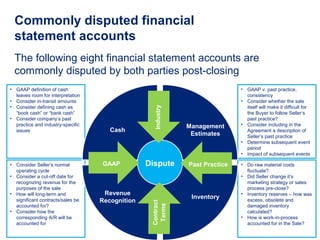
The following eight financial statement accounts are
commonly disputed by both parties post-closing
Commonly disputed financial
statement accounts
Dispute
Cash
Management
Estimates
Revenue
Recognition
Inventory
Industry
GAAP Past Practice
Contract
Terms
• Seller can’t control Buyer’s
post-closing efforts to collect
outstanding A/R
• If Seller maintains cash in the
sale they have incentive to
collect outstanding A/R prior
to close
• Consider the interplay
between A/R write-offs and
A/R reserves when drafting
the Agreement
• How will un-recorded liabilities
be handled? Through an
indemnity claim?
• Consider whether these
liabilities have been over-
accrued or under-accrued
• Look for changes in strategy
shortly prior to or following
closing
• What is the availability of
information?
• Consider the impact of
subsequent events
• Consider involving an actuary
• How will pension liabilities be
valued, at the cost to the
Buyer or Seller?
• Consider international
pension laws and GAAP v.
IFRS differences
• How are “contingent” or
“vesting” pensions accounted
for in the Agreement?
• How are IBNR liabilities
calculated?
• Completeness – does the
Agreement consider
expenses that have been
incurred but not invoiced?
• What is the cut-off date?
• Consider requiring the Seller
to provide evidence of
expected debits to A/P
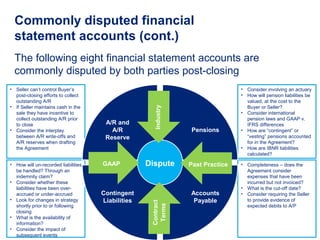
The following eight financial statement accounts are
commonly disputed by both parties post-closing
Commonly disputed financial
statement accounts (cont.)
Dispute
A/R and
A/R
Reserve
Pensions
Contingent
Liabilities
Accounts
Payable
Industry
GAAP Past Practice
Contract
Terms
Contact information
Deloitte Financial Advisory
Services LLP
111 S. Wacker Drive
Chicago, IL 60606
USA
Brian R. Lappen Tel: (312) 486-4981
Senior Manager Fax: (312) 247-4981
Deloitte Forensic blappen@deloitte.com
www.deloitte.com
Deloitte Financial Advisory
Services LLP
111 S. Wacker Drive
Chicago, IL 60606
USA
Jennifer L. Larson Tel: (312) 486-2539
Senior Manager Fax: (312) 247-2539
Deloitte Forensic jenlarson@deloitte.com
www.deloitte.com
Connect with me on LinkedIn! Connect with me on LinkedIn!
These materials and the information contained herein are provided by Deloitte Financial Advisory
Services LLP (“Deloitte FAS”) and are intended to provide general information on a particular subject or
subjects and are not an exhaustive treatment of such subject(s).
Accordingly, the information in these materials is not intended to constitute accounting, tax, legal,
investment, consulting, or other professional advice or services. The information is not intended to be
relied upon as the sole basis for any decision which may affect you or your business. Before making any
decision or taking any action that might affect your personal finances or business, you should consult a
qualified professional adviser.
These materials and the information contained therein are provided as is, and Deloitte FAS makes no
express or implied representations or warranties regarding these materials or the information contained
therein. Without limiting the foregoing, Deloitte FAS does not warrant that the materials or information
contained therein will be error-free or will meet any particular criteria of performance or quality. Deloitte
FAS expressly disclaims all implied warranties, including, without limitation, warranties of merchantability,
title, fitness for a particular purpose, non-infringement, compatibility, security, and accuracy.
Your use of these materials and information contained therein is at your own risk, and you assume full
responsibility and risk of loss resulting from the use thereof. Deloitte FAS will not be liable for any special,
indirect, incidental, consequential, or punitive damages or any other damages whatsoever, whether in an
action of contract, statute, tort (including, without limitation, negligence), or otherwise, relating to the use
of these materials or the information contained therein.
If any of the foregoing is not fully enforceable for any reason, the remainder shall nonetheless continue to
apply.
Disclaimer
Copyright © 2014 Deloitte Development LLC. All rights reserved.
This publication contains general information only and is based on the experiences and research of Deloitte practitioners. Deloitte is not, by means of this
publication, rendering business, financial, investment, or other professional advice or services. This publication is not a substitute for such professional advice or
services, nor should it be used as a basis for any decision or action that may affect your business. Before making any decision or taking any action that may affect
your business, you should consult a qualified professional advisor. Deloitte, its affiliates, and related entities shall not be responsible for any loss sustained by any
person who relies on this publication.
About Deloitte
Deloitte refers to one or more of Deloitte Touche Tohmatsu Limited, a UK private company limited by guarantee, and its network of member firms, each of which is a
legally separate and independent entity. Please see www.deloitte.com/about for a detailed description of the legal structure of Deloitte Touche Tohmatsu Limited
and its member firms. Please see www.deloitte.com/us/about for a detailed description of the legal structure of Deloitte LLP and its subsidiaries. Certain services
may not be available to attest clients under the rules and regulations of public accounting.
Copyright © 2014 Deloitte Development LLC. All rights reserved.
This publication contains general information only and is based on the experiences and research of Deloitte practitioners. Deloitte is not, by means of this
publication, rendering business, financial, investment, or other professional advice or services. This publication is not a substitute for such professional advice or
services, nor should it be used as a basis for any decision or action that may affect your business. Before making any decision or taking any action that may affect
your business, you should consult a qualified professional advisor. Deloitte, its affiliates, and related entities shall not be responsible for any loss sustained by any
person who relies on this publication.
About Deloitte
Deloitte refers to one or more of Deloitte Touche Tohmatsu Limited, a UK private company limited by guarantee, and its network of member firms, each of which is a
legally separate and independent entity. Please see www.deloitte.com/about for a detailed description of the legal structure of Deloitte Touche Tohmatsu Limited
and its member firms. Please see www.deloitte.com/us/about for a detailed description of the legal structure of Deloitte LLP and its subsidiaries. Certain services
may not be available to attest clients under the rules and regulations of public accounting.

Commonly disputed accounts final slideshare

  • 1.
    M&A Post-Closing Disputes Commonlydisputed financial statement accounts Deloitte Financial Advisory Services LLP You may find a live recording of this presentation, with audio here.
  • 2.
    • GAAP definitionof cash leaves room for interpretation • Consider in-transit amounts • Consider defining cash as “book cash” or “bank cash” • Consider company’s past practice and industry-specific issues • Consider Seller’s normal operating cycle • Consider a cut-off date for recognizing revenue for the purposes of the sale • How will long-term and significant contracts/sales be accounted for? • Consider how the corresponding A/R will be accounted for • GAAP v. past practice, consistency • Consider whether the sale itself will make it difficult for the Buyer to follow Seller’s past practice? • Consider including in the Agreement a description of Seller’s past practice • Determine subsequent event period • Impact of subsequent events • Do raw material costs fluctuate? • Did Seller change it’s marketing strategy or sales process pre-close? • Inventory reserves – how was excess, obsolete and damaged inventory calculated? • How is work-in-process accounted for in the Sale? The following eight financial statement accounts are commonly disputed by both parties post-closing Commonly disputed financial statement accounts Dispute Cash Management Estimates Revenue Recognition Inventory Industry GAAP Past Practice Contract Terms
  • 3.
    • Seller can’tcontrol Buyer’s post-closing efforts to collect outstanding A/R • If Seller maintains cash in the sale they have incentive to collect outstanding A/R prior to close • Consider the interplay between A/R write-offs and A/R reserves when drafting the Agreement • How will un-recorded liabilities be handled? Through an indemnity claim? • Consider whether these liabilities have been over- accrued or under-accrued • Look for changes in strategy shortly prior to or following closing • What is the availability of information? • Consider the impact of subsequent events • Consider involving an actuary • How will pension liabilities be valued, at the cost to the Buyer or Seller? • Consider international pension laws and GAAP v. IFRS differences • How are “contingent” or “vesting” pensions accounted for in the Agreement? • How are IBNR liabilities calculated? • Completeness – does the Agreement consider expenses that have been incurred but not invoiced? • What is the cut-off date? • Consider requiring the Seller to provide evidence of expected debits to A/P The following eight financial statement accounts are commonly disputed by both parties post-closing Commonly disputed financial statement accounts (cont.) Dispute A/R and A/R Reserve Pensions Contingent Liabilities Accounts Payable Industry GAAP Past Practice Contract Terms
  • 4.
    Contact information Deloitte FinancialAdvisory Services LLP 111 S. Wacker Drive Chicago, IL 60606 USA Brian R. Lappen Tel: (312) 486-4981 Senior Manager Fax: (312) 247-4981 Deloitte Forensic blappen@deloitte.com www.deloitte.com Deloitte Financial Advisory Services LLP 111 S. Wacker Drive Chicago, IL 60606 USA Jennifer L. Larson Tel: (312) 486-2539 Senior Manager Fax: (312) 247-2539 Deloitte Forensic jenlarson@deloitte.com www.deloitte.com Connect with me on LinkedIn! Connect with me on LinkedIn!
  • 5.
    These materials andthe information contained herein are provided by Deloitte Financial Advisory Services LLP (“Deloitte FAS”) and are intended to provide general information on a particular subject or subjects and are not an exhaustive treatment of such subject(s). Accordingly, the information in these materials is not intended to constitute accounting, tax, legal, investment, consulting, or other professional advice or services. The information is not intended to be relied upon as the sole basis for any decision which may affect you or your business. Before making any decision or taking any action that might affect your personal finances or business, you should consult a qualified professional adviser. These materials and the information contained therein are provided as is, and Deloitte FAS makes no express or implied representations or warranties regarding these materials or the information contained therein. Without limiting the foregoing, Deloitte FAS does not warrant that the materials or information contained therein will be error-free or will meet any particular criteria of performance or quality. Deloitte FAS expressly disclaims all implied warranties, including, without limitation, warranties of merchantability, title, fitness for a particular purpose, non-infringement, compatibility, security, and accuracy. Your use of these materials and information contained therein is at your own risk, and you assume full responsibility and risk of loss resulting from the use thereof. Deloitte FAS will not be liable for any special, indirect, incidental, consequential, or punitive damages or any other damages whatsoever, whether in an action of contract, statute, tort (including, without limitation, negligence), or otherwise, relating to the use of these materials or the information contained therein. If any of the foregoing is not fully enforceable for any reason, the remainder shall nonetheless continue to apply. Disclaimer
  • 6.
    Copyright © 2014Deloitte Development LLC. All rights reserved. This publication contains general information only and is based on the experiences and research of Deloitte practitioners. Deloitte is not, by means of this publication, rendering business, financial, investment, or other professional advice or services. This publication is not a substitute for such professional advice or services, nor should it be used as a basis for any decision or action that may affect your business. Before making any decision or taking any action that may affect your business, you should consult a qualified professional advisor. Deloitte, its affiliates, and related entities shall not be responsible for any loss sustained by any person who relies on this publication. About Deloitte Deloitte refers to one or more of Deloitte Touche Tohmatsu Limited, a UK private company limited by guarantee, and its network of member firms, each of which is a legally separate and independent entity. Please see www.deloitte.com/about for a detailed description of the legal structure of Deloitte Touche Tohmatsu Limited and its member firms. Please see www.deloitte.com/us/about for a detailed description of the legal structure of Deloitte LLP and its subsidiaries. Certain services may not be available to attest clients under the rules and regulations of public accounting.
  • 7.
    Copyright © 2014Deloitte Development LLC. All rights reserved. This publication contains general information only and is based on the experiences and research of Deloitte practitioners. Deloitte is not, by means of this publication, rendering business, financial, investment, or other professional advice or services. This publication is not a substitute for such professional advice or services, nor should it be used as a basis for any decision or action that may affect your business. Before making any decision or taking any action that may affect your business, you should consult a qualified professional advisor. Deloitte, its affiliates, and related entities shall not be responsible for any loss sustained by any person who relies on this publication. About Deloitte Deloitte refers to one or more of Deloitte Touche Tohmatsu Limited, a UK private company limited by guarantee, and its network of member firms, each of which is a legally separate and independent entity. Please see www.deloitte.com/about for a detailed description of the legal structure of Deloitte Touche Tohmatsu Limited and its member firms. Please see www.deloitte.com/us/about for a detailed description of the legal structure of Deloitte LLP and its subsidiaries. Certain services may not be available to attest clients under the rules and regulations of public accounting.