BITCOIN
Bitcoin is the latest rage in the
online world. It has been around
since 2009 but all of a sudden it
has become the new buzzword.
BITCOIN
Let us see the formula of the Current Account Balance (CAB)
CAB = X - M + NI + NCT
X = Exports of goods and services
M = Imports of goods and services
NI = Net income abroad  [Salaries paid or received,
credit / debit of income from
FII & FDI etc. ]
NCT = Net current transfers [Workers' Remittances
(unilateral),
Donations, Aids & Grants,
Official, Assistance and
Pensions etc]
CURRENT ACCOUNT DEFICIT
Bitcoin is a form of virtual currency.
You can think of it as 'cash' for the
internet.
Bitcoin (capital B) refers to the entire
system whereas bitcoins (b in
lowercase) refers to the currency
itself.
WHAT ARE BITCOINS?
WHAT ARE BITCOINS?
Bitcoins can be stored electronically on computers and mobile phones across
the internet. It is also a means to circulate, share and transact, just like PayPal
or VISA.
Like Bitcoin, similar examples of virtual currencies are peercoin, litecoin,
anoncoin and ripple.
Bitcoin has been a subject of scrutiny due to its association with the Silk Road
- an illegal online black market that used bitcoins to obtain illegal items easily
and anonymously.
Pure demand and supply for bitcoins is
what determines its price. Since there is
no centralized authority that sets
relative value, they keep fluctuating in
value relative to other currencies.
HOW ARE BITCOINS PRICED?
Just as the Indian rupee fluctuates against the US dollar, bitcoins too
exhibit price volatility.
In the absence of any governing body, the onus is on the seller to
give a fair price to the buyer based on the rates traded elsewhere.
Within five years of coming into existence, bitcoin has become the
world's most expensive currency.
The most common methods to obtain bitcoins are
1.Sell goods and accept bitcoins as payment.
2.Buy or sell bitcoins through Bitcoin exchanges available online.
3.Buy and sell bitcoins for traditional currencies (with a legal tender
status) like rupees, dollars etc.
One can get started by obtaining a 'Bitcoin wallet'- an App that
stores bitcoins needs to be installed on the phone or computer.
HOW DOES ONE OBTAIN BITCOINS?
1. Allows sending and receiving any amount of bitcoins instantly anywhere
in the world at any time.
2. Bitcoin payments are currently processed with either no fees or
extremely small fees as compared to PayPal or credit cards.
3. Bitcoin transactions are secure, irreversible and do not contain
customers’ sensitive or personal information. Bitcoin uses
cryptography, a kind of a secret code to secure the transaction.
4. It is possible to know the amount of money supply in the bitcoin system.
Thus making it quite transparent and predictable.
WHAT ARE THE ADVANTAGES OF BITCOIN?
Here is an example of a typical
Bitcoin transaction.
BITCOIN
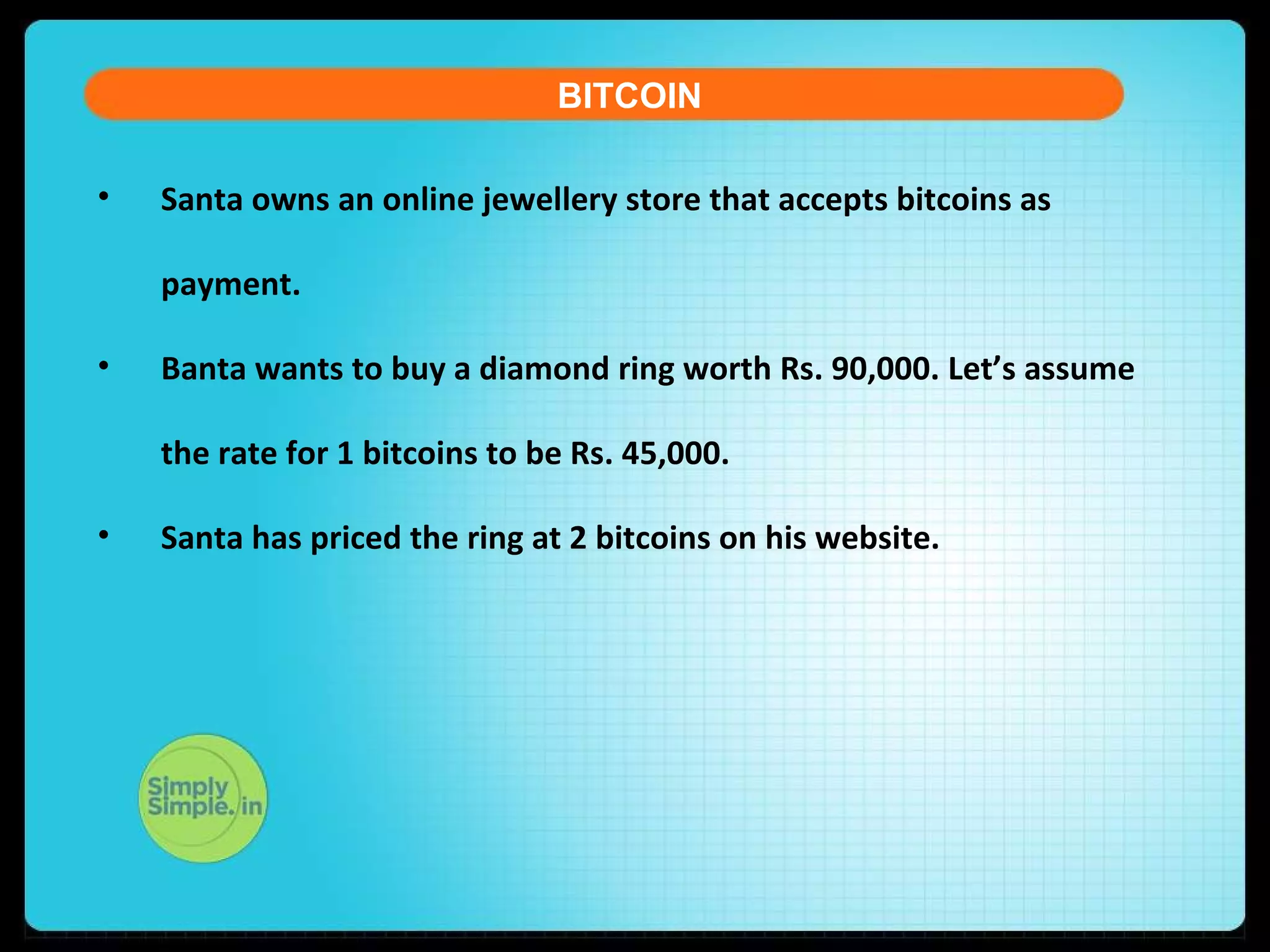
• Santa owns an online jewellery store that accepts bitcoins as
payment.
• Banta wants to buy a diamond ring worth Rs. 90,000. Let’s assume
the rate for 1 bitcoins to be Rs. 45,000.
• Santa has priced the ring at 2 bitcoins on his website.
BITCOIN
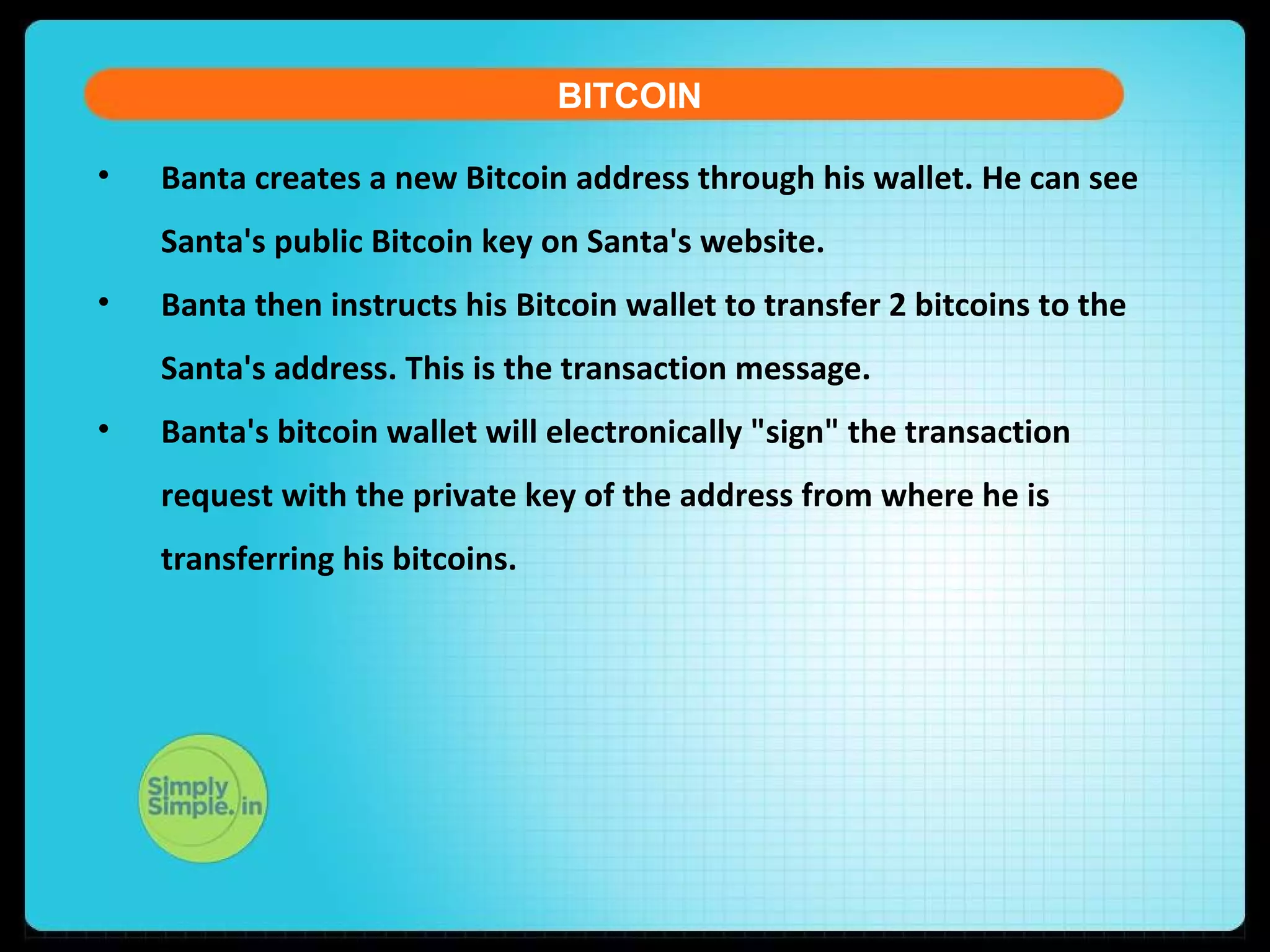
• Banta creates a new Bitcoin address through his wallet. He can see
Santa's public Bitcoin key on Santa's website.
• Banta then instructs his Bitcoin wallet to transfer 2 bitcoins to the
Santa's address. This is the transaction message.
• Banta's bitcoin wallet will electronically "sign" the transaction
request with the private key of the address from where he is
transferring his bitcoins.
BITCOIN
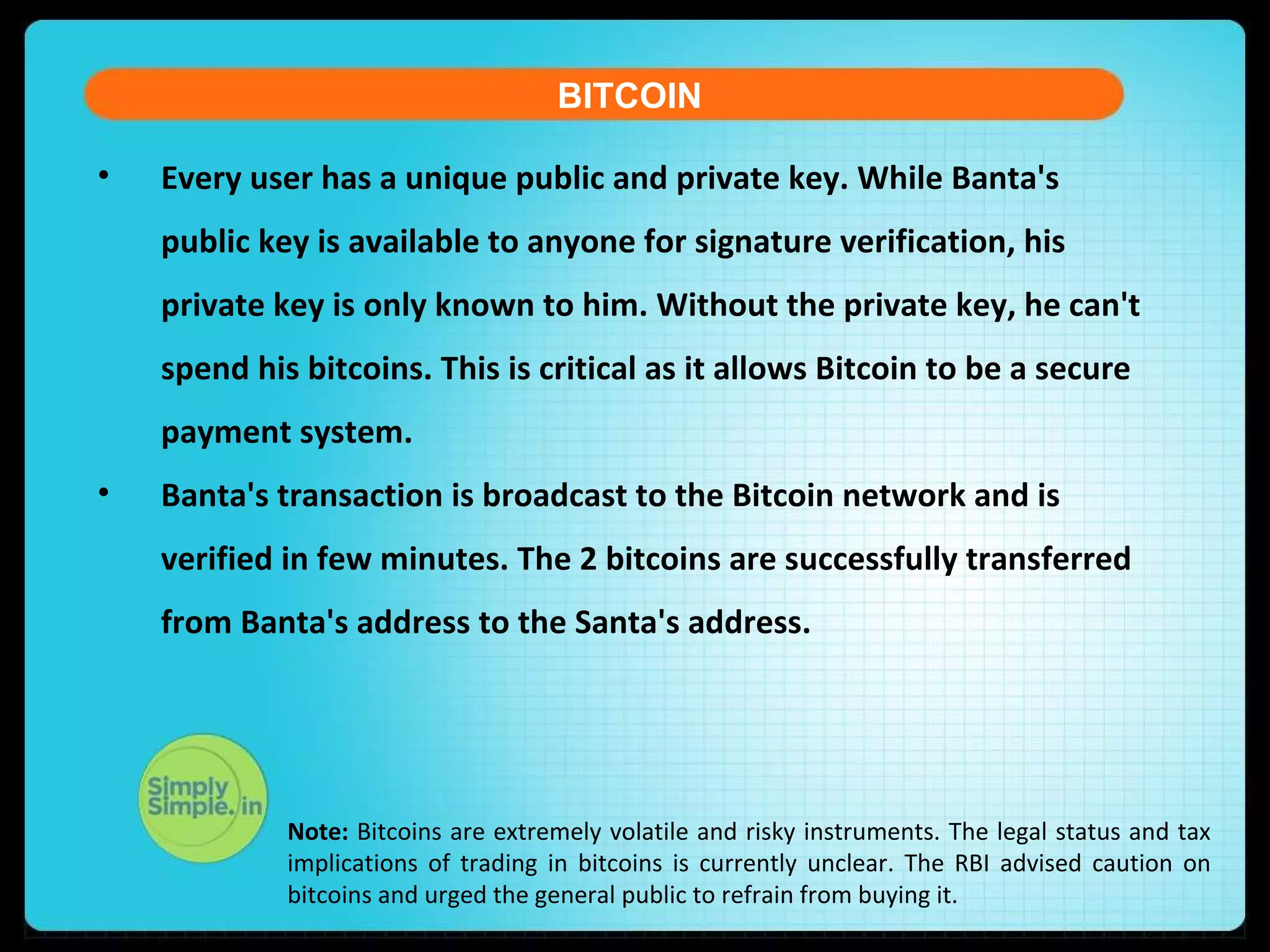
• Every user has a unique public and private key. While Banta's
public key is available to anyone for signature verification, his
private key is only known to him. Without the private key, he can't
spend his bitcoins. This is critical as it allows Bitcoin to be a secure
payment system.
• Banta's transaction is broadcast to the Bitcoin network and is
verified in few minutes. The 2 bitcoins are successfully transferred
from Banta's address to the Santa's address.
BITCOIN
Note: Bitcoins are extremely volatile and risky instruments. The legal status and tax
implications of trading in bitcoins is currently unclear. The RBI advised caution on
bitcoins and urged the general public to refrain from buying it.
Let us see the formula of the Current Account Balance (CAB)
CAB = X - M + NI + NCT
X = Exports of goods and services
M = Imports of goods and services
NI = Net income abroad  [Salaries paid or received,
credit / debit of income from
FII & FDI etc. ]
NCT = Net current transfers [Workers' Remittances
(unilateral),
Donations, Aids & Grants,
Official, Assistance and
Pensions etc]
CURRENT ACCOUNT DEFICIT
Hope you have understood the
concept of Bitcoin.
BITCOIN
Please give us
your feedback at
professor@tataamc.com
DISCLAIMER
The views expressed in this lesson are for information purposes only and do not construe
to be any investment, legal or taxation advice. The lesson is a conceptual representation
and may not include several nuances that are associated and vital. The purpose of this
lesson is to clarify the basics of the concept so that readers at large can relate and thereby
take more interest in the product / concept. In a nutshell, Professor Simply Simple lessons
should be seen from the perspective of it being a primer on financial concepts. The
contents are topical in nature and held true at the time of creation of the lesson. This is not
indicative of future market trends, nor is Tata Asset Management Ltd. attempting to predict
the same. Reprinting any part of this material will be at your own risk. Tata Asset
Management Ltd. will not be liable for the consequences of such action.
Mutual Fund investments are subject to market risks, read
all scheme related documents carefully.

Bitcoin

  • 1.
  • 2.
    Bitcoin is thelatest rage in the online world. It has been around since 2009 but all of a sudden it has become the new buzzword. BITCOIN
  • 3.
    Let us seethe formula of the Current Account Balance (CAB) CAB = X - M + NI + NCT X = Exports of goods and services M = Imports of goods and services NI = Net income abroad  [Salaries paid or received, credit / debit of income from FII & FDI etc. ] NCT = Net current transfers [Workers' Remittances (unilateral), Donations, Aids & Grants, Official, Assistance and Pensions etc] CURRENT ACCOUNT DEFICIT Bitcoin is a form of virtual currency. You can think of it as 'cash' for the internet. Bitcoin (capital B) refers to the entire system whereas bitcoins (b in lowercase) refers to the currency itself. WHAT ARE BITCOINS?
  • 4.
    WHAT ARE BITCOINS? Bitcoinscan be stored electronically on computers and mobile phones across the internet. It is also a means to circulate, share and transact, just like PayPal or VISA. Like Bitcoin, similar examples of virtual currencies are peercoin, litecoin, anoncoin and ripple. Bitcoin has been a subject of scrutiny due to its association with the Silk Road - an illegal online black market that used bitcoins to obtain illegal items easily and anonymously.
  • 5.
    Pure demand andsupply for bitcoins is what determines its price. Since there is no centralized authority that sets relative value, they keep fluctuating in value relative to other currencies. HOW ARE BITCOINS PRICED?
  • 6.
    HOW ARE BITCOINSPRICED? Just as the Indian rupee fluctuates against the US dollar, bitcoins too exhibit price volatility. In the absence of any governing body, the onus is on the seller to give a fair price to the buyer based on the rates traded elsewhere. Within five years of coming into existence, bitcoin has become the world's most expensive currency.
  • 7.
    The most commonmethods to obtain bitcoins are 1.Sell goods and accept bitcoins as payment. 2.Buy or sell bitcoins through Bitcoin exchanges available online. 3.Buy and sell bitcoins for traditional currencies (with a legal tender status) like rupees, dollars etc. One can get started by obtaining a 'Bitcoin wallet'- an App that stores bitcoins needs to be installed on the phone or computer. HOW DOES ONE OBTAIN BITCOINS?
  • 8.
    1. Allows sendingand receiving any amount of bitcoins instantly anywhere in the world at any time. 2. Bitcoin payments are currently processed with either no fees or extremely small fees as compared to PayPal or credit cards. 3. Bitcoin transactions are secure, irreversible and do not contain customers’ sensitive or personal information. Bitcoin uses cryptography, a kind of a secret code to secure the transaction. 4. It is possible to know the amount of money supply in the bitcoin system. Thus making it quite transparent and predictable. WHAT ARE THE ADVANTAGES OF BITCOIN?
  • 9.
    Here is anexample of a typical Bitcoin transaction. BITCOIN
  • 10.
    • Santa ownsan online jewellery store that accepts bitcoins as payment. • Banta wants to buy a diamond ring worth Rs. 90,000. Let’s assume the rate for 1 bitcoins to be Rs. 45,000. • Santa has priced the ring at 2 bitcoins on his website. BITCOIN
  • 11.
    • Banta createsa new Bitcoin address through his wallet. He can see Santa's public Bitcoin key on Santa's website. • Banta then instructs his Bitcoin wallet to transfer 2 bitcoins to the Santa's address. This is the transaction message. • Banta's bitcoin wallet will electronically "sign" the transaction request with the private key of the address from where he is transferring his bitcoins. BITCOIN
  • 12.
    • Every userhas a unique public and private key. While Banta's public key is available to anyone for signature verification, his private key is only known to him. Without the private key, he can't spend his bitcoins. This is critical as it allows Bitcoin to be a secure payment system. • Banta's transaction is broadcast to the Bitcoin network and is verified in few minutes. The 2 bitcoins are successfully transferred from Banta's address to the Santa's address. BITCOIN Note: Bitcoins are extremely volatile and risky instruments. The legal status and tax implications of trading in bitcoins is currently unclear. The RBI advised caution on bitcoins and urged the general public to refrain from buying it.
  • 13.
    Let us seethe formula of the Current Account Balance (CAB) CAB = X - M + NI + NCT X = Exports of goods and services M = Imports of goods and services NI = Net income abroad  [Salaries paid or received, credit / debit of income from FII & FDI etc. ] NCT = Net current transfers [Workers' Remittances (unilateral), Donations, Aids & Grants, Official, Assistance and Pensions etc] CURRENT ACCOUNT DEFICIT Hope you have understood the concept of Bitcoin. BITCOIN
  • 14.
    Please give us yourfeedback at professor@tataamc.com
  • 15.
    DISCLAIMER The views expressedin this lesson are for information purposes only and do not construe to be any investment, legal or taxation advice. The lesson is a conceptual representation and may not include several nuances that are associated and vital. The purpose of this lesson is to clarify the basics of the concept so that readers at large can relate and thereby take more interest in the product / concept. In a nutshell, Professor Simply Simple lessons should be seen from the perspective of it being a primer on financial concepts. The contents are topical in nature and held true at the time of creation of the lesson. This is not indicative of future market trends, nor is Tata Asset Management Ltd. attempting to predict the same. Reprinting any part of this material will be at your own risk. Tata Asset Management Ltd. will not be liable for the consequences of such action. Mutual Fund investments are subject to market risks, read all scheme related documents carefully.