
Overview of Mutual Funds:
Prepared by:
Mr. B.M.Naik, Teaching Assistant
Department of Studies in Commerce
Rani Channamma University, Belagavi
P.G. Centre, Jamkhandi.
 Mutual fund is a vehicle to mobilize moneys from investors, to
invest in different markets and securities, in line with the
investment objectives agreed upon, between the mutual fund
and the investors. In other words, through investment in a
mutual fund, a small investor can avail of professional fund
management services offered by an asset management
company.
 What is Mutual Fund?
A mutual fund is a professionally managed type of
collective investment scheme that pools money from many
investors to buy stocks, bonds, short-term money market
instruments, and/or other securities.
Concept of Mutual Fund
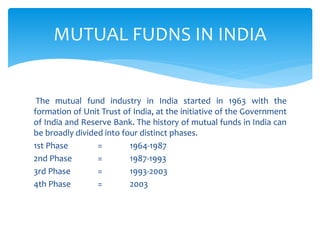
The mutual fund industry in India started in 1963 with the
formation of Unit Trust of India, at the initiative of the Government
of India and Reserve Bank. The history of mutual funds in India can
be broadly divided into four distinct phases.
1st Phase = 1964-1987
2nd Phase = 1987-1993
3rd Phase = 1993-2003
4th Phase = 2003
MUTUAL FUDNS IN INDIA
SEBI (Mutual Funds) Regulations, 1996
Securities Exchange Board of India (“SEBI”), the mutual
funds regulator has clearly defined rules, which govern
mutual funds. These rules relate to the formation,
administration and management of mutual funds and
also prescribe disclosure and accounting requirements.
Such a high level of regulation seeks to protect the
interest of investors.
Regulation:
 Mutual funds seek to mobilize money from all possible
investors. Various investors have different investment
preferences. In order to accommodate these preferences,
mutual funds mobilize different pools of money. Each such
pool of money is called a mutual fund scheme.
 Every scheme has a pre-announced investment objective.
When investors invest in a mutual fund scheme, they are
effectively buying into its investment objective.
Why Mutual Fund Schemes?
 Mutual fund schemes announce their investment
objective and seek investments from the public.
Depending on how the scheme is structured, it may
be open to accept money from investors, either
during a limited period only, or at any time.
 The investment that an investor makes in a scheme is
translated into a certain number of ‘Units’ in the
scheme. Thus, an investor in a scheme is issued units
of the scheme.
How do Mutual Fund Schemes
Operate?
 Under the law, every unit has a face value of Rs. 10.
(However, older schemes in the market may have a
different face value). The face value is relevant from an
accounting perspective. The number of units multiplied by
its face value (Rs. 10) is the capital of the scheme – its Unit
Capital.
 The scheme earns interest income or dividend income on
the investments it holds. Further, when it purchases and
sells investments, it earns capital gains or incurs capital
losses. These are called realized capital gains or realized
capital losses as the case may be.
 Investments owned by the scheme may be quoted in the market at
higher than the cost paid. Such gains in values on securities held are
called valuation gains.
 Investments can be said to have been handled profitably, if the
following profitability metric is positive:
 (A) +Interest income
 (B) + Dividend income
 (C) + Realized capital gains
 (D) + Valuation gains
 (E) – Realized capital losses
 (F) – Valuation losses
 (G) – Scheme expenses
 When the investment activity is profitable, the true worth
of a unit goes up; when there are losses, the true worth of
a unit goes down. The true worth of a unit of the scheme is
otherwise called Net Asset Value (NAV) of the scheme.
When a scheme is first made available for investment, it is
called a ‘New Fund Offer’ (NFO). During the NFO, investors
may have the chance of buying the units at their face value.
Post-NFO, when they buy into a scheme, they need to pay a
price that is linked to its NAV.
 Step 1. The investors must read the offer document before investing in a mutual fund
scheme
 Step 2. Investor has to fill a form, which is available with the distributor
 Step 3. In a case the investor does not read the OD, he must read the key available
with the application form, Investor have the right to ask for the KIM, OD form the
distributor
 Step 4. Once the form is filled and the cheque is given to the distributor; he forward
both these document to the RTA
 Step 5. The RTA offer capturing all the information from the application form into the
system, sends the form to a location where all the forms are stored & the cheque is
sent to the bank where the mutual fund has an account
 Step 6. After the cheque is cleared, The RTA then create units for the investors
 Step 7. The same process is followed in case an investor intends to invest in a scheme,
which invest unit are available from subscription of an ongoing basis, even after the
NFO period is over.
Procedure for investing in at NFO.
(New fund offer)
By Structure:
1. Open-ended Funds
2. Closed-ended Funds
3. Interval Funds
TYPES OF MUTUAL FUNDS
1. Growth Funds
2. Income Funds
3. Balanced Funds
4. Money Market Funds
By Investment Objective:
Tax Saving Schemes
Some times the investors investing their money in the
mutual funds to get some tax benefits.
OTHER SCHEMES
 Portfolio diversification
 Professional management
 Reduction/Diversification of Risks
 Reduction of transaction costs
 Liquidity
 Convenience and Flexibility
 Transparency
Advantages of Mutual Funds
 Lengthy procedure
 Needs much proficiency in the mutual funds scheme
 We can’t predict the future
 It requires much time
Disadvantages of mutual funds:
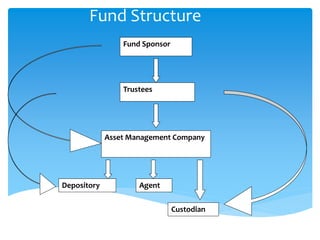
Fund Structure
Fund Sponsor
Trustees
Asset Management Company
Depository
Custodian
Agent
 Fund Sponsor:
A company established under the companies Act forms a mutual fund.
 AMC:
 An Entity registered under the companies act to manage the money invested in the
mutual fund and to operate the schemes of the mutual fund and to operate the
schemes of the mutual fund as per regulations. It carries the responsibility of investing
and managing the investors money.
 Trustee:
 The trustees have a critical role in ensuring that the mutual fund complies with all the
regulations, and protects the interests of the unit-holders.
 Other Service Providers :
EXPERT ON YOUR SIDE: When you invest in a mutual fund, you buy
into the experience and skills of a fund manager and an army of
professional analysts.
LIMITED RISK: Mutual funds are diversification in action and hence do
not rely on the performance of a single entity.
MORE FOR LESS: For the price of one blue chip stock for instance, you
could get yourself a number of units across a number of companies
and industries when you invest in a fund!
EASY INVESTING: You can invest in a mutual fund with as little as Rs.
5,000. Salaried individuals also have the option of investing in a
monthly savings plan.
CONVENIENCE: You can invest directly with a fund house, or through
your bank or financial adviser, or even over the internet.
Reasons to invest:
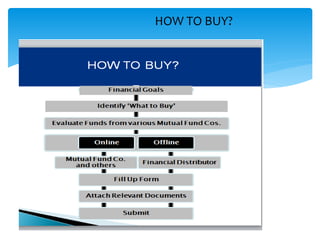
HOW TO BUY?
Presentation on Overview of mutual funds

Presentation on Overview of mutual funds

  • 1.
    Overview of MutualFunds: Prepared by: Mr. B.M.Naik, Teaching Assistant Department of Studies in Commerce Rani Channamma University, Belagavi P.G. Centre, Jamkhandi.
  • 2.
     Mutual fundis a vehicle to mobilize moneys from investors, to invest in different markets and securities, in line with the investment objectives agreed upon, between the mutual fund and the investors. In other words, through investment in a mutual fund, a small investor can avail of professional fund management services offered by an asset management company.  What is Mutual Fund? A mutual fund is a professionally managed type of collective investment scheme that pools money from many investors to buy stocks, bonds, short-term money market instruments, and/or other securities. Concept of Mutual Fund
  • 4.
    The mutual fundindustry in India started in 1963 with the formation of Unit Trust of India, at the initiative of the Government of India and Reserve Bank. The history of mutual funds in India can be broadly divided into four distinct phases. 1st Phase = 1964-1987 2nd Phase = 1987-1993 3rd Phase = 1993-2003 4th Phase = 2003 MUTUAL FUDNS IN INDIA
  • 5.
    SEBI (Mutual Funds)Regulations, 1996 Securities Exchange Board of India (“SEBI”), the mutual funds regulator has clearly defined rules, which govern mutual funds. These rules relate to the formation, administration and management of mutual funds and also prescribe disclosure and accounting requirements. Such a high level of regulation seeks to protect the interest of investors. Regulation:
  • 6.
     Mutual fundsseek to mobilize money from all possible investors. Various investors have different investment preferences. In order to accommodate these preferences, mutual funds mobilize different pools of money. Each such pool of money is called a mutual fund scheme.  Every scheme has a pre-announced investment objective. When investors invest in a mutual fund scheme, they are effectively buying into its investment objective. Why Mutual Fund Schemes?
  • 7.
     Mutual fundschemes announce their investment objective and seek investments from the public. Depending on how the scheme is structured, it may be open to accept money from investors, either during a limited period only, or at any time.  The investment that an investor makes in a scheme is translated into a certain number of ‘Units’ in the scheme. Thus, an investor in a scheme is issued units of the scheme. How do Mutual Fund Schemes Operate?
  • 8.
     Under thelaw, every unit has a face value of Rs. 10. (However, older schemes in the market may have a different face value). The face value is relevant from an accounting perspective. The number of units multiplied by its face value (Rs. 10) is the capital of the scheme – its Unit Capital.  The scheme earns interest income or dividend income on the investments it holds. Further, when it purchases and sells investments, it earns capital gains or incurs capital losses. These are called realized capital gains or realized capital losses as the case may be.
  • 9.
     Investments ownedby the scheme may be quoted in the market at higher than the cost paid. Such gains in values on securities held are called valuation gains.  Investments can be said to have been handled profitably, if the following profitability metric is positive:  (A) +Interest income  (B) + Dividend income  (C) + Realized capital gains  (D) + Valuation gains  (E) – Realized capital losses  (F) – Valuation losses  (G) – Scheme expenses
  • 10.
     When theinvestment activity is profitable, the true worth of a unit goes up; when there are losses, the true worth of a unit goes down. The true worth of a unit of the scheme is otherwise called Net Asset Value (NAV) of the scheme. When a scheme is first made available for investment, it is called a ‘New Fund Offer’ (NFO). During the NFO, investors may have the chance of buying the units at their face value. Post-NFO, when they buy into a scheme, they need to pay a price that is linked to its NAV.
  • 11.
     Step 1.The investors must read the offer document before investing in a mutual fund scheme  Step 2. Investor has to fill a form, which is available with the distributor  Step 3. In a case the investor does not read the OD, he must read the key available with the application form, Investor have the right to ask for the KIM, OD form the distributor  Step 4. Once the form is filled and the cheque is given to the distributor; he forward both these document to the RTA  Step 5. The RTA offer capturing all the information from the application form into the system, sends the form to a location where all the forms are stored & the cheque is sent to the bank where the mutual fund has an account  Step 6. After the cheque is cleared, The RTA then create units for the investors  Step 7. The same process is followed in case an investor intends to invest in a scheme, which invest unit are available from subscription of an ongoing basis, even after the NFO period is over. Procedure for investing in at NFO. (New fund offer)
  • 12.
    By Structure: 1. Open-endedFunds 2. Closed-ended Funds 3. Interval Funds TYPES OF MUTUAL FUNDS
  • 13.
    1. Growth Funds 2.Income Funds 3. Balanced Funds 4. Money Market Funds By Investment Objective:
  • 14.
    Tax Saving Schemes Sometimes the investors investing their money in the mutual funds to get some tax benefits. OTHER SCHEMES
  • 15.
     Portfolio diversification Professional management  Reduction/Diversification of Risks  Reduction of transaction costs  Liquidity  Convenience and Flexibility  Transparency Advantages of Mutual Funds
  • 16.
     Lengthy procedure Needs much proficiency in the mutual funds scheme  We can’t predict the future  It requires much time Disadvantages of mutual funds:
  • 17.
    Fund Structure Fund Sponsor Trustees AssetManagement Company Depository Custodian Agent
  • 18.
     Fund Sponsor: Acompany established under the companies Act forms a mutual fund.  AMC:  An Entity registered under the companies act to manage the money invested in the mutual fund and to operate the schemes of the mutual fund and to operate the schemes of the mutual fund as per regulations. It carries the responsibility of investing and managing the investors money.  Trustee:  The trustees have a critical role in ensuring that the mutual fund complies with all the regulations, and protects the interests of the unit-holders.  Other Service Providers :
  • 19.
    EXPERT ON YOURSIDE: When you invest in a mutual fund, you buy into the experience and skills of a fund manager and an army of professional analysts. LIMITED RISK: Mutual funds are diversification in action and hence do not rely on the performance of a single entity. MORE FOR LESS: For the price of one blue chip stock for instance, you could get yourself a number of units across a number of companies and industries when you invest in a fund! EASY INVESTING: You can invest in a mutual fund with as little as Rs. 5,000. Salaried individuals also have the option of investing in a monthly savings plan. CONVENIENCE: You can invest directly with a fund house, or through your bank or financial adviser, or even over the internet. Reasons to invest:
  • 20.