LESSON 1
USE AND MAINTAIN KITCHEN
TOOLS AND EQUIPMENT
 Cleaning – a physical removal of visible soil and food
 Disinfection – a substance use to destroy germs and diseases
 Exterminate – to destroy totally
 Filth – anything that is dirty
 Grates – Frames of iron bars for holding fuel while it burns
 Infestation – the state of being infested as with parasites or
vermin
 Kitchen – a room especially set apart and containing the
necessary utensils for cooking food
Definition of Terms
 Parts per million (PPM) – is commonly used as a measure of
small levels of pollutants in air, water, body fluids, etc. Parts
per million is the mass ratio between the pollutant
component and the solution. Usually describes the
concentration of something in water or oil. One PPM is
equivalent to 1 milligram of something per liter of water
(mg/l)or 1 milligram of something per kilogram soil (mg/kg).
 Pedestal – a base or support
 Sanitizer – a chemical agent used for cleansing and sanitizing
surfaces and equipment
 Sanitizing – process of reducing number of harmful
organisms to safe level on food contact services
 Stack – a case compose of several rows of shelves
Materials of kitchen utensils and
equipment commonly found in the
kitchen
Any cook should be familiar with the correct utensils,
devices and equipment in the kitchen. It is important to consider
several things and not only the price when buying them. The job
of cooking requires specific tools, utensils, and equipment for
proper and efficient preparation of food. Each piece has been
designed to accomplish a specific job in the kitchen.
The tools, utensils and equipment are made of different
materials, each having certain advantages and disadvantages. The
following lists are materials of kitchen utensils and equipment
commonly found in the kitchen.
A. Aluminum is the best for all-around use. It is the most
popular, lightweight, attractive and less expensive. It requires
care to keep it shiny and clean. Much more, it gives even heat
distribution no matter what heat temperature you have. It is
available in sheet or cast aluminum. Since it is a soft metal, the
lighter gauges will dent and scratch easily, making the utensil
unusable. Aluminum turns dark when used with alkalis, such as
potatoes, beefs, carrots and other vegetables. Acid vegetables like
tomatoes will brighten it.
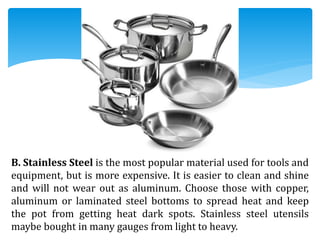
B. Stainless Steel is the most popular material used for tools and
equipment, but is more expensive. It is easier to clean and shine
and will not wear out as aluminum. Choose those with copper,
aluminum or laminated steel bottoms to spread heat and keep
the pot from getting heat dark spots. Stainless steel utensils
maybe bought in many gauges from light to heavy.
C. Glass is good for baking but not practical on top or
surface cooking. Great care is needed to make sure for
long shelf life.
D. Cast iron is sturdy but must be kept seasoned to
avoid rust. Salad oil with no salt or shortening can be
rub inside and out and dry. Glass and ceramic conduct
the heat slowly and evenly. Many of these baking dishes
are decorated and can from stove or oven to the dining
table.
E. Teflon is a special coating applied to the inside of
some aluminum or steel pots and pans. It helps food
from not sticking to the pan. It is easier to wash and
clean, however, take care not to scratch the Teflon
coating with sharp instrument such as knife or fork. Use
wooden or plastic spatula to turn or mix food inside.
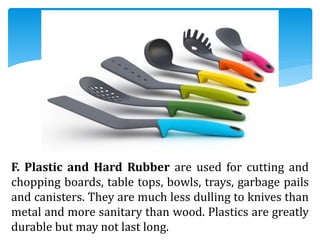
F. Plastic and Hard Rubber are used for cutting and
chopping boards, table tops, bowls, trays, garbage pails
and canisters. They are much less dulling to knives than
metal and more sanitary than wood. Plastics are greatly
durable but may not last long.
Cooking Utensils List Every Kitchen
Needs
1. A baster is handy for returning some of the meat or
poultry juices from the pan, back to the food. Basting
brushes can be used for the same purpose, but they are
also convenient for buttering the tops of breads and
baked goods after they come out of the oven.
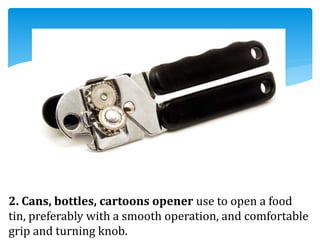
2. Cans, bottles, cartoons opener use to open a food
tin, preferably with a smooth operation, and comfortable
grip and turning knob.
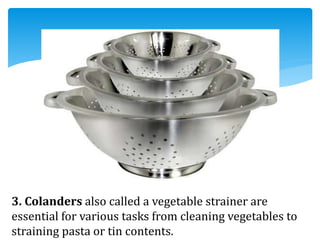
3. Colanders also called a vegetable strainer are
essential for various tasks from cleaning vegetables to
straining pasta or tin contents.
4. Cutting boards a wooden or plastic board where
meats and vegetables can be cut.
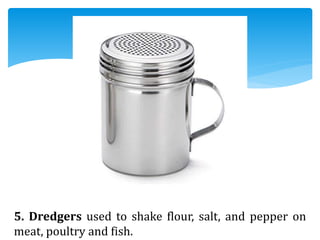
5. Dredgers used to shake flour, salt, and pepper on
meat, poultry and fish.
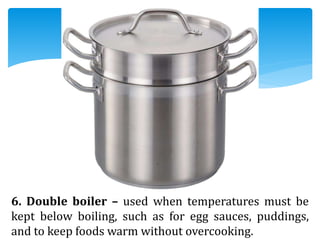
6. Double boiler – used when temperatures must be
kept below boiling, such as for egg sauces, puddings,
and to keep foods warm without overcooking.
7. Emery boards/sharpening steel – used to sharpen
long knives
8. Flipper – used for turning hamburgers and other
food items.
9. Funnels- used to fill jars, made of various sizes of
stainless steel, aluminum, or of plastic
10. Garlic press- is a kitchen tool which is specifically
designed for the purpose of pulping garlic for cooking.
11. Graters used to grate, shred, slice and separate
foods such as carrots, cabbage and cheese.
12. Handy poultry and Roasting tools make it easier
to lift a hot roasted turkey from the roaster to the
serving platter without it falling apart.
13. Kitchen knives- often referred to as cook’s or chef’s
tools, knives are a must for all types of kitchen tasks,
from peeling an onion and slicing carrots, to carving a
roast or turkey.
14. Kitchen Shears – they are practical for opening
food packages, cutting tape or string to package foods
or simply to remove labels or tags from items. Other
cutting tools such as box cutters are just as handy,
especially for opening packages.
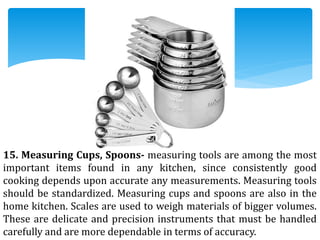
15. Measuring Cups, Spoons- measuring tools are among the most
important items found in any kitchen, since consistently good
cooking depends upon accurate any measurements. Measuring tools
should be standardized. Measuring cups and spoons are also in the
home kitchen. Scales are used to weigh materials of bigger volumes.
These are delicate and precision instruments that must be handled
carefully and are more dependable in terms of accuracy.
Commonly used measuring tools in
the home or in commercial kitchens
include the following:
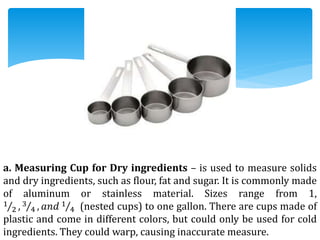
a. Measuring Cup for Dry ingredients – is used to measure solids
and dry ingredients, such as flour, fat and sugar. It is commonly made
of aluminum or stainless material. Sizes range from 1,
1
2 , 3
4 , 𝑎𝑛𝑑 1
4 (nested cups) to one gallon. There are cups made of
plastic and come in different colors, but could only be used for cold
ingredients. They could warp, causing inaccurate measure.
b. Measuring cup for Liquid ingredients – commonly
made up of heat-proof glass and transparent so that liquid
can be seen. Quantity of measure of liquid ingredient is
different in a dry measuring cup.
c. Portion scales – used to weigh serving portions from
ounce to one pound.
d. Scoops or dippers – used to measure serving of soft
foods, such as fillings, ice cream, and mashed potato.
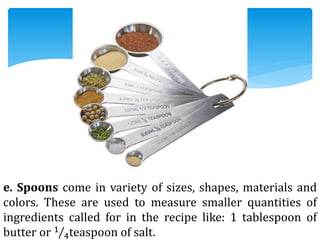
e. Spoons come in variety of sizes, shapes, materials and
colors. These are used to measure smaller quantities of
ingredients called for in the recipe like: 1 tablespoon of
butter or 1
4teaspoon of salt.
f. Household scales are used to weigh large quantity of
ingredients in kilos, commonly in rice, flour sugar, legumes
or vegetables and meat up to 25 pounds.
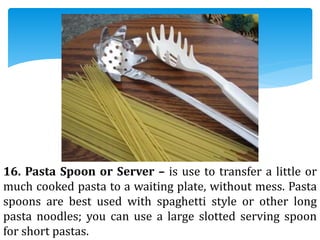
16. Pasta Spoon or Server – is use to transfer a little or
much cooked pasta to a waiting plate, without mess. Pasta
spoons are best used with spaghetti style or other long
pasta noodles; you can use a large slotted serving spoon
for short pastas.
17. Potato Masher- used for mashing cooked potatoes,
turnips, carrots or other soft cooked vegetables.
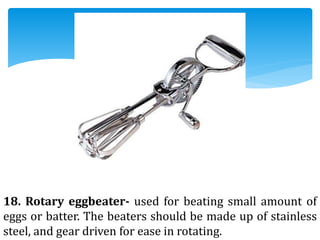
18. Rotary eggbeater- used for beating small amount of
eggs or batter. The beaters should be made up of stainless
steel, and gear driven for ease in rotating.
19. Scraper- a rubber or silicone tools to blend or scrape
the food from the bowl; metal, silicone or plastic egg
turners or flippers.
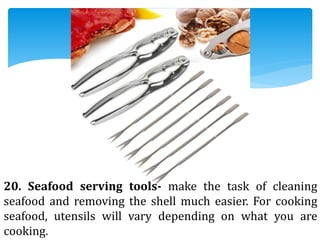
20. Seafood serving tools- make the task of cleaning
seafood and removing the shell much easier. For cooking
seafood, utensils will vary depending on what you are
cooking.
21. Serving spoons – a utensil consisting of a small,
shallow bowl on a handle, used in preparing, serving, or
eating food.
22. Serving Tongs- enables you to more easily grab and
transfer larger food items, poultry or meat portions to a
serving platter, to a hot skillet or deep fryer, or to a plate. It
gives you a better grip and longer tongs, better especially
when used with a deep fryer, a large stock pot or at the
barbecue.
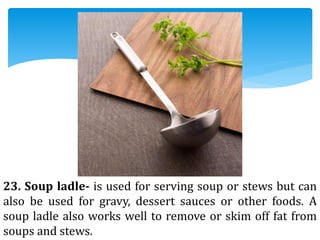
23. Soup ladle- is used for serving soup or stews but can
also be used for gravy, dessert sauces or other foods. A
soup ladle also works well to remove or skim off fat from
soups and stews.
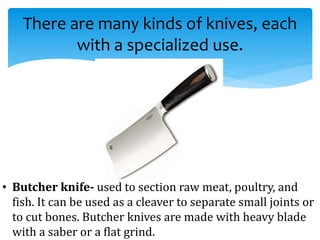
There are many kinds of knives, each
with a specialized use.
• Butcher knife- used to section raw meat, poultry, and
fish. It can be used as a cleaver to separate small joints or
to cut bones. Butcher knives are made with heavy blade
with a saber or a flat grind.
• French knife- used to chop, dice, or mince food. Heavy
knives have a saber or flat grind.
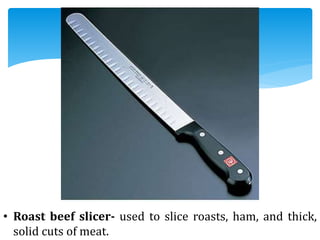
• Roast beef slicer- used to slice roasts, ham, and thick,
solid cuts of meat.
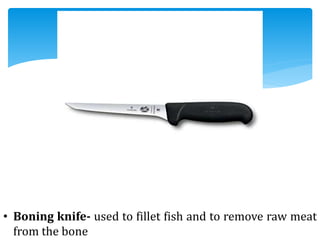
• Boning knife- used to fillet fish and to remove raw meat
from the bone
• Fruit and salad knife- used to prepare salad greens,
vegetables, and fruits.
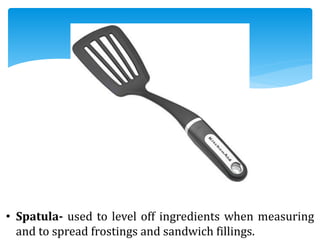
• Spatula- used to level off ingredients when measuring
and to spread frostings and sandwich fillings.
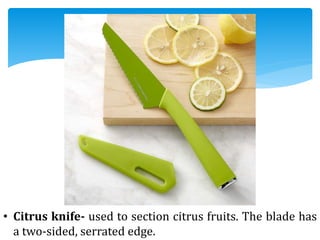
• Citrus knife- used to section citrus fruits. The blade has
a two-sided, serrated edge.
• Paring knife- used to core, peel, and section fruits and
vegetables. Blades are short concave with hollow ground.
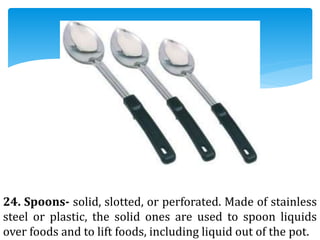
24. Spoons- solid, slotted, or perforated. Made of stainless
steel or plastic, the solid ones are used to spoon liquids
over foods and to lift foods, including liquid out of the pot.
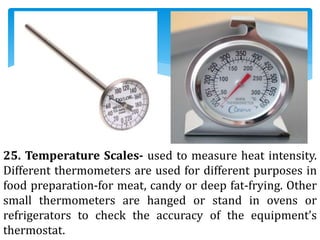
25. Temperature Scales- used to measure heat intensity.
Different thermometers are used for different purposes in
food preparation-for meat, candy or deep fat-frying. Other
small thermometers are hanged or stand in ovens or
refrigerators to check the accuracy of the equipment’s
thermostat.
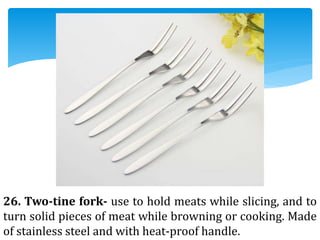
26. Two-tine fork- use to hold meats while slicing, and to
turn solid pieces of meat while browning or cooking. Made
of stainless steel and with heat-proof handle.
27. Vegetable peeler- used to scrape vegetables, such as
carrots and potatoes and to peel fruits. The best ones are
made of stainless steel with sharp double blade that
swivels.
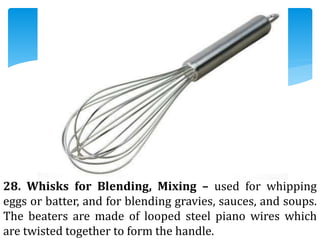
28. Whisks for Blending, Mixing – used for whipping
eggs or batter, and for blending gravies, sauces, and soups.
The beaters are made of looped steel piano wires which
are twisted together to form the handle.
EQUIPMENT
More complicated tools are called equipment. They
may refer to a small electrical appliance, such as mixer, or a
large, expensive, power-operated appliance such a range or
a refrigerator.
Equipment like range, ovens, refrigerators
(conventional, convection, and microwave) is mandatory
pieces in the kitchen or in any food establishment.
Refrigerators/Freezers
- are necessary in preventing bacterial infections
from foods. Most refrigerators have special compartment
for meat, fruits, and vegetables to keep the moisture
content of each type of food. Butter compartment holds
butter separately to prevent food odors from spoiling its
flavors. Basically, refrigerator or freezer is an insulated
box, equipped with refrigeration unit and a control to
maintain the proper inside temperature for food storage.
Auxiliary equipment
- like griddles, tilting skillets, broilers/grills,
steamers, coffee makers, deep-fat fryers, wok, crockery,
cutting equipment (meat slicer, food choppers, grinders)
mixers and bowls, pots and pans are utilized most
commonly in big food establishments, some with
specialized uses and some are optional.
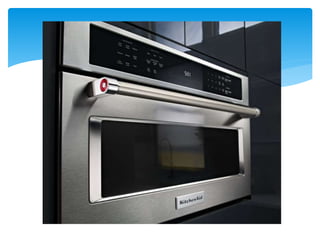
Microwave ovens
- have greatly increased their use in the food
industry. Foods can be prepared ahead of time, frozen or
refrigerated during the slack periods, and cooked or
heated quickly in microwave ovens.
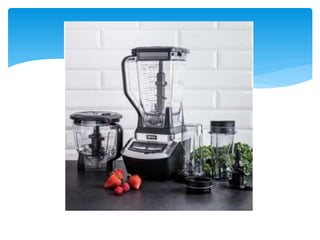
Blenders
- are used to chop, blend, mix, whip, puree, grate, and
liquefy all kinds of food. A blender is a very useful
appliance. They vary in the amount of power
(voltage/wattage). Others vary and do not do the same
jobs.
THANK YOU 

commercial cooking.pptx

  • 1.
    LESSON 1 USE ANDMAINTAIN KITCHEN TOOLS AND EQUIPMENT
  • 2.
     Cleaning –a physical removal of visible soil and food  Disinfection – a substance use to destroy germs and diseases  Exterminate – to destroy totally  Filth – anything that is dirty  Grates – Frames of iron bars for holding fuel while it burns  Infestation – the state of being infested as with parasites or vermin  Kitchen – a room especially set apart and containing the necessary utensils for cooking food Definition of Terms
  • 3.
     Parts permillion (PPM) – is commonly used as a measure of small levels of pollutants in air, water, body fluids, etc. Parts per million is the mass ratio between the pollutant component and the solution. Usually describes the concentration of something in water or oil. One PPM is equivalent to 1 milligram of something per liter of water (mg/l)or 1 milligram of something per kilogram soil (mg/kg).  Pedestal – a base or support  Sanitizer – a chemical agent used for cleansing and sanitizing surfaces and equipment  Sanitizing – process of reducing number of harmful organisms to safe level on food contact services  Stack – a case compose of several rows of shelves
  • 4.
    Materials of kitchenutensils and equipment commonly found in the kitchen Any cook should be familiar with the correct utensils, devices and equipment in the kitchen. It is important to consider several things and not only the price when buying them. The job of cooking requires specific tools, utensils, and equipment for proper and efficient preparation of food. Each piece has been designed to accomplish a specific job in the kitchen. The tools, utensils and equipment are made of different materials, each having certain advantages and disadvantages. The following lists are materials of kitchen utensils and equipment commonly found in the kitchen.
  • 5.
    A. Aluminum isthe best for all-around use. It is the most popular, lightweight, attractive and less expensive. It requires care to keep it shiny and clean. Much more, it gives even heat distribution no matter what heat temperature you have. It is available in sheet or cast aluminum. Since it is a soft metal, the lighter gauges will dent and scratch easily, making the utensil unusable. Aluminum turns dark when used with alkalis, such as potatoes, beefs, carrots and other vegetables. Acid vegetables like tomatoes will brighten it.
  • 6.
    B. Stainless Steelis the most popular material used for tools and equipment, but is more expensive. It is easier to clean and shine and will not wear out as aluminum. Choose those with copper, aluminum or laminated steel bottoms to spread heat and keep the pot from getting heat dark spots. Stainless steel utensils maybe bought in many gauges from light to heavy.
  • 7.
    C. Glass isgood for baking but not practical on top or surface cooking. Great care is needed to make sure for long shelf life.
  • 8.
    D. Cast ironis sturdy but must be kept seasoned to avoid rust. Salad oil with no salt or shortening can be rub inside and out and dry. Glass and ceramic conduct the heat slowly and evenly. Many of these baking dishes are decorated and can from stove or oven to the dining table.
  • 9.
    E. Teflon isa special coating applied to the inside of some aluminum or steel pots and pans. It helps food from not sticking to the pan. It is easier to wash and clean, however, take care not to scratch the Teflon coating with sharp instrument such as knife or fork. Use wooden or plastic spatula to turn or mix food inside.
  • 10.
    F. Plastic andHard Rubber are used for cutting and chopping boards, table tops, bowls, trays, garbage pails and canisters. They are much less dulling to knives than metal and more sanitary than wood. Plastics are greatly durable but may not last long.
  • 11.
    Cooking Utensils ListEvery Kitchen Needs
  • 12.
    1. A basteris handy for returning some of the meat or poultry juices from the pan, back to the food. Basting brushes can be used for the same purpose, but they are also convenient for buttering the tops of breads and baked goods after they come out of the oven.
  • 13.
    2. Cans, bottles,cartoons opener use to open a food tin, preferably with a smooth operation, and comfortable grip and turning knob.
  • 14.
    3. Colanders alsocalled a vegetable strainer are essential for various tasks from cleaning vegetables to straining pasta or tin contents.
  • 15.
    4. Cutting boardsa wooden or plastic board where meats and vegetables can be cut.
  • 16.
    5. Dredgers usedto shake flour, salt, and pepper on meat, poultry and fish.
  • 17.
    6. Double boiler– used when temperatures must be kept below boiling, such as for egg sauces, puddings, and to keep foods warm without overcooking.
  • 18.
    7. Emery boards/sharpeningsteel – used to sharpen long knives
  • 19.
    8. Flipper –used for turning hamburgers and other food items.
  • 20.
    9. Funnels- usedto fill jars, made of various sizes of stainless steel, aluminum, or of plastic
  • 21.
    10. Garlic press-is a kitchen tool which is specifically designed for the purpose of pulping garlic for cooking.
  • 22.
    11. Graters usedto grate, shred, slice and separate foods such as carrots, cabbage and cheese.
  • 23.
    12. Handy poultryand Roasting tools make it easier to lift a hot roasted turkey from the roaster to the serving platter without it falling apart.
  • 24.
    13. Kitchen knives-often referred to as cook’s or chef’s tools, knives are a must for all types of kitchen tasks, from peeling an onion and slicing carrots, to carving a roast or turkey.
  • 25.
    14. Kitchen Shears– they are practical for opening food packages, cutting tape or string to package foods or simply to remove labels or tags from items. Other cutting tools such as box cutters are just as handy, especially for opening packages.
  • 26.
    15. Measuring Cups,Spoons- measuring tools are among the most important items found in any kitchen, since consistently good cooking depends upon accurate any measurements. Measuring tools should be standardized. Measuring cups and spoons are also in the home kitchen. Scales are used to weigh materials of bigger volumes. These are delicate and precision instruments that must be handled carefully and are more dependable in terms of accuracy.
  • 27.
    Commonly used measuringtools in the home or in commercial kitchens include the following:
  • 28.
    a. Measuring Cupfor Dry ingredients – is used to measure solids and dry ingredients, such as flour, fat and sugar. It is commonly made of aluminum or stainless material. Sizes range from 1, 1 2 , 3 4 , 𝑎𝑛𝑑 1 4 (nested cups) to one gallon. There are cups made of plastic and come in different colors, but could only be used for cold ingredients. They could warp, causing inaccurate measure.
  • 29.
    b. Measuring cupfor Liquid ingredients – commonly made up of heat-proof glass and transparent so that liquid can be seen. Quantity of measure of liquid ingredient is different in a dry measuring cup.
  • 30.
    c. Portion scales– used to weigh serving portions from ounce to one pound.
  • 31.
    d. Scoops ordippers – used to measure serving of soft foods, such as fillings, ice cream, and mashed potato.
  • 32.
    e. Spoons comein variety of sizes, shapes, materials and colors. These are used to measure smaller quantities of ingredients called for in the recipe like: 1 tablespoon of butter or 1 4teaspoon of salt.
  • 33.
    f. Household scalesare used to weigh large quantity of ingredients in kilos, commonly in rice, flour sugar, legumes or vegetables and meat up to 25 pounds.
  • 34.
    16. Pasta Spoonor Server – is use to transfer a little or much cooked pasta to a waiting plate, without mess. Pasta spoons are best used with spaghetti style or other long pasta noodles; you can use a large slotted serving spoon for short pastas.
  • 35.
    17. Potato Masher-used for mashing cooked potatoes, turnips, carrots or other soft cooked vegetables.
  • 36.
    18. Rotary eggbeater-used for beating small amount of eggs or batter. The beaters should be made up of stainless steel, and gear driven for ease in rotating.
  • 37.
    19. Scraper- arubber or silicone tools to blend or scrape the food from the bowl; metal, silicone or plastic egg turners or flippers.
  • 38.
    20. Seafood servingtools- make the task of cleaning seafood and removing the shell much easier. For cooking seafood, utensils will vary depending on what you are cooking.
  • 39.
    21. Serving spoons– a utensil consisting of a small, shallow bowl on a handle, used in preparing, serving, or eating food.
  • 40.
    22. Serving Tongs-enables you to more easily grab and transfer larger food items, poultry or meat portions to a serving platter, to a hot skillet or deep fryer, or to a plate. It gives you a better grip and longer tongs, better especially when used with a deep fryer, a large stock pot or at the barbecue.
  • 41.
    23. Soup ladle-is used for serving soup or stews but can also be used for gravy, dessert sauces or other foods. A soup ladle also works well to remove or skim off fat from soups and stews.
  • 42.
    There are manykinds of knives, each with a specialized use. • Butcher knife- used to section raw meat, poultry, and fish. It can be used as a cleaver to separate small joints or to cut bones. Butcher knives are made with heavy blade with a saber or a flat grind.
  • 43.
    • French knife-used to chop, dice, or mince food. Heavy knives have a saber or flat grind.
  • 44.
    • Roast beefslicer- used to slice roasts, ham, and thick, solid cuts of meat.
  • 45.
    • Boning knife-used to fillet fish and to remove raw meat from the bone
  • 46.
    • Fruit andsalad knife- used to prepare salad greens, vegetables, and fruits.
  • 47.
    • Spatula- usedto level off ingredients when measuring and to spread frostings and sandwich fillings.
  • 48.
    • Citrus knife-used to section citrus fruits. The blade has a two-sided, serrated edge.
  • 49.
    • Paring knife-used to core, peel, and section fruits and vegetables. Blades are short concave with hollow ground.
  • 50.
    24. Spoons- solid,slotted, or perforated. Made of stainless steel or plastic, the solid ones are used to spoon liquids over foods and to lift foods, including liquid out of the pot.
  • 51.
    25. Temperature Scales-used to measure heat intensity. Different thermometers are used for different purposes in food preparation-for meat, candy or deep fat-frying. Other small thermometers are hanged or stand in ovens or refrigerators to check the accuracy of the equipment’s thermostat.
  • 52.
    26. Two-tine fork-use to hold meats while slicing, and to turn solid pieces of meat while browning or cooking. Made of stainless steel and with heat-proof handle.
  • 53.
    27. Vegetable peeler-used to scrape vegetables, such as carrots and potatoes and to peel fruits. The best ones are made of stainless steel with sharp double blade that swivels.
  • 54.
    28. Whisks forBlending, Mixing – used for whipping eggs or batter, and for blending gravies, sauces, and soups. The beaters are made of looped steel piano wires which are twisted together to form the handle.
  • 55.
    EQUIPMENT More complicated toolsare called equipment. They may refer to a small electrical appliance, such as mixer, or a large, expensive, power-operated appliance such a range or a refrigerator. Equipment like range, ovens, refrigerators (conventional, convection, and microwave) is mandatory pieces in the kitchen or in any food establishment.
  • 56.
    Refrigerators/Freezers - are necessaryin preventing bacterial infections from foods. Most refrigerators have special compartment for meat, fruits, and vegetables to keep the moisture content of each type of food. Butter compartment holds butter separately to prevent food odors from spoiling its flavors. Basically, refrigerator or freezer is an insulated box, equipped with refrigeration unit and a control to maintain the proper inside temperature for food storage.
  • 58.
    Auxiliary equipment - likegriddles, tilting skillets, broilers/grills, steamers, coffee makers, deep-fat fryers, wok, crockery, cutting equipment (meat slicer, food choppers, grinders) mixers and bowls, pots and pans are utilized most commonly in big food establishments, some with specialized uses and some are optional.
  • 60.
    Microwave ovens - havegreatly increased their use in the food industry. Foods can be prepared ahead of time, frozen or refrigerated during the slack periods, and cooked or heated quickly in microwave ovens.
  • 62.
    Blenders - are usedto chop, blend, mix, whip, puree, grate, and liquefy all kinds of food. A blender is a very useful appliance. They vary in the amount of power (voltage/wattage). Others vary and do not do the same jobs.
  • 64.