ANDRA MEYERS, BSN, RN
INDIANA UNIVERSITY SCHOOL OF NURSING
Comfort Theory
Analysis
Definition of Theory Analysis
Walker and Avant (2011)
describe theory analysis
as, “a systematic
examination of the theory
for meaning, logical
adequacy, usefulness,
generality, parsimony,
and testability (p. 193).”
To perform this analysis on
Katherine Kolcaba’s
Comfort Theory strengths
and weaknesses will be
examined that may provide
additional insight and
interpretations not
previously discovered.
Steps in Theory Analysis
Identify origins
Examine the meaning
Analyze the logical adequacy
Determine usefulness
Define the degree of generalizability and parsimony
Determine testability
ORIGINS
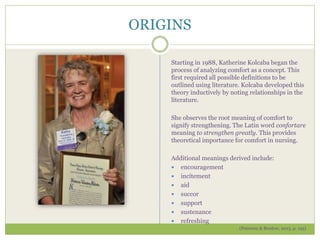
Starting in 1988, Katherine Kolcaba began the
process of analyzing comfort as a concept. This
first required all possible definitions to be
outlined using literature. Kolcaba developed this
theory inductively by noting relationships in the
literature.
She observes the root meaning of comfort to
signify strengthening. The Latin word confortare
meaning to strengthen greatly. This provides
theoretical importance for comfort in nursing.
Additional meanings derived include:
 encouragement
 incitement
 aid
 succor
 support
 sustenance
 refreshing
(Peterson & Bredow, 2013, p. 195)
ORIGINS
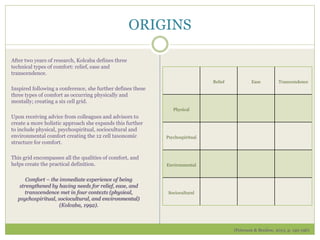
After two years of research, Kolcaba defines three
technical types of comfort: relief, ease and
transcendence.
Inspired following a conference, she further defines these
three types of comfort as occurring physically and
mentally; creating a six cell grid.
Upon receiving advice from colleagues and advisors to
create a more holistic approach she expands this further
to include physical, psychospiritual, sociocultural and
environmental comfort creating the 12 cell taxonomic
structure for comfort.
This grid encompasses all the qualities of comfort, and
helps create the practical definition.
Comfort – the immediate experience of being
strengthened by having needs for relief, ease, and
transcendence met in four contexts (physical,
psychospiritual, sociocultural, and environmental)
(Kolcaba, 1992).
Relief Ease Transcendence
Physical
Psychospiritual
Environmental
Sociocultural
(Peterson & Bredow, 2013, p. 195-196)
MEANING
 Health Care Needs – identify comfort needs of patient and family
 Nursing Interventions – design and coordinate nursing care to
meet comfort needs
 Intervening Variables – taken into account while designing
interventions to determine probability of success
 Enhanced Comfort – occurs when interventions are effective
while delivered in a caring manner
 Health Seeking Behaviors (HSB) – Patient, nurses, and other
health team members agree on desirable and realistic HSBs
 If Enhanced Comfort is achieved all parties will be strengthened to engage in HSBs
further still enhancing comfort
 Institutional Integrity – When patients/families engage in HSBs
due to being strengthened by comfort interventions, all parties are
more satisfied and achieve better outcomes
 Patients and family are satisfied with health care received at the institution with
improved outcomes and public acknowledgment of care provided contributes to the
institutions success
(Peterson & Bredow, 2013, p. 197-198)
 Widely accepted by the nursing
community and scholars
 Applicable to all populations
 Framework structure
dependable and relevant across
multiple disciplines and areas
of healthcare
 Renamed, “theory of health
care” to include multiple
disciplines of health care not
merely nursing
 The author spent years
researching, defining, and
redesigning the concepts and
propositions to be readily
operationalized
 Multiple reviews of the theory
were completed by peers and
professors in nursing to
legitimize the taxonomic
structure of comfort
(Peterson & Bredow, 2013, p. 198)
LOGICAL ADEQUACY
USEFULNESS
 Empirical testing
instruments created using
the taxonomic structure
 Comfort Questionnaire
 Comfort Behaviors Checklist
 Verbal Rating Scales
 Radiation Therapy Comfort
Questionnaire
 Urinary Incontinence and
Frequency Comfort
Questionnaire
Available in multiple languages -
allows the phenomena to be
measured objectively
(Peterson & Bredow, 2013, p. 203-206)
 Increased customer
satisfaction
 Sense of autonomy for
patients
 Applicable in any healthcare
setting
 Hospitals
 Extended care facility
 Assisted living
 Rehabilitation
 Easy to interpret
GENERALIZABILITY
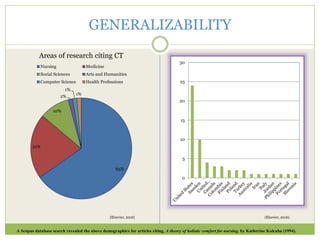
65%
21%
10%
2%
1%
1%
Areas of research citing CT
Nursing Medicine
Social Sciences Arts and Humanities
Computer Science Health Professions
0
5
10
15
20
25
30
A Scopus database search revealed the above demographics for articles citing, A theory of holistic comfort for nursing, by Katherine Kolcaba (1994).
(Elsevier, 2016)(Elsevier, 2016)
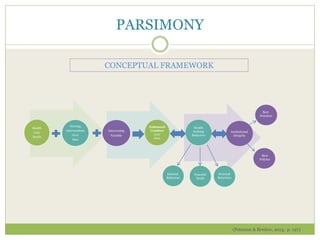
PARSIMONY
Health
Care
Needs
Nursing
Interventions
Over
time
Intervening
Variable
Enhanced
Comfort
over
time
Health
Seeking
Behaviors
Institutional
Integrity
Best
Practices
Best
Policies
Internal
Behaviors
Peaceful
Death
External
Behaviors
CONCEPTUAL FRAMEWORK
(Peterson & Bredow, 2013, p. 197)
TESTABILITY
Samples of research influenced by Comfort Theory:
 Pedrazza, M., Trifiletti, E., Berlanda, S., Minuzzo, S., & Motteran, A. (2015).
Development and initial validation of the nurses' comfort with touch
scale. Journal of Nursing Measurement, 23(3), 364-378. doi:10.1891/1061-
3749.23.3.364
 Guevara Lozano, M., & Laverde Contreras, O. L. (2015). Application of the theory of
comfort in the bath in bed. [Aplicación de la teoría de la comodidad en El
baño en cama] Index De Enfermeria, 24(1-2) Retrieved from www.scopus.com
 Lee, E., Li, N., & Yates, A. (2015). Magnet journey: A quality improvement project-
implementation of family visitation in the PACU. Journal of Perianesthesia
Nursing, 30(1), 39-49. doi:10.1016/j.jopan.2014.01.010
 McRee, L., & Reed, P. G. (2016). Nurse practitioners: Knowledge, skills, and leadership for the
end-of-life conversation in intensive care. Nursing Science Quarterly, 29(1), 78-81.
doi:10.1177/0894318415614910
 Vendlinski, S., & Kolcaba, K. Y. (1997). Comfort care: A framework for hospice
nursing. American Journal of Hospice and Palliative Medicine, 14(6), 271-276.
doi:10.1177/104990919701400602
 Alves-Apóstolo, J. L., Kolcaba, K., Cruz-Mendes, A., & Calvário-Antunes, M. T. (2007).
Development and psychometric evaluation of the psychiatric in-patients comfort scale
(PICS). Enfermeria Clinica, 17(1), 17-23. doi:10.1016/S1130-8621(07)71760-6
References
 A theory of holistic comfort for nursing. Kolcaba K.Y. (1994) Journal of
advanced nursing, 19 (6) , pp. 1178-1184. Retrieved
from www.scopus.com
 Peterson, S., & Bredow, T. (2013). Middle Range Theories.
Philadelphia: Wolter Kluwer Health: Lippincott Williams & Wilkins.
 Walker, L., & Avant, K. (2011). Strategies for Theory Construction
in Nursing. Upper Saddle River, NJ: Pearson.
 Elsevier. (2016). Analyze search results. Retrieved from Scopus:
http://www.scopuscom.proxy.ulib.uits.iu.edu/term/analyzer.uri?sid=A7E8
9E30F87BA7F56DAFF439A8DF8CB4.iqs8TDG0Wy6BURhzD3nFA%3a70
&origin=resultslist&src=s&s=REFEID%282-s2.0-
0028453674%29&sort=plf-
f&sdt=a&sot=cite&sl=25&count=52&analyzeResults=Analyze+results

Comfort Theory Analysis

  • 1.
    ANDRA MEYERS, BSN,RN INDIANA UNIVERSITY SCHOOL OF NURSING Comfort Theory Analysis
  • 2.
    Definition of TheoryAnalysis Walker and Avant (2011) describe theory analysis as, “a systematic examination of the theory for meaning, logical adequacy, usefulness, generality, parsimony, and testability (p. 193).” To perform this analysis on Katherine Kolcaba’s Comfort Theory strengths and weaknesses will be examined that may provide additional insight and interpretations not previously discovered.
  • 3.
    Steps in TheoryAnalysis Identify origins Examine the meaning Analyze the logical adequacy Determine usefulness Define the degree of generalizability and parsimony Determine testability
  • 4.
    ORIGINS Starting in 1988,Katherine Kolcaba began the process of analyzing comfort as a concept. This first required all possible definitions to be outlined using literature. Kolcaba developed this theory inductively by noting relationships in the literature. She observes the root meaning of comfort to signify strengthening. The Latin word confortare meaning to strengthen greatly. This provides theoretical importance for comfort in nursing. Additional meanings derived include:  encouragement  incitement  aid  succor  support  sustenance  refreshing (Peterson & Bredow, 2013, p. 195)
  • 5.
    ORIGINS After two yearsof research, Kolcaba defines three technical types of comfort: relief, ease and transcendence. Inspired following a conference, she further defines these three types of comfort as occurring physically and mentally; creating a six cell grid. Upon receiving advice from colleagues and advisors to create a more holistic approach she expands this further to include physical, psychospiritual, sociocultural and environmental comfort creating the 12 cell taxonomic structure for comfort. This grid encompasses all the qualities of comfort, and helps create the practical definition. Comfort – the immediate experience of being strengthened by having needs for relief, ease, and transcendence met in four contexts (physical, psychospiritual, sociocultural, and environmental) (Kolcaba, 1992). Relief Ease Transcendence Physical Psychospiritual Environmental Sociocultural (Peterson & Bredow, 2013, p. 195-196)
  • 6.
    MEANING  Health CareNeeds – identify comfort needs of patient and family  Nursing Interventions – design and coordinate nursing care to meet comfort needs  Intervening Variables – taken into account while designing interventions to determine probability of success  Enhanced Comfort – occurs when interventions are effective while delivered in a caring manner  Health Seeking Behaviors (HSB) – Patient, nurses, and other health team members agree on desirable and realistic HSBs  If Enhanced Comfort is achieved all parties will be strengthened to engage in HSBs further still enhancing comfort  Institutional Integrity – When patients/families engage in HSBs due to being strengthened by comfort interventions, all parties are more satisfied and achieve better outcomes  Patients and family are satisfied with health care received at the institution with improved outcomes and public acknowledgment of care provided contributes to the institutions success (Peterson & Bredow, 2013, p. 197-198)
  • 7.
     Widely acceptedby the nursing community and scholars  Applicable to all populations  Framework structure dependable and relevant across multiple disciplines and areas of healthcare  Renamed, “theory of health care” to include multiple disciplines of health care not merely nursing  The author spent years researching, defining, and redesigning the concepts and propositions to be readily operationalized  Multiple reviews of the theory were completed by peers and professors in nursing to legitimize the taxonomic structure of comfort (Peterson & Bredow, 2013, p. 198) LOGICAL ADEQUACY
  • 8.
    USEFULNESS  Empirical testing instrumentscreated using the taxonomic structure  Comfort Questionnaire  Comfort Behaviors Checklist  Verbal Rating Scales  Radiation Therapy Comfort Questionnaire  Urinary Incontinence and Frequency Comfort Questionnaire Available in multiple languages - allows the phenomena to be measured objectively (Peterson & Bredow, 2013, p. 203-206)  Increased customer satisfaction  Sense of autonomy for patients  Applicable in any healthcare setting  Hospitals  Extended care facility  Assisted living  Rehabilitation  Easy to interpret
  • 9.
    GENERALIZABILITY 65% 21% 10% 2% 1% 1% Areas of researchciting CT Nursing Medicine Social Sciences Arts and Humanities Computer Science Health Professions 0 5 10 15 20 25 30 A Scopus database search revealed the above demographics for articles citing, A theory of holistic comfort for nursing, by Katherine Kolcaba (1994). (Elsevier, 2016)(Elsevier, 2016)
  • 10.
  • 11.
    TESTABILITY Samples of researchinfluenced by Comfort Theory:  Pedrazza, M., Trifiletti, E., Berlanda, S., Minuzzo, S., & Motteran, A. (2015). Development and initial validation of the nurses' comfort with touch scale. Journal of Nursing Measurement, 23(3), 364-378. doi:10.1891/1061- 3749.23.3.364  Guevara Lozano, M., & Laverde Contreras, O. L. (2015). Application of the theory of comfort in the bath in bed. [Aplicación de la teoría de la comodidad en El baño en cama] Index De Enfermeria, 24(1-2) Retrieved from www.scopus.com  Lee, E., Li, N., & Yates, A. (2015). Magnet journey: A quality improvement project- implementation of family visitation in the PACU. Journal of Perianesthesia Nursing, 30(1), 39-49. doi:10.1016/j.jopan.2014.01.010  McRee, L., & Reed, P. G. (2016). Nurse practitioners: Knowledge, skills, and leadership for the end-of-life conversation in intensive care. Nursing Science Quarterly, 29(1), 78-81. doi:10.1177/0894318415614910  Vendlinski, S., & Kolcaba, K. Y. (1997). Comfort care: A framework for hospice nursing. American Journal of Hospice and Palliative Medicine, 14(6), 271-276. doi:10.1177/104990919701400602  Alves-Apóstolo, J. L., Kolcaba, K., Cruz-Mendes, A., & Calvário-Antunes, M. T. (2007). Development and psychometric evaluation of the psychiatric in-patients comfort scale (PICS). Enfermeria Clinica, 17(1), 17-23. doi:10.1016/S1130-8621(07)71760-6
  • 12.
    References  A theoryof holistic comfort for nursing. Kolcaba K.Y. (1994) Journal of advanced nursing, 19 (6) , pp. 1178-1184. Retrieved from www.scopus.com  Peterson, S., & Bredow, T. (2013). Middle Range Theories. Philadelphia: Wolter Kluwer Health: Lippincott Williams & Wilkins.  Walker, L., & Avant, K. (2011). Strategies for Theory Construction in Nursing. Upper Saddle River, NJ: Pearson.  Elsevier. (2016). Analyze search results. Retrieved from Scopus: http://www.scopuscom.proxy.ulib.uits.iu.edu/term/analyzer.uri?sid=A7E8 9E30F87BA7F56DAFF439A8DF8CB4.iqs8TDG0Wy6BURhzD3nFA%3a70 &origin=resultslist&src=s&s=REFEID%282-s2.0- 0028453674%29&sort=plf- f&sdt=a&sot=cite&sl=25&count=52&analyzeResults=Analyze+results