Regulatory aspects for drug/device
combination product
Case study: Warning Letter
Meridian Medical Technologies, Pfizer
Aman Kumar Naik
Biocon Academy
6th February 2019
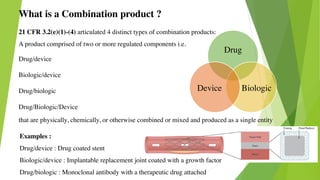
21 CFR 3.2(e)(1)-(4) articulated 4 distinct types of combination products:
A product comprised of two or more regulated components i.e.
Drug/device
Biologic/device
Drug/biologic
Drug/Biologic/Device
that are physically, chemically, or otherwise combined or mixed and produced as a single entity
What is a Combination product ?
Drug
BiologicDevice
Examples :
Drug/device : Drug coated stent
Biologic/device : Implantable replacement joint coated with a growth factor
Drug/biologic : Monoclonal antibody with a therapeutic drug attached
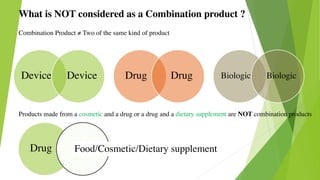
Products made from a cosmetic and a drug or a drug and a dietary supplement are NOT combination products
What is NOT considered as a Combination product ?
Device Device
Combination Product ≠ Two of the same kind of product
Drug Drug Biologic Biologic
Drug Food/Cosmetic/Dietary supplement
Safe Medical Devices Act of 1990
• Addresses which Center within the FDA will review and regulate the combo device?
• Assignment is made based on the product’s Primary Mode of Action (PMOA)
Primary Mode of Action (PMOA)
Mode of Action (21 CFR §3.2(k))
“the means by which a product achieves an intended therapeutic effect or action”
What if PMOA is unclear? (21 CFR §3.4(b))
• FDA uses assignment algorithm
• FDA assigns the combination product to the agency component that regulates other combination products
that present similar questions of safety and effectiveness
• If no similar combination product, then to agency component with most expertise related to the most
significant questions posed
Which is Primary? (21 CFR §3.2(m))
“the single mode of action of a combination product that provides the most important therapeutic
action of the combination product. The most important therapeutic action is the mode of action expected
to make the greatest contribution to the overall intended therapeutic effects of the combination product.”
Request for Designation (RFD)
• Sponsor may request a specific Center be assigned the combination product for review
• Sponsor assesses PMOA and advises FDA of its recommendations
• This request must be no more than 15 pages
• Agency has 60 days to make a decision
• Agency issues a letter of designation
• If the Agency does not issue a letter within 60 days, then the Sponsor’s
recommendation takes effect (Rare)
• There is a lot of cross-collaboration between Centers - FDA has SOP for this
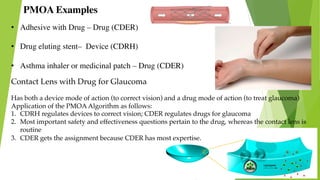
• Adhesive with Drug – Drug (CDER)
• Drug eluting stent– Device (CDRH)
• Asthma inhaler or medicinal patch – Drug (CDER)
Contact Lens with Drug for Glaucoma
Has both a device mode of action (to correct vision) and a drug mode of action (to treat glaucoma)
Application of the PMOA Algorithm as follows:
1. CDRH regulates devices to correct vision; CDER regulates drugs for glaucoma
2. Most important safety and effectiveness questions pertain to the drug, whereas the contact lens is
routine
3. CDER gets the assignment because CDER has most expertise.
PMOA Examples
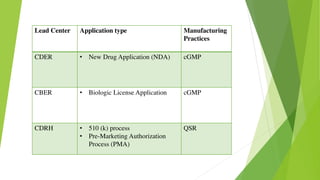
Lead Center Application type Manufacturing
Practices
CDER • New Drug Application (NDA) cGMP
CBER • Biologic License Application cGMP
CDRH • 510 (k) process
• Pre-Marketing Authorization
Process (PMA)
QSR
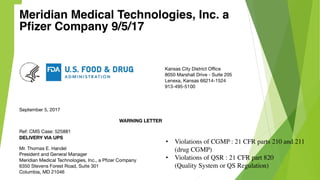
• Violations of CGMP : 21 CFR parts 210 and 211
(drug CGMP)
• Violations of QSR : 21 CFR part 820
(Quality System or QS Regulation)
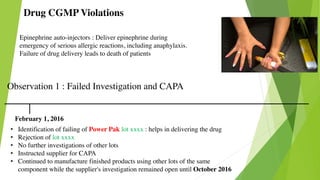
Drug CGMP Violations
Epinephrine auto-injectors : Deliver epinephrine during
emergency of serious allergic reactions, including anaphylaxis.
Failure of drug delivery leads to death of patients
Observation 1 : Failed Investigation and CAPA
February 1, 2016
• Identification of failing of Power Pak lot xxxx : helps in delivering the drug
• Rejection of lot xxxx
• No further investigations of other lots
• Instructed supplier for CAPA
• Continued to manufacture finished products using other lots of the same
component while the supplier's investigation remained open until October 2016
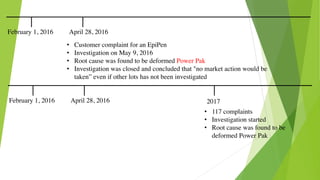
February 1, 2016 April 28, 2016
• Customer complaint for an EpiPen
• Investigation on May 9, 2016
• Root cause was found to be deformed Power Pak
• Investigation was closed and concluded that "no market action would be
taken” even if other lots has not been investigated
February 1, 2016 April 28, 2016 2017
• 117 complaints
• Investigation started
• Root cause was found to be
deformed Power Pak
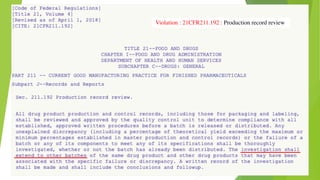
Violation : 21CFR211.192 : Production record review
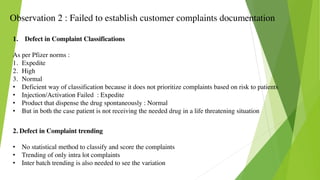
Observation 2 : Failed to establish customer complaints documentation
1. Defect in Complaint Classifications
As per Pfizer norms :
1. Expedite
2. High
3. Normal
• Deficient way of classification because it does not prioritize complaints based on risk to patients
• Injection/Activation Failed : Expedite
• Product that dispense the drug spontaneously : Normal
• But in both the case patient is not receiving the needed drug in a life threatening situation
2. Defect in Complaint trending
• No statistical method to classify and score the complaints
• Trending of only intra lot complaints
• Inter batch trending is also needed to see the variation
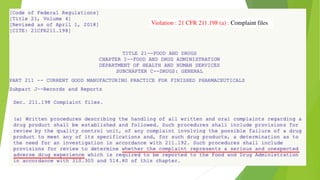
Violation : 21 CFR 211.198 (a) : Complaint files
Device QSR Violations
Observation 3 : Failed to establish Analysis of Nonconformities and Processes
1. Causes of Nonconformities
• Firm didn’t assess the types or causes of rejects, and instead only records the total number of rejects
• Therefore firm does not adequately analyze processes to identify existing and potential causes of
nonconformities related to product or other quality problems
2. No analysis for critical process parameters
• There is no statistical methodology for trending critical process parameters such as pressure applied, gluing
etc.
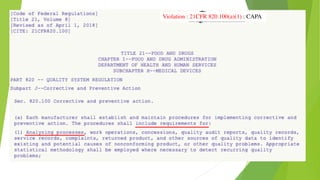
Violation : 21CFR 820.100(a)(1) : CAPA
Observation 5 : No Design Validation
• SOP for design validation exists
• But firm has not completed any validation testing
Observation 4 : No Design Verification
• Firm didn’t have analysis to show design verification
Violation 21 CFR 820.30 (f) : Design controls
Violation 21 CFR 820.30 (g) : Design controls
Summary
• Complex Regulation
• Often difficult to identify appropriate regulations
• Early meetings and discussion with the FDA is recommended
Thank
You

Combination product warning letter

  • 1.
    Regulatory aspects fordrug/device combination product Case study: Warning Letter Meridian Medical Technologies, Pfizer Aman Kumar Naik Biocon Academy 6th February 2019
  • 2.
    21 CFR 3.2(e)(1)-(4)articulated 4 distinct types of combination products: A product comprised of two or more regulated components i.e. Drug/device Biologic/device Drug/biologic Drug/Biologic/Device that are physically, chemically, or otherwise combined or mixed and produced as a single entity What is a Combination product ? Drug BiologicDevice Examples : Drug/device : Drug coated stent Biologic/device : Implantable replacement joint coated with a growth factor Drug/biologic : Monoclonal antibody with a therapeutic drug attached
  • 3.
    Products made froma cosmetic and a drug or a drug and a dietary supplement are NOT combination products What is NOT considered as a Combination product ? Device Device Combination Product ≠ Two of the same kind of product Drug Drug Biologic Biologic Drug Food/Cosmetic/Dietary supplement
  • 4.
    Safe Medical DevicesAct of 1990 • Addresses which Center within the FDA will review and regulate the combo device? • Assignment is made based on the product’s Primary Mode of Action (PMOA) Primary Mode of Action (PMOA) Mode of Action (21 CFR §3.2(k)) “the means by which a product achieves an intended therapeutic effect or action” What if PMOA is unclear? (21 CFR §3.4(b)) • FDA uses assignment algorithm • FDA assigns the combination product to the agency component that regulates other combination products that present similar questions of safety and effectiveness • If no similar combination product, then to agency component with most expertise related to the most significant questions posed Which is Primary? (21 CFR §3.2(m)) “the single mode of action of a combination product that provides the most important therapeutic action of the combination product. The most important therapeutic action is the mode of action expected to make the greatest contribution to the overall intended therapeutic effects of the combination product.”
  • 5.
    Request for Designation(RFD) • Sponsor may request a specific Center be assigned the combination product for review • Sponsor assesses PMOA and advises FDA of its recommendations • This request must be no more than 15 pages • Agency has 60 days to make a decision • Agency issues a letter of designation • If the Agency does not issue a letter within 60 days, then the Sponsor’s recommendation takes effect (Rare) • There is a lot of cross-collaboration between Centers - FDA has SOP for this
  • 6.
    • Adhesive withDrug – Drug (CDER) • Drug eluting stent– Device (CDRH) • Asthma inhaler or medicinal patch – Drug (CDER) Contact Lens with Drug for Glaucoma Has both a device mode of action (to correct vision) and a drug mode of action (to treat glaucoma) Application of the PMOA Algorithm as follows: 1. CDRH regulates devices to correct vision; CDER regulates drugs for glaucoma 2. Most important safety and effectiveness questions pertain to the drug, whereas the contact lens is routine 3. CDER gets the assignment because CDER has most expertise. PMOA Examples
  • 7.
    Lead Center Applicationtype Manufacturing Practices CDER • New Drug Application (NDA) cGMP CBER • Biologic License Application cGMP CDRH • 510 (k) process • Pre-Marketing Authorization Process (PMA) QSR
  • 8.
    • Violations ofCGMP : 21 CFR parts 210 and 211 (drug CGMP) • Violations of QSR : 21 CFR part 820 (Quality System or QS Regulation)
  • 9.
    Drug CGMP Violations Epinephrineauto-injectors : Deliver epinephrine during emergency of serious allergic reactions, including anaphylaxis. Failure of drug delivery leads to death of patients Observation 1 : Failed Investigation and CAPA February 1, 2016 • Identification of failing of Power Pak lot xxxx : helps in delivering the drug • Rejection of lot xxxx • No further investigations of other lots • Instructed supplier for CAPA • Continued to manufacture finished products using other lots of the same component while the supplier's investigation remained open until October 2016
  • 10.
    February 1, 2016April 28, 2016 • Customer complaint for an EpiPen • Investigation on May 9, 2016 • Root cause was found to be deformed Power Pak • Investigation was closed and concluded that "no market action would be taken” even if other lots has not been investigated February 1, 2016 April 28, 2016 2017 • 117 complaints • Investigation started • Root cause was found to be deformed Power Pak
  • 11.
    Violation : 21CFR211.192: Production record review
  • 12.
    Observation 2 :Failed to establish customer complaints documentation 1. Defect in Complaint Classifications As per Pfizer norms : 1. Expedite 2. High 3. Normal • Deficient way of classification because it does not prioritize complaints based on risk to patients • Injection/Activation Failed : Expedite • Product that dispense the drug spontaneously : Normal • But in both the case patient is not receiving the needed drug in a life threatening situation 2. Defect in Complaint trending • No statistical method to classify and score the complaints • Trending of only intra lot complaints • Inter batch trending is also needed to see the variation
  • 13.
    Violation : 21CFR 211.198 (a) : Complaint files
  • 14.
    Device QSR Violations Observation3 : Failed to establish Analysis of Nonconformities and Processes 1. Causes of Nonconformities • Firm didn’t assess the types or causes of rejects, and instead only records the total number of rejects • Therefore firm does not adequately analyze processes to identify existing and potential causes of nonconformities related to product or other quality problems 2. No analysis for critical process parameters • There is no statistical methodology for trending critical process parameters such as pressure applied, gluing etc.
  • 15.
    Violation : 21CFR820.100(a)(1) : CAPA
  • 16.
    Observation 5 :No Design Validation • SOP for design validation exists • But firm has not completed any validation testing Observation 4 : No Design Verification • Firm didn’t have analysis to show design verification Violation 21 CFR 820.30 (f) : Design controls Violation 21 CFR 820.30 (g) : Design controls
  • 17.
    Summary • Complex Regulation •Often difficult to identify appropriate regulations • Early meetings and discussion with the FDA is recommended
  • 18.