COMBATCOMBAT
APPRECIATIONAPPRECIATION
LT COL PR PATHIRAVITHANA psc M def S- SLAC
Tactical Decision Requires Sound Military Judgment
INTRODUCTION
What is Judgment?
Inherent in judgment is ……experience and analytical
thought.
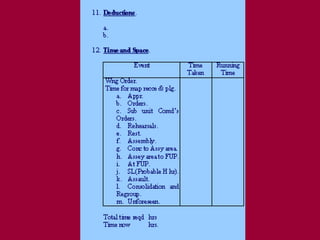
An estimate or appreciation of a situation is the military term
defined as a 'logical process of reasoning by which a commander
considers all the circumstances affecting the military situation and
arrives at a decision as to the Course of Action to be taken in order to
accomplish his mission'
DEFINITION
APPRECIATION NUT SHELL:
 Study the existing situation – what are we confronted with
 Decide on the aim to be attained – what is it we have to
achieve (not to be confused with the aim of the appreciation itself,
which is to identify a course of action)
 Consider all factors, select the relevant factors and
draw deductions – what are the factors that will or may impact
on the course of action we choose, in one way or another
 Consider possible ways of attaining the aim – what options do
we have
 Decide on the best course of action to attain the aim – what
will be do
• Considering the task allotted together with restrictions
on the method of carrying it out to get the TERMS OF
REFERENCE/LIMITATION AND AIM
• Collecting and collating all relevant info under
appropriate FACTORS and arranged at relevant
DEDUCTIONS, towards achieving the aim
• Review of the deductions to bring out possible ways
of achieving the aim to give the COURSES OF
ACTON
• The elaboration of the course selected to give the
OUTLINE PLAN
LAYOUT AND SEQUENCE
AIM
The Aim of my presentation is to acquaint the audience
on military decision making process (Appreciation) at
tactical level.
SEQUENCE
 Formulation of the Aim
 Review of the Situation
 Terms of Reference / Limitation
 How to Derive the Aim
 Factors
 Deductions
 Courses of Action
 Outline Plan
 Appreciation Format
Aim is a statement of what is intended to be
achieved. A clear and concise formulation of the
aim is an essential pre-requisite of any military
appreciation. A faulty aim will lead to a faulty
plan. The task may be clearly laid down by higher
commander. If so, the task will become the aim.
If not, a review of the situation will be required
to set the aim.
FORMULATION OF THE
AIM
The Aim must be simple, clear and concise. It
should satisfy the following:
• Must be single
• Must not indicate the method of
achievement
• Must be positive. No negative verbs should
be used
• Must be capable of being attained with the
existing resources
• Must be confined to the boundaries of
immediate planning
 The alternatives for the statement
for the aim for the attack could be:
 to clear
 to capture
 to secure
 to destroy
• What exactly is to be done?
• What does this involve?
• How far can I plan now?
QUESTIONS TO BE ASKED
TO BRING OUT THE AIM
Example One.
If the task laid down by the higher
commander is ‘To capture Green Hill’, the
task itself may become the aim, as the
answers to all the three questions are the
same, ie, ‘To capture Green Hill’. At Bn level,
selection of aim is often simple, the task
itself becoming the Aim.
Example Two.
The task laid down by higher commander is
‘To capture Brown Hill’. The answer to first
question remains the same, ie, to capture
Brown Hill. However, the answer to second
question brings out - that capture of Brown
Hill also involves capture of Mound and
Knoll since the latter two are in close
proximity of Brown Hill and will interfere in
its capture and subsequent holding. The
answer to third question is that the capture
of all the three features can be planned
now. Thus the Aim is this case would be ‘To
capture Mound, Knoll and Brown Hill’.
Example Three.
The task laid down by the higher
commander is, ‘Act as advance guard and
establish a firm base in area Metipihibiya’.
The answer to first question is, ‘To act as
advance Guard’ and’ To establish firm base
in Area Metipihibiya’. The next question
‘What does this involve?’ brings out ‘To act
as advance Guard upto area Metipihibiya
and then secure Metipihibiya’ The answer to
‘How far can I plan now ?‘ is that I can only
plan to act as advance Guard.
 At higher levels, review of the overall sit obtaining
at that time may be carried out under the following
heads:
• A general review of the situation and
environment. This may include terrain
evaluation, weather, political and
psychological conditions
• Terms of reference (period)
• En forces and intentions
• Own forces and higher intentions
 At lower levels, Div and below, review of the sit
normally limited to listing the Terms of
Reference/Limitation only
REVIEW OF THE SITUATION
TERMS OF REFERENCE /
LIMITATION
• Time Stipulation
• Restrictions on use of troops and
equipment
• Purpose of an operation
• Ground stipulation
• Amplification of task
• Administration stipulation
Limitations
 In contrast to the defence appreciation the
attack proffers few
limitations. Typical of those Imposed are:
 ASAP ;
 Attack complete by ; or
 Exploit to; or within the bdry (ground)
 Strength
 Timings are normal and if they are the only
limitation they should be included in the
statement of the aim (eg to clear WANNI
JUNCTION by 121400 May).
A factor may be defined as a series of
statement of facts or reasonable
assumptions bearing on the aim, from
which deductions also having a bearing on
the aim can be drawn.
FACTORS
PURPOSE
The purpose of examining factors is to
carry out an analysis of all available
relevant info, facts and “ possibilities,
whether known or deduce, with a view to
deriving definite and relevant conclusions
‘(deductions), towards determining the
Courses of Action. Deductions that emerge
enable us to suggest the possible courses
that the en may adopt, to know clearly
what options are available to own forces to
achieve, the aim and finally to select the
best option or course of action to realise
the aim.
SELECTION OF FACTORS
Selection of factors is dependent on the
aim of the appreciation only relevant info
and facts having a beating on the
attainment of aim should be considered. All
irrelevant matter not having a bearing on
the ‘aim or not leading to useful deductions
should be ruthlessly discarded.
CONSIDERATION OF
FACTORS
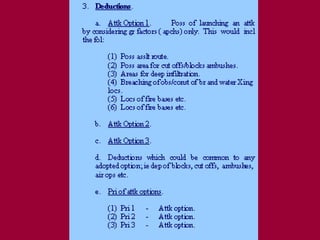
DEDUCTIONS
THE DEDUCTIVE REASONING
PROCESS (two up-two down)
Level of Thinking. The level' of the reasoning
process sets the scene. A battalion commander in
giving a task to a company commander will have
considered the problem to platoon level to ensure
that the company commander has the necessary
resources. In like manner the brigade commander
considers down to company level and tasks
battalions, and the company commander considers
section level and tasks platoons. The frame work for
this 'two down' level of consideration is set by the
context of 'two up' both in terms of own forces and
enemy.
 FACTOR : cover and concealment
 FACT: There is no cover on Northern Approach
 DEDUCTIONS:
• During day, enemy will be able to observe
my move on Northern Approach (An effect),
So what?
• Move on Northern Approach is likely to draw
heavy enemy interference (An inference), So
what ?
• I should move on Northern Approach during
night or I should cover my move with arty
fire. (These suggest a course of action and
there is no further answer to ‘So What?’
Therefore, these are deductions)
METHOD OF DRAWING
DEDUCTIONS
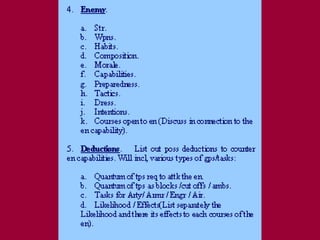
En. (From ex papers list):
 Gen sit.
 Intent/reaction (narrative and
by doctrine).
 Str
 loc and state of def.
 Wpns ident.
 Posn (obj) size (for
deductions on tgt size and fire
unit required).
 Air sit.
 Sp and admin sit.
 Str and Loc. From info given
ident size of posn (eg coy), what
is in it, what extra eqpt might be
incl which so far has not been
shown.
 Obj. Ident number and loc of
two down size objs (at coy level,
squad or hy wpn posns, at coy
level, pl posns).
DEDUCTIONS:
 Size of Obj. Determine size of
objs and therefore sizes of fire
units required to cover them.
 Sp. Determine what sp the en
posn will get in term of indir and
dir FS (if applicable) and eff on
you. Ident possible OP.
 Res. Will en use a res for
counter atk? If so what should
you do?
 Air. How does en air eff you (if
applicable) and what should you
do about it?
 Artificial obs. How has he
used artificial obs, for what
purpose and what can you do to
defeat his aim in obs
deployment?
• Always use the word ‘should’ for wording
deductions
• Deductions should always be positive. Never
draw negative deductions
• Do not include facts from which no useful
deductions can be drawn
• Do not arrive at deductions without first
considering the relevant factors. Such deductions
may be termed as unsupported deductions.
Unsupported deductions go against the technique
of a written appreciation Cont ...
IMPORTANT POINTS TO
REMEMBER WHILE DRAWING
DEDUCTIONS
• Do not confuse statement of facts with deductions
• Deductions are conclusions leading to courses of
action. A statement which is a fact and not a
conclusion is not a deduction as it does not lead
to a course of action
• Deductions pertain to own courses of action. Do
not include deductions pertaining to enemy
courses of action in the Factors
• Do not draw deductions from the wrong
factors/sub factors
Cont ...
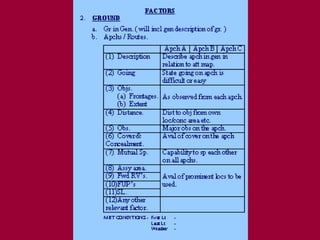
GROUND
This involves the following:
 OCOKA
 A statement of ground general.
 Selection of key terrain features and their numbering.
 Selection of the vital Drawing in of approaches by:
 Selection of assembly areas,
 Selection of FUP,
 Identification of obstacles constricting the assault
between FUP and vital ground, and drawing In of routes to
the FUP and the dimensions of
the assault.
 Completion of a tabular analysis of approaches.
Cont…..
f.
 Completion of an approach overlay showing:
 Key terrain,
 Vital ground,
 Assembly area,
 Routes to FUP,
 FUP,
 Assault routes,
 Objectives,
 Killing ground if desired
 Locations suitable for direct fire support if
desired.
…..Cont
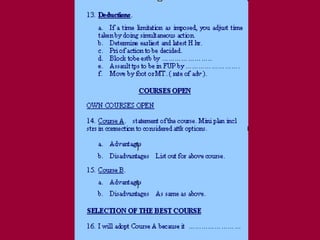
• Courses of action are the various options
available to achieve the aim. Factors have to be
considered logically, the likely courses, both
own and enemy, will be derived by
considering the factors
• Most suitable course to attain the aim
has to be selected by detailed consideration of
the merits of each and weighing it against
likely en action
• Courses, which are obviously
unworkable, must not be included
COURSES OF ACTION
Develop each COA in detail: (as time allowed)
 Once you have ident the complete set of threat COAs, devlp
each COA in to as much as detail as the sit reqd and time avail
allows. Based on the seqence which you devlp each COA on its
probablity of adoption and the comds guidance. To ensure
completeness each COA must answer the five questions.
 WHAT. The type of op ,such as attk ,def ,rft or conduct
retrogate.
 WHEN. The time the action will began. ( earliest time)
 WHERE. The sectors ,zones ,axis of attk Aas and obj that makes
up the COA.
 HOW. The method by which the threat will empl his assets, such
as disposn,loc, ME the scheme of mnvr and how it will be sp.
 WHY. The obj or end state the threat intended to accomplish
• When En Has the Initiative:
* State and examine en courses
* Determine en’s most probable Course
* State and examine own courses
* Decide own best course of action in
relation to enemy’s most probable
course
• When We Have the Initiative:
* State and examine own courses
* State and examine en courses
* Determine en’s most probable course
* Decide own best course of action in
relation to enemy’s most probable
course
SEQUENCE
 Enemy courses are derived from doctrinal
statements and deductions made under relative
strengths and ground. The examination of ground
will reveal his favored killing ground, his
dispositions to achieve his aim and his most likely
withdrawal routes if applicable. Do not simply
restate the doctrine (eg: he will fight until I deploy
and then withdraw) but detail how he will achieve
the statement of doctrine.
EN COURSES
En courses are discussed under the headings
‘Likelihood’ (most probable) and ‘Effect’ (Dangerous).
Under ‘Likelihood’, discuss the likelihood of adoption
of that course by the enemy and under ‘Effect’,
examine the fleet of that course on the attainment of
our aim.
Enemy Courses:
ENEMY’S MOST PROBABLE
COURSE
If no concrete indication of the enemy’s most
probable course may be forthcoming from the
consideration of factors, assess the enemy’s most
dangerous course as his most probable course.
• Own courses are the various methods of
achieving the aim, derived from
consideration of factors
• A course is a plan in nut shell. Hence while
describing own courses, describe briefly the
full essentials of each course
• No new own courses to be introduced it
should be a logical outcome of all factors
considered in the appreciation
• Each course should be examined in the light
of the aim under the headings ‘Advantages’
and ‘Disadvantages’
• Combination of courses may be considered
if they more likely to achieve the aim, such a
combination course should have been discussed
in the factors before hand
OWN COURSES
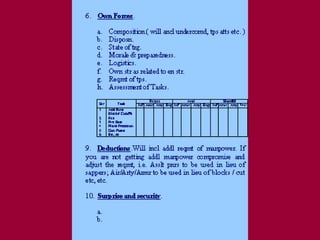
Own Courses:
 Own courses are based on the assessment of tasks and
the effect of enemy courses.
 Incorporate the aim and limitations;
 Be based on earlier deductions;
 Be achievable within resources;
 Take account of all the considerations for the attack
 Be stated fully (by phase, objs captured, fire support,
Flank security, preliminary operations, subsequent
Operations, reorganization, etc);,
 Be detailed as a number of options (ie more than one
Course); and
OWN BEST COURSE OF ACTION
 Detail advantages and disadvantages for each
course Including the time and space aspect (this may
necessitate an extra time and space segment for each
course)
 Use Functions in Combat to compare the COAs and
asses the advantages and disadvantages before
deriving on to the own best COA.
 Functions in Combat are :
 Command
 Info/Int
 Manvr
 Protection
 Fire Power
 CSS
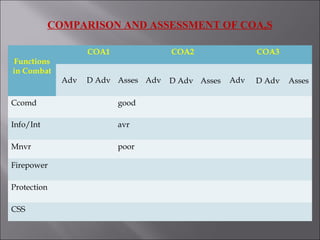
Functions
in Combat
COA1 COA2 COA3
Adv D Adv Asses Adv D Adv Asses Adv D Adv Asses
Ccomd good
Info/Int avr
Mnvr poor
Firepower
Protection
CSS
COMPARISON AND ASSESSMENT OF COA,S
• Feasible. The unit must be able to accomplish the mission within the available
time, space, and resources.
• Acceptable. The tactical or operational advantage gained by executing the
COA must justify the cost in resources, especially casualties. This assessment
is largely subjective.
• Distinguishable. Each COA must differ significantly from the others.
This criterion is also largely subjective. Significant differences include differences
in the –
• Use of reserves.
• Task organization.
• Timing (day or night).
• Scheme of maneuver.
• Suitable. A COA must accomplish the mission and comply with the
commander’s planning guidance. However, commanders may modify their
planning guidance at any time. When this happens, the staff records the
changes and incorporates the new guidance, and reevaluates each COA to
ensure it complies with the change.
• Complete. A COA must show how –
• The decisive operation accomplishes the mission.
• Shaping operations create and preserve conditions for success of the
decisive operation.
• Sustaining operations enable shaping and decisive operations.
COA SCREENING CRITERIACOA SCREENING CRITERIA
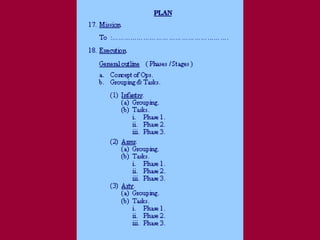
The plan is a statement of the method by which
derived through an elaboration of the course
selected to achieve the aim. It is a logical
outcome of the consideration of factors.
OUTLINE PLAN
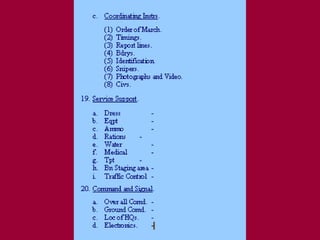
• Mission
• Execution
• Service Support
• Command and Signals
THE GROUP HEADINGS
USED IN THE PLAN
An appreciation may be re-appreciate at any
stage prior to execution of the plan if
warranted by change in original situation or
factors. It is a matter of judgement as to when
and under what circumstances re-appreciation
may be necessary.
RE-APPRECIATION
DOs AND DONTs
DOs
• Evolve a clear, concise and simple aim
• Keep the terms of reference at the back of
your mind while discussing factors
• Give due importance to all the factors,
courses of action and the plan
• Be brief and to the point
• Be neat and tidy in your writing
• Follow the rules of minor Staff Duties
• Do not situate an appreciation but
appreciate the Situation
• Do not include information facts in factors
from which no useful deductions can be
drawn
• Do not draw negative deductions
• Do not draw unsupported deductions
• Do not draw deductions from the wrong
factors
• Do not produce ‘Courses of Action’ out of
nowhere. These must be based on
consideration of factors
• Do not include new matter in the plan
DONTs
RECEIVE THE MISSIONRECEIVE THE MISSION
•The leader must understand the order and most importantly the commander’s intent.
Analyze the order to determine what tasks must be accomplished whether they are
specified in the order or implied by the mission.
•Also determine what resources, including time, are available to prepare and execute
the mission.
•Receive the mission to be completed from command, whether it be a new mission or
a change to a mission in progress. Leader must analyze the mission based on the
factors of the Mission, Enemy, Terrain, Troops available, and Time available
(METT-T).
•For the factor of time, the leader should use less than 1/3 of the time to the beginning of
the mission to plan and issue the order so that his subordinates have 2/3 of that time to
prepare (1/3 - 2/3 Rule).

Combat-Appreciation

  • 1.
    COMBATCOMBAT APPRECIATIONAPPRECIATION LT COL PRPATHIRAVITHANA psc M def S- SLAC Tactical Decision Requires Sound Military Judgment
  • 2.
  • 3.
    What is Judgment? Inherentin judgment is ……experience and analytical thought.
  • 4.
    An estimate orappreciation of a situation is the military term defined as a 'logical process of reasoning by which a commander considers all the circumstances affecting the military situation and arrives at a decision as to the Course of Action to be taken in order to accomplish his mission' DEFINITION
  • 5.
    APPRECIATION NUT SHELL: Study the existing situation – what are we confronted with  Decide on the aim to be attained – what is it we have to achieve (not to be confused with the aim of the appreciation itself, which is to identify a course of action)  Consider all factors, select the relevant factors and draw deductions – what are the factors that will or may impact on the course of action we choose, in one way or another  Consider possible ways of attaining the aim – what options do we have  Decide on the best course of action to attain the aim – what will be do
  • 6.
    • Considering thetask allotted together with restrictions on the method of carrying it out to get the TERMS OF REFERENCE/LIMITATION AND AIM • Collecting and collating all relevant info under appropriate FACTORS and arranged at relevant DEDUCTIONS, towards achieving the aim • Review of the deductions to bring out possible ways of achieving the aim to give the COURSES OF ACTON • The elaboration of the course selected to give the OUTLINE PLAN LAYOUT AND SEQUENCE
  • 7.
    AIM The Aim ofmy presentation is to acquaint the audience on military decision making process (Appreciation) at tactical level.
  • 8.
    SEQUENCE  Formulation ofthe Aim  Review of the Situation  Terms of Reference / Limitation  How to Derive the Aim  Factors  Deductions  Courses of Action  Outline Plan  Appreciation Format
  • 9.
    Aim is astatement of what is intended to be achieved. A clear and concise formulation of the aim is an essential pre-requisite of any military appreciation. A faulty aim will lead to a faulty plan. The task may be clearly laid down by higher commander. If so, the task will become the aim. If not, a review of the situation will be required to set the aim. FORMULATION OF THE AIM
  • 10.
    The Aim mustbe simple, clear and concise. It should satisfy the following: • Must be single • Must not indicate the method of achievement • Must be positive. No negative verbs should be used • Must be capable of being attained with the existing resources • Must be confined to the boundaries of immediate planning
  • 11.
     The alternativesfor the statement for the aim for the attack could be:  to clear  to capture  to secure  to destroy
  • 12.
    • What exactlyis to be done? • What does this involve? • How far can I plan now? QUESTIONS TO BE ASKED TO BRING OUT THE AIM
  • 13.
    Example One. If thetask laid down by the higher commander is ‘To capture Green Hill’, the task itself may become the aim, as the answers to all the three questions are the same, ie, ‘To capture Green Hill’. At Bn level, selection of aim is often simple, the task itself becoming the Aim.
  • 14.
    Example Two. The tasklaid down by higher commander is ‘To capture Brown Hill’. The answer to first question remains the same, ie, to capture Brown Hill. However, the answer to second question brings out - that capture of Brown Hill also involves capture of Mound and Knoll since the latter two are in close proximity of Brown Hill and will interfere in its capture and subsequent holding. The answer to third question is that the capture of all the three features can be planned now. Thus the Aim is this case would be ‘To capture Mound, Knoll and Brown Hill’.
  • 15.
    Example Three. The tasklaid down by the higher commander is, ‘Act as advance guard and establish a firm base in area Metipihibiya’. The answer to first question is, ‘To act as advance Guard’ and’ To establish firm base in Area Metipihibiya’. The next question ‘What does this involve?’ brings out ‘To act as advance Guard upto area Metipihibiya and then secure Metipihibiya’ The answer to ‘How far can I plan now ?‘ is that I can only plan to act as advance Guard.
  • 16.
     At higherlevels, review of the overall sit obtaining at that time may be carried out under the following heads: • A general review of the situation and environment. This may include terrain evaluation, weather, political and psychological conditions • Terms of reference (period) • En forces and intentions • Own forces and higher intentions  At lower levels, Div and below, review of the sit normally limited to listing the Terms of Reference/Limitation only REVIEW OF THE SITUATION
  • 17.
    TERMS OF REFERENCE/ LIMITATION • Time Stipulation • Restrictions on use of troops and equipment • Purpose of an operation • Ground stipulation • Amplification of task • Administration stipulation
  • 18.
    Limitations  In contrastto the defence appreciation the attack proffers few limitations. Typical of those Imposed are:  ASAP ;  Attack complete by ; or  Exploit to; or within the bdry (ground)  Strength  Timings are normal and if they are the only limitation they should be included in the statement of the aim (eg to clear WANNI JUNCTION by 121400 May).
  • 19.
    A factor maybe defined as a series of statement of facts or reasonable assumptions bearing on the aim, from which deductions also having a bearing on the aim can be drawn. FACTORS
  • 20.
    PURPOSE The purpose ofexamining factors is to carry out an analysis of all available relevant info, facts and “ possibilities, whether known or deduce, with a view to deriving definite and relevant conclusions ‘(deductions), towards determining the Courses of Action. Deductions that emerge enable us to suggest the possible courses that the en may adopt, to know clearly what options are available to own forces to achieve, the aim and finally to select the best option or course of action to realise the aim.
  • 21.
    SELECTION OF FACTORS Selectionof factors is dependent on the aim of the appreciation only relevant info and facts having a beating on the attainment of aim should be considered. All irrelevant matter not having a bearing on the ‘aim or not leading to useful deductions should be ruthlessly discarded.
  • 22.
  • 23.
  • 24.
    THE DEDUCTIVE REASONING PROCESS(two up-two down) Level of Thinking. The level' of the reasoning process sets the scene. A battalion commander in giving a task to a company commander will have considered the problem to platoon level to ensure that the company commander has the necessary resources. In like manner the brigade commander considers down to company level and tasks battalions, and the company commander considers section level and tasks platoons. The frame work for this 'two down' level of consideration is set by the context of 'two up' both in terms of own forces and enemy.
  • 25.
     FACTOR :cover and concealment  FACT: There is no cover on Northern Approach  DEDUCTIONS: • During day, enemy will be able to observe my move on Northern Approach (An effect), So what? • Move on Northern Approach is likely to draw heavy enemy interference (An inference), So what ? • I should move on Northern Approach during night or I should cover my move with arty fire. (These suggest a course of action and there is no further answer to ‘So What?’ Therefore, these are deductions) METHOD OF DRAWING DEDUCTIONS
  • 26.
    En. (From expapers list):  Gen sit.  Intent/reaction (narrative and by doctrine).  Str  loc and state of def.  Wpns ident.  Posn (obj) size (for deductions on tgt size and fire unit required).  Air sit.  Sp and admin sit.  Str and Loc. From info given ident size of posn (eg coy), what is in it, what extra eqpt might be incl which so far has not been shown.  Obj. Ident number and loc of two down size objs (at coy level, squad or hy wpn posns, at coy level, pl posns). DEDUCTIONS:
  • 27.
     Size ofObj. Determine size of objs and therefore sizes of fire units required to cover them.  Sp. Determine what sp the en posn will get in term of indir and dir FS (if applicable) and eff on you. Ident possible OP.  Res. Will en use a res for counter atk? If so what should you do?  Air. How does en air eff you (if applicable) and what should you do about it?  Artificial obs. How has he used artificial obs, for what purpose and what can you do to defeat his aim in obs deployment?
  • 28.
    • Always usethe word ‘should’ for wording deductions • Deductions should always be positive. Never draw negative deductions • Do not include facts from which no useful deductions can be drawn • Do not arrive at deductions without first considering the relevant factors. Such deductions may be termed as unsupported deductions. Unsupported deductions go against the technique of a written appreciation Cont ... IMPORTANT POINTS TO REMEMBER WHILE DRAWING DEDUCTIONS
  • 29.
    • Do notconfuse statement of facts with deductions • Deductions are conclusions leading to courses of action. A statement which is a fact and not a conclusion is not a deduction as it does not lead to a course of action • Deductions pertain to own courses of action. Do not include deductions pertaining to enemy courses of action in the Factors • Do not draw deductions from the wrong factors/sub factors Cont ...
  • 30.
    GROUND This involves thefollowing:  OCOKA  A statement of ground general.  Selection of key terrain features and their numbering.  Selection of the vital Drawing in of approaches by:  Selection of assembly areas,  Selection of FUP,  Identification of obstacles constricting the assault between FUP and vital ground, and drawing In of routes to the FUP and the dimensions of the assault.  Completion of a tabular analysis of approaches. Cont….. f.
  • 31.
     Completion ofan approach overlay showing:  Key terrain,  Vital ground,  Assembly area,  Routes to FUP,  FUP,  Assault routes,  Objectives,  Killing ground if desired  Locations suitable for direct fire support if desired. …..Cont
  • 32.
    • Courses ofaction are the various options available to achieve the aim. Factors have to be considered logically, the likely courses, both own and enemy, will be derived by considering the factors • Most suitable course to attain the aim has to be selected by detailed consideration of the merits of each and weighing it against likely en action • Courses, which are obviously unworkable, must not be included COURSES OF ACTION
  • 33.
    Develop each COAin detail: (as time allowed)  Once you have ident the complete set of threat COAs, devlp each COA in to as much as detail as the sit reqd and time avail allows. Based on the seqence which you devlp each COA on its probablity of adoption and the comds guidance. To ensure completeness each COA must answer the five questions.  WHAT. The type of op ,such as attk ,def ,rft or conduct retrogate.  WHEN. The time the action will began. ( earliest time)  WHERE. The sectors ,zones ,axis of attk Aas and obj that makes up the COA.  HOW. The method by which the threat will empl his assets, such as disposn,loc, ME the scheme of mnvr and how it will be sp.  WHY. The obj or end state the threat intended to accomplish
  • 34.
    • When EnHas the Initiative: * State and examine en courses * Determine en’s most probable Course * State and examine own courses * Decide own best course of action in relation to enemy’s most probable course • When We Have the Initiative: * State and examine own courses * State and examine en courses * Determine en’s most probable course * Decide own best course of action in relation to enemy’s most probable course SEQUENCE
  • 35.
     Enemy coursesare derived from doctrinal statements and deductions made under relative strengths and ground. The examination of ground will reveal his favored killing ground, his dispositions to achieve his aim and his most likely withdrawal routes if applicable. Do not simply restate the doctrine (eg: he will fight until I deploy and then withdraw) but detail how he will achieve the statement of doctrine. EN COURSES
  • 36.
    En courses arediscussed under the headings ‘Likelihood’ (most probable) and ‘Effect’ (Dangerous). Under ‘Likelihood’, discuss the likelihood of adoption of that course by the enemy and under ‘Effect’, examine the fleet of that course on the attainment of our aim. Enemy Courses:
  • 37.
    ENEMY’S MOST PROBABLE COURSE Ifno concrete indication of the enemy’s most probable course may be forthcoming from the consideration of factors, assess the enemy’s most dangerous course as his most probable course.
  • 38.
    • Own coursesare the various methods of achieving the aim, derived from consideration of factors • A course is a plan in nut shell. Hence while describing own courses, describe briefly the full essentials of each course • No new own courses to be introduced it should be a logical outcome of all factors considered in the appreciation • Each course should be examined in the light of the aim under the headings ‘Advantages’ and ‘Disadvantages’ • Combination of courses may be considered if they more likely to achieve the aim, such a combination course should have been discussed in the factors before hand OWN COURSES
  • 39.
    Own Courses:  Owncourses are based on the assessment of tasks and the effect of enemy courses.  Incorporate the aim and limitations;  Be based on earlier deductions;  Be achievable within resources;  Take account of all the considerations for the attack  Be stated fully (by phase, objs captured, fire support, Flank security, preliminary operations, subsequent Operations, reorganization, etc);,  Be detailed as a number of options (ie more than one Course); and
  • 40.
    OWN BEST COURSEOF ACTION  Detail advantages and disadvantages for each course Including the time and space aspect (this may necessitate an extra time and space segment for each course)  Use Functions in Combat to compare the COAs and asses the advantages and disadvantages before deriving on to the own best COA.  Functions in Combat are :  Command  Info/Int  Manvr  Protection  Fire Power  CSS
  • 41.
    Functions in Combat COA1 COA2COA3 Adv D Adv Asses Adv D Adv Asses Adv D Adv Asses Ccomd good Info/Int avr Mnvr poor Firepower Protection CSS COMPARISON AND ASSESSMENT OF COA,S
  • 42.
    • Feasible. Theunit must be able to accomplish the mission within the available time, space, and resources. • Acceptable. The tactical or operational advantage gained by executing the COA must justify the cost in resources, especially casualties. This assessment is largely subjective. • Distinguishable. Each COA must differ significantly from the others. This criterion is also largely subjective. Significant differences include differences in the – • Use of reserves. • Task organization. • Timing (day or night). • Scheme of maneuver. • Suitable. A COA must accomplish the mission and comply with the commander’s planning guidance. However, commanders may modify their planning guidance at any time. When this happens, the staff records the changes and incorporates the new guidance, and reevaluates each COA to ensure it complies with the change. • Complete. A COA must show how – • The decisive operation accomplishes the mission. • Shaping operations create and preserve conditions for success of the decisive operation. • Sustaining operations enable shaping and decisive operations. COA SCREENING CRITERIACOA SCREENING CRITERIA
  • 43.
    The plan isa statement of the method by which derived through an elaboration of the course selected to achieve the aim. It is a logical outcome of the consideration of factors. OUTLINE PLAN
  • 44.
    • Mission • Execution •Service Support • Command and Signals THE GROUP HEADINGS USED IN THE PLAN
  • 45.
    An appreciation maybe re-appreciate at any stage prior to execution of the plan if warranted by change in original situation or factors. It is a matter of judgement as to when and under what circumstances re-appreciation may be necessary. RE-APPRECIATION
  • 55.
  • 56.
    DOs • Evolve aclear, concise and simple aim • Keep the terms of reference at the back of your mind while discussing factors • Give due importance to all the factors, courses of action and the plan • Be brief and to the point • Be neat and tidy in your writing • Follow the rules of minor Staff Duties
  • 57.
    • Do notsituate an appreciation but appreciate the Situation • Do not include information facts in factors from which no useful deductions can be drawn • Do not draw negative deductions • Do not draw unsupported deductions • Do not draw deductions from the wrong factors • Do not produce ‘Courses of Action’ out of nowhere. These must be based on consideration of factors • Do not include new matter in the plan DONTs
  • 59.
    RECEIVE THE MISSIONRECEIVETHE MISSION •The leader must understand the order and most importantly the commander’s intent. Analyze the order to determine what tasks must be accomplished whether they are specified in the order or implied by the mission. •Also determine what resources, including time, are available to prepare and execute the mission. •Receive the mission to be completed from command, whether it be a new mission or a change to a mission in progress. Leader must analyze the mission based on the factors of the Mission, Enemy, Terrain, Troops available, and Time available (METT-T). •For the factor of time, the leader should use less than 1/3 of the time to the beginning of the mission to plan and issue the order so that his subordinates have 2/3 of that time to prepare (1/3 - 2/3 Rule).