The Targeting Process...
this unknown process
 by LTC (ITA A) Giulio Di Marzio
Preface
The level of ambitions of this serial of ar-
ticles is focalised to propose to the audience
a general flavour of what TARGETING is
and what it could provide for supporting our
accomplishment of the Mission. In particu-
lar, this first Part aim is to give the essential
& basic background concepts to better un-
derstanding the entire development process.
Introduction
In the general framework of the Military
Operations, the Targeting Cycle is one of the
most significant and, in parallel, one of the
most complex procedures we have to deal with.
Indeed it implies a massive and extreme-
ly dynamic course involving all the key ele-
ments of the HQ acting with a top-down data
evaluation process.
Most of the time when we use the word
Targeting, we principally are referring to all
those kinetic actions taken to hit or strike a
specific critical point or, more properly
speaking, a well defined target itself.
In other words in our perception we im-
mediately associate this concept with some-
thing that looks like in our eyes as an effec-
tive, destructive and lethal combination of
power and strength.
This is a tricky vision of the reality indeed,
since we have to assume that a target in itself
is not identified – at all - by the effects we
want to achieve for hitting it (both kinetic or
non-kinetics as well) using the entire range of
lethal means or non-lethal ones available at
our level of command.
Having highlighted this misperception of
ours, we do need to define clearly the real
object of the targeting process: how a tar-
get has to be prosecuted.
Among the many ways we could use to
deal with this issue the first and the most
critical distinction we have to do - speaking
of the target prosecution - is defining which
kind of means we want to select for achiev-
ing the desiderate effect on it.
This is the direct approaching line telling
us what kind of target we are dealing with.
Consequently we will make use of lethal
means when the required effect is to destroy
(Part I)
nrdc-ita magazine Issue13 11
NRDC-ITAonexercise
the target. Otherwise non-lethal means will
be utilized when the required effect is to de-
grade a target, disrupt it or deny the use of it
to our opponent.
This procedure, therefore, generates an-
other misperception since it drives our way
of thinking to generalise and to label – quite
improperly - a target in term of lethal tar-
get and non-lethal target.
To add a furthermore semantic difficulty
on this matter, we could state looking from a
different perspective that the word kinetic
mostly works with lethal means but is not
real the vice versa at all.
In fact a target prosecuted with lethal
means produces both kinetic effect and
even non kinetic ones as well.
On the contrary, as said previously, it is
not possible to say the opposite.
Therefore a lethal mean could even have
a secondary undesired no-kinetic effect or
unintended one. And this very last option
could be even have a more massive impact
than the expected desired effect on the con-
duct of Operations, hampering the full
achievement of the Mission itself.
Nowadays our units are daily operating
in different COIN operations and therefore
an integration between kinetic and non-
kinetic effects - or solutions suitable to com-
bine both of them - are the more and the
more crucial aspect and above all very more
demanding than in the past. Meanwhile an
increasing importance has to be attribute to
all the different de-confliction processes
about the means used in the execution of
these specific tasks, as well.
No doubt this practise has to rely on a
range of choice based on the risk assessment
and effectiveness mainly.
This approach gives us the possibility to
discover the non-kinetic side of the moon
generally known as Info Ops or better so
called Effect Based Operations (EBO).
Addressing our attention to this very last
aspect of the development of operation an
important one EBO key aspect to mention is
its Objective based-approach, which
forms a hierarchy that drives us from a de-
sired effect on some specific objectives to
specific targets.
A peculiar key component for the Info
Ops is the ability to perform the CA which
provides feedback of the effect based strate-
gy to task methodology and relates on what
is occurring within the battle space to the
intentions of the civilian leadership.
In fact it is relevant that the EBO affects
a larger number of actors, have different im-
plications PAN HQ and moreover a more
significant sequence of impact at a different
tier in the Public Opinion.
Last but not least I would even mention
that the targeting process aimed to deliver
such as a non-kinetic effect is quite problem-
atic in terms of judging or assessing in the
framework time the effects delivered to the
target itself. Assessing is always a crucial
step wherever you are, but when the cycle
has to regenerate itself or if a target needs to
be vetted or a new pool of effects has to be
re-delivered (re-target), you understand that
this is a non negotiable condition.
The Process
Now we are entering in a more detailed
discussion to explain how this targeting
process works.
In general terms, the purpose of targeting
is aimed to develop, coordinate, integrate
and synchronise both lethal and non-le-
thal means of fire in support of the COM’s
intent and plan. This has to be in accordance
with High Cdr’s D & G and reinforced with
Subordinate Cdr’s Objectives and intent.
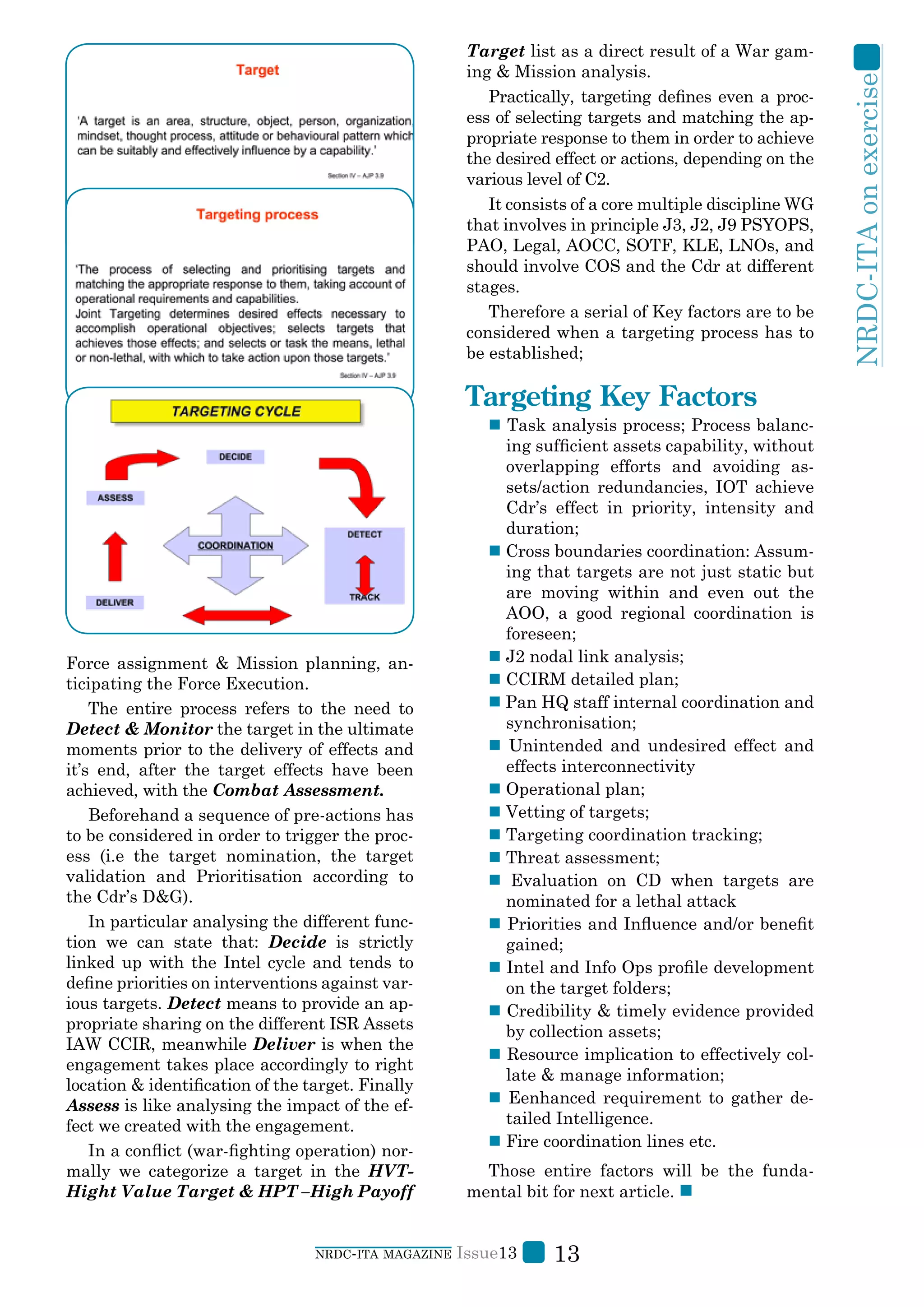
Normally the targeting process is devel-
oped throughout five important steps. These,
namely, are defined by the following De-
cide, Detect, Track, Deliver and Assess
phases, aimed to produce a quite complete
target package to be delivered to the Ma-
noeuvres Units.
In particular each step includes a serial
of actions - to be taken - relating to develop a
Capabilities Analysis, followed by the GO/
NOGO COM Decision Briefing and the
Issue13 nrdc-ita magazine12
NRDC-ITAonexercise
Force assignment & Mission planning, an-
ticipating the Force Execution.
The entire process refers to the need to
Detect & Monitor the target in the ultimate
moments prior to the delivery of effects and
it’s end, after the target effects have been
achieved, with the Combat Assessment.
Beforehand a sequence of pre-actions has
to be considered in order to trigger the proc-
ess (i.e the target nomination, the target
validation and Prioritisation according to
the Cdr’s D&G).
In particular analysing the different func-
tion we can state that: Decide is strictly
linked up with the Intel cycle and tends to
define priorities on interventions against var-
ious targets. Detect means to provide an ap-
propriate sharing on the different ISR Assets
IAW CCIR, meanwhile Deliver is when the
engagement takes place accordingly to right
location & identification of the target. Finally
Assess is like analysing the impact of the ef-
fect we created with the engagement.
In a conflict (war-fighting operation) nor-
mally we categorize a target in the HVT-
Hight Value Target & HPT –High Payoff
Target list as a direct result of a War gam-
ing & Mission analysis.
Practically, targeting defines even a proc-
ess of selecting targets and matching the ap-
propriate response to them in order to achieve
the desired effect or actions, depending on the
various level of C2.
It consists of a core multiple discipline WG
that involves in principle J3, J2, J9 PSYOPS,
PAO, Legal, AOCC, SOTF, KLE, LNOs, and
should involve COS and the Cdr at different
stages.
Therefore a serial of Key factors are to be
considered when a targeting process has to
be established;
Targeting Key Factors
 Task analysis process; Process balanc-
ing sufficient assets capability, without
overlapping efforts and avoiding as-
sets/action redundancies, IOT achieve
Cdr’s effect in priority, intensity and
duration;
 Cross boundaries coordination: Assum-
ing that targets are not just static but
are moving within and even out the
AOO, a good regional coordination is
foreseen;
 J2 nodal link analysis;
 CCIRM detailed plan;
 Pan HQ staff internal coordination and
synchronisation;
 Unintended and undesired effect and
effects interconnectivity
 Operational plan;
 Vetting of targets;
 Targeting coordination tracking;
 Threat assessment;
 Evaluation on CD when targets are
nominated for a lethal attack
 Priorities and Influence and/or benefit
gained;
 Intel and Info Ops profile development
on the target folders;
 Credibility & timely evidence provided
by collection assets;
 Resource implication to effectively col-
late & manage information;
 Eenhanced requirement to gather de-
tailed Intelligence.
 Fire coordination lines etc.
Those entire factors will be the funda-
mental bit for next article. 
nrdc-ita magazine Issue13 13
NRDC-ITAonexercise

targeting process part 1

  • 1.
    The Targeting Process... thisunknown process  by LTC (ITA A) Giulio Di Marzio Preface The level of ambitions of this serial of ar- ticles is focalised to propose to the audience a general flavour of what TARGETING is and what it could provide for supporting our accomplishment of the Mission. In particu- lar, this first Part aim is to give the essential & basic background concepts to better un- derstanding the entire development process. Introduction In the general framework of the Military Operations, the Targeting Cycle is one of the most significant and, in parallel, one of the most complex procedures we have to deal with. Indeed it implies a massive and extreme- ly dynamic course involving all the key ele- ments of the HQ acting with a top-down data evaluation process. Most of the time when we use the word Targeting, we principally are referring to all those kinetic actions taken to hit or strike a specific critical point or, more properly speaking, a well defined target itself. In other words in our perception we im- mediately associate this concept with some- thing that looks like in our eyes as an effec- tive, destructive and lethal combination of power and strength. This is a tricky vision of the reality indeed, since we have to assume that a target in itself is not identified – at all - by the effects we want to achieve for hitting it (both kinetic or non-kinetics as well) using the entire range of lethal means or non-lethal ones available at our level of command. Having highlighted this misperception of ours, we do need to define clearly the real object of the targeting process: how a tar- get has to be prosecuted. Among the many ways we could use to deal with this issue the first and the most critical distinction we have to do - speaking of the target prosecution - is defining which kind of means we want to select for achiev- ing the desiderate effect on it. This is the direct approaching line telling us what kind of target we are dealing with. Consequently we will make use of lethal means when the required effect is to destroy (Part I) nrdc-ita magazine Issue13 11 NRDC-ITAonexercise
  • 2.
    the target. Otherwisenon-lethal means will be utilized when the required effect is to de- grade a target, disrupt it or deny the use of it to our opponent. This procedure, therefore, generates an- other misperception since it drives our way of thinking to generalise and to label – quite improperly - a target in term of lethal tar- get and non-lethal target. To add a furthermore semantic difficulty on this matter, we could state looking from a different perspective that the word kinetic mostly works with lethal means but is not real the vice versa at all. In fact a target prosecuted with lethal means produces both kinetic effect and even non kinetic ones as well. On the contrary, as said previously, it is not possible to say the opposite. Therefore a lethal mean could even have a secondary undesired no-kinetic effect or unintended one. And this very last option could be even have a more massive impact than the expected desired effect on the con- duct of Operations, hampering the full achievement of the Mission itself. Nowadays our units are daily operating in different COIN operations and therefore an integration between kinetic and non- kinetic effects - or solutions suitable to com- bine both of them - are the more and the more crucial aspect and above all very more demanding than in the past. Meanwhile an increasing importance has to be attribute to all the different de-confliction processes about the means used in the execution of these specific tasks, as well. No doubt this practise has to rely on a range of choice based on the risk assessment and effectiveness mainly. This approach gives us the possibility to discover the non-kinetic side of the moon generally known as Info Ops or better so called Effect Based Operations (EBO). Addressing our attention to this very last aspect of the development of operation an important one EBO key aspect to mention is its Objective based-approach, which forms a hierarchy that drives us from a de- sired effect on some specific objectives to specific targets. A peculiar key component for the Info Ops is the ability to perform the CA which provides feedback of the effect based strate- gy to task methodology and relates on what is occurring within the battle space to the intentions of the civilian leadership. In fact it is relevant that the EBO affects a larger number of actors, have different im- plications PAN HQ and moreover a more significant sequence of impact at a different tier in the Public Opinion. Last but not least I would even mention that the targeting process aimed to deliver such as a non-kinetic effect is quite problem- atic in terms of judging or assessing in the framework time the effects delivered to the target itself. Assessing is always a crucial step wherever you are, but when the cycle has to regenerate itself or if a target needs to be vetted or a new pool of effects has to be re-delivered (re-target), you understand that this is a non negotiable condition. The Process Now we are entering in a more detailed discussion to explain how this targeting process works. In general terms, the purpose of targeting is aimed to develop, coordinate, integrate and synchronise both lethal and non-le- thal means of fire in support of the COM’s intent and plan. This has to be in accordance with High Cdr’s D & G and reinforced with Subordinate Cdr’s Objectives and intent. Normally the targeting process is devel- oped throughout five important steps. These, namely, are defined by the following De- cide, Detect, Track, Deliver and Assess phases, aimed to produce a quite complete target package to be delivered to the Ma- noeuvres Units. In particular each step includes a serial of actions - to be taken - relating to develop a Capabilities Analysis, followed by the GO/ NOGO COM Decision Briefing and the Issue13 nrdc-ita magazine12 NRDC-ITAonexercise
  • 3.
    Force assignment &Mission planning, an- ticipating the Force Execution. The entire process refers to the need to Detect & Monitor the target in the ultimate moments prior to the delivery of effects and it’s end, after the target effects have been achieved, with the Combat Assessment. Beforehand a sequence of pre-actions has to be considered in order to trigger the proc- ess (i.e the target nomination, the target validation and Prioritisation according to the Cdr’s D&G). In particular analysing the different func- tion we can state that: Decide is strictly linked up with the Intel cycle and tends to define priorities on interventions against var- ious targets. Detect means to provide an ap- propriate sharing on the different ISR Assets IAW CCIR, meanwhile Deliver is when the engagement takes place accordingly to right location & identification of the target. Finally Assess is like analysing the impact of the ef- fect we created with the engagement. In a conflict (war-fighting operation) nor- mally we categorize a target in the HVT- Hight Value Target & HPT –High Payoff Target list as a direct result of a War gam- ing & Mission analysis. Practically, targeting defines even a proc- ess of selecting targets and matching the ap- propriate response to them in order to achieve the desired effect or actions, depending on the various level of C2. It consists of a core multiple discipline WG that involves in principle J3, J2, J9 PSYOPS, PAO, Legal, AOCC, SOTF, KLE, LNOs, and should involve COS and the Cdr at different stages. Therefore a serial of Key factors are to be considered when a targeting process has to be established; Targeting Key Factors  Task analysis process; Process balanc- ing sufficient assets capability, without overlapping efforts and avoiding as- sets/action redundancies, IOT achieve Cdr’s effect in priority, intensity and duration;  Cross boundaries coordination: Assum- ing that targets are not just static but are moving within and even out the AOO, a good regional coordination is foreseen;  J2 nodal link analysis;  CCIRM detailed plan;  Pan HQ staff internal coordination and synchronisation;  Unintended and undesired effect and effects interconnectivity  Operational plan;  Vetting of targets;  Targeting coordination tracking;  Threat assessment;  Evaluation on CD when targets are nominated for a lethal attack  Priorities and Influence and/or benefit gained;  Intel and Info Ops profile development on the target folders;  Credibility & timely evidence provided by collection assets;  Resource implication to effectively col- late & manage information;  Eenhanced requirement to gather de- tailed Intelligence.  Fire coordination lines etc. Those entire factors will be the funda- mental bit for next article.  nrdc-ita magazine Issue13 13 NRDC-ITAonexercise