Evolution of Armoured Fighting
Vehicles
Presented by
RGR Kavanagh JAVELIN PLT
CONTENTS
• The First AFV`S
• Through The Years
• Necessity
• Deployments
• Notable Wars and Conflicts
• Today
• Future
The First AVF`s
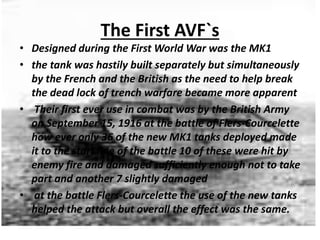
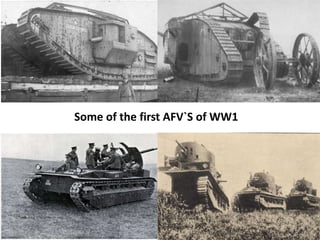
• Designed during the First World War was the MK1
• the tank was hastily built separately but simultaneously
by the French and the British as the need to help break
the dead lock of trench warfare became more apparent
• Their first ever use in combat was by the British Army
on September 15, 1916 at the battle of Flers-Courcelette
how ever only 36 of the new MK1 tanks deployed made
it to the start line of the battle 10 of these were hit by
enemy fire and damaged sufficiently enough not to take
part and another 7 slightly damaged
• at the battle Flers-Courcelette the use of the new tanks
helped the attack but overall the effect was the same.
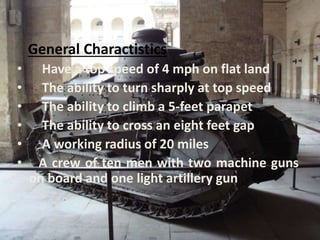
General Charactistics
• Have a top speed of 4 mph on flat land
• The ability to turn sharply at top speed
• The ability to climb a 5-feet parapet
• The ability to cross an eight feet gap
• A working radius of 20 miles
• A crew of ten men with two machine guns
on board and one light artillery gun
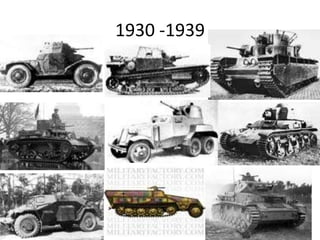
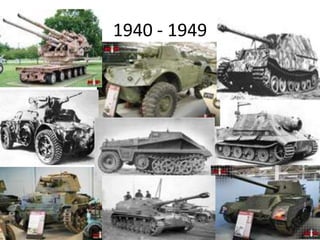
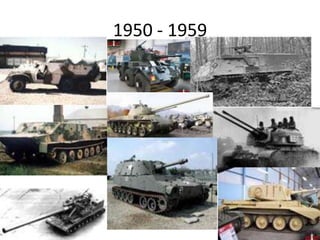
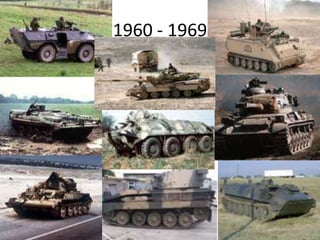
Evolution of AFV
Through The Years
Some of the first AFV`S of WW1
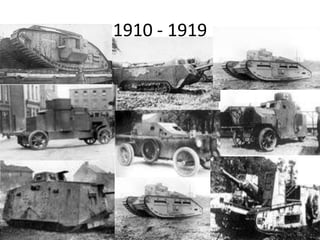
1910 - 1919
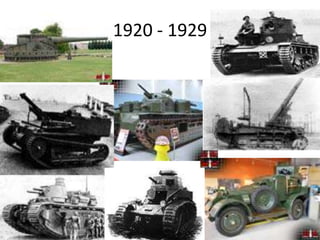
1920 - 1929
1930 -1939
1940 - 1949
1950 - 1959
1960 - 1969
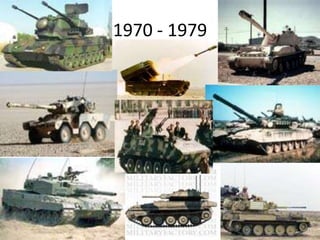
1970 - 1979
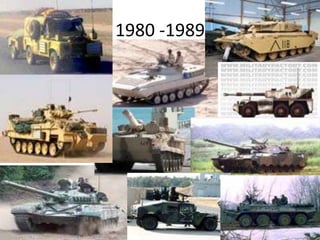
1980 -1989
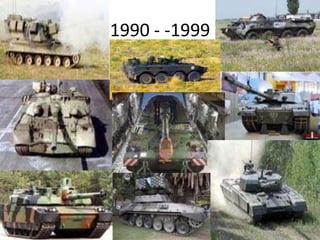
1990 - -1999
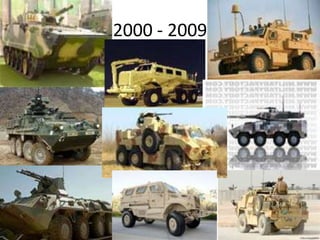
2000 - 2009
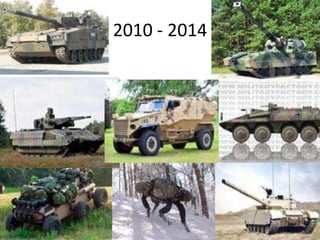
2010 - 2014
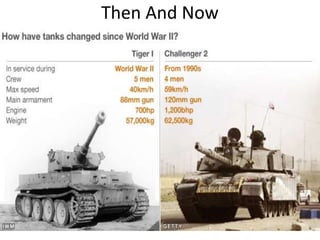
Then And Now
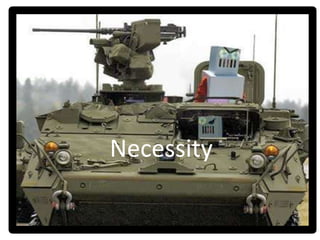
Necessity
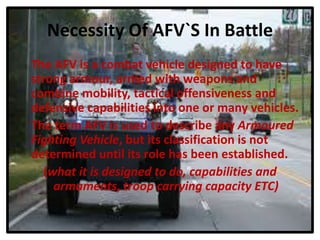
Necessity Of AFV`S In Battle
The AFV is a combat vehicle designed to have
strong armour, armed with weapons and
combine mobility, tactical offensiveness and
defensive capabilities into one or many vehicles.
The term AFV is used to describe any Armoured
Fighting Vehicle, but its classification is not
determined until its role has been established.
(what it is designed to do, capabilities and
armaments, troop carrying capacity ETC)
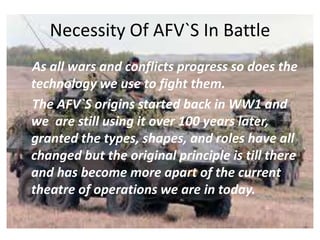
Necessity Of AFV`S In Battle
As all wars and conflicts progress so does the
technology we use to fight them.
The AFV`S origins started back in WW1 and
we are still using it over 100 years later,
granted the types, shapes, and roles have all
changed but the original principle is till there
and has become more apart of the current
theatre of operations we are in today.
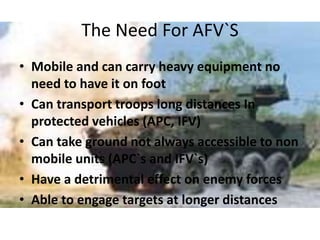
The Need For AFV`S
• Mobile and can carry heavy equipment no
need to have it on foot
• Can transport troops long distances In
protected vehicles (APC, IFV)
• Can take ground not always accessible to non
mobile units (APC`s and IFV`s)
• Have a detrimental effect on enemy forces
• Able to engage targets at longer distances
Deployments
Falkland's
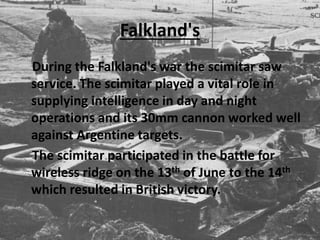
During the Falkland's war the scimitar saw
service. The scimitar played a vital role in
supplying intelligence in day and night
operations and its 30mm cannon worked well
against Argentine targets.
The scimitar participated in the battle for
wireless ridge on the 13th of June to the 14th
which resulted in British victory.
Iraq
Gulf war 1 + 2
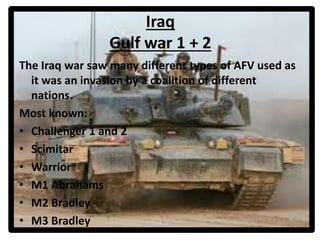
The Iraq war saw many different types of AFV used as
it was an invasion by a coalition of different
nations.
Most known:
• Challenger 1 and 2
• Scimitar
• Warrior
• M1 Abrahams
• M2 Bradley
• M3 Bradley
Afghanistan
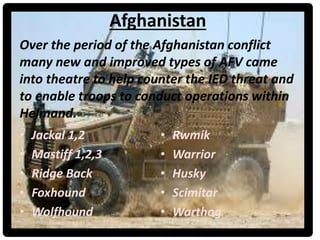
• Jackal 1,2
• Mastiff 1,2,3
• Ridge Back
• Foxhound
• Wolfhound
• Rwmik
• Warrior
• Husky
• Scimitar
• Warthog
Over the period of the Afghanistan conflict
many new and improved types of AFV came
into theatre to help counter the IED threat and
to enable troops to conduct operations within
Helmand.
Notable Wars And Conflicts
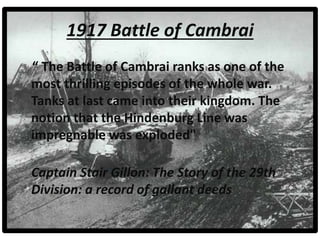
“ The Battle of Cambrai ranks as one of the
most thrilling episodes of the whole war.
Tanks at last came into their kingdom. The
notion that the Hindenburg Line was
impregnable was exploded"
Captain Stair Gillon: The Story of the 29th
Division: a record of gallant deeds
1917 Battle of Cambrai
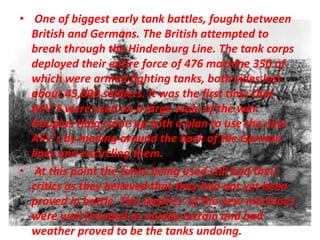
• One of biggest early tank battles, fought between
British and Germans. The British attempted to
break through the Hindenburg Line. The tank corps
deployed their entire force of 476 machine 350 of
which were armed fighting tanks, both sides lost
about 45,000 soldiers. It was the first time that
AFV`S were used on a large scale of the war.
Douglas Haig came up with a plan to use the new
AFV`s by moving around the back of the German
lines and encircling them.
• At this point the tanks being used still had their
critics as they believed that they had not yet been
proved in battle. The skeptics' of the new machines
were well founded as muddy terrain and bad
weather proved to be the tanks undoing.
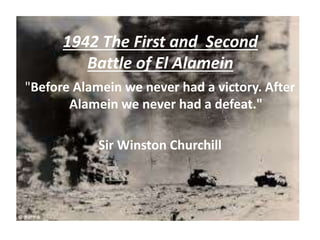
"Before Alamein we never had a victory. After
Alamein we never had a defeat."
Sir Winston Churchill
1942 The First and Second
Battle of El Alamein
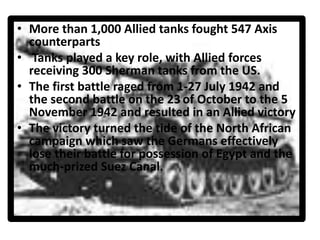
• More than 1,000 Allied tanks fought 547 Axis
counterparts
• Tanks played a key role, with Allied forces
receiving 300 Sherman tanks from the US.
• The first battle raged from 1-27 July 1942 and
the second battle on the 23 of October to the 5
November 1942 and resulted in an Allied victory
• The victory turned the tide of the North African
campaign which saw the Germans effectively
lose their battle for possession of Egypt and the
much-prized Suez Canal.
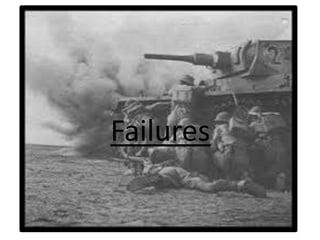
Failures
The first battle of El Alamein (1-27 July 1942) was fought on the northern
coast of Egypt between the German axis forces and the allied forces. The
battle which was a stale halted a second advance by the axis forces how
ever they were only 106km away in El Alamein they still had control of
the Sues Canal this was to dangerously close for the allies to allow, a
second battle would have to be fought.
On the 26/27 July general Auchinleck launched operation MANHOOD in
the north as a final attempt to break the axis forces. The axis forces were
expecting the attack.
This was a hurried and poorly planned attack .
reports from the battle front regarding mine field gaps were confused and
conflicting as a result of this the 2ND armoured brigade was delayed which
left the initial attackers exposed when the daylight hours came.
Under general Rommel the axis forces launched an immediate counter
attack and over ran the two forward battalions of the 69th brigade.
The 8th army was exhausted and on the 31st July Auchinleck ordered an
end to offensive operations and a strength of defensive measures to
meet a major counter offensive of the axis forces.
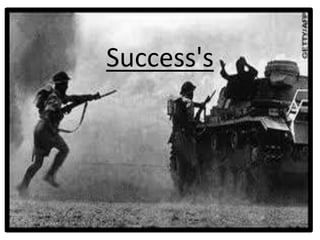
Success's
Auchinleck was replaced by LT General Montgomery, his plan was to use light
infantry to advance across the minefields (Operation Lightfoot) which would
allow engineers to open up to routes for armoured vehicles to get through.
Once though the armoured units would reform whilst the infantry defeated
the initial axis defences.
On the night of October 23 1942 “Monty's” plan began he started with a five
hour bombardment of the axis forces whilst behind this the engineers
cleared the land mines by 2.00am the armoured advance began however
progress was slow as traffic jams developed. Though their advance was
bogged down the British forces defeated these assaults and the first major
tan k battle of the assault was fought. Having made a gap of six miles wide
“Monty” began to push more forces through into the offensive.
At this point Rommel's army was stretched with only three days of fuel
remaining. Even after moving fuel reserves up from the south Rommel found
that he even lacked the fuel to withdraw.
On the 4th of November “Monty” launched his final assaults with the 1st, 7th
and 10th armoured divisions clearing the axis lines. After the battle of El
Alamein Rommel's armoured units effectively ceased to exist and the battle
was won.
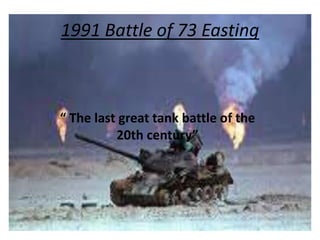
1991 Battle of 73 Easting
“ The last great tank battle of the
20th century”
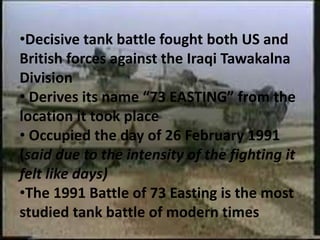
•Decisive tank battle fought both US and
British forces against the Iraqi Tawakalna
Division
• Derives its name “73 EASTING” from the
location it took place
• Occupied the day of 26 February 1991
(said due to the intensity of the fighting it
felt like days)
•The 1991 Battle of 73 Easting is the most
studied tank battle of modern times
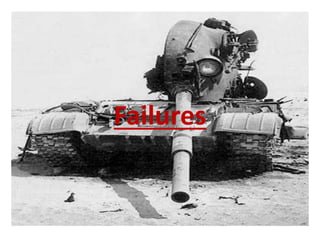
Failures
Even though the Iraqi`s out numbered the
Coalition forces in number of Armoured
Fighting Vehicles they did not have the same
level of new technology equipped to
successfully combat the invading US and UK
forces.
As a result of this the fighting was fairly one
sided with extremely limited mobility kills from
the Iraqi forces on coalition forces.
How ever despite this British and American
forces suffered more casualties from friendly
fire (BLUE ON BLUE) than enemy actions in
armoured vehicles alone.
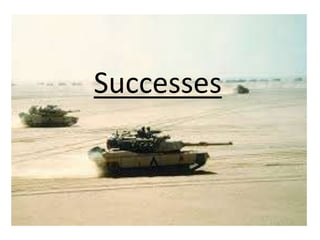
Successes
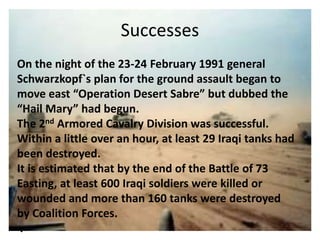
Successes
On the night of the 23-24 February 1991 general
Schwarzkopf`s plan for the ground assault began to
move east “Operation Desert Sabre” but dubbed the
“Hail Mary” had begun.
The 2nd Armored Cavalry Division was successful.
Within a little over an hour, at least 29 Iraqi tanks had
been destroyed.
It is estimated that by the end of the Battle of 73
Easting, at least 600 Iraqi soldiers were killed or
wounded and more than 160 tanks were destroyed
by Coalition Forces.
.
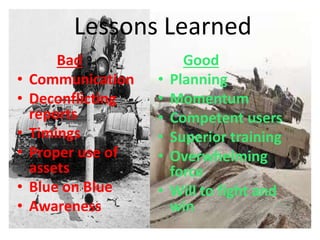
Lessons Learned
Bad
• Communication
• Deconflicting
reports
• Timings
• Proper use of
assets
• Blue on Blue
• Awareness
Good
• Planning
• Momentum
• Competent users
• Superior training
• Overwhelming
force
• Will to fight and
win
"Those Brits are a strange old race, they show
affection by abusing each other, will think
nothing of casually stopping in the middle of a
fire fight for there "brew up" and eat food
that I wouldn't give to a dying dog! but fuck
me, I would rather have one British squaddie
on side than a entire battalion of spetznaz!!!...
Why? Because the British are the only people
in the world who when the chips are down
and there seems like no hope left, instead of
getting sentimental or hysterical, will strap on
there pack, charge there rifle, light up a smoke
and calmly and wryly grin "well are we going
then you wanker??"
Today
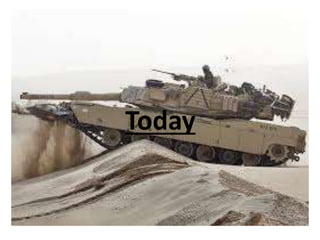
The nature of the Armoured Fighting
Vehicle today has come a long way form
its humble origins in WW1 to today in
conflicts like Iraq And Afghanistan. It
finds it self in more and more demand
in current military operations world
wide and has been said to be an in
valued asset for troops on the ground
and commanders alike.
Future
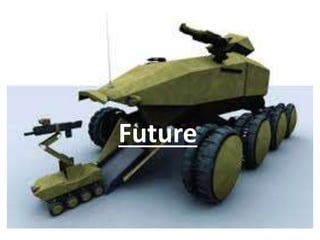
As with anything give it enough time a new types of
AVF will emerge.
Some may very possibly not require a crew and
operate completely independently as an a
unmanned vehicle (like a drone) there fore
decreasing the risk to human life on the
battlefield.
Some could potentially not use kinetic weaponry
systems but use electronic systems to disable
targets.
The future for the AFV is wide open and possibly
limitless depending on its need in conflicts in the
future
Evolution of Armoured Fighting Vehicles 1

Evolution of Armoured Fighting Vehicles 1

  • 1.
    Evolution of ArmouredFighting Vehicles Presented by RGR Kavanagh JAVELIN PLT
  • 2.
    CONTENTS • The FirstAFV`S • Through The Years • Necessity • Deployments • Notable Wars and Conflicts • Today • Future
  • 3.
    The First AVF`s •Designed during the First World War was the MK1 • the tank was hastily built separately but simultaneously by the French and the British as the need to help break the dead lock of trench warfare became more apparent • Their first ever use in combat was by the British Army on September 15, 1916 at the battle of Flers-Courcelette how ever only 36 of the new MK1 tanks deployed made it to the start line of the battle 10 of these were hit by enemy fire and damaged sufficiently enough not to take part and another 7 slightly damaged • at the battle Flers-Courcelette the use of the new tanks helped the attack but overall the effect was the same.
  • 4.
    General Charactistics • Havea top speed of 4 mph on flat land • The ability to turn sharply at top speed • The ability to climb a 5-feet parapet • The ability to cross an eight feet gap • A working radius of 20 miles • A crew of ten men with two machine guns on board and one light artillery gun
  • 5.
  • 6.
    Some of thefirst AFV`S of WW1
  • 7.
  • 8.
  • 9.
  • 10.
  • 11.
  • 12.
  • 13.
  • 14.
  • 15.
  • 16.
  • 17.
  • 18.
  • 20.
  • 21.
    Necessity Of AFV`SIn Battle The AFV is a combat vehicle designed to have strong armour, armed with weapons and combine mobility, tactical offensiveness and defensive capabilities into one or many vehicles. The term AFV is used to describe any Armoured Fighting Vehicle, but its classification is not determined until its role has been established. (what it is designed to do, capabilities and armaments, troop carrying capacity ETC)
  • 22.
    Necessity Of AFV`SIn Battle As all wars and conflicts progress so does the technology we use to fight them. The AFV`S origins started back in WW1 and we are still using it over 100 years later, granted the types, shapes, and roles have all changed but the original principle is till there and has become more apart of the current theatre of operations we are in today.
  • 23.
    The Need ForAFV`S • Mobile and can carry heavy equipment no need to have it on foot • Can transport troops long distances In protected vehicles (APC, IFV) • Can take ground not always accessible to non mobile units (APC`s and IFV`s) • Have a detrimental effect on enemy forces • Able to engage targets at longer distances
  • 24.
  • 25.
    Falkland's During the Falkland'swar the scimitar saw service. The scimitar played a vital role in supplying intelligence in day and night operations and its 30mm cannon worked well against Argentine targets. The scimitar participated in the battle for wireless ridge on the 13th of June to the 14th which resulted in British victory.
  • 26.
    Iraq Gulf war 1+ 2 The Iraq war saw many different types of AFV used as it was an invasion by a coalition of different nations. Most known: • Challenger 1 and 2 • Scimitar • Warrior • M1 Abrahams • M2 Bradley • M3 Bradley
  • 27.
    Afghanistan • Jackal 1,2 •Mastiff 1,2,3 • Ridge Back • Foxhound • Wolfhound • Rwmik • Warrior • Husky • Scimitar • Warthog Over the period of the Afghanistan conflict many new and improved types of AFV came into theatre to help counter the IED threat and to enable troops to conduct operations within Helmand.
  • 28.
  • 29.
    “ The Battleof Cambrai ranks as one of the most thrilling episodes of the whole war. Tanks at last came into their kingdom. The notion that the Hindenburg Line was impregnable was exploded" Captain Stair Gillon: The Story of the 29th Division: a record of gallant deeds 1917 Battle of Cambrai
  • 30.
    • One ofbiggest early tank battles, fought between British and Germans. The British attempted to break through the Hindenburg Line. The tank corps deployed their entire force of 476 machine 350 of which were armed fighting tanks, both sides lost about 45,000 soldiers. It was the first time that AFV`S were used on a large scale of the war. Douglas Haig came up with a plan to use the new AFV`s by moving around the back of the German lines and encircling them. • At this point the tanks being used still had their critics as they believed that they had not yet been proved in battle. The skeptics' of the new machines were well founded as muddy terrain and bad weather proved to be the tanks undoing.
  • 31.
    "Before Alamein wenever had a victory. After Alamein we never had a defeat." Sir Winston Churchill 1942 The First and Second Battle of El Alamein
  • 32.
    • More than1,000 Allied tanks fought 547 Axis counterparts • Tanks played a key role, with Allied forces receiving 300 Sherman tanks from the US. • The first battle raged from 1-27 July 1942 and the second battle on the 23 of October to the 5 November 1942 and resulted in an Allied victory • The victory turned the tide of the North African campaign which saw the Germans effectively lose their battle for possession of Egypt and the much-prized Suez Canal.
  • 33.
  • 34.
    The first battleof El Alamein (1-27 July 1942) was fought on the northern coast of Egypt between the German axis forces and the allied forces. The battle which was a stale halted a second advance by the axis forces how ever they were only 106km away in El Alamein they still had control of the Sues Canal this was to dangerously close for the allies to allow, a second battle would have to be fought. On the 26/27 July general Auchinleck launched operation MANHOOD in the north as a final attempt to break the axis forces. The axis forces were expecting the attack. This was a hurried and poorly planned attack . reports from the battle front regarding mine field gaps were confused and conflicting as a result of this the 2ND armoured brigade was delayed which left the initial attackers exposed when the daylight hours came. Under general Rommel the axis forces launched an immediate counter attack and over ran the two forward battalions of the 69th brigade. The 8th army was exhausted and on the 31st July Auchinleck ordered an end to offensive operations and a strength of defensive measures to meet a major counter offensive of the axis forces.
  • 35.
  • 36.
    Auchinleck was replacedby LT General Montgomery, his plan was to use light infantry to advance across the minefields (Operation Lightfoot) which would allow engineers to open up to routes for armoured vehicles to get through. Once though the armoured units would reform whilst the infantry defeated the initial axis defences. On the night of October 23 1942 “Monty's” plan began he started with a five hour bombardment of the axis forces whilst behind this the engineers cleared the land mines by 2.00am the armoured advance began however progress was slow as traffic jams developed. Though their advance was bogged down the British forces defeated these assaults and the first major tan k battle of the assault was fought. Having made a gap of six miles wide “Monty” began to push more forces through into the offensive. At this point Rommel's army was stretched with only three days of fuel remaining. Even after moving fuel reserves up from the south Rommel found that he even lacked the fuel to withdraw. On the 4th of November “Monty” launched his final assaults with the 1st, 7th and 10th armoured divisions clearing the axis lines. After the battle of El Alamein Rommel's armoured units effectively ceased to exist and the battle was won.
  • 37.
    1991 Battle of73 Easting “ The last great tank battle of the 20th century”
  • 38.
    •Decisive tank battlefought both US and British forces against the Iraqi Tawakalna Division • Derives its name “73 EASTING” from the location it took place • Occupied the day of 26 February 1991 (said due to the intensity of the fighting it felt like days) •The 1991 Battle of 73 Easting is the most studied tank battle of modern times
  • 39.
  • 40.
    Even though theIraqi`s out numbered the Coalition forces in number of Armoured Fighting Vehicles they did not have the same level of new technology equipped to successfully combat the invading US and UK forces. As a result of this the fighting was fairly one sided with extremely limited mobility kills from the Iraqi forces on coalition forces. How ever despite this British and American forces suffered more casualties from friendly fire (BLUE ON BLUE) than enemy actions in armoured vehicles alone.
  • 41.
  • 42.
    Successes On the nightof the 23-24 February 1991 general Schwarzkopf`s plan for the ground assault began to move east “Operation Desert Sabre” but dubbed the “Hail Mary” had begun. The 2nd Armored Cavalry Division was successful. Within a little over an hour, at least 29 Iraqi tanks had been destroyed. It is estimated that by the end of the Battle of 73 Easting, at least 600 Iraqi soldiers were killed or wounded and more than 160 tanks were destroyed by Coalition Forces. .
  • 43.
    Lessons Learned Bad • Communication •Deconflicting reports • Timings • Proper use of assets • Blue on Blue • Awareness Good • Planning • Momentum • Competent users • Superior training • Overwhelming force • Will to fight and win
  • 44.
    "Those Brits area strange old race, they show affection by abusing each other, will think nothing of casually stopping in the middle of a fire fight for there "brew up" and eat food that I wouldn't give to a dying dog! but fuck me, I would rather have one British squaddie on side than a entire battalion of spetznaz!!!... Why? Because the British are the only people in the world who when the chips are down and there seems like no hope left, instead of getting sentimental or hysterical, will strap on there pack, charge there rifle, light up a smoke and calmly and wryly grin "well are we going then you wanker??"
  • 46.
  • 47.
    The nature ofthe Armoured Fighting Vehicle today has come a long way form its humble origins in WW1 to today in conflicts like Iraq And Afghanistan. It finds it self in more and more demand in current military operations world wide and has been said to be an in valued asset for troops on the ground and commanders alike.
  • 48.
  • 49.
    As with anythinggive it enough time a new types of AVF will emerge. Some may very possibly not require a crew and operate completely independently as an a unmanned vehicle (like a drone) there fore decreasing the risk to human life on the battlefield. Some could potentially not use kinetic weaponry systems but use electronic systems to disable targets. The future for the AFV is wide open and possibly limitless depending on its need in conflicts in the future

Editor's Notes