“So then,
       just as you received Christ Jesus as Lord,
          continue to live your lives in him,
   7 rooted and built up in him,

     strengthened in the faith as you were taught,
              and overflowing with thankfulness.”
                                         Colossians 2:6
Colossians 1:1-14
• Introduction
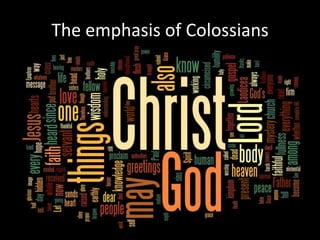
The emphasis of Colossians
Colossians 1:1-14
• Introduction
  – Place
  – People
  – History of church
  – Occasion
  – Purpose
Colossians 1:1-14
• Introduction
  – Place
  – People
  – History of church
  – Occasion
  – Purpose


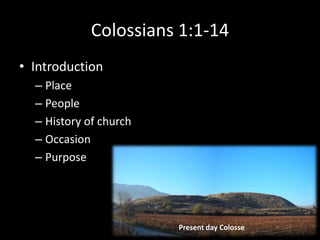
                        Present day Colosse
Colossians 1:1-14
• Introduction
  – Place
  – People
  – History of church
  – Occasion
  – Purpose


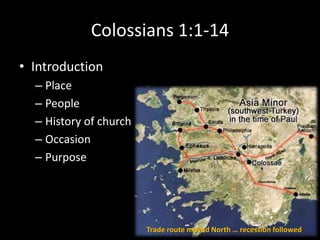
                        Trade route moved North … recession followed
Colossians 1:1-14
• Introduction
• Greetings, v. 1-2
“Paul, an apostle of Christ Jesus by the will of
God, and Timothy our brother,
2 To God’s holy people in Colossae, the faithful

brothers and sisters in Christ:
Grace and peace to you from God our Father.”
Colossians 1:1-14
• Introduction
• Greetings, v. 1-2
• What Paul appreciates about them, vv. 3-8
Colossians 1:1-14
• Introduction
• Greetings, v. 1-2
• What Paul appreciates about them, vv. 3-8
“We always thank God, the Father of our Lord Jesus Christ, when we pray
for you, 4 because we have heard of
your faith in Christ Jesus and of
the love you have for all God’s people – 5 the faith and love that spring from
the hope stored up for you in heaven and
about which you have already heard in the true message of the gospel 6 that
has come to you.
In the same way, the gospel is bearing fruit and growing throughout the whole
world – just as it has been doing among you since the day you heard it and truly
understood God’s grace.
7 You learned it from Epaphras, our dear fellow servant, who is a faithful
minister of Christ on our behalf, 8 and who also told us of your love in the Spirit.
Colossians 1:1-14
• Introduction
• Greetings, v. 1-2
• What Paul appreciates about them, vv. 3-8
   – Understood God’s grace
Colossians 1:1-14
• Introduction
• Greetings, v. 1-2
• What Paul appreciates about them, vv. 3-8
   – Understood God’s grace
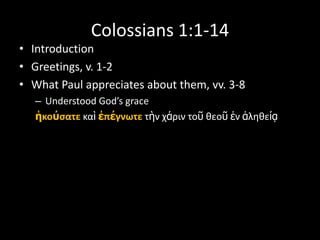
   ἠκούσατε καὶ ἐπέγνωτε τὴν χάριν τοῦ θεοῦ ἐν ἀληθείᾳ
Colossians 1:1-14
• Introduction
• Greetings, v. 1-2
• What Paul appreciates about them, vv. 3-8
   – Understood God’s grace
   – Fruit “All over the world this gospel is bearing fruit and
     growing, just as it has been doing among you since the day
     you heard it and understood God's grace in all its truth.”
Colossians 1:1-14
• Introduction
• Greetings, v. 1-2
• What Paul appreciates about them, vv. 3-8
   – Understood God’s grace
   – Fruit
   – Faith
Colossians 1:1-14
• Introduction
• Greetings, v. 1-2
• What Paul appreciates about them, vv. 3-8
   –   Understood God’s grace
   –   Fruit
   –   Faith
   –   Hope
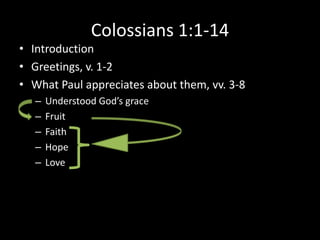
Colossians 1:1-14
• Introduction
• Greetings, v. 1-2
• What Paul appreciates about them, vv. 3-8
   –   Understood God’s grace
   –   Fruit
   –   Faith
   –   Hope
   –   Love
Colossians 1:1-14
•   Introduction
•   Greetings, v. 1-2
•   What Paul appreciates about them, vv. 3-8
•   What Paul prays for them, vv. 9-14
Paul’s Prayer, vv. 9-14
“For this reason, since the day we heard about you, we have not
stopped praying for you.
We continually ask God to
fill you with the knowledge of his will through all the wisdom and
understanding that the Spirit gives, 10
so that you may live a life worthy of the Lord and
please him in every way:
bearing fruit in every good work,
growing in the knowledge of God,
11 being strengthened with all power according to his glorious might

so that you may have great endurance and patience, 12 and
giving joyful thanks to the Father, who has qualified you to share in
the inheritance of his holy people in the kingdom of light.
13 For he has rescued us from the dominion of darkness and brought us
into the kingdom of the Son he loves, 14 in whom we have redemption,
the forgiveness of sins.”
Colossians 1:1-14
•   Introduction
•   Greetings, v. 1-2
•   What Paul appreciates about them, vv. 3-8
•   What Paul prays for them, vv. 9-14
•   Conclusion
Colossians 1:1-14

Colossians 1 vv 1 8

  • 1.
    “So then, just as you received Christ Jesus as Lord, continue to live your lives in him, 7 rooted and built up in him, strengthened in the faith as you were taught, and overflowing with thankfulness.” Colossians 2:6
  • 2.
  • 3.
    The emphasis ofColossians
  • 4.
    Colossians 1:1-14 • Introduction – Place – People – History of church – Occasion – Purpose
  • 5.
    Colossians 1:1-14 • Introduction – Place – People – History of church – Occasion – Purpose Present day Colosse
  • 6.
    Colossians 1:1-14 • Introduction – Place – People – History of church – Occasion – Purpose Trade route moved North … recession followed
  • 7.
    Colossians 1:1-14 • Introduction •Greetings, v. 1-2 “Paul, an apostle of Christ Jesus by the will of God, and Timothy our brother, 2 To God’s holy people in Colossae, the faithful brothers and sisters in Christ: Grace and peace to you from God our Father.”
  • 8.
    Colossians 1:1-14 • Introduction •Greetings, v. 1-2 • What Paul appreciates about them, vv. 3-8
  • 9.
    Colossians 1:1-14 • Introduction •Greetings, v. 1-2 • What Paul appreciates about them, vv. 3-8 “We always thank God, the Father of our Lord Jesus Christ, when we pray for you, 4 because we have heard of your faith in Christ Jesus and of the love you have for all God’s people – 5 the faith and love that spring from the hope stored up for you in heaven and about which you have already heard in the true message of the gospel 6 that has come to you. In the same way, the gospel is bearing fruit and growing throughout the whole world – just as it has been doing among you since the day you heard it and truly understood God’s grace. 7 You learned it from Epaphras, our dear fellow servant, who is a faithful minister of Christ on our behalf, 8 and who also told us of your love in the Spirit.
  • 10.
    Colossians 1:1-14 • Introduction •Greetings, v. 1-2 • What Paul appreciates about them, vv. 3-8 – Understood God’s grace
  • 11.
    Colossians 1:1-14 • Introduction •Greetings, v. 1-2 • What Paul appreciates about them, vv. 3-8 – Understood God’s grace ἠκούσατε καὶ ἐπέγνωτε τὴν χάριν τοῦ θεοῦ ἐν ἀληθείᾳ
  • 12.
    Colossians 1:1-14 • Introduction •Greetings, v. 1-2 • What Paul appreciates about them, vv. 3-8 – Understood God’s grace – Fruit “All over the world this gospel is bearing fruit and growing, just as it has been doing among you since the day you heard it and understood God's grace in all its truth.”
  • 13.
    Colossians 1:1-14 • Introduction •Greetings, v. 1-2 • What Paul appreciates about them, vv. 3-8 – Understood God’s grace – Fruit – Faith
  • 14.
    Colossians 1:1-14 • Introduction •Greetings, v. 1-2 • What Paul appreciates about them, vv. 3-8 – Understood God’s grace – Fruit – Faith – Hope
  • 15.
    Colossians 1:1-14 • Introduction •Greetings, v. 1-2 • What Paul appreciates about them, vv. 3-8 – Understood God’s grace – Fruit – Faith – Hope – Love
  • 16.
    Colossians 1:1-14 • Introduction • Greetings, v. 1-2 • What Paul appreciates about them, vv. 3-8 • What Paul prays for them, vv. 9-14
  • 17.
    Paul’s Prayer, vv.9-14 “For this reason, since the day we heard about you, we have not stopped praying for you. We continually ask God to fill you with the knowledge of his will through all the wisdom and understanding that the Spirit gives, 10 so that you may live a life worthy of the Lord and please him in every way: bearing fruit in every good work, growing in the knowledge of God, 11 being strengthened with all power according to his glorious might so that you may have great endurance and patience, 12 and giving joyful thanks to the Father, who has qualified you to share in the inheritance of his holy people in the kingdom of light. 13 For he has rescued us from the dominion of darkness and brought us into the kingdom of the Son he loves, 14 in whom we have redemption, the forgiveness of sins.”
  • 18.
    Colossians 1:1-14 • Introduction • Greetings, v. 1-2 • What Paul appreciates about them, vv. 3-8 • What Paul prays for them, vv. 9-14 • Conclusion
  • 19.

Editor's Notes

  • #3 Here’s the opening section of a new letter from Paul … apparently written AD 60-61 during his imprisonment at Rome … to a church he did not know particularly well, and hadn’t started himself.We’ll fill in the background on that shortly because it might well be important for us.But the important thing here as we set out on a new series … before filling in times and place and dates from external sources … is to first of all let the book speak for itself and to overview its main points and emphases.What on earth ARE they?
  • #4 Christ … big Jewish minority community and ‘Christ’ the word for Messiah in Greek comes out much bigger than the Semitically derived name ‘Jesus’.The point about this church – with all of it’s failings – is that really, it’s all about Jesus, the appointed anointed … the One Who’s come from God to do the rescue job for humanity.He is God … over against the growing Gnosticism of their environment (that word ‘body’ is a bit relevant to Gnosticism too!)He is Lord … over against the ‘Lord’s and powers of the Greek mystery religions … which He overcame in His body on the Cross as we’ll see when we get to chapter 2.Notice how big that word ‘may’ is too.Paul stresses and re-stresses his PRAYERS for them.Things are not perfect for the Colossian church … they’re a mess, they’ve got issues with sin and ideology and all that.They are in trouble in the Lycus Valley.He is in prison in Rome.All Paul can do is PRAY for them … he certainly can’t go over to help!And their main man is away from them too … their messenger Epaphras … the person who had founded the church at Colossae … is there with Paul working hard, says Paul in 4:12, wrestling for them in prayer that they will stand firm in the faith.So what do we know about their difficult situation?
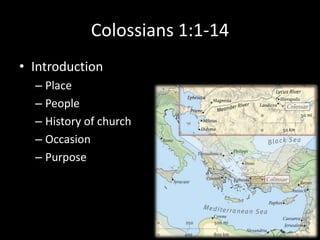
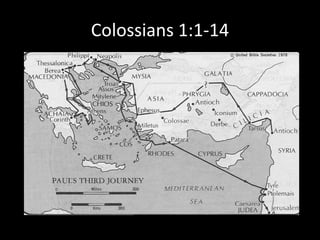
  • #5 Colossae or Colosse was an ancient city in the Lycus River valley, about 100 miles east of the great, cosmopolitan capital city of Ephesus, located in the Roman province of Asia, in present-day Turkey. Colossae was the smallest of three cities in the Lycus Valley -- along with Laodicea (12 miles west) and Hierapolis (15 miles northwest). Each of these cities had Christian churches (4:13-16).Though these cities were far from the big city, they weren't isolated, since they were situated near the great Persian Royal Road that ran from Ephesus and Sardis in the West to the Euphrates and on to Persia in the East.At one point in the fourth or third centuries BC, Colossae had been the most important of the three cities, known for its flourishing textile industry and high-quality dark red wool, known as "Colossian wool." But after the north-south road was moved west to pass through Laodicea, Colossae began to decline.Roman historian Tacitus mentions an earthquake that destroyed Laodicea in 60-61 AD.Laodicea was wealthy and got rebuilt quickly. We don't know how long it took to rebuild Colossae. Today, however, nothing remains of Colossae above ground. The tell (acropolis or mound) of the city has not been excavated, though the contour of an outdoor amphitheater is discernable on the site.It’s a definite ‘has been’ sort of place.
  • #6 The Peoples of ColossaeSo – you can see that calamity eventually befell the entire place, let alone the church that is being tried and tested at this point in time as Paul writes.The population of Colossae was probably quite diverse -- especially in light of the nearby highway. We know that Antiochus III had settled about 2,000 Jewish families in the general area in 213 BC.The area still had a strong Jewish minority presence in Paul's day, a fact which probably relates directly to Paul's letter.
  • #7 Proximity to the nearby highways ensured that the Colossians were exposed to the latest ideas, which then mixed together with other ideas. Thus the Christian church was subject to syncretism with other religious movements.Colossians is apparently written primarily to Gentile Christians. We observe:Paul's description of their conversion in terms more appropriate to Gentiles, rather than to Jews (1:12, 21)He mentions the mystery revealed "among the Gentiles"(1:27)The sins mentioned are more typical of Gentiles, than of Jews (3:5)He includes neither Old Testament quotations nor any explicit reference to the law.Though he writes primarily to Gentile Christians, the heresy that Paul was fighting seems to have Jewish roots.They are people who come with a past … and that past is coming right back to bite them!History of the ChurchPaul didn't found the church at Colossae -- directly. Rather, it was founded by Epaphras, whom Paul mentions in this letter (1:7-8; 4:12-13). Paul had been preaching in the "big city" of Ephesus, about 100 miles west of Colossae from 53 to 55 AD. His ministry was quite effective, first in the synagogue and later in the rented lecture hall of Tyrannus."This went on for two years, so that all the Jews and Greeks who lived in the province of Asia heard the word of the Lord." Acts 19:10)Paul didn't travel through the province of Asia, but people came to him to learn about Jesus, and then took the message of the gospel to their own hometowns. Epaphras was undoubtedly one of these. Occasion of the LetterPaul is in prison "for the sake of the gospel"(4:3, 10), probably in Rome. Epaphras, the pastor/ planter of the Colossian church, has come to Paul's place of imprisonment. In his letter to Philemon, Paul speaks of Epaphras as "my fellow prisoner in Christ Jesus" (Philemon 1:23).PerhapsEpaphras had come to consult with Paul about the heresy that was causing problems in the Colossian church, and ended up sitting in the slammer with Paul.So Paul writes a letter to the Colossians designed to expose and stop the heresy and to encourage the church in their new Christian faith. Since Epaphras can't return at this time, Paul sends the letter by the hand of his co-worker Tychicus (4:7-8).The particular heresy that Paul addresses in Colossae is difficult to pin down exactly. It has similarities -- and differences -- with doctrinal problems that Paul addresses in other churches.Just what is the "Colossian heresy"? As we read between the lines in 2:8-25 we can begin to discern its shape. The heresy seems to have had these elements:A belief system, called a "hollow and deceptive philosophy"(2:8).Tradition-based, "depends on human tradition"(2:8, 22).Elemental spiritual forces underlie the system (2:8).Not Christ-centered, the teaching doesn't "depend on ... Christ"(2:8).Food restrictions and Jewish "holy days" are involved (2:16).Ascetic disciplines are encouraged (2:18, 23).Angel worship is central (2:18).Visionary experiences are touted (2:18).Pride characterizes the proponents (2:18).Losing connection with Christ is the result (2:19).Rule-keeping is urged (2:20-23).Most scholars agree on these points. Three more possible points are less certain."Fullness" language (1:19; 2:9, 10) suggests that a "fullness" of spiritual experience couldn't be found in Christ alone. The vocabulary is found in both Gnosticism and Stoicism.Circumcision is advocated (2:11, 13; 3:11) -- perhaps.Christ is being denigrated -- perhaps -- though this may reflect Paul's cure more than the active teaching of his opponents.Who Are the False Teachers?The identity of the false teachers at Colossae has been widely debated. The major views tend to cluster around four explanations:Mystery religions have been argued by some as one of the sources of the heresy, but this is hard to pin down or prove.Gnosticism would assume a much later composition of this letter, since full-blown Gnosticism didn't mature until the mid-second century AD. It is possible, however, to see some incipient Gnostic elements in the false teachers' position.16Jewish mysticism was one of the strands of Judaism that was flourishing at the time. Bruce argues for a background of Jewish merkabah mysticism, which gave way to exercises designed to facilitate entry into the vision of the heavenly chariot (Hebrew merkābâ, of Ezekiel's vision of the wheel within the wheel, Ezekiel 1:15-26).17Wright sees Colossians as a warning against Judaism itself.18A mixture of teachings is most likely, I think. We would like to see a simple opponent, but movements are inevitably affected by the winds of thought swirling through the culture. Clinton Arnold argues for a syncretism or combination of Phrygian19folk belief, local folk Judaism, and Christianity.20We just don't have enough information to determine the exact identity of the Colossian heretics beyond the basic outlines. However, these teachers seem to represent an ascetic and mystical form of Jewish piety mixed with local folk belief, perhaps with Christian overtones, since Paul says that they weren't "holding fast to the Head"(2:19).Whoever they were, Paul's prescription is a focus on the sufficiency and supremacy of Christ as the antidote to being pulled away to a heresy that promised greater "fullness.”They’ve got loads of fancy ideas and philosophies, but what they really need is to get the Good News about Jesus.Purpose of the LetterColossians seems to have been written with two purposes in mind: To encourage and ground this relatively new Christian community, andTo protect them from the seduction of false teachers, probably from a variety of mystical Judaism, that tended to denigrate these Gentile Christians' faith in Christ in favor of the claims of Judaism.
  • #8 Paul addresses these people in a really weird way … ‘an apostle of Christ Jesus by the will of God’.What lies behind that?!Well, he’s going to be straight with them fairly shortly.There are things they’ve been exposed to as ideas come drifting through the place along the trade routes on that previous map, and the ideas that are ‘out there’ get ever so easily ‘in here’ (which is why US based Evangelicals on websites are questioning the uniqueness of Christ and the sufficiency of the closed canon of Scripture in response to the prospect of having a Mormon President shortly, and British Evangelicals are questioning Biblical orthodoxy over gay/ heterosexual marriage) …It’s no different at Colossae and Paul is going to need to teach things that will squeeze some people’s toes.And who IS he? … he didn’t even plant their church!Paul says: ‘I am an Apostle by the will of God’.His authority doesn’t arise because they like him, or they chose him, or even elected or employed him.His authority to speak plainly and lovingly to them on these matters where they are mistaken is not an authority THEY give him, but that God has.Paul speaks as a man sent by God.Now, on the one hand that means that Paul has NO authority of his own to speak of (because he owes it all to God).But on the other hand, rejecting the teaching of this God-called and appointed teacher of truth implies the rejection of the authority of God.And of course he has to tread carefully and wisely because he’s dealing with a people who are NOT Paul’s, but God’s!Holy … set apart.Faithful … brothers and sisters in Christ.Paul greets them in the name of their God … and on behalf of God, Paul speaks out and sends them grace and peace as their greeting (not from Paul, but) from God.Wow!If that’s where this is coming from, it’s going to be good!
  • #9 So where does this message from God start out?It starts with Paul explaining the things he appreciates about these wandering people who’ve sucked up uncritically the ideas their world walks along the trade route past their door.
  • #10 Now, the first thing to notice here is that Paul does not see this church as a problem … but a reason to thank God.He isn’t just praising the Colossians.I do see a lot of twittering and facebooking of flattering intent … congratulating and boosting Christian leaders’ egos.There are dangers inherent in this, and a good book on a Biblical understanding of flattery seems to me to be well overdue.Paul isn’t here just flattering the Colossians, but giving thanks to God for the work that God’s done in them (as we’ll see in a minute).Moreover, Paul emphasises here in ways that might not be SO plain in English that it isn’t just Paul who is doing this.That plural there ‘we’ is a genuine plural, there’s no epistolary ‘we’ going on here!Paul is writing on behalf of Timothy and others as well as himself … at least there’s a reference here to the fact that their beloved Epaphras, their local church planter but NOT an apostle as Paul and Timothy were, is tied up in the rejoicing as well!(4:12 spells out how much he is wrestling in prayer for them all of the time and makes reference to others there on the team too).Paul and his companions consider that Colossian church, struggling with its pressures and problems and wracked with distractions and the lot of them are agreed in their thankfulness to God for the church in that Lycas Valley backwater … and reassuringly the ‘when we pray for you’ is found to be in the same plural too.Why?Why are these guys giving thanks for that church?Fundamentally (and here’s the foundation on which the rest of it is built) because they have truly understood God’s grace, or ‘understood God's grace in all its truth.’The Colossian church has genuinely ‘got it’.
  • #11 Now, the church at Colossae is in many ways a bit of a vulnerable mess … under pressure, leaders suffering and persecuted because of their Christian faith, all sorts of appealing sounding, POPULAR ideas floating down the road past their door … near enough Christianity but more socially acceptable and popular.You can see what their tendency will be, can’t you?But the point about you guys there is this, says Paul, and this is the thing that will make the difference …The fundamental key to the formation of this great Christian character that Paul sees in the guys at Colossae lies here:They have UNDERSTOOD God’s grace.Not just heard it.Not just got a name for it.Not just embraced the terminology.These Colossians have genuinely both heard it and understood it.Now – let’s be clear … it’s frighteningly easy to grasp the concept intellectually, but not have grasped the grace of God that’s being described.
  • #12 There is no ‘Christian’ conduct in life without Hearing and understanding, God’s grace in all of its truth.So this raises the question straight away … what on EARTH is God’s grace in all its truth.The first thing to notice is that TRUTH MATTERS.Truth.Not negotiable and flexible hypothesis … absolute and empirical truth.It matters.And not in some of its carefully chosen aspects … ‘I love the idea of Heaven, but I don’t think it’s very Christian to believe in hell’ … ALL its truth.Heard and understood it in ALL OF ITS TRUTH.Why is Paul putting it like this?Because flowing along the roads that passed Colossian doors came the latest sophisticated relativistic ideas pouring out of the Greek philosophical schools in decline.The teaching that truth is personally selected from the supermarket of ideas, negotiated, flexible and moulded to taste is not new to the 21st century.It was encroaching also on the Colossians’ world of ideas.It was unliveable nonsense then, and it’s unliveable nonsense here now … but it was peddled in such sophisticated ways.And it appealed to the darker side of human nature then as it does to this day … but these guys had heard of the grace of God in all its truth and embraced THAT.There are people happy with ‘grace’ but not truth.They will not accept God’s definition of sin, His definition of their problem, but are happy to embrace His solution … so long as they can go on wallowing in sin as if it’s NOT sin.Guys … you can’t!Better things are true of these people at Colossae and Paul gives thanks to God loudly and publicly for it: it shows that they’d heard of God’s grace and UNDERSTOOD it …It’s not enough just to have HEARD of it, or to use the word even regularly and confidently.{Illustrate}Paul’s saying that he constantly gives thanks to God for them because they’ve heard it and understood it and he knows they have.It’s got past their ears.It’s got into their minds.So what have they understood?God’s GRACE … in all its truth.Now this is about old fashioned things that come out of the dangerous idea that there IS truth … things like the idea that because some things are right, then others are just wrong, and that there’s a God Who’s going to sort out the wrong ‘uns!This week in the news … lovers’ tiff down in Devon, he got violent and gouged two of her eyes out and the court gave him six years for life.I don’t know if that’s justice … but I know there’s a God Who’ll make sure that justice happens.Or five children killed yesterday in a house fire in England … two arrested – we don’t know the detail … but we the Bible says that God is a God of justice and truth.And these Colossians have heard and understood God’s grace in all of its truth.So if He says it’s truly sin … sin it is, and they turn from it back to their God!So they don’t just accept that they’re sinners … they KNOW it and they know the when and why.And what’s more, they don’t just ‘believe’ that Christ died for sins on the Cross, with an understanding of substitution and atonement … they grasp that He died there for them, He the worthy One giving it up for them the unworthy, and they see the implication that has for their life!I’ve got to say, there’s a really loose grip on this in what people around see as ‘churches’ … and it makes them horribly unreal and unconvincing at best …We’ve got to do better than that!How does Paul know that they’ve moved beyond a thin conception of the details of faith to having heard and UNDERSTOOD?HOW does he know they have heard and understood, and have ‘got’ the grace of their God?
  • #13 Because when you have actually (not just theoretically, intellectually, socially or tribally) accepted and understood God’s grace IN ALL ITS TRUTH … THEN you get two things happening … you get the Gospel bearing fruit and growing.And that’s consistent with the experience of God’s people everywhere, says Paul … Bearing fruit refers to the growth of good worksGrowing refers to the numerical growth of converts … and this is said to be happening in the experience of those who have understood the grace of God in all its truth all over the world of Paul’s day.So … failure to grow arises out of the failure of God’s people to actually grasp and understand the grace of God in all its truth?Well, OK … try hard now and you’ll definitely find yourself some wriggle room there …But Paul has surely GOT to be saying that where God’s people really get the grace of God and its implications and get to work on working the principles of the grace God has shown us right into their lives, kneading it in to their living the way the baker liberates the gluten by kneading the dough … then that bread is going to rise!This, Paul is saying, is the worldwide experience of the people of God.If you’ve really understood it …. heard and understood … it shapes your life and the lives around you as we all hear and understand more of the grace of God that bears fruit in human lives and GROWS.Now THERE’S something to be praying about!What is it Paul sees as fruit of understanding God’s grace … and appreciates and rejoices about?
  • #14 He’s seen their faith.Now, that’s not resignation … ‘oh well, we’ll just sit here and take what comes’It’s not fatalism … ‘ it’s going to happen anyway’It’s trusting God to do as He says, not trust to your own devices or wisdom, trust in the Lord with all your heart and lean not on your own understanding, but act on HIS, in all your ways to acknowledge Him … and rest on His directing your paths!Now of course the Colossians faith gets mentioned first because until you’ve entrusted your whole life (including your death!) into the hands of God you have not set out on the Christian life and you have not been put right with God … there’s nothing of Christianity until you’ve taken God at His Word and trusted your destiny to what Christ did on the Cross to keep you safe for ever.Faith is Peter in the boat on the Lake when Jesus told him to walk to the Lord on the water.Everything we know says this just can’t be done … except Jesus is standing on the water and telling you to get out there with Him.Peter … do you TRUST me against the evidence of what every schoolboy knows?Yes … there are things faith believes.But it grasps and believes them – against the flow of the stuff coming down the street by your door – because it trusts the One Who declares that it’s true.It’s faith IN CHRIST.And along with that faith Paul sees HOPE.
  • #15 Now here’s a tough one.It’s a tough one for us because we’re facing recession, diminishing asset values and crashing real earnings … and that’s when there’s any work to be had out there at all.So let me tell you what’s happening to Colossae.Believe it, Colossae was a town in recession.Imagine taking hold of the M4 and shifting it twenty miles north of Newport.What do you think would be the effect on the commerce and people of that city?You see, Colossae didn’t even have any docks or natural resources to keep the trade it relied on alive.And they moved the road along the trade route through the Lycus Valley away from Colossae and over to Laodicea.All of a sudden poor Colossae had nothing (but good drinking water – and their neighbours built an aqueduct to nick that too!) and stopped being a good place to be.The jobs went.The entrepreneurs upped and shifted.The young left in droves for better prospects elsewhere and the elderly got sad in their loneliness and desertion.Colossae suffered.Colossae languished.But the church that had grasped the grace of God in all its truth put their trust in God (faith) and fruited out in hope!O’Brien: “Hope is oriented to that which is unseen in the future, the content of which is defined in various ways …” (he lists salvation, righteousness, resurrection in an incorruptible body, eternal life, God’s glory) … the stuff, Paul says, that ALREADY LIES PREPARED for them in the heavens.Heaven … where no power, authority or cool, popular philosophy or comedian can TOUCH it.So Paul is keen to direct their thoughts (3:4) towards their confidently expected future … ‘set your minds on the things above, where Christ is seated at the right hand of God.’Hope grows on the hearing and understanding the grace of God in all its truth … and in their grim, recession hit world, they are people of hope.What else does Paul appreciate about them and thank God for?
  • #16 Their love.Well, now we can see that what we’ve got here is that well known triad of things that Paul depicts God growing on His faithful followers … faith hope and love, these three remain (he says in 1 Corinthians 13) but the greatest of these is love.O Brien: “ἀγάπη is ‘the practical expression of care and concern’ … which is directed to all of God’s holy people”That ALL is a bit overpowering, isn’t it?Christians generally, including that lot further out across the Lycas Valley at Laodicea whose fortunes were very different from their own, based on sucking up all the young people that’d come up through Sunday School and youth group at Colossae but were now off to the big city to work and supporting the ministry and the growth of the church over there.See, that’s the fruit of having grasped the idea that we are nothing and having nothing and deserve nothing but the justice of God coming down on our record of sin and rebellion, but have been treated graciously and lovingly by God.
  • #19 This all came about through Epaphras.How was that?
  • #20 On the first leg of the journey on this map Paul and his companions seemed to be wandering in a fairly confused way until they got down to the seaside at Troas and Paul had his vision of the Macedonian man calling to them to go over and preach the Gospel to them.So they took a ship to Neapolis and went straight down to Philippi where that first Sabbath Lydia was converted and a mission began which saw the slave girl converted and then the Philippian gaoler.In brief – after what happened in the gaol house - Paul and Silas ‘got off’ and after their release left the town, going down to Thessalonica, then Berea, then Athens, then Corinth.Things went VERY well in Corinth after they were thrown out of the synagogue and went next door to the house of Titius Justus … where Paul stayed teaching the Word of God for a year and a half.Then Apollos left and went to Corinth while Paul went down to Ephesus.Again he was thrown out of the Synagogue (after three months), then went next door to the lecture hall of Tyrannus … now get this:“This went on for two years, so that all the Jews and Greeks who lived in the province of Asia heard the word of the Lord.”This is clever … Paul never went near Colossae, Hierapolis or any of those places.He stayed in Ephesus preaching and teaching and the inhabitants of the Lycus Valley … flowing in and out of Ephesus … heard Paul preaching and teaching in the lecture hall of Tyrannus, were convinced, went home and (as Epaphras had done) set up the churches at Colossae and (we presume) Laodicea and Hierapolis and various points beyond in various homes and gathering places in their own towns.Their allegiance was to God and the Gospel and the team … so Epaphras was there with Paul in his Roman captivity, still working hard on behalf of the Colossian church but at Rome.There is a lesson there for us – to be learned – about how we set about ‘doing’ church!And there are lessons about what shaped up and filled out their lives.Hearing and understanding the truth of God’s Word.Gospel fruit growing and spreading … the fruit of faith, hope and love (love that’s for ALL of the brothers!)Here’s the picture of ‘church’ to aspire to.