Dr. Danish Sagheer
HISTORY
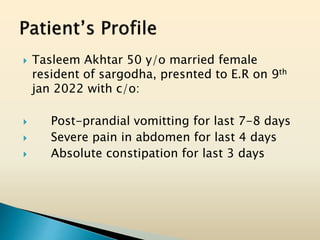
 Tasleem Akhtar 50 y/o married female
resident of sargodha, presnted to E.R on 9th
jan 2022 with c/o:
 Post-prandial vomitting for last 7-8 days
 Severe pain in abdomen for last 4 days
 Absolute constipation for last 3 days
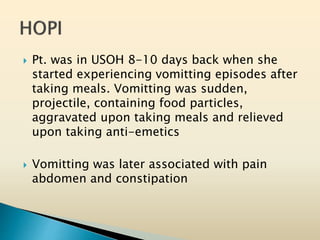
 Pt. was in USOH 8-10 days back when she
started experiencing vomitting episodes after
taking meals. Vomitting was sudden,
projectile, containing food particles,
aggravated upon taking meals and relieved
upon taking anti-emetics
 Vomitting was later associated with pain
abdomen and constipation
 Patient started experiencing generalized
abdominal pain 4 days back which started
from epigastric reigon and spread throughout
the abdomen.
 Pain was severe, colicky in nature, aggravated
upon taking meals and relieved upon
vomitting and on taking analgesics.
 Patient also complained of Obstipation for
last 3 days.
 She gave history of a similar episode of
Obstipation one week back which was
relieved by enema at a local hospital
 CVS: HTN -ve, IHD -ve
 RESP: Asthma -ve, COPD -ve, TB -ve
 CNS: CVA -ve , No other senile illnes
 RENAL: CKD -ve
 GIT: Hepatitis -ve, CLD -ve, NAFLD -ve
 Medical: Insignificant
 Surgical: Hx of Appendectomy 20 years ago
 Patient belong to a lower middle class family
 She lives in her own house having 6 rooms
with 12 people among which 2 are bread
earners
 Uses drinking water from a well and has no
pets
Allergies:
 No hx of any known allergies
 HTN, DM both parents
 No other hx of any familial disease
Personal history:
Normal sleep and appetite
No Addictions
 Upon GPE, a middle aged ladyof medium
hieght, moderately obese, lying in bed in
obvious discomcomfort, well oriented in time,
place and person
 Her vitals were
 B.P: 150/90, Pulse: 102/min
 Temp: 99F , R.R 16/min
 Jaundice –ve
 Anaemia –ve
 Cyanosis –ve
 Koilonychia –ve
 Palpable Lymph nodes –ve
 Edema -ve
 GIT:
Abdomen – Tender, Distended with sluggish
bowel sounds
Hernial orificies were normal
Upon DRE:
No impacted stool, hemmorhoids or fissure
seen. Normal mucosa
 CVS: S1+S2+0
 CNS: GCS: 15/15. No sensorimotor
neurological deficit
 RESP: Normal vesicular breathing. No added
sounds
Intestinal Obstruction??
CBC:
Hb: 14.7, TLC : 10700, PLT: 380000
LFTs:
Bilirubin: 0.9 , ALP: 234 U/L, ALT: 37U/L
RFTs and S/E:
Urea: 27, Creatinine: 0.7
Serum Na+ : 140, Serum K+: 3.9
 BSR : 94 mg/dl
 HbsAg: -ve
 Anti HCV: -ve
 HIV: -ve
>X-RAY Abdomen:
Multiple air fluids levels with dilated Gut
loops
 USG Abdomen:
Excessive gas shadows and Dilated gut loops
noted. Mild interloopal fluid was noted
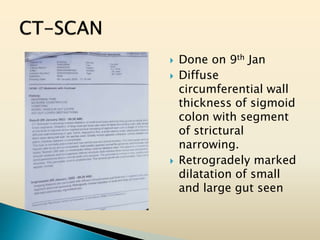
 Done on 9th Jan
 Diffuse
circumferential wall
thickness of sigmoid
colon with segment
of strictural
narrowing.
 Retrogradely marked
dilatation of small
and large gut seen
 Admit
 NPO
 NG Intubation
 Foley’s cathertization
 Inf. 5% D/W 1000ml B.D
 Inf. R/L 1000ml O.D
 Inj. Metronidazole 500mg/100ml i/v TDS
 Inj. Tramal+ Gravinate
 On 13th jan, her exploratory laparotomy was
performed. Her per-op findings were:
 An Omental band near ileocecal junction
 Sigmoid stricuture and a hard fixed mass
involving sigmoid colon
 Enlarged mesenteric lymph nodes
 Omental band was released
 Tumor identified and 8-10cm of sigmoid colon was
resected along with it and sample was sent for
histopathology
 Proximal end was brought out as end colostomy and
dital stump was closed using silk suture (Hartman’s
Procedure)
 1 pelvic drain was placed
 Haemostasis secured and patient was sent back to
ward
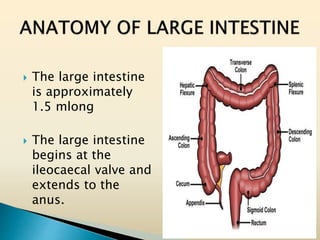
 The large intestine
is approximately
1.5 mlong
 The large intestine
begins at the
ileocaecal valve and
extends to the
anus.
Cancer effecting:
 Caecum
 Colon
 Rectum
 Anal canal and appendix are not considered
in the definition, and are treated as separate
entities
 Epidemiology
 Colorectal cancer is the second leading cause
of cancer-related deaths after lung cancer
 5-year survival rate : 55%.
 The most lethal GI malignant diseases in the
Western world.
 Is preventable and is highly curable if
detected early
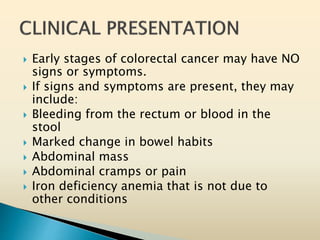
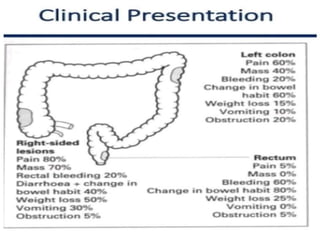
 Early stages of colorectal cancer may have NO
signs or symptoms.
 If signs and symptoms are present, they may
include:
 Bleeding from the rectum or blood in the
stool
 Marked change in bowel habits
 Abdominal mass
 Abdominal cramps or pain
 Iron deficiency anemia that is not due to
other conditions
Lab INVESTIGATIONS:
CBC,
RFTS,
LFTS,
BSR,
Serum electrolytes
Stool R/E
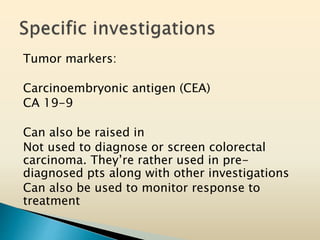
Tumor markers:
Carcinoembryonic antigen (CEA)
CA 19-9
Can also be raised in
Not used to diagnose or screen colorectal
carcinoma. They’re rather used in pre-
diagnosed pts along with other investigations
Can also be used to monitor response to
treatment
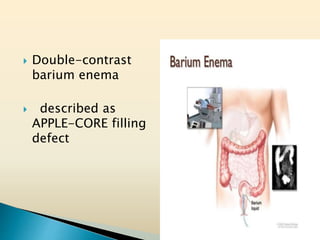
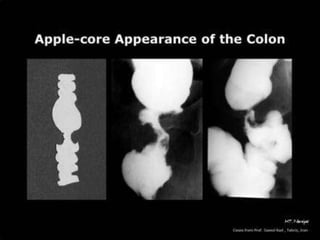
 Double-contrast
barium enema
 described as
APPLE-CORE filling
defect
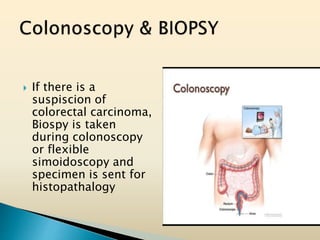
 If there is a
suspiscion of
colorectal carcinoma,
Biospy is taken
during colonoscopy
or flexible
simoidoscopy and
specimen is sent for
histopathalogy
 Chest X-ray: Mets in lungs
 Ultrasonography
 Contrast enhaced CT-Scan and MRI Scan
These investigations are helpful to identify
if tumor has spread into surrounding
structures and into distant abdominal visceras
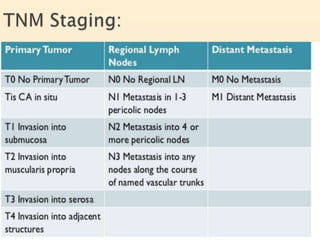
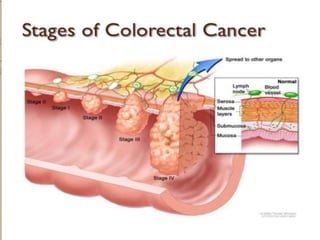
 Dukes’ staging for colorectal cancer
 ●● A: invasion of but not breaching the muscularis
propria
 ●● B: breaching the muscularis propria but not
involving lymph nodes
 ●● C: lymph nodes involved.
D: Distant mets
Surgery is mainstay treatment of both palliative
and curative management of ca colon
It is necessary that tumor and 2 cm tumor free
margins should be resected
Following are various types of resections
depending upon the location of tumor:
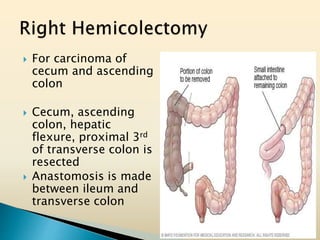
 For carcinoma of
cecum and ascending
colon
 Cecum, ascending
colon, hepatic
flexure, proximal 3rd
of transverse colon is
resected
 Anastomosis is made
between ileum and
transverse colon
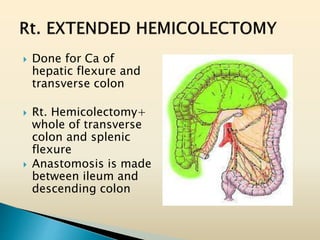
 Done for Ca of
hepatic flexure and
transverse colon
 Rt. Hemicolectomy+
whole of transverse
colon and splenic
flexure
 Anastomosis is made
between ileum and
descending colon
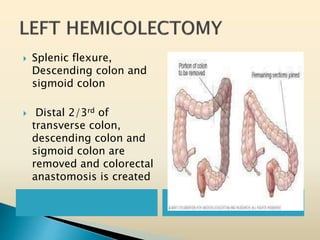
 Splenic flexure,
Descending colon and
sigmoid colon
 Distal 2/3rd of
transverse colon,
descending colon and
sigmoid colon are
removed and colorectal
anastomosis is created
 Tumor of upper 2/3rd is treated with Anterior
resection
 Tumor of distal 3rd is treated with
Abdominoperineal resection
 HARTMAN’S PROCEDURE: In this procedure
rectum is excised, distal stump is closed and
proximal stump is brought out as End
colostomy
 Advanced carcinoma of rectum which is fixed
and un-resectable is managed by palliative
procedures such as Colostomy to relieve the
obstruction and chemo/radiotherapy to
shrink the tumor
 Given in stage III and IV patients
 It has no survival benefits in stage 1 and II
 5-Fluorouracil in combination with Folinic
acid is most frequently used
 Neo adjuvant chemo is sometimes used in
non-operable cases to shrink the size of
tumor and make them operable
 Limited role in colorectal carcinoma
 Can be given pre-operatively or post op. to
reduce risk of local recurrence
Has also some role in combination therapy
with chemo as neo-adjuvant. Used to shrink
size of tumor preoperatively
Colorectal carcinoma

Colorectal carcinoma

  • 1.
  • 2.
  • 3.
     Tasleem Akhtar50 y/o married female resident of sargodha, presnted to E.R on 9th jan 2022 with c/o:  Post-prandial vomitting for last 7-8 days  Severe pain in abdomen for last 4 days  Absolute constipation for last 3 days
  • 4.
     Pt. wasin USOH 8-10 days back when she started experiencing vomitting episodes after taking meals. Vomitting was sudden, projectile, containing food particles, aggravated upon taking meals and relieved upon taking anti-emetics  Vomitting was later associated with pain abdomen and constipation
  • 5.
     Patient startedexperiencing generalized abdominal pain 4 days back which started from epigastric reigon and spread throughout the abdomen.  Pain was severe, colicky in nature, aggravated upon taking meals and relieved upon vomitting and on taking analgesics.
  • 6.
     Patient alsocomplained of Obstipation for last 3 days.  She gave history of a similar episode of Obstipation one week back which was relieved by enema at a local hospital
  • 7.
     CVS: HTN-ve, IHD -ve  RESP: Asthma -ve, COPD -ve, TB -ve  CNS: CVA -ve , No other senile illnes  RENAL: CKD -ve  GIT: Hepatitis -ve, CLD -ve, NAFLD -ve
  • 8.
     Medical: Insignificant Surgical: Hx of Appendectomy 20 years ago
  • 9.
     Patient belongto a lower middle class family  She lives in her own house having 6 rooms with 12 people among which 2 are bread earners  Uses drinking water from a well and has no pets Allergies:  No hx of any known allergies
  • 10.
     HTN, DMboth parents  No other hx of any familial disease Personal history: Normal sleep and appetite No Addictions
  • 11.
     Upon GPE,a middle aged ladyof medium hieght, moderately obese, lying in bed in obvious discomcomfort, well oriented in time, place and person  Her vitals were  B.P: 150/90, Pulse: 102/min  Temp: 99F , R.R 16/min
  • 12.
     Jaundice –ve Anaemia –ve  Cyanosis –ve  Koilonychia –ve  Palpable Lymph nodes –ve  Edema -ve
  • 13.
     GIT: Abdomen –Tender, Distended with sluggish bowel sounds Hernial orificies were normal Upon DRE: No impacted stool, hemmorhoids or fissure seen. Normal mucosa
  • 14.
     CVS: S1+S2+0 CNS: GCS: 15/15. No sensorimotor neurological deficit  RESP: Normal vesicular breathing. No added sounds
  • 15.
  • 16.
    CBC: Hb: 14.7, TLC: 10700, PLT: 380000 LFTs: Bilirubin: 0.9 , ALP: 234 U/L, ALT: 37U/L RFTs and S/E: Urea: 27, Creatinine: 0.7 Serum Na+ : 140, Serum K+: 3.9
  • 17.
     BSR :94 mg/dl  HbsAg: -ve  Anti HCV: -ve  HIV: -ve
  • 18.
    >X-RAY Abdomen: Multiple airfluids levels with dilated Gut loops  USG Abdomen: Excessive gas shadows and Dilated gut loops noted. Mild interloopal fluid was noted
  • 19.
     Done on9th Jan  Diffuse circumferential wall thickness of sigmoid colon with segment of strictural narrowing.  Retrogradely marked dilatation of small and large gut seen
  • 20.
     Admit  NPO NG Intubation  Foley’s cathertization  Inf. 5% D/W 1000ml B.D  Inf. R/L 1000ml O.D  Inj. Metronidazole 500mg/100ml i/v TDS  Inj. Tramal+ Gravinate
  • 21.
     On 13thjan, her exploratory laparotomy was performed. Her per-op findings were:  An Omental band near ileocecal junction  Sigmoid stricuture and a hard fixed mass involving sigmoid colon  Enlarged mesenteric lymph nodes
  • 22.
     Omental bandwas released  Tumor identified and 8-10cm of sigmoid colon was resected along with it and sample was sent for histopathology  Proximal end was brought out as end colostomy and dital stump was closed using silk suture (Hartman’s Procedure)  1 pelvic drain was placed  Haemostasis secured and patient was sent back to ward
  • 24.
     The largeintestine is approximately 1.5 mlong  The large intestine begins at the ileocaecal valve and extends to the anus.
  • 25.
    Cancer effecting:  Caecum Colon  Rectum  Anal canal and appendix are not considered in the definition, and are treated as separate entities
  • 26.
     Epidemiology  Colorectalcancer is the second leading cause of cancer-related deaths after lung cancer  5-year survival rate : 55%.  The most lethal GI malignant diseases in the Western world.  Is preventable and is highly curable if detected early
  • 28.
     Early stagesof colorectal cancer may have NO signs or symptoms.  If signs and symptoms are present, they may include:  Bleeding from the rectum or blood in the stool  Marked change in bowel habits  Abdominal mass  Abdominal cramps or pain  Iron deficiency anemia that is not due to other conditions
  • 33.
  • 34.
    Tumor markers: Carcinoembryonic antigen(CEA) CA 19-9 Can also be raised in Not used to diagnose or screen colorectal carcinoma. They’re rather used in pre- diagnosed pts along with other investigations Can also be used to monitor response to treatment
  • 35.
     Double-contrast barium enema described as APPLE-CORE filling defect
  • 37.
     If thereis a suspiscion of colorectal carcinoma, Biospy is taken during colonoscopy or flexible simoidoscopy and specimen is sent for histopathalogy
  • 38.
     Chest X-ray:Mets in lungs  Ultrasonography  Contrast enhaced CT-Scan and MRI Scan These investigations are helpful to identify if tumor has spread into surrounding structures and into distant abdominal visceras
  • 41.
     Dukes’ stagingfor colorectal cancer  ●● A: invasion of but not breaching the muscularis propria  ●● B: breaching the muscularis propria but not involving lymph nodes  ●● C: lymph nodes involved. D: Distant mets
  • 42.
    Surgery is mainstaytreatment of both palliative and curative management of ca colon It is necessary that tumor and 2 cm tumor free margins should be resected Following are various types of resections depending upon the location of tumor:
  • 43.
     For carcinomaof cecum and ascending colon  Cecum, ascending colon, hepatic flexure, proximal 3rd of transverse colon is resected  Anastomosis is made between ileum and transverse colon
  • 44.
     Done forCa of hepatic flexure and transverse colon  Rt. Hemicolectomy+ whole of transverse colon and splenic flexure  Anastomosis is made between ileum and descending colon
  • 45.
     Splenic flexure, Descendingcolon and sigmoid colon  Distal 2/3rd of transverse colon, descending colon and sigmoid colon are removed and colorectal anastomosis is created
  • 46.
     Tumor ofupper 2/3rd is treated with Anterior resection  Tumor of distal 3rd is treated with Abdominoperineal resection  HARTMAN’S PROCEDURE: In this procedure rectum is excised, distal stump is closed and proximal stump is brought out as End colostomy
  • 47.
     Advanced carcinomaof rectum which is fixed and un-resectable is managed by palliative procedures such as Colostomy to relieve the obstruction and chemo/radiotherapy to shrink the tumor
  • 48.
     Given instage III and IV patients  It has no survival benefits in stage 1 and II  5-Fluorouracil in combination with Folinic acid is most frequently used  Neo adjuvant chemo is sometimes used in non-operable cases to shrink the size of tumor and make them operable
  • 49.
     Limited rolein colorectal carcinoma  Can be given pre-operatively or post op. to reduce risk of local recurrence Has also some role in combination therapy with chemo as neo-adjuvant. Used to shrink size of tumor preoperatively