Colorectal CancerDEFINITION
Colorectal cancer (CRC) is a neoplasm arising from the luminal surface of the large
bowel; locations include:
descending colon (40% to 42%),
rectosigmoid and rectum (30% to 33%),
cecum and ascending colon (25% to 30%), and
transverse colon (10% to 13%).
EPIDEMIOLOGY &
DEMOGRAPHICS
• Worldwide, CRC accounts for about 1.4
million new cases and 700,000 deaths
annually. The highest incidence is in North
America, Australasia, Europe, and South
Korea.
• CRC is the third commonest cancer and the
third leading cause of cancer deaths in the
U.S. (135,430 new cases and 50,260 deaths
for 2017). Distant metastatic disease is
present in 18% to 22% of patients at time of
diagnosis.
• The peak incidence is in the seventh decade
of life. The lifetime risk for development of
CRC is 1 in 17, with 90% of cases occurring
after age 50 yr.
Risk factors:
1. Hereditary polyposis syndromes
2. Familial polyposis (high risk)
3. Gardner’s syndrome (high risk)
4. Turcot’s syndrome (high risk)
5. Peutz-Jeghers syndrome (low to moderate risk)
6. Inflammatory bowel disease (IBD), both ulcerative colitis and
Crohn’s disease
7. Family history of “cancer family syndrome”
8. Heredofamilial breast cancer and colon carcinoma
9. Pelvic irradiation history
10. First-degree relatives with colorectal carcinoma
11. Age >50 years
12. Dietary factors (diet high in fat or red meat, alcohol use, low
vegetable intake)
13. Hereditary nonpolyposis colon cancer (HNPCC): autosomal
dominant disorder characterized by early age of onset (mean age,
44 yr) and right-sided or proximal colon cancers, synchronous and
metachronous colon cancers, mucinous and poorly differentiated
colon cancers; accounts for 1% to 5% of all cases of CRC
14. Previous endometrial or ovarian cancer, particularly when
diagnosed at an early age
PHYSICAL FINDINGS & CLINICAL
PRESENTATION
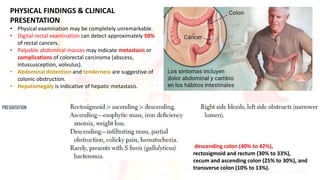
• Physical examination may be completely unremarkable.
• Digital rectal examination can detect approximately 50%
of rectal cancers.
• Palpable abdominal masses may indicate metastasis or
complications of colorectal carcinoma (abscess,
intussusception, volvulus).
• Abdominal distention and tenderness are suggestive of
colonic obstruction.
• Hepatomegaly is indicative of hepatic metastasis.
descending colon (40% to 42%),
rectosigmoid and rectum (30% to 33%),
cecum and ascending colon (25% to 30%), and
transverse colon (10% to 13%).
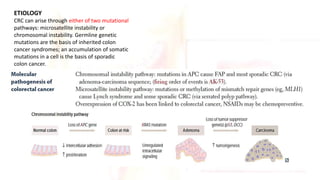
ETIOLOGY
CRC can arise through either of two mutational
pathways: microsatellite instability or
chromosomal instability. Germline genetic
mutations are the basis of inherited colon
cancer syndromes; an accumulation of somatic
mutations in a cell is the basis of sporadic
colon cancer.
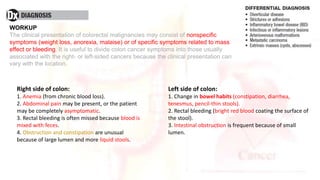
WORKUP
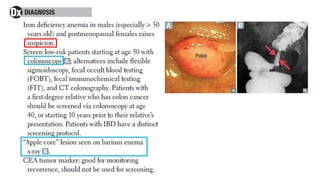
The clinical presentation of colorectal malignancies may consist of nonspecific
symptoms (weight loss, anorexia, malaise) or of specific symptoms related to mass
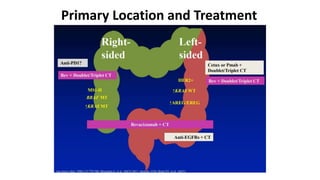
effect or bleeding. It is useful to divide colon cancer symptoms into those usually
associated with the right- or left-sided cancers because the clinical presentation can
vary with the location.
Right side of colon:
1. Anemia (from chronic blood loss).
2. Abdominal pain may be present, or the patient
may be completely asymptomatic.
3. Rectal bleeding is often missed because blood is
mixed with feces.
4. Obstruction and constipation are unusual
because of large lumen and more liquid stools.
Left side of colon:
1. Change in bowel habits (constipation, diarrhea,
tenesmus, pencil-thin stools).
2. Rectal bleeding (bright red blood coating the surface of
the stool).
3. Intestinal obstruction is frequent because of small
lumen.
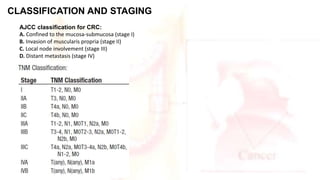
CLASSIFICATION AND STAGING
AJCC classification for CRC:
A. Confined to the mucosa-submucosa (stage I)
B. Invasion of muscularis propria (stage II)
C. Local node involvement (stage III)
D. Distant metastasis (stage IV)
treatment by stage
Stage 0 (Tis N0 M0)
Treatment options are: Stage I (T1-2 N0 M0)
•Local excision or simple polypectomy.
•Segmentary en-bloc resection for larger lesions not amenable to local excision.
(old staging: Dukes’ A or modified Astler–Coller A and B1).Wide surgical resection and anastomosis. No adjuvant
chemotherapy.
Stage II A, B, C (T3 N0 M0, T4 a-b N0 M0)
Standard treatment options:
•Wide surgical resection and anastomosis.
•Following surgery, adjuvant therapy should not be routinely recommended for unselected patients. In high-risk
patients who present at least one of the previously mentioned clinical high-risk features (see above), adjuvant
therapy could be considered in clinical practice [II, B].
Stage III (any T, N1-N2, M0)
•Wide surgical resection and anastomosis.
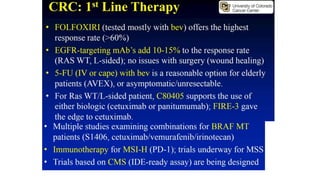
•Following surgery, the standard treatment is a doublet schedule with oxaliplatin and a fluoropyrimidine. Although
all three combination regimens are superior to 5-FU/FA alone [I, A], FOLFOX4 or XELOX should be preferred to
FLOX. When oxaliplatin is contraindicated, monotherapy with infusional or oral fluoropyrimidines should be
preferred to bolus 5-FU FU/LV.
Primary Location and Treatment
03 colorectal cancer

03 colorectal cancer

  • 1.
    Colorectal CancerDEFINITION Colorectal cancer(CRC) is a neoplasm arising from the luminal surface of the large bowel; locations include: descending colon (40% to 42%), rectosigmoid and rectum (30% to 33%), cecum and ascending colon (25% to 30%), and transverse colon (10% to 13%).
  • 2.
    EPIDEMIOLOGY & DEMOGRAPHICS • Worldwide,CRC accounts for about 1.4 million new cases and 700,000 deaths annually. The highest incidence is in North America, Australasia, Europe, and South Korea. • CRC is the third commonest cancer and the third leading cause of cancer deaths in the U.S. (135,430 new cases and 50,260 deaths for 2017). Distant metastatic disease is present in 18% to 22% of patients at time of diagnosis. • The peak incidence is in the seventh decade of life. The lifetime risk for development of CRC is 1 in 17, with 90% of cases occurring after age 50 yr. Risk factors: 1. Hereditary polyposis syndromes 2. Familial polyposis (high risk) 3. Gardner’s syndrome (high risk) 4. Turcot’s syndrome (high risk) 5. Peutz-Jeghers syndrome (low to moderate risk) 6. Inflammatory bowel disease (IBD), both ulcerative colitis and Crohn’s disease 7. Family history of “cancer family syndrome” 8. Heredofamilial breast cancer and colon carcinoma 9. Pelvic irradiation history 10. First-degree relatives with colorectal carcinoma 11. Age >50 years 12. Dietary factors (diet high in fat or red meat, alcohol use, low vegetable intake) 13. Hereditary nonpolyposis colon cancer (HNPCC): autosomal dominant disorder characterized by early age of onset (mean age, 44 yr) and right-sided or proximal colon cancers, synchronous and metachronous colon cancers, mucinous and poorly differentiated colon cancers; accounts for 1% to 5% of all cases of CRC 14. Previous endometrial or ovarian cancer, particularly when diagnosed at an early age
  • 4.
    PHYSICAL FINDINGS &CLINICAL PRESENTATION • Physical examination may be completely unremarkable. • Digital rectal examination can detect approximately 50% of rectal cancers. • Palpable abdominal masses may indicate metastasis or complications of colorectal carcinoma (abscess, intussusception, volvulus). • Abdominal distention and tenderness are suggestive of colonic obstruction. • Hepatomegaly is indicative of hepatic metastasis. descending colon (40% to 42%), rectosigmoid and rectum (30% to 33%), cecum and ascending colon (25% to 30%), and transverse colon (10% to 13%).
  • 5.
    ETIOLOGY CRC can arisethrough either of two mutational pathways: microsatellite instability or chromosomal instability. Germline genetic mutations are the basis of inherited colon cancer syndromes; an accumulation of somatic mutations in a cell is the basis of sporadic colon cancer.
  • 6.
    WORKUP The clinical presentationof colorectal malignancies may consist of nonspecific symptoms (weight loss, anorexia, malaise) or of specific symptoms related to mass effect or bleeding. It is useful to divide colon cancer symptoms into those usually associated with the right- or left-sided cancers because the clinical presentation can vary with the location. Right side of colon: 1. Anemia (from chronic blood loss). 2. Abdominal pain may be present, or the patient may be completely asymptomatic. 3. Rectal bleeding is often missed because blood is mixed with feces. 4. Obstruction and constipation are unusual because of large lumen and more liquid stools. Left side of colon: 1. Change in bowel habits (constipation, diarrhea, tenesmus, pencil-thin stools). 2. Rectal bleeding (bright red blood coating the surface of the stool). 3. Intestinal obstruction is frequent because of small lumen.
  • 7.
    CLASSIFICATION AND STAGING AJCCclassification for CRC: A. Confined to the mucosa-submucosa (stage I) B. Invasion of muscularis propria (stage II) C. Local node involvement (stage III) D. Distant metastasis (stage IV)
  • 9.
    treatment by stage Stage0 (Tis N0 M0) Treatment options are: Stage I (T1-2 N0 M0) •Local excision or simple polypectomy. •Segmentary en-bloc resection for larger lesions not amenable to local excision. (old staging: Dukes’ A or modified Astler–Coller A and B1).Wide surgical resection and anastomosis. No adjuvant chemotherapy. Stage II A, B, C (T3 N0 M0, T4 a-b N0 M0) Standard treatment options: •Wide surgical resection and anastomosis. •Following surgery, adjuvant therapy should not be routinely recommended for unselected patients. In high-risk patients who present at least one of the previously mentioned clinical high-risk features (see above), adjuvant therapy could be considered in clinical practice [II, B]. Stage III (any T, N1-N2, M0) •Wide surgical resection and anastomosis. •Following surgery, the standard treatment is a doublet schedule with oxaliplatin and a fluoropyrimidine. Although all three combination regimens are superior to 5-FU/FA alone [I, A], FOLFOX4 or XELOX should be preferred to FLOX. When oxaliplatin is contraindicated, monotherapy with infusional or oral fluoropyrimidines should be preferred to bolus 5-FU FU/LV.
  • 10.