COLOR THEORY
Hollie Winningham
Grades 9-12
Beginning/Intermediate Art
CA Content Standards
• CREATING—Anchor Standard 2: Organize and develop artistic ideas and work.
2.3 Enduring Understanding: People create and interact with objects, places, and design that define,
shape, enhance, and empower their lives.
Essential Questions: How do objects, places, and design shape lives and communities? How do artists and
designers determine goals for designing or redesigning objects, places, or systems? How do artists and
designers create works of art or design that communicate effectively?
Process Component: Investigate
Prof.VA:Cr2.3: Collaboratively develop a proposal for an installation, artwork, or space design that
transforms the perception and experience of a particular place.
Acc.VA:Cr2.3: Redesign an object, system, place, or design in response to contemporary issues.
• CONNECTING—Anchor Standard 11: Relate artistic ideas and works with societal, cultural, and
historical context to deepen understanding.
Enduring Understanding: People develop ideas and understandings of society, culture, and history through
their interactions with and analysis of art.
Essential Questions: How does art help us understand the lives of people of different times, places, and
cultures? How is art used to impact the views of a society? How does art preserve aspects of life?
Process Component: Relate
Prof.VA:Cn11: Describe how knowledge of culture, traditions, and history may influence personal responses to
art.
Acc.VA:Cn11: Compare uses of art in a variety of societal, cultural, and historical contexts and make
connections to uses of art in contemporary, local and global contexts.
Mastery Hook
• I am using the Principles of Design and
Elements of art that they have been using up
until now and giving them a new way to apply
them through color.
• First step it to review the Principles of Design
and Elements of art
Elements of Art Overview
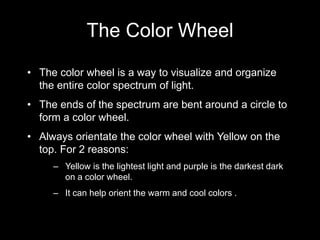
The Color Wheel
• The color wheel is a way to visualize and organize
the entire color spectrum of light.
• The ends of the spectrum are bent around a circle to

form a color wheel.
• Always orientate the color wheel with Yellow on the
top. For 2 reasons:
– Yellow is the lightest light and purple is the darkest dark
on a color wheel.
– It can help orient the warm and cool colors .
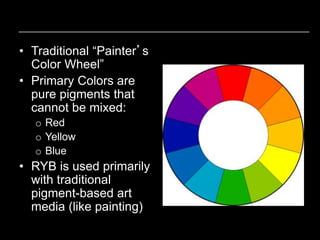
• Traditional “Painter’s
Color Wheel”
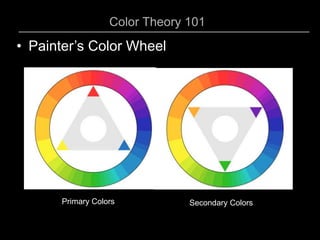
• Primary Colors are
pure pigments that
cannot be mixed:
o Red
o Yellow
o Blue
• RYB is used primarily
with traditional
pigment-based art
media (like painting)
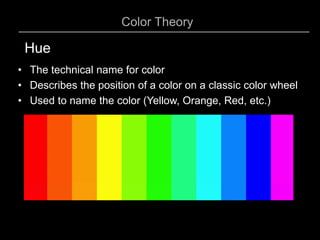
Color Theory
• The technical name for color
• Describes the position of a color on a classic color wheel
• Used to name the color (Yellow, Orange, Red, etc.)
Hue
Color Theory
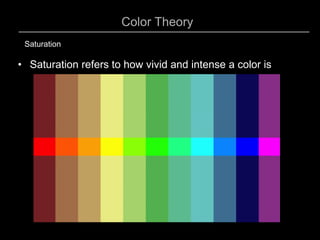
• Saturation refers to how vivid and intense a color is
Saturation
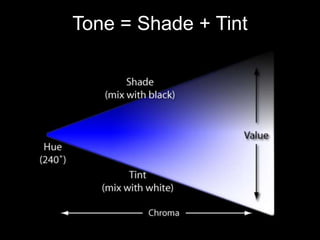
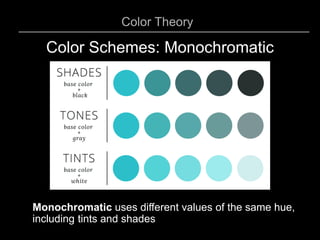
Tone = Shade + Tint
Color Theory 101
• Painter’s Color Wheel
Secondary ColorsPrimary Colors
Color Theory
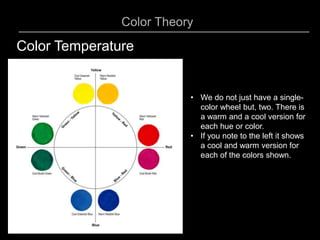
Color Temperature
• We do not just have a single-
color wheel but, two. There is
a warm and a cool version for
each hue or color.
• If you note to the left it shows
a cool and warm version for
each of the colors shown.
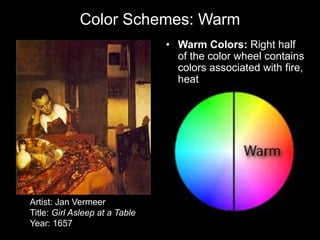
Color Schemes: Warm
• Warm Colors: Right half
of the color wheel contains
colors associated with fire,
heat
Artist: Jan Vermeer
Title: Girl Asleep at a Table
Year: 1657
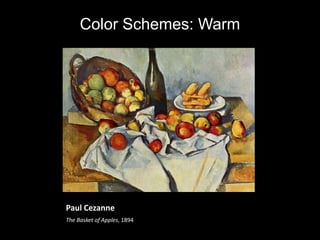
Paul Cezanne
The Basket of Apples, 1894
Color Schemes: Warm
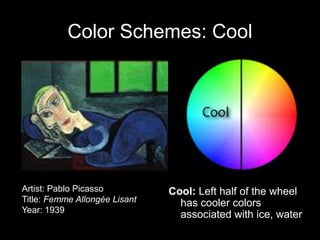
Color Schemes: Cool
Cool: Left half of the wheel
has cooler colors
associated with ice, water
Artist: Pablo Picasso
Title: Femme Allongée Lisant
Year: 1939
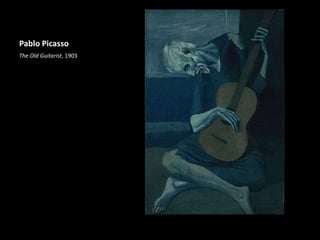
Pablo Picasso
The Old Guitarist, 1903
Monochromatic uses different values of the same hue,
including tints and shades
Color Theory
Color Schemes: Monochromatic
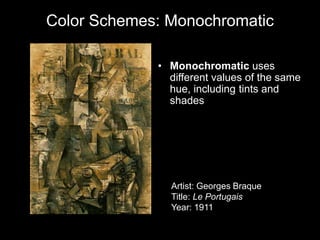
• Monochromatic uses
different values of the same
hue, including tints and
shades
Artist: Georges Braque
Title: Le Portugais
Year: 1911
Color Schemes: Monochromatic
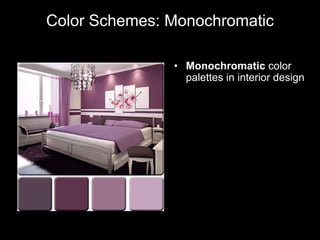
• Monochromatic color
palettes in interior design
You Try:
• Can you name 2 popular logos with a
monochromatic color scheme?
• Fill in the boxes with examples of
Tint, Shade and Tone.
Color Theory
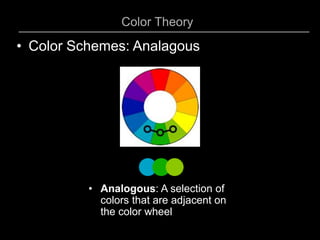
• Color Schemes: Analagous
• Analogous: A selection of
colors that are adjacent on
the color wheel
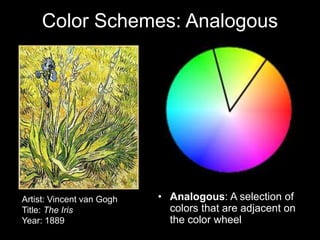
Color Schemes: Analogous
• Analogous: A selection of
colors that are adjacent on
the color wheel
Artist: Vincent van Gogh
Title: The Iris
Year: 1889
You Try:
• Can you name 2 popular logos with
an analogous color scheme?
• Fill in the 3 triangle examples for
analogous colors.
Color Theory
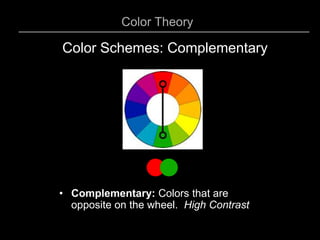
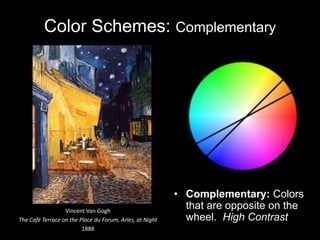
Color Schemes: Complementary
• Complementary: Colors that are
opposite on the wheel. High Contrast
Color Schemes: Complementary
• Complementary: Colors
that are opposite on the
wheel. High Contrast
Vincent Van Gogh
The Café Terrace on the Place du Forum, Arles, at Night
1888
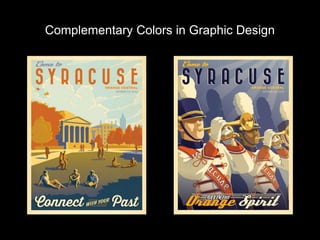
Complementary Colors in Graphic Design
You Try:
• Can you name 2 popular logos with
a complementary color scheme?
• Fill in the 3 examples for
complementary colors.
Color Theory
Split-
Complementary
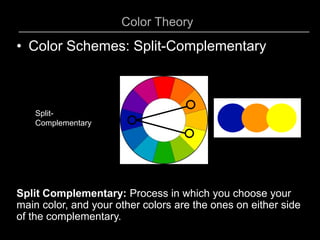
• Color Schemes: Split-Complementary
Split Complementary: Process in which you choose your
main color, and your other colors are the ones on either side
of the complementary.
Color Theory
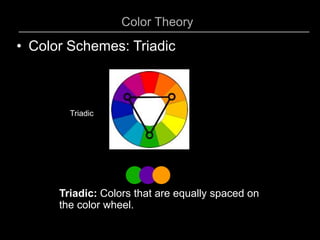
Triadic
• Color Schemes: Triadic
Triadic: Colors that are equally spaced on
the color wheel.
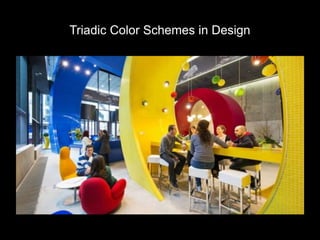
Triadic Color Schemes in Design
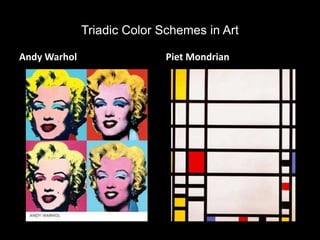
Triadic Color Schemes in Art
Andy Warhol Piet Mondrian
You Try:
• Can you name 2 popular logos with a
triadic color scheme?
• Fill in the 3 triangle examples for
analogous colors.
Color theory

Color theory

  • 1.
    COLOR THEORY Hollie Winningham Grades9-12 Beginning/Intermediate Art
  • 2.
    CA Content Standards •CREATING—Anchor Standard 2: Organize and develop artistic ideas and work. 2.3 Enduring Understanding: People create and interact with objects, places, and design that define, shape, enhance, and empower their lives. Essential Questions: How do objects, places, and design shape lives and communities? How do artists and designers determine goals for designing or redesigning objects, places, or systems? How do artists and designers create works of art or design that communicate effectively? Process Component: Investigate Prof.VA:Cr2.3: Collaboratively develop a proposal for an installation, artwork, or space design that transforms the perception and experience of a particular place. Acc.VA:Cr2.3: Redesign an object, system, place, or design in response to contemporary issues. • CONNECTING—Anchor Standard 11: Relate artistic ideas and works with societal, cultural, and historical context to deepen understanding. Enduring Understanding: People develop ideas and understandings of society, culture, and history through their interactions with and analysis of art. Essential Questions: How does art help us understand the lives of people of different times, places, and cultures? How is art used to impact the views of a society? How does art preserve aspects of life? Process Component: Relate Prof.VA:Cn11: Describe how knowledge of culture, traditions, and history may influence personal responses to art. Acc.VA:Cn11: Compare uses of art in a variety of societal, cultural, and historical contexts and make connections to uses of art in contemporary, local and global contexts.
  • 3.
    Mastery Hook • Iam using the Principles of Design and Elements of art that they have been using up until now and giving them a new way to apply them through color. • First step it to review the Principles of Design and Elements of art
  • 4.
  • 5.
    The Color Wheel •The color wheel is a way to visualize and organize the entire color spectrum of light. • The ends of the spectrum are bent around a circle to form a color wheel. • Always orientate the color wheel with Yellow on the top. For 2 reasons: – Yellow is the lightest light and purple is the darkest dark on a color wheel. – It can help orient the warm and cool colors .
  • 6.
    • Traditional “Painter’s ColorWheel” • Primary Colors are pure pigments that cannot be mixed: o Red o Yellow o Blue • RYB is used primarily with traditional pigment-based art media (like painting)
  • 8.
    Color Theory • Thetechnical name for color • Describes the position of a color on a classic color wheel • Used to name the color (Yellow, Orange, Red, etc.) Hue
  • 9.
    Color Theory • Saturationrefers to how vivid and intense a color is Saturation
  • 10.
  • 11.
    Color Theory 101 •Painter’s Color Wheel Secondary ColorsPrimary Colors
  • 12.
    Color Theory Color Temperature •We do not just have a single- color wheel but, two. There is a warm and a cool version for each hue or color. • If you note to the left it shows a cool and warm version for each of the colors shown.
  • 13.
    Color Schemes: Warm •Warm Colors: Right half of the color wheel contains colors associated with fire, heat Artist: Jan Vermeer Title: Girl Asleep at a Table Year: 1657
  • 14.
    Paul Cezanne The Basketof Apples, 1894 Color Schemes: Warm
  • 15.
    Color Schemes: Cool Cool:Left half of the wheel has cooler colors associated with ice, water Artist: Pablo Picasso Title: Femme Allongée Lisant Year: 1939
  • 16.
    Pablo Picasso The OldGuitarist, 1903
  • 17.
    Monochromatic uses differentvalues of the same hue, including tints and shades Color Theory Color Schemes: Monochromatic
  • 18.
    Color Schemes: Monochromatic •Monochromatic uses different values of the same hue, including tints and shades Artist: Georges Braque Title: Le Portugais Year: 1911
  • 19.
    Color Schemes: Monochromatic •Monochromatic color palettes in interior design
  • 20.
    You Try: • Canyou name 2 popular logos with a monochromatic color scheme? • Fill in the boxes with examples of Tint, Shade and Tone.
  • 22.
    Color Theory • ColorSchemes: Analagous • Analogous: A selection of colors that are adjacent on the color wheel
  • 23.
    Color Schemes: Analogous •Analogous: A selection of colors that are adjacent on the color wheel Artist: Vincent van Gogh Title: The Iris Year: 1889
  • 24.
    You Try: • Canyou name 2 popular logos with an analogous color scheme? • Fill in the 3 triangle examples for analogous colors.
  • 26.
    Color Theory Color Schemes:Complementary • Complementary: Colors that are opposite on the wheel. High Contrast
  • 27.
    Color Schemes: Complementary •Complementary: Colors that are opposite on the wheel. High Contrast Vincent Van Gogh The Café Terrace on the Place du Forum, Arles, at Night 1888
  • 28.
  • 29.
    You Try: • Canyou name 2 popular logos with a complementary color scheme? • Fill in the 3 examples for complementary colors.
  • 31.
    Color Theory Split- Complementary • ColorSchemes: Split-Complementary Split Complementary: Process in which you choose your main color, and your other colors are the ones on either side of the complementary.
  • 32.
    Color Theory Triadic • ColorSchemes: Triadic Triadic: Colors that are equally spaced on the color wheel.
  • 33.
  • 34.
    Triadic Color Schemesin Art Andy Warhol Piet Mondrian
  • 35.
    You Try: • Canyou name 2 popular logos with a triadic color scheme? • Fill in the 3 triangle examples for analogous colors.