Color Coding and Chromatic Coding
Venkatesh Raman
The Institute of Mathematical Sciences

3 March 2014

Venkatesh Raman (IMSc)

Randomized Techniques in FPT

3 March 2014

1 / 17
Randomized Algorithms
Let Π ⊆ Σ∗ be a problem.

Venkatesh Raman (IMSc)

Randomized Techniques in FPT

3 March 2014

2 / 17
Randomized Algorithms
Let Π ⊆ Σ∗ be a problem.

Algorithm

Venkatesh Raman (IMSc)

Randomized Techniques in FPT

3 March 2014

2 / 17
Randomized Algorithms
Let Π ⊆ Σ∗ be a problem.
x ∈ Σ∗

Algorithm

Venkatesh Raman (IMSc)

Randomized Techniques in FPT

3 March 2014

2 / 17
Randomized Algorithms
Let Π ⊆ Σ∗ be a problem.
x ∈ Σ∗

Algorithm

Venkatesh Raman (IMSc)

Randomized Techniques in FPT

3 March 2014

2 / 17
Randomized Algorithms
Let Π ⊆ Σ∗ be a problem.
x ∈ Σ∗

Algorithm
x ∈ Π?
(Output correct answer with good probability)

Venkatesh Raman (IMSc)

Randomized Techniques in FPT

3 March 2014

2 / 17
Randomized Algorithms
Let Π ⊆ Σ∗ be a problem.
x ∈ Σ∗

Algorithm
x ∈ Π?
(Output correct answer with good probability)
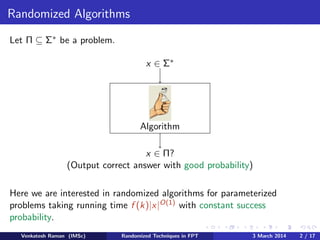
Here we are interested in randomized algorithms for parameterized
problems taking running time f (k)|x|O(1) with constant success
probability.
Venkatesh Raman (IMSc)

Randomized Techniques in FPT

3 March 2014

2 / 17
Randomized Algorithm for UFVS

Definition (Feedback Vertex Set)
Let G = (V , E ) be an undirected graph. S ⊆ V is called feedback vertex
set if G  S is a forest.

Venkatesh Raman (IMSc)

Randomized Techniques in FPT

3 March 2014

3 / 17
Randomized Algorithm for UFVS

Definition (Feedback Vertex Set)
Let G = (V , E ) be an undirected graph. S ⊆ V is called feedback vertex
set if G  S is a forest.
Undirected Feedback Vertex Set (UFVS)
Input:
Parameter:
Question:

An undirected graph G = (V , E ) and a positive integer k
k
Does there exists a feedback vertex set of size at most k

Venkatesh Raman (IMSc)

Randomized Techniques in FPT

3 March 2014

3 / 17
Randomized Algorithm for UFVS

Do the following preprocessing rules

Venkatesh Raman (IMSc)

Randomized Techniques in FPT

3 March 2014

4 / 17
Randomized Algorithm for UFVS

Do the following preprocessing rules
Delete degree ≤ 1 vertices.

Venkatesh Raman (IMSc)

Randomized Techniques in FPT

3 March 2014

4 / 17
Randomized Algorithm for UFVS

Do the following preprocessing rules
Delete degree ≤ 1 vertices.
Short circuit degree 2 vertices.

Venkatesh Raman (IMSc)

Randomized Techniques in FPT

3 March 2014

4 / 17
Randomized Algorithm for UFVS

Do the following preprocessing rules
Delete degree ≤ 1 vertices.
Short circuit degree 2 vertices.

Venkatesh Raman (IMSc)

Randomized Techniques in FPT

3 March 2014

4 / 17
Randomized Algorithm for UFVS

Do the following preprocessing rules
Delete degree ≤ 1 vertices.
Short circuit degree 2 vertices.

Venkatesh Raman (IMSc)

Randomized Techniques in FPT

3 March 2014

4 / 17
Randomized Algorithm for UFVS

Do the following preprocessing rules
Delete degree ≤ 1 vertices.
Short circuit degree 2 vertices.
Add vertex x to FVS, if x has self loop.

Venkatesh Raman (IMSc)

Randomized Techniques in FPT

3 March 2014

4 / 17
Randomized Algorithm for UFVS

Do the following preprocessing rules
Delete degree ≤ 1 vertices.
Short circuit degree 2 vertices.
Add vertex x to FVS, if x has self loop.
Now we can assume every vertex in G has degree ≥ 3.

Venkatesh Raman (IMSc)

Randomized Techniques in FPT

3 March 2014

4 / 17
Randomized Algorithm for UFVS
Claim : If G is graph with minimum degree ≥ 3, then number of edges
incident to any FVS F is ≥ E (G ) .
2

Venkatesh Raman (IMSc)

Randomized Techniques in FPT

3 March 2014

5 / 17
Randomized Algorithm for UFVS
Claim : If G is graph with minimum degree ≥ 3, then number of edges
incident to any FVS F is ≥ E (G ) .
2
Proof:

F
H=G - F
;
Venkatesh Raman (IMSc)

Randomized Techniques in FPT

3 March 2014

5 / 17
Randomized Algorithm for UFVS
Claim : If G is graph with minimum degree ≥ 3, then number of edges
incident to any FVS F is ≥ E (G ) .
2
Proof:

Let

V≤1 = set of degree ≤ 1 vertices in H,
V2 = set of degree 2 vertices in H, and

F

V≥3 = set of degree ≥ 3 vertices in H.

H=G - F
;
Venkatesh Raman (IMSc)

Randomized Techniques in FPT

3 March 2014

5 / 17
Randomized Algorithm for UFVS
Claim : If G is graph with minimum degree ≥ 3, then number of edges
incident to any FVS F is ≥ E (G ) .
2
Proof:

Let

V≤1 = set of degree ≤ 1 vertices in H,
V2 = set of degree 2 vertices in H, and

F

V≥3 = set of degree ≥ 3 vertices in H.
Number of edges between H and F ,
E (H, F ) ≥ 2V≤1 + V2

H=G - F
;
Venkatesh Raman (IMSc)

Randomized Techniques in FPT

3 March 2014

5 / 17
Randomized Algorithm for UFVS
Claim : If G is graph with minimum degree ≥ 3, then number of edges
incident to any FVS F is ≥ E (G ) .
2
Proof:

Let

V≤1 = set of degree ≤ 1 vertices in H,
V2 = set of degree 2 vertices in H, and

F

V≥3 = set of degree ≥ 3 vertices in H.
Number of edges between H and F ,
E (H, F ) ≥ 2V≤1 + V2
> V≤1 + V2 + V≥3 ( V≤1 > V≥3 )

H=G - F
;
Venkatesh Raman (IMSc)

Randomized Techniques in FPT

3 March 2014

5 / 17
Randomized Algorithm for UFVS
Claim : If G is graph with minimum degree ≥ 3, then number of edges
incident to any FVS F is ≥ E (G ) .
2
Proof:

Let

V≤1 = set of degree ≤ 1 vertices in H,
V2 = set of degree 2 vertices in H, and

F

V≥3 = set of degree ≥ 3 vertices in H.
Number of edges between H and F ,
E (H, F ) ≥ 2V≤1 + V2
> V≤1 + V2 + V≥3 ( V≤1 > V≥3 )
= V (H)> E (H).

H=G - F
;

Venkatesh Raman (IMSc)

Randomized Techniques in FPT

3 March 2014

5 / 17
Randomized Algorithm for UFVS

Algorithm
Initially we set S ← ∅. Now run the following steps k times.
1: Apply preprocessing rules and create an equivalent instance (G , k )
2: Pick an edge e, u.a.r (i.e with probability

1
E (G ) )

3: Choose an end point of e, u.a.r (i.e with probability 1 ) into S and
2
delete it from the graph.
Now if S is a FVS, output S, otherwise output No.

Venkatesh Raman (IMSc)

Randomized Techniques in FPT

3 March 2014

6 / 17
Analysis

If the input instance is No instance Pr[Algorithm output No] = 1.
Let the input instance is Yes instance and F is a FVS od size ≤ k.
Pr[Choosing an edge incident to F in step 2] ≥
Pr[Chosen vertex is in F in step 3] ≥
Pr[S=F] ≥

1
2
1 1
·
2 2
1
4k

Now we repeat the algorithm 4k times.
1
Pr[Algorithm fails in all repetitions] ≤ 1 − 4k
1
Pr[Algorithm succeed at least once] ≥ 1 − e ≥

Venkatesh Raman (IMSc)

Randomized Techniques in FPT

4k
1
2

1
≤ e.

3 March 2014

7 / 17
Color Coding

This technique is introduced by Alon et al. (1995)
This technique is used to solve constant treewidth k-sized subgraph
isomorphism problem.

Venkatesh Raman (IMSc)

Randomized Techniques in FPT

3 March 2014

8 / 17
Color Coding

This technique is introduced by Alon et al. (1995)
This technique is used to solve constant treewidth k-sized subgraph
isomorphism problem.
We illustrate this technique by applying to k-path

Venkatesh Raman (IMSc)

Randomized Techniques in FPT

3 March 2014

8 / 17
k-path

k-path
Input:
Parameter:
Question:

An undirected graph G and a positive integer k
k
Does there exists a path on k vertices in G

Venkatesh Raman (IMSc)

Randomized Techniques in FPT

3 March 2014

9 / 17
Colorful path

v1
v5
v7

v2

v6

v3

v4

Venkatesh Raman (IMSc)

Randomized Techniques in FPT

3 March 2014

10 / 17
Colorful path

v1
v5
v7

v2

v6

v3

v4
colorful path on 5 vertices in the graph G ?

Venkatesh Raman (IMSc)

Randomized Techniques in FPT

3 March 2014

10 / 17
Algorithm for k-path

Venkatesh Raman (IMSc)

Randomized Techniques in FPT

3 March 2014

11 / 17
Algorithm for k-path

Color each vertex of the input graph G , u.a.r using from the set of k
colors, [k]
Check whether there exists a colorful k-path in the colored graph and
output Yes/No accordingly

Venkatesh Raman (IMSc)

Randomized Techniques in FPT

3 March 2014

11 / 17
Algorithm for k-path

Color each vertex of the input graph G , u.a.r using from the set of k
colors, [k]
Check whether there exists a colorful k-path in the colored graph and
output Yes/No accordingly
Running Time : Time to check colorful k-path × nO(1)

Venkatesh Raman (IMSc)

Randomized Techniques in FPT

3 March 2014

11 / 17
Algorithm for k-path

Color each vertex of the input graph G , u.a.r using from the set of k
colors, [k]
Check whether there exists a colorful k-path in the colored graph and
output Yes/No accordingly
Running Time : Time to check colorful k-path × nO(1)
Probability of success
If (G , k) is a No instance, the probability of success is 1.
If (G , k) is an Yes instance, the probability of success is at least

Venkatesh Raman (IMSc)

Randomized Techniques in FPT

3 March 2014

k!
.
kk

11 / 17
DP for Checking colorful k-path

We introduce 2k · |V (G )| Boolean variables:

x(v , C ) = TRUE for some v ∈ V (G ) and C ⊆ [k]
There is path ends at v where each color in C appears
exactly once and no other color appears.

Venkatesh Raman (IMSc)

Randomized Techniques in FPT

3 March 2014

12 / 17
DP for Checking colorful k-path

Clearly, x(v , {color (v )}) = TRUE. Recurrence for vertex v with color r :
x(u, C  {r })

x(v , C ) =
uv ∈E (G )

If we know every x(v , C ) with |C | = i, then we can determine every
x(v , C ) with |C | = i + 1. All the values can be determined in time
O(2k · |E (G )|).
There is a colorful path ends at t ⇐⇒ x(t, [k]) = TRUE for some t.

Venkatesh Raman (IMSc)

Randomized Techniques in FPT

3 March 2014

13 / 17
Analysis for k-path
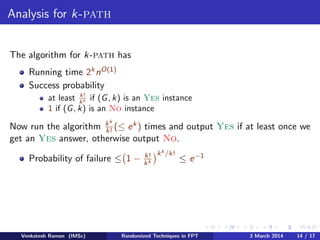
The algorithm for k-path has
Running time 2k nO(1)

Venkatesh Raman (IMSc)

Randomized Techniques in FPT

3 March 2014

14 / 17
Analysis for k-path
The algorithm for k-path has
Running time 2k nO(1)
Success probability
k!
at least k k if (G , k) is an Yes instance
1 if (G , k) is an No instance

Venkatesh Raman (IMSc)

Randomized Techniques in FPT

3 March 2014

14 / 17
Analysis for k-path
The algorithm for k-path has
Running time 2k nO(1)
Success probability
k!
at least k k if (G , k) is an Yes instance
1 if (G , k) is an No instance
k

Now run the algorithm k (≤ e k ) times and output Yes if at least once we
k!
get an Yes answer, otherwise output No.

Venkatesh Raman (IMSc)

Randomized Techniques in FPT

3 March 2014

14 / 17
Analysis for k-path
The algorithm for k-path has
Running time 2k nO(1)
Success probability
k!
at least k k if (G , k) is an Yes instance
1 if (G , k) is an No instance
k

Now run the algorithm k (≤ e k ) times and output Yes if at least once we
k!
get an Yes answer, otherwise output No.
Probability of failure ≤ 1 −

Venkatesh Raman (IMSc)

k
k! k /k!
kk

≤ e −1

Randomized Techniques in FPT

3 March 2014

14 / 17
Analysis for k-path
The algorithm for k-path has
Running time 2k nO(1)
Success probability
k!
at least k k if (G , k) is an Yes instance
1 if (G , k) is an No instance
k

Now run the algorithm k (≤ e k ) times and output Yes if at least once we
k!
get an Yes answer, otherwise output No.
Probability of failure ≤ 1 −

k
k! k /k!
kk

≤ e −1

k-path can be solved in randomized (2e)k nO(1) time, with constant success probability.

Venkatesh Raman (IMSc)

Randomized Techniques in FPT

3 March 2014

14 / 17
Derandomization

Suppose we have a list of colorings col1 , col2 , . . . , colm such that for
any S ⊆ V with |S| = k there exists i, coli is one-to-one on S, then
instead of random coloring we can use these list of colorings to get a
deterministic algorithm.

Venkatesh Raman (IMSc)

Randomized Techniques in FPT

3 March 2014

15 / 17
Derandomization

Suppose we have a list of colorings col1 , col2 , . . . , colm such that for
any S ⊆ V with |S| = k there exists i, coli is one-to-one on S, then
instead of random coloring we can use these list of colorings to get a
deterministic algorithm.
Such a list of colorings is called an (n, k)-family of perfect hash
functions

Venkatesh Raman (IMSc)

Randomized Techniques in FPT

3 March 2014

15 / 17
Derandomization

Suppose we have a list of colorings col1 , col2 , . . . , colm such that for
any S ⊆ V with |S| = k there exists i, coli is one-to-one on S, then
instead of random coloring we can use these list of colorings to get a
deterministic algorithm.
Such a list of colorings is called an (n, k)-family of perfect hash
functions
There exists an (n, k)-family of perfect hash functions of size
e k k O(log k) log2 n and can be constructed in time linear in the output
size

Venkatesh Raman (IMSc)

Randomized Techniques in FPT

3 March 2014

15 / 17
Derandomization

Suppose we have a list of colorings col1 , col2 , . . . , colm such that for
any S ⊆ V with |S| = k there exists i, coli is one-to-one on S, then
instead of random coloring we can use these list of colorings to get a
deterministic algorithm.
Such a list of colorings is called an (n, k)-family of perfect hash
functions
There exists an (n, k)-family of perfect hash functions of size
e k k O(log k) log2 n and can be constructed in time linear in the output
size
k-path can be solved deterministically in (2e)k k O(log k) nO(1) time.

Venkatesh Raman (IMSc)

Randomized Techniques in FPT

3 March 2014

15 / 17
Chromatic Coding

Venkatesh Raman (IMSc)

Randomized Techniques in FPT

3 March 2014

16 / 17
Thank You

Venkatesh Raman (IMSc)

Randomized Techniques in FPT

3 March 2014

17 / 17

Color Coding

  • 1.
    Color Coding andChromatic Coding Venkatesh Raman The Institute of Mathematical Sciences 3 March 2014 Venkatesh Raman (IMSc) Randomized Techniques in FPT 3 March 2014 1 / 17
  • 2.
    Randomized Algorithms Let Π⊆ Σ∗ be a problem. Venkatesh Raman (IMSc) Randomized Techniques in FPT 3 March 2014 2 / 17
  • 3.
    Randomized Algorithms Let Π⊆ Σ∗ be a problem. Algorithm Venkatesh Raman (IMSc) Randomized Techniques in FPT 3 March 2014 2 / 17
  • 4.
    Randomized Algorithms Let Π⊆ Σ∗ be a problem. x ∈ Σ∗ Algorithm Venkatesh Raman (IMSc) Randomized Techniques in FPT 3 March 2014 2 / 17
  • 5.
    Randomized Algorithms Let Π⊆ Σ∗ be a problem. x ∈ Σ∗ Algorithm Venkatesh Raman (IMSc) Randomized Techniques in FPT 3 March 2014 2 / 17
  • 6.
    Randomized Algorithms Let Π⊆ Σ∗ be a problem. x ∈ Σ∗ Algorithm x ∈ Π? (Output correct answer with good probability) Venkatesh Raman (IMSc) Randomized Techniques in FPT 3 March 2014 2 / 17
  • 7.
    Randomized Algorithms Let Π⊆ Σ∗ be a problem. x ∈ Σ∗ Algorithm x ∈ Π? (Output correct answer with good probability) Here we are interested in randomized algorithms for parameterized problems taking running time f (k)|x|O(1) with constant success probability. Venkatesh Raman (IMSc) Randomized Techniques in FPT 3 March 2014 2 / 17
  • 8.
    Randomized Algorithm forUFVS Definition (Feedback Vertex Set) Let G = (V , E ) be an undirected graph. S ⊆ V is called feedback vertex set if G S is a forest. Venkatesh Raman (IMSc) Randomized Techniques in FPT 3 March 2014 3 / 17
  • 9.
    Randomized Algorithm forUFVS Definition (Feedback Vertex Set) Let G = (V , E ) be an undirected graph. S ⊆ V is called feedback vertex set if G S is a forest. Undirected Feedback Vertex Set (UFVS) Input: Parameter: Question: An undirected graph G = (V , E ) and a positive integer k k Does there exists a feedback vertex set of size at most k Venkatesh Raman (IMSc) Randomized Techniques in FPT 3 March 2014 3 / 17
  • 10.
    Randomized Algorithm forUFVS Do the following preprocessing rules Venkatesh Raman (IMSc) Randomized Techniques in FPT 3 March 2014 4 / 17
  • 11.
    Randomized Algorithm forUFVS Do the following preprocessing rules Delete degree ≤ 1 vertices. Venkatesh Raman (IMSc) Randomized Techniques in FPT 3 March 2014 4 / 17
  • 12.
    Randomized Algorithm forUFVS Do the following preprocessing rules Delete degree ≤ 1 vertices. Short circuit degree 2 vertices. Venkatesh Raman (IMSc) Randomized Techniques in FPT 3 March 2014 4 / 17
  • 13.
    Randomized Algorithm forUFVS Do the following preprocessing rules Delete degree ≤ 1 vertices. Short circuit degree 2 vertices. Venkatesh Raman (IMSc) Randomized Techniques in FPT 3 March 2014 4 / 17
  • 14.
    Randomized Algorithm forUFVS Do the following preprocessing rules Delete degree ≤ 1 vertices. Short circuit degree 2 vertices. Venkatesh Raman (IMSc) Randomized Techniques in FPT 3 March 2014 4 / 17
  • 15.
    Randomized Algorithm forUFVS Do the following preprocessing rules Delete degree ≤ 1 vertices. Short circuit degree 2 vertices. Add vertex x to FVS, if x has self loop. Venkatesh Raman (IMSc) Randomized Techniques in FPT 3 March 2014 4 / 17
  • 16.
    Randomized Algorithm forUFVS Do the following preprocessing rules Delete degree ≤ 1 vertices. Short circuit degree 2 vertices. Add vertex x to FVS, if x has self loop. Now we can assume every vertex in G has degree ≥ 3. Venkatesh Raman (IMSc) Randomized Techniques in FPT 3 March 2014 4 / 17
  • 17.
    Randomized Algorithm forUFVS Claim : If G is graph with minimum degree ≥ 3, then number of edges incident to any FVS F is ≥ E (G ) . 2 Venkatesh Raman (IMSc) Randomized Techniques in FPT 3 March 2014 5 / 17
  • 18.
    Randomized Algorithm forUFVS Claim : If G is graph with minimum degree ≥ 3, then number of edges incident to any FVS F is ≥ E (G ) . 2 Proof: F H=G - F ; Venkatesh Raman (IMSc) Randomized Techniques in FPT 3 March 2014 5 / 17
  • 19.
    Randomized Algorithm forUFVS Claim : If G is graph with minimum degree ≥ 3, then number of edges incident to any FVS F is ≥ E (G ) . 2 Proof: Let V≤1 = set of degree ≤ 1 vertices in H, V2 = set of degree 2 vertices in H, and F V≥3 = set of degree ≥ 3 vertices in H. H=G - F ; Venkatesh Raman (IMSc) Randomized Techniques in FPT 3 March 2014 5 / 17
  • 20.
    Randomized Algorithm forUFVS Claim : If G is graph with minimum degree ≥ 3, then number of edges incident to any FVS F is ≥ E (G ) . 2 Proof: Let V≤1 = set of degree ≤ 1 vertices in H, V2 = set of degree 2 vertices in H, and F V≥3 = set of degree ≥ 3 vertices in H. Number of edges between H and F , E (H, F ) ≥ 2V≤1 + V2 H=G - F ; Venkatesh Raman (IMSc) Randomized Techniques in FPT 3 March 2014 5 / 17
  • 21.
    Randomized Algorithm forUFVS Claim : If G is graph with minimum degree ≥ 3, then number of edges incident to any FVS F is ≥ E (G ) . 2 Proof: Let V≤1 = set of degree ≤ 1 vertices in H, V2 = set of degree 2 vertices in H, and F V≥3 = set of degree ≥ 3 vertices in H. Number of edges between H and F , E (H, F ) ≥ 2V≤1 + V2 > V≤1 + V2 + V≥3 ( V≤1 > V≥3 ) H=G - F ; Venkatesh Raman (IMSc) Randomized Techniques in FPT 3 March 2014 5 / 17
  • 22.
    Randomized Algorithm forUFVS Claim : If G is graph with minimum degree ≥ 3, then number of edges incident to any FVS F is ≥ E (G ) . 2 Proof: Let V≤1 = set of degree ≤ 1 vertices in H, V2 = set of degree 2 vertices in H, and F V≥3 = set of degree ≥ 3 vertices in H. Number of edges between H and F , E (H, F ) ≥ 2V≤1 + V2 > V≤1 + V2 + V≥3 ( V≤1 > V≥3 ) = V (H)> E (H). H=G - F ; Venkatesh Raman (IMSc) Randomized Techniques in FPT 3 March 2014 5 / 17
  • 23.
    Randomized Algorithm forUFVS Algorithm Initially we set S ← ∅. Now run the following steps k times. 1: Apply preprocessing rules and create an equivalent instance (G , k ) 2: Pick an edge e, u.a.r (i.e with probability 1 E (G ) ) 3: Choose an end point of e, u.a.r (i.e with probability 1 ) into S and 2 delete it from the graph. Now if S is a FVS, output S, otherwise output No. Venkatesh Raman (IMSc) Randomized Techniques in FPT 3 March 2014 6 / 17
  • 24.
    Analysis If the inputinstance is No instance Pr[Algorithm output No] = 1. Let the input instance is Yes instance and F is a FVS od size ≤ k. Pr[Choosing an edge incident to F in step 2] ≥ Pr[Chosen vertex is in F in step 3] ≥ Pr[S=F] ≥ 1 2 1 1 · 2 2 1 4k Now we repeat the algorithm 4k times. 1 Pr[Algorithm fails in all repetitions] ≤ 1 − 4k 1 Pr[Algorithm succeed at least once] ≥ 1 − e ≥ Venkatesh Raman (IMSc) Randomized Techniques in FPT 4k 1 2 1 ≤ e. 3 March 2014 7 / 17
  • 25.
    Color Coding This techniqueis introduced by Alon et al. (1995) This technique is used to solve constant treewidth k-sized subgraph isomorphism problem. Venkatesh Raman (IMSc) Randomized Techniques in FPT 3 March 2014 8 / 17
  • 26.
    Color Coding This techniqueis introduced by Alon et al. (1995) This technique is used to solve constant treewidth k-sized subgraph isomorphism problem. We illustrate this technique by applying to k-path Venkatesh Raman (IMSc) Randomized Techniques in FPT 3 March 2014 8 / 17
  • 27.
    k-path k-path Input: Parameter: Question: An undirected graphG and a positive integer k k Does there exists a path on k vertices in G Venkatesh Raman (IMSc) Randomized Techniques in FPT 3 March 2014 9 / 17
  • 28.
    Colorful path v1 v5 v7 v2 v6 v3 v4 Venkatesh Raman(IMSc) Randomized Techniques in FPT 3 March 2014 10 / 17
  • 29.
    Colorful path v1 v5 v7 v2 v6 v3 v4 colorful pathon 5 vertices in the graph G ? Venkatesh Raman (IMSc) Randomized Techniques in FPT 3 March 2014 10 / 17
  • 30.
    Algorithm for k-path VenkateshRaman (IMSc) Randomized Techniques in FPT 3 March 2014 11 / 17
  • 31.
    Algorithm for k-path Coloreach vertex of the input graph G , u.a.r using from the set of k colors, [k] Check whether there exists a colorful k-path in the colored graph and output Yes/No accordingly Venkatesh Raman (IMSc) Randomized Techniques in FPT 3 March 2014 11 / 17
  • 32.
    Algorithm for k-path Coloreach vertex of the input graph G , u.a.r using from the set of k colors, [k] Check whether there exists a colorful k-path in the colored graph and output Yes/No accordingly Running Time : Time to check colorful k-path × nO(1) Venkatesh Raman (IMSc) Randomized Techniques in FPT 3 March 2014 11 / 17
  • 33.
    Algorithm for k-path Coloreach vertex of the input graph G , u.a.r using from the set of k colors, [k] Check whether there exists a colorful k-path in the colored graph and output Yes/No accordingly Running Time : Time to check colorful k-path × nO(1) Probability of success If (G , k) is a No instance, the probability of success is 1. If (G , k) is an Yes instance, the probability of success is at least Venkatesh Raman (IMSc) Randomized Techniques in FPT 3 March 2014 k! . kk 11 / 17
  • 34.
    DP for Checkingcolorful k-path We introduce 2k · |V (G )| Boolean variables: x(v , C ) = TRUE for some v ∈ V (G ) and C ⊆ [k] There is path ends at v where each color in C appears exactly once and no other color appears. Venkatesh Raman (IMSc) Randomized Techniques in FPT 3 March 2014 12 / 17
  • 35.
    DP for Checkingcolorful k-path Clearly, x(v , {color (v )}) = TRUE. Recurrence for vertex v with color r : x(u, C {r }) x(v , C ) = uv ∈E (G ) If we know every x(v , C ) with |C | = i, then we can determine every x(v , C ) with |C | = i + 1. All the values can be determined in time O(2k · |E (G )|). There is a colorful path ends at t ⇐⇒ x(t, [k]) = TRUE for some t. Venkatesh Raman (IMSc) Randomized Techniques in FPT 3 March 2014 13 / 17
  • 36.
    Analysis for k-path Thealgorithm for k-path has Running time 2k nO(1) Venkatesh Raman (IMSc) Randomized Techniques in FPT 3 March 2014 14 / 17
  • 37.
    Analysis for k-path Thealgorithm for k-path has Running time 2k nO(1) Success probability k! at least k k if (G , k) is an Yes instance 1 if (G , k) is an No instance Venkatesh Raman (IMSc) Randomized Techniques in FPT 3 March 2014 14 / 17
  • 38.
    Analysis for k-path Thealgorithm for k-path has Running time 2k nO(1) Success probability k! at least k k if (G , k) is an Yes instance 1 if (G , k) is an No instance k Now run the algorithm k (≤ e k ) times and output Yes if at least once we k! get an Yes answer, otherwise output No. Venkatesh Raman (IMSc) Randomized Techniques in FPT 3 March 2014 14 / 17
  • 39.
    Analysis for k-path Thealgorithm for k-path has Running time 2k nO(1) Success probability k! at least k k if (G , k) is an Yes instance 1 if (G , k) is an No instance k Now run the algorithm k (≤ e k ) times and output Yes if at least once we k! get an Yes answer, otherwise output No. Probability of failure ≤ 1 − Venkatesh Raman (IMSc) k k! k /k! kk ≤ e −1 Randomized Techniques in FPT 3 March 2014 14 / 17
  • 40.
    Analysis for k-path Thealgorithm for k-path has Running time 2k nO(1) Success probability k! at least k k if (G , k) is an Yes instance 1 if (G , k) is an No instance k Now run the algorithm k (≤ e k ) times and output Yes if at least once we k! get an Yes answer, otherwise output No. Probability of failure ≤ 1 − k k! k /k! kk ≤ e −1 k-path can be solved in randomized (2e)k nO(1) time, with constant success probability. Venkatesh Raman (IMSc) Randomized Techniques in FPT 3 March 2014 14 / 17
  • 41.
    Derandomization Suppose we havea list of colorings col1 , col2 , . . . , colm such that for any S ⊆ V with |S| = k there exists i, coli is one-to-one on S, then instead of random coloring we can use these list of colorings to get a deterministic algorithm. Venkatesh Raman (IMSc) Randomized Techniques in FPT 3 March 2014 15 / 17
  • 42.
    Derandomization Suppose we havea list of colorings col1 , col2 , . . . , colm such that for any S ⊆ V with |S| = k there exists i, coli is one-to-one on S, then instead of random coloring we can use these list of colorings to get a deterministic algorithm. Such a list of colorings is called an (n, k)-family of perfect hash functions Venkatesh Raman (IMSc) Randomized Techniques in FPT 3 March 2014 15 / 17
  • 43.
    Derandomization Suppose we havea list of colorings col1 , col2 , . . . , colm such that for any S ⊆ V with |S| = k there exists i, coli is one-to-one on S, then instead of random coloring we can use these list of colorings to get a deterministic algorithm. Such a list of colorings is called an (n, k)-family of perfect hash functions There exists an (n, k)-family of perfect hash functions of size e k k O(log k) log2 n and can be constructed in time linear in the output size Venkatesh Raman (IMSc) Randomized Techniques in FPT 3 March 2014 15 / 17
  • 44.
    Derandomization Suppose we havea list of colorings col1 , col2 , . . . , colm such that for any S ⊆ V with |S| = k there exists i, coli is one-to-one on S, then instead of random coloring we can use these list of colorings to get a deterministic algorithm. Such a list of colorings is called an (n, k)-family of perfect hash functions There exists an (n, k)-family of perfect hash functions of size e k k O(log k) log2 n and can be constructed in time linear in the output size k-path can be solved deterministically in (2e)k k O(log k) nO(1) time. Venkatesh Raman (IMSc) Randomized Techniques in FPT 3 March 2014 15 / 17
  • 45.
    Chromatic Coding Venkatesh Raman(IMSc) Randomized Techniques in FPT 3 March 2014 16 / 17
  • 46.
    Thank You Venkatesh Raman(IMSc) Randomized Techniques in FPT 3 March 2014 17 / 17