KERNELS
FOR F-DELETION
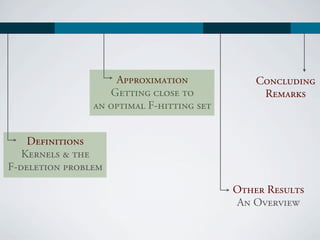
aÉÑáåáíáçåë=
   hÉêåÉäë=C=íÜÉ=
cJÇÉäÉíáçå=éêçÄäÉã
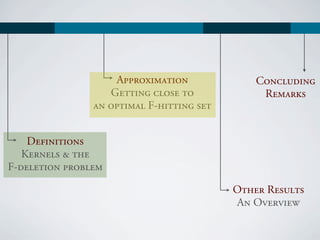
^ééêçñáã~íáçå=
                   dÉííáåÖ=ÅäçëÉ=íç
                ~å=çéíáã~ä=cJÜáííáåÖ=ëÉí


    aÉÑáåáíáçåë=
   hÉêåÉäë=C=íÜÉ=
cJÇÉäÉíáçå=éêçÄäÉã
^ééêçñáã~íáçå=
                   dÉííáåÖ=ÅäçëÉ=íç
                ~å=çéíáã~ä=cJÜáííáåÖ=ëÉí


    aÉÑáåáíáçåë=
   hÉêåÉäë=C=íÜÉ=
cJÇÉäÉíáçå=éêçÄäÉã

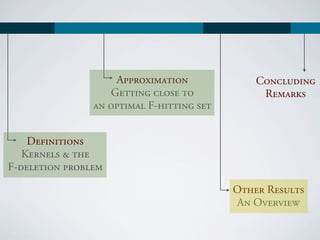
                                           líÜÉê=RÉëìäíë=
                                           ^å=lîÉêîáÉï
^ééêçñáã~íáçå=             `çåÅäìÇáåÖ
                   dÉííáåÖ=ÅäçëÉ=íç             RÉã~êâë=
                ~å=çéíáã~ä=cJÜáííáåÖ=ëÉí


    aÉÑáåáíáçåë=
   hÉêåÉäë=C=íÜÉ=
cJÇÉäÉíáçå=éêçÄäÉã

                                           líÜÉê=RÉëìäíë=
                                           ^å=lîÉêîáÉï
^ééêçñáã~íáçå=             `çåÅäìÇáåÖ
                   dÉííáåÖ=ÅäçëÉ=íç             RÉã~êâë=
                ~å=çéíáã~ä=cJÜáííáåÖ=ëÉí


    aÉÑáåáíáçåë=
   hÉêåÉäë=C=íÜÉ=
cJÇÉäÉíáçå=éêçÄäÉã

                                           líÜÉê=RÉëìäíë=
                                           ^å=lîÉêîáÉï
^ééêçñáã~íáçå=             `çåÅäìÇáåÖ
                   dÉííáåÖ=ÅäçëÉ=íç             RÉã~êâë=
                ~å=çéíáã~ä=cJÜáííáåÖ=ëÉí


    aÉÑáåáíáçåë=
   hÉêåÉäë=C=íÜÉ=
cJÇÉäÉíáçå=éêçÄäÉã

                                           líÜÉê=RÉëìäíë=
                                           ^å=lîÉêîáÉï
KERNELIZATION
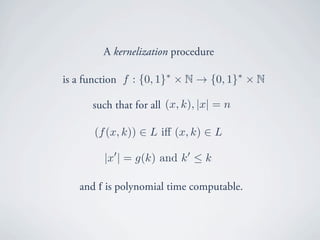
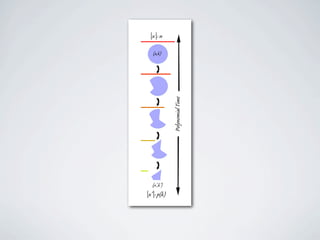
A kernelization procedure

                       ⇤                  ⇤
is a function f : {0, 1}    N ⇥ {0, 1}        N

      such that for all (x, k), |x| = n

       (f (x, k)) 2 L i (x, k) 2 L
           0                 0
         |x | = g(k) and k       k

   and f is polynomial time computable.
The F-Deletion Problem
A classic optimization question
often takes the following general form...
A classic optimization question
     often takes the following general form...

How “close” is a graph to having a certain property?
This question can be formalized in a number of ways,
     and a well-studied version is the following:
What is the smallest number of vertices that need to be
        deleted so that the remaining graph is
               __________________?
What is the smallest number of vertices that need to be
        deleted so that the remaining graph is
                     independent?
What is the smallest number of vertices that need to be
        deleted so that the remaining graph is
                        acyclic?
What is the smallest number of vertices that need to be
        deleted so that the remaining graph is
                        planar?
What is the smallest number of vertices that need to be
        deleted so that the remaining graph is
                 constant treewidth?
What is the smallest number of vertices that need to be
        deleted so that the remaining graph is
                         in X?
X = a property
A property = an infinite collection of graphs
that satisfy the property.


A property = an infinite collection of graphs
that satisfy the property.


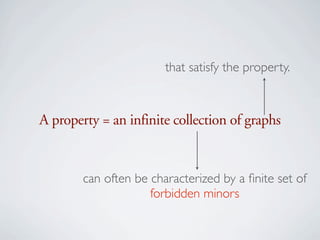
A property = an infinite collection of graphs


        can often be characterized by a finite set of
                     forbidden minors
that satisfy the property.


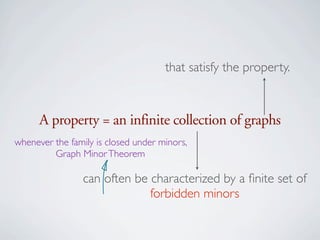
      A property = an infinite collection of graphs
whenever the family is closed under minors,
         Graph Minor Theorem

                 can often be characterized by a finite set of
                              forbidden minors
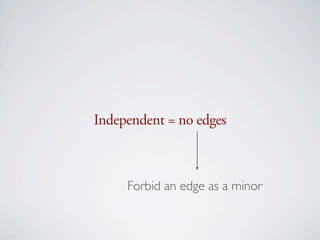
Independent = no edges


     Forbid an edge as a minor
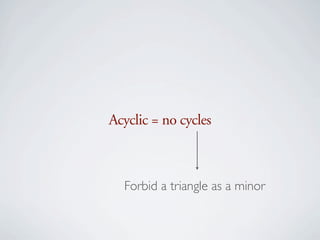
Acyclic = no cycles


  Forbid a triangle as a minor
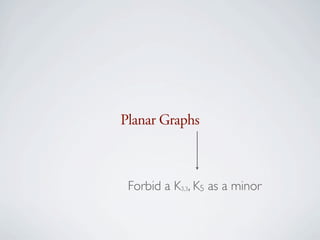
Planar Graphs


 Forbid a K3,3, K5 as a minor
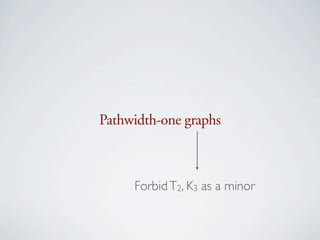
Pathwidth-one graphs


     Forbid T2, K3 as a minor
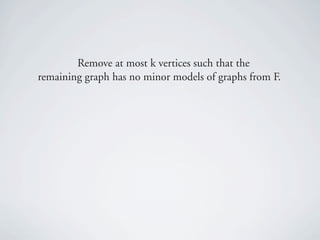
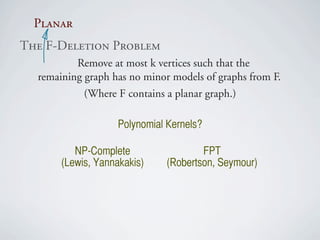
Remove at most k vertices such that the
remaining graph has no minor models of graphs from F.
qÜÉ=cJaÉäÉíáçå=mêçÄäÉã
          Remove at most k vertices such that the
  remaining graph has no minor models of graphs from F.
qÜÉ=cJaÉäÉíáçå=mêçÄäÉã
          Remove at most k vertices such that the
  remaining graph has no minor models of graphs from F.


          NP-Complete
       (Lewis, Yannakakis)
qÜÉ=cJaÉäÉíáçå=mêçÄäÉã
          Remove at most k vertices such that the
  remaining graph has no minor models of graphs from F.


          NP-Complete                 FPT
       (Lewis, Yannakakis)    (Robertson, Seymour)
qÜÉ=cJaÉäÉíáçå=mêçÄäÉã
          Remove at most k vertices such that the
  remaining graph has no minor models of graphs from F.


                    Polynomial Kernels

          NP-Complete                  FPT
       (Lewis, Yannakakis)     (Robertson, Seymour)
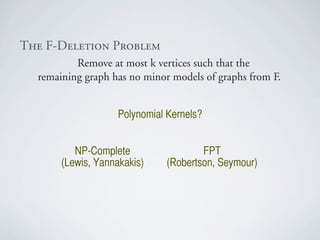
qÜÉ=cJaÉäÉíáçå=mêçÄäÉã
          Remove at most k vertices such that the
  remaining graph has no minor models of graphs from F.


                    Polynomial Kernels?

          NP-Complete                 FPT
       (Lewis, Yannakakis)    (Robertson, Seymour)
mä~å~ê
qÜÉ=cJaÉäÉíáçå=mêçÄäÉã
          Remove at most k vertices such that the
  remaining graph has no minor models of graphs from F.


                    Polynomial Kernels?

          NP-Complete                 FPT
       (Lewis, Yannakakis)    (Robertson, Seymour)
mä~å~ê
qÜÉ=cJaÉäÉíáçå=mêçÄäÉã
          Remove at most k vertices such that the
  remaining graph has no minor models of graphs from F.
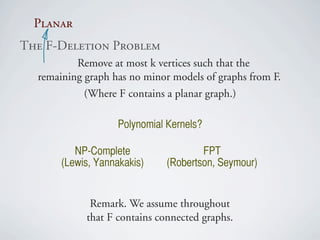
            (Where F contains a planar graph.)

                    Polynomial Kernels?

          NP-Complete                 FPT
       (Lewis, Yannakakis)    (Robertson, Seymour)
mä~å~ê
qÜÉ=cJaÉäÉíáçå=mêçÄäÉã
          Remove at most k vertices such that the
  remaining graph has no minor models of graphs from F.
            (Where F contains a planar graph.)

                    Polynomial Kernels?

          NP-Complete                 FPT
       (Lewis, Yannakakis)    (Robertson, Seymour)


             Remark. We assume throughout
            that F contains connected graphs.
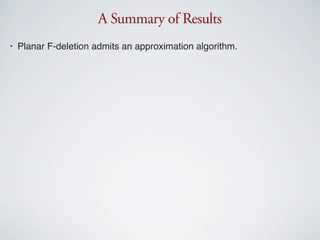
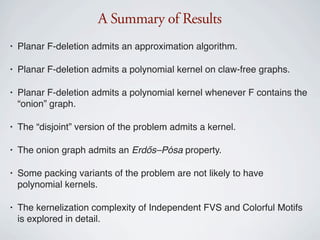
A Summary of Results
•   Planar F-deletion admits an approximation algorithm.
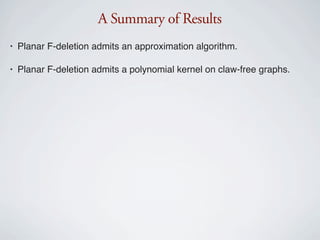
A Summary of Results
•   Planar F-deletion admits an approximation algorithm.

•   Planar F-deletion admits a polynomial kernel on claw-free graphs.
A Summary of Results
•   Planar F-deletion admits an approximation algorithm.

•   Planar F-deletion admits a polynomial kernel on claw-free graphs.

•   Planar F-deletion admits a polynomial kernel whenever F contains the
    “onion” graph.
A Summary of Results
•   Planar F-deletion admits an approximation algorithm.

•   Planar F-deletion admits a polynomial kernel on claw-free graphs.

•   Planar F-deletion admits a polynomial kernel whenever F contains the
    “onion” graph.

•   The “disjoint” version of the problem admits a kernel.
A Summary of Results
•   Planar F-deletion admits an approximation algorithm.

•   Planar F-deletion admits a polynomial kernel on claw-free graphs.

•   Planar F-deletion admits a polynomial kernel whenever F contains the
    “onion” graph.

•   The “disjoint” version of the problem admits a kernel.

•   The onion graph admits an Erdős–Pósa property.
A Summary of Results
•   Planar F-deletion admits an approximation algorithm.

•   Planar F-deletion admits a polynomial kernel on claw-free graphs.

•   Planar F-deletion admits a polynomial kernel whenever F contains the
    “onion” graph.

•   The “disjoint” version of the problem admits a kernel.

•   The onion graph admits an Erdős–Pósa property.

•   Some packing variants of the problem are not likely to have
    polynomial kernels.
A Summary of Results
•   Planar F-deletion admits an approximation algorithm.

•   Planar F-deletion admits a polynomial kernel on claw-free graphs.

•   Planar F-deletion admits a polynomial kernel whenever F contains the
    “onion” graph.

•   The “disjoint” version of the problem admits a kernel.

•   The onion graph admits an Erdős–Pósa property.

•   Some packing variants of the problem are not likely to have
    polynomial kernels.

•   The kernelization complexity of Independent FVS and Colorful Motifs
    is explored in detail.
^ééêçñáã~íáçå=             `çåÅäìÇáåÖ
                   dÉííáåÖ=ÅäçëÉ=íç             RÉã~êâë=
                ~å=çéíáã~ä=cJÜáííáåÖ=ëÉí


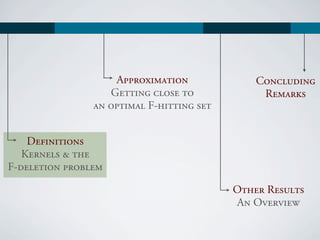
    aÉÑáåáíáçåë=
   hÉêåÉäë=C=íÜÉ=
cJÇÉäÉíáçå=éêçÄäÉã

                                           líÜÉê=RÉëìäíë=
                                           ^å=lîÉêîáÉï
^ééêçñáã~íáçå=             `çåÅäìÇáåÖ
                   dÉííáåÖ=ÅäçëÉ=íç             RÉã~êâë=
                ~å=çéíáã~ä=cJÜáííáåÖ=ëÉí


    aÉÑáåáíáçåë=
   hÉêåÉäë=C=íÜÉ=
cJÇÉäÉíáçå=éêçÄäÉã

                                           líÜÉê=RÉëìäíë=
                                           ^å=lîÉêîáÉï
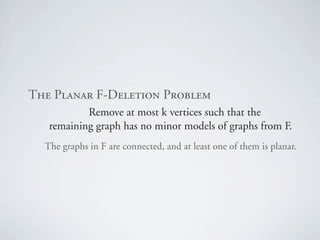
qÜÉ=mä~å~ê=cJaÉäÉíáçå=mêçÄäÉã
           Remove at most k vertices such that the
   remaining graph has no minor models of graphs from F.
  The graphs in F are connected, and at least one of them is planar.

Ingredients
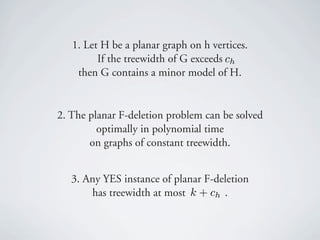
1. Let H be a planar graph on h vertices.
         If the treewidth of G exceeds ch
    then G contains a minor model of H.


2. The planar F-deletion problem can be solved
         optimally in polynomial time
       on graphs of constant treewidth.


   3. Any YES instance of planar F-deletion
       has treewidth at most k + ch .
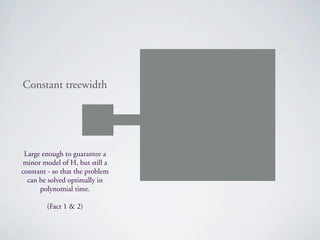
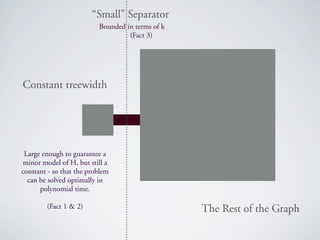
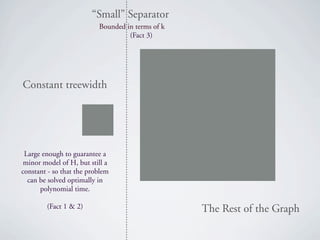
Constant treewidth


 Large enough to guarantee a
 minor model of H, but still a
constant - so that the problem
  can be solved optimally in
      polynomial time.

        (Fact 1 & 2)
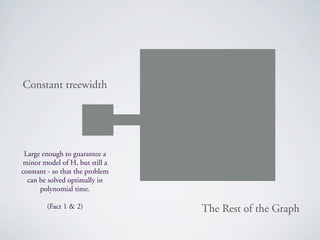
Constant treewidth


 Large enough to guarantee a
 minor model of H, but still a
constant - so that the problem
  can be solved optimally in
      polynomial time.

        (Fact 1 & 2)             The Rest of the Graph
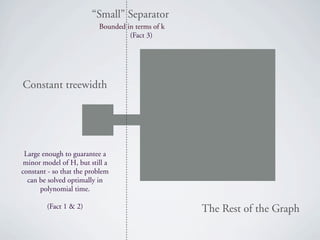
“Small” Separator
                          Bounded in terms of k
                                   (Fact 3)


Constant treewidth


 Large enough to guarantee a
 minor model of H, but still a
constant - so that the problem
  can be solved optimally in
      polynomial time.

        (Fact 1 & 2)                              The Rest of the Graph
“Small” Separator
                          Bounded in terms of k
                                   (Fact 3)


Constant treewidth


 Large enough to guarantee a
 minor model of H, but still a
constant - so that the problem
  can be solved optimally in
      polynomial time.

        (Fact 1 & 2)                              The Rest of the Graph
“Small” Separator
                          Bounded in terms of k
                                   (Fact 3)


Constant treewidth


 Large enough to guarantee a
 minor model of H, but still a
constant - so that the problem
  can be solved optimally in
      polynomial time.

        (Fact 1 & 2)                              The Rest of the Graph
“Small” Separator
                          Bounded in terms of k
                                   (Fact 3)


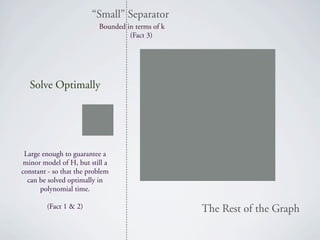
  Solve Optimally


 Large enough to guarantee a
 minor model of H, but still a
constant - so that the problem
  can be solved optimally in
      polynomial time.

        (Fact 1 & 2)                              The Rest of the Graph
“Small” Separator
                          Bounded in terms of k
                                   (Fact 3)


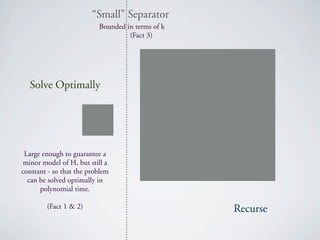
  Solve Optimally


 Large enough to guarantee a
 minor model of H, but still a
constant - so that the problem
  can be solved optimally in
      polynomial time.

        (Fact 1 & 2)                              Recurse
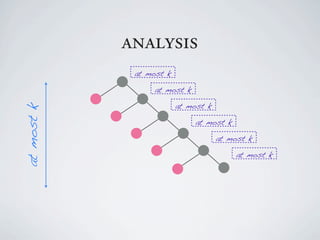
~å~äóëáë
~å~äóëáë
~å~äóëáë
~å~äóëáë
~å~äóëáë
~å~äóëáë
~å~äóëáë
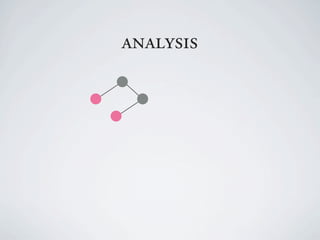
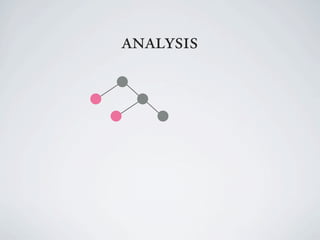
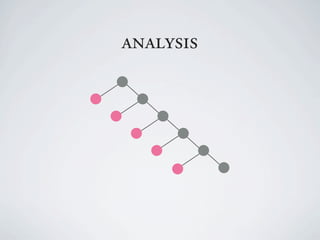
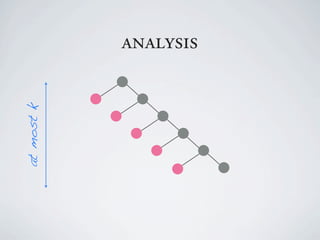
at most k
            ~å~äóëáë
~å~äóëáë
             at most k

                  at most k

                         at most k
at most k


                              at most k

                                     at most k

                                          at most k
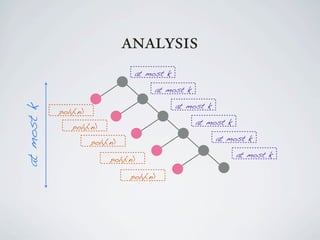
~å~äóëáë
                                 at most k

                                      at most k

                                             at most k
at most k


            poly(n)
                                                  at most k
               poly(n)
                                                         at most k
                      poly(n)
                                                              at most k
                           poly(n)

                                poly(n)
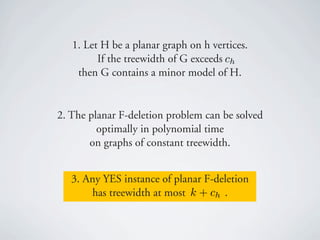
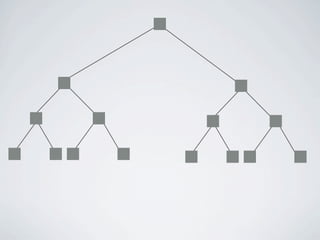
How do we get here?
1. Let H be a planar graph on h vertices.
         If the treewidth of G exceeds ch
    then G contains a minor model of H.


2. The planar F-deletion problem can be solved
         optimally in polynomial time
       on graphs of constant treewidth.


   3. Any YES instance of planar F-deletion
       has treewidth at most k + ch .
1. Let H be a planar graph on h vertices.
         If the treewidth of G exceeds ch
    then G contains a minor model of H.


2. The planar F-deletion problem can be solved
         optimally in polynomial time
       on graphs of constant treewidth.


   3. Any YES instance of planar F-deletion
       has treewidth at most k + ch .
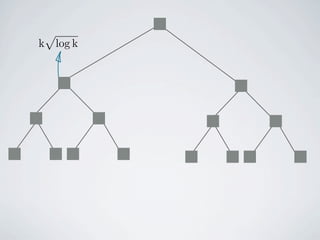
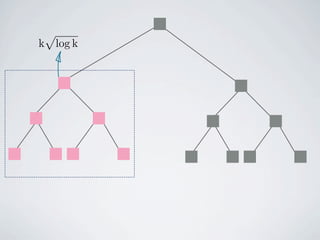
p
k       log k
p
k       log k
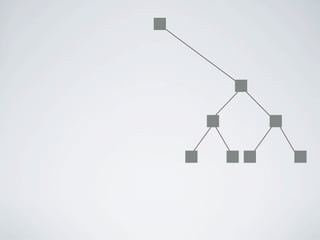
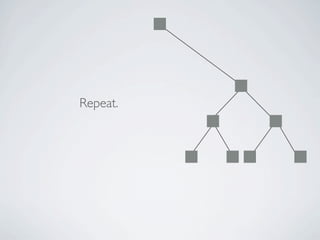
Repeat.
p
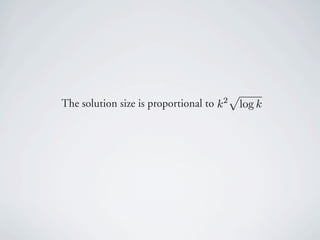
The solution size is proportional to k 2 log k
p
         The solution size is proportional to k 2 log k

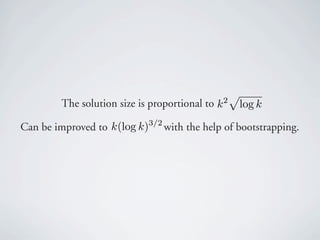
Can be improved to k(log k)3/2 with the help of bootstrapping.
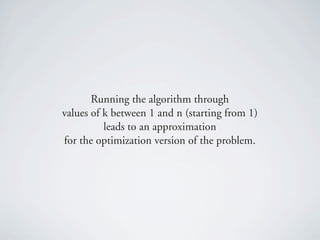
Running the algorithm through
values of k between 1 and n (starting from 1)
          leads to an approximation
for the optimization version of the problem.
^ééêçñáã~íáçå=             `çåÅäìÇáåÖ
                   dÉííáåÖ=ÅäçëÉ=íç             RÉã~êâë=
                ~å=çéíáã~ä=cJÜáííáåÖ=ëÉí


    aÉÑáåáíáçåë=
   hÉêåÉäë=C=íÜÉ=
cJÇÉäÉíáçå=éêçÄäÉã

                                           líÜÉê=RÉëìäíë=
                                           ^å=lîÉêîáÉï
^ééêçñáã~íáçå=             `çåÅäìÇáåÖ
                   dÉííáåÖ=ÅäçëÉ=íç             RÉã~êâë=
                ~å=çéíáã~ä=cJÜáííáåÖ=ëÉí


    aÉÑáåáíáçåë=
   hÉêåÉäë=C=íÜÉ=
cJÇÉäÉíáçå=éêçÄäÉã

                                           líÜÉê=RÉëìäíë=
                                           ^å=lîÉêîáÉï
qÜÉ=cJaÉäÉíáçå=mêçÄäÉã
          Remove at most k vertices such that the
  remaining graph has no minor models of graphs from F.


                    Polynomial Kernels?


          NP-Complete                 FPT
       (Lewis, Yannakakis)    (Robertson, Seymour)
Conjecture
qÜÉ=cJaÉäÉíáçå=mêçÄäÉã
          Remove at most k vertices such that the
  remaining graph has no minor models of graphs from F.
qÜÉ=cJaÉäÉíáçå=mêçÄäÉã
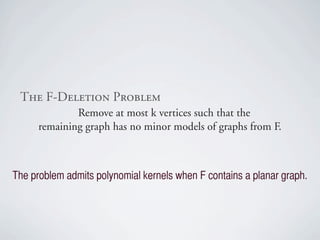
              Remove at most k vertices such that the
      remaining graph has no minor models of graphs from F.


The problem admits polynomial kernels when F contains a planar graph.
qÜÉ=cJaÉäÉíáçå=mêçÄäÉã
              Remove at most k vertices such that the
      remaining graph has no minor models of graphs from F.
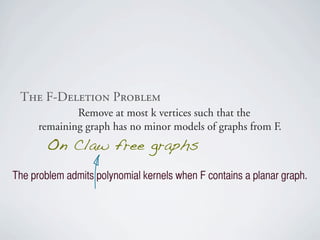
        On Claw free graphs
The problem admits polynomial kernels when F contains a planar graph.
qÜÉ=cJaÉäÉíáçå=mêçÄäÉã
              Remove at most k vertices such that the
      remaining graph has no minor models of graphs from F.
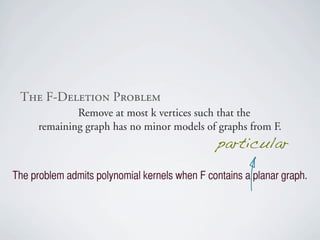
                                               particular

The problem admits polynomial kernels when F contains a planar graph.
Protrusion-based reductions
         the idea
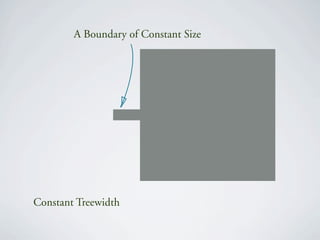
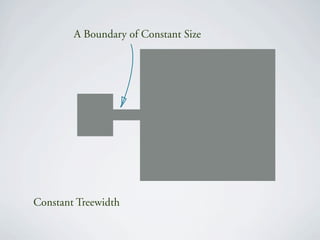
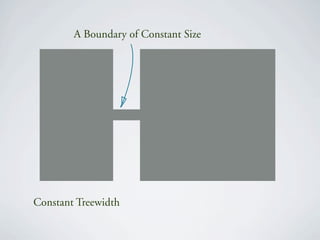
A Boundary of Constant Size


Constant Treewidth
A Boundary of Constant Size


Constant Treewidth
A Boundary of Constant Size


Constant Treewidth
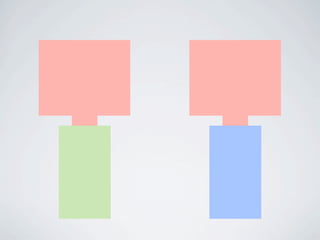
The space of t-boundaried graphs
can be broken up into equivalence classes
    based on how they “behave” with
    the “other side” of the boundary.
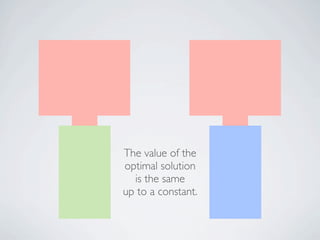
The value of the
optimal solution
  is the same
up to a constant.
The space of t-boundaried graphs
can be broken up into equivalence classes
    based on how they “behave” with
    the “other side” of the boundary.
The space of t-boundaried graphs
 can be broken up into equivalence classes
     based on how they “behave” with
     the “other side” of the boundary.

            For some problems,
 the number of equivalence classes is finite,
allowing us to replace protrusions in graphs.
For the protrusion-based reductions to take effect,
   we require subgraphs of constant treewidth
 that are separated from the rest of the graph by
            a constant-sized separator.
Approximation Algorithm

For the protrusion-based reductions to take effect,
   we require subgraphs of constant treewidth
 that are separated from the rest of the graph by
            a constant-sized separator.
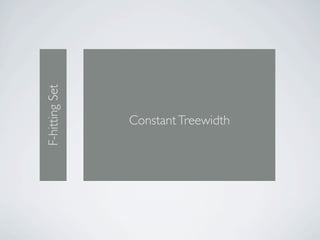
F-hitting Set


                Constant Treewidth
Approximation Algorithm

For the protrusion-based reductions to take effect,
   we require subgraphs of constant treewidth
 that are separated from the rest of the graph by
            a constant-sized separator.
Approximation Algorithm

     For the protrusion-based reductions to take effect,
        we require subgraphs of constant treewidth
      that are separated from the rest of the graph by
                 a constant-sized separator.

Restrictions like claw-freeness.
^ééêçñáã~íáçå=             `çåÅäìÇáåÖ
                   dÉííáåÖ=ÅäçëÉ=íç             RÉã~êâë=
                ~å=çéíáã~ä=cJÜáííáåÖ=ëÉí


    aÉÑáåáíáçåë=
   hÉêåÉäë=C=íÜÉ=
cJÇÉäÉíáçå=éêçÄäÉã

                                           líÜÉê=RÉëìäíë=
                                           ^å=lîÉêîáÉï
^ééêçñáã~íáçå=             `çåÅäìÇáåÖ
                   dÉííáåÖ=ÅäçëÉ=íç             RÉã~êâë=
                ~å=çéíáã~ä=cJÜáííáåÖ=ëÉí


    aÉÑáåáíáçåë=
   hÉêåÉäë=C=íÜÉ=
cJÇÉäÉíáçå=éêçÄäÉã

                                           líÜÉê=RÉëìäíë=
                                           ^å=lîÉêîáÉï
crRqebR=afRb`qflkp
crRqebR=afRb`qflkp

•   What happens when we drop the planarity assumption?
crRqebR=afRb`qflkp

•   What happens when we drop the planarity assumption?

•   What happens if there are graphs in the forbidden set that are
    not connected?
crRqebR=afRb`qflkp

•   What happens when we drop the planarity assumption?

•   What happens if there are graphs in the forbidden set that are
    not connected?

•   Are there other infinite classes of graphs (not captured by finite
    sets of forbidden minors) for which the same reasoning holds?
crRqebR=afRb`qflkp

•   What happens when we drop the planarity assumption?

•   What happens if there are graphs in the forbidden set that are
    not connected?

•   Are there other infinite classes of graphs (not captured by finite
    sets of forbidden minors) for which the same reasoning holds?

•   How do structural requirements on the solution
    (independence, connectivity) affect the complexity of the
    problem?
^`hkltibadjbkqp
^`hkltibadjbkqp


      Abhimanyu M. Ambalath, S. Arumugam,
  Radheshyam Balasundaram, K. Raja Chandrasekar,
        Michael R. Fellows, Fedor V. Fomin,
Venkata Koppula, Daniel Lokshtanov, Matthias Mnich
     N. S. Narayanaswamy, Geevarghese Philip,
Venkatesh Raman, M. S. Ramanujan, Chintan Rao H.,
        Frances A. Rosamond, Saket Saurabh,
          Somnath Sikdar, Bal Sri Shankar
Thank you!

Kernels for Planar F-Deletion (Restricted Variants)

  • 1.
  • 3.
    aÉÑáåáíáçåë= hÉêåÉäë=C=íÜÉ= cJÇÉäÉíáçå=éêçÄäÉã
  • 4.
    ^ééêçñáã~íáçå= dÉííáåÖ=ÅäçëÉ=íç ~å=çéíáã~ä=cJÜáííáåÖ=ëÉí aÉÑáåáíáçåë= hÉêåÉäë=C=íÜÉ= cJÇÉäÉíáçå=éêçÄäÉã
  • 5.
    ^ééêçñáã~íáçå= dÉííáåÖ=ÅäçëÉ=íç ~å=çéíáã~ä=cJÜáííáåÖ=ëÉí aÉÑáåáíáçåë= hÉêåÉäë=C=íÜÉ= cJÇÉäÉíáçå=éêçÄäÉã líÜÉê=RÉëìäíë= ^å=lîÉêîáÉï
  • 6.
    ^ééêçñáã~íáçå= `çåÅäìÇáåÖ dÉííáåÖ=ÅäçëÉ=íç RÉã~êâë= ~å=çéíáã~ä=cJÜáííáåÖ=ëÉí aÉÑáåáíáçåë= hÉêåÉäë=C=íÜÉ= cJÇÉäÉíáçå=éêçÄäÉã líÜÉê=RÉëìäíë= ^å=lîÉêîáÉï
  • 7.
    ^ééêçñáã~íáçå= `çåÅäìÇáåÖ dÉííáåÖ=ÅäçëÉ=íç RÉã~êâë= ~å=çéíáã~ä=cJÜáííáåÖ=ëÉí aÉÑáåáíáçåë= hÉêåÉäë=C=íÜÉ= cJÇÉäÉíáçå=éêçÄäÉã líÜÉê=RÉëìäíë= ^å=lîÉêîáÉï
  • 8.
    ^ééêçñáã~íáçå= `çåÅäìÇáåÖ dÉííáåÖ=ÅäçëÉ=íç RÉã~êâë= ~å=çéíáã~ä=cJÜáííáåÖ=ëÉí aÉÑáåáíáçåë= hÉêåÉäë=C=íÜÉ= cJÇÉäÉíáçå=éêçÄäÉã líÜÉê=RÉëìäíë= ^å=lîÉêîáÉï
  • 9.
  • 12.
    A kernelization procedure ⇤ ⇤ is a function f : {0, 1} N ⇥ {0, 1} N such that for all (x, k), |x| = n (f (x, k)) 2 L i (x, k) 2 L 0 0 |x | = g(k) and k k and f is polynomial time computable.
  • 16.
  • 17.
    A classic optimizationquestion often takes the following general form...
  • 18.
    A classic optimizationquestion often takes the following general form... How “close” is a graph to having a certain property?
  • 19.
    This question canbe formalized in a number of ways, and a well-studied version is the following:
  • 20.
    What is thesmallest number of vertices that need to be deleted so that the remaining graph is __________________?
  • 21.
    What is thesmallest number of vertices that need to be deleted so that the remaining graph is independent?
  • 22.
    What is thesmallest number of vertices that need to be deleted so that the remaining graph is acyclic?
  • 23.
    What is thesmallest number of vertices that need to be deleted so that the remaining graph is planar?
  • 24.
    What is thesmallest number of vertices that need to be deleted so that the remaining graph is constant treewidth?
  • 25.
    What is thesmallest number of vertices that need to be deleted so that the remaining graph is in X?
  • 26.
    X = aproperty
  • 27.
    A property =an infinite collection of graphs
  • 28.
    that satisfy theproperty. A property = an infinite collection of graphs
  • 29.
    that satisfy theproperty. A property = an infinite collection of graphs can often be characterized by a finite set of forbidden minors
  • 30.
    that satisfy theproperty. A property = an infinite collection of graphs whenever the family is closed under minors, Graph Minor Theorem can often be characterized by a finite set of forbidden minors
  • 31.
    Independent = noedges Forbid an edge as a minor
  • 32.
    Acyclic = nocycles Forbid a triangle as a minor
  • 33.
    Planar Graphs Forbida K3,3, K5 as a minor
  • 34.
    Pathwidth-one graphs Forbid T2, K3 as a minor
  • 35.
    Remove at mostk vertices such that the remaining graph has no minor models of graphs from F.
  • 36.
    qÜÉ=cJaÉäÉíáçå=mêçÄäÉã Remove at most k vertices such that the remaining graph has no minor models of graphs from F.
  • 37.
    qÜÉ=cJaÉäÉíáçå=mêçÄäÉã Remove at most k vertices such that the remaining graph has no minor models of graphs from F. NP-Complete (Lewis, Yannakakis)
  • 38.
    qÜÉ=cJaÉäÉíáçå=mêçÄäÉã Remove at most k vertices such that the remaining graph has no minor models of graphs from F. NP-Complete FPT (Lewis, Yannakakis) (Robertson, Seymour)
  • 39.
    qÜÉ=cJaÉäÉíáçå=mêçÄäÉã Remove at most k vertices such that the remaining graph has no minor models of graphs from F. Polynomial Kernels NP-Complete FPT (Lewis, Yannakakis) (Robertson, Seymour)
  • 40.
    qÜÉ=cJaÉäÉíáçå=mêçÄäÉã Remove at most k vertices such that the remaining graph has no minor models of graphs from F. Polynomial Kernels? NP-Complete FPT (Lewis, Yannakakis) (Robertson, Seymour)
  • 41.
    mä~å~ê qÜÉ=cJaÉäÉíáçå=mêçÄäÉã Remove at most k vertices such that the remaining graph has no minor models of graphs from F. Polynomial Kernels? NP-Complete FPT (Lewis, Yannakakis) (Robertson, Seymour)
  • 42.
    mä~å~ê qÜÉ=cJaÉäÉíáçå=mêçÄäÉã Remove at most k vertices such that the remaining graph has no minor models of graphs from F. (Where F contains a planar graph.) Polynomial Kernels? NP-Complete FPT (Lewis, Yannakakis) (Robertson, Seymour)
  • 43.
    mä~å~ê qÜÉ=cJaÉäÉíáçå=mêçÄäÉã Remove at most k vertices such that the remaining graph has no minor models of graphs from F. (Where F contains a planar graph.) Polynomial Kernels? NP-Complete FPT (Lewis, Yannakakis) (Robertson, Seymour) Remark. We assume throughout that F contains connected graphs.
  • 45.
    A Summary ofResults
  • 46.
    A Summary ofResults • Planar F-deletion admits an approximation algorithm.
  • 47.
    A Summary ofResults • Planar F-deletion admits an approximation algorithm. • Planar F-deletion admits a polynomial kernel on claw-free graphs.
  • 48.
    A Summary ofResults • Planar F-deletion admits an approximation algorithm. • Planar F-deletion admits a polynomial kernel on claw-free graphs. • Planar F-deletion admits a polynomial kernel whenever F contains the “onion” graph.
  • 49.
    A Summary ofResults • Planar F-deletion admits an approximation algorithm. • Planar F-deletion admits a polynomial kernel on claw-free graphs. • Planar F-deletion admits a polynomial kernel whenever F contains the “onion” graph. • The “disjoint” version of the problem admits a kernel.
  • 50.
    A Summary ofResults • Planar F-deletion admits an approximation algorithm. • Planar F-deletion admits a polynomial kernel on claw-free graphs. • Planar F-deletion admits a polynomial kernel whenever F contains the “onion” graph. • The “disjoint” version of the problem admits a kernel. • The onion graph admits an Erdős–Pósa property.
  • 51.
    A Summary ofResults • Planar F-deletion admits an approximation algorithm. • Planar F-deletion admits a polynomial kernel on claw-free graphs. • Planar F-deletion admits a polynomial kernel whenever F contains the “onion” graph. • The “disjoint” version of the problem admits a kernel. • The onion graph admits an Erdős–Pósa property. • Some packing variants of the problem are not likely to have polynomial kernels.
  • 52.
    A Summary ofResults • Planar F-deletion admits an approximation algorithm. • Planar F-deletion admits a polynomial kernel on claw-free graphs. • Planar F-deletion admits a polynomial kernel whenever F contains the “onion” graph. • The “disjoint” version of the problem admits a kernel. • The onion graph admits an Erdős–Pósa property. • Some packing variants of the problem are not likely to have polynomial kernels. • The kernelization complexity of Independent FVS and Colorful Motifs is explored in detail.
  • 53.
    ^ééêçñáã~íáçå= `çåÅäìÇáåÖ dÉííáåÖ=ÅäçëÉ=íç RÉã~êâë= ~å=çéíáã~ä=cJÜáííáåÖ=ëÉí aÉÑáåáíáçåë= hÉêåÉäë=C=íÜÉ= cJÇÉäÉíáçå=éêçÄäÉã líÜÉê=RÉëìäíë= ^å=lîÉêîáÉï
  • 54.
    ^ééêçñáã~íáçå= `çåÅäìÇáåÖ dÉííáåÖ=ÅäçëÉ=íç RÉã~êâë= ~å=çéíáã~ä=cJÜáííáåÖ=ëÉí aÉÑáåáíáçåë= hÉêåÉäë=C=íÜÉ= cJÇÉäÉíáçå=éêçÄäÉã líÜÉê=RÉëìäíë= ^å=lîÉêîáÉï
  • 55.
    qÜÉ=mä~å~ê=cJaÉäÉíáçå=mêçÄäÉã Remove at most k vertices such that the remaining graph has no minor models of graphs from F. The graphs in F are connected, and at least one of them is planar.
  • 56.
  • 57.
    1. Let Hbe a planar graph on h vertices. If the treewidth of G exceeds ch then G contains a minor model of H. 2. The planar F-deletion problem can be solved optimally in polynomial time on graphs of constant treewidth. 3. Any YES instance of planar F-deletion has treewidth at most k + ch .
  • 59.
    Constant treewidth Largeenough to guarantee a minor model of H, but still a constant - so that the problem can be solved optimally in polynomial time. (Fact 1 & 2)
  • 60.
    Constant treewidth Largeenough to guarantee a minor model of H, but still a constant - so that the problem can be solved optimally in polynomial time. (Fact 1 & 2) The Rest of the Graph
  • 61.
    “Small” Separator Bounded in terms of k (Fact 3) Constant treewidth Large enough to guarantee a minor model of H, but still a constant - so that the problem can be solved optimally in polynomial time. (Fact 1 & 2) The Rest of the Graph
  • 62.
    “Small” Separator Bounded in terms of k (Fact 3) Constant treewidth Large enough to guarantee a minor model of H, but still a constant - so that the problem can be solved optimally in polynomial time. (Fact 1 & 2) The Rest of the Graph
  • 63.
    “Small” Separator Bounded in terms of k (Fact 3) Constant treewidth Large enough to guarantee a minor model of H, but still a constant - so that the problem can be solved optimally in polynomial time. (Fact 1 & 2) The Rest of the Graph
  • 64.
    “Small” Separator Bounded in terms of k (Fact 3) Solve Optimally Large enough to guarantee a minor model of H, but still a constant - so that the problem can be solved optimally in polynomial time. (Fact 1 & 2) The Rest of the Graph
  • 65.
    “Small” Separator Bounded in terms of k (Fact 3) Solve Optimally Large enough to guarantee a minor model of H, but still a constant - so that the problem can be solved optimally in polynomial time. (Fact 1 & 2) Recurse
  • 66.
  • 67.
  • 68.
  • 69.
  • 70.
  • 71.
  • 72.
  • 73.
    at most k ~å~äóëáë
  • 74.
    ~å~äóëáë at most k at most k at most k at most k at most k at most k at most k
  • 75.
    ~å~äóëáë at most k at most k at most k at most k poly(n) at most k poly(n) at most k poly(n) at most k poly(n) poly(n)
  • 77.
    How do weget here?
  • 78.
    1. Let Hbe a planar graph on h vertices. If the treewidth of G exceeds ch then G contains a minor model of H. 2. The planar F-deletion problem can be solved optimally in polynomial time on graphs of constant treewidth. 3. Any YES instance of planar F-deletion has treewidth at most k + ch .
  • 79.
    1. Let Hbe a planar graph on h vertices. If the treewidth of G exceeds ch then G contains a minor model of H. 2. The planar F-deletion problem can be solved optimally in polynomial time on graphs of constant treewidth. 3. Any YES instance of planar F-deletion has treewidth at most k + ch .
  • 81.
    p k log k
  • 82.
    p k log k
  • 84.
  • 85.
    p The solution sizeis proportional to k 2 log k
  • 86.
    p The solution size is proportional to k 2 log k Can be improved to k(log k)3/2 with the help of bootstrapping.
  • 87.
    Running the algorithmthrough values of k between 1 and n (starting from 1) leads to an approximation for the optimization version of the problem.
  • 88.
    ^ééêçñáã~íáçå= `çåÅäìÇáåÖ dÉííáåÖ=ÅäçëÉ=íç RÉã~êâë= ~å=çéíáã~ä=cJÜáííáåÖ=ëÉí aÉÑáåáíáçåë= hÉêåÉäë=C=íÜÉ= cJÇÉäÉíáçå=éêçÄäÉã líÜÉê=RÉëìäíë= ^å=lîÉêîáÉï
  • 89.
    ^ééêçñáã~íáçå= `çåÅäìÇáåÖ dÉííáåÖ=ÅäçëÉ=íç RÉã~êâë= ~å=çéíáã~ä=cJÜáííáåÖ=ëÉí aÉÑáåáíáçåë= hÉêåÉäë=C=íÜÉ= cJÇÉäÉíáçå=éêçÄäÉã líÜÉê=RÉëìäíë= ^å=lîÉêîáÉï
  • 90.
    qÜÉ=cJaÉäÉíáçå=mêçÄäÉã Remove at most k vertices such that the remaining graph has no minor models of graphs from F. Polynomial Kernels? NP-Complete FPT (Lewis, Yannakakis) (Robertson, Seymour)
  • 91.
  • 92.
    qÜÉ=cJaÉäÉíáçå=mêçÄäÉã Remove at most k vertices such that the remaining graph has no minor models of graphs from F.
  • 93.
    qÜÉ=cJaÉäÉíáçå=mêçÄäÉã Remove at most k vertices such that the remaining graph has no minor models of graphs from F. The problem admits polynomial kernels when F contains a planar graph.
  • 94.
    qÜÉ=cJaÉäÉíáçå=mêçÄäÉã Remove at most k vertices such that the remaining graph has no minor models of graphs from F. On Claw free graphs The problem admits polynomial kernels when F contains a planar graph.
  • 95.
    qÜÉ=cJaÉäÉíáçå=mêçÄäÉã Remove at most k vertices such that the remaining graph has no minor models of graphs from F. particular The problem admits polynomial kernels when F contains a planar graph.
  • 97.
  • 98.
    A Boundary ofConstant Size Constant Treewidth
  • 99.
    A Boundary ofConstant Size Constant Treewidth
  • 100.
    A Boundary ofConstant Size Constant Treewidth
  • 104.
    The space oft-boundaried graphs can be broken up into equivalence classes based on how they “behave” with the “other side” of the boundary.
  • 107.
    The value ofthe optimal solution is the same up to a constant.
  • 108.
    The space oft-boundaried graphs can be broken up into equivalence classes based on how they “behave” with the “other side” of the boundary.
  • 109.
    The space oft-boundaried graphs can be broken up into equivalence classes based on how they “behave” with the “other side” of the boundary. For some problems, the number of equivalence classes is finite, allowing us to replace protrusions in graphs.
  • 110.
    For the protrusion-basedreductions to take effect, we require subgraphs of constant treewidth that are separated from the rest of the graph by a constant-sized separator.
  • 111.
    Approximation Algorithm For theprotrusion-based reductions to take effect, we require subgraphs of constant treewidth that are separated from the rest of the graph by a constant-sized separator.
  • 112.
    F-hitting Set Constant Treewidth
  • 113.
    Approximation Algorithm For theprotrusion-based reductions to take effect, we require subgraphs of constant treewidth that are separated from the rest of the graph by a constant-sized separator.
  • 114.
    Approximation Algorithm For the protrusion-based reductions to take effect, we require subgraphs of constant treewidth that are separated from the rest of the graph by a constant-sized separator. Restrictions like claw-freeness.
  • 115.
    ^ééêçñáã~íáçå= `çåÅäìÇáåÖ dÉííáåÖ=ÅäçëÉ=íç RÉã~êâë= ~å=çéíáã~ä=cJÜáííáåÖ=ëÉí aÉÑáåáíáçåë= hÉêåÉäë=C=íÜÉ= cJÇÉäÉíáçå=éêçÄäÉã líÜÉê=RÉëìäíë= ^å=lîÉêîáÉï
  • 116.
    ^ééêçñáã~íáçå= `çåÅäìÇáåÖ dÉííáåÖ=ÅäçëÉ=íç RÉã~êâë= ~å=çéíáã~ä=cJÜáííáåÖ=ëÉí aÉÑáåáíáçåë= hÉêåÉäë=C=íÜÉ= cJÇÉäÉíáçå=éêçÄäÉã líÜÉê=RÉëìäíë= ^å=lîÉêîáÉï
  • 117.
  • 118.
    crRqebR=afRb`qflkp • What happens when we drop the planarity assumption?
  • 119.
    crRqebR=afRb`qflkp • What happens when we drop the planarity assumption? • What happens if there are graphs in the forbidden set that are not connected?
  • 120.
    crRqebR=afRb`qflkp • What happens when we drop the planarity assumption? • What happens if there are graphs in the forbidden set that are not connected? • Are there other infinite classes of graphs (not captured by finite sets of forbidden minors) for which the same reasoning holds?
  • 121.
    crRqebR=afRb`qflkp • What happens when we drop the planarity assumption? • What happens if there are graphs in the forbidden set that are not connected? • Are there other infinite classes of graphs (not captured by finite sets of forbidden minors) for which the same reasoning holds? • How do structural requirements on the solution (independence, connectivity) affect the complexity of the problem?
  • 122.
  • 123.
    ^`hkltibadjbkqp Abhimanyu M. Ambalath, S. Arumugam, Radheshyam Balasundaram, K. Raja Chandrasekar, Michael R. Fellows, Fedor V. Fomin, Venkata Koppula, Daniel Lokshtanov, Matthias Mnich N. S. Narayanaswamy, Geevarghese Philip, Venkatesh Raman, M. S. Ramanujan, Chintan Rao H., Frances A. Rosamond, Saket Saurabh, Somnath Sikdar, Bal Sri Shankar
  • 124.