Collective Choice in Community Based Management: Lesson From Pakistan and Preliminary Result of Banyumas Survey Tatsuro Sakano Associate Professor Tokyo Institute of Technology ESTs and Forest Governance  December 4 – 7, 2006, in Banyumas, Indonesia
Stalemate?


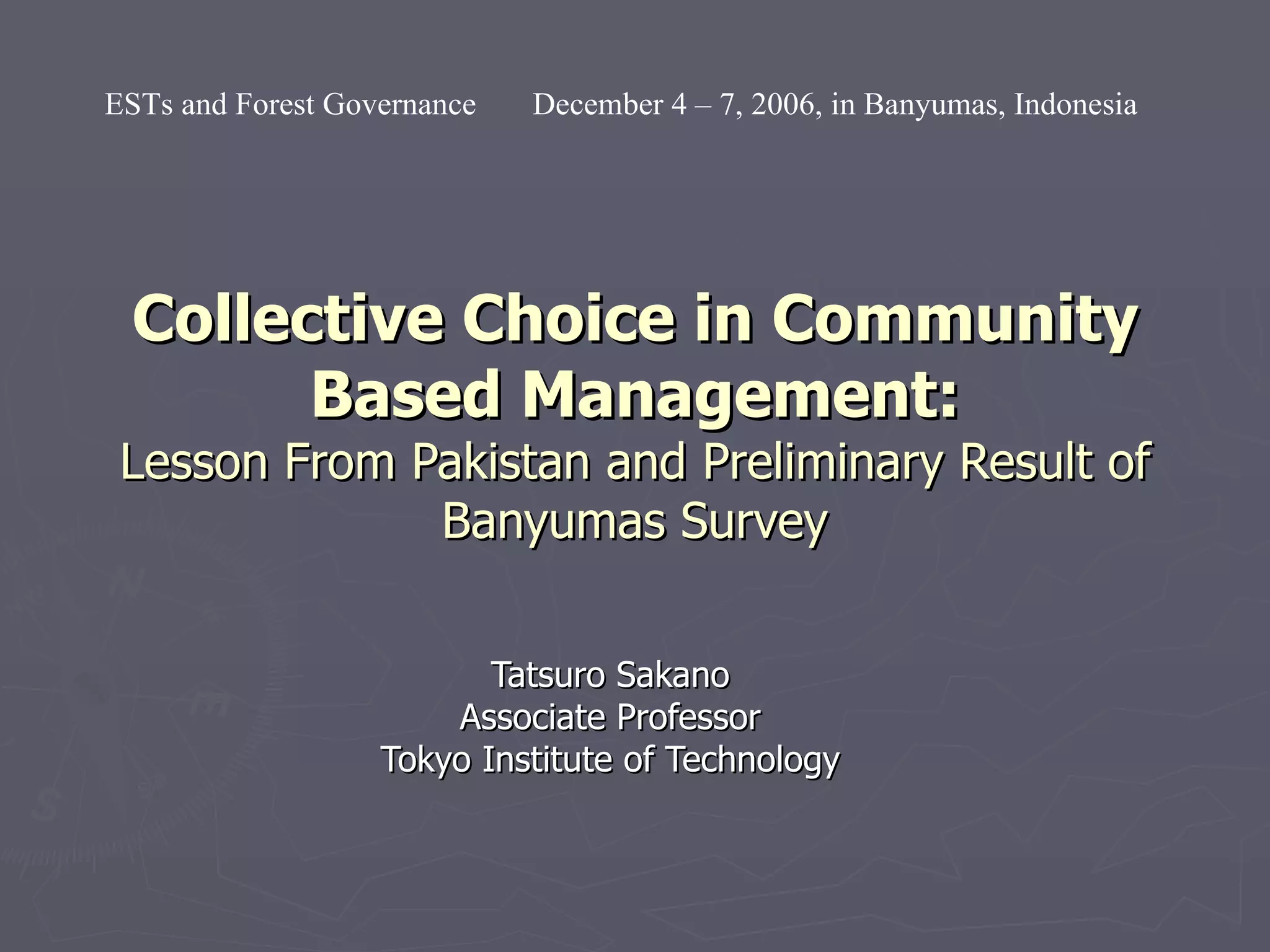
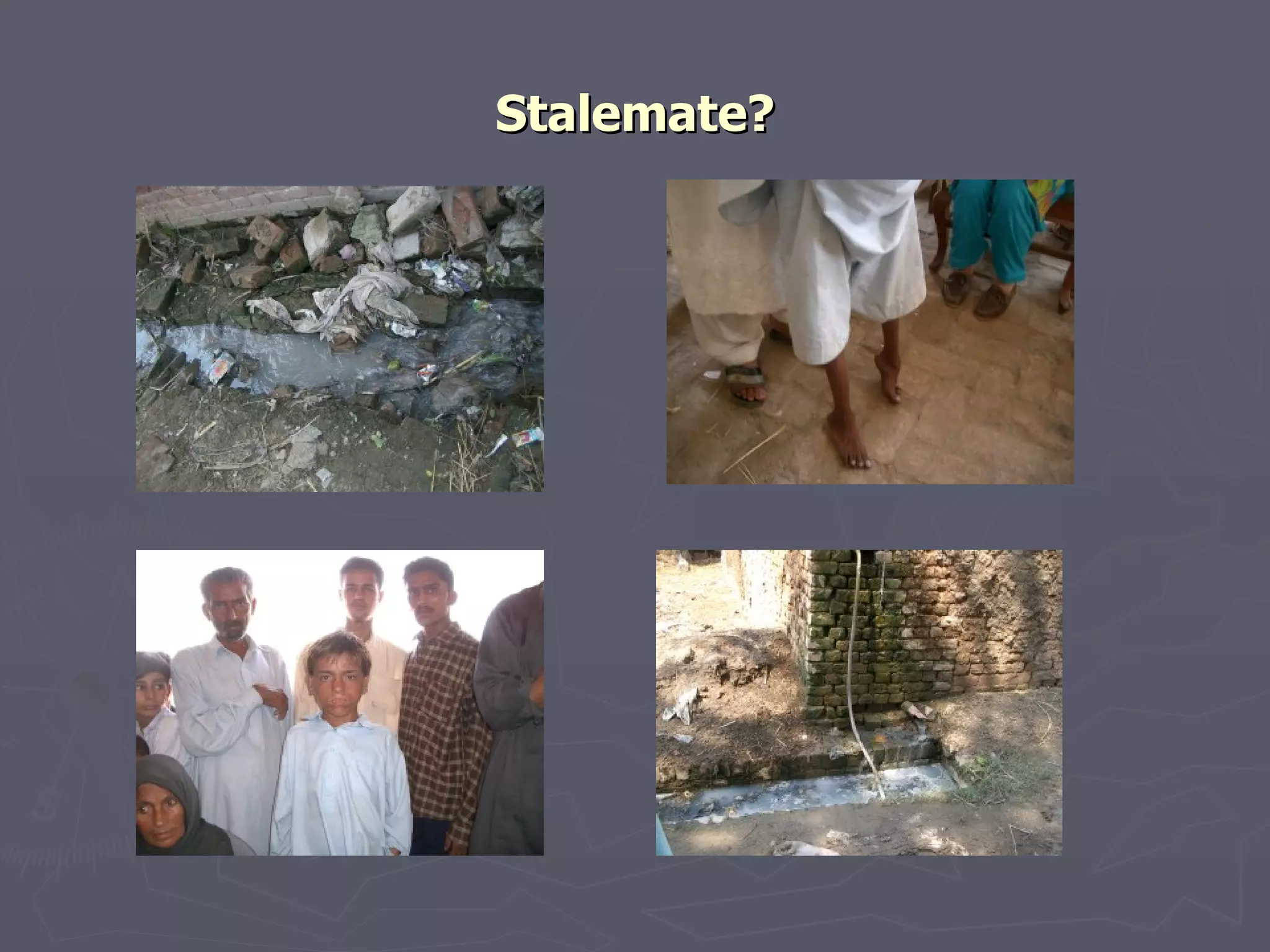
Stalemate? Polarization and trap of poverty Pakistan  GNI  103 rd /143 (2001)       income poverty 25% in 1985 to 30% in 1995   The world seems to be divided into two parts:    the growing/already grown people            v.s.   the ones that cannot escape from the trap of poverty What are the causes?  How can they escape?
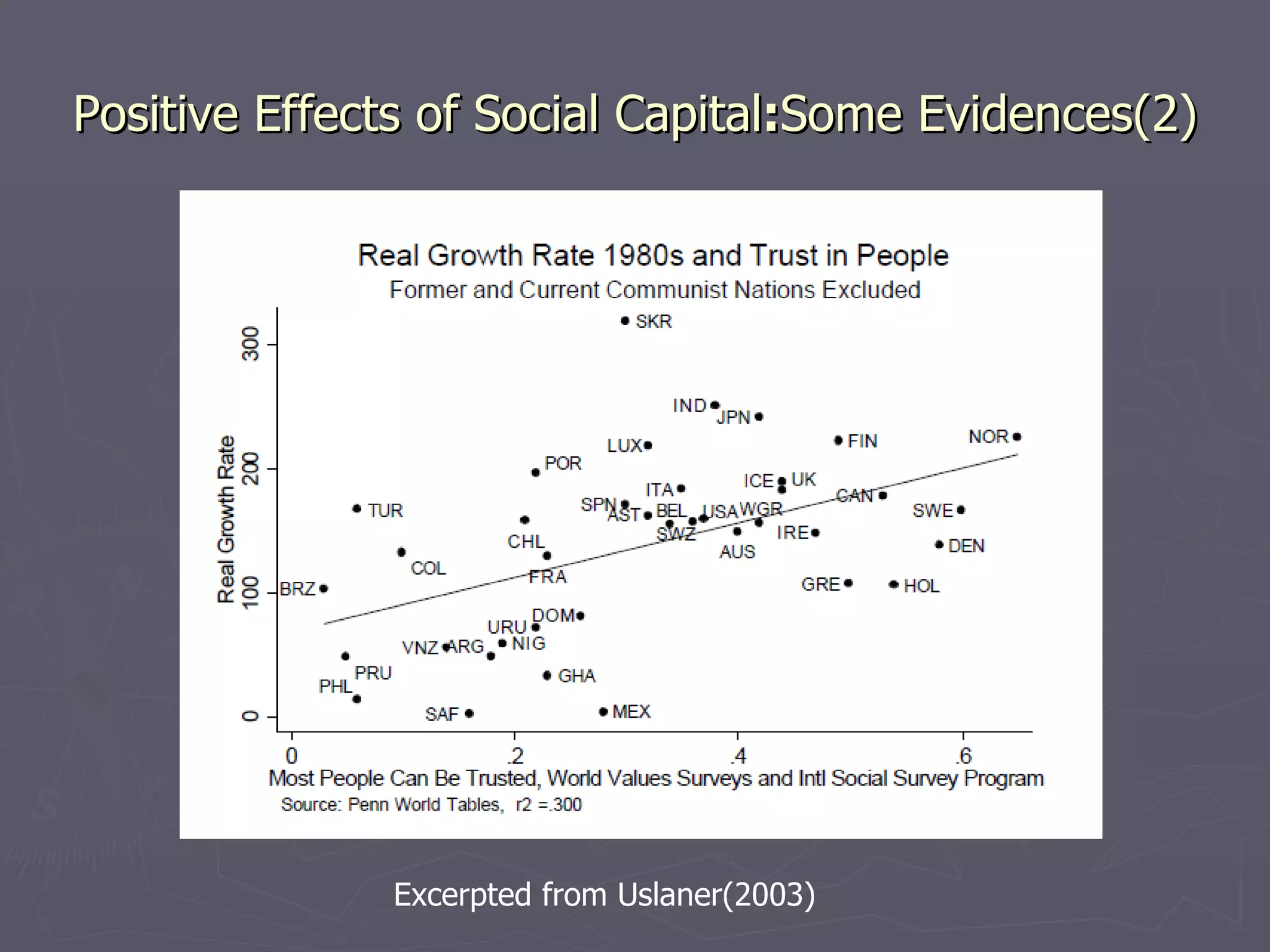
Positive Effects of Social Capital : Some Evidences(2) Excerpted from Uslaner(2003)
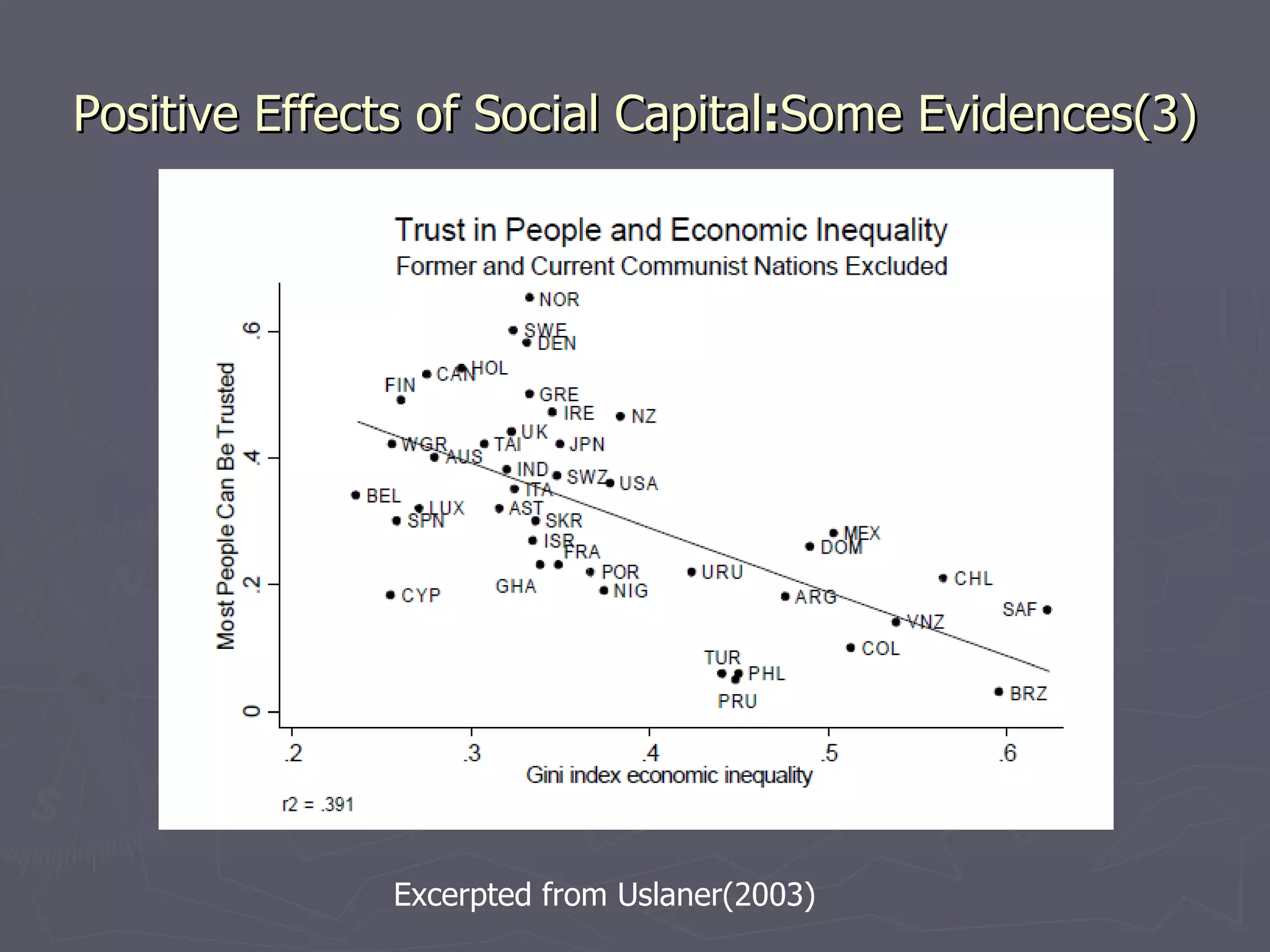
Positive Effects of Social Capital : Some Evidences(3) Excerpted from Uslaner(2003)
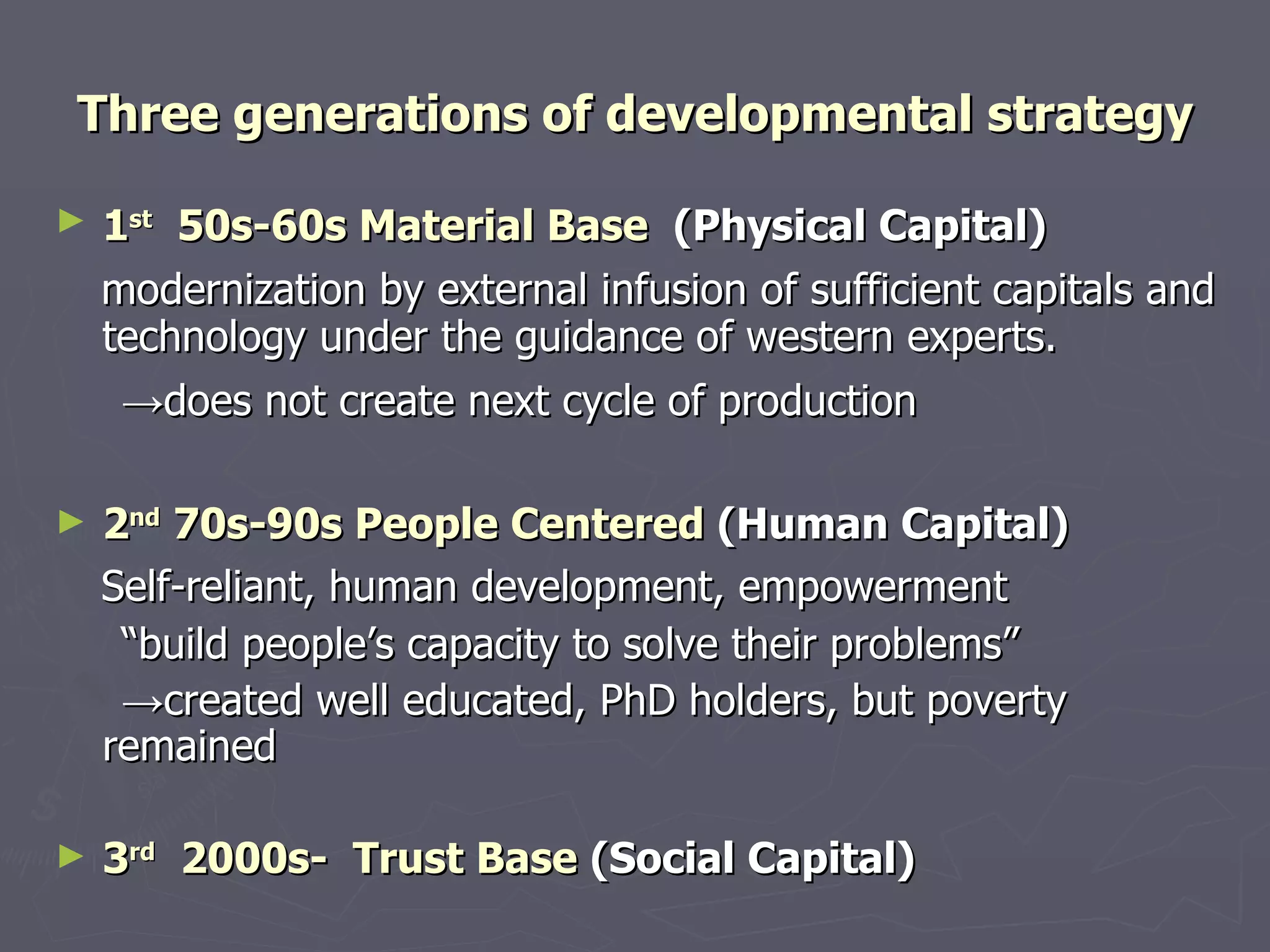
Three generations of developmental strategy 1 st   50s-60s Material Base   (Physical Capital)   modernization by external infusion of sufficient capitals and technology under the guidance of western experts.   -> does not create next cycle of production   2 nd  70s-90s People Centered  (Human Capital) Self-reliant, human development, empowerment  “ build people’s capacity to solve their problems” -> created well  educated, PhD holders, but poverty remained 3 rd   2000s-  Trust Base  (Social Capital)
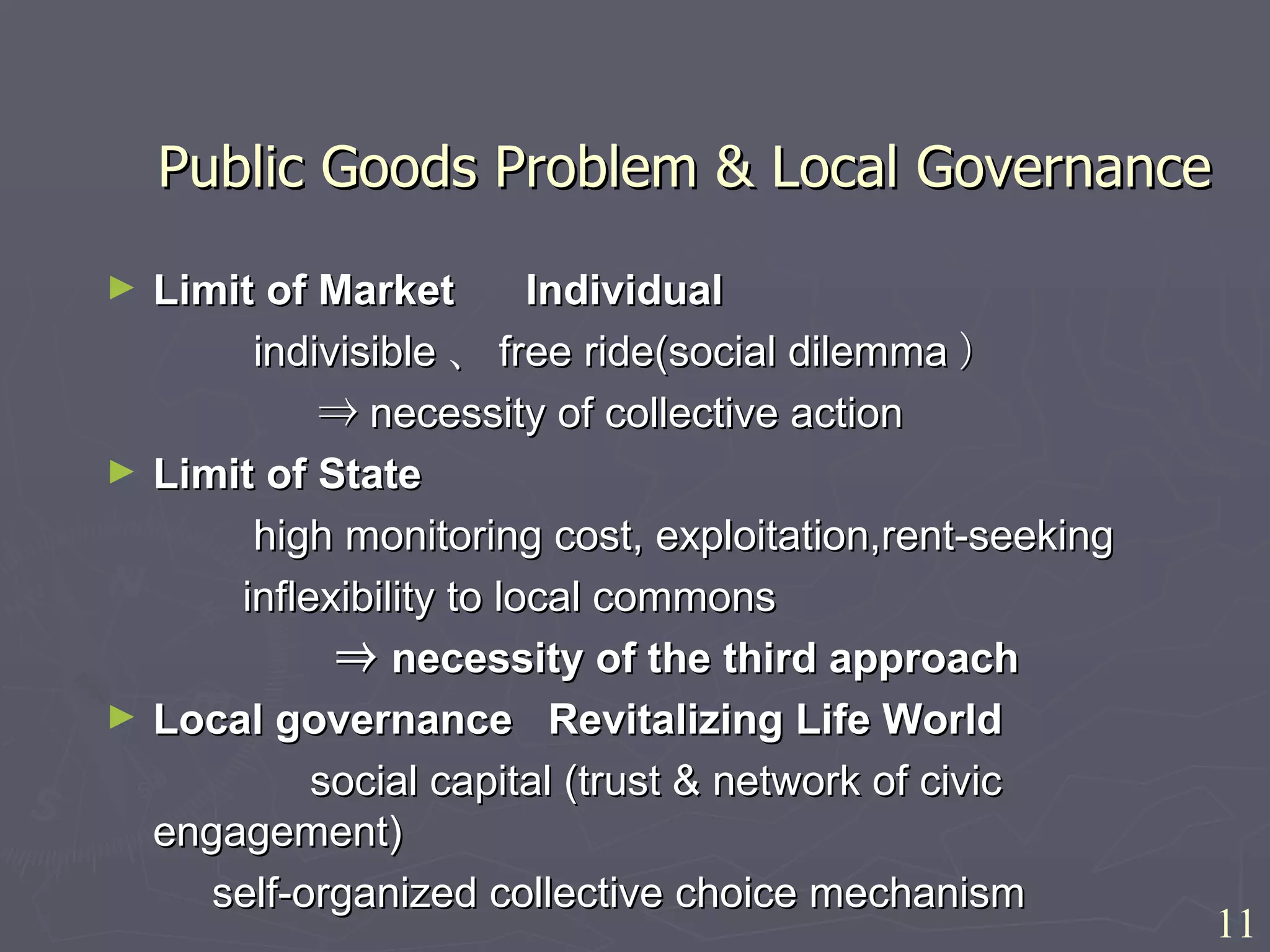
Public Goods Problem & Local Governance Limit of Market  Individual      indivisible 、 free ride(social dilemma )      ⇒ necessity of collective action Limit of State      high monitoring cost, exploitation,rent-seeking     inflexibility to local commons      ⇒ necessity of the third approach Local governance  Revitalizing Life World     social capital (trust & network of civic  engagement) self-organized collective choice mechanism
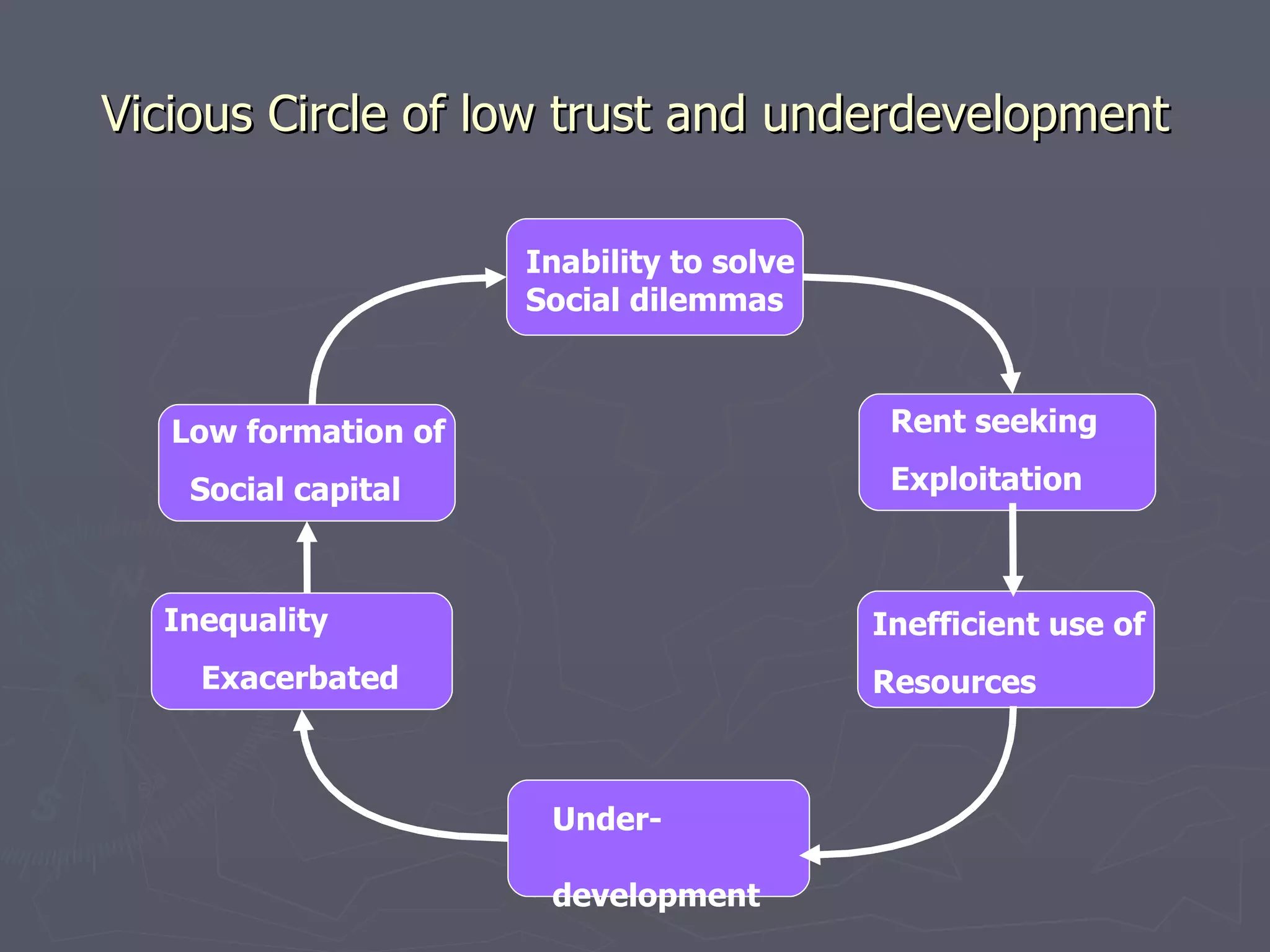
Vicious Circle of low trust and underdevelopment Inefficient use of  Resources Low formation of  Social capital Inability to solve Social dilemmas Rent seeking Exploitation Under-  development Inequality Exacerbated
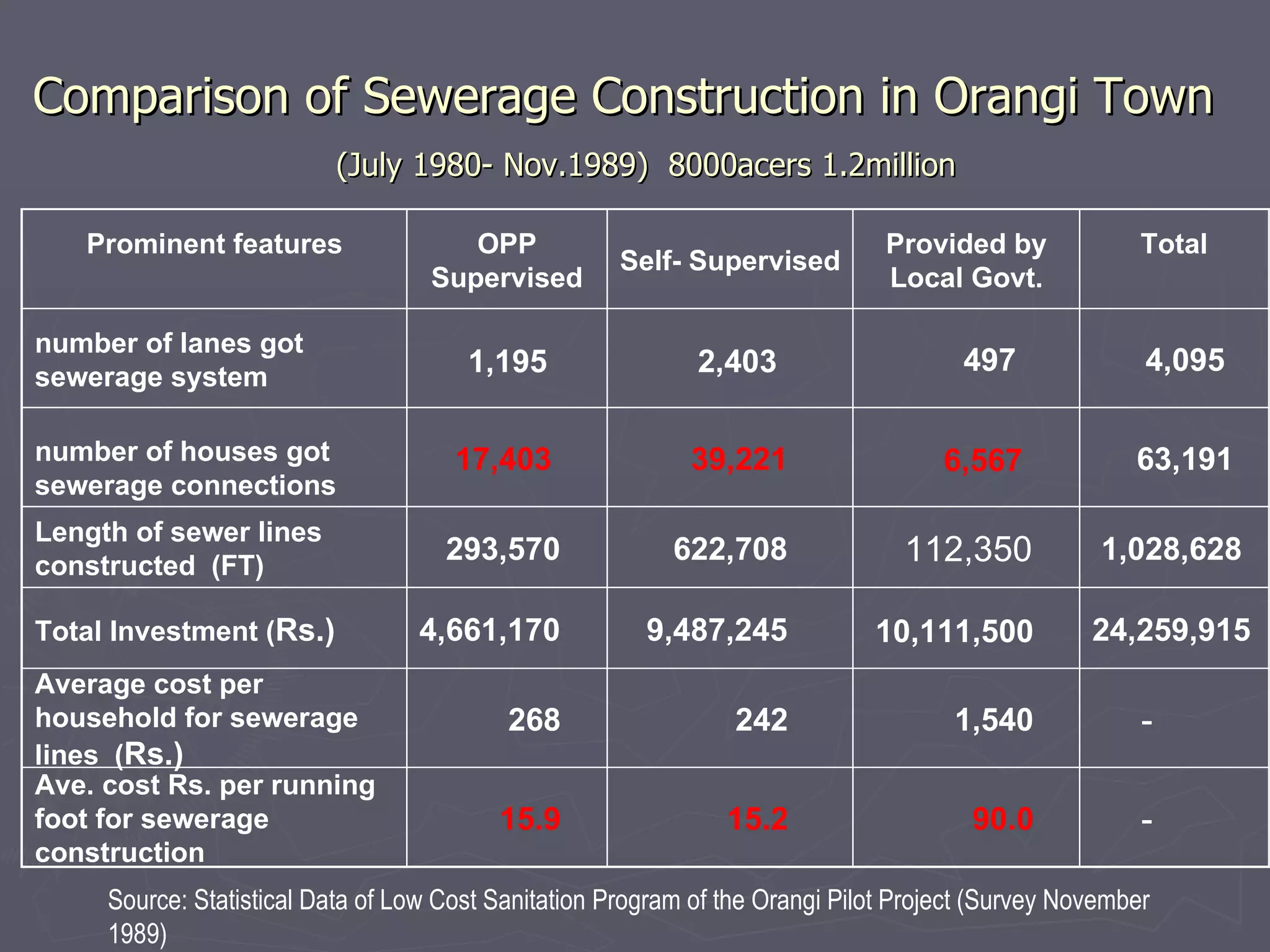
Comparison of Sewerage Construction in Orangi Town (July 1980- Nov.1989)  8000acers 1.2million Source: Statistical Data of Low Cost Sanitation Program of the Orangi Pilot Project (Survey November 1989)  Prominent features OPP Supervised Self- Supervised Provided by Local Govt. Total number of lanes got sewerage system 1,195 2,403 497 4,095 number of houses got sewerage connections   17,403 39,221 6,567 63,191 Length of sewer lines constructed  (FT) 293,570 622,708 112,350 1,028,628  Total Investment ( Rs.)   4,661,170 9,487,245 10,111,500 24,259,915 Average cost per household for sewerage lines  ( Rs.)  268 242 1,540 -  Ave. cost Rs. per running foot for sewerage construction 15.9 15.2 90.0 -
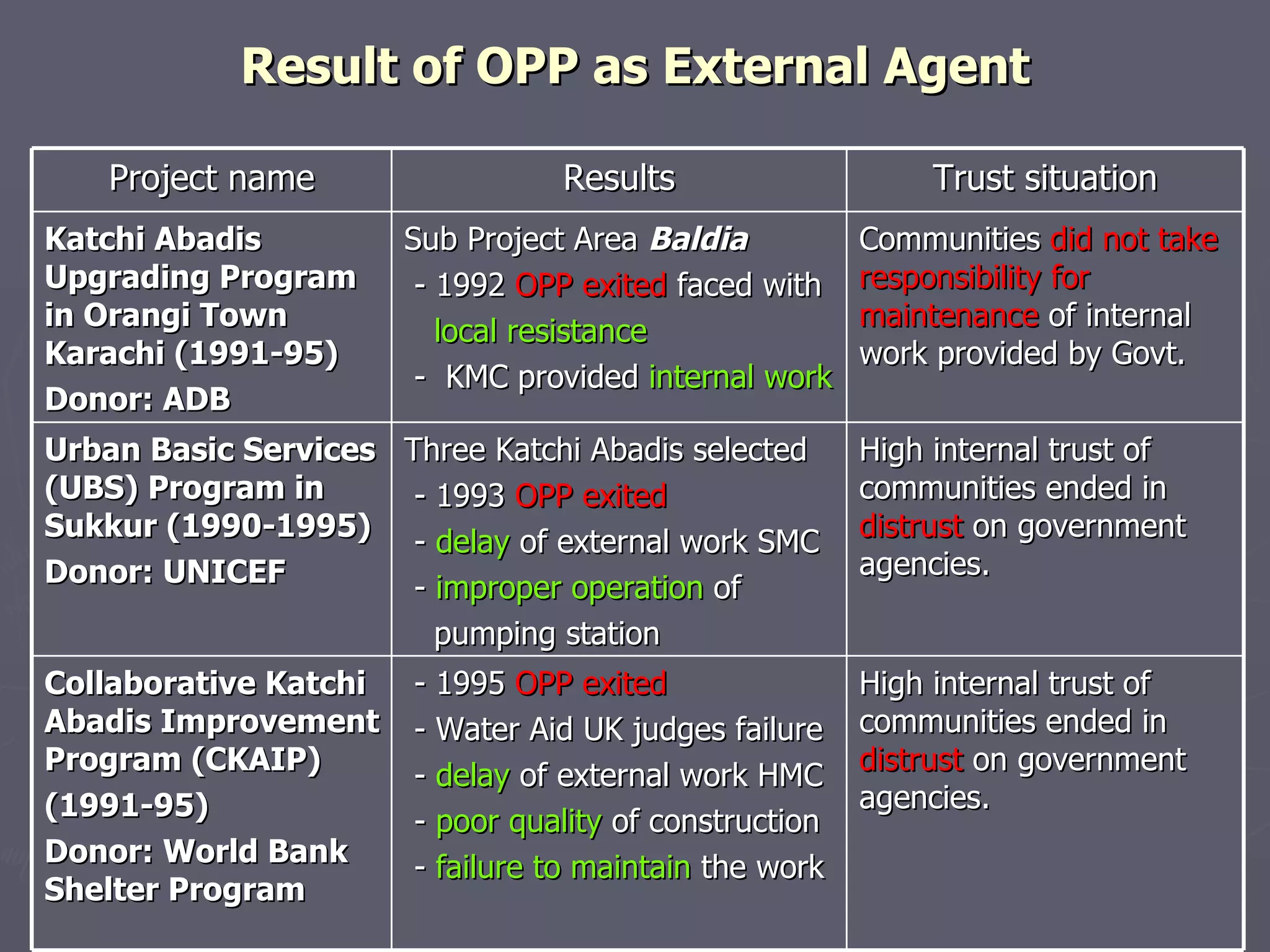
Result of OPP as External Agent Project name Results Trust situation Katchi Abadis Upgrading Program in Orangi Town Karachi (1991-95) Donor: ADB Sub Project Area  Baldia - 1992  OPP exited  faced with local resistance -  KMC provided  internal work   Communities  did not take responsibility for maintenance  of internal work provided by Govt.  Urban Basic Services (UBS) Program in Sukkur (1990-1995) Donor: UNICEF Three Katchi Abadis selected - 1993  OPP exited   -  delay  of external work SMC -  improper operation  of  pumping station High internal trust of communities ended in  distrust  on government agencies. Collaborative Katchi Abadis Improvement Program (CKAIP) (1991-95) Donor: World Bank Shelter Program  - 1995  OPP exited - Water Aid UK judges failure -  delay  of external work HMC -  poor quality  of construction  -  failure to maintain  the work  High internal trust of communities ended in  distrust  on government agencies.
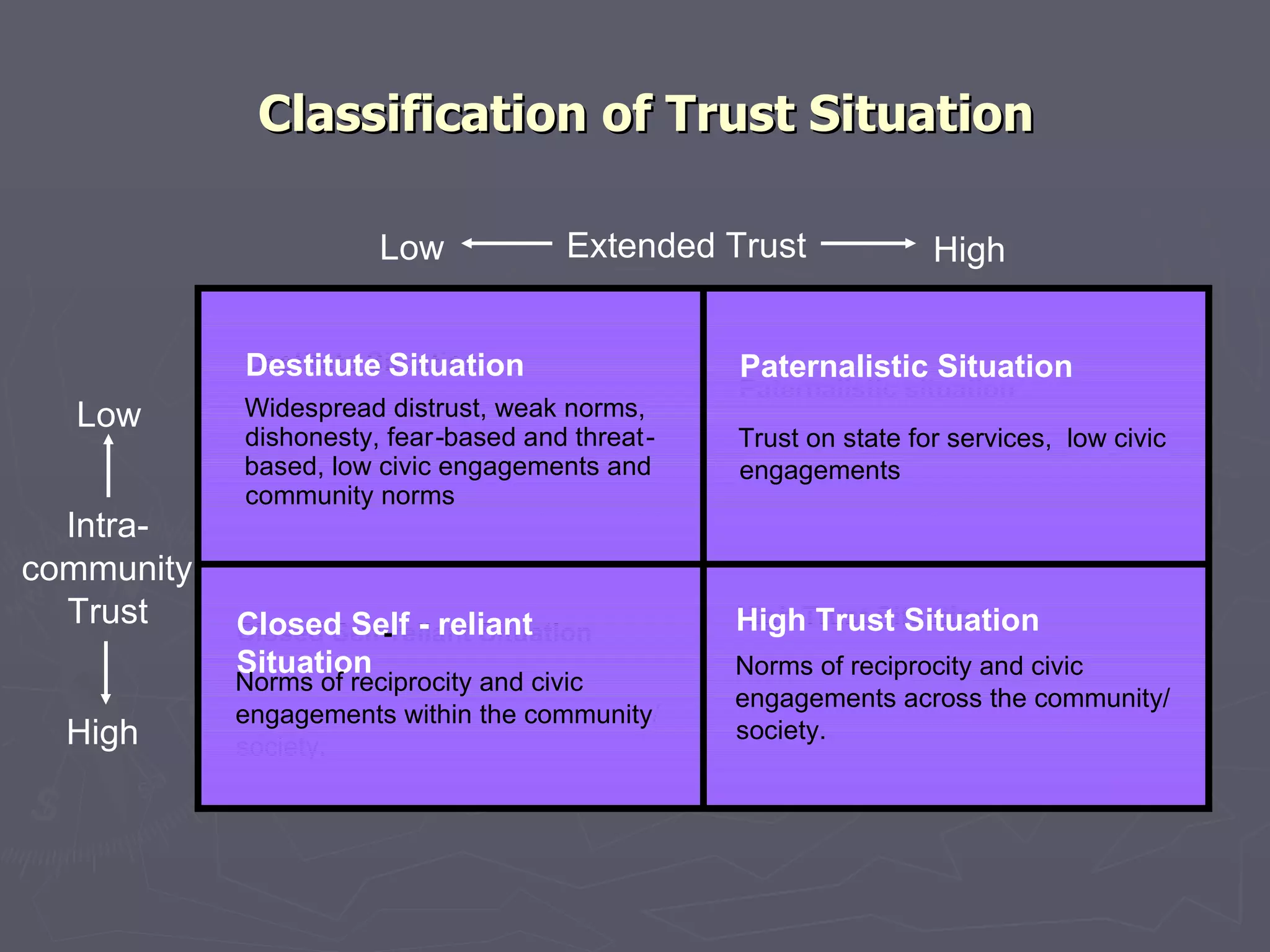
Classification of Trust Situation High Trust Situation  Norms of reciprocity and civic  engagements across the community/  society.  Closed Self - reliant Situation  Norms of reciprocity and civic  engagements within the community/  society. Paternalistic situation  Trust on state for services,  low civic  engagements  Destitute Situation  Widespread distrust, weak norms,  dishonesty, fear - based and threat - based, low civic engagements and  community norms High Trust Situation   Norms of reciprocity and civic  engagements across the community/  society.  Closed Self - reliant Situation  - Norms of reciprocity and civic  engagements within the community Paternalistic Situation   Trust on state for services,  low civic  engagements  Destitute   Situation  Widespread distrust, weak norms,  dishonesty, fear - based and threat - based, low civic engagements and  community norms Extended Trust  Low High Intra- community  Trust  Low High
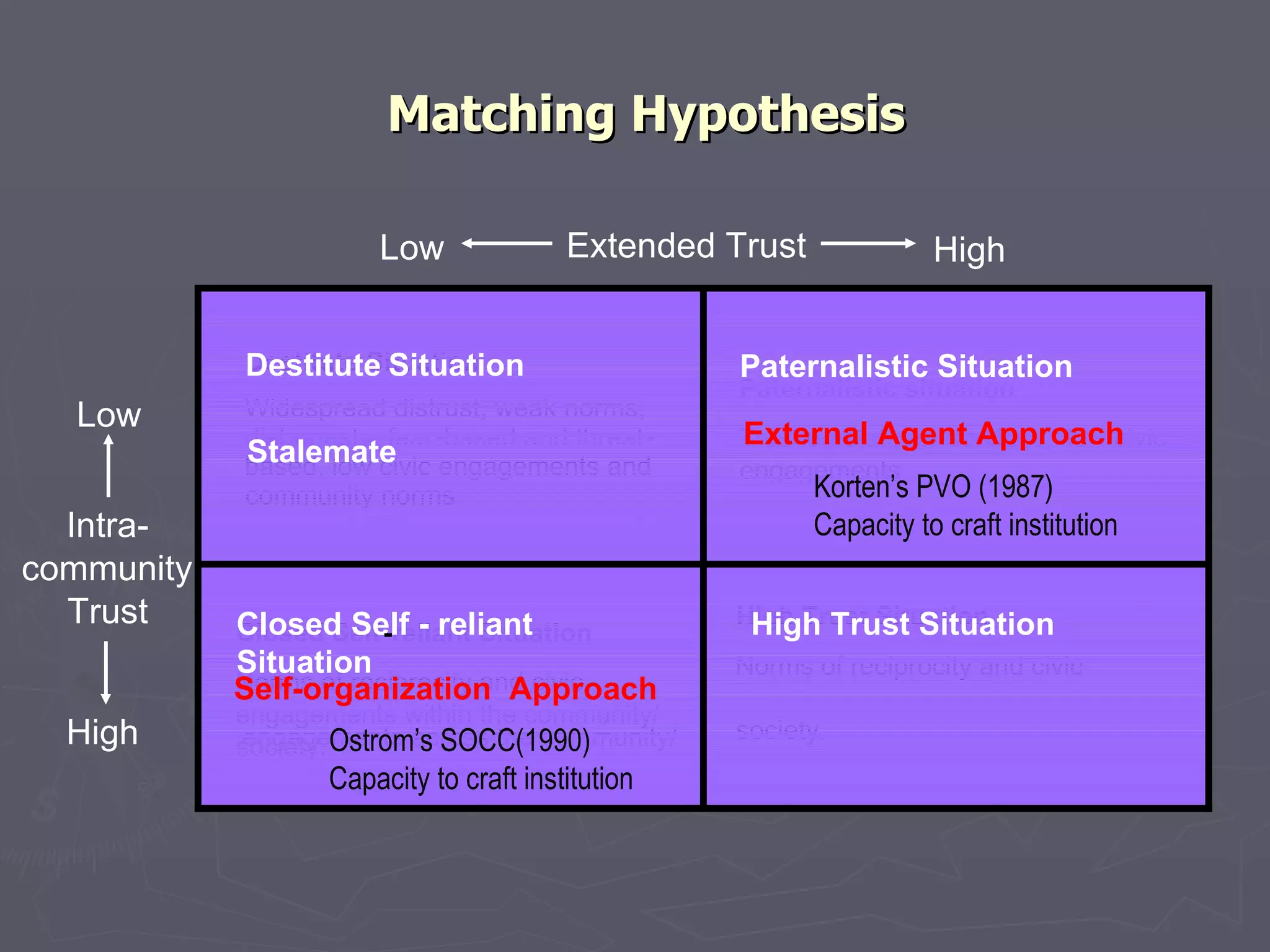
Matching Hypothesis High Trust Situation  Norms of reciprocity and civic  society.  Closed Self - reliant Situation  Norms of reciprocity and civic  engagements within the community/  society. Paternalistic situation  Trust on state for services,  low civic  engagements  Destitute Situation  Widespread distrust, weak norms,  dishonesty, fear - based and threat - based, low civic engagements and  community norms High Trust Situation   engagements across the community/  Closed Self - reliant Situation  - Paternalistic Situation   Destitute   Situation  Extended Trust  Low High Intra- community  Trust  Low High Self-organization  Approach Stalemate External Agent Approach  Ostrom’s SOCC(1990) Capacity to craft institution   Korten’s PVO (1987) Capacity to craft institution
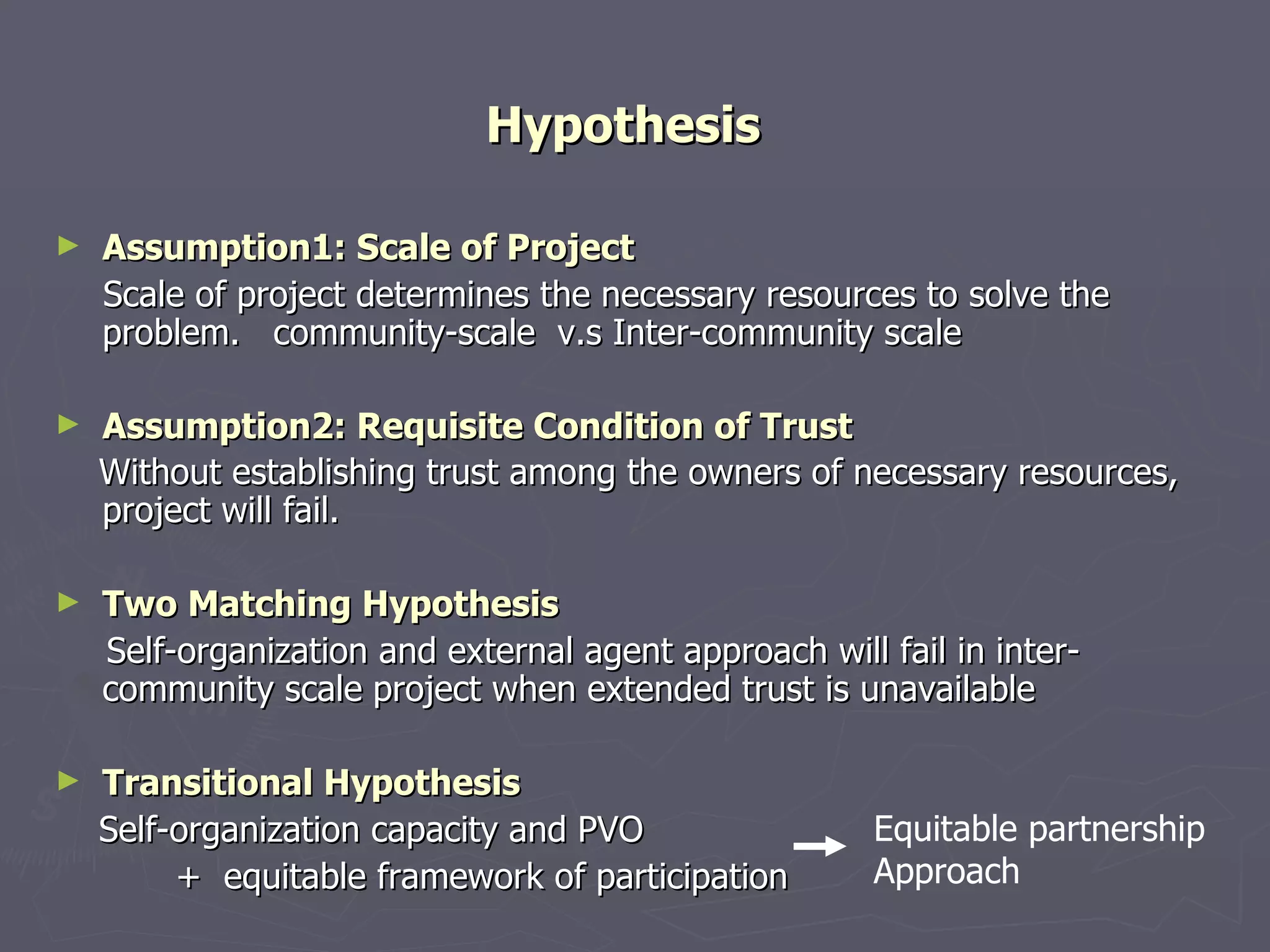
Hypothesis   Assumption1: Scale of Project Scale of project determines the necessary resources to solve the problem .  community-scale   v.s  Inter-community scale Assumption2: Requisite Condition of Trust Without establishing trust among the owners of necessary resources, project will fail.   Two Matching Hypothesis Self-organization and external agent approach will fail in  inter-community scale   project when extended trust is unavailable Transitional Hypothesis   Self-organization capacity and PVO  +  equitable framework of participation  Equitable partnership Approach
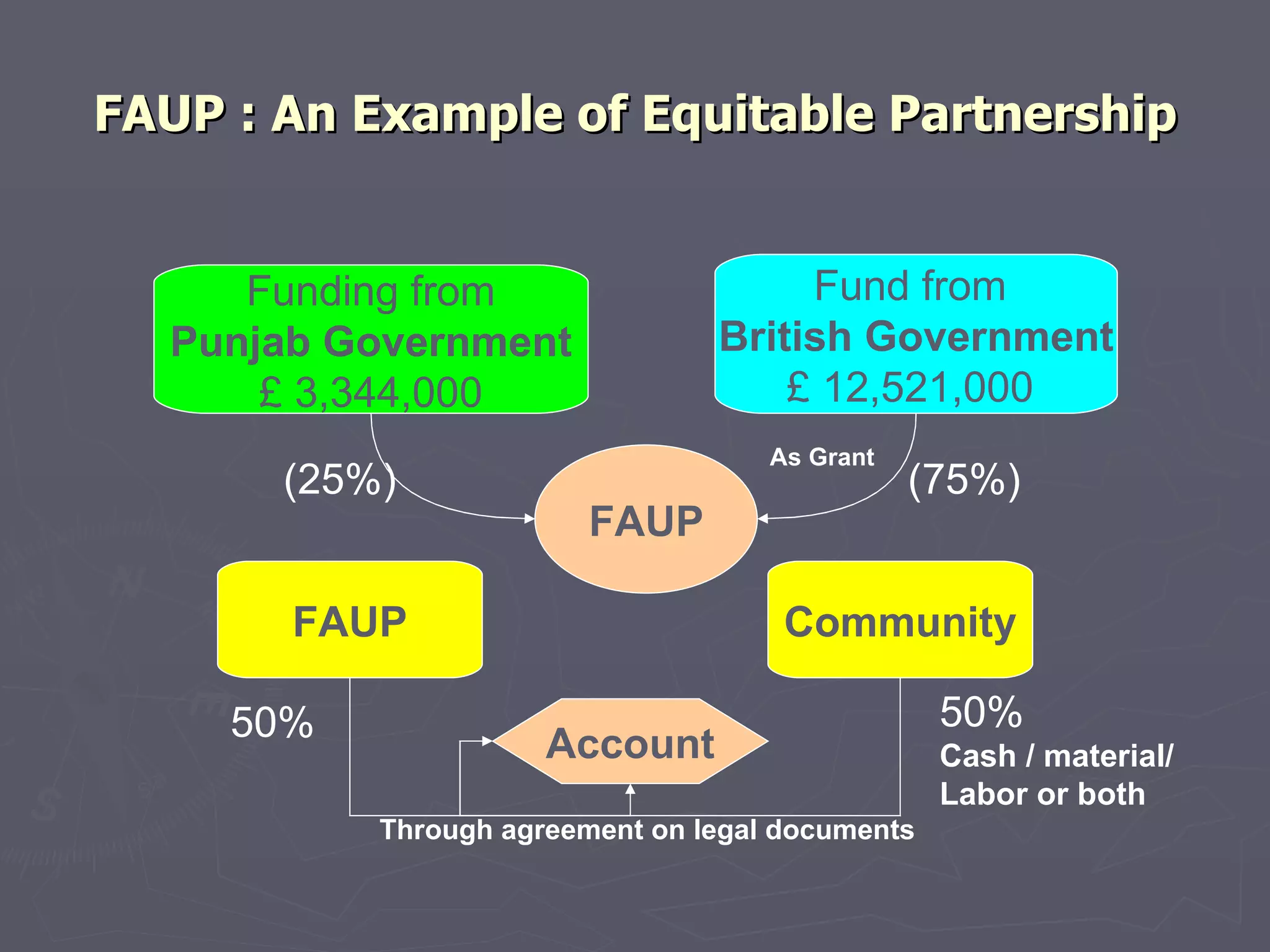
FAUP : An Example of Equitable Partnership Fund from  British Government £ 12,521,000   Funding from Punjab Government £ 3,344,000 FAUP FAUP Community Account 50% 50% Cash / material/ Labor or both (25%) (75%) Through agreement on legal documents As Grant
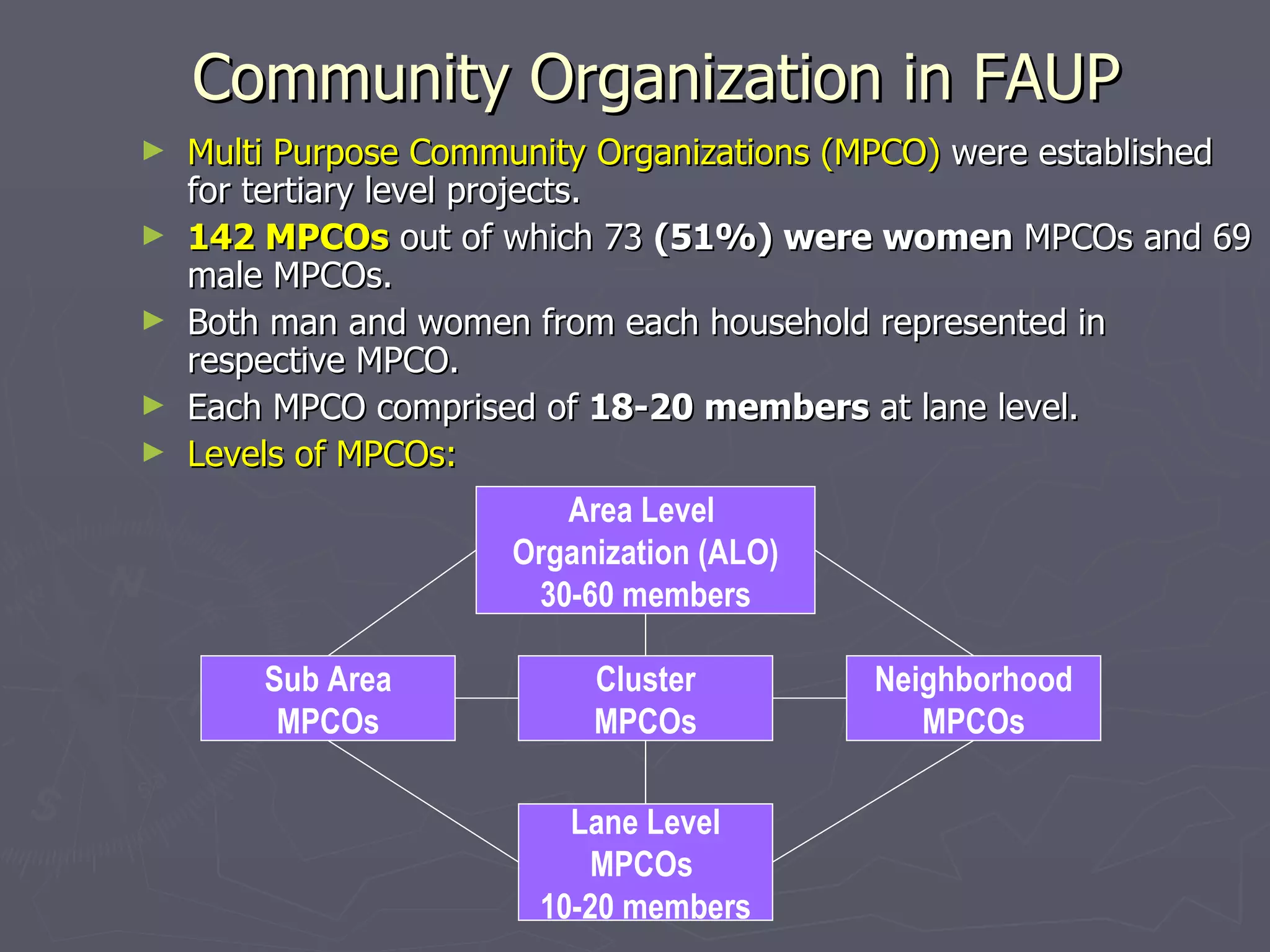
Community Organization in FAUP Multi Purpose Community Organizations   (MPCO)  were established for tertiary level projects. 142 MPCOs  out of which 73  (51%) were women  MPCOs and 69 male MPCOs. Both man and women from each household represented in respective MPCO. Each MPCO comprised of  18-20 members  at lane level. Levels of MPCOs: Sub Area MPCOs Cluster MPCOs Neighborhood MPCOs Lane Level MPCOs  10-20 members Area Level  Organization (ALO) 30-60 members
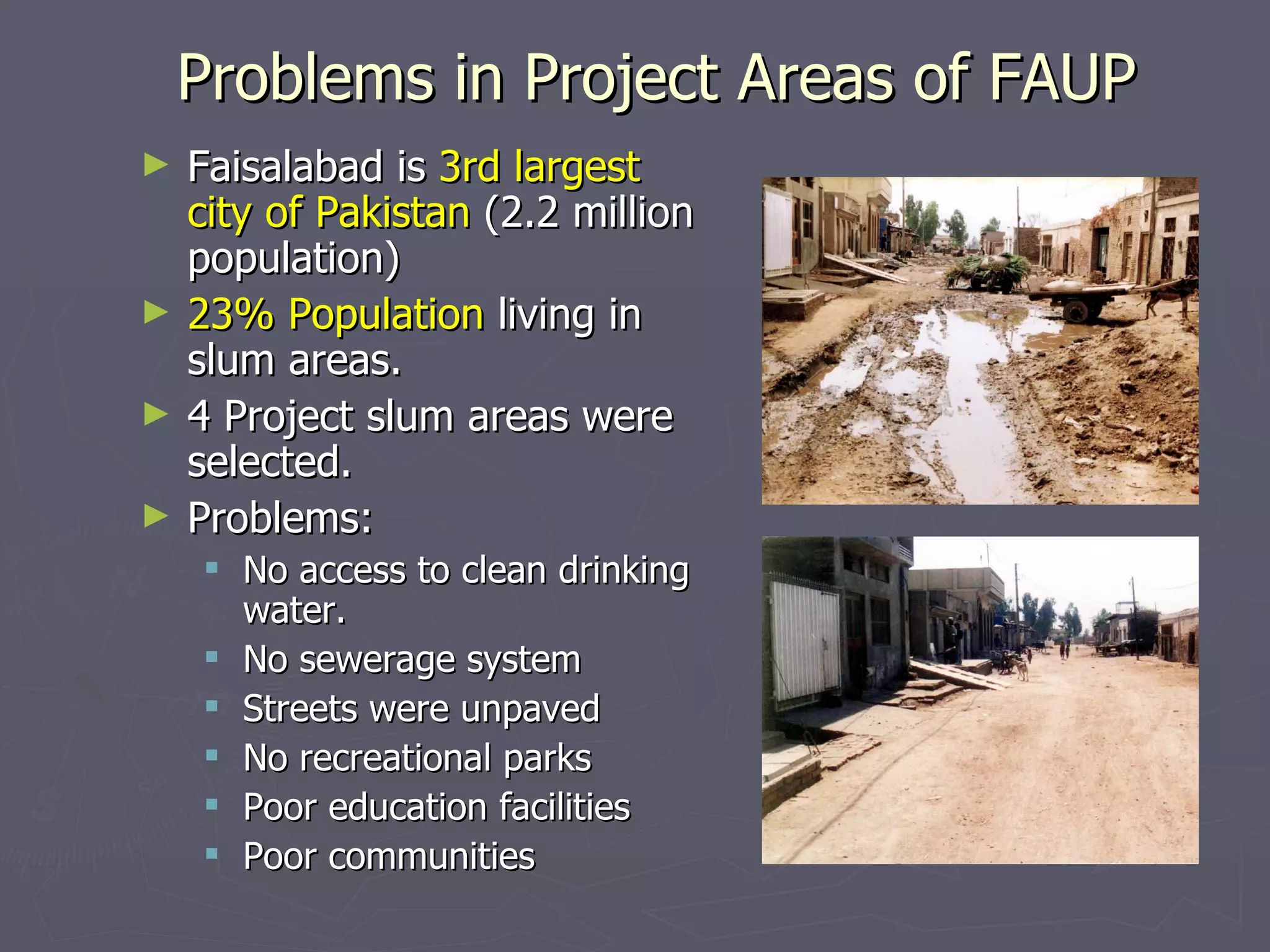
Problems in Project Areas of FAUP Faisalabad is  3rd largest city of Pakistan  (2.2 million population) 23% Population  living in slum areas. 4 Project slum areas were selected.  Problems: No access to clean drinking water. No sewerage system Streets were unpaved No recreational parks Poor education facilities Poor communities
Conclusion Trust is the key for development External Agent Approach, exemplified by PVO, dose not work in low extended trust situation For small scale projects, local community has capacity to solve the problem but not for larger scale Society based account, typically Fukuyama, under-estimates the capacity of local community and Ostrom overestimates it. Dichotomy of low and high trust society is too simple The transitional path should be explored along the institutional account The path is Equitable partnership approach Self-organization capacity and PVO  +  equitable framework of participation
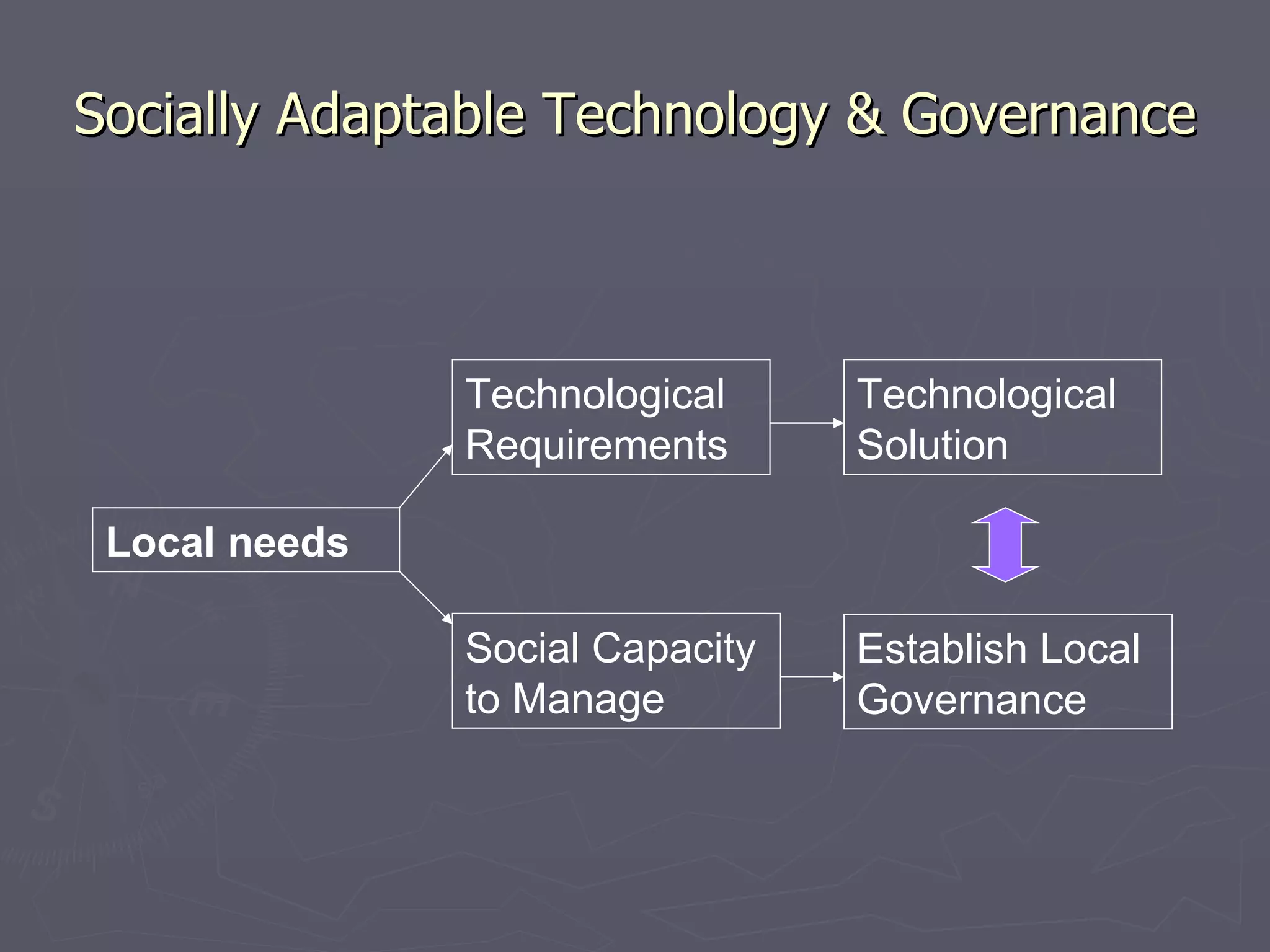
Socially Adaptable Technology & Governance Local needs Technological  Requirements Social Capacity to Manage Technological  Solution Establish Local Governance
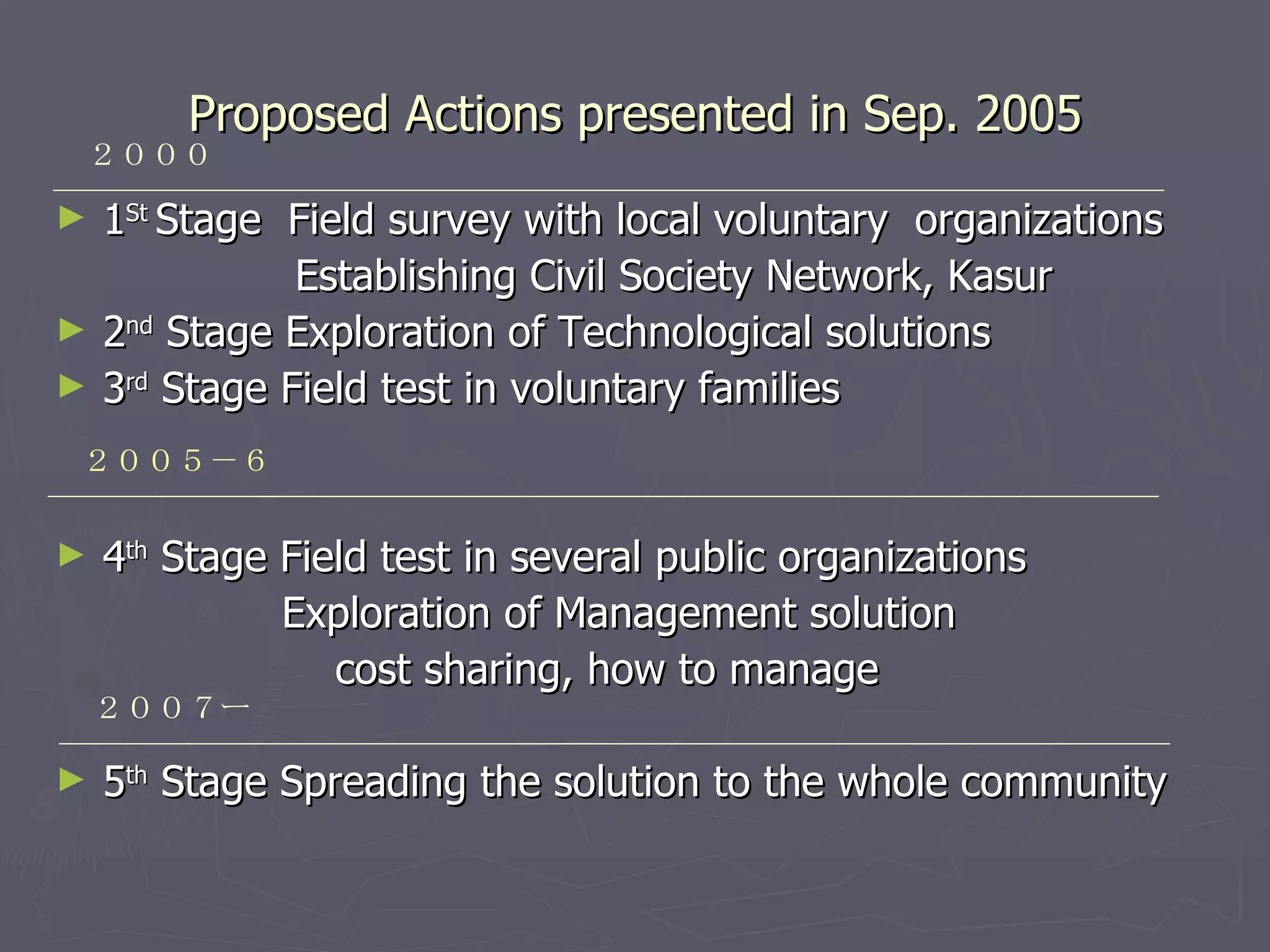
Proposed Actions presented in Sep. 2005 1 St  Stage  Field survey with local voluntary  organizations  Establishing Civil Society Network, Kasur  2 nd  Stage Exploration of Technological solutions  3 rd  Stage Field test in voluntary families 4 th  Stage Field test in several public organizations Exploration of Management solution cost sharing, how to manage 5 th  Stage Spreading the solution to the whole community 2000 2005-6 2007ー
New Strategy Problem of Household/small community as operation unit maintenance cost to low income household Advantage of New Solution: Clean Water Club low production cost when centralized by a large system high competitiveness to Pet bottled water and municipal water in terms of cost and quality, high marketability even to tanneries ⇒ establish production company & Clean Water Club ⇒ distribute water to the members of the club maintenance free for consumers expel fake/low quality pet  bottled water raise awareness and encourage civic action profit may be used for environmental monitoring and epidemic survey
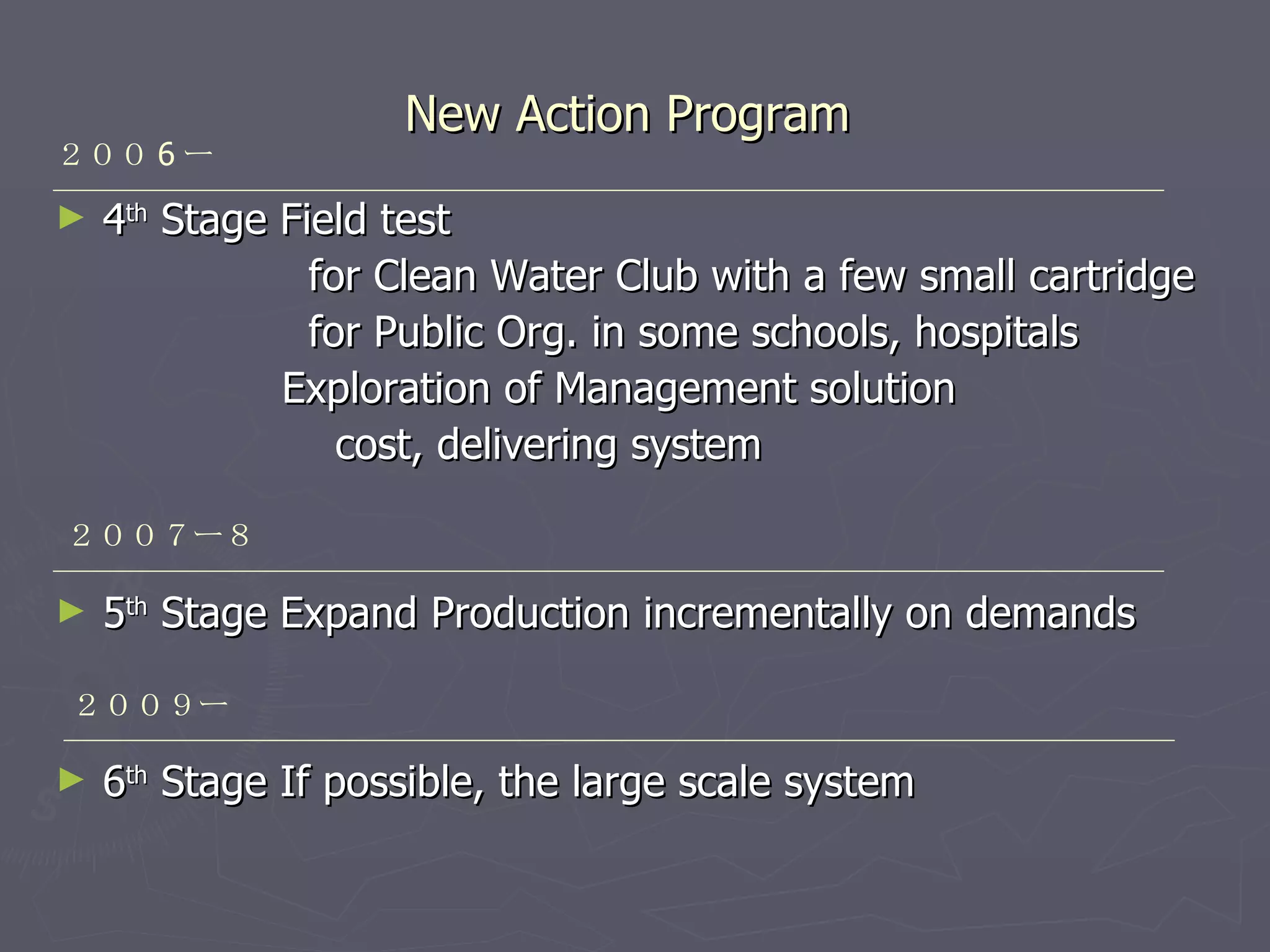
New Action Program  4 th  Stage Field test  for Clean Water Club with a few small cartridge for Public Org. in some schools, hospitals Exploration of Management solution cost, delivering system 5 th  Stage Expand Production incrementally on demands 6 th  Stage If possible, the large scale system  200 6 ー 2007ー8 2009ー
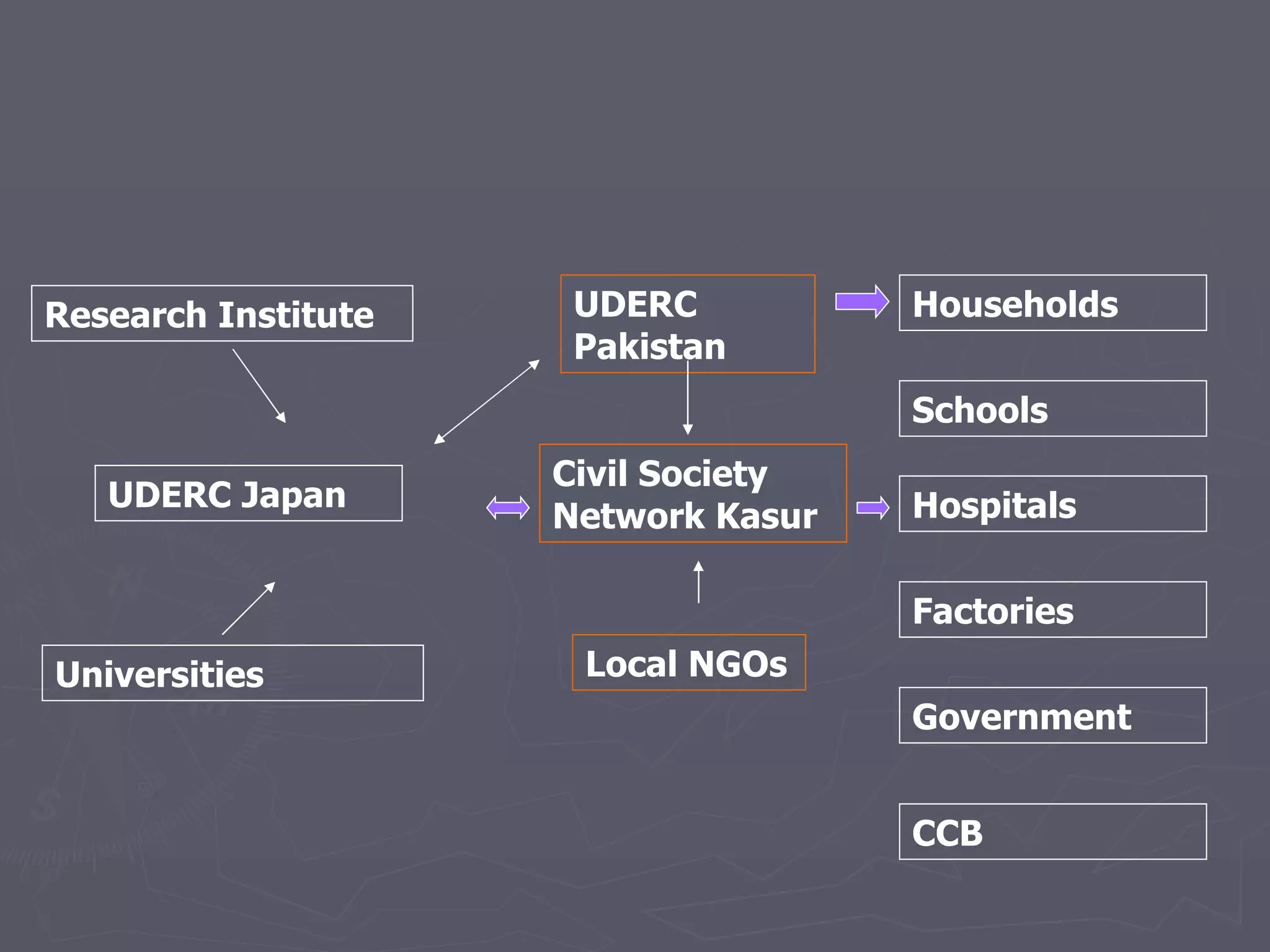
Civil Society Network Kasur Households Schools Hospitals Factories  UDERC Japan Government UDERC Pakistan Research Institute Universities Local NGOs CCB
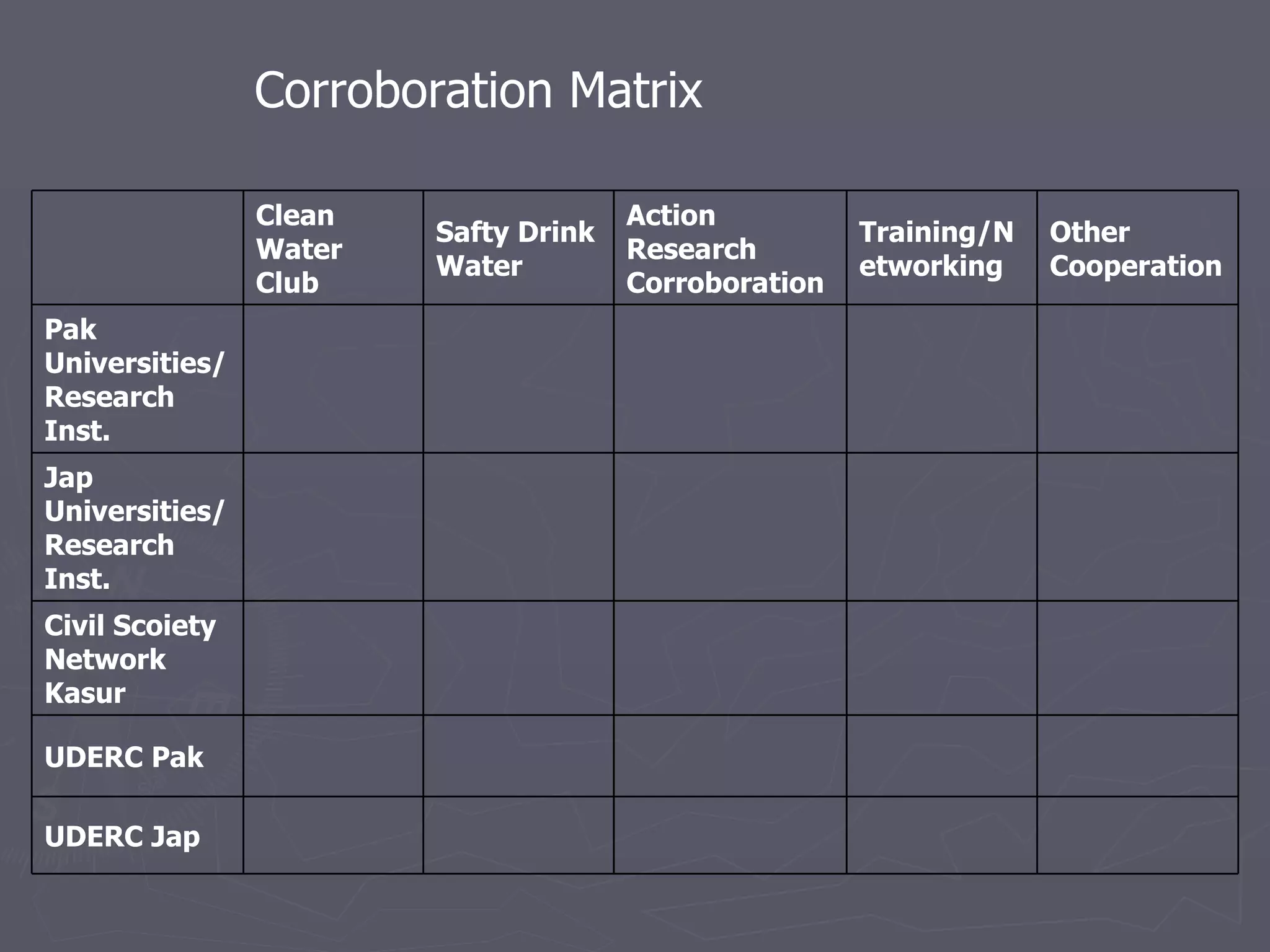
Corroboration Matrix   Clean Water Club Safty Drink Water Action Research Corroboration Training/Networking Other Cooperation Pak Universities/ Research Inst.           Jap Universities/ Research Inst.           Civil Scoiety Network Kasur           UDERC Pak           UDERC Jap          
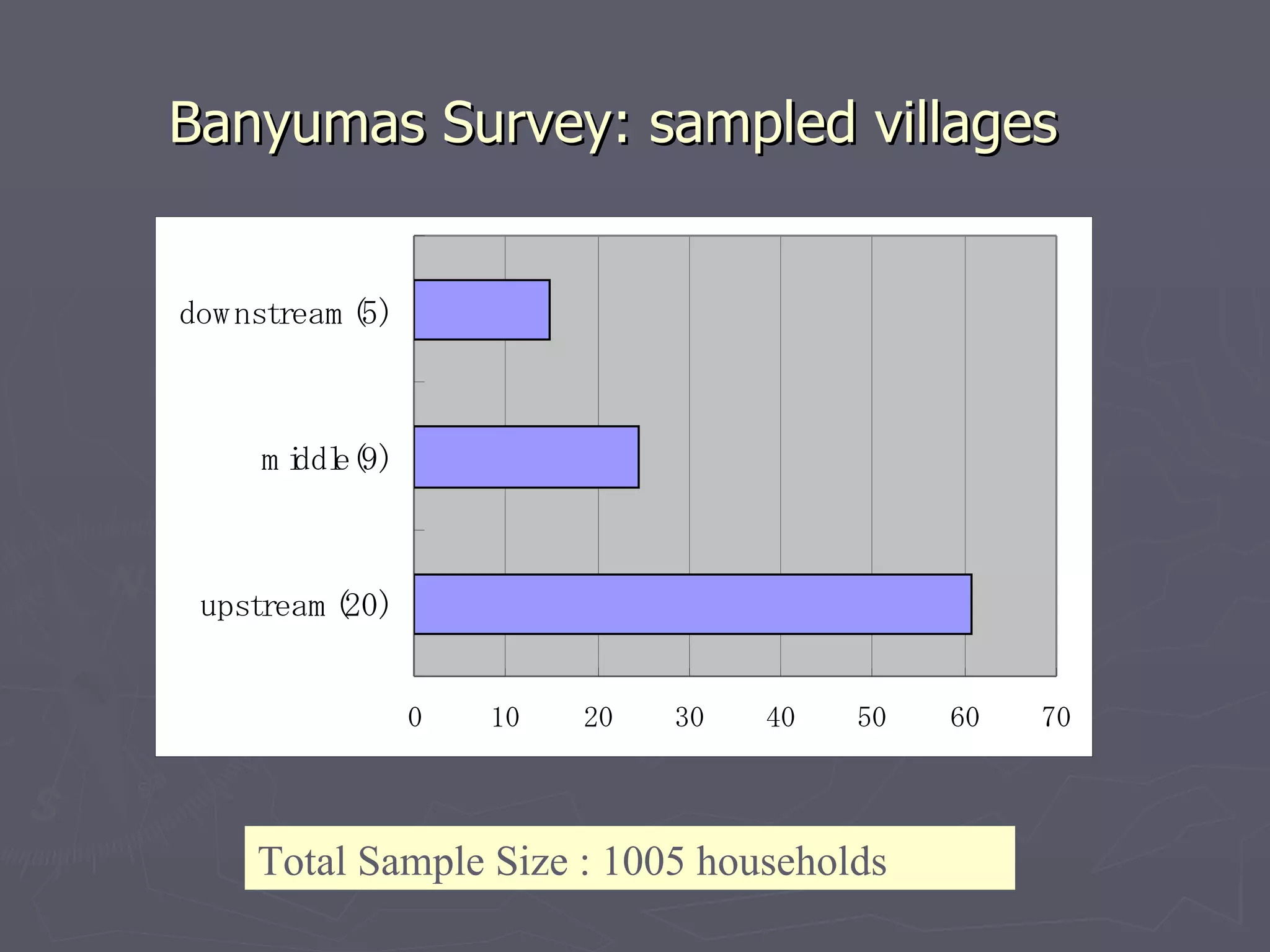
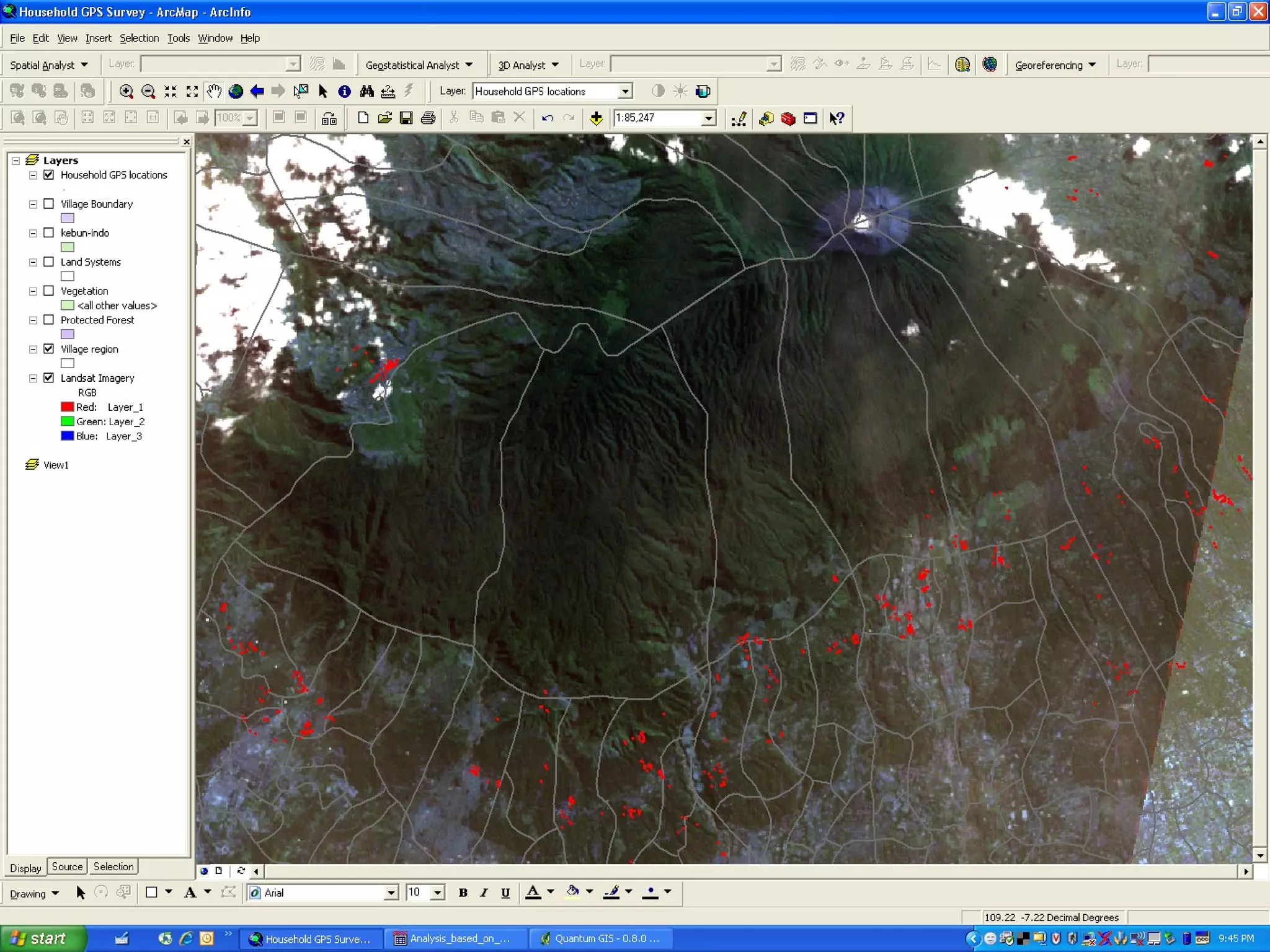
Banyumas Survey: sampled villages   Total Sample Size : 1005 households
 
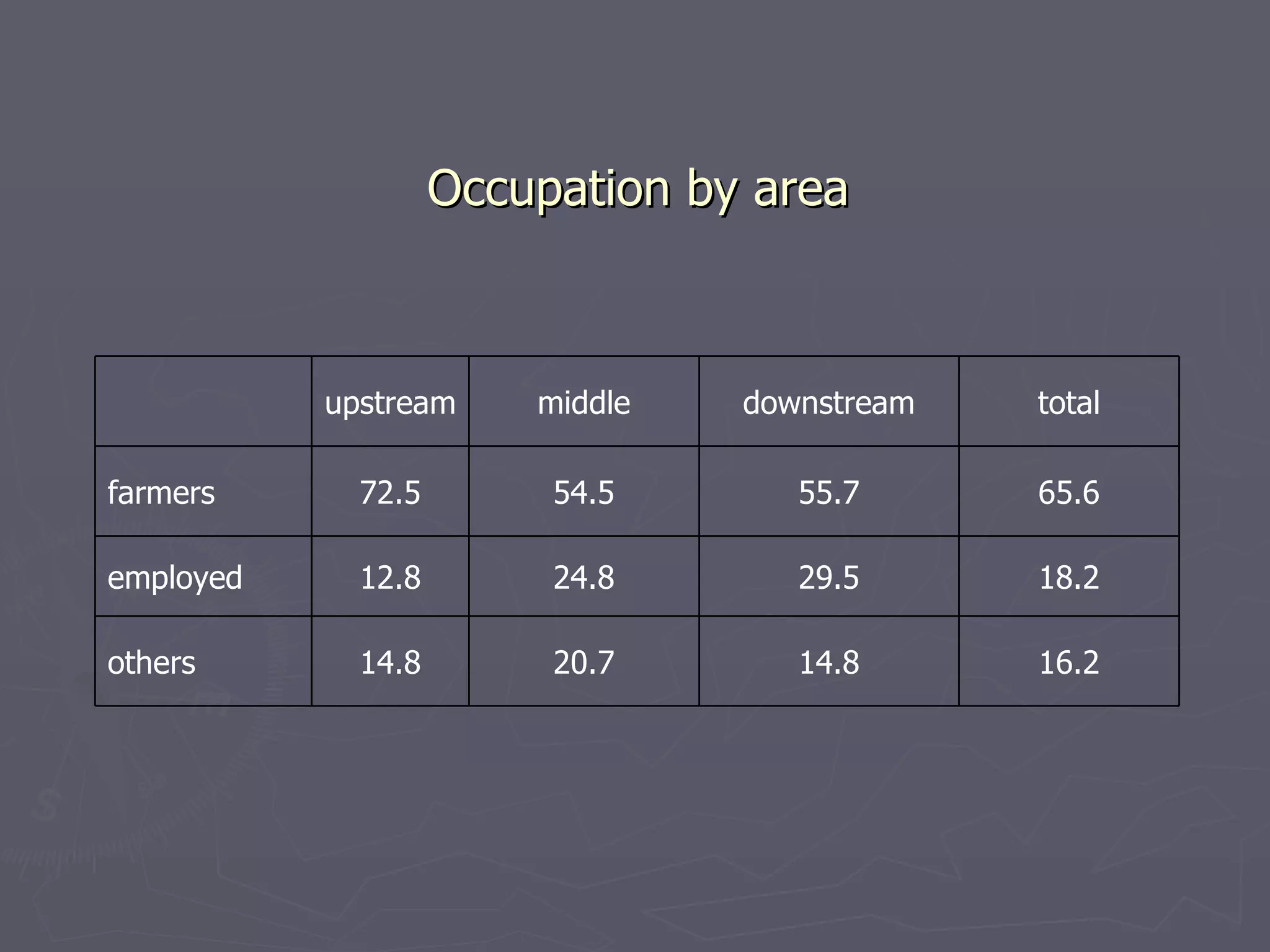
Occupation by area   upstream middle downstream total farmers 72.5 54.5 55.7 65.6 employed 12.8 24.8 29.5 18.2 others 14.8 20.7 14.8 16.2
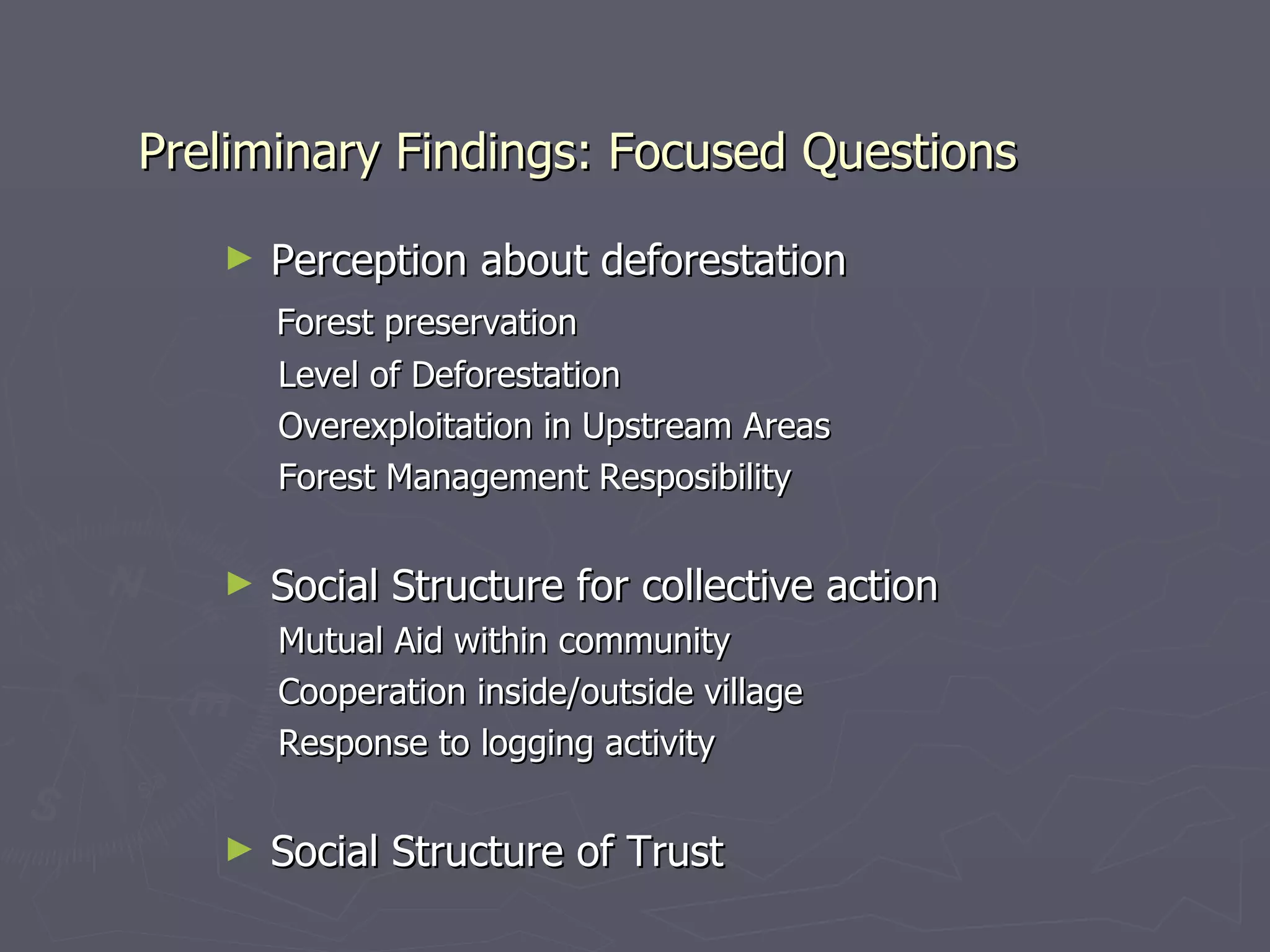
Preliminary Findings: Focused Questions Perception about deforestation Forest preservation Level of Deforestation Overexploitation in Upstream Areas Forest Management Resposibility Social Structure for collective action Mutual Aid within community Cooperation inside/outside village Response to logging activity Social Structure of Trust
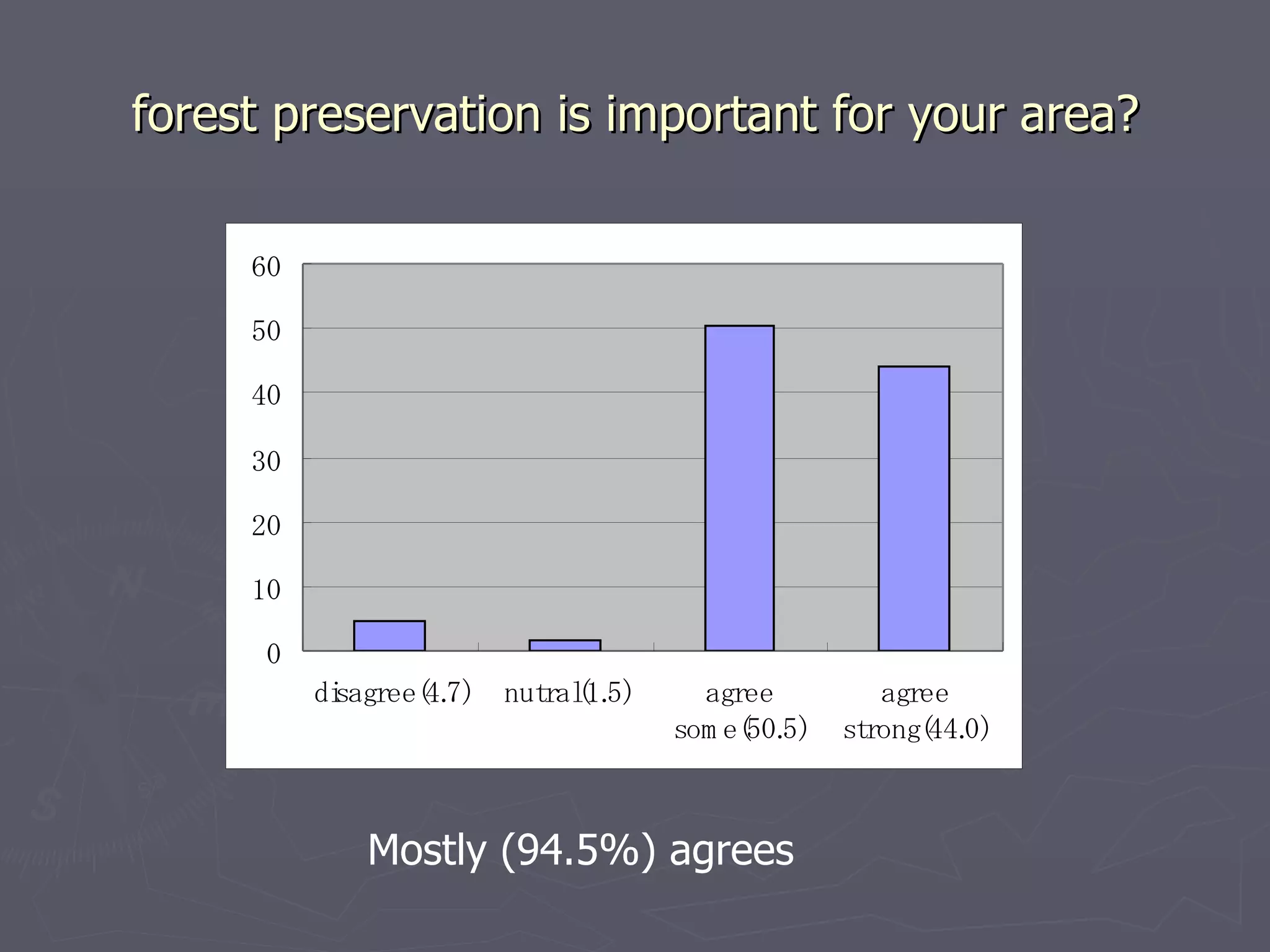
forest preservation is important for your area? Mostly (94.5%) agrees
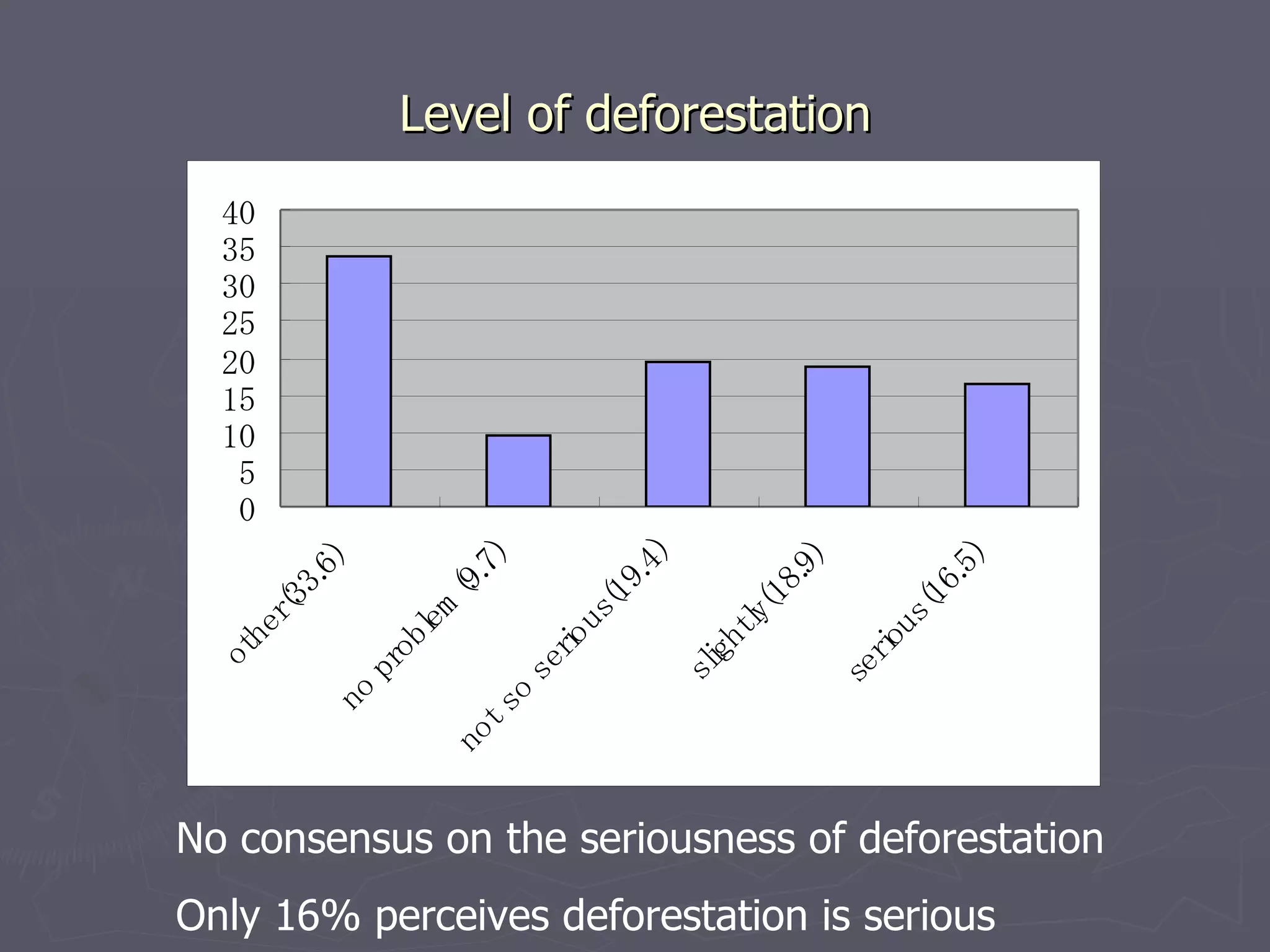
Level of deforestation No consensus on the seriousness of deforestation Only 16% perceives deforestation is serious
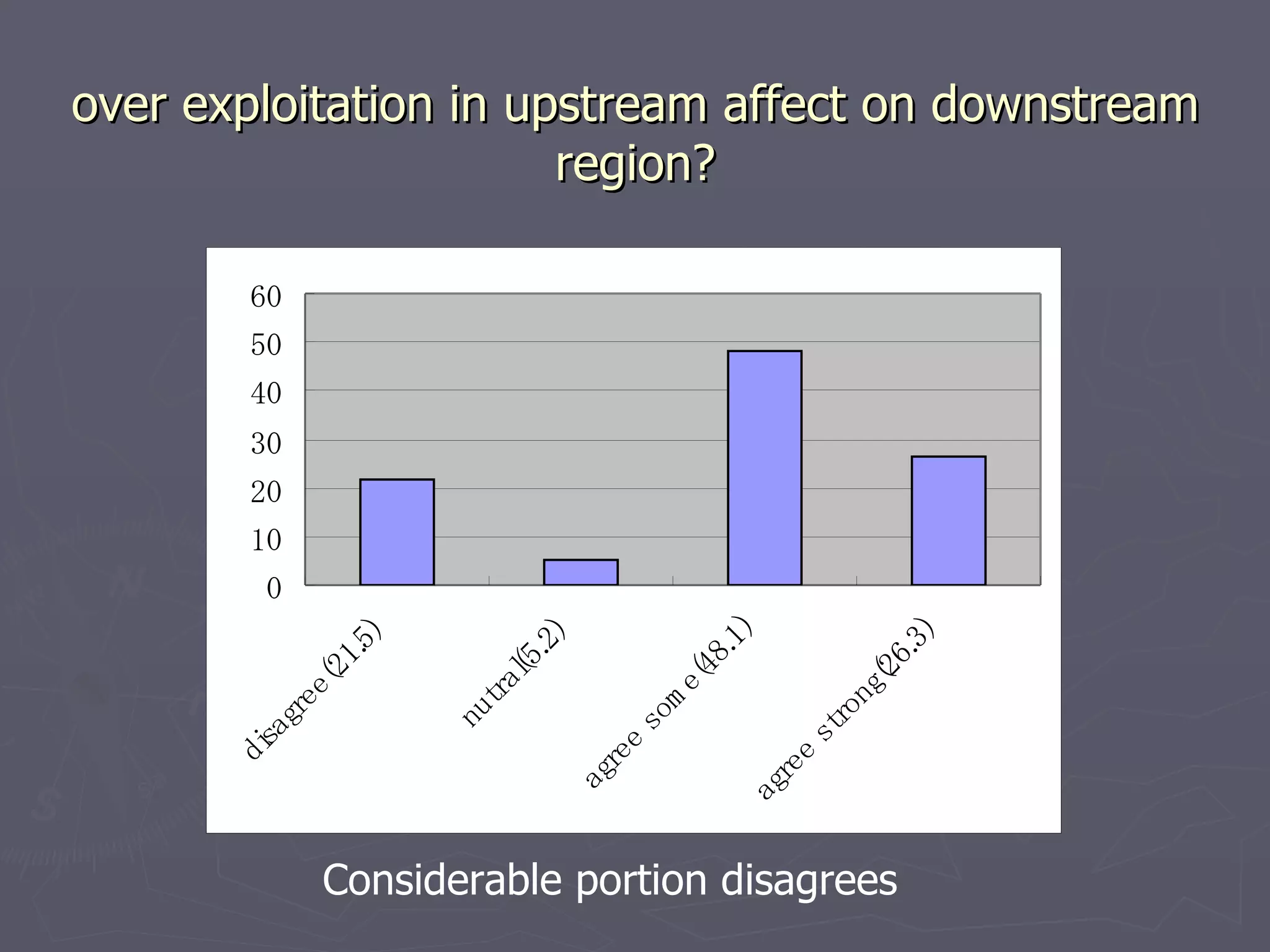
over exploitation in upstream affect on downstream region? Considerable portion disagrees
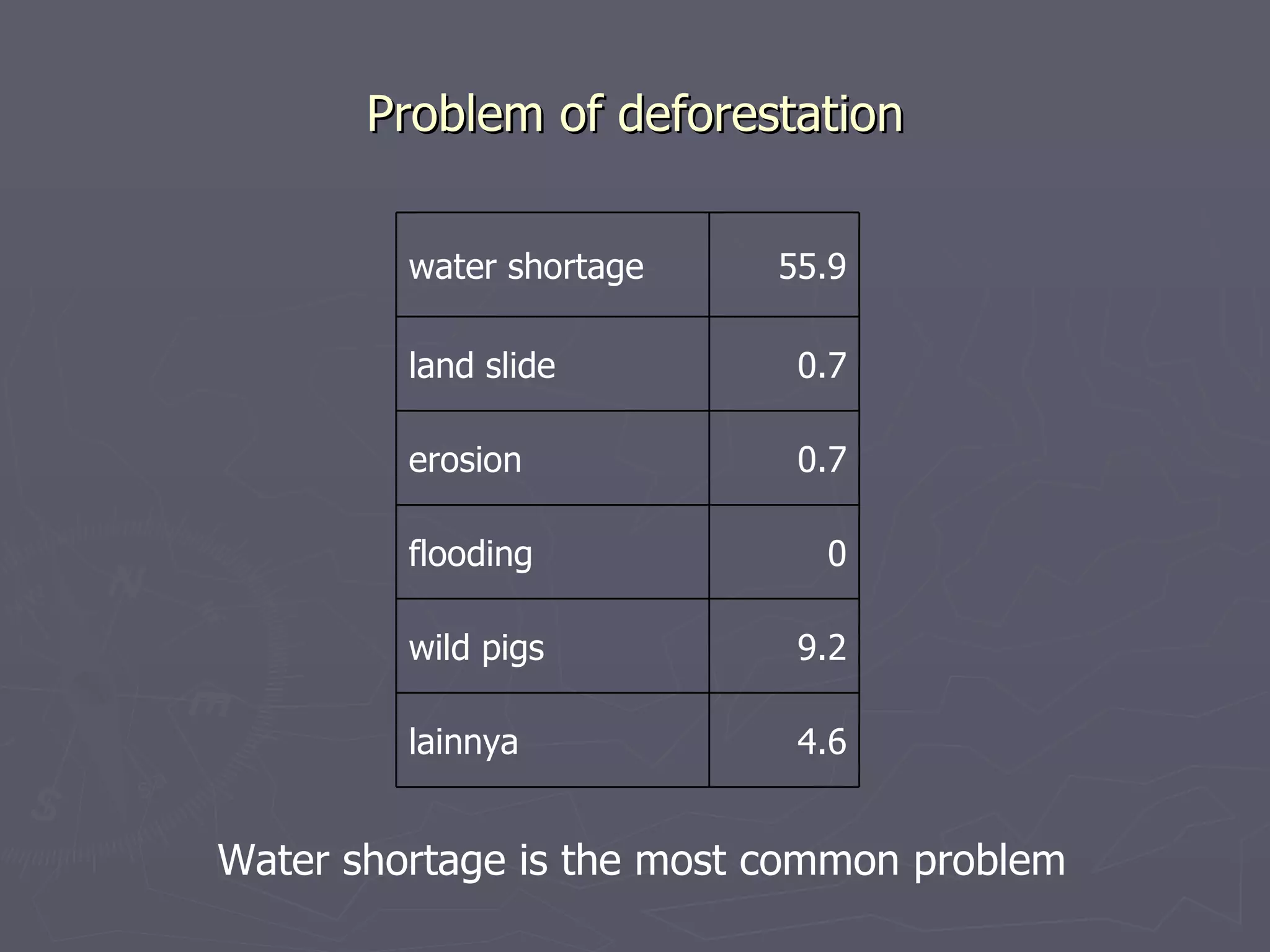
Problem of deforestation Water shortage is the most common problem water shortage 55.9 land slide 0.7 erosion 0.7 flooding 0 wild pigs 9.2 lainnya 4.6
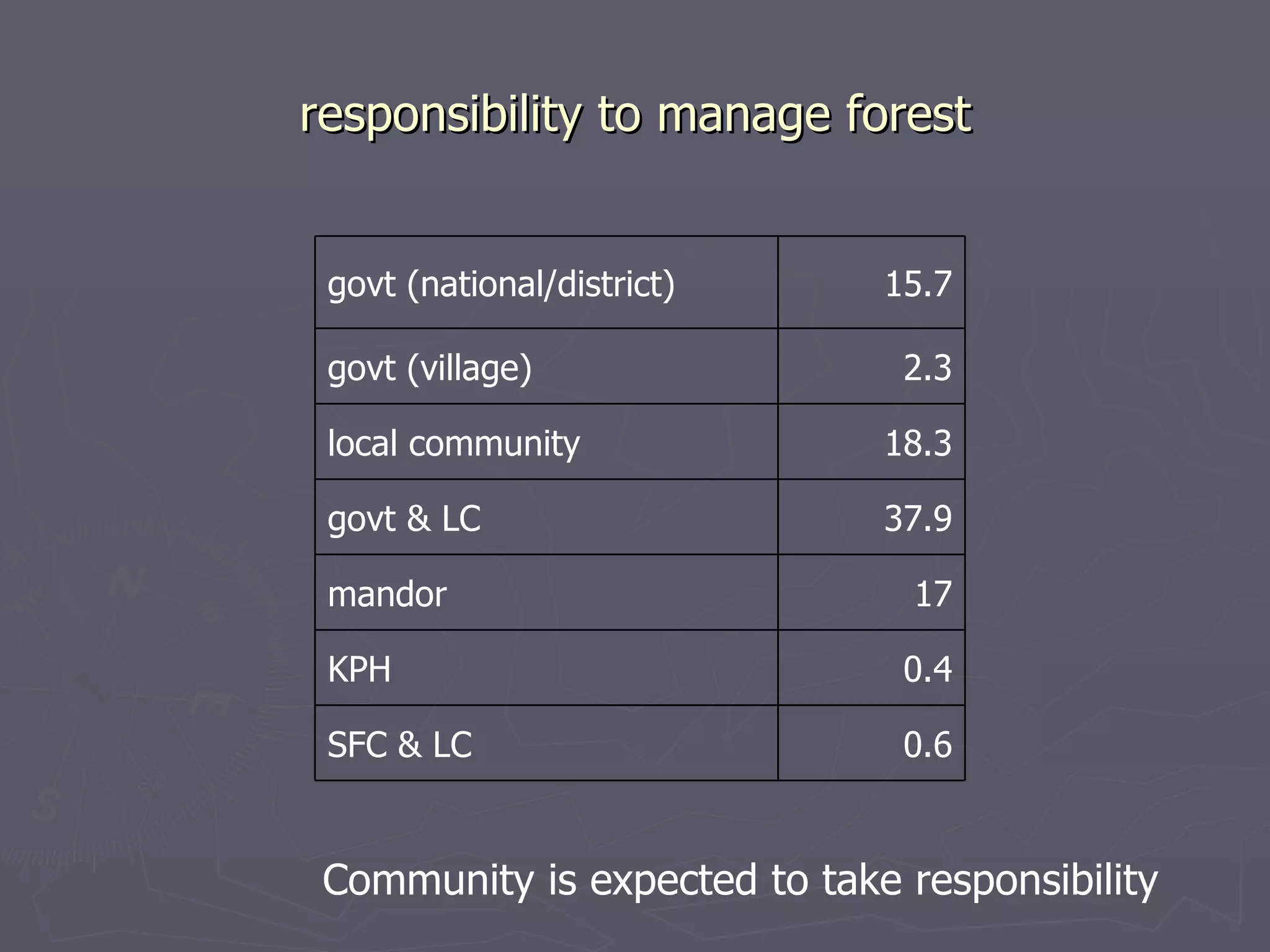
responsibility to manage forest Community is expected to take responsibility govt (national/district) 15.7 govt (village) 2.3 local community 18.3 govt & LC 37.9 mandor 17 KPH 0.4 SFC & LC 0.6
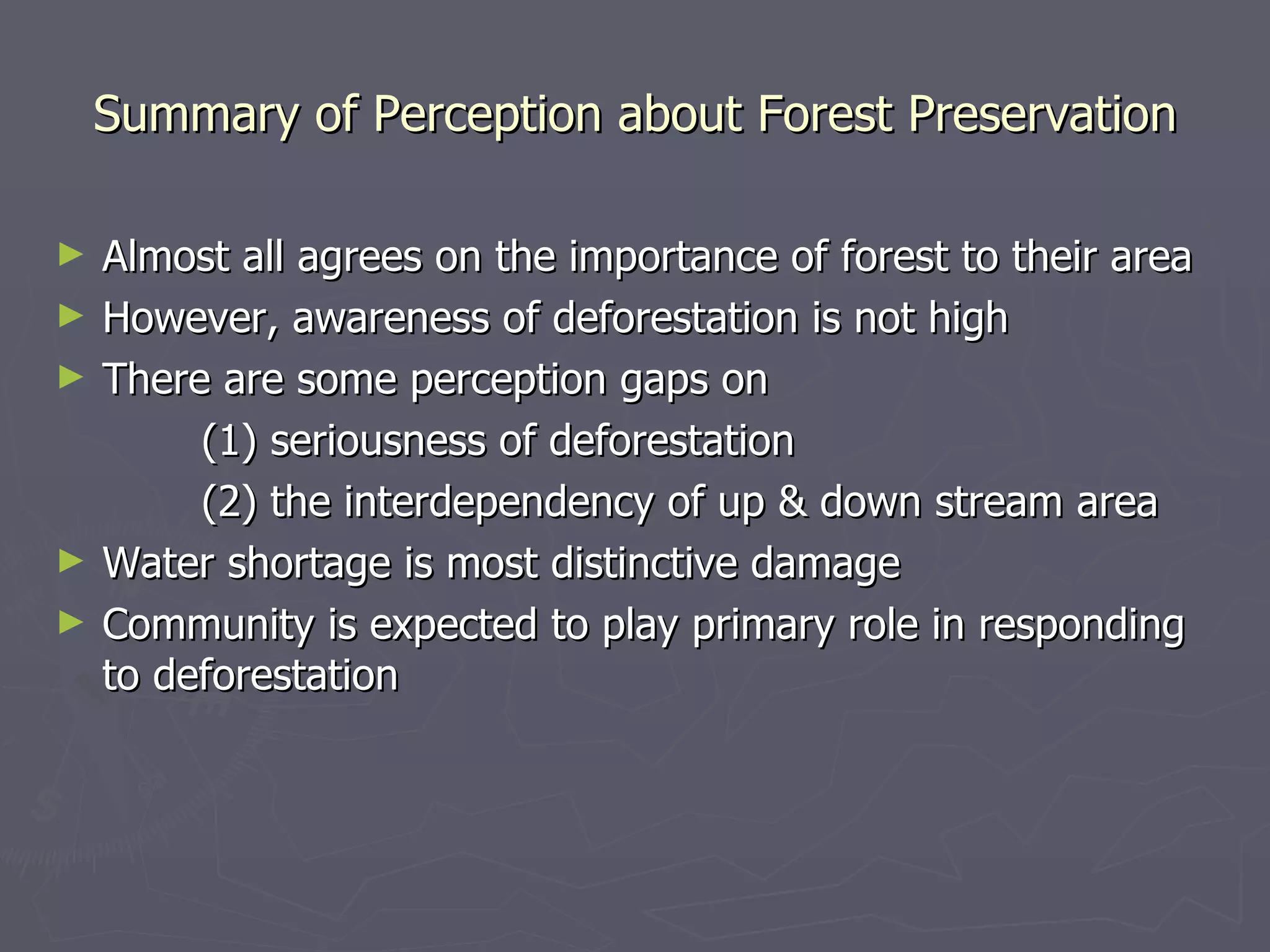
Summary of Perception about Forest Preservation Almost all agrees on the importance of forest to their area However, awareness of deforestation is not high There are some perception gaps on (1) seriousness of deforestation (2) the interdependency of up & down stream area Water shortage is most distinctive damage Community is expected to play primary role in responding to deforestation
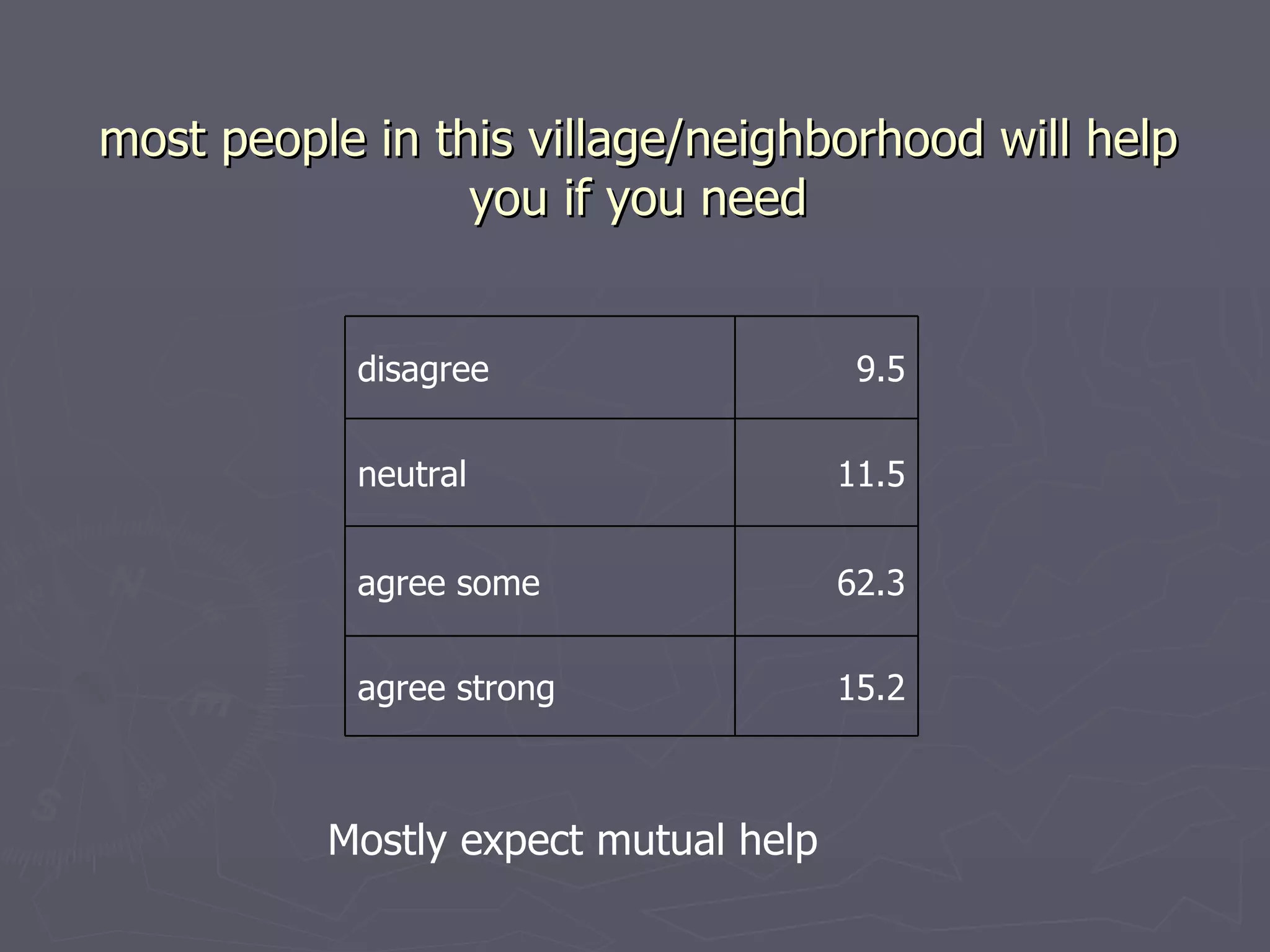
most people in this village/neighborhood will help you if you need Mostly expect mutual help disagree 9.5 neutral 11.5 agree some 62.3 agree strong 15.2
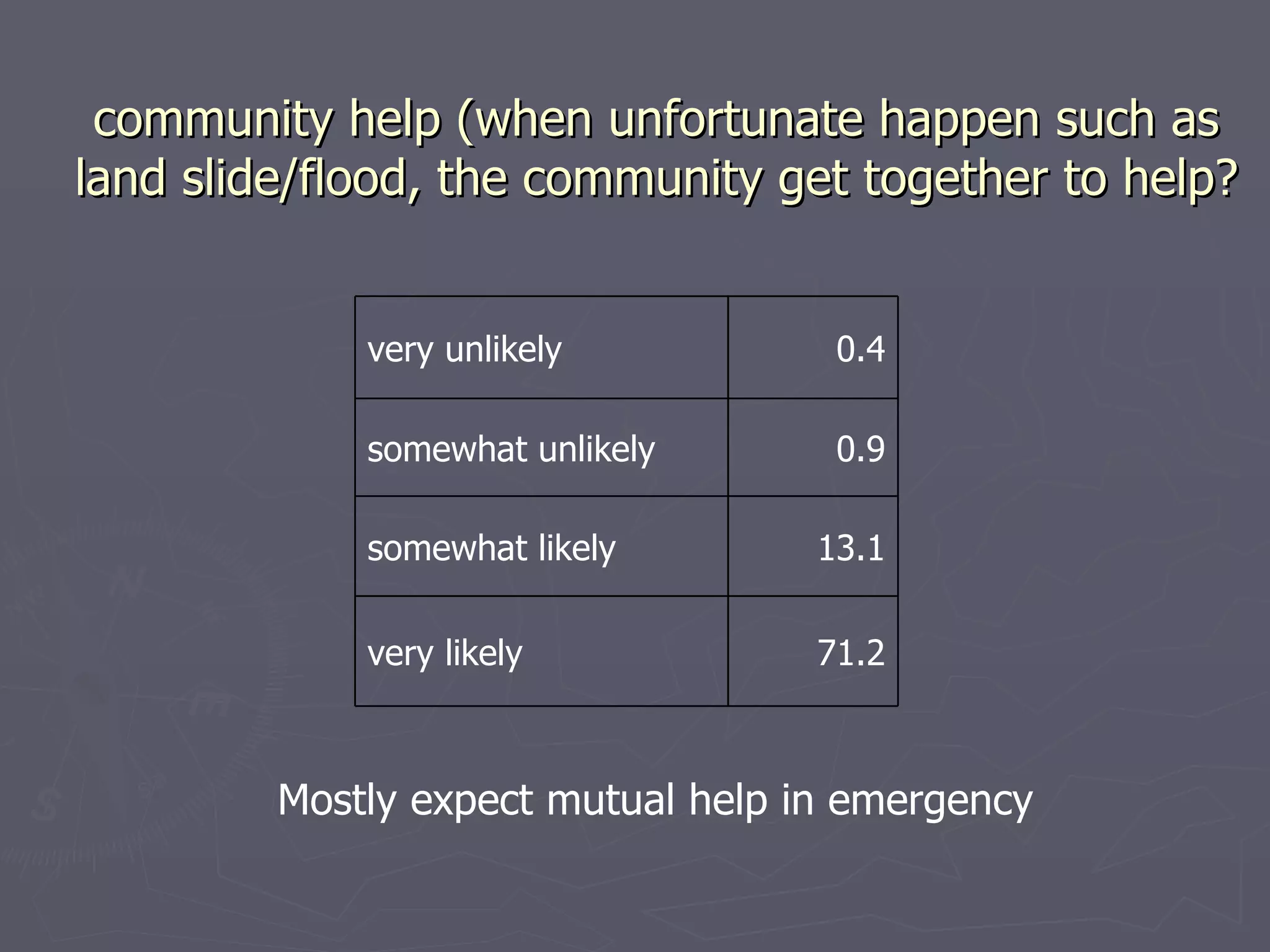
community help (when unfortunate happen such as land slide/flood, the community get together to help? Mostly expect mutual help in emergency  very unlikely 0.4 somewhat unlikely 0.9 somewhat likely 13.1 very likely 71.2
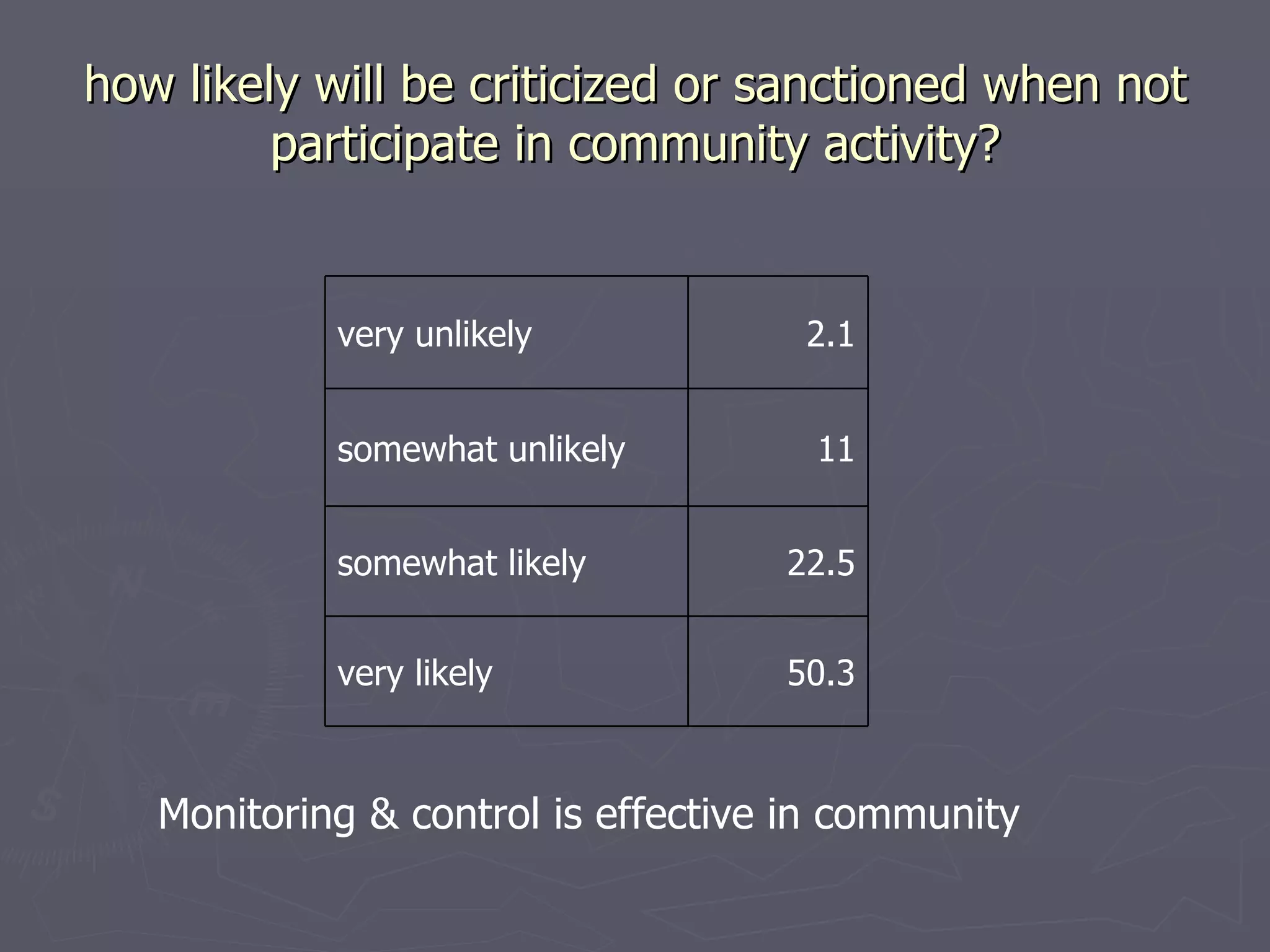
how likely will be criticized or sanctioned when not participate in community activity? Monitoring & control is effective in community  very unlikely 2.1 somewhat unlikely 11 somewhat likely 22.5 very likely 50.3
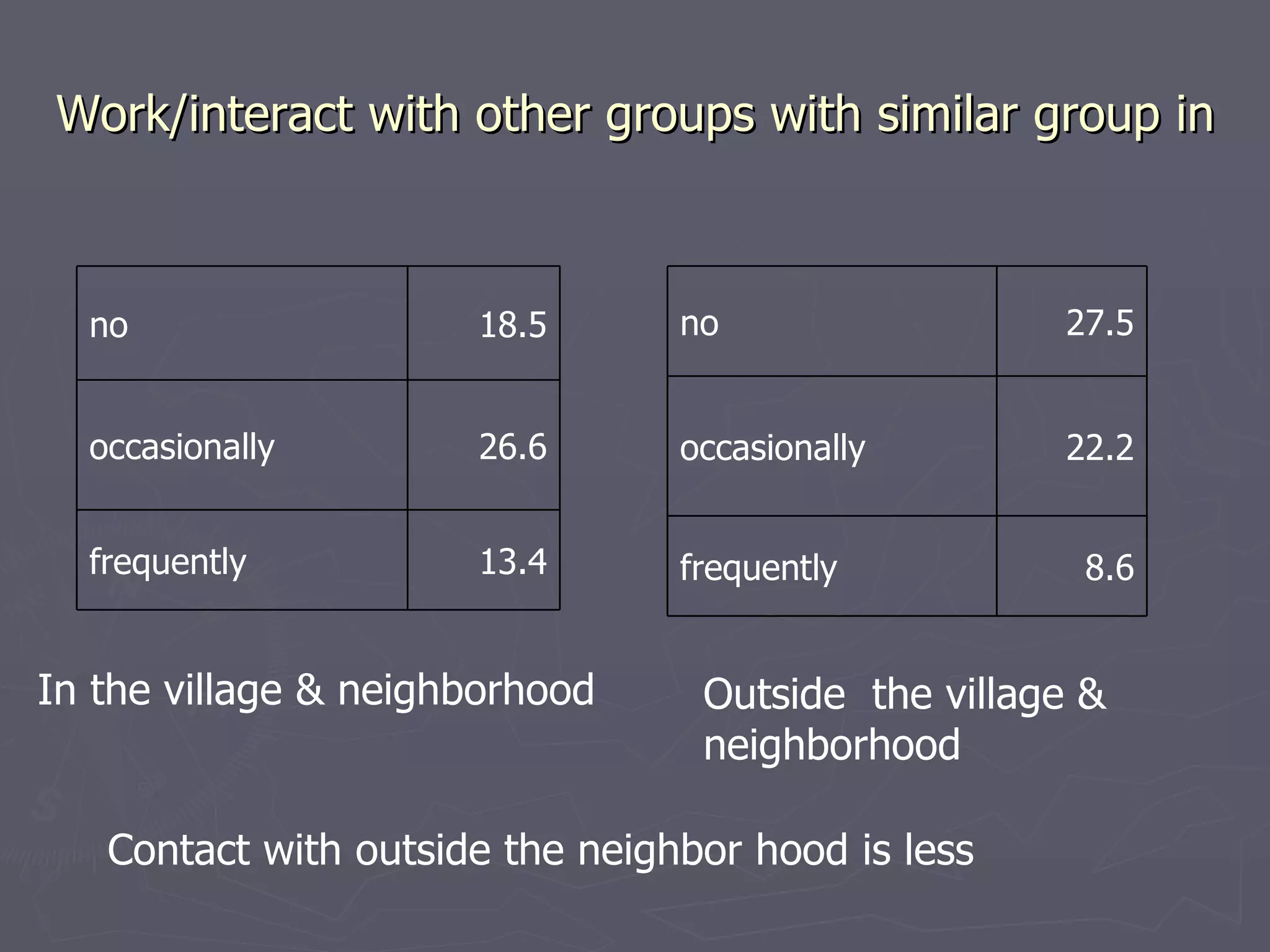
Work/interact with other groups with similar group in In the village & neighborhood Outside  the village & neighborhood Contact with outside the neighbor hood is less  no 18.5 occasionally 26.6 frequently 13.4 no 27.5 occasionally 22.2 frequently 8.6
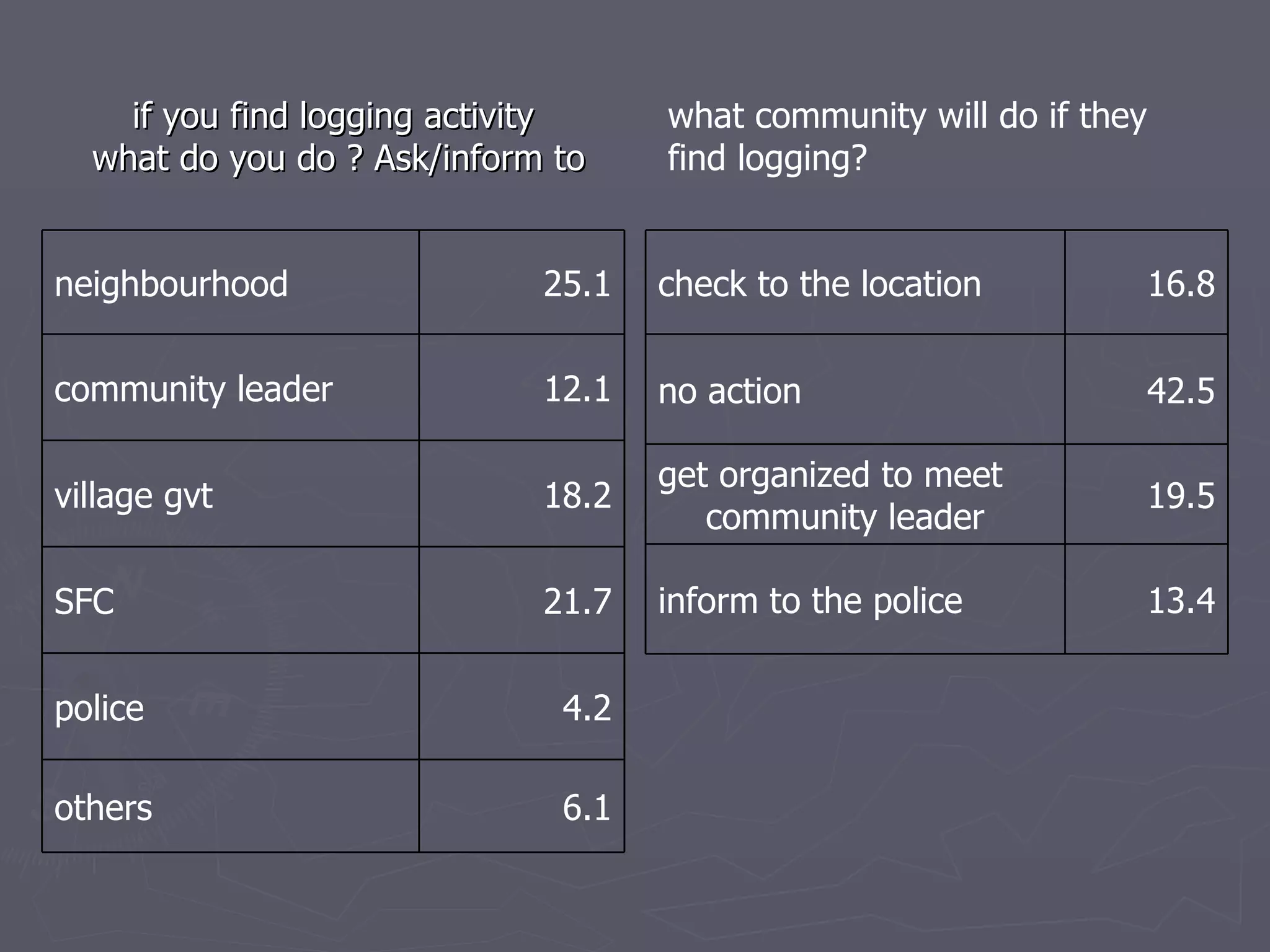
if you find logging activity  what do you do ? Ask/inform to what community will do if they find logging? neighbourhood 25.1 community leader 12.1 village gvt 18.2 SFC 21.7 police 4.2 others 6.1 check to the location 16.8 no action 42.5 get organized to meet community leader 19.5 inform to the police 13.4
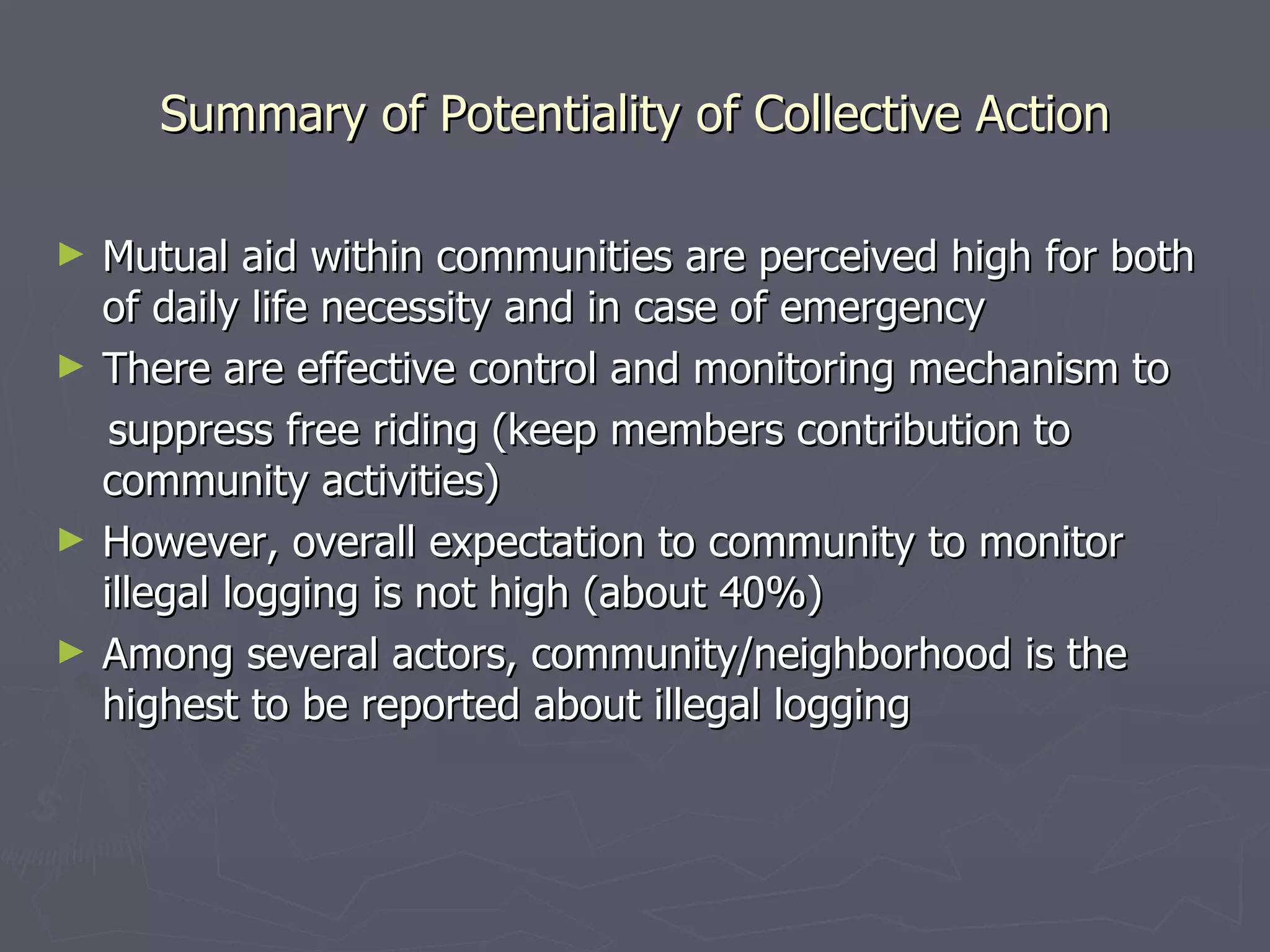
Summary of Potentiality of Collective Action Mutual aid within communities are perceived high for both of daily life necessity and in case of emergency There are effective control and monitoring mechanism to suppress free riding (keep members contribution to community activities) However, overall expectation to community to monitor illegal logging is not high (about 40%) Among several actors, community/neighborhood is the highest to be reported about illegal logging
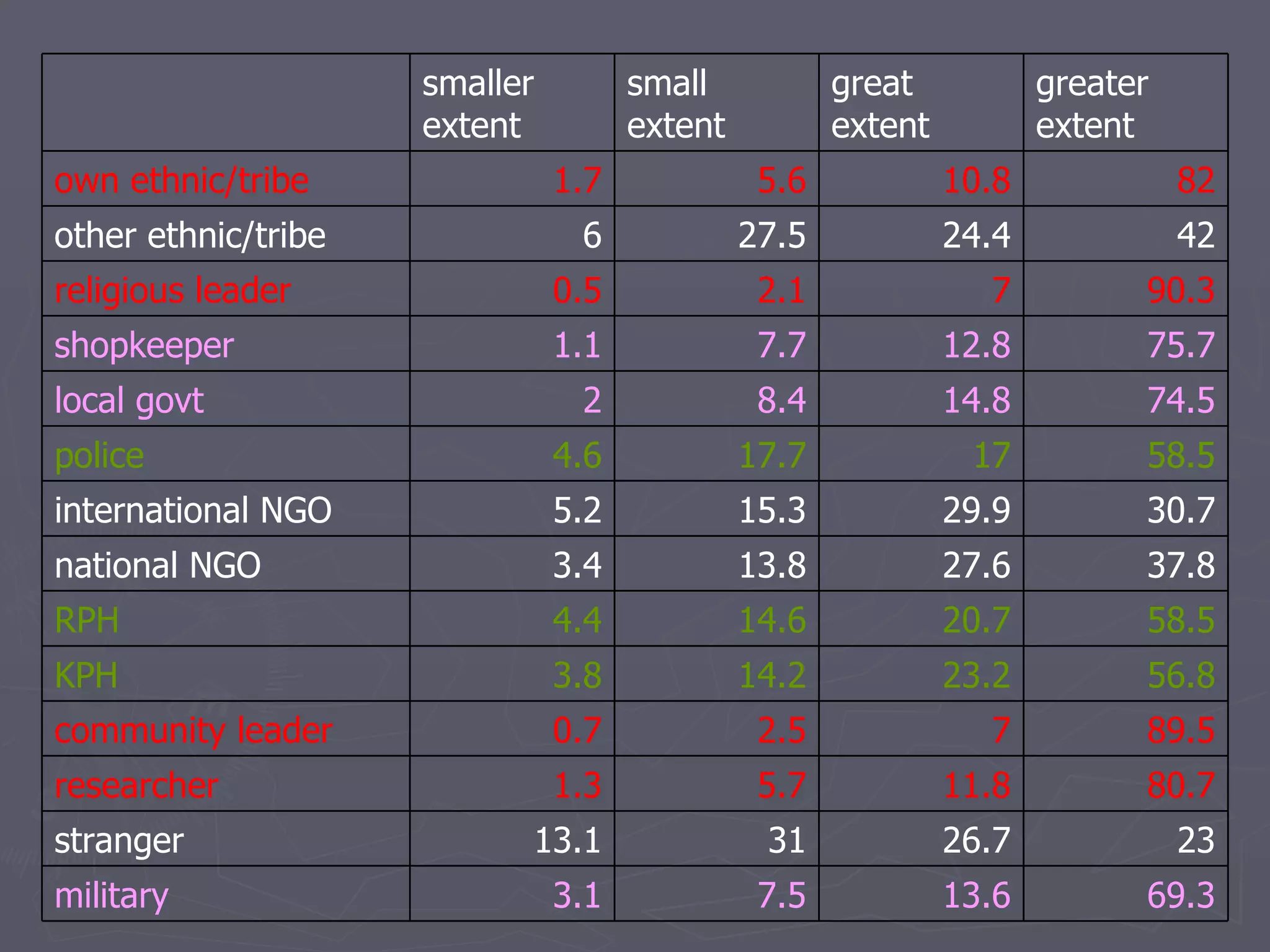
  smaller extent small extent great extent greater extent own ethnic/tribe 1.7 5.6 10.8 82 other ethnic/tribe 6 27.5 24.4 42 religious leader 0.5 2.1 7 90.3 shopkeeper 1.1 7.7 12.8 75.7 local govt 2 8.4 14.8 74.5 police 4.6 17.7 17 58.5 international NGO 5.2 15.3 29.9 30.7 national NGO 3.4 13.8 27.6 37.8 RPH 4.4 14.6 20.7 58.5 KPH 3.8 14.2 23.2 56.8 community leader 0.7 2.5 7 89.5 researcher 1.3 5.7 11.8 80.7 stranger 13.1 31 26.7 23 military 3.1 7.5 13.6 69.3
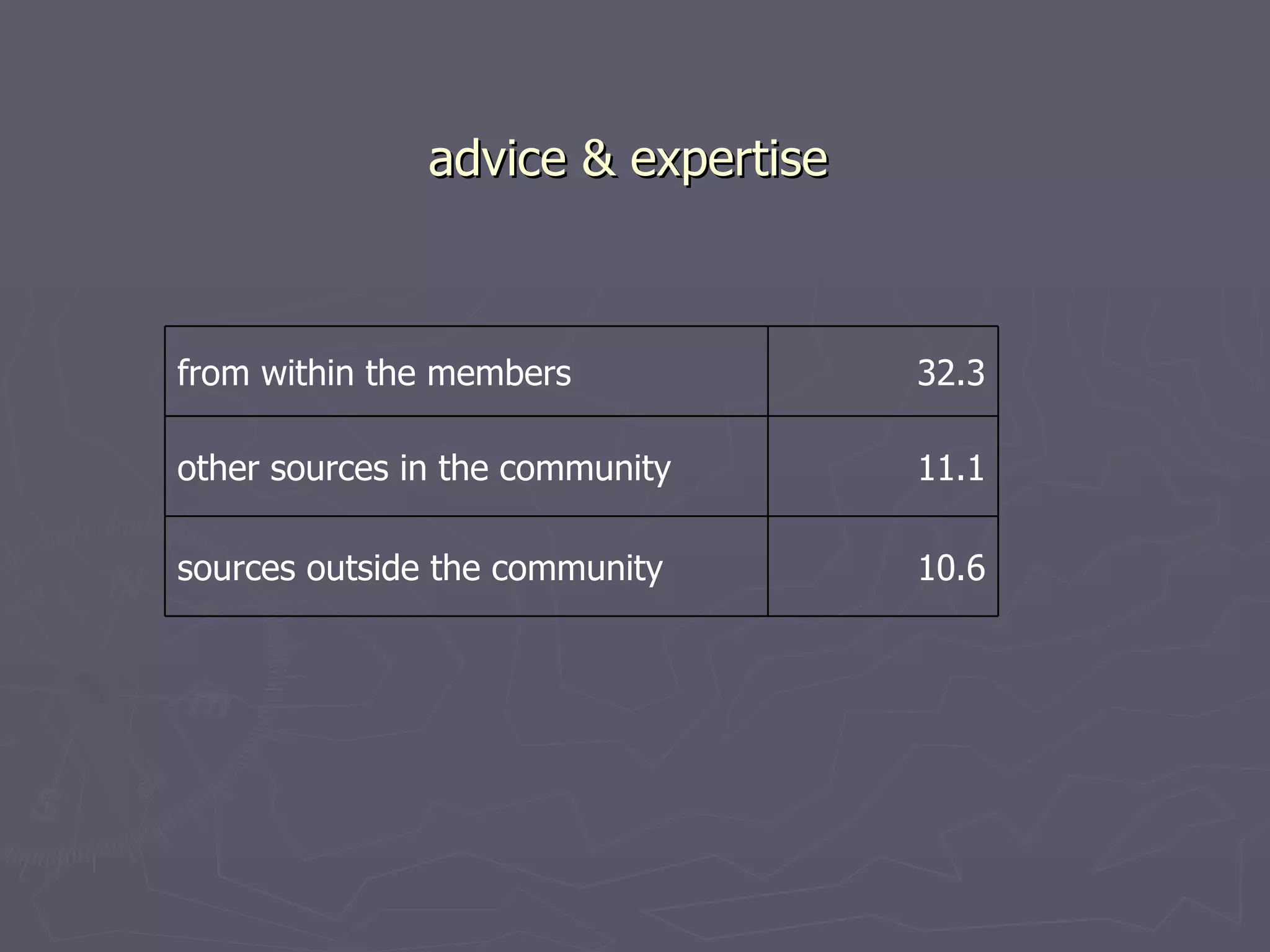
advice & expertise from within the members 32.3 other sources in the community 11.1 sources outside the community 10.6
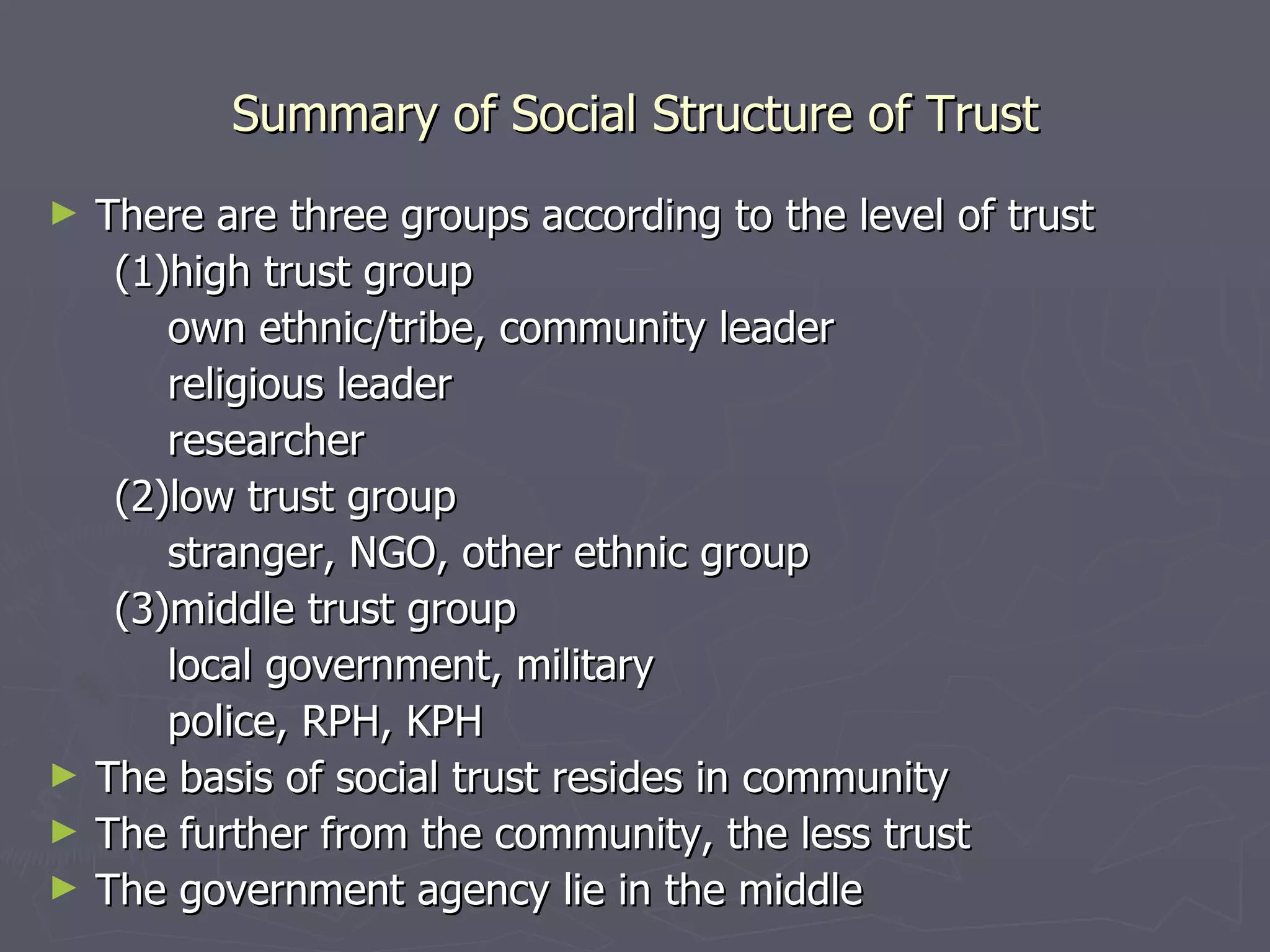
Summary of Social Structure of Trust There are three groups according to the level of trust (1)high trust group own ethnic/tribe, community leader religious leader  researcher (2)low trust group stranger, NGO, other ethnic group (3)middle trust group local government, military police, RPH, KPH The basis of social trust resides in community The further from the community, the less trust The government agency lie in the middle
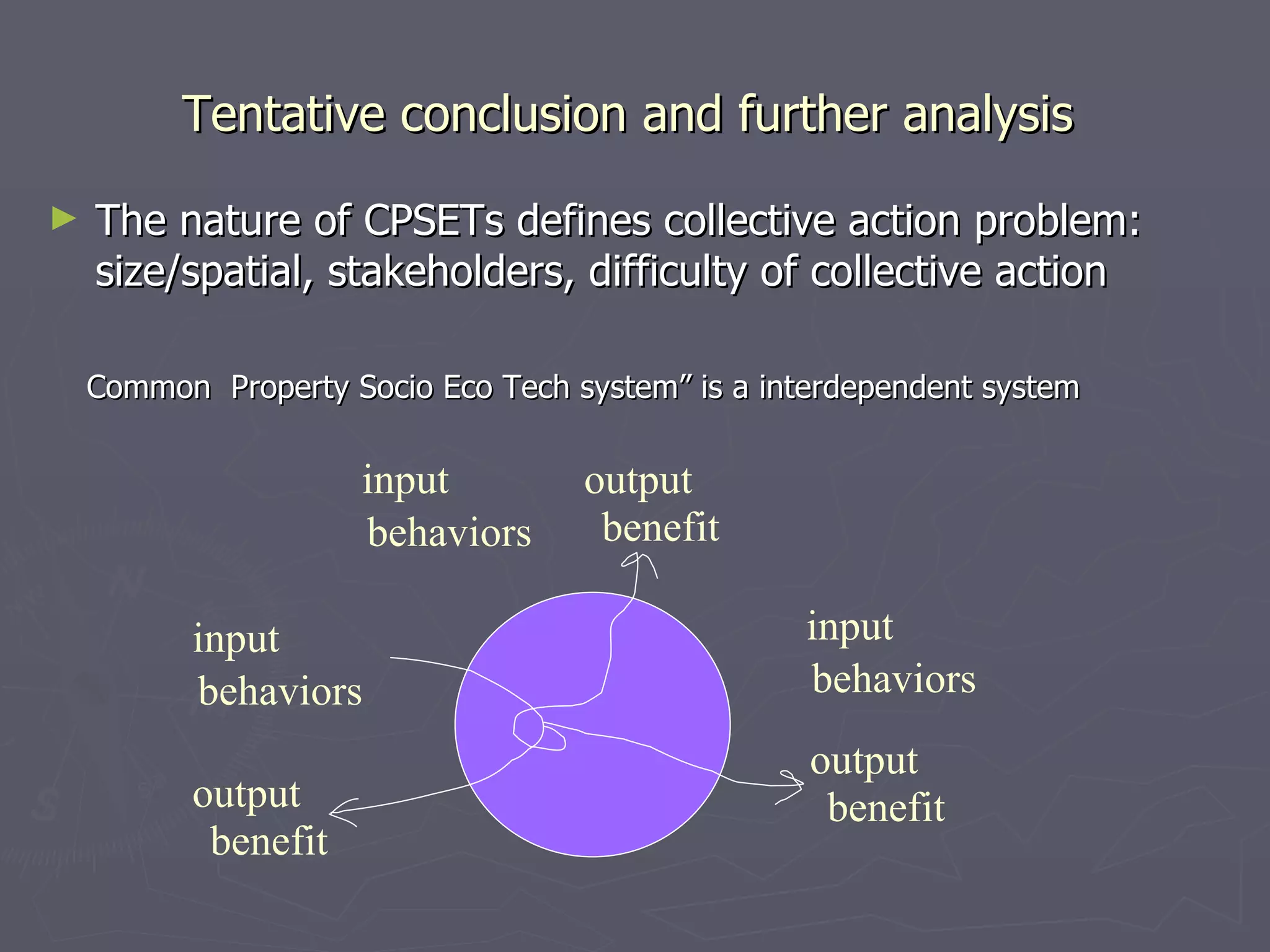
Tentative conclusion and further analysis  The nature of CPSETs defines collective action problem: size/spatial, stakeholders, difficulty of collective action behaviors benefit input output Common  Property Socio Eco Tech system” is a interdependent system behaviors benefit input output behaviors input benefit output
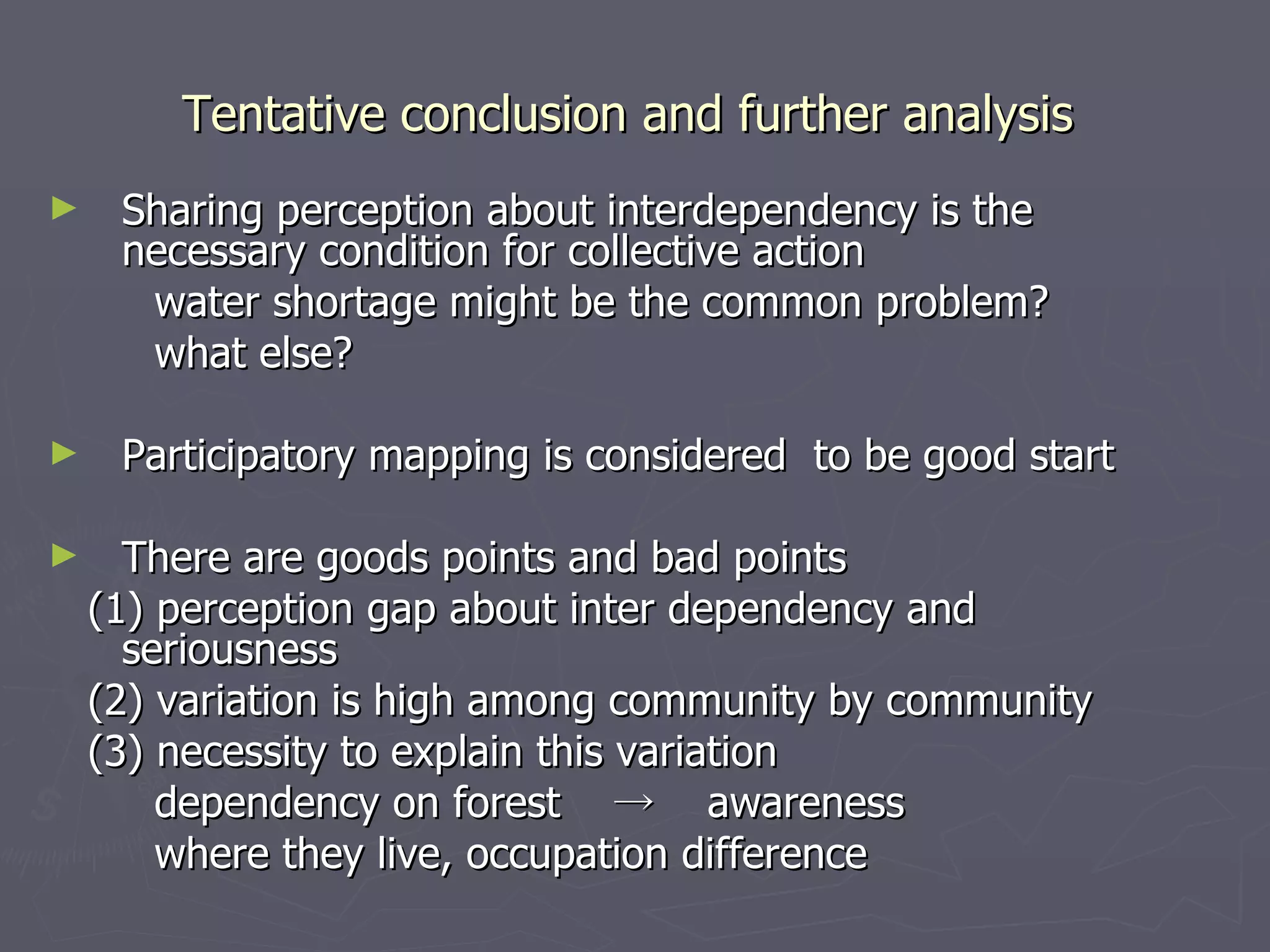
Tentative conclusion and further analysis  Sharing perception about interdependency is the necessary condition for collective action water shortage might be the common problem? what else? Participatory mapping is considered  to be good start There are goods points and bad points (1) perception gap about inter dependency and  seriousness (2) variation is high among community by community (3) necessity to explain this variation dependency on forest  ->  awareness where they live, occupation difference
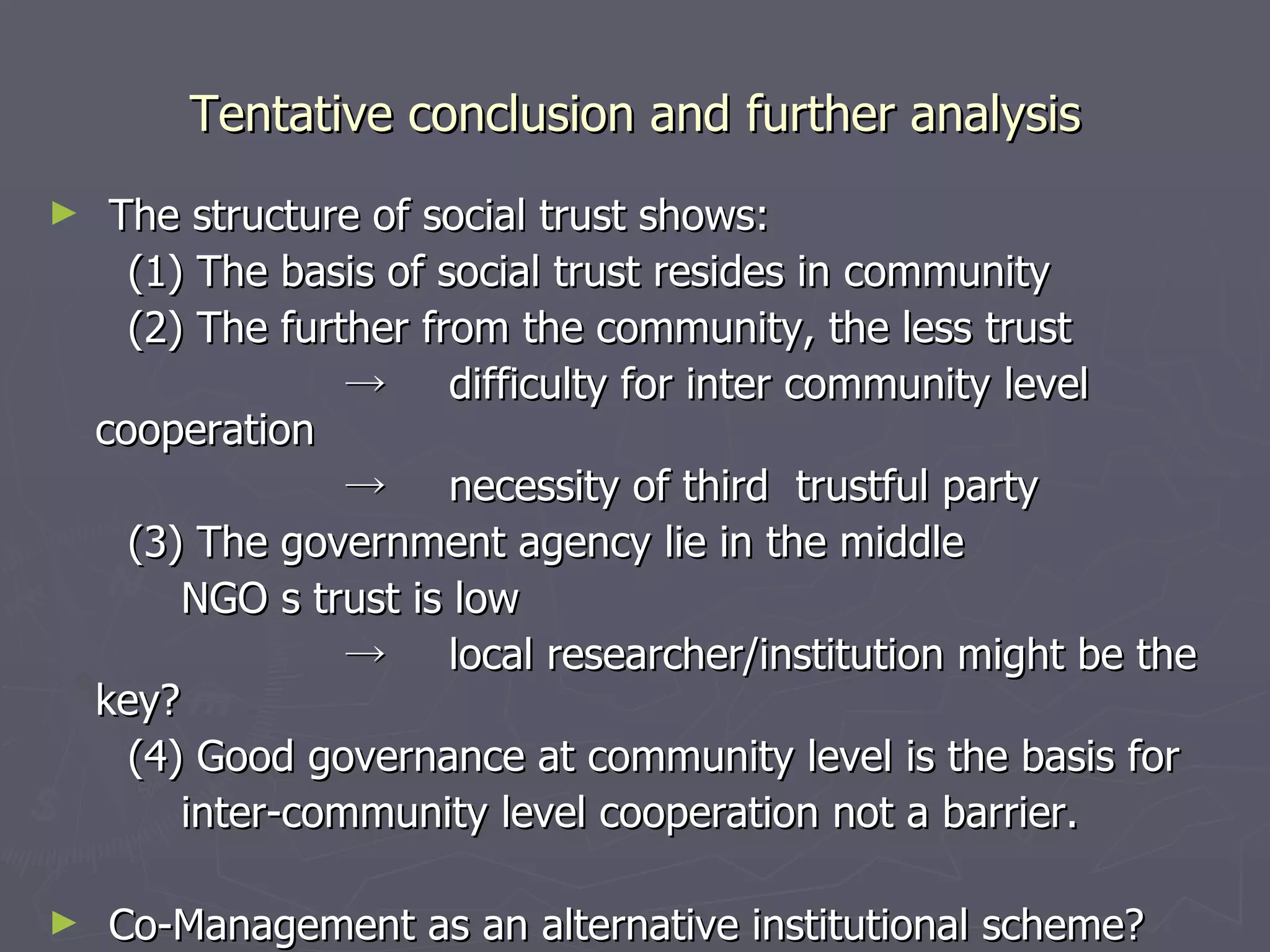
Tentative conclusion and further analysis The structure of social trust shows: (1) The basis of social trust resides in community (2) The further from the community, the less trust ->   difficulty for inter community level cooperation ->   necessity of third  trustful party  (3) The government agency lie in the middle NGO s trust is low ->   local researcher/institution might be the key? (4) Good governance at community level is the basis for inter-community level cooperation not a barrier. Co-Management as an alternative institutional scheme?

Collective Choice In Community Based Management: Lesson Learnt from Pakistan

  • 1.
    Collective Choice inCommunity Based Management: Lesson From Pakistan and Preliminary Result of Banyumas Survey Tatsuro Sakano Associate Professor Tokyo Institute of Technology ESTs and Forest Governance December 4 – 7, 2006, in Banyumas, Indonesia
  • 2.
  • 3.
  • 4.
  • 5.
  • 6.
  • 7.
    Stalemate? Polarization andtrap of poverty Pakistan GNI 103 rd /143 (2001)       income poverty 25% in 1985 to 30% in 1995 The world seems to be divided into two parts:    the growing/already grown people           v.s.   the ones that cannot escape from the trap of poverty What are the causes? How can they escape?
  • 8.
    Positive Effects ofSocial Capital : Some Evidences(2) Excerpted from Uslaner(2003)
  • 9.
    Positive Effects ofSocial Capital : Some Evidences(3) Excerpted from Uslaner(2003)
  • 10.
    Three generations ofdevelopmental strategy 1 st 50s-60s Material Base (Physical Capital) modernization by external infusion of sufficient capitals and technology under the guidance of western experts. -> does not create next cycle of production 2 nd 70s-90s People Centered (Human Capital) Self-reliant, human development, empowerment “ build people’s capacity to solve their problems” -> created well educated, PhD holders, but poverty remained 3 rd 2000s- Trust Base (Social Capital)
  • 11.
    Public Goods Problem& Local Governance Limit of Market Individual     indivisible 、 free ride(social dilemma )      ⇒ necessity of collective action Limit of State     high monitoring cost, exploitation,rent-seeking     inflexibility to local commons      ⇒ necessity of the third approach Local governance Revitalizing Life World   social capital (trust & network of civic engagement) self-organized collective choice mechanism
  • 12.
    Vicious Circle oflow trust and underdevelopment Inefficient use of Resources Low formation of Social capital Inability to solve Social dilemmas Rent seeking Exploitation Under- development Inequality Exacerbated
  • 13.
    Comparison of SewerageConstruction in Orangi Town (July 1980- Nov.1989) 8000acers 1.2million Source: Statistical Data of Low Cost Sanitation Program of the Orangi Pilot Project (Survey November 1989) Prominent features OPP Supervised Self- Supervised Provided by Local Govt. Total number of lanes got sewerage system 1,195 2,403 497 4,095 number of houses got sewerage connections 17,403 39,221 6,567 63,191 Length of sewer lines constructed (FT) 293,570 622,708 112,350 1,028,628 Total Investment ( Rs.) 4,661,170 9,487,245 10,111,500 24,259,915 Average cost per household for sewerage lines ( Rs.) 268 242 1,540 - Ave. cost Rs. per running foot for sewerage construction 15.9 15.2 90.0 -
  • 14.
    Result of OPPas External Agent Project name Results Trust situation Katchi Abadis Upgrading Program in Orangi Town Karachi (1991-95) Donor: ADB Sub Project Area Baldia - 1992 OPP exited faced with local resistance - KMC provided internal work Communities did not take responsibility for maintenance of internal work provided by Govt. Urban Basic Services (UBS) Program in Sukkur (1990-1995) Donor: UNICEF Three Katchi Abadis selected - 1993 OPP exited - delay of external work SMC - improper operation of pumping station High internal trust of communities ended in distrust on government agencies. Collaborative Katchi Abadis Improvement Program (CKAIP) (1991-95) Donor: World Bank Shelter Program - 1995 OPP exited - Water Aid UK judges failure - delay of external work HMC - poor quality of construction - failure to maintain the work High internal trust of communities ended in distrust on government agencies.
  • 15.
    Classification of TrustSituation High Trust Situation Norms of reciprocity and civic engagements across the community/ society. Closed Self - reliant Situation Norms of reciprocity and civic engagements within the community/ society. Paternalistic situation Trust on state for services, low civic engagements Destitute Situation Widespread distrust, weak norms, dishonesty, fear - based and threat - based, low civic engagements and community norms High Trust Situation Norms of reciprocity and civic engagements across the community/ society. Closed Self - reliant Situation - Norms of reciprocity and civic engagements within the community Paternalistic Situation Trust on state for services, low civic engagements Destitute Situation Widespread distrust, weak norms, dishonesty, fear - based and threat - based, low civic engagements and community norms Extended Trust Low High Intra- community Trust Low High
  • 16.
    Matching Hypothesis HighTrust Situation Norms of reciprocity and civic society. Closed Self - reliant Situation Norms of reciprocity and civic engagements within the community/ society. Paternalistic situation Trust on state for services, low civic engagements Destitute Situation Widespread distrust, weak norms, dishonesty, fear - based and threat - based, low civic engagements and community norms High Trust Situation engagements across the community/ Closed Self - reliant Situation - Paternalistic Situation Destitute Situation Extended Trust Low High Intra- community Trust Low High Self-organization Approach Stalemate External Agent Approach Ostrom’s SOCC(1990) Capacity to craft institution Korten’s PVO (1987) Capacity to craft institution
  • 17.
    Hypothesis Assumption1: Scale of Project Scale of project determines the necessary resources to solve the problem . community-scale v.s Inter-community scale Assumption2: Requisite Condition of Trust Without establishing trust among the owners of necessary resources, project will fail. Two Matching Hypothesis Self-organization and external agent approach will fail in inter-community scale project when extended trust is unavailable Transitional Hypothesis Self-organization capacity and PVO + equitable framework of participation Equitable partnership Approach
  • 18.
    FAUP : AnExample of Equitable Partnership Fund from British Government £ 12,521,000 Funding from Punjab Government £ 3,344,000 FAUP FAUP Community Account 50% 50% Cash / material/ Labor or both (25%) (75%) Through agreement on legal documents As Grant
  • 19.
    Community Organization inFAUP Multi Purpose Community Organizations (MPCO) were established for tertiary level projects. 142 MPCOs out of which 73 (51%) were women MPCOs and 69 male MPCOs. Both man and women from each household represented in respective MPCO. Each MPCO comprised of 18-20 members at lane level. Levels of MPCOs: Sub Area MPCOs Cluster MPCOs Neighborhood MPCOs Lane Level MPCOs 10-20 members Area Level Organization (ALO) 30-60 members
  • 20.
    Problems in ProjectAreas of FAUP Faisalabad is 3rd largest city of Pakistan (2.2 million population) 23% Population living in slum areas. 4 Project slum areas were selected. Problems: No access to clean drinking water. No sewerage system Streets were unpaved No recreational parks Poor education facilities Poor communities
  • 21.
    Conclusion Trust isthe key for development External Agent Approach, exemplified by PVO, dose not work in low extended trust situation For small scale projects, local community has capacity to solve the problem but not for larger scale Society based account, typically Fukuyama, under-estimates the capacity of local community and Ostrom overestimates it. Dichotomy of low and high trust society is too simple The transitional path should be explored along the institutional account The path is Equitable partnership approach Self-organization capacity and PVO + equitable framework of participation
  • 22.
    Socially Adaptable Technology& Governance Local needs Technological Requirements Social Capacity to Manage Technological Solution Establish Local Governance
  • 23.
    Proposed Actions presentedin Sep. 2005 1 St Stage Field survey with local voluntary organizations Establishing Civil Society Network, Kasur 2 nd Stage Exploration of Technological solutions 3 rd Stage Field test in voluntary families 4 th Stage Field test in several public organizations Exploration of Management solution cost sharing, how to manage 5 th Stage Spreading the solution to the whole community 2000 2005-6 2007ー
  • 24.
    New Strategy Problemof Household/small community as operation unit maintenance cost to low income household Advantage of New Solution: Clean Water Club low production cost when centralized by a large system high competitiveness to Pet bottled water and municipal water in terms of cost and quality, high marketability even to tanneries ⇒ establish production company & Clean Water Club ⇒ distribute water to the members of the club maintenance free for consumers expel fake/low quality pet bottled water raise awareness and encourage civic action profit may be used for environmental monitoring and epidemic survey
  • 25.
    New Action Program 4 th Stage Field test for Clean Water Club with a few small cartridge for Public Org. in some schools, hospitals Exploration of Management solution cost, delivering system 5 th Stage Expand Production incrementally on demands 6 th Stage If possible, the large scale system 200 6 ー 2007ー8 2009ー
  • 26.
    Civil Society NetworkKasur Households Schools Hospitals Factories UDERC Japan Government UDERC Pakistan Research Institute Universities Local NGOs CCB
  • 27.
    Corroboration Matrix  Clean Water Club Safty Drink Water Action Research Corroboration Training/Networking Other Cooperation Pak Universities/ Research Inst.           Jap Universities/ Research Inst.           Civil Scoiety Network Kasur           UDERC Pak           UDERC Jap          
  • 28.
    Banyumas Survey: sampledvillages Total Sample Size : 1005 households
  • 29.
  • 30.
    Occupation by area  upstream middle downstream total farmers 72.5 54.5 55.7 65.6 employed 12.8 24.8 29.5 18.2 others 14.8 20.7 14.8 16.2
  • 31.
    Preliminary Findings: FocusedQuestions Perception about deforestation Forest preservation Level of Deforestation Overexploitation in Upstream Areas Forest Management Resposibility Social Structure for collective action Mutual Aid within community Cooperation inside/outside village Response to logging activity Social Structure of Trust
  • 32.
    forest preservation isimportant for your area? Mostly (94.5%) agrees
  • 33.
    Level of deforestationNo consensus on the seriousness of deforestation Only 16% perceives deforestation is serious
  • 34.
    over exploitation inupstream affect on downstream region? Considerable portion disagrees
  • 35.
    Problem of deforestationWater shortage is the most common problem water shortage 55.9 land slide 0.7 erosion 0.7 flooding 0 wild pigs 9.2 lainnya 4.6
  • 36.
    responsibility to manageforest Community is expected to take responsibility govt (national/district) 15.7 govt (village) 2.3 local community 18.3 govt & LC 37.9 mandor 17 KPH 0.4 SFC & LC 0.6
  • 37.
    Summary of Perceptionabout Forest Preservation Almost all agrees on the importance of forest to their area However, awareness of deforestation is not high There are some perception gaps on (1) seriousness of deforestation (2) the interdependency of up & down stream area Water shortage is most distinctive damage Community is expected to play primary role in responding to deforestation
  • 38.
    most people inthis village/neighborhood will help you if you need Mostly expect mutual help disagree 9.5 neutral 11.5 agree some 62.3 agree strong 15.2
  • 39.
    community help (whenunfortunate happen such as land slide/flood, the community get together to help? Mostly expect mutual help in emergency very unlikely 0.4 somewhat unlikely 0.9 somewhat likely 13.1 very likely 71.2
  • 40.
    how likely willbe criticized or sanctioned when not participate in community activity? Monitoring & control is effective in community very unlikely 2.1 somewhat unlikely 11 somewhat likely 22.5 very likely 50.3
  • 41.
    Work/interact with othergroups with similar group in In the village & neighborhood Outside the village & neighborhood Contact with outside the neighbor hood is less no 18.5 occasionally 26.6 frequently 13.4 no 27.5 occasionally 22.2 frequently 8.6
  • 42.
    if you findlogging activity what do you do ? Ask/inform to what community will do if they find logging? neighbourhood 25.1 community leader 12.1 village gvt 18.2 SFC 21.7 police 4.2 others 6.1 check to the location 16.8 no action 42.5 get organized to meet community leader 19.5 inform to the police 13.4
  • 43.
    Summary of Potentialityof Collective Action Mutual aid within communities are perceived high for both of daily life necessity and in case of emergency There are effective control and monitoring mechanism to suppress free riding (keep members contribution to community activities) However, overall expectation to community to monitor illegal logging is not high (about 40%) Among several actors, community/neighborhood is the highest to be reported about illegal logging
  • 44.
      smaller extentsmall extent great extent greater extent own ethnic/tribe 1.7 5.6 10.8 82 other ethnic/tribe 6 27.5 24.4 42 religious leader 0.5 2.1 7 90.3 shopkeeper 1.1 7.7 12.8 75.7 local govt 2 8.4 14.8 74.5 police 4.6 17.7 17 58.5 international NGO 5.2 15.3 29.9 30.7 national NGO 3.4 13.8 27.6 37.8 RPH 4.4 14.6 20.7 58.5 KPH 3.8 14.2 23.2 56.8 community leader 0.7 2.5 7 89.5 researcher 1.3 5.7 11.8 80.7 stranger 13.1 31 26.7 23 military 3.1 7.5 13.6 69.3
  • 45.
    advice & expertisefrom within the members 32.3 other sources in the community 11.1 sources outside the community 10.6
  • 46.
    Summary of SocialStructure of Trust There are three groups according to the level of trust (1)high trust group own ethnic/tribe, community leader religious leader researcher (2)low trust group stranger, NGO, other ethnic group (3)middle trust group local government, military police, RPH, KPH The basis of social trust resides in community The further from the community, the less trust The government agency lie in the middle
  • 47.
    Tentative conclusion andfurther analysis The nature of CPSETs defines collective action problem: size/spatial, stakeholders, difficulty of collective action behaviors benefit input output Common Property Socio Eco Tech system” is a interdependent system behaviors benefit input output behaviors input benefit output
  • 48.
    Tentative conclusion andfurther analysis Sharing perception about interdependency is the necessary condition for collective action water shortage might be the common problem? what else? Participatory mapping is considered to be good start There are goods points and bad points (1) perception gap about inter dependency and seriousness (2) variation is high among community by community (3) necessity to explain this variation dependency on forest  ->  awareness where they live, occupation difference
  • 49.
    Tentative conclusion andfurther analysis The structure of social trust shows: (1) The basis of social trust resides in community (2) The further from the community, the less trust ->   difficulty for inter community level cooperation ->   necessity of third trustful party (3) The government agency lie in the middle NGO s trust is low ->   local researcher/institution might be the key? (4) Good governance at community level is the basis for inter-community level cooperation not a barrier. Co-Management as an alternative institutional scheme?