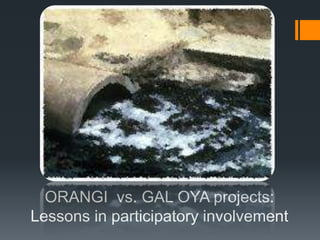
ORANGI  vs. GAL OYA projects:Lessons in participatory involvement
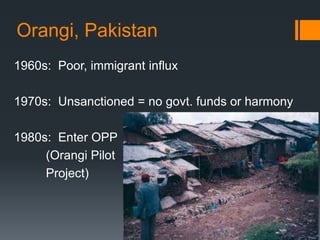
Orangi, Pakistan1960s:  Poor, immigrant influx1970s:  Unsanctioned = no govt. funds or harmony1980s:  Enter OPP 	(Orangi Pilot 	Project)
Challenges for Dr. A.H. Khan -CONCEPTUALTECHNICALORGANIZATIONAL
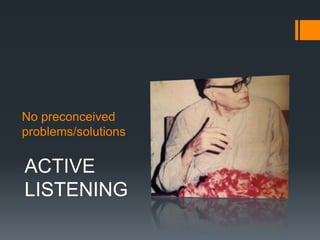
No preconceived problems/solutionsACTIVE LISTENING
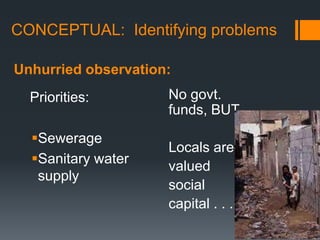
CONCEPTUAL:  Identifying problemsUnhurried observation:No govt. funds, BUT…Locals are valuedsocial capital . . .Priorities:SewerageSanitary water supply
ORGANIZATIONAL: Build local capacityOnly initial impetus from OPP:  SOCIAL MOTIVATORS talked about:	-- Benefits of sewer lines…	-- Govt. not solving problems…	-- Informal, elective process at fraction of cost
TECHNICAL:  OPP plus Thallawalas (and other indigenous populations)Inexpensive, simple technology to:Minimize costSimplify training/educationOwnership, installation, maintenance
Pre-project findingsNo formal impositionsPeople free to organize efforts, elect leadersVery slow education process for buy-in
Funding realitiesOPPLocal peopleNo donor funds to projects themselvesSolely for:  tech assistance, training, overhead, tools loaned to citizensFinancial resourcesLaborProject scheduling(and whether/when to lay lines)
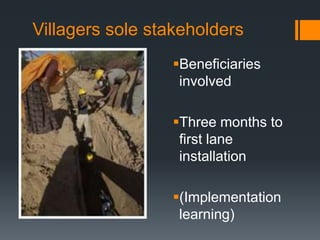
Villagers sole stakeholdersBeneficiaries involvedThree months to first lane installation(Implementation learning)
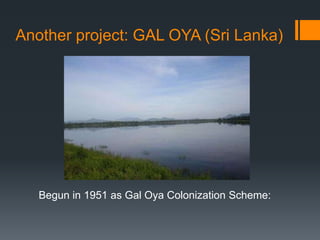
Another project: GAL OYA (Sri Lanka)Begun in 1951 as Gal Oya Colonization Scheme:
Relevant lens(Reservoir water going throughout area to benefit ALL people in Valley; e.g. tail-enders for those at end of water stream and head-enders for those at beginning);Multiple perspectives:  Prime Minister, farmers, and several affected indigenous populations
LENS: Prime Minister/Irrigation dept. Mission:  Increase small farmer rice production through the use of irrigationResult:  self-managed farmer organizationSize:  120,000 acres, 40 colonies of 150 families
LENS:  FarmersOld system:  Govt. built systems, engineers supervise construction, farmers trained to maintain.          (Farmers uncooperative)Newer system:  More active role, stronger water associationsFarmer-to-farmer approach (from research by “Institutional Organizers”)Design:   Outside consultants and govt. staff
LENS:  Sinhalese communityHead-enders on chainViewed as direct beneficiaries of Gal Oya projectMajor ethnic group in Sri Lanka“Head-enders”
LENS:  Tamil communityTail-enders on chain, Skewed number of Sinhalese households were resettled in Tamil community, favoring Sinhalese political/ethnic balanceTamil protests led to widespread ethnic, religious riots (aka Gal Oya massacre)Now noted as case study of how one minority group can be elevated over a majority group (Sinhalese over Tamil)
LENS:  Wanniyala-Aetto communityDam  Eviction from hunting-and-gathering landsForest home clear-cut for hydro-electricityNear extinction in 1983 with three new reservoirsTribe split into three resettlement areasForbidden to live in ecological sustainability
OngoingCivil war between Sinhalese and TamilIndigenous fellow-citizens rebel at Gal Oya anniversary
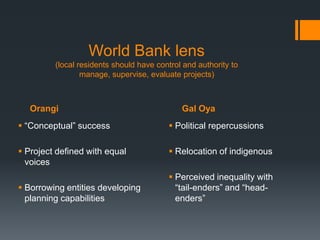
World Bank lens(local residents should have control and authority to                             manage, supervise, evaluate projects)OrangiGal Oya“Conceptual” successProject defined with equal voicesBorrowing entities developing planning capabilitiesPolitical repercussionsRelocation of indigenousPerceived inequality with “tail-enders” and “head-enders”
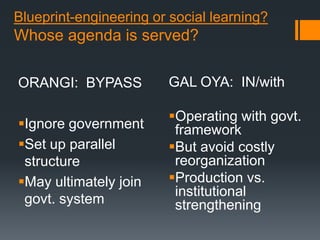
Blueprint-engineering or social learning?  Whose agenda is served?ORANGI:  BYPASSIgnore governmentSet up parallel structureMay ultimately join govt. systemGAL OYA:  IN/with Operating with govt. frameworkBut avoid costly reorganizationProduction vs. institutional strengthening
AMA calls for eradication of bucket latrines by 2010  in Ghana, AccraOrangi model adopted elsewhere.Gal Oya:  Paternalist vs. Populist  fallacyIs guided participation best approach for empowerment, ORIs it too open to outside manipulation?Updates

Orangi and gal oya

  • 1.
    ORANGI vs.GAL OYA projects:Lessons in participatory involvement
  • 2.
    Orangi, Pakistan1960s: Poor, immigrant influx1970s: Unsanctioned = no govt. funds or harmony1980s: Enter OPP (Orangi Pilot Project)
  • 3.
    Challenges for Dr.A.H. Khan -CONCEPTUALTECHNICALORGANIZATIONAL
  • 4.
  • 5.
    CONCEPTUAL: IdentifyingproblemsUnhurried observation:No govt. funds, BUT…Locals are valuedsocial capital . . .Priorities:SewerageSanitary water supply
  • 6.
    ORGANIZATIONAL: Build localcapacityOnly initial impetus from OPP: SOCIAL MOTIVATORS talked about: -- Benefits of sewer lines… -- Govt. not solving problems… -- Informal, elective process at fraction of cost
  • 7.
    TECHNICAL: OPPplus Thallawalas (and other indigenous populations)Inexpensive, simple technology to:Minimize costSimplify training/educationOwnership, installation, maintenance
  • 8.
    Pre-project findingsNo formalimpositionsPeople free to organize efforts, elect leadersVery slow education process for buy-in
  • 9.
    Funding realitiesOPPLocal peopleNodonor funds to projects themselvesSolely for: tech assistance, training, overhead, tools loaned to citizensFinancial resourcesLaborProject scheduling(and whether/when to lay lines)
  • 10.
    Villagers sole stakeholdersBeneficiariesinvolvedThree months to first lane installation(Implementation learning)
  • 11.
    Another project: GALOYA (Sri Lanka)Begun in 1951 as Gal Oya Colonization Scheme:
  • 12.
    Relevant lens(Reservoir watergoing throughout area to benefit ALL people in Valley; e.g. tail-enders for those at end of water stream and head-enders for those at beginning);Multiple perspectives: Prime Minister, farmers, and several affected indigenous populations
  • 13.
    LENS: Prime Minister/Irrigationdept. Mission: Increase small farmer rice production through the use of irrigationResult: self-managed farmer organizationSize: 120,000 acres, 40 colonies of 150 families
  • 14.
    LENS: FarmersOldsystem: Govt. built systems, engineers supervise construction, farmers trained to maintain. (Farmers uncooperative)Newer system: More active role, stronger water associationsFarmer-to-farmer approach (from research by “Institutional Organizers”)Design: Outside consultants and govt. staff
  • 15.
    LENS: SinhalesecommunityHead-enders on chainViewed as direct beneficiaries of Gal Oya projectMajor ethnic group in Sri Lanka“Head-enders”
  • 16.
    LENS: TamilcommunityTail-enders on chain, Skewed number of Sinhalese households were resettled in Tamil community, favoring Sinhalese political/ethnic balanceTamil protests led to widespread ethnic, religious riots (aka Gal Oya massacre)Now noted as case study of how one minority group can be elevated over a majority group (Sinhalese over Tamil)
  • 17.
    LENS: Wanniyala-AettocommunityDam  Eviction from hunting-and-gathering landsForest home clear-cut for hydro-electricityNear extinction in 1983 with three new reservoirsTribe split into three resettlement areasForbidden to live in ecological sustainability
  • 18.
    OngoingCivil war betweenSinhalese and TamilIndigenous fellow-citizens rebel at Gal Oya anniversary
  • 19.
    World Bank lens(localresidents should have control and authority to manage, supervise, evaluate projects)OrangiGal Oya“Conceptual” successProject defined with equal voicesBorrowing entities developing planning capabilitiesPolitical repercussionsRelocation of indigenousPerceived inequality with “tail-enders” and “head-enders”
  • 20.
    Blueprint-engineering or sociallearning? Whose agenda is served?ORANGI: BYPASSIgnore governmentSet up parallel structureMay ultimately join govt. systemGAL OYA: IN/with Operating with govt. frameworkBut avoid costly reorganizationProduction vs. institutional strengthening
  • 21.
    AMA calls foreradication of bucket latrines by 2010 in Ghana, AccraOrangi model adopted elsewhere.Gal Oya: Paternalist vs. Populist fallacyIs guided participation best approach for empowerment, ORIs it too open to outside manipulation?Updates