Collateralized Debt Obligations“The Biology of CDOs”A General Overview of the Genus-JAMES“Focus on a Species”Commercial Real Estate CDOs-TOM
What Are Collateralized Debt Obligations (CDOs)?Type of SPE constructed to hold assets as collateral and to sell tranches of the cash flows derived from the underlying assets to “QIBs”
The Taxonomy of CDOs
Taxonomy Based on AssetsWhat are they made of?Debt Products That Create Cash Flow StreamsREIT Debt
Mezzanine Debt
Middle Market Loans
Non-Performing Loans
Distressed Debt and DIP Financings
Non-funded Loan Commitments
Forfaiting Assets                             (trade finance-related debt)
Private Equity
Hedge Funds
Derivative Exposures
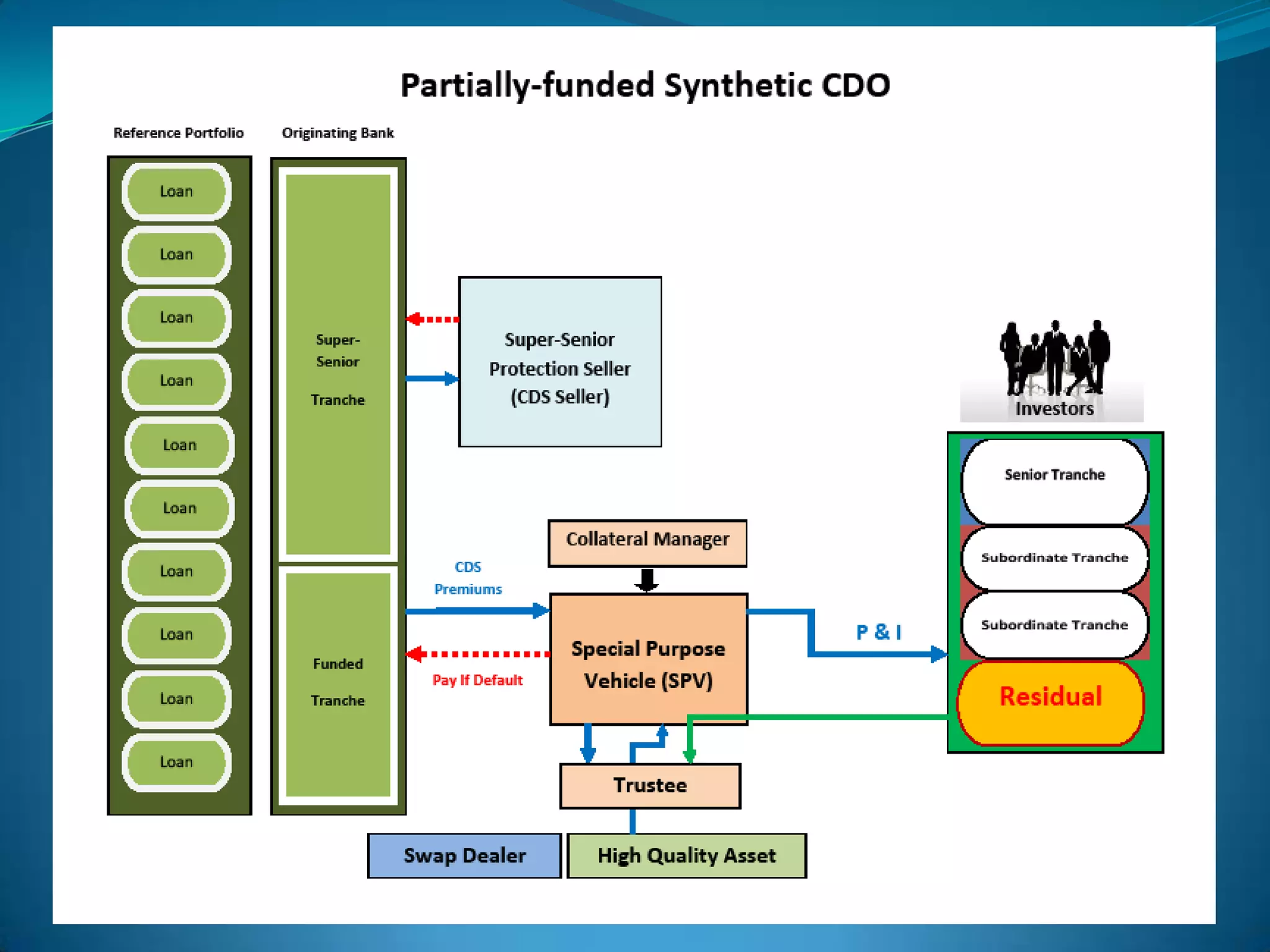
Synthetic Securities
High Yield Bonds
Leveraged Bank Loans                    (both term and revolving)
Investment Grade Bonds and Loans (both term and revolving)
Emerging Market Sovereign Debt
Emerging Market Corporate Debt
Asset-Backed Securities  (ABS)    (including CDO securities)
Mortgage-Backed Securities        (MBS & CMBS)
Project Finance Debt                     (bonds and loans)Taxonomy Based on Sourceof Cash FlowsHow do the investors make money?Cash Flow (Par Value)
“Mark to Market ” eliminated through securitization
Market Value
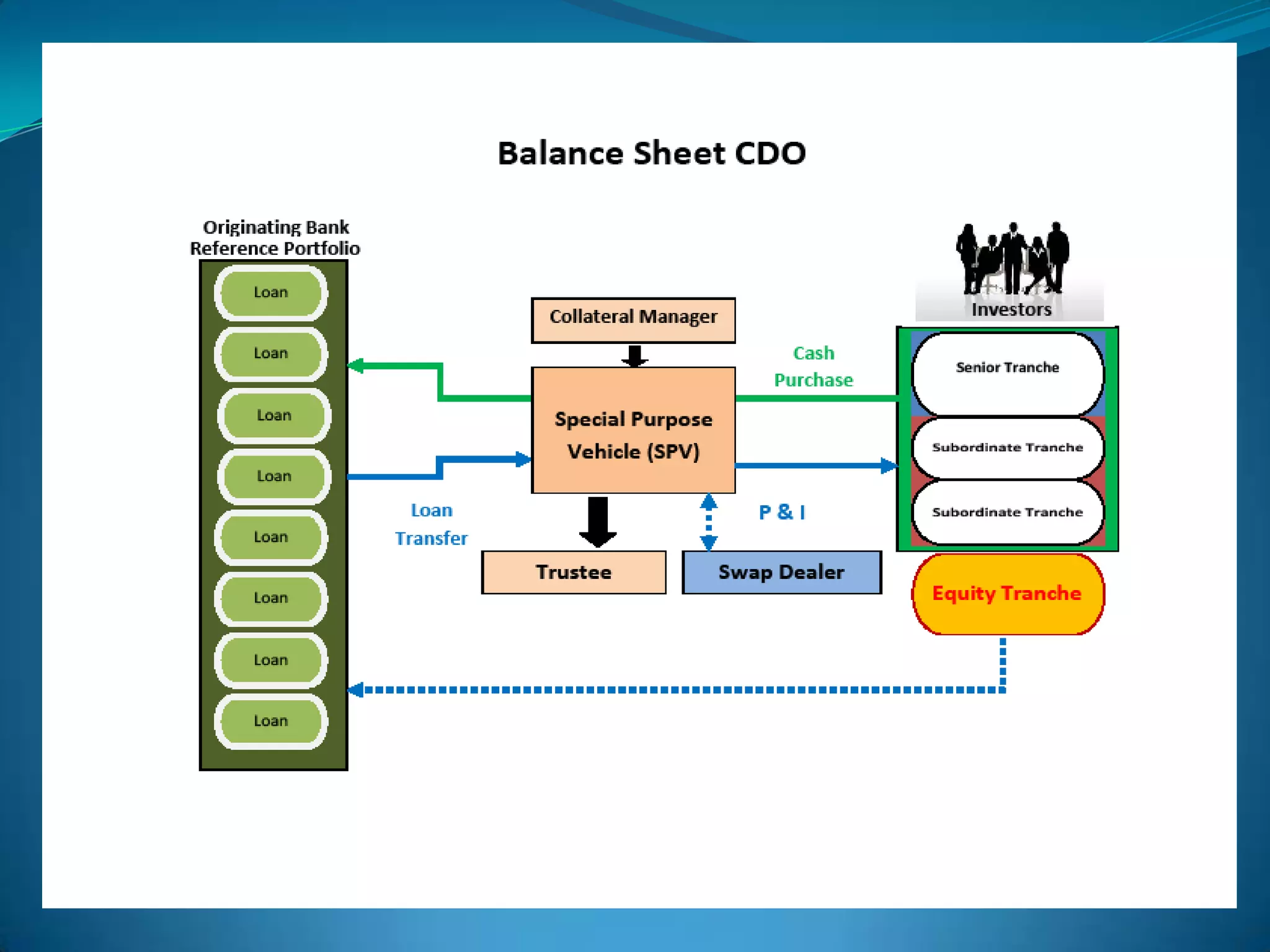
More frequent trading to realize capital gains profitsTaxonomy Based on MotivationWho initiates the CDO?Balance Sheet CDO
Initiated by  originators to remove assets from the balance sheet
Arbitrage CDO
Initiated by Investors
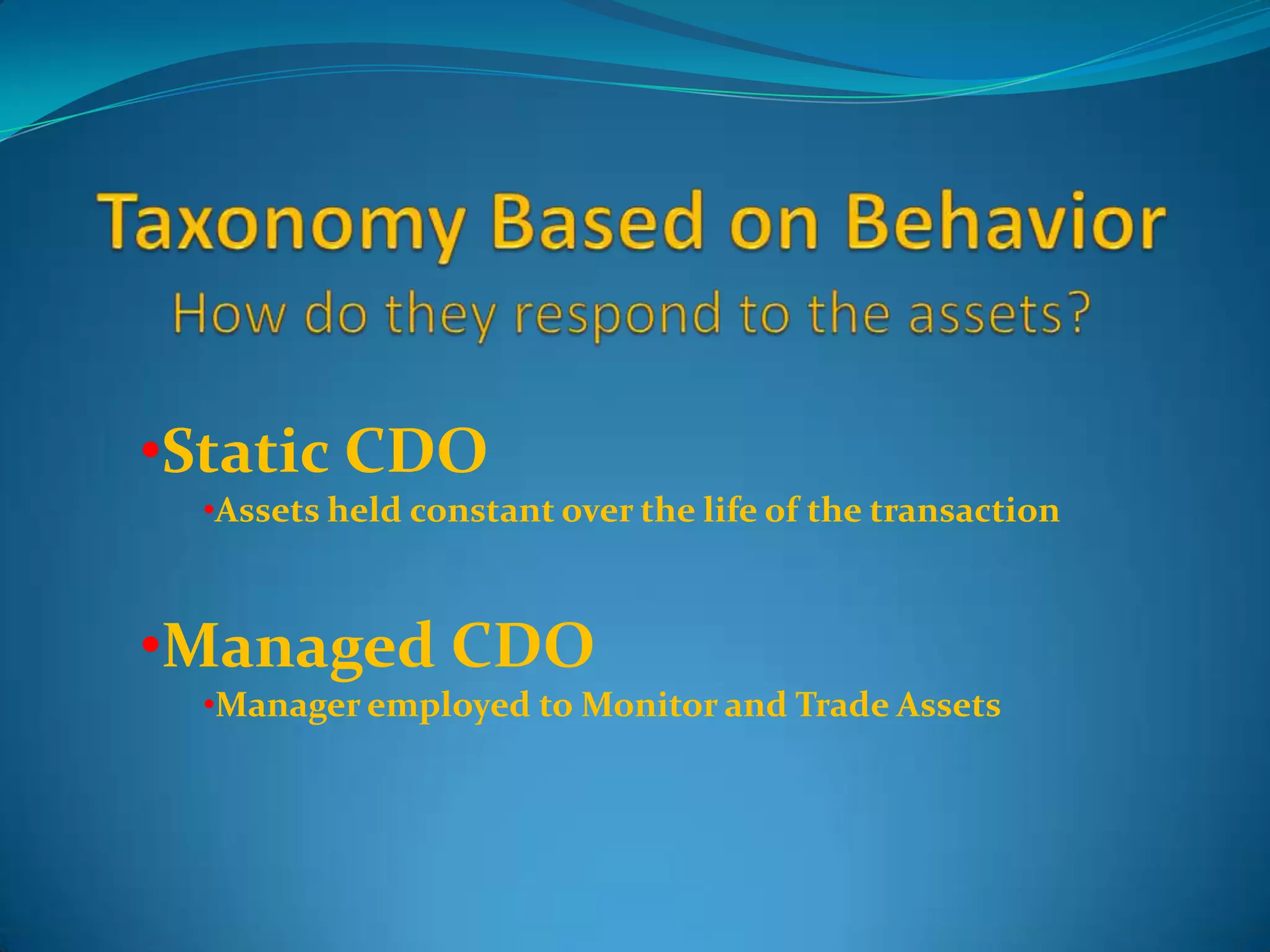
Collateral Manager purchases assets from the marketTaxonomy Based on BehaviorHow do they respond to the assets?Static CDO

Collateralized Debt Obligations Presentation Final Version!

  • 1.
    Collateralized Debt Obligations“TheBiology of CDOs”A General Overview of the Genus-JAMES“Focus on a Species”Commercial Real Estate CDOs-TOM
  • 2.
    What Are CollateralizedDebt Obligations (CDOs)?Type of SPE constructed to hold assets as collateral and to sell tranches of the cash flows derived from the underlying assets to “QIBs”
  • 3.
  • 4.
    Taxonomy Based onAssetsWhat are they made of?Debt Products That Create Cash Flow StreamsREIT Debt
  • 5.
  • 6.
  • 7.
  • 8.
    Distressed Debt andDIP Financings
  • 9.
  • 10.
    Forfaiting Assets (trade finance-related debt)
  • 11.
  • 12.
  • 13.
  • 14.
  • 15.
  • 16.
    Leveraged Bank Loans (both term and revolving)
  • 17.
    Investment Grade Bondsand Loans (both term and revolving)
  • 18.
  • 19.
  • 20.
    Asset-Backed Securities (ABS) (including CDO securities)
  • 21.
  • 22.
    Project Finance Debt (bonds and loans)Taxonomy Based on Sourceof Cash FlowsHow do the investors make money?Cash Flow (Par Value)
  • 23.
    “Mark to Market” eliminated through securitization
  • 24.
  • 25.
    More frequent tradingto realize capital gains profitsTaxonomy Based on MotivationWho initiates the CDO?Balance Sheet CDO
  • 26.
    Initiated by originators to remove assets from the balance sheet
  • 27.
  • 28.
  • 29.
    Collateral Manager purchasesassets from the marketTaxonomy Based on BehaviorHow do they respond to the assets?Static CDO
  • 30.
    Assets held constantover the life of the transaction
  • 31.
  • 32.
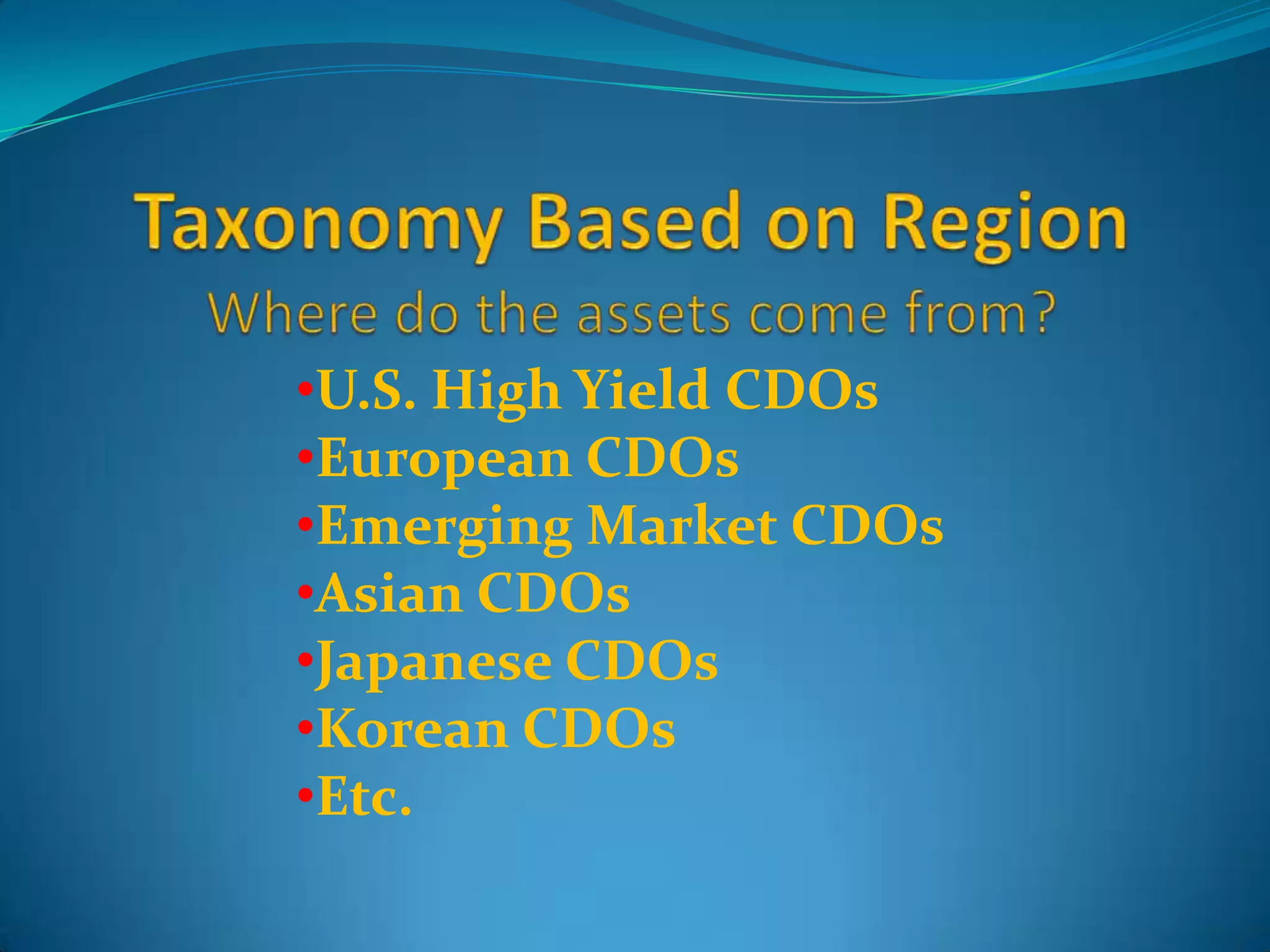
    Manager employed toMonitor and Trade AssetsTaxonomy Based on RegionWhere do the assets come from?U.S. High Yield CDOs
  • 33.
  • 34.
  • 35.
  • 36.
  • 37.
  • 38.
  • 40.
  • 41.
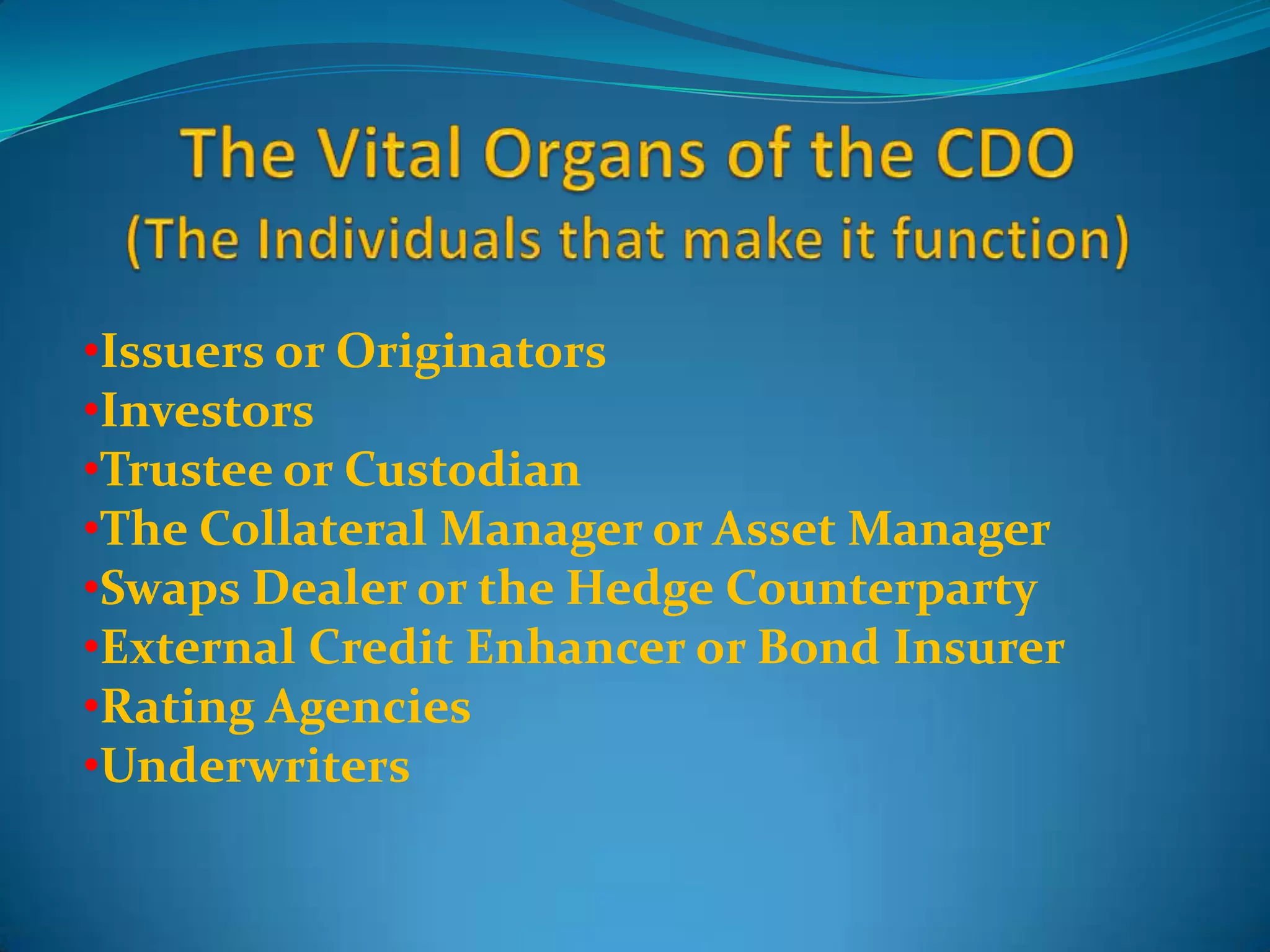
    The Vital Organsof the CDO(The Individuals that make it function)Issuers or Originators
  • 42.
  • 43.
  • 44.
    The Collateral Manageror Asset Manager
  • 45.
    Swaps Dealer orthe Hedge Counterparty
  • 46.
  • 47.
  • 48.
  • 50.
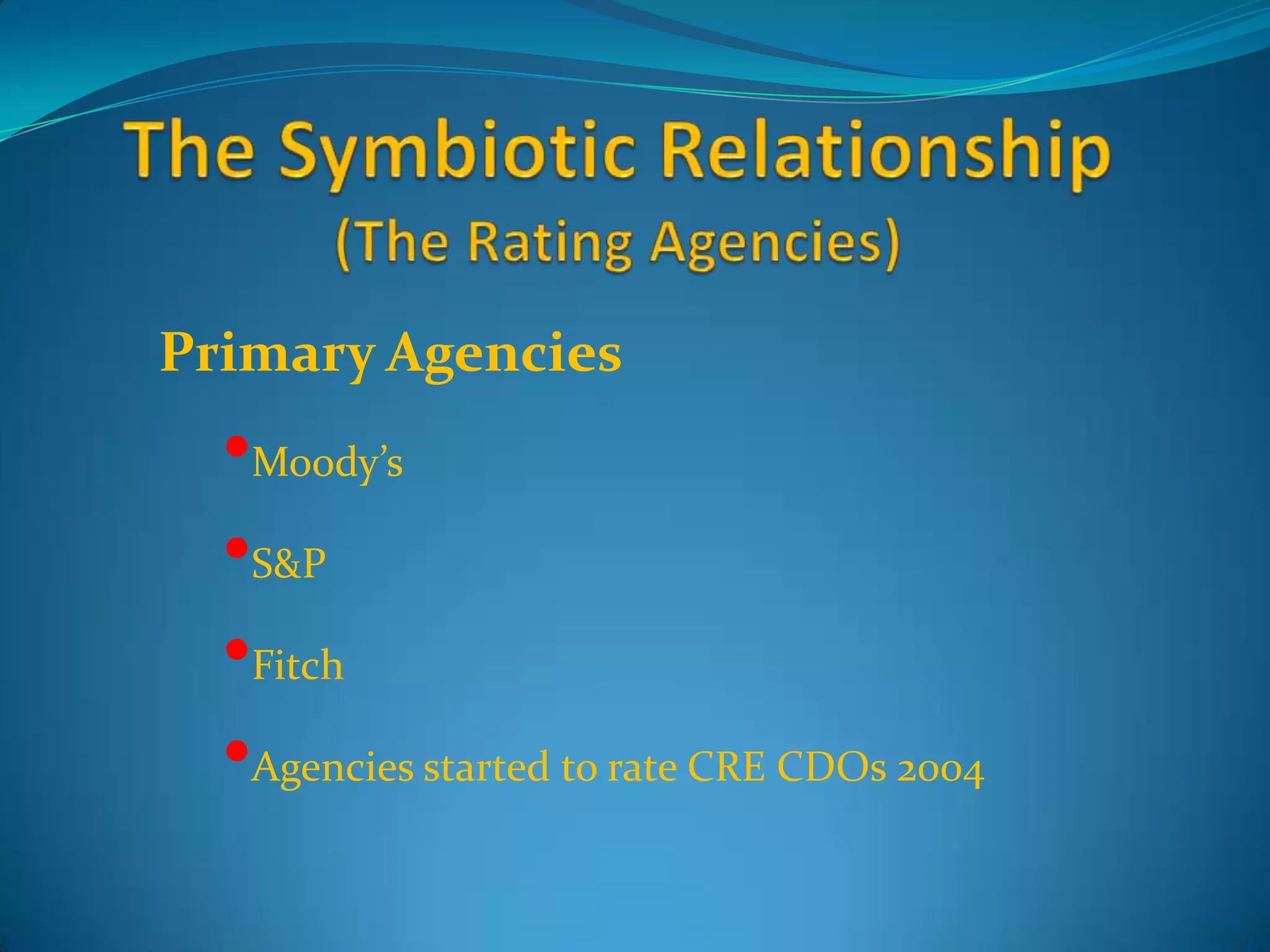
    The Symbiotic Relationship(TheRating Agencies)Primary Agencies Moody’s
  • 51.
  • 52.
  • 53.
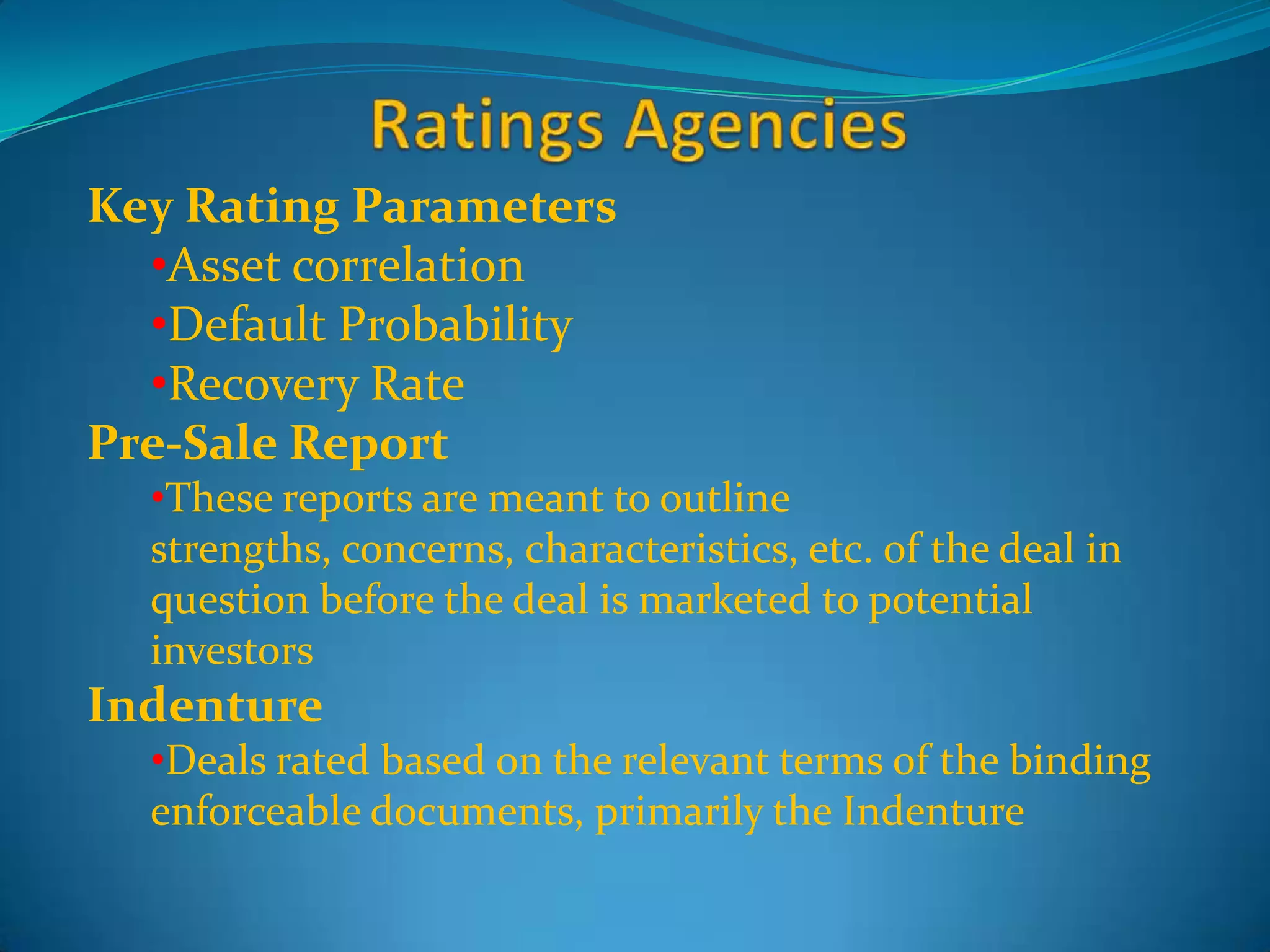
    Agencies started torate CRE CDOs 2004Ratings Agencies Key Rating ParametersAsset correlation
  • 54.
  • 55.
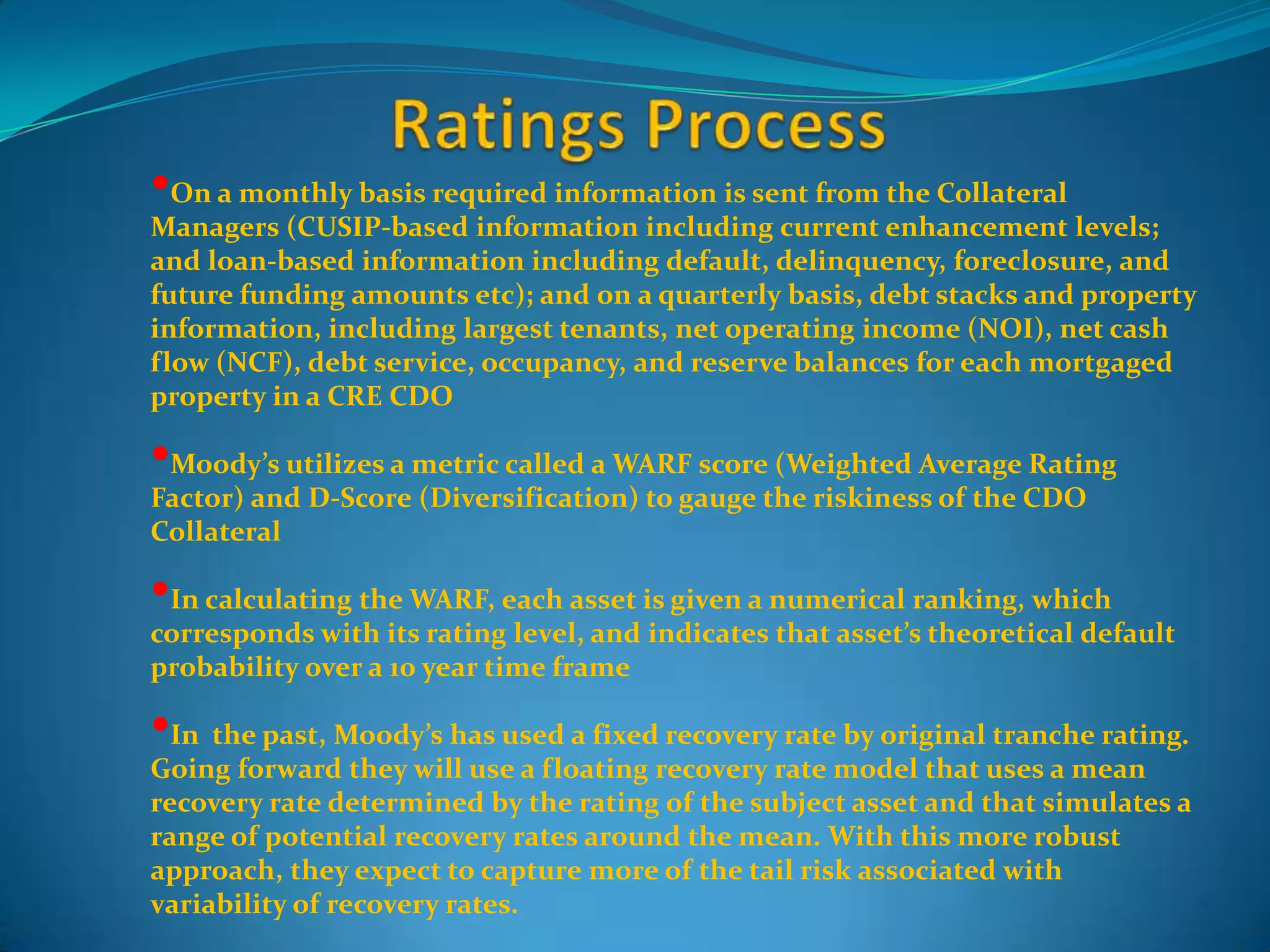
    Recovery RatePre-Sale ReportThese reports are meant to outline strengths, concerns, characteristics, etc. of the deal in question before the deal is marketed to potential investorsIndentureDeals rated based on the relevant terms of the binding enforceable documents, primarily the IndentureRatings Process On a monthly basis required information is sent from the Collateral Managers (CUSIP-based information including current enhancement levels; and loan-based information including default, delinquency, foreclosure, and future funding amounts etc); and on a quarterly basis, debt stacks and property information, including largest tenants, net operating income (NOI), net cash flow (NCF), debt service, occupancy, and reserve balances for each mortgaged property in a CRE CDO
  • 56.
    Moody’s utilizes ametric called a WARF score (Weighted Average Rating Factor) and D-Score (Diversification) to gauge the riskiness of the CDO Collateral
  • 57.
    In calculating theWARF, each asset is given a numerical ranking, which corresponds with its rating level, and indicates that asset’s theoretical default probability over a 10 year time frame
  • 58.
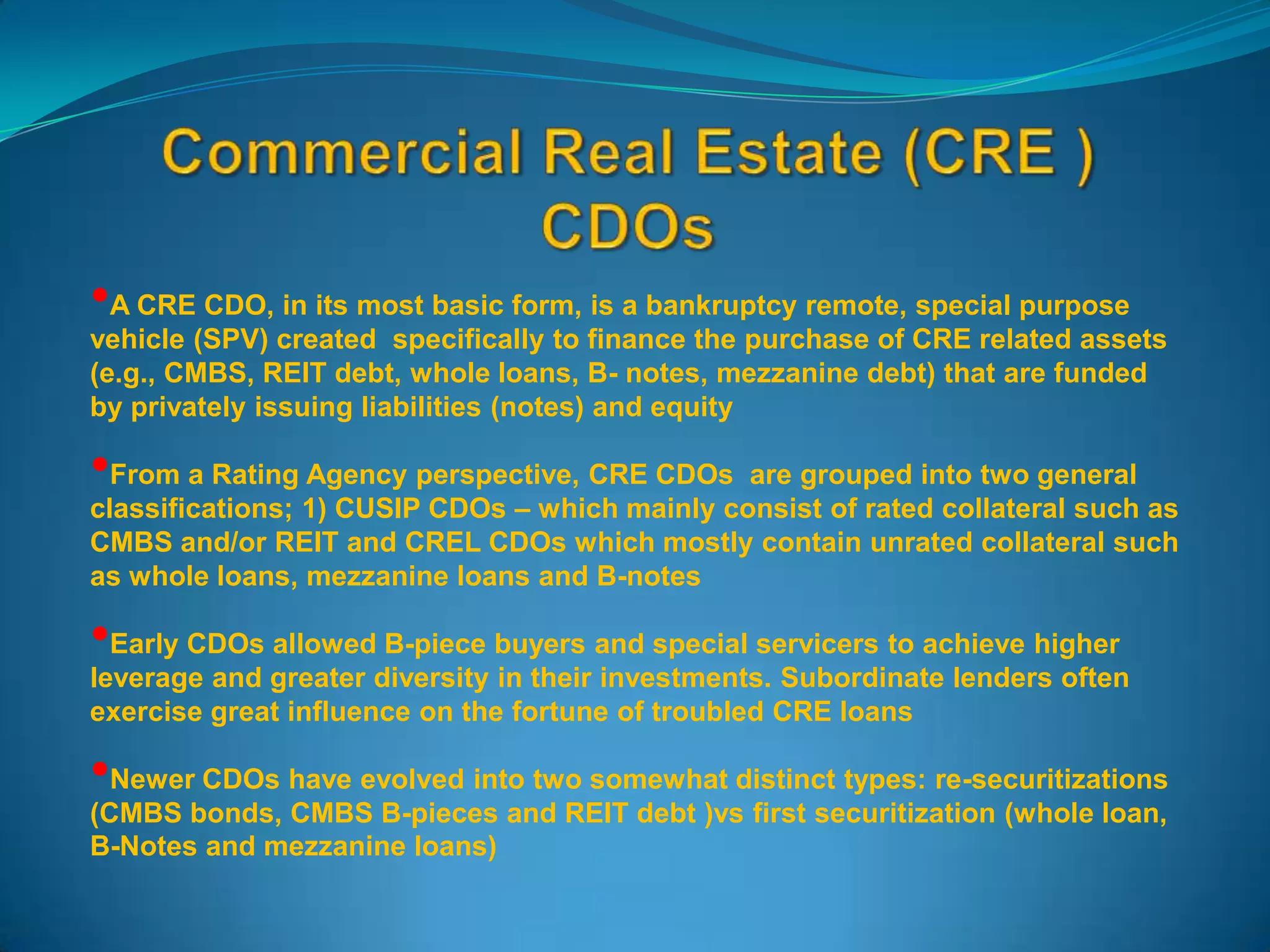
    In thepast, Moody’s has used a fixed recovery rate by original tranche rating. Going forward they will use a floating recovery rate model that uses a mean recovery rate determined by the rating of the subject asset and that simulates a range of potential recovery rates around the mean. With this more robust approach, they expect to capture more of the tail risk associated with variability of recovery rates.Commercial Real Estate (CRE ) CDOsA CRE CDO, in its most basic form, is a bankruptcy remote, special purpose vehicle (SPV) created specifically to finance the purchase of CRE related assets (e.g., CMBS, REIT debt, whole loans, B- notes, mezzanine debt) that are funded by privately issuing liabilities (notes) and equity
  • 59.
    From a RatingAgency perspective, CRE CDOs are grouped into two general classifications; 1) CUSIP CDOs – which mainly consist of rated collateral such as CMBS and/or REIT and CREL CDOs which mostly contain unrated collateral such as whole loans, mezzanine loans and B-notes
  • 60.
    Early CDOs allowedB-piece buyers and special servicers to achieve higher leverage and greater diversity in their investments. Subordinate lenders often exercise great influence on the fortune of troubled CRE loans
  • 61.
    Newer CDOs haveevolved into two somewhat distinct types: re-securitizations (CMBS bonds, CMBS B-pieces and REIT debt )vs first securitization (whole loan, B-Notes and mezzanine loans)
  • 62.
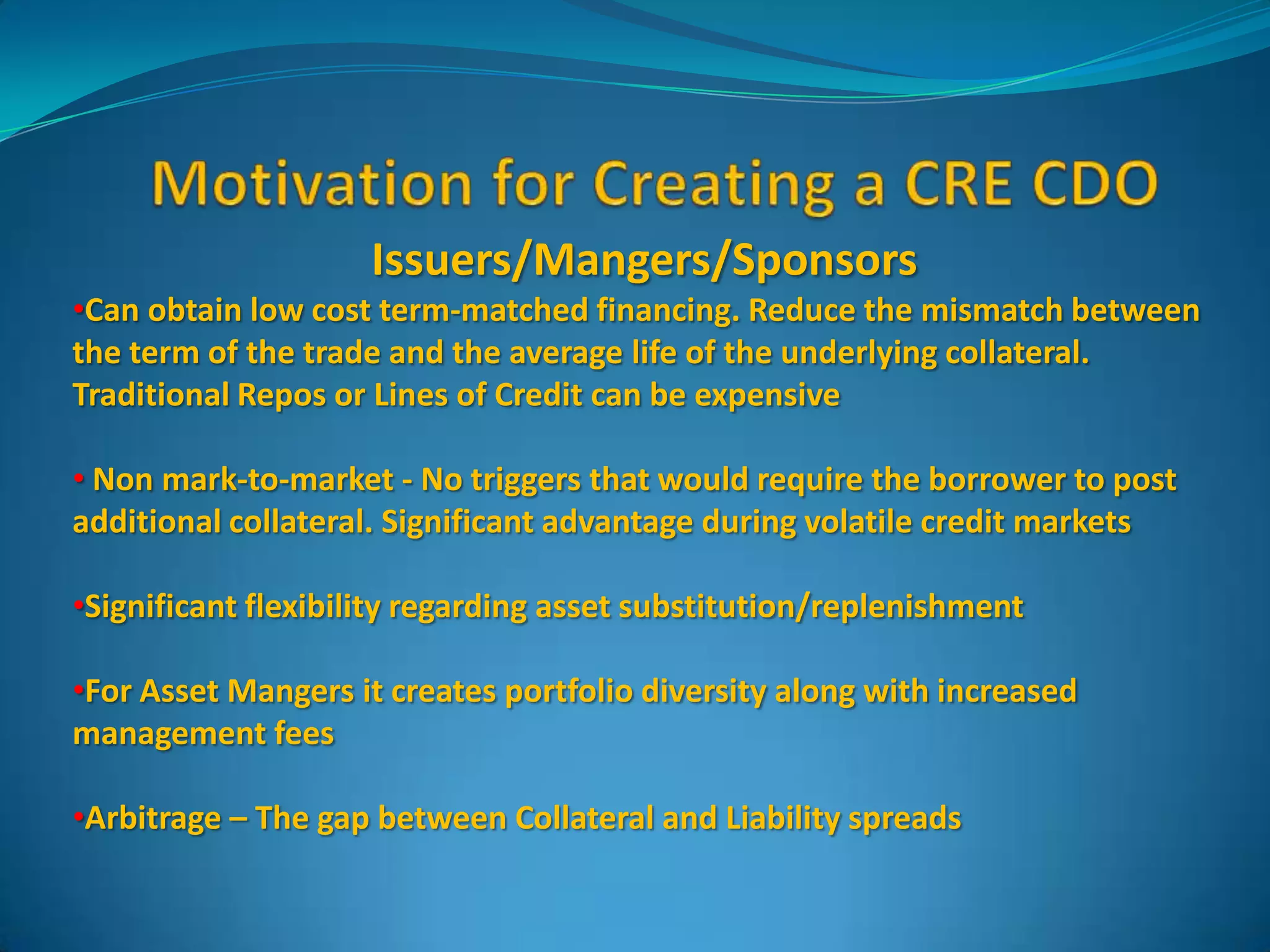
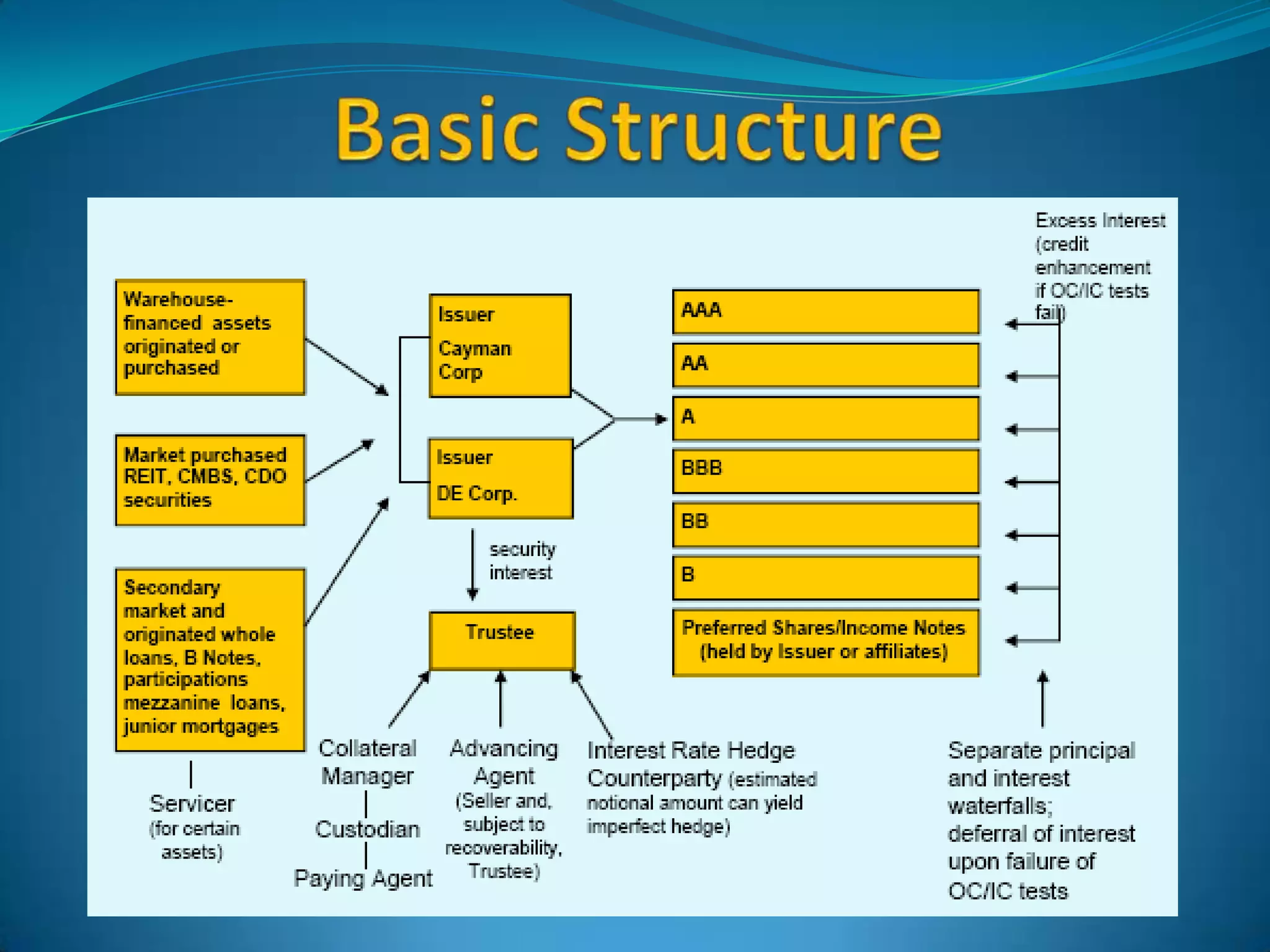
    Motivation for Creatinga CRE CDOIssuers/Mangers/Sponsors Can obtain low cost term-matched financing. Reduce the mismatch between the term of the trade and the average life of the underlying collateral. Traditional Repos or Lines of Credit can be expensive
  • 63.
    Non mark-to-market- No triggers that would require the borrower to post additional collateral. Significant advantage during volatile credit markets
  • 64.
    Significant flexibility regardingasset substitution/replenishment
  • 65.
    For Asset Mangersit creates portfolio diversity along with increased management fees
  • 66.
    Arbitrage – Thegap between Collateral and Liability spreadsMotivation for Creating a CRE CDOInvestorsOffer a way to gain access to an otherwise illiquid market
  • 67.
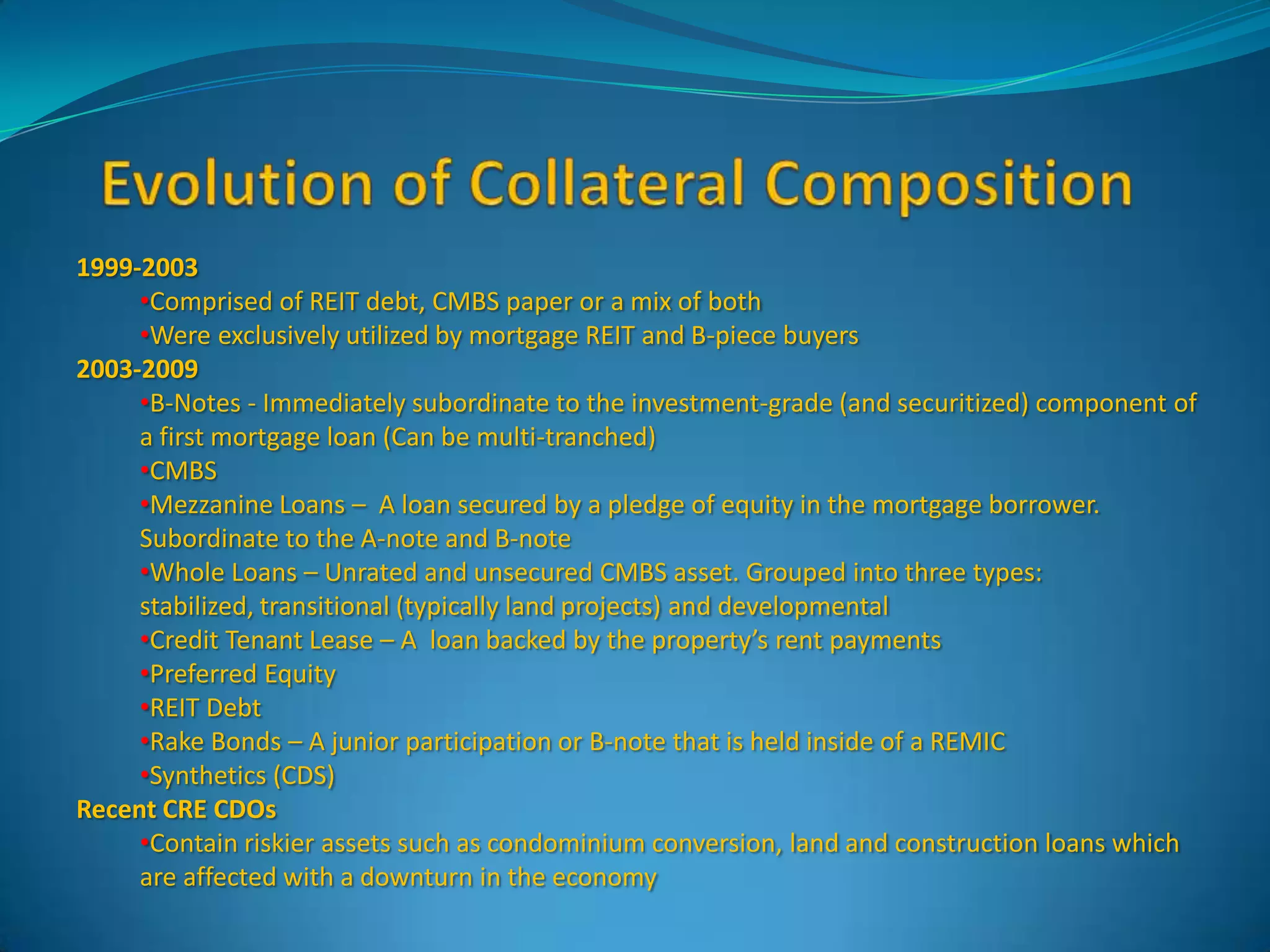
    Customized tranched risk(high/low investment grade notes). For example an insurance company will buy the senior tranche whereas the hedge fund may buy the subordinate trancheEvolution of Collateral Composition1999-2003Comprised of REIT debt, CMBS paper or a mix of both
  • 68.
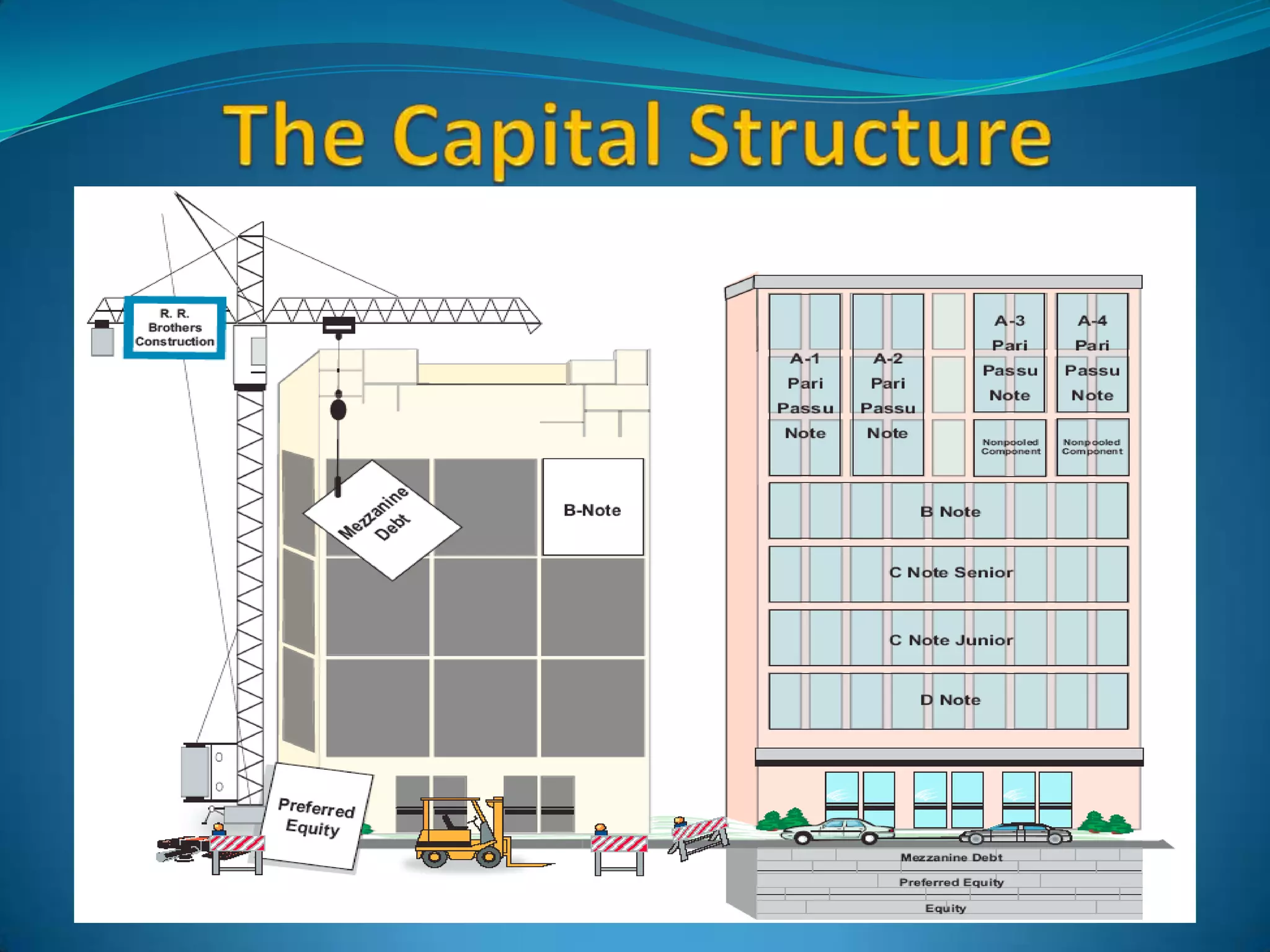
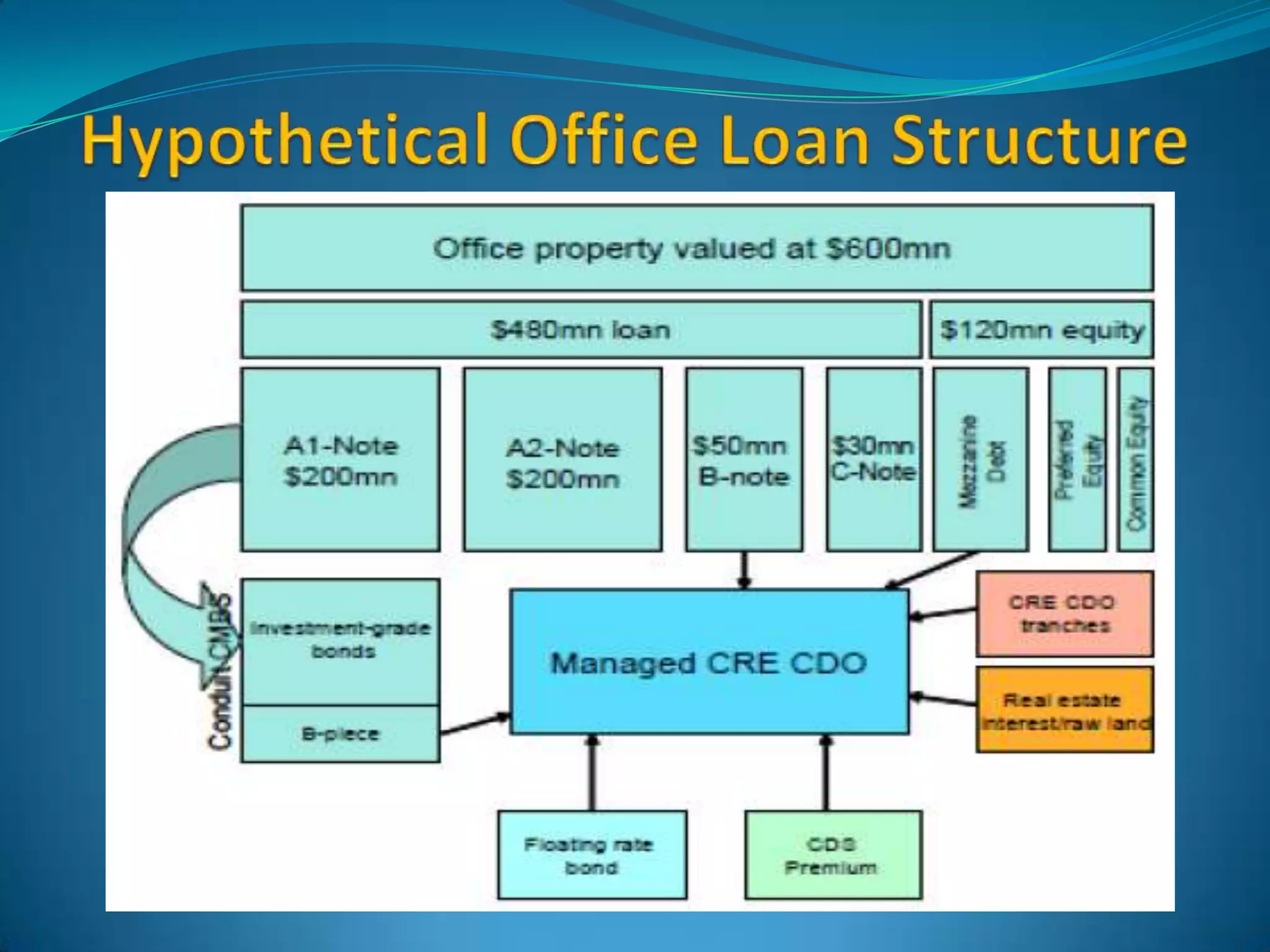
    Were exclusively utilizedby mortgage REIT and B-piece buyers2003-2009B-Notes - Immediately subordinate to the investment-grade (and securitized) component of a first mortgage loan (Can be multi-tranched)
  • 69.
  • 70.
    Mezzanine Loans – A loan secured by a pledge of equity in the mortgage borrower. Subordinate to the A-note and B-note
  • 71.
    Whole Loans –Unrated and unsecured CMBS asset. Grouped into three types: stabilized, transitional (typically land projects) and developmental
  • 72.
    Credit Tenant Lease– A loan backed by the property’s rent payments
  • 73.
  • 74.
  • 75.
    Rake Bonds –A junior participation or B-note that is held inside of a REMIC
  • 76.
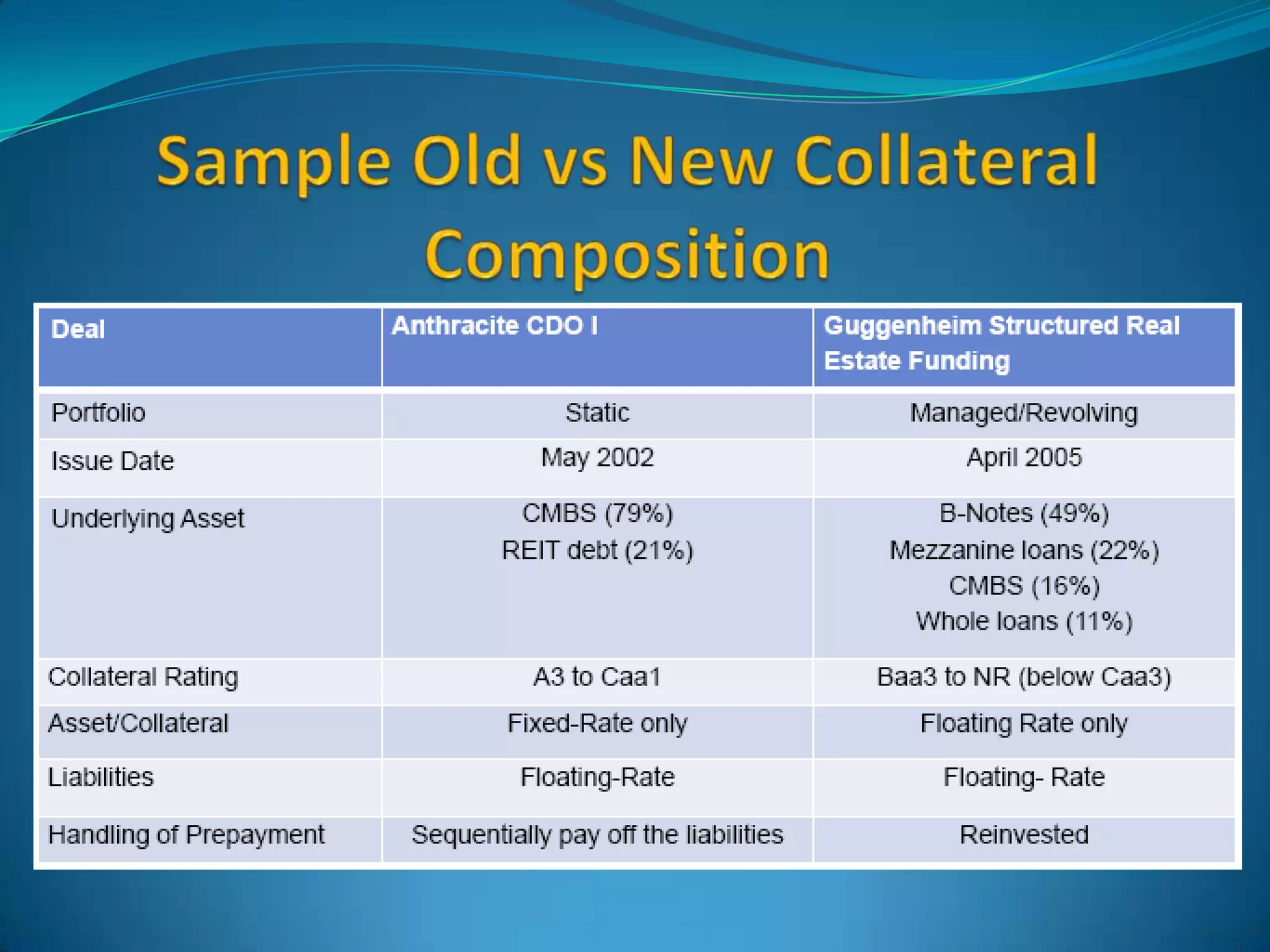
    Synthetics (CDS)Recent CRECDOs Contain riskier assets such as condominium conversion, land and construction loans which are affected with a downturn in the economySample Old vs New Collateral Composition
  • 77.
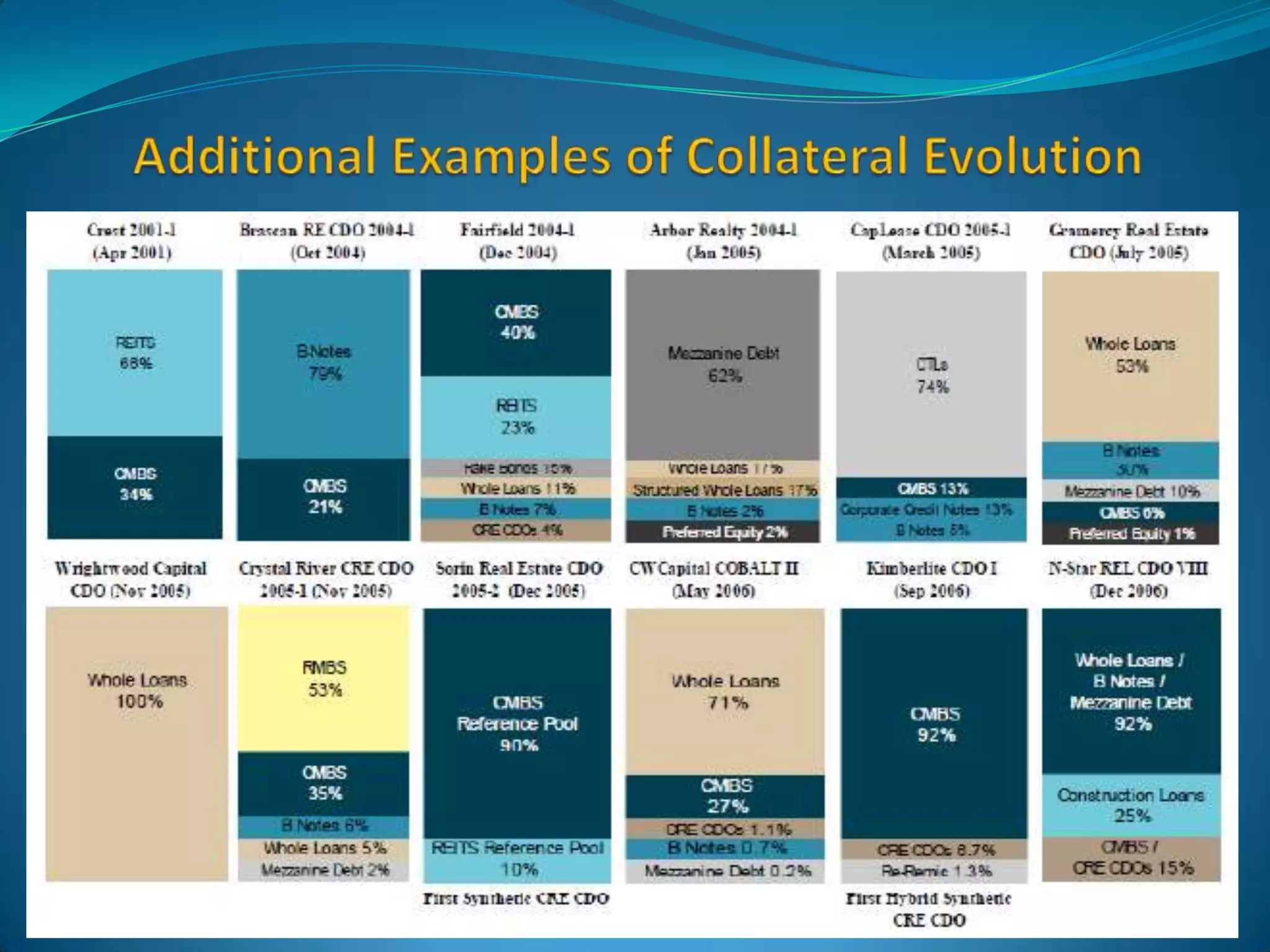
    Additional Examples ofCollateral Evolution
  • 78.
  • 79.
  • 80.
  • 81.
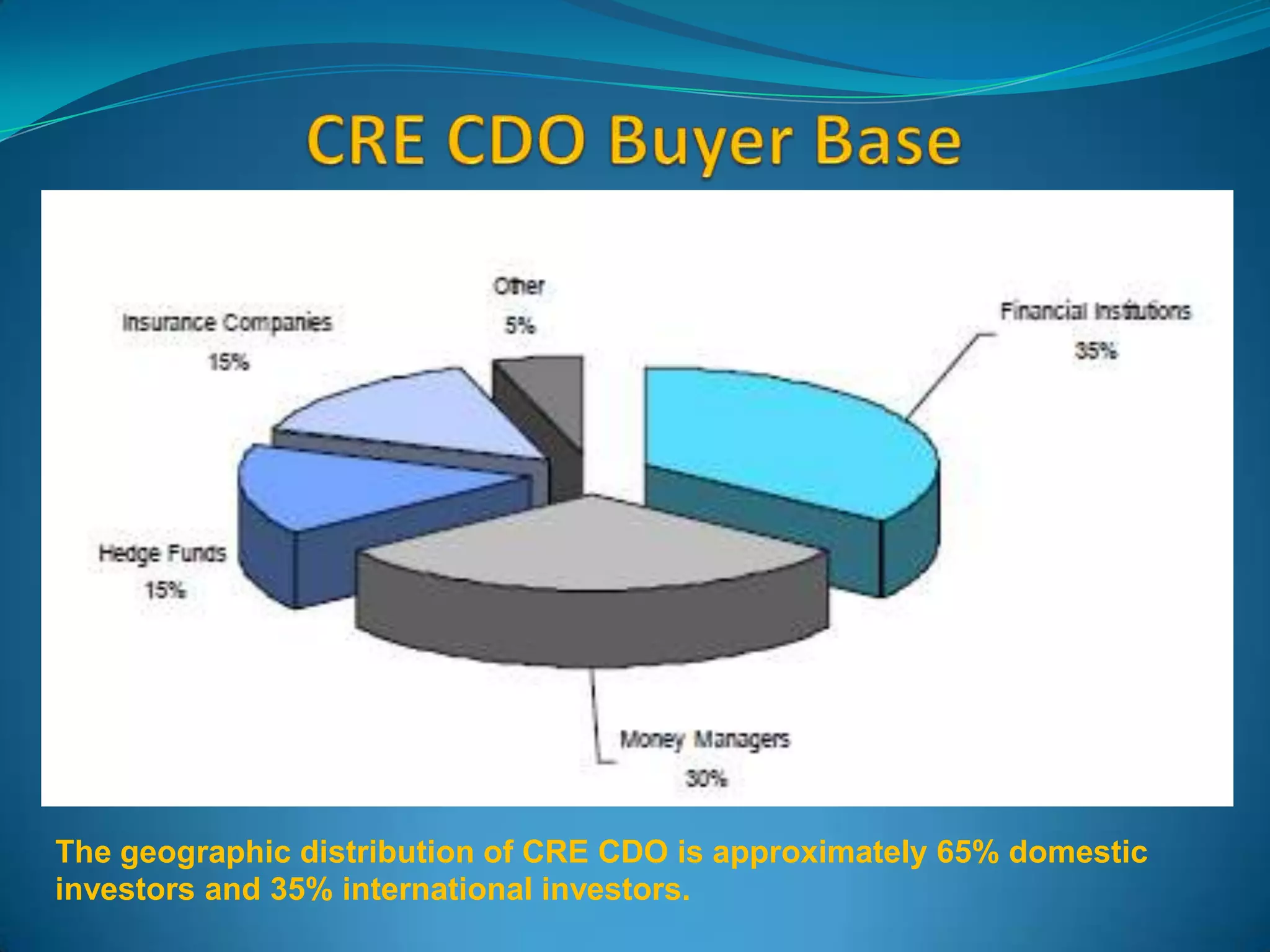
    CRE CDO BuyerBaseThe geographic distribution of CRE CDO is approximately 65% domestic investors and 35% international investors.
  • 82.
    CRE CDO vsCMBSCRE CDO spreads have been historically wider than the spreads of CMBS(A triple-A CRE CDO paper can offer 10bp to 30bp pickup over comparable rated CMBS)