Synthetic CDOXLRI JamshedpurHimadriSingha(019)Kumar Vikram      (024)HozefaBharmal(078)              Group 3    RituAgarwal        (102)Subhadip Das      (110)Nikhil Uppal          (092)
Basics of Synthetic CDOThis product was introduced where Credit Risk Transfer was more importantCredit Risk is transferred by Originator to the Investors by means of CD instrumentsRisk transfer is undertaken by an SPVOriginator is the “Protection Buyer” and Investors are “Protection Seller”Main purpose is to mitigate risk without any asset transfer.
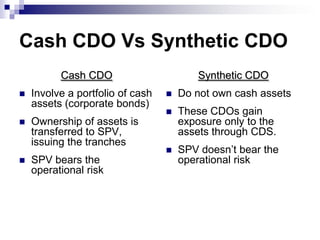
Cash CDO Vs Synthetic CDOCash CDOInvolve a portfolio of cash assets (corporate bonds)Ownership of assets is transferred to SPV, issuing the tranchesSPV bears the operational riskSynthetic CDODo not own cash assetsThese CDOs gain exposure only to the assets through CDS.SPV doesn’t bear the operational risk
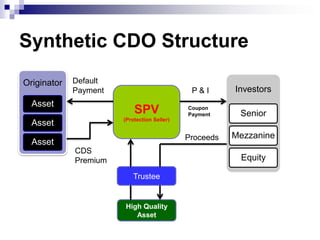
Synthetic CDO StructureDefault PaymentP & ISPV(Protection Seller)Coupon PaymentProceedsCDS PremiumTrusteeHigh Quality Asset
Waterfall DiagramCDS PremiumDefault PaymentLow RiskSenior TrancheLow YieldMezzanine TrancheHigh RiskEquityHigh Yield
Types of Synthetic CDO Unfunded Synthetic CDO
Protection seller’s payment obligation is not paid upfront
Investors are ultimate protection seller.
Funded Synthetic CDO
Protection seller’s payment obligation is paid upfront through issuing CLN
Proceeds from CLN are invested in Risk Free assets
Partially Funded Synthetic CDOUnfunded Synthetic CDOProtection buyer enters into a CDS with SPV, which in turn, enters into a CDS with investors, the ultimate protection seller
Funded Synthetic CDOInterest payment equal to the yield on high quality asset + CDS PremiumDefault PaymentSPV(Protection Seller)Coupon LIBOR + X bpsProceedsCDS PremiumFrom CLNTrusteeThis is done to “delink” the credit ratings of the notes from the rating of the originator.Else downgrade of the originator would downgrade the issued notes.Notes equal to 100% of the value of the ref pool  of assets are issuedHigh Quality Asset
Partially Funded Synthetic CDOUnfundedTrancheFundedTrancheSST does not pay purchase price. Rather SST receives payments as protection seller and is liable to pay the originator if the underlying assets suffer a loss above specified level.Perceived risk is less5-10% default riskSuper Senior Protection CDS PremiumPay if defaultSPV(Protection Seller) CDSPremiumCoupon Libor+ X bpsProceedsPay if defaultFrom CLNTrusteeHigh Quality Asset
A typical funding structure
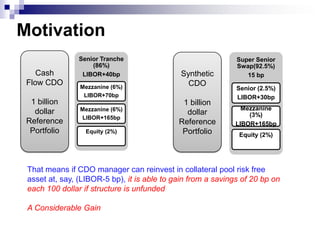
MotivationTypically the reference assets are not actually removed from the sponsoring firm’s balance sheet. For this reason: Synthetic CDOs are easier to execute than cash structuresthe legal documentation and other administrative requirements are less burdensomeSynthetic CDO ensures transfer of credit risk of assets not suited for conventional securitization, while the actual assets are retained on the balance sheet.For example, Bank guarantees, Letter of Credit etc.A more efficient way of Credit risk mitigationOriginator does not have to reduce book size as BS remains unchangedThe super senior tranche, which prices well below a typical AAA tranche and which makes up more than 80% of the synthetic CDO, is a major driver of the economics of the synthetic CDO
MotivationCash Flow CDO1 billion dollar Reference PortfolioSynthetic  CDO1 billion dollar Reference PortfolioThat means if CDO manager can reinvest in collateral pool risk free asset at, say, (LIBOR-5 bp), it is able to gain from a savings of 20 bp on each 100 dollar if structure is unfundedA Considerable Gain
Structure of a CDO TrancheTraditionally, a collateralized debt obligation pool is divided into three tranches; wherein each tranche behaves as a separate CDO, enabling the CDO originators to attract multiple investors having varying risk preferences1. Senior Tranche or Senior Debt: This is typically highly rated, since it is ranked on top in terms of priority of payments. However, the interest rate on investments in this tranche is the lowest due to the lower risk that accompanies them2. Mezzanine Tranche: This tranche has moderate returns and moderate risk3. Equity Tranche: Investment in this tranche yields the highest interest rate. This high rate is offered to counter the higher risk on this tranche. Equity tranche investors are the first to lose funds when loans in the pool are not repaid
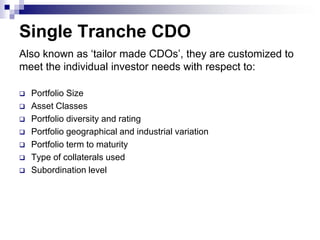
Single Tranche CDOAlso known as ‘tailor made CDOs’, they are customized to meet the individual investor needs with respect to:Portfolio Size
Asset Classes
Portfolio diversity and rating
Portfolio geographical and industrial variation
Portfolio term to maturity
Type of collaterals used
Subordination levelSingle Tranche CDOSingle-tranche CDOs represent the vast majority of all new synthetic CDO issuances.
The CDO manager sells only a single tranche – usually at the mezzanine level – of the capital structure to an investor instead of selling all the tranches at the same time
The Single Tranche CDO can be issued either directly by the Banks or via SPVsAdvantages of Single Tranche:Single tranche is tailored to the specific investor’s needs
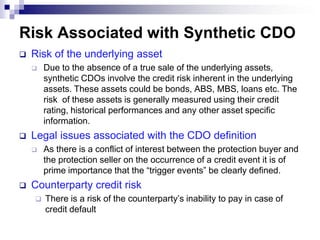
It is not necessary for the CDO manager to find investors across the entire capital structure simultaneouslyRisk Associated with Synthetic CDORisk of the underlying asset
Due to the absence of a true sale of the underlying assets, synthetic CDOs involve the credit risk inherent in the underlying assets. These assets could be bonds, ABS, MBS, loans etc. The risk  of these assets is generally measured using their credit rating, historical performances and any other asset specific information.
Legal issues associated with the CDO definition
As there is a conflict of interest between the protection buyer and the protection seller on the occurrence of a credit event it is of prime importance that the “trigger events” be clearly defined.
Counterparty credit risk
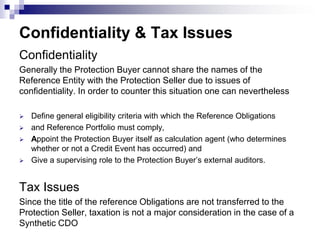
There is a risk of the counterparty’s inability to pay in case of credit defaultConfidentiality & Tax IssuesConfidentialityGenerally the Protection Buyer cannot share the names of the Reference Entity with the Protection Seller due to issues of confidentiality. In order to counter this situation one can neverthelessDefine general eligibility criteria with which the Reference Obligations
and Reference Portfolio must comply,
Appoint the Protection Buyer itself as calculation agent (who determines whether or not a Credit Event has occurred) and
Give a supervising role to the Protection Buyer’s external auditors.Tax IssuesSince the title of the reference Obligations are not transferred to the Protection Seller, taxation is not a major consideration in the case of a Synthetic CDO
Moody’s Ratings FrameworkMoody's rating on each rated note represents the expected loss on the note, which is the difference between the present value of the expected payments on the note and the present value of the promised payments under the note, expressed as a percentage of the present value of the promiseTo evaluate the expected loss, Moody’s incorporates both quantitative and qualitative analysisMoody's expected loss models capture the quantifiable risks while a legal review of the transaction seeks to ensure that non-quantifiable risks are mitigated through documentation provisions
Quantitative AnalysesThe primary source of risk in a synthetic CDO comes from the reference poolMoody’s uses the quantitative analysis to assess the risks stemming from the reference poolThe premium payments are excluded from the scope of the quantitative analysis because the promised premium is large enough to ensure coverage of the interest payments on the CDOThere are two primary methods to model a default risk:Binomial Expansion ModelingMultiple Binomial Modeling
Binomial Expansion ModelingPrimarily used for a pool of homogeneous assetsA model portfolio is created which contains a pool of Ndiversity bondsEach diversity bond is assumed to have identical characteristics in terms of par/notional amount, rating, average life, spread and recovery, and is uncorrelated with every other diversity bond in the poolThe number of diversity bonds in the portfolio is equivalent to Moody's diversity score

Synthetic CDO

  • 1.
    Synthetic CDOXLRI JamshedpurHimadriSingha(019)KumarVikram (024)HozefaBharmal(078) Group 3 RituAgarwal (102)Subhadip Das (110)Nikhil Uppal (092)
  • 2.
    Basics of SyntheticCDOThis product was introduced where Credit Risk Transfer was more importantCredit Risk is transferred by Originator to the Investors by means of CD instrumentsRisk transfer is undertaken by an SPVOriginator is the “Protection Buyer” and Investors are “Protection Seller”Main purpose is to mitigate risk without any asset transfer.
  • 3.
    Cash CDO VsSynthetic CDOCash CDOInvolve a portfolio of cash assets (corporate bonds)Ownership of assets is transferred to SPV, issuing the tranchesSPV bears the operational riskSynthetic CDODo not own cash assetsThese CDOs gain exposure only to the assets through CDS.SPV doesn’t bear the operational risk
  • 4.
    Synthetic CDO StructureDefaultPaymentP & ISPV(Protection Seller)Coupon PaymentProceedsCDS PremiumTrusteeHigh Quality Asset
  • 5.
    Waterfall DiagramCDS PremiumDefaultPaymentLow RiskSenior TrancheLow YieldMezzanine TrancheHigh RiskEquityHigh Yield
  • 6.
    Types of SyntheticCDO Unfunded Synthetic CDO
  • 7.
    Protection seller’s paymentobligation is not paid upfront
  • 8.
    Investors are ultimateprotection seller.
  • 9.
  • 10.
    Protection seller’s paymentobligation is paid upfront through issuing CLN
  • 11.
    Proceeds from CLNare invested in Risk Free assets
  • 12.
    Partially Funded SyntheticCDOUnfunded Synthetic CDOProtection buyer enters into a CDS with SPV, which in turn, enters into a CDS with investors, the ultimate protection seller
  • 13.
    Funded Synthetic CDOInterestpayment equal to the yield on high quality asset + CDS PremiumDefault PaymentSPV(Protection Seller)Coupon LIBOR + X bpsProceedsCDS PremiumFrom CLNTrusteeThis is done to “delink” the credit ratings of the notes from the rating of the originator.Else downgrade of the originator would downgrade the issued notes.Notes equal to 100% of the value of the ref pool of assets are issuedHigh Quality Asset
  • 14.
    Partially Funded SyntheticCDOUnfundedTrancheFundedTrancheSST does not pay purchase price. Rather SST receives payments as protection seller and is liable to pay the originator if the underlying assets suffer a loss above specified level.Perceived risk is less5-10% default riskSuper Senior Protection CDS PremiumPay if defaultSPV(Protection Seller) CDSPremiumCoupon Libor+ X bpsProceedsPay if defaultFrom CLNTrusteeHigh Quality Asset
  • 15.
  • 16.
    MotivationTypically the referenceassets are not actually removed from the sponsoring firm’s balance sheet. For this reason: Synthetic CDOs are easier to execute than cash structuresthe legal documentation and other administrative requirements are less burdensomeSynthetic CDO ensures transfer of credit risk of assets not suited for conventional securitization, while the actual assets are retained on the balance sheet.For example, Bank guarantees, Letter of Credit etc.A more efficient way of Credit risk mitigationOriginator does not have to reduce book size as BS remains unchangedThe super senior tranche, which prices well below a typical AAA tranche and which makes up more than 80% of the synthetic CDO, is a major driver of the economics of the synthetic CDO
  • 17.
    MotivationCash Flow CDO1billion dollar Reference PortfolioSynthetic CDO1 billion dollar Reference PortfolioThat means if CDO manager can reinvest in collateral pool risk free asset at, say, (LIBOR-5 bp), it is able to gain from a savings of 20 bp on each 100 dollar if structure is unfundedA Considerable Gain
  • 18.
    Structure of aCDO TrancheTraditionally, a collateralized debt obligation pool is divided into three tranches; wherein each tranche behaves as a separate CDO, enabling the CDO originators to attract multiple investors having varying risk preferences1. Senior Tranche or Senior Debt: This is typically highly rated, since it is ranked on top in terms of priority of payments. However, the interest rate on investments in this tranche is the lowest due to the lower risk that accompanies them2. Mezzanine Tranche: This tranche has moderate returns and moderate risk3. Equity Tranche: Investment in this tranche yields the highest interest rate. This high rate is offered to counter the higher risk on this tranche. Equity tranche investors are the first to lose funds when loans in the pool are not repaid
  • 19.
    Single Tranche CDOAlsoknown as ‘tailor made CDOs’, they are customized to meet the individual investor needs with respect to:Portfolio Size
  • 20.
  • 21.
  • 22.
    Portfolio geographical andindustrial variation
  • 23.
  • 24.
  • 25.
    Subordination levelSingle TrancheCDOSingle-tranche CDOs represent the vast majority of all new synthetic CDO issuances.
  • 26.
    The CDO managersells only a single tranche – usually at the mezzanine level – of the capital structure to an investor instead of selling all the tranches at the same time
  • 27.
    The Single TrancheCDO can be issued either directly by the Banks or via SPVsAdvantages of Single Tranche:Single tranche is tailored to the specific investor’s needs
  • 28.
    It is notnecessary for the CDO manager to find investors across the entire capital structure simultaneouslyRisk Associated with Synthetic CDORisk of the underlying asset
  • 29.
    Due to theabsence of a true sale of the underlying assets, synthetic CDOs involve the credit risk inherent in the underlying assets. These assets could be bonds, ABS, MBS, loans etc. The risk of these assets is generally measured using their credit rating, historical performances and any other asset specific information.
  • 30.
    Legal issues associatedwith the CDO definition
  • 31.
    As there isa conflict of interest between the protection buyer and the protection seller on the occurrence of a credit event it is of prime importance that the “trigger events” be clearly defined.
  • 32.
  • 33.
    There is arisk of the counterparty’s inability to pay in case of credit defaultConfidentiality & Tax IssuesConfidentialityGenerally the Protection Buyer cannot share the names of the Reference Entity with the Protection Seller due to issues of confidentiality. In order to counter this situation one can neverthelessDefine general eligibility criteria with which the Reference Obligations
  • 34.
  • 35.
    Appoint the ProtectionBuyer itself as calculation agent (who determines whether or not a Credit Event has occurred) and
  • 36.
    Give a supervisingrole to the Protection Buyer’s external auditors.Tax IssuesSince the title of the reference Obligations are not transferred to the Protection Seller, taxation is not a major consideration in the case of a Synthetic CDO
  • 37.
    Moody’s Ratings FrameworkMoody'srating on each rated note represents the expected loss on the note, which is the difference between the present value of the expected payments on the note and the present value of the promised payments under the note, expressed as a percentage of the present value of the promiseTo evaluate the expected loss, Moody’s incorporates both quantitative and qualitative analysisMoody's expected loss models capture the quantifiable risks while a legal review of the transaction seeks to ensure that non-quantifiable risks are mitigated through documentation provisions
  • 38.
    Quantitative AnalysesThe primarysource of risk in a synthetic CDO comes from the reference poolMoody’s uses the quantitative analysis to assess the risks stemming from the reference poolThe premium payments are excluded from the scope of the quantitative analysis because the promised premium is large enough to ensure coverage of the interest payments on the CDOThere are two primary methods to model a default risk:Binomial Expansion ModelingMultiple Binomial Modeling
  • 39.
    Binomial Expansion ModelingPrimarilyused for a pool of homogeneous assetsA model portfolio is created which contains a pool of Ndiversity bondsEach diversity bond is assumed to have identical characteristics in terms of par/notional amount, rating, average life, spread and recovery, and is uncorrelated with every other diversity bond in the poolThe number of diversity bonds in the portfolio is equivalent to Moody's diversity score