Creating Environments for Successful Interaction Nigel Oseland and Alexi Marmot [email_address] +44 207 284 5888
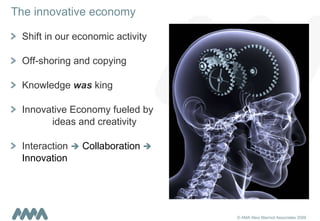
Shift in our economic activity Off-shoring and copying Knowledge  was  king Innovative Economy fueled by  ideas and creativity Interaction     Collaboration     Innovation The innovative economy
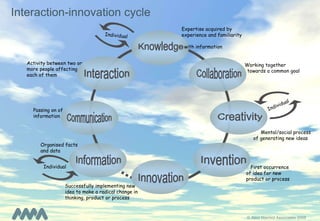
Interaction-innovation cycle Activity between two or more people affecting each of them Organised facts and data Passing on of information Interaction Knowledge Collaboration Innovation Creativity Invention Communication Mental/social process  of generating new ideas First occurrence of idea for new product or process Successfully implementing new idea to make a radical change in thinking, product or process Expertise acquired by  experience and familiarity  with information Working together  towards a common goal Information © Alexi Marmot Associates 2008 Individual Individual Individual
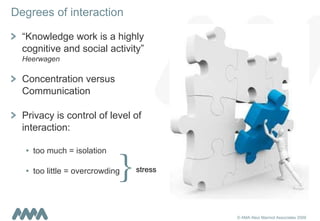
“ Knowledge work is a highly cognitive and social activity”  Heerwagen Concentration versus Communication Privacy is control of level of interaction: too much = isolation too little = overcrowding Degrees of interaction    stress
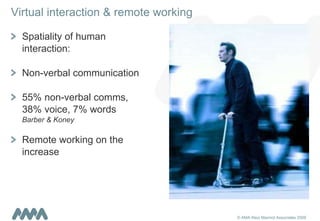
Virtual interaction & remote working Spatiality of human interaction: Non-verbal communication 55% non-verbal comms,  38% voice, 7% words  Barber & Koney Remote working on the increase
Spaces for interaction Proximity Privacy Legitimacy Accessibility Functionality
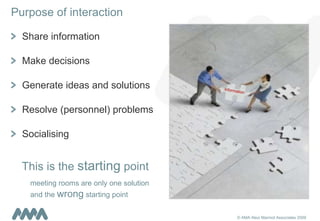
Purpose of interaction Share information  Make decisions Generate ideas and solutions Resolve (personnel) problems Socialising This is the  starting  point meeting rooms are only one solution  and the  wrong  starting point information
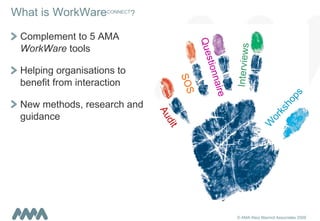
Complement to 5 AMA  WorkWare  tools Helping organisations to benefit from interaction New methods, research and guidance  What is WorkWare CONNECT ? Audit SOS Interviews Workshops Questionnaire
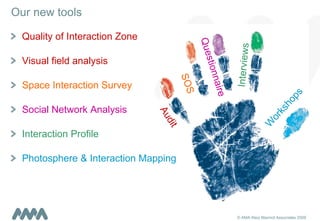
Our new tools Quality of Interaction Zone Visual field analysis Space Interaction Survey Social Network Analysis Interaction Profile Photosphere & Interaction Mapping Audit SOS Interviews Workshops Questionnaire
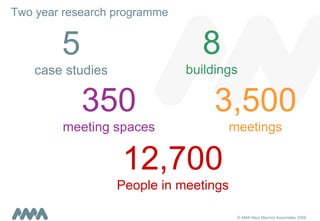
Two year research programme 5 case studies 350 meeting spaces 8 buildings 3,500 meetings 12,700 People in meetings
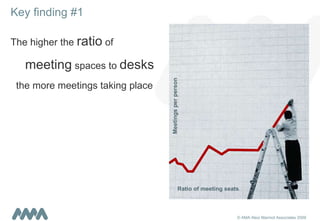
Key finding #1 The higher the  ratio  of meeting  spaces to  desks   the more meetings taking place   Ratio of meeting seats Meetings per person
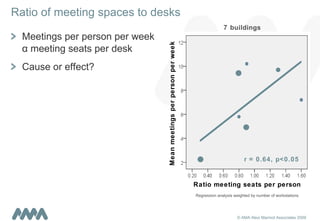
Ratio of meeting spaces to desks Meetings per person per week  α   meeting seats per desk Cause or effect? Mean meetings per person per week Ratio meeting seats per person Regression analysis weighted by number of workstations 7 buildings r = 0.64, p<0.05
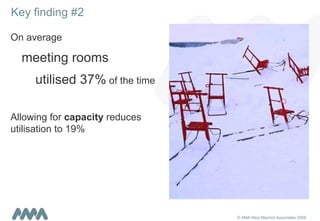
Key finding #2 On average meeting rooms   utilised 37%  of the time Allowing for  capacity  reduces utilisation to 19%
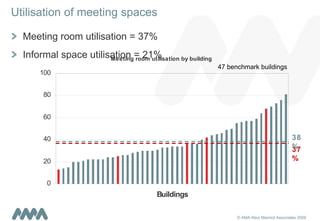
Utilisation of meeting spaces Meeting room utilisation = 37% Informal space utilisation = 21% 37% 38% 47 benchmark buildings
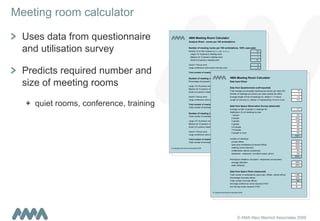
Meeting room calculator Uses data from questionnaire and utilisation survey  Predicts required number and size of meeting rooms quiet rooms, conference, training
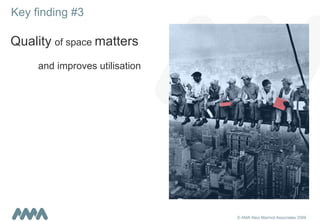
Key finding #3 Quality   of space  matters and improves utilisation
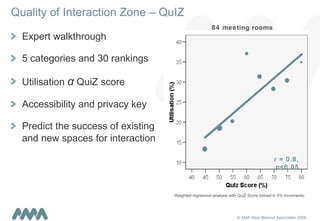
Quality of Interaction Zone – QuIZ Expert walkthrough 5 categories and 30 rankings Utilisation  α  QuiZ score Accessibility and privacy key Predict the success of existing and new spaces for interaction r = 0.8, p<0.05 Weighted regression analysis with QuIZ Score binned in 5% increments,  84 meeting rooms
Key finding #4 Only 20% of  interactions   in meeting rooms used  any form of  technology
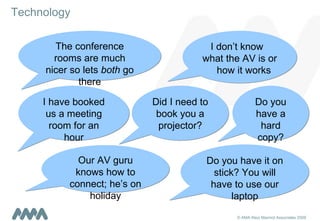
Technology The conference rooms are much nicer so lets  both  go there I don’t know  what the AV is or  how it works I have booked us a meeting room for an hour Did I need to book you a projector? Our AV guru knows how to connect; he’s on holiday Do you have it on stick? You will have to use our laptop Do you have a hard copy?
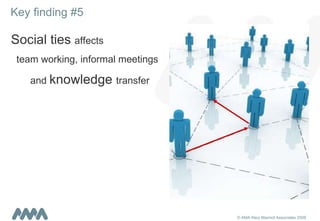
Key finding #5 Social ties  affects  team working, informal meetings  and  knowledge  transfer
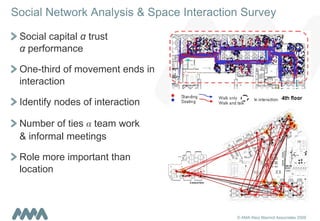
Social Network Analysis & Space Interaction Survey  Social capital  α   trust  α   performance One-third of movement ends in interaction Identify nodes of interaction  Number of ties  α   team work  & informal meetings Role more important than location
Key finding #6 Space matters   but cannot alone overcome  organisational predictors   of  success
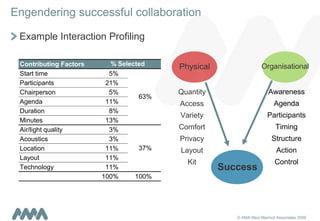
Engendering successful collaboration Example Interaction Profiling  Quantity Access Variety Comfort Privacy Layout Kit Physical Success Awareness Agenda Participants Timing Structure Action Control Organisational
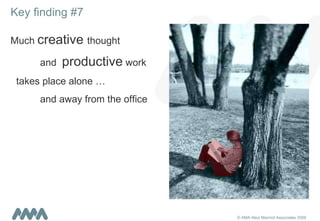
Key finding #7 Much  creative  thought and  productive  work takes place alone …   and away from the office
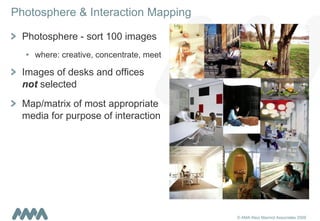
Photosphere & Interaction Mapping Photosphere - sort 100 images where: creative, concentrate, meet Images of desks and offices  not  selected Map/matrix of most appropriate media for purpose of interaction
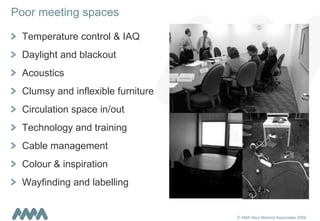
Poor meeting spaces Temperature control & IAQ Daylight and blackout Acoustics Clumsy and inflexible furniture Circulation space in/out Technology and training Cable management Colour & inspiration Wayfinding and labelling
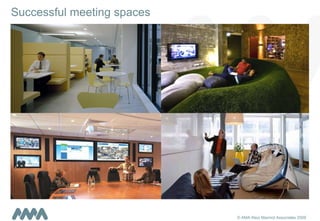
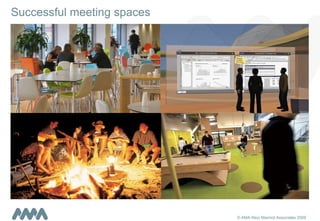
Successful meeting spaces
Meeting organisation Purpose – agenda & participants Arrangement – location & time Control – timing & input Action – minutes & follow up
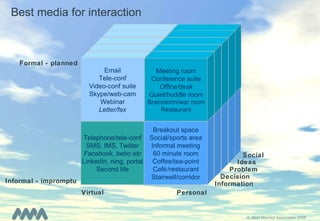
Best media for interaction Telephone/tele-conf SMS, IMS, Twitter Facebook, bebo etc LinkedIn, ning, portal Second life Email Tele-conf Video-conf suite Skype/web-cam Webinar Letter/fax Breakout space Social/sports area Informal meeting 60 minute room Coffee/tea-point Café/restaurant Stairwell/corridor Meeting room Conference suite Office/desk Quiet/huddle room Brainstorm/war room Restaurant Formal - planned Informal - impromptu Virtual Personal Information Decision Ideas Problem Social © Alexi Marmot Associates 2008 Tele-conf SMS, IMS, Twitter Facebook etc Portal/team room Web cam Email Tele-conf Video-conf suite Webinar Fax Breakout space Social/sports area Informal meeting Café/restaurant Stairwell/corridor Meeting room Conference suite Office/desk Quiet/huddle room Brainstorm/war room Tele-conf SMS, IMS, Twitter Facebook etc Portal/team room Web cam Email Tele-conf Video-conf suite Webinar Fax Breakout space Social/sports area Informal meeting Café/restaurant Stairwell/corridor Meeting room Conference suite Office/desk Quiet/huddle room Brainstorm/war room Tele-conf SMS, IMS, Twitter Facebook etc Portal/team room Web cam Email Tele-conf Video-conf suite Webinar Fax Breakout space Social/sports area Informal meeting Café/restaurant Stairwell/corridor Meeting room Conference suite Office/desk Quiet/huddle room Brainstorm/war room Tele-conf SMS, IMS, Twitter Facebook etc Portal/team room Web cam Email Tele-conf Video-conf suite Webinar Fax Breakout space Social/sports area Informal meeting Café/restaurant Stairwell/corridor Meeting room Conference suite Office/desk Quiet/huddle room Brainstorm/war room
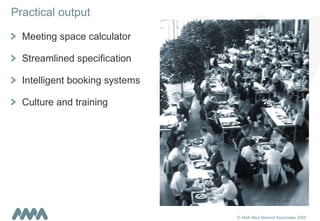
Practical output Meeting space calculator Streamlined specification Intelligent booking systems Culture and training
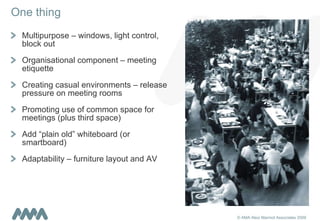
One thing Multipurpose – windows, light control, block out Organisational component – meeting etiquette Creating casual environments – release pressure on meeting rooms Promoting use of common space for meetings (plus third space) Add “plain old” whiteboard (or smartboard) Adaptability – furniture layout and AV
Thank you © Alexi Marmot Associates 2008 Nigel Oseland and Alexi Marmot [email_address] +44 207 284 5888

Successful Interaction

  • 1.
    Creating Environments forSuccessful Interaction Nigel Oseland and Alexi Marmot [email_address] +44 207 284 5888
  • 2.
    Shift in oureconomic activity Off-shoring and copying Knowledge was king Innovative Economy fueled by ideas and creativity Interaction  Collaboration  Innovation The innovative economy
  • 3.
    Interaction-innovation cycle Activitybetween two or more people affecting each of them Organised facts and data Passing on of information Interaction Knowledge Collaboration Innovation Creativity Invention Communication Mental/social process of generating new ideas First occurrence of idea for new product or process Successfully implementing new idea to make a radical change in thinking, product or process Expertise acquired by experience and familiarity with information Working together towards a common goal Information © Alexi Marmot Associates 2008 Individual Individual Individual
  • 4.
    “ Knowledge workis a highly cognitive and social activity” Heerwagen Concentration versus Communication Privacy is control of level of interaction: too much = isolation too little = overcrowding Degrees of interaction  stress
  • 5.
    Virtual interaction &remote working Spatiality of human interaction: Non-verbal communication 55% non-verbal comms, 38% voice, 7% words Barber & Koney Remote working on the increase
  • 6.
    Spaces for interactionProximity Privacy Legitimacy Accessibility Functionality
  • 7.
    Purpose of interactionShare information Make decisions Generate ideas and solutions Resolve (personnel) problems Socialising This is the starting point meeting rooms are only one solution and the wrong starting point information
  • 8.
    Complement to 5AMA WorkWare tools Helping organisations to benefit from interaction New methods, research and guidance What is WorkWare CONNECT ? Audit SOS Interviews Workshops Questionnaire
  • 9.
    Our new toolsQuality of Interaction Zone Visual field analysis Space Interaction Survey Social Network Analysis Interaction Profile Photosphere & Interaction Mapping Audit SOS Interviews Workshops Questionnaire
  • 10.
    Two year researchprogramme 5 case studies 350 meeting spaces 8 buildings 3,500 meetings 12,700 People in meetings
  • 11.
    Key finding #1The higher the ratio of meeting spaces to desks the more meetings taking place Ratio of meeting seats Meetings per person
  • 12.
    Ratio of meetingspaces to desks Meetings per person per week α meeting seats per desk Cause or effect? Mean meetings per person per week Ratio meeting seats per person Regression analysis weighted by number of workstations 7 buildings r = 0.64, p<0.05
  • 13.
    Key finding #2On average meeting rooms utilised 37% of the time Allowing for capacity reduces utilisation to 19%
  • 14.
    Utilisation of meetingspaces Meeting room utilisation = 37% Informal space utilisation = 21% 37% 38% 47 benchmark buildings
  • 15.
    Meeting room calculatorUses data from questionnaire and utilisation survey Predicts required number and size of meeting rooms quiet rooms, conference, training
  • 16.
    Key finding #3Quality of space matters and improves utilisation
  • 17.
    Quality of InteractionZone – QuIZ Expert walkthrough 5 categories and 30 rankings Utilisation α QuiZ score Accessibility and privacy key Predict the success of existing and new spaces for interaction r = 0.8, p<0.05 Weighted regression analysis with QuIZ Score binned in 5% increments, 84 meeting rooms
  • 18.
    Key finding #4Only 20% of interactions in meeting rooms used any form of technology
  • 19.
    Technology The conferencerooms are much nicer so lets both go there I don’t know what the AV is or how it works I have booked us a meeting room for an hour Did I need to book you a projector? Our AV guru knows how to connect; he’s on holiday Do you have it on stick? You will have to use our laptop Do you have a hard copy?
  • 20.
    Key finding #5Social ties affects team working, informal meetings and knowledge transfer
  • 21.
    Social Network Analysis& Space Interaction Survey Social capital α trust α performance One-third of movement ends in interaction Identify nodes of interaction Number of ties α team work & informal meetings Role more important than location
  • 22.
    Key finding #6Space matters but cannot alone overcome organisational predictors of success
  • 23.
    Engendering successful collaborationExample Interaction Profiling Quantity Access Variety Comfort Privacy Layout Kit Physical Success Awareness Agenda Participants Timing Structure Action Control Organisational
  • 24.
    Key finding #7Much creative thought and productive work takes place alone … and away from the office
  • 25.
    Photosphere & InteractionMapping Photosphere - sort 100 images where: creative, concentrate, meet Images of desks and offices not selected Map/matrix of most appropriate media for purpose of interaction
  • 26.
    Poor meeting spacesTemperature control & IAQ Daylight and blackout Acoustics Clumsy and inflexible furniture Circulation space in/out Technology and training Cable management Colour & inspiration Wayfinding and labelling
  • 27.
  • 28.
  • 29.
    Meeting organisation Purpose– agenda & participants Arrangement – location & time Control – timing & input Action – minutes & follow up
  • 30.
    Best media forinteraction Telephone/tele-conf SMS, IMS, Twitter Facebook, bebo etc LinkedIn, ning, portal Second life Email Tele-conf Video-conf suite Skype/web-cam Webinar Letter/fax Breakout space Social/sports area Informal meeting 60 minute room Coffee/tea-point Café/restaurant Stairwell/corridor Meeting room Conference suite Office/desk Quiet/huddle room Brainstorm/war room Restaurant Formal - planned Informal - impromptu Virtual Personal Information Decision Ideas Problem Social © Alexi Marmot Associates 2008 Tele-conf SMS, IMS, Twitter Facebook etc Portal/team room Web cam Email Tele-conf Video-conf suite Webinar Fax Breakout space Social/sports area Informal meeting Café/restaurant Stairwell/corridor Meeting room Conference suite Office/desk Quiet/huddle room Brainstorm/war room Tele-conf SMS, IMS, Twitter Facebook etc Portal/team room Web cam Email Tele-conf Video-conf suite Webinar Fax Breakout space Social/sports area Informal meeting Café/restaurant Stairwell/corridor Meeting room Conference suite Office/desk Quiet/huddle room Brainstorm/war room Tele-conf SMS, IMS, Twitter Facebook etc Portal/team room Web cam Email Tele-conf Video-conf suite Webinar Fax Breakout space Social/sports area Informal meeting Café/restaurant Stairwell/corridor Meeting room Conference suite Office/desk Quiet/huddle room Brainstorm/war room Tele-conf SMS, IMS, Twitter Facebook etc Portal/team room Web cam Email Tele-conf Video-conf suite Webinar Fax Breakout space Social/sports area Informal meeting Café/restaurant Stairwell/corridor Meeting room Conference suite Office/desk Quiet/huddle room Brainstorm/war room
  • 31.
    Practical output Meetingspace calculator Streamlined specification Intelligent booking systems Culture and training
  • 32.
    One thing Multipurpose– windows, light control, block out Organisational component – meeting etiquette Creating casual environments – release pressure on meeting rooms Promoting use of common space for meetings (plus third space) Add “plain old” whiteboard (or smartboard) Adaptability – furniture layout and AV
  • 33.
    Thank you ©Alexi Marmot Associates 2008 Nigel Oseland and Alexi Marmot [email_address] +44 207 284 5888

Editor's Notes

  • #3 10% primary – agriculture, mining etc 20% secondary – manufacturing 70% tertiary – service (knowledge) quaternary – R&amp;D Three ages of industrial evolution represented by three economic sectors Currently a service industry – most of us now Drucker’s knowledge workers Through ages we have off-shored our primary economic activity and moved up to next economic sector Recently been off-shoring services (due to economy now coming back plus maybe manufacturing) Overseas can now provide a service economy for less and they are good at copying so developing own industry Information is ubiquitous so knowledge is no longer king So to stay ahead we need to look towards the next economic sector, Ideas and creativity are real asset, key to new innovative economy (Still need processing, but ideas important when others can process more for less) We believe that interaction is a key part of the process of innovation collaboration requires social interaction Heerwagen interaction enhances trust and mentoring Becker intermingling important for innovation Drucker
  • #5 Require solo time to: think and develop ideas, draw on insight, non-conscious processing … then share ideas through social and formal networks Café less distracting because conversation less meaningful Reflex action and unconscious listening and processing of information “ Knowledge work is a highly cognitive and social activity” Heerwagen collaboration includes bouts of solitary work and social interaction Concentration versus Communication: 15 minutes to reach maximum flow meaning not level is distracting Privacy is control of level of interaction: too much = isolation too little = overcrowding
  • #6 Proxemics – use and perceive space Chronemics – willingness to listen and punctuality Haptics – touching Paralanguage – cues in voice “ Louder than words; non-verbal communication” Spatiality of human interaction: context/point, gesticulation, judge reaction Non-verbal communication: gesture, body language, posture, facial expression, eye contact, pheromones proxemics, chronemics, haptics, paralanguage 55% non-verbal communication, 38% voice, 7% words Barber &amp; Koney Remote working on the increase
  • #7 Visual, way-finding Proximity: 1 st Law of Geography: “nearer things are more related than those further away” interaction significantly decreases after 30m Tom Allen Privacy: sense of visual/aural privacy Legitimacy: is there a valid reason for being there? Accessibility: easily located, visual access, occupancy signs, non-bookable Functionality: layout, equipment, environment
  • #8 Accidental/regular
  • #15 Expected (peak) utilisation - Mon am to Fri am, 10-12.00 and 14.00-16.00 = 16 hours = 42%, say 50%? Why less for informal Interaction profiling says design, location, no privacy, or culture
  • #18 Expert walkthrough 5 categories, 30 rankings: accessibility/availability privacy usability comfort quality Utilisation ∞ QuiZ score Accessibility and privacy are key We can predict the success of existing and new spaces for interaction
  • #23 who attends keeping to time sticking to an agenda following up actions
  • #26 100 images of places Card sorting task Key questions: where are you most creative? where can you concentrate best? where do you prefer to meet? where are you most productive? Images of desks &amp; offices not selected Useful tool for change to flexible working Workshop exercise to: map best communication media to purpose of communication advise on meeting protocols Case study findings: heavy meeting culture little time to prepare and travel to meetings
  • #28 Semi-privacy Technology Nature and huddle brainstorm
  • #29 Café Virtual Social
  • #30 purpose – confirm the need to meet, draft and issue the agenda and draw up a list of key participants, arrangement – determine the most appropriate location and time that allows key participants to attend, control – appoint a chairperson to ensure the meeting runs on time and follows the agenda, the chair should also be capable of controlling the input of the participants, action – appoint someone to take minutes and ensure all actions are captured and followed up before the next meeting.
  • #32 purpose – confirm the need to meet, draft and issue the agenda and draw up a list of key participants, arrangement – determine the most appropriate location and time that allows key participants to attend, control – appoint a chairperson to ensure the meeting runs on time and follows the agenda, the chair should also be capable of controlling the input of the participants, action – appoint someone to take minutes and ensure all actions are captured and followed up before the next meeting.
  • #33 purpose – confirm the need to meet, draft and issue the agenda and draw up a list of key participants, arrangement – determine the most appropriate location and time that allows key participants to attend, control – appoint a chairperson to ensure the meeting runs on time and follows the agenda, the chair should also be capable of controlling the input of the participants, action – appoint someone to take minutes and ensure all actions are captured and followed up before the next meeting.