Collaborative Teaching & Learning 25 th  November –  18 th  December 2009  Instructor: Deborah Elzie, Instructional Designer, Tulane University, Payson Center for International Development / Innovative Learning Center TA: Mike Bagorozi Ndimurukundo. IT Manager, Tulane University/Rwanda Country Office Interaction in the “Classroom”
Play Play  — the capacity to experiment with one’s surroundings as a form of problem-solving  Lowers emotional stakes of failing Learn through trial and error Die and do over. Gee (2003) notes the textbook is often depersonalized and the abstract prose  may make children sometimes feel locked out of the worlds. This may also be true of those who are new to a discipline. Players move through game worlds. “ Players feel a part of those worlds and have some stake in the events unfolding.”
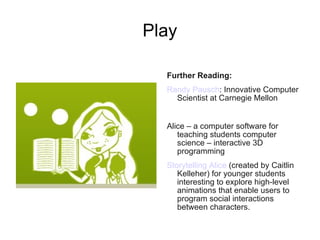
Play Further Reading:   Randy Pausch : Innovative Computer Scientist at Carnegie Mellon  Alice – a computer software for teaching students computer science – interactive 3D programming  Storytelling Alice  (created by Caitlin Kelleher) for younger students interesting to explore high-level animations that enable users to program social interactions between characters.
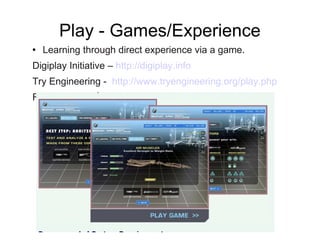
Play - Games/Experience Learning through direct experience via a game.  Digiplay Initiative –  http://digiplay.info Try Engineering -  http://www.tryengineering.org/play.php RoboCup 2010  http://www.robocup2010.org
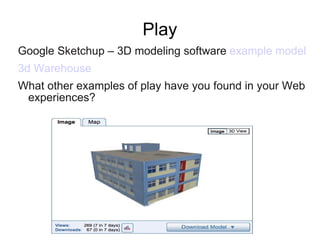
Play Google Sketchup – 3D modeling software  example model 3d Warehouse What other examples of play have you found in your Web experiences?
Performance Ability to adopt alternative identities for the purpose of improvisation and discovery  Virtual Worlds Second Life  & Virtual Worlds for Academic Healthcare & Education Further Reading:   Parker, Jan (2009).  Academics' virtual identities . Teaching in Higher Education, 14(3), pp. 221–224.
Storytelling The Creative Process: A  Computer Model of Storytelling  and Creativity
Simulation Ability to interpret and construct dynamic models of real-world processes
Transmedia Navigation Ability   to follow the flow of stories and information across multiple modalities
Negotiation Ability to travel across diverse communities, discerning and respecting multiple perspectives, and grasping and following alternative norms.
Participatory Literacy Skills Play  — the capacity to experiment with one’s surroundings as a form of problem-solving  Performance  — the ability to adopt alternative identities for the purpose of improvisation and discovery  Simulation  — the ability to interpret and construct dynamic models of real-world processes Appropriation  — the ability to meaningfully sample and remix media content  Multitasking  — the ability to scan one’s environment and shift focus as needed to salient details Distributed Cognition  — the ability to interact meaningfully with tools that expand mental capacities  Collective Intelligence  — the ability to pool knowledge and compare notes with others toward a common goal  Judgment  — the ability to evaluate the reliability and credibility of different information sources  Transmedia Navigation  — the ability to follow the flow of stories and information across multiple modalities  Networking  — the ability to search for, synthesize, and disseminate information  Negotiation  — the ability to travel across diverse communities, discerning and respecting multiple perspectives, and grasping and following alternative norms. Jenkins, H., Clinton, K., Purushotma, R., Robison, A. & Weigel, M. (2006)
Forms of Participatory Culture Affiliations  — memberships, formal and informal, in online communities centered around various forms of media, such as Friendster, Facebook, message boards, metagaming, game clans, or MySpace).  Expressions  — producing new creative forms, such as digital sampling, skinning and modding, fan videomaking, fan fiction writing, zines, mash-ups). Collaborative Problem-solving  — working together in teams, formal and informal, to complete tasks and develop new knowledge (such as through Wikipedia, alternative reality gaming, spoiling).  Circulations  — Shaping the flow of media (such as podcasting, blogging). Note: “Interactivity (H. Jenkins, 2006a) is a property of the technology, while participation is a property of culture.” Gee (2004) -  informal learning cultures “affinity spaces

Collab Teach Learning Day11

  • 1.
    Collaborative Teaching &Learning 25 th November – 18 th December 2009 Instructor: Deborah Elzie, Instructional Designer, Tulane University, Payson Center for International Development / Innovative Learning Center TA: Mike Bagorozi Ndimurukundo. IT Manager, Tulane University/Rwanda Country Office Interaction in the “Classroom”
  • 2.
    Play Play — the capacity to experiment with one’s surroundings as a form of problem-solving Lowers emotional stakes of failing Learn through trial and error Die and do over. Gee (2003) notes the textbook is often depersonalized and the abstract prose may make children sometimes feel locked out of the worlds. This may also be true of those who are new to a discipline. Players move through game worlds. “ Players feel a part of those worlds and have some stake in the events unfolding.”
  • 3.
    Play Further Reading: Randy Pausch : Innovative Computer Scientist at Carnegie Mellon Alice – a computer software for teaching students computer science – interactive 3D programming Storytelling Alice (created by Caitlin Kelleher) for younger students interesting to explore high-level animations that enable users to program social interactions between characters.
  • 4.
    Play - Games/ExperienceLearning through direct experience via a game. Digiplay Initiative – http://digiplay.info Try Engineering - http://www.tryengineering.org/play.php RoboCup 2010 http://www.robocup2010.org
  • 5.
    Play Google Sketchup– 3D modeling software example model 3d Warehouse What other examples of play have you found in your Web experiences?
  • 6.
    Performance Ability toadopt alternative identities for the purpose of improvisation and discovery Virtual Worlds Second Life & Virtual Worlds for Academic Healthcare & Education Further Reading: Parker, Jan (2009). Academics' virtual identities . Teaching in Higher Education, 14(3), pp. 221–224.
  • 7.
    Storytelling The CreativeProcess: A Computer Model of Storytelling and Creativity
  • 8.
    Simulation Ability tointerpret and construct dynamic models of real-world processes
  • 9.
    Transmedia Navigation Ability to follow the flow of stories and information across multiple modalities
  • 10.
    Negotiation Ability totravel across diverse communities, discerning and respecting multiple perspectives, and grasping and following alternative norms.
  • 11.
    Participatory Literacy SkillsPlay — the capacity to experiment with one’s surroundings as a form of problem-solving Performance — the ability to adopt alternative identities for the purpose of improvisation and discovery Simulation — the ability to interpret and construct dynamic models of real-world processes Appropriation — the ability to meaningfully sample and remix media content Multitasking — the ability to scan one’s environment and shift focus as needed to salient details Distributed Cognition — the ability to interact meaningfully with tools that expand mental capacities Collective Intelligence — the ability to pool knowledge and compare notes with others toward a common goal Judgment — the ability to evaluate the reliability and credibility of different information sources Transmedia Navigation — the ability to follow the flow of stories and information across multiple modalities Networking — the ability to search for, synthesize, and disseminate information Negotiation — the ability to travel across diverse communities, discerning and respecting multiple perspectives, and grasping and following alternative norms. Jenkins, H., Clinton, K., Purushotma, R., Robison, A. & Weigel, M. (2006)
  • 12.
    Forms of ParticipatoryCulture Affiliations — memberships, formal and informal, in online communities centered around various forms of media, such as Friendster, Facebook, message boards, metagaming, game clans, or MySpace). Expressions — producing new creative forms, such as digital sampling, skinning and modding, fan videomaking, fan fiction writing, zines, mash-ups). Collaborative Problem-solving — working together in teams, formal and informal, to complete tasks and develop new knowledge (such as through Wikipedia, alternative reality gaming, spoiling). Circulations — Shaping the flow of media (such as podcasting, blogging). Note: “Interactivity (H. Jenkins, 2006a) is a property of the technology, while participation is a property of culture.” Gee (2004) - informal learning cultures “affinity spaces

Editor's Notes

  • #2 “ Classroom” - thinning the walls
  • #3 Jenkins Whitepaper
  • #4 Patricia Anderson
  • #5 Jenkins Whitepaper How can teachers build on this type of play? Teachers can then build on this intuitive and experiential learning in the classroom, introducing equations, diagrams, or visualizations that help them to better understand the underlying principles that they are deploying and then sending them back to play through the levels again and improve their performance. www.igi-global.com/downloads/excerpts/33410.pdf
  • #6 Google Sketchup – model from University of Patras – Department of Mechanical Engineering and Aeronautics http://www.educationarcade.org/
  • #7 Patricia Anderson
  • #12 Jenkins, H., Clinton, K., Purushotma, R., Robison, A. & Weigel, M. (2006). Confronting the Challenges of Participatory Culture: Media Education of the 21st Century. Chicago: The MacArthur Foundation. http://digitallearning.macfound.org http://www.henryjenkins.org/2006/10/confronting_the_challenges_of.html
  • #13 Jenkins Whitepaper