Ludic and Social
  Media in Learning
Innovation Processes


              Patrick J. Coppock
Department of Communication and Economics
 University of Modena & Reggio Emilia, Italy
         patrick.coppock@unimore.it
           http://game.unimore.it
        http://facebook.com/patcop
           Twitter: Pat_Coppock
Defining Ludic and
       Social Media
• Ludic Media
• Ludic Interface
• Social Interface
• Social Media
Ludic Media

• "Ludic”: from the Latin “ludus”, meaning play, game,
  sport, pastime

• Most contemporary media consumption/fruition
  practices are to some extent playful and thus ludic

• Skills we acquire through play may have implications
  for how we learn, work, participate in the political
  process, and connect with other people around the
  world (Henry Jenkins)
Ludic Interfaces

• Ludic Interfaces:
  • are devices designed to connect human interactors in a
    playful, functional manner with complex technical
    systems like computer programs, databases, game
    consoles, web applications, mobile apps, and even whole
    buildings, their exteriors and wider urban spaces.
  • seek to offer users a high degree of freedom of action and
    multiple access options.
  • are expected to contribute to an increase in accessibility
    of complex technical systems, and of user creativity and
    self-fulfillment.
Ludic Interfaces
• share methods and knowledge from computer games,
  artistic experimentation, interactive media, media
  conversion, social networks and hacker culture
• result in tools offering ease of use and playfulness.
• tools and concepts endowed with ludic interface
  principles differ from traditional technological systems as
  they are playful, user-generated and user-driven, flexible,
  low-cost and cooperative
Ludic interfaces
Ludic interfaces
Ludic interfaces
Interface Art

• Game Art Interfaces:
    •   innovative, application specific
    •   custom-built, locative
    •   rich in connotative power and surprise
    •   playful
    •   critical
    •   invite co-creativity, user-generated or user-driven content

   Mathias Fuchs http://www.creativegames.org.uk/art/projects.htm
Interface art
Interface art
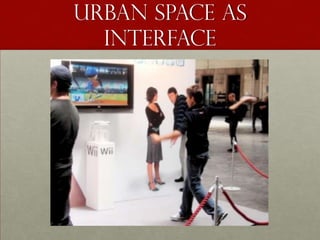
Urban space as
  interface


   http://www.codedcultures.net
Urban space as
  interface
Urban games
Urban games
Live action role play
Social interface
• In general (sociology):
  • a social interface is a critical point of intersection between
    different life worlds, social fields or levels of social
    organization, where social discontinuities based upon
    discrepancies in values, interests, knowledges and power,
    are most likely to be located (Long,1989, 2001)

• In the field of (user) experience design:
  • a social interface is one designed to facilitate as wide a
    range as possible of mediated social interactions between
    individuals and groups, and the development and
    symbolic representation of virtual (and actual)
    communities
Social Media
• mediated means of interaction enabling people to create,
  exchange, share and comment on, a wide range of
  content matter forms in online virtual communities and
  networks
• take many different forms: online journals, internet
  forums, mailing lists, weblogs, micro-blogging, wikis,
  social networks, podcasts, photographic and video
  archives, performance rating and social bookmarking, etc.
• a key ludic (but not only) characteristic of social media
  practices is the ideation, production, sharing and
  appraisal/rating of user-based remix/remake content
  matter
Social Media
Social Media
Social Media
Media & identity
• Personal ID v.1


• Personal ID v.2


• Digital ID v.1


• Digital ID v.2
The joys of
traditional
educatioin
Games and play
• Peppino Ortoleva (University of Torino):
  • new technologies, reorganization of leisure and work
    time, and other less visible cultural factors have brought
    significant historical modifications to the traditionally
    separate ludic sphere.
  • new game types are emerging, and the threshold between
    play and reality is being redefined to include aspects of
    social life that may seem unrelated to play activities.
  • in the area of ludic practices, where games are played,
    new, previously marginalized, play spaces and practices
    have emerged: theme parks, surfing, reality shows, casual
    games, social networking, etc.
Applied play
• Some examples:
  • informal and formal learning activities in schools, at work,
    art games, urban games used to explore unknown sides of
    city spaces and build new relationships
  • gamification strategies in training, marketing and commerce
  • flying military drones that kill people in other lands far away
  • brainstorming sessions in business and science
  • ludic interfaces for public information and archive systems
  • play as resource for creatively confronting situations
    requiring unplanned adaptations or improvisations
Three learning types

1. Formal learning:
    • Institutionally structured, learning objectives, certification,
      intentional
2. Informal learning:
    • Not institutionally structured, derives from work, family or
      leisure activities, no explicit learning objectives, no certification,
      rarely intentional
3. Non-formal learning:
    • Learner interest & community based, structured, knowledge,
      skill, experientially, emotionally oriented objectives, ±intentional
Life long learning

• Organisation for Economic Co-operation and
  Development (OECD): Life Long Learning for All
  (1996)
Mobile vs desktop
Participatory
              Learning
• Henry Jenkins, James Paul Gee & others
  •   Media Convergence > Participatory Culture
  •   Knowledge Communities > Collective Intelligence
  •   Problem solving as exercises in teamwork
  •   “Ad-hocracies” (Cory Doctorow) vs Bureaucracies
  •   Just-in-time open learning
  •   Knowledge as process, not product
  •   Critical thinking and information quality
  •   Fact/fiction; argument/documentation; real/fake;
      marketing/enlightenment
Knowledge
           communities
• group ownership of work/knowledge vs. autonomous
  problem solvers

• cooperative games/work with different roles assigned
  according to problems to solve and individual
  competencies

• just-in-time collaborative data/knowledge sharing
Multimodal
              literacies
• Composition seen as informed choices regarding the
  relative qualities and efficacy of different media types
  and communication strategies in getting a message
  across

• Literacy seen as a broad set of competencies in reading
  and writing through images, texts, sounds and
  simulations

• Games and play as active problem solving
  environments, challenging traditional educational
  models
Research on ludic
media and education
• James Paul Gee, Arizona State University
    http://www.youtube.com/watch?v=qGd1URORsoE
    http://www.youtube.com/watch?v=jwouueYlwGo&feature=endscreen&NR=1
    http://www.edutopia.org/james-gee-video
    http://www.youtube.com/watch?v=FmcgMK46nfg (debate chaired by Tracy Fullerton)

•   Henry Jenkins, University of Southern California
    http://henryjenkins.org/
    http://www.macfound.org/programs/learning/
    http://www.youtube.com/watch?v=FmcgMK46nfg (debate chaired by Tracy Fullerton)

•   Elena Bertozzi, Long Island University
    http://myweb.cwpost.liu.edu/ebertozz/vita.html

•   Rick Ferdig, Kent State University http://www.ferdig.com
    International Journal of Gaming and Computer Mediated Simulations (IJGCMS) http://www.igi-
    global.com/journal/international-journal-gaming-computer-mediated/1125
A few ludic theory
      references
• Johannes Huizinga “Homo Ludens”

• Roger Caillois, “Man, Play and Games”

• Brian Sutton-Smith “The Ambiguity of Play”

• Ian Bogost “How to Do Things With Games”

• Jesper Juul “Half real”; “The Art of Failure”

Haifa 2013

  • 1.
    Ludic and Social Media in Learning Innovation Processes Patrick J. Coppock Department of Communication and Economics University of Modena & Reggio Emilia, Italy patrick.coppock@unimore.it http://game.unimore.it http://facebook.com/patcop Twitter: Pat_Coppock
  • 2.
    Defining Ludic and Social Media • Ludic Media • Ludic Interface • Social Interface • Social Media
  • 3.
    Ludic Media • "Ludic”:from the Latin “ludus”, meaning play, game, sport, pastime • Most contemporary media consumption/fruition practices are to some extent playful and thus ludic • Skills we acquire through play may have implications for how we learn, work, participate in the political process, and connect with other people around the world (Henry Jenkins)
  • 4.
    Ludic Interfaces • LudicInterfaces: • are devices designed to connect human interactors in a playful, functional manner with complex technical systems like computer programs, databases, game consoles, web applications, mobile apps, and even whole buildings, their exteriors and wider urban spaces. • seek to offer users a high degree of freedom of action and multiple access options. • are expected to contribute to an increase in accessibility of complex technical systems, and of user creativity and self-fulfillment.
  • 5.
    Ludic Interfaces • sharemethods and knowledge from computer games, artistic experimentation, interactive media, media conversion, social networks and hacker culture • result in tools offering ease of use and playfulness. • tools and concepts endowed with ludic interface principles differ from traditional technological systems as they are playful, user-generated and user-driven, flexible, low-cost and cooperative
  • 6.
  • 7.
  • 8.
  • 9.
    Interface Art • GameArt Interfaces: • innovative, application specific • custom-built, locative • rich in connotative power and surprise • playful • critical • invite co-creativity, user-generated or user-driven content Mathias Fuchs http://www.creativegames.org.uk/art/projects.htm
  • 10.
  • 11.
  • 12.
    Urban space as interface http://www.codedcultures.net
  • 13.
    Urban space as interface
  • 14.
  • 15.
  • 16.
  • 17.
    Social interface • Ingeneral (sociology): • a social interface is a critical point of intersection between different life worlds, social fields or levels of social organization, where social discontinuities based upon discrepancies in values, interests, knowledges and power, are most likely to be located (Long,1989, 2001) • In the field of (user) experience design: • a social interface is one designed to facilitate as wide a range as possible of mediated social interactions between individuals and groups, and the development and symbolic representation of virtual (and actual) communities
  • 18.
    Social Media • mediatedmeans of interaction enabling people to create, exchange, share and comment on, a wide range of content matter forms in online virtual communities and networks • take many different forms: online journals, internet forums, mailing lists, weblogs, micro-blogging, wikis, social networks, podcasts, photographic and video archives, performance rating and social bookmarking, etc. • a key ludic (but not only) characteristic of social media practices is the ideation, production, sharing and appraisal/rating of user-based remix/remake content matter
  • 19.
  • 20.
  • 21.
  • 22.
    Media & identity •Personal ID v.1 • Personal ID v.2 • Digital ID v.1 • Digital ID v.2
  • 23.
  • 24.
    Games and play •Peppino Ortoleva (University of Torino): • new technologies, reorganization of leisure and work time, and other less visible cultural factors have brought significant historical modifications to the traditionally separate ludic sphere. • new game types are emerging, and the threshold between play and reality is being redefined to include aspects of social life that may seem unrelated to play activities. • in the area of ludic practices, where games are played, new, previously marginalized, play spaces and practices have emerged: theme parks, surfing, reality shows, casual games, social networking, etc.
  • 25.
    Applied play • Someexamples: • informal and formal learning activities in schools, at work, art games, urban games used to explore unknown sides of city spaces and build new relationships • gamification strategies in training, marketing and commerce • flying military drones that kill people in other lands far away • brainstorming sessions in business and science • ludic interfaces for public information and archive systems • play as resource for creatively confronting situations requiring unplanned adaptations or improvisations
  • 26.
    Three learning types 1.Formal learning: • Institutionally structured, learning objectives, certification, intentional 2. Informal learning: • Not institutionally structured, derives from work, family or leisure activities, no explicit learning objectives, no certification, rarely intentional 3. Non-formal learning: • Learner interest & community based, structured, knowledge, skill, experientially, emotionally oriented objectives, ±intentional
  • 27.
    Life long learning •Organisation for Economic Co-operation and Development (OECD): Life Long Learning for All (1996)
  • 28.
  • 29.
    Participatory Learning • Henry Jenkins, James Paul Gee & others • Media Convergence > Participatory Culture • Knowledge Communities > Collective Intelligence • Problem solving as exercises in teamwork • “Ad-hocracies” (Cory Doctorow) vs Bureaucracies • Just-in-time open learning • Knowledge as process, not product • Critical thinking and information quality • Fact/fiction; argument/documentation; real/fake; marketing/enlightenment
  • 30.
    Knowledge communities • group ownership of work/knowledge vs. autonomous problem solvers • cooperative games/work with different roles assigned according to problems to solve and individual competencies • just-in-time collaborative data/knowledge sharing
  • 31.
    Multimodal literacies • Composition seen as informed choices regarding the relative qualities and efficacy of different media types and communication strategies in getting a message across • Literacy seen as a broad set of competencies in reading and writing through images, texts, sounds and simulations • Games and play as active problem solving environments, challenging traditional educational models
  • 32.
    Research on ludic mediaand education • James Paul Gee, Arizona State University http://www.youtube.com/watch?v=qGd1URORsoE http://www.youtube.com/watch?v=jwouueYlwGo&feature=endscreen&NR=1 http://www.edutopia.org/james-gee-video http://www.youtube.com/watch?v=FmcgMK46nfg (debate chaired by Tracy Fullerton) • Henry Jenkins, University of Southern California http://henryjenkins.org/ http://www.macfound.org/programs/learning/ http://www.youtube.com/watch?v=FmcgMK46nfg (debate chaired by Tracy Fullerton) • Elena Bertozzi, Long Island University http://myweb.cwpost.liu.edu/ebertozz/vita.html • Rick Ferdig, Kent State University http://www.ferdig.com International Journal of Gaming and Computer Mediated Simulations (IJGCMS) http://www.igi- global.com/journal/international-journal-gaming-computer-mediated/1125
  • 33.
    A few ludictheory references • Johannes Huizinga “Homo Ludens” • Roger Caillois, “Man, Play and Games” • Brian Sutton-Smith “The Ambiguity of Play” • Ian Bogost “How to Do Things With Games” • Jesper Juul “Half real”; “The Art of Failure”