Colgate-Palmolive
Company
THE PRECISION TOOTHBRUSH
Situation
Colgate Palmolive a global market leader in household and personal
care products, finds itself in a promising yet challenging position in
1992 as it attempts to launch a revolutionary and technologically
superior product in a highly competitive market with substantial new
product activity.
Company Background
 Net worldwide research and development expenditures for 1991 were $114 million and media
advertising expenditures totaled $428 million.
 International sales remained CP’s strong suit, accounting for 64% of sales and 67% of profits in
1991.
 The company faced tough competition in international markets from Procter & Gamble,
Unilever, Nestle’s L’Oreal Division, Henkel of Germany, and Kao of Japan.
 In 1991, worldwide sales of CP’s oral care products increased 12% to $1.3 billion, accounting
for 22% of CP’s total sales.
 In 1991, $243 million was spent to upgrade 25 of CP’s 91 manufacturing plants and 275 new
products were introduced worldwide
The US Oral Care Market
 The US Oral Care Market has seen a growth at an annual rate of 6.1% since 1986.
 Toothpaste accounted for 46% of this market, mouth rinses 24%, toothbrushes
15.5%, with dental floss and other products making up the remainder.
 Dollar sales of toothbrushes had grown at an average rate of 9.3% per annum since
1987, however, in 1992 they increased by 21% in value and 18% in volume.
 The growth is attributed to the introduction of 47 new products and line extensions
during 1991-1992.
Product Segments
 The toothbrush category was divided into three segments:
1. Value
2. Professional
3. Super-premium
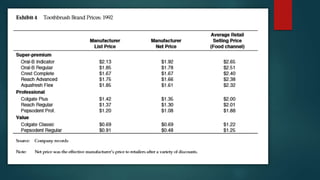
 Emerged in late 1980s, by 1992 super-premium brushes, with retail prices between $2.29
and $2.89, accounted for 35% of unit volume and 46% of dollar sales.
 Professional brushes, priced between $1.59 and $2.09, accounted for a corresponding
41% and 42%
 Value brushes, priced on average at $1.29, accounted for 24% and 12%.
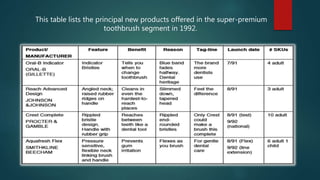
This table lists the principal new products offered in the super-premium
toothbrush segment in 1992.
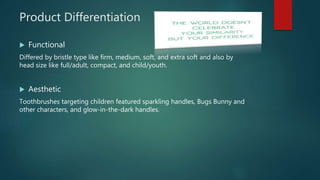
Product Differentiation
 Functional
Differed by bristle type like firm, medium, soft, and extra soft and also by
head size like full/adult, compact, and child/youth.
 Aesthetic
Toothbrushes targeting children featured sparkling handles, Bugs Bunny and
other characters, and glow-in-the-dark handles.
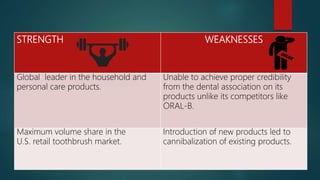
STRENGTH WEAKNESSES
Global leader in the household and
personal care products.
Unable to achieve proper credibility
from the dental association on its
products unlike its competitors like
ORAL-B.
Maximum volume share in the
U.S. retail toothbrush market.
Introduction of new products led to
cannibalization of existing products.
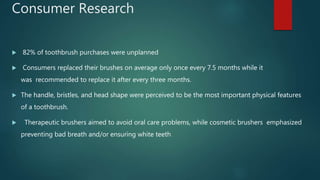
Consumer Research
 82% of toothbrush purchases were unplanned
 Consumers replaced their brushes on average only once every 7.5 months while it
was recommended to replace it after every three months.
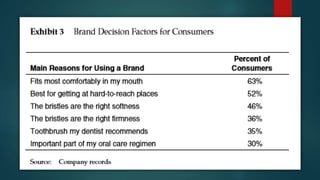
 The handle, bristles, and head shape were perceived to be the most important physical features
of a toothbrush.
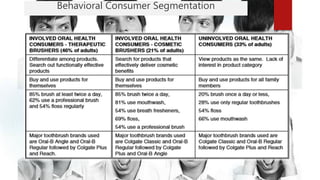
 Therapeutic brushers aimed to avoid oral care problems, while cosmetic brushers emphasized
preventing bad breath and/or ensuring white teeth
Behavioral Consumer Segmentation
Competition
Major competitor brands in the super-premium segment included Oral-B, Reach Advanced
Design, Crest Complete, and Aquafresh Flex.
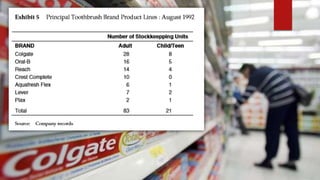
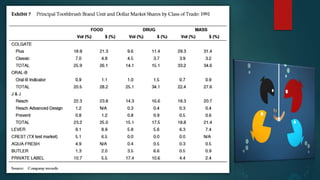
To have a better understanding of the market scenario, we should look at the exhibits
listing major brands and product prices for each of the three toothbrush product segments,
showing the number and type of stock keeping units (SKUs) for each major brand and finally
summarizing market shares over time and by class of trade.
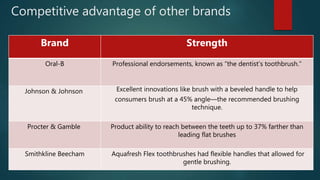
Competitive advantage of other brands
Brand Strength
Oral-B Professional endorsements, known as “the dentist’s toothbrush.”
Johnson & Johnson Excellent innovations like brush with a beveled handle to help
consumers brush at a 45% angle—the recommended brushing
technique.
Procter & Gamble Product ability to reach between the teeth up to 37% farther than
leading flat brushes
Smithkline Beecham Aquafresh Flex toothbrushes had flexible handles that allowed for
gentle brushing.
Advertising
and Promotion
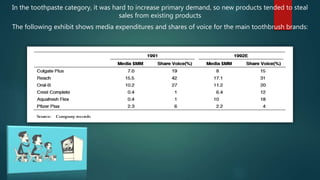
In the toothpaste category, it was hard to increase primary demand, so new products tended to steal
sales from existing products
The following exhibit shows media expenditures and shares of voice for the main toothbrush brands:
 Growing competition increased the frequency and value of consumer promotion events.
 Retail advertising features and in-store displays increased toothbrush sales.
 A typical CP toothbrush display increased sales by 90% over a normal shelf facing. When
Colgate toothbrushes were combined with Colgate toothpaste in a single display, toothbrush
sales increased by 170%.
 To maximize retail sales, CP salespeople tried to locate the Colgate line in the middle of the
category shelf space, between the Reach and the Oral-B product lines.
Overview
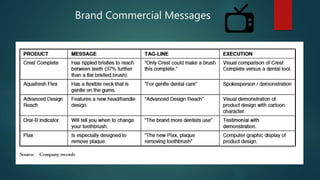
Brand Commercial Messages
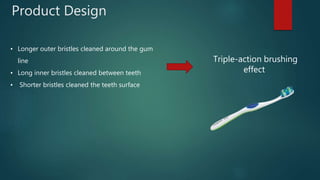
Product Design
• Longer outer bristles cleaned around the gum
line
• Long inner bristles cleaned between teeth
• Shorter bristles cleaned the teeth surface
Triple-action brushing
effect
Positioning
Objective
To create the best brush possible and as such, becoming a top-of-the range, super-premium
product.
Options
 Niche Marketing
 Mainstream Marketing
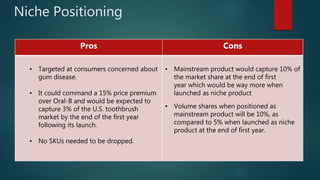
Niche Positioning
Pros Cons
• Targeted at consumers concerned about
gum disease.
• It could command a 15% price premium
over Oral-B and would be expected to
capture 3% of the U.S. toothbrush
market by the end of the first year
following its launch.
• No SKUs needed to be dropped.
• Mainstream product would capture 10% of
the market share at the end of first
year which would be way more when
launched as niche product
• Volume shares when positioned as
mainstream product will be 10%, as
compared to 5% when launched as niche
product at the end of first year.
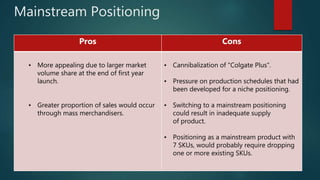
Mainstream Positioning
Pros Cons
• More appealing due to larger market
volume share at the end of first year
launch.
• Greater proportion of sales would occur
through mass merchandisers.
• Cannibalization of "Colgate Plus".
• Pressure on production schedules that had
been developed for a niche positioning.
• Switching to a mainstream positioning
could result in inadequate supply
of product.
• Positioning as a mainstream product with
7 SKUs, would probably require dropping
one or more existing SKUs.
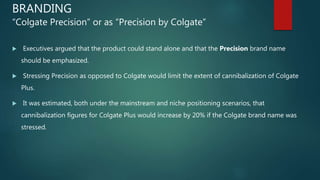
BRANDING
“Colgate Precision” or as “Precision by Colgate”
 Executives argued that the product could stand alone and that the Precision brand name
should be emphasized.
 Stressing Precision as opposed to Colgate would limit the extent of cannibalization of Colgate
Plus.
 It was estimated, both under the mainstream and niche positioning scenarios, that
cannibalization figures for Colgate Plus would increase by 20% if the Colgate brand name was
stressed.
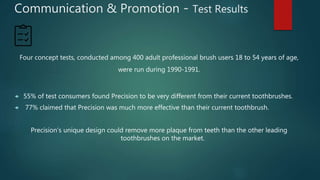
Communication & Promotion - Test Results
Four concept tests, conducted among 400 adult professional brush users 18 to 54 years of age,
were run during 1990-1991.
 55% of test consumers found Precision to be very different from their current toothbrushes.
 77% claimed that Precision was much more effective than their current toothbrush.
Precision’s unique design could remove more plaque from teeth than the other leading
toothbrushes on the market.
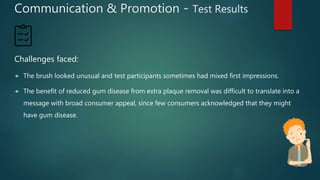
Communication & Promotion - Test Results
Challenges faced:
 The brush looked unusual and test participants sometimes had mixed first impressions.
 The benefit of reduced gum disease from extra plaque removal was difficult to translate into a
message with broad consumer appeal, since few consumers acknowledged that they might
have gum disease.
Recommendations
 Get professional endorsements and credibility from dental community for its products.
 Niche marketing should be preferred initially to prevent cannibalization of its existing
products and to focus more on therapeutic brushers who wanted to avoid oral care
problems and would appreciate the better performance.
 Later move on to mainstream marketing as additional capacity came on line, increasing
proportion of sales and customer's trust on product as the product would already have
been proved to be technologically superior after being used by therapeutic brushers.
Recommendations
 Position the brush in the super-premium category.
 Demonstrate the product's performance, the "triple-action brushing effect" using creative
and aggressive advertisement.
 Launch the product by the name “Precision by Colgate”, this would limit the extent of
cannibalization of Colgate Plus.
 Since few consumers acknowledged that they might have gum disease, the primary act of
promoting the product should be by conducting Free Professional Oral Checkups, so that
consumers get to acknowledge first, that there's a issue to be addressed and at the same
time they have a solution.
Recommendations
 Substantial spending on advertising and promotion is necessary initially to demonstrate the
differences and superiority of the product.
 Sampling is critical to product sales and should be done more often by dentists to attract
the potential buyers.
THANK YOU!
Created by Arnav Das, IIT Kharagpur
during a Marketing Internship under Prof. Sameer Mathur,
IIM Lucknow

Colgate-Palmolive Company Case Analysis

  • 1.
  • 2.
    Situation Colgate Palmolive aglobal market leader in household and personal care products, finds itself in a promising yet challenging position in 1992 as it attempts to launch a revolutionary and technologically superior product in a highly competitive market with substantial new product activity.
  • 3.
    Company Background  Networldwide research and development expenditures for 1991 were $114 million and media advertising expenditures totaled $428 million.  International sales remained CP’s strong suit, accounting for 64% of sales and 67% of profits in 1991.  The company faced tough competition in international markets from Procter & Gamble, Unilever, Nestle’s L’Oreal Division, Henkel of Germany, and Kao of Japan.  In 1991, worldwide sales of CP’s oral care products increased 12% to $1.3 billion, accounting for 22% of CP’s total sales.  In 1991, $243 million was spent to upgrade 25 of CP’s 91 manufacturing plants and 275 new products were introduced worldwide
  • 4.
    The US OralCare Market  The US Oral Care Market has seen a growth at an annual rate of 6.1% since 1986.  Toothpaste accounted for 46% of this market, mouth rinses 24%, toothbrushes 15.5%, with dental floss and other products making up the remainder.  Dollar sales of toothbrushes had grown at an average rate of 9.3% per annum since 1987, however, in 1992 they increased by 21% in value and 18% in volume.  The growth is attributed to the introduction of 47 new products and line extensions during 1991-1992.
  • 5.
    Product Segments  Thetoothbrush category was divided into three segments: 1. Value 2. Professional 3. Super-premium  Emerged in late 1980s, by 1992 super-premium brushes, with retail prices between $2.29 and $2.89, accounted for 35% of unit volume and 46% of dollar sales.  Professional brushes, priced between $1.59 and $2.09, accounted for a corresponding 41% and 42%  Value brushes, priced on average at $1.29, accounted for 24% and 12%.
  • 6.
    This table liststhe principal new products offered in the super-premium toothbrush segment in 1992.
  • 7.
    Product Differentiation  Functional Differedby bristle type like firm, medium, soft, and extra soft and also by head size like full/adult, compact, and child/youth.  Aesthetic Toothbrushes targeting children featured sparkling handles, Bugs Bunny and other characters, and glow-in-the-dark handles.
  • 8.
    STRENGTH WEAKNESSES Global leaderin the household and personal care products. Unable to achieve proper credibility from the dental association on its products unlike its competitors like ORAL-B. Maximum volume share in the U.S. retail toothbrush market. Introduction of new products led to cannibalization of existing products.
  • 9.
    Consumer Research  82%of toothbrush purchases were unplanned  Consumers replaced their brushes on average only once every 7.5 months while it was recommended to replace it after every three months.  The handle, bristles, and head shape were perceived to be the most important physical features of a toothbrush.  Therapeutic brushers aimed to avoid oral care problems, while cosmetic brushers emphasized preventing bad breath and/or ensuring white teeth
  • 10.
  • 12.
    Competition Major competitor brandsin the super-premium segment included Oral-B, Reach Advanced Design, Crest Complete, and Aquafresh Flex. To have a better understanding of the market scenario, we should look at the exhibits listing major brands and product prices for each of the three toothbrush product segments, showing the number and type of stock keeping units (SKUs) for each major brand and finally summarizing market shares over time and by class of trade.
  • 16.
    Competitive advantage ofother brands Brand Strength Oral-B Professional endorsements, known as “the dentist’s toothbrush.” Johnson & Johnson Excellent innovations like brush with a beveled handle to help consumers brush at a 45% angle—the recommended brushing technique. Procter & Gamble Product ability to reach between the teeth up to 37% farther than leading flat brushes Smithkline Beecham Aquafresh Flex toothbrushes had flexible handles that allowed for gentle brushing.
  • 17.
  • 18.
    In the toothpastecategory, it was hard to increase primary demand, so new products tended to steal sales from existing products The following exhibit shows media expenditures and shares of voice for the main toothbrush brands:
  • 19.
     Growing competitionincreased the frequency and value of consumer promotion events.  Retail advertising features and in-store displays increased toothbrush sales.  A typical CP toothbrush display increased sales by 90% over a normal shelf facing. When Colgate toothbrushes were combined with Colgate toothpaste in a single display, toothbrush sales increased by 170%.  To maximize retail sales, CP salespeople tried to locate the Colgate line in the middle of the category shelf space, between the Reach and the Oral-B product lines. Overview
  • 20.
  • 21.
    Product Design • Longerouter bristles cleaned around the gum line • Long inner bristles cleaned between teeth • Shorter bristles cleaned the teeth surface Triple-action brushing effect
  • 22.
    Positioning Objective To create thebest brush possible and as such, becoming a top-of-the range, super-premium product. Options  Niche Marketing  Mainstream Marketing
  • 23.
    Niche Positioning Pros Cons •Targeted at consumers concerned about gum disease. • It could command a 15% price premium over Oral-B and would be expected to capture 3% of the U.S. toothbrush market by the end of the first year following its launch. • No SKUs needed to be dropped. • Mainstream product would capture 10% of the market share at the end of first year which would be way more when launched as niche product • Volume shares when positioned as mainstream product will be 10%, as compared to 5% when launched as niche product at the end of first year.
  • 24.
    Mainstream Positioning Pros Cons •More appealing due to larger market volume share at the end of first year launch. • Greater proportion of sales would occur through mass merchandisers. • Cannibalization of "Colgate Plus". • Pressure on production schedules that had been developed for a niche positioning. • Switching to a mainstream positioning could result in inadequate supply of product. • Positioning as a mainstream product with 7 SKUs, would probably require dropping one or more existing SKUs.
  • 25.
    BRANDING “Colgate Precision” oras “Precision by Colgate”  Executives argued that the product could stand alone and that the Precision brand name should be emphasized.  Stressing Precision as opposed to Colgate would limit the extent of cannibalization of Colgate Plus.  It was estimated, both under the mainstream and niche positioning scenarios, that cannibalization figures for Colgate Plus would increase by 20% if the Colgate brand name was stressed.
  • 26.
    Communication & Promotion- Test Results Four concept tests, conducted among 400 adult professional brush users 18 to 54 years of age, were run during 1990-1991.  55% of test consumers found Precision to be very different from their current toothbrushes.  77% claimed that Precision was much more effective than their current toothbrush. Precision’s unique design could remove more plaque from teeth than the other leading toothbrushes on the market.
  • 27.
    Communication & Promotion- Test Results Challenges faced:  The brush looked unusual and test participants sometimes had mixed first impressions.  The benefit of reduced gum disease from extra plaque removal was difficult to translate into a message with broad consumer appeal, since few consumers acknowledged that they might have gum disease.
  • 28.
    Recommendations  Get professionalendorsements and credibility from dental community for its products.  Niche marketing should be preferred initially to prevent cannibalization of its existing products and to focus more on therapeutic brushers who wanted to avoid oral care problems and would appreciate the better performance.  Later move on to mainstream marketing as additional capacity came on line, increasing proportion of sales and customer's trust on product as the product would already have been proved to be technologically superior after being used by therapeutic brushers.
  • 29.
    Recommendations  Position thebrush in the super-premium category.  Demonstrate the product's performance, the "triple-action brushing effect" using creative and aggressive advertisement.  Launch the product by the name “Precision by Colgate”, this would limit the extent of cannibalization of Colgate Plus.  Since few consumers acknowledged that they might have gum disease, the primary act of promoting the product should be by conducting Free Professional Oral Checkups, so that consumers get to acknowledge first, that there's a issue to be addressed and at the same time they have a solution.
  • 30.
    Recommendations  Substantial spendingon advertising and promotion is necessary initially to demonstrate the differences and superiority of the product.  Sampling is critical to product sales and should be done more often by dentists to attract the potential buyers.
  • 31.
    THANK YOU! Created byArnav Das, IIT Kharagpur during a Marketing Internship under Prof. Sameer Mathur, IIM Lucknow