

REDEFINE
YOUR
COMPANY
BASED
ONTHE
COMPANY
YOUKEEP.
Accenture Technology Vision 2018
Intelligent Enterprise Unleashed
Pierre Nanterme,
Chairman & CEO
Paul Daugherty,
Chief Technology & Innovation Officer
Foreword
We invite you to explore the Accenture Technology
Vision 2018, our annual forecast of the technology
trends unfolding in the next three years.
With it, we present the important strategic
shifts companies must make to unleash
the unprecedented potential of the
intelligent enterprise.
We are working and living in a time
of unparalleled technology innovation
and invention. This technology revolution
is marked by a series of exponential
technological advances—including cloud,
artificial intelligence, blockchain, augmented
and virtual reality, internet of things, robotics,
quantum computing, and more. Individually
and collectively, these technologies represent
vast potential for the future of business,
and are creating the imperative to reinvent
and reimagine the way we do business.
This future also comes with broader
responsibility. In producing this year’s
report, the third in our People First series,
we discovered a foundational shift in the
role of enterprise, itself: It is moving closer
to the center of people’s lives. As leading
companies apply digital technologies and
operate with ever-increasing intelligence,
traditional boundaries between business and
personal are dissolving. The very role of the
enterprise in society is being redefined.
Tomorrow’s leading companies are already
moving beyond providing products and
services. They are applying technology
to create deeper, more meaningful
relationships with people. They are creating
new affiliations with businesses across
industries who share their vision and mission.
They are using these new partnerships to
invent new products and services that meet
the goals of their customers and employees
and, in doing so, are achieving new levels
of growth and differentiation. They are
also helping their communities create new
economic opportunities and develop new
ways of serving and protecting citizens,
benefitting society as a whole.
Accenture’s year-long research into the
technology trends driving this change resulted
in this thought-provoking report: ”Intelligent
Enterprise Unleashed: Redefine your company
based on the company you keep.” Our forecast
describes the widespread opportunities
available to companies to use technology
at each level of the enterprise—from strategy
through operations—to improve performance
and move closer to the center of people’s lives.
Through innovation-led research,
deep insights and powerful examples,
the Accenture Technology Vision 2018 helps
enterprises around the globe succeed and
grow in this new era. We look forward to
supporting your digital transformation and
helping you unleash the potential of your
intelligent enterprise.
WELCOME
#TechVision2018Technology Vision 2018 Intelligent Enterprise Unleashed2
Contents
Introduction	4
Trend 1
CITIZENAI	 19
Raising AI to Benefit Business and Society
Trend 2
EXTENDEDREALITY	 29
The End of Distance
Trend 3
DATAVERACITY	 39
The Importance of Trust
Trend 4
FRICTIONLESSBUSINESS	 47
Built to Partner at Scale
Trend 5
INTERNETOFTHINKING	 59
Creating Intelligent Distributed Systems
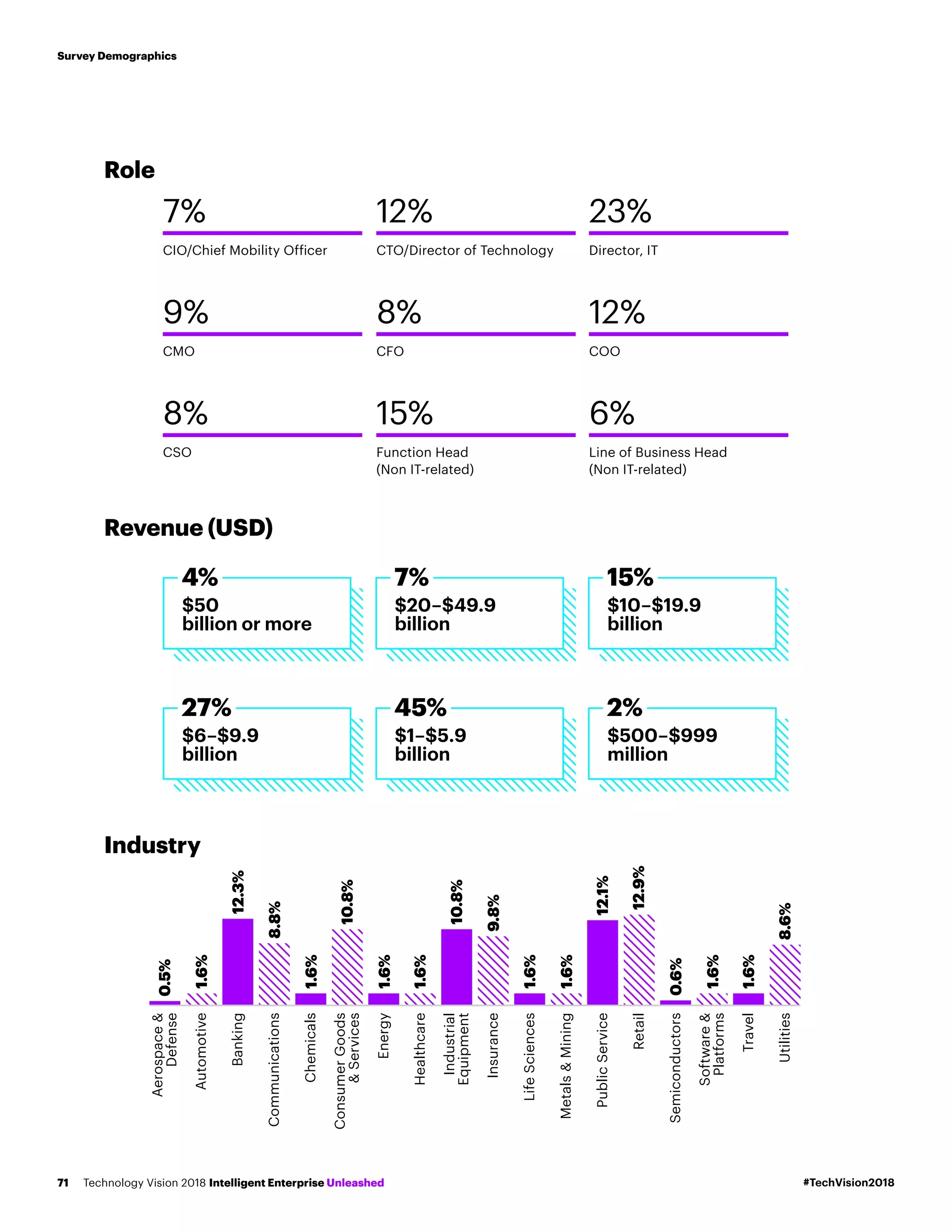
Research Methodology	 68
Survey Demographics	 69
References	72
#TechVision2018Technology Vision 2018 Intelligent Enterprise Unleashed3
Leveraging the rapid advancements in technology to
create increasingly innovative products and services,
businesses are driving unprecedented changes in
the way people work and live.
By embedding themselves throughout society, companies are blurring the lines
between business and personal—and blazing a new trail for their own future growth.
Technology is now firmly embedded throughout our everyday activities, but its
reach is larger than that: it’s reshaping pieces of our society. This year’s Accenture
Technology Vision trends highlight the rapid advancements in technologies that,
in turn, are improving the ways people work and live.
HOWDO
YOUIMPROVE
THEWAY
PEOPLEWORK
ANDLIVE?
Introduction
There’s a new obligation—
and a new opportunity—
for companies to engage
with people differently.
Paul Daugherty | Chief Technology
& Innovation Officer at Accenture
#TechVision2018Technology Vision 2018 Intelligent Enterprise Unleashed4
GE is equipping field technicians with cutting-edge
augmented reality glasses, changing the way workers
engage with the physical world by giving them hands-
free access to information, or allowing remote experts
to see exactly what the technicians see as they repair
wind turbines.1
The Chinese education firm Liulishuo is
changing education by introducing a new
actor into society: a sophisticated artificial
intelligence (AI)-powered English teacher
that delivers personalized, adaptive learning
to millions of people.2
And responding to the
critical need for accurate information to feed
the 24-hour news cycle, Thomson Reuters has
developed an algorithm that uses streams of
real-time data from Twitter to help journalists
classify, source, fact-check, and debunk
rumors faster than ever before.3
Individually, each of these technology-driven
efforts represents a company’s pursuit of
the most creative or disruptive product or
service. But their innovative efforts are part
of a larger strategy: driving company growth
by making technology inseparable—and
indispensable—in how things get done.
Businesses are using their products and
services to reshape and reimagine how our
society works, communicates, and even
governs. According to the global Accenture
Technology Vision 2018 survey, 84 percent
of 6,381 business and IT executives surveyed
agree that through technology, companies
are weaving themselves seamlessly into
the fabric of how people live today.
Just look at Amazon’s efforts to embed itself
into consumer households. Through the Echo
and its AI assistant, Alexa, Amazon is managing
not just shopping needs, but also the daily
demands of busy lives. In fact, Amazon is
so integrated into everyday living that new
apartment complexes are building dedicated
Amazon Lockers into their designs; and people
now trust the company with physical access to
their homes, letting couriers make deliveries
when no one is around via Amazon Key
and its smart lock system.4,5
These changes are reaching beyond
consumer spaces, as well. Tesla and other
companies involved in automated driving
are embedding themselves into the
regulatory course for their own industries,
partnering closely with governments to
accelerate the development of guidelines
needed for autonomous vehicles to operate
at scale.6
In enterprise ecosystems, Siemens
is embedding itself into its business partners’
architectures. By offering the use of its
MindSphere operating system for Internet
of Things (IoT) manufacturing devices to
anyone, Siemens is cementing itself as
an integral part of the new IoT universe—
and its tremendous societal reach.7
#TechVision2018Technology Vision 2018 Intelligent Enterprise Unleashed5
Introduction
This level of integration is the next great
societal evolution. The same way cities were
built around railroads, or people rebuilt
their lives around electricity, the world is
reimagining itself not just around digital
innovation but, by extension, around the
companies that provide those services.
Of course, society has rebuilt itself around
technological disruption many times before,
and will no doubt do so again. But this latest
transformation is unique: for the first time in
a technological transformation, the change
is a two-way street. People aren’t just
using companies’ products and services,
but feeding information and access back to
them. To deliver such “integrated innovation,”
companies need a profound level of insight
and impact into people’s lives, and their
partners’ business. Savvy organizations
are realizing that this level of connection—
and this degree of trust—will require a new
type of relationship. It’s not just business;
it’s personal. And it’s how leaders will
redefine their company, based on the
company they keep.
#TechVision2018Technology Vision 2018 Intelligent Enterprise Unleashed6
Introduction
NEWEXPECTATIONS:
READINGTHE
LABELSOF
ENTERPRISEIn a world where everything is connected, the lines that
have traditionally separated our society into neat little
boxes of customers, employees, citizens, companies,
and even governments, are blurring.
Increasingly, in exchange for the access and
impact they allow companies to have in their
lives, people expect partnerships, based not
only on a company’s products, but its goals,
and its values. In short: people are “reading
the labels” of enterprise—and companies
must define those labels for themselves,
or have the labels determined for them.
These new expectations are creating a strain
on businesses that have introduced innovative
platforms and services. It’s a parallel to the
innovative startups that sprang up during the
dot-com era, only to be forced to take a step
back and flesh out traditional business models:
companies that have quickly innovated their
way into society are now being pushed to
develop clear expectations for how those
societal interactions will play out.
Years ago, Uber pioneered a new model for
working with drivers, upending transit and
transportation models. Now, as it has evolved
its business model and relationships with
local communities, the company is working
to address corporate responsibility in its
interactions with drivers, customers,
and regulatory organizations.
The premium that people, governments,
and business partners put on these labels
of enterprise stems from the responsibilities
that two-way partnerships create. When
those responsibilities aren’t met, the results
are worse than disappointed customers:
the failure creates a society disillusioned
with the integrated innovation model that
businesses rely on to grow.
#TechVision2018Technology Vision 2018 Intelligent Enterprise Unleashed7
Introduction
Security failures at Equifax resulted in
a theft of personal information that will
impact hundreds of millions of lives for
decades to come—including individuals
who had no explicit business relationship
with Equifax.8
Rebuilding the trust required
to sustain partnerships with consumers,
governments, and the general public
will be a massive undertaking.
The magnitude of these challenges will only
grow as additional revolutionary technologies
begin to reach maturity in the coming years,
and accelerate technology-driven societal
change. Quantum computing has the potential
to break the cryptographic standards that
underpin the world’s financial systems;
new workforce models and platforms are
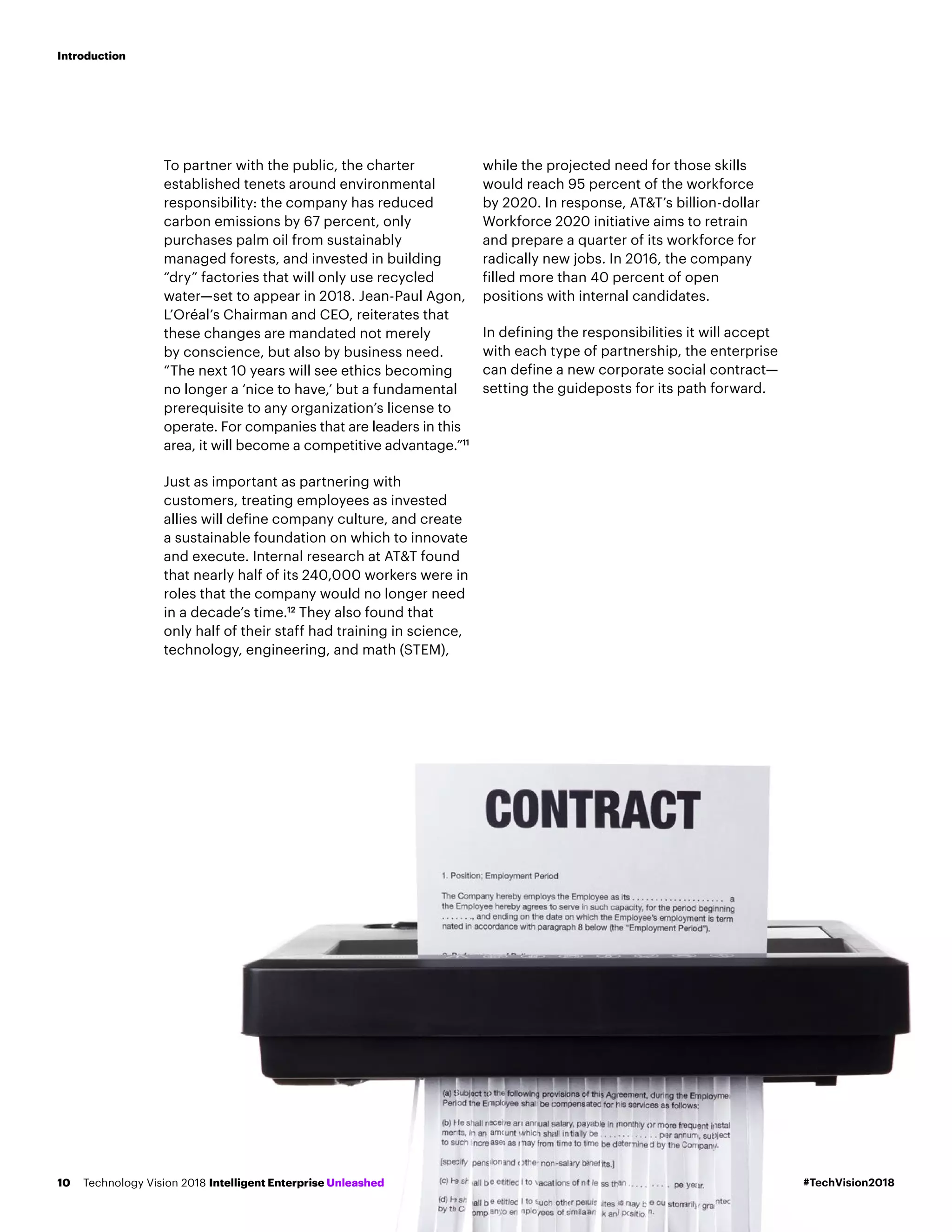
shredding the long-accepted understanding
of the term “employee”; and as AI grows in
capability and reach, there will be large-scale
failures and scandals around improper
use of the technology.
It’s clear that both individuals and society as
a whole will have to create new partnerships
to deal with the impact of such revolutionary
changes—but the role that companies will play
remains an open question. How responsible is
a company whose secure encryption is broken
because of advances in quantum technology?
How much blame should a business take if one
of its partners uses AI to make decisions in a
way that’s biased, or invades people’s privacy?
There’s a reason why tech giants are
growing more vocal and active around
societal questions, like debates over access
and privacy—because actions will define
these enterprise labels. Apple went so far
as to refuse to give the US government the
capability to decrypt the data on an iPhone,
and devoted significant time and resources
to explaining its decision to the public.9
That level of discourse was no accident:
it’s demonstrating what the company will
and won’t do as part of their partnerships with
customers, governments, and the public—
and the first step on a path toward defining
a formalized corporate social contract.
#TechVision2018Technology Vision 2018 Intelligent Enterprise Unleashed8
Introduction
DEFININGTHE
CORPORATE
SOCIAL
CONTRACTWhile new expectations driven by a shifting technology
landscape can be daunting, pioneering companies have
recognized that these new societal expectations can
be transformed into an enterprise strength.
They’re using their increased and
embedded technology interactions to
lean in and build deeper partnerships
with customers, employees, governments,
and the public. By explicitly defining the
nature of their partnerships, these leading
companies are also defining the new
corporate social contract.
Creating a consistent set of principles around
their relationships will help companies meet
raised expectations. But it’s also becoming
a key piece of empowering the business
to innovate and grow. The commitments a
company makes to partnership will become
the “nutritional value” information that people
are searching for; as companies build and
extend their ecosystems, individuals and
organizations with goals and ideals that
match their own will be natural partners.
Ultimately, companies will create the “terms
and conditions” for their constellations of
relationships within the connected society—
and create a clear path for their future growth.
The nature and scope of these new terms
and conditions will vary with the type of
partnership, whether it’s with customers,
employees, governments, or the public.
So, too, will the opportunities for growth
from putting them in place.
L’Oréal, the cosmetics company, is paving the
way. To continually operate as a good partner
with society, the company wrote a strict ethical
charter that was drafted in collaboration with
French government agencies and international
ethics organizations.10
Importantly, the charter
serves as a decision-making framework
across nearly every aspect of L’Oréal.
Guided by the charter, L’Oréal also requires
that potential suppliers commit to an equally
strict set of ethical standards, and guides
internal buyers through steps to ensure
they are purchasing from suppliers who
meet that code.
#TechVision2018Technology Vision 2018 Intelligent Enterprise Unleashed9
Introduction
To partner with the public, the charter
established tenets around environmental
responsibility: the company has reduced
carbon emissions by 67 percent, only
purchases palm oil from sustainably
managed forests, and invested in building
“dry” factories that will only use recycled
water—set to appear in 2018. Jean-Paul Agon,
L’Oréal’s Chairman and CEO, reiterates that
these changes are mandated not merely
by conscience, but also by business need.
“The next 10 years will see ethics becoming
no longer a ‘nice to have,’ but a fundamental
prerequisite to any organization’s license to
operate. For companies that are leaders in this
area, it will become a competitive advantage.”11
Just as important as partnering with
customers, treating employees as invested
allies will define company culture, and create
a sustainable foundation on which to innovate
and execute. Internal research at AT&T found
that nearly half of its 240,000 workers were in
roles that the company would no longer need
in a decade’s time.12
They also found that
only half of their staff had training in science,
technology, engineering, and math (STEM),
while the projected need for those skills
would reach 95 percent of the workforce
by 2020. In response, AT&T’s billion-dollar
Workforce 2020 initiative aims to retrain
and prepare a quarter of its workforce for
radically new jobs. In 2016, the company
filled more than 40 percent of open
positions with internal candidates.
In defining the responsibilities it will accept
with each type of partnership, the enterprise
can define a new corporate social contract—
setting the guideposts for its path forward.
#TechVision2018Technology Vision 2018 Intelligent Enterprise Unleashed10
Introduction
of executives agree that through
technology, companies are
weaving themselves seamlessly
into the fabric of how people
live today.
84%
EMBEDDING
OPPORTUNITYAs companies have reached further than ever into
people’s lives, they’ve shaped society around their
products and services. This transformed society
now provides the new foundation for each
company’s future growth.
Through new partnerships with customers, employees, partners, and even governments,
companies are empowered to build ever-stronger access and trust. This trust will give
companies the inroads to further embed themselves into society, becoming ever more
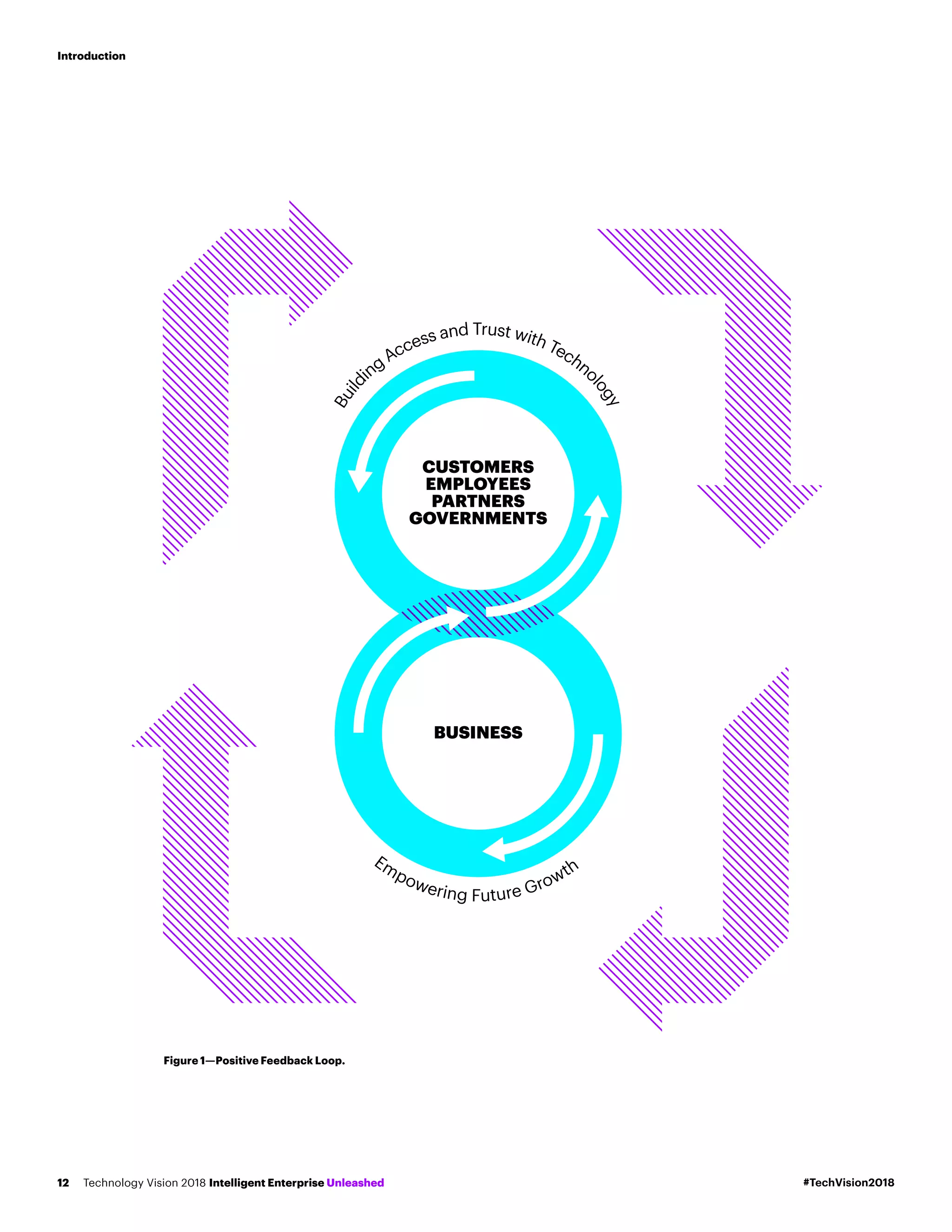
indispensable—and empowering their own revolutionary growth. (See Figure 1.)
#TechVision2018Technology Vision 2018 Intelligent Enterprise Unleashed11
Introduction
CUSTOMERS
EMPLOYEES
PARTNERS
GOVERNMENTS
BUSINESS
Empowering Future Growth
Build
ingAccess and Trust with Techno
logy
Figure 1­­—Positive Feedback Loop.
#TechVision2018Technology Vision 2018 Intelligent Enterprise Unleashed12
Introduction
Technology-based products and services have a
tremendous impact on the way people work and live.
Through those products and services, businesses
are driving unprecedented change in society.
This year’s Accenture Technology Vision highlights five emerging trends shaping the
way technology is increasing businesses’ impact across society. But in exchange for
the unprecedented access and influence businesses enjoy today, people are demanding
more responsibilities from them. In each chapter, you will see how expectations are
growing, as customers, employees, business partners, governments, and more,
seek formalized partnerships with businesses.
INTELLIGENT
ENTERPRISE
UNLEASHED
2018 Tech Trends
#TechVision2018Technology Vision 2018 Intelligent Enterprise Unleashed13
Introduction
As artificial intelligence grows in its
capabilities—and its impact on people’s
lives—businesses must move to “raise”
their AIs to act as responsible, productive
members of society.
Trend 1
CITIZENAI
Raising AI to Benefit
Business and Society
Virtual and augmented reality technologies
are removing the distance to people,
information, and experiences, transforming
the ways people live and work.
By transforming themselves to run on data,
businesses have created a new kind of
vulnerability: inaccurate, manipulated,
and biased data that leads to corrupted
business insights, and skewed decisions
with a major impact on society.
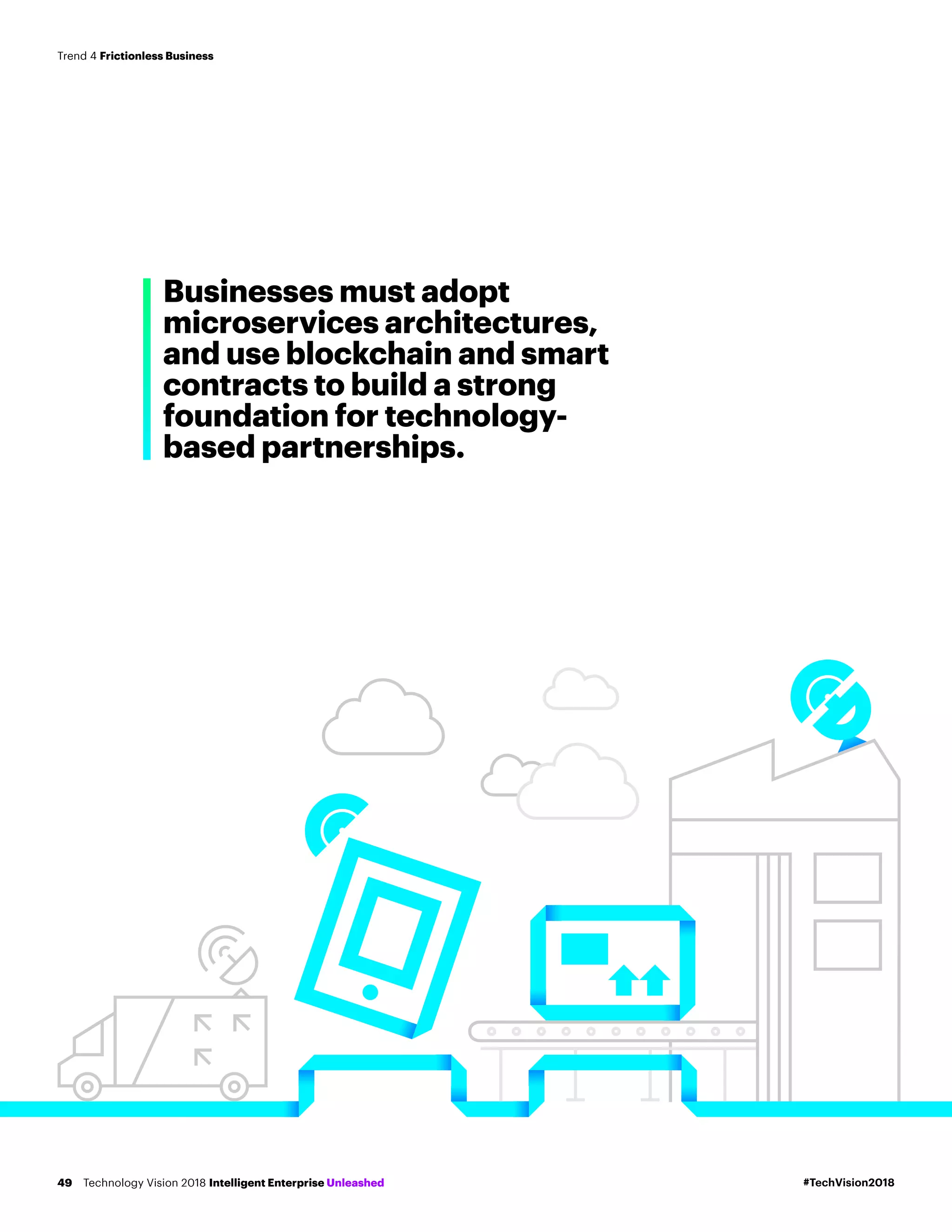
Businesses depend on technology-based
partnerships for growth, but their own
legacy systems aren’t designed to support
partnerships at scale. To fully power the
connected Intelligent Enterprise, companies
must first re-architect themselves.
Businesses are making big bets on intelligent
environments via robotics, AI and immersive
experiences. But to bring these intelligent
environments to life, they must extend their
infrastructures into the dynamic, real-world
environments they want to reach.
Trend 2
EXTENDED
REALITY
The End of Distance
Trend 3
DATA
VERACITY
The Importance of Trust
Trend 4
FRICTIONLESS
BUSINESS
Built to Partner at Scale
Trend 5
INTERNET
OFTHINKING
Creating Intelligent
Distributed Systems
#TechVision2018Technology Vision 2018 Intelligent Enterprise Unleashed14
Introduction
As part of Accenture’s multi-year perspective on
technology’s impact on enterprise, these trends
reflect the continuously evolving digital culture
that creates challenges and opportunities
for organizations worldwide.
Since the dawn of the digital era, businesses have been doing more with each passing
year: Becoming digital themselves; growing more involved in people’s lives; embracing
the “People First” view of the changing enterprise landscape. Now we’re at a point of
fusion: businesses are looking to reshape society, and can’t do it alone. Partnerships
with people are the clear path forward for every business, and for society as a whole.
Each year’s individual Vision trends highlight new or evolving technologies and their
emerging impact across enterprise. Some technologies are already playing important
roles in the strategies of leading companies, while others are just beginning to emerge as
difference-makers. Viewed as a whole, our Technology Vision trends provide a guidepost
for the way companies must consider their resources, responsibilities, and opportunities
for success in the years to come.
With businesses shaping change throughout the world, being a leader isn’t just about
incorporating new technologies. It’s about the ways you partner throughout everyday
life with people to improve lives and shape society—and in so doing, build the
foundation on which you’ll continue to grow.
This new era is all about how we can
use these ties and information that
we have about companies—and they
have about us—to change the way
that we work together.
Michael Biltz | Managing Director,
Accenture Technology Vision—Accenture Labs
#TechVision2018Technology Vision 2018 Intelligent Enterprise Unleashed15
Introduction
2018 Trend 1
CITIZEN AI
Trend 2
EXTENDED
REALITY
Trend 3
DATA
VERACITY
Trend 4
FRICTIONLESS
BUSINESS
Trend 5
INTERNET OF
THINKING
2017 Trend 1
AI IS THE
NEW UI
Trend 2
ECOSYSTEM
POWER PLAYS
Trend 3
WORKFORCE
MARKETPLACE
Trend 4
DESIGN FOR
HUMANS
Trend 5
THE
UNCHARTED
2016 Trend 1
INTELLIGENT
AUTOMATION
Trend 2
LIQUID
WORKFORCE
Trend 3
PLATFORM
ECONOMY
Trend 4
PREDICTABLE
DISRUPTION
Trend 5
DIGITAL
TRUST
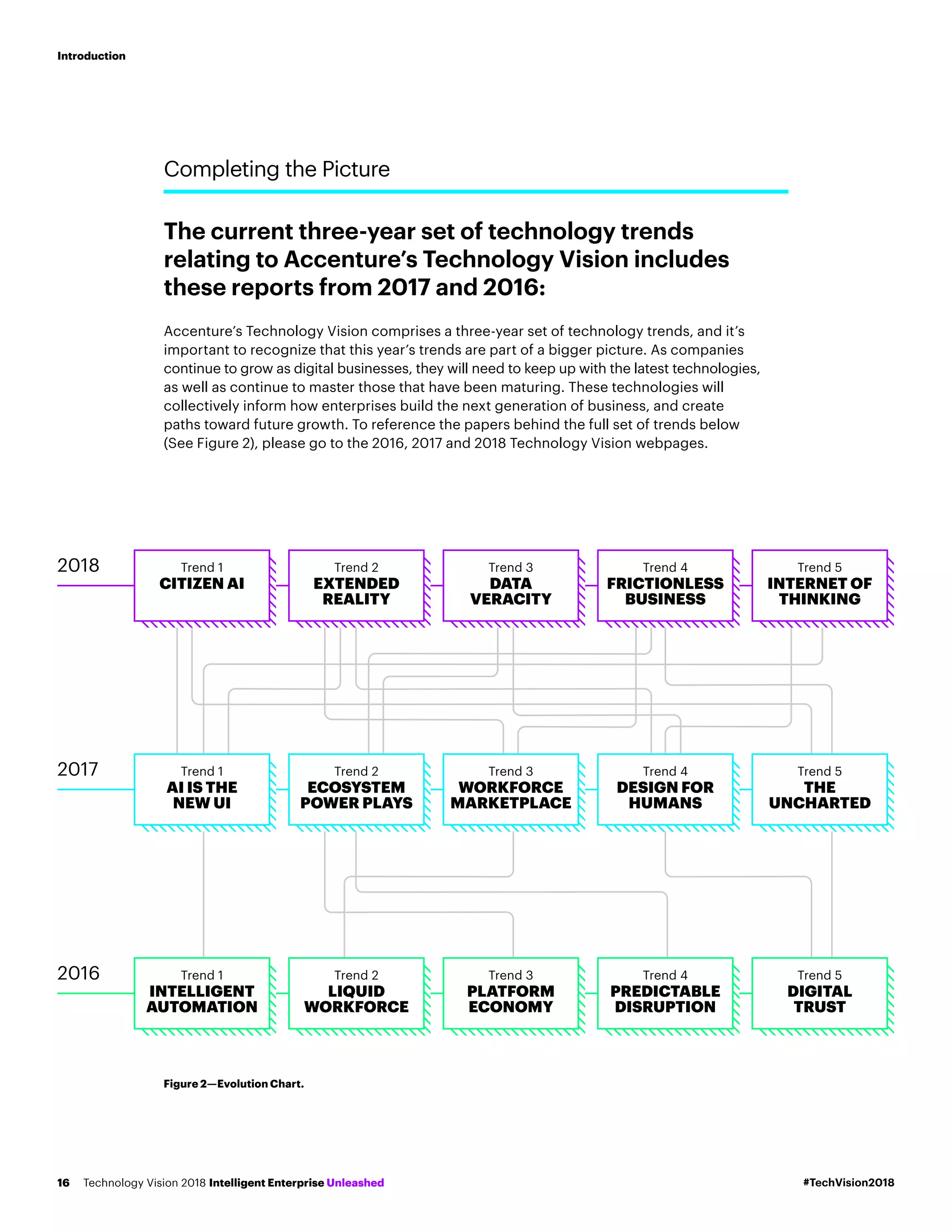
The current three-year set of technology trends
relating to Accenture’s Technology Vision includes
these reports from 2017 and 2016:
Accenture’s Technology Vision comprises a three-year set of technology trends, and it’s
important to recognize that this year’s trends are part of a bigger picture. As companies
continue to grow as digital businesses, they will need to keep up with the latest technologies,
as well as continue to master those that have been maturing. These technologies will
collectively inform how enterprises build the next generation of business, and create
paths toward future growth. To reference the papers behind the full set of trends below
(See Figure 2), please go to the 2016, 2017 and 2018 Technology Vision webpages.
Completing the Picture
Figure 2­­—Evolution Chart.
#TechVision2018Technology Vision 2018 Intelligent Enterprise Unleashed16
Introduction
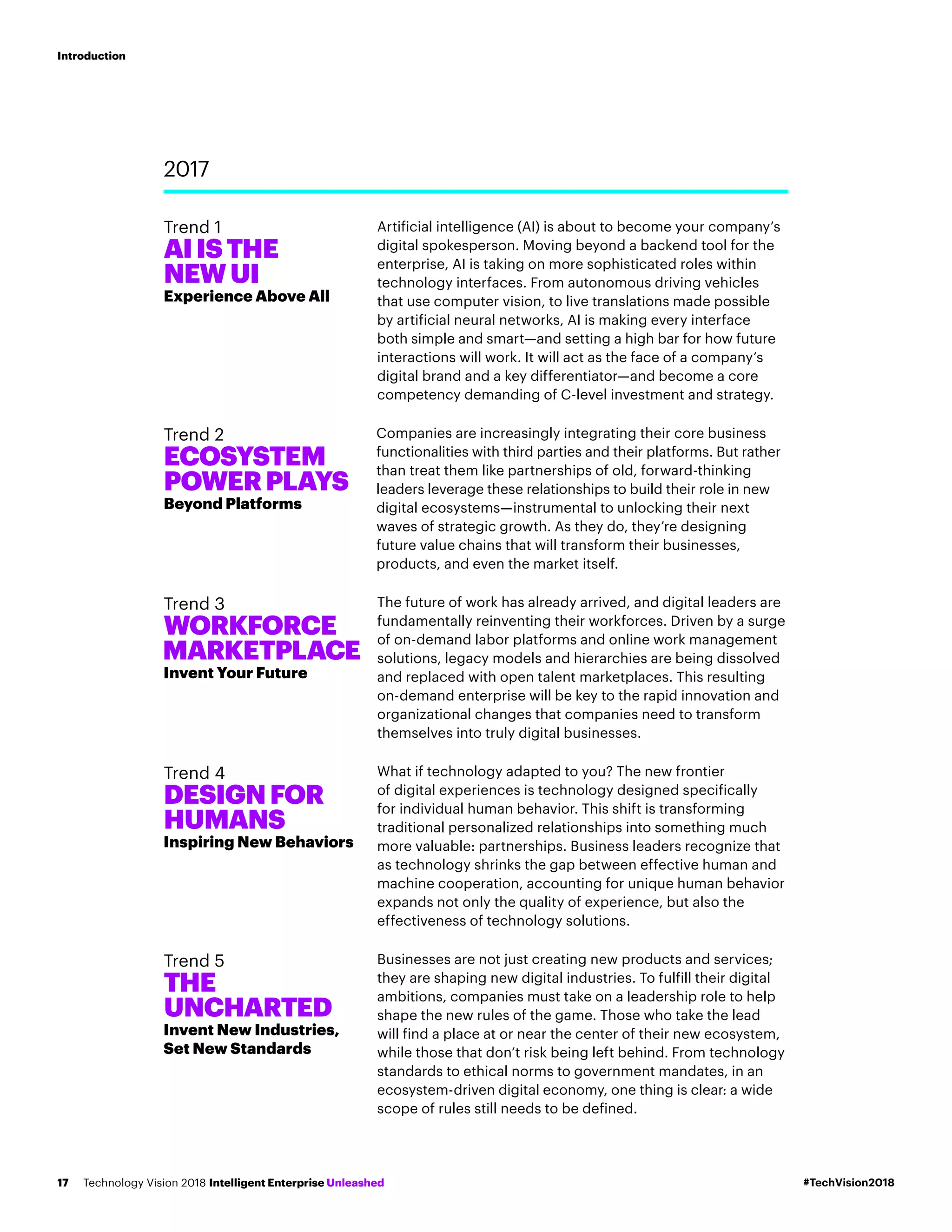
Artificial intelligence (AI) is about to become your company’s
digital spokesperson. Moving beyond a backend tool for the
enterprise, AI is taking on more sophisticated roles within
technology interfaces. From autonomous driving vehicles
that use computer vision, to live translations made possible
by artificial neural networks, AI is making every interface
both simple and smart—and setting a high bar for how future
interactions will work. It will act as the face of a company’s
digital brand and a key differentiator—and become a core
competency demanding of C-level investment and strategy.
Companies are increasingly integrating their core business
functionalities with third parties and their platforms. But rather
than treat them like partnerships of old, forward-thinking
leaders leverage these relationships to build their role in new
digital ecosystems—instrumental to unlocking their next
waves of strategic growth. As they do, they’re designing
future value chains that will transform their businesses,
products, and even the market itself.
The future of work has already arrived, and digital leaders are
fundamentally reinventing their workforces. Driven by a surge
of on-demand labor platforms and online work management
solutions, legacy models and hierarchies are being dissolved
and replaced with open talent marketplaces. This resulting
on-demand enterprise will be key to the rapid innovation and
organizational changes that companies need to transform
themselves into truly digital businesses.
What if technology adapted to you? The new frontier
of digital experiences is technology designed specifically
for individual human behavior. This shift is transforming
traditional personalized relationships into something much
more valuable: partnerships. Business leaders recognize that
as technology shrinks the gap between effective human and
machine cooperation, accounting for unique human behavior
expands not only the quality of experience, but also the
effectiveness of technology solutions.
Businesses are not just creating new products and services;
they are shaping new digital industries. To fulfill their digital
ambitions, companies must take on a leadership role to help
shape the new rules of the game. Those who take the lead
will find a place at or near the center of their new ecosystem,
while those that don’t risk being left behind. From technology
standards to ethical norms to government mandates, in an
ecosystem-driven digital economy, one thing is clear: a wide
scope of rules still needs to be defined.
2017
Trend 1
AIISTHE
NEWUI
Experience Above All
Trend 2
ECOSYSTEM
POWERPLAYS
Beyond Platforms
Trend 3
WORKFORCE
MARKETPLACE
Invent Your Future
Trend 4
DESIGNFOR
HUMANS
Inspiring New Behaviors
Trend 5
THE
UNCHARTED
Invent New Industries,
Set New Standards
#TechVision2018Technology Vision 2018 Intelligent Enterprise Unleashed17
Introduction
Leaders will embrace automation not just to take advantage
of the breakneck pace of digital change, but also to create
a new digital world where they hold competitive advantage.
Machines and artificial intelligence will be the newest recruits
to the workforce, bringing new skills to help people do new
jobs, and reinventing what’s possible.
Companies are investing in the tools and technologies they
need to keep pace with constant change in the digital era.
But to achieve their ambitious goals, leaders are refocusing
on an often overlooked factor: the workforce. They are looking
at technology as not just a disrupter, but also an enabler to
transform their people, projects, and entire organizations
into a highly adaptable and change-ready enterprise. In short,
business leaders are realizing their new liquid workforce can
become their new competitive advantage.
Industry leaders are unleashing technology’s power by
developing not only new technology platforms, but also the
platform-based business models and strategies they enable.
But the technology changes are only the beginning.
Fast-emerging digital ecosystems—think precision
agriculture, the industrial Internet or smart cities—create
the foundation for the next big wave of enterprise disruption.
Digital ecosystems like these, and the businesses that
power them, are straddling markets and blurring
industry boundaries.
To gain the trust of individuals, ecosystems, and regulators in
the digital economy, businesses must possess strong security
and ethics at each stage of the customer journey. And new
products and services must be ethical—and secure-by-design.
Businesses that get this right will enjoy such high levels
of trust that their customers will look to them as guides
for the digital future.
2016
Trend 1
INTELLIGENT
AUTOMATION
The Essential New
Coworker for the
Digital Age
Trend 2
LIQUID
WORKFORCE
Building the Workforce
for Today’s Digital
Demands
Trend 3
PLATFORM
ECONOMY
Technology-Driven
BusinessModelInnovation
from the Outside In
Trend 4
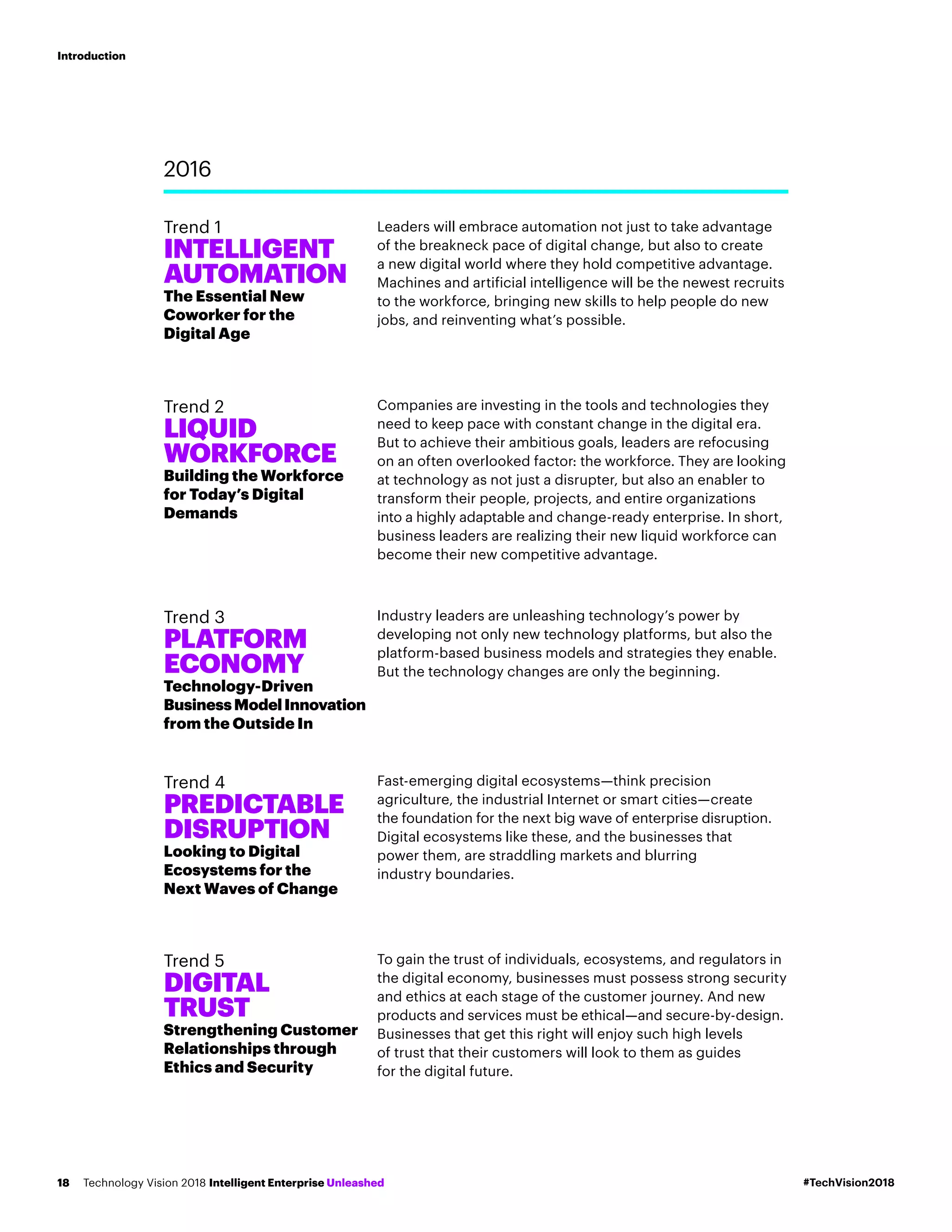
PREDICTABLE
DISRUPTION
Looking to Digital
Ecosystems for the
Next Waves of Change
Trend 5
DIGITAL
TRUST
Strengthening Customer
Relationships through
Ethics and Security
#TechVision2018Technology Vision 2018 Intelligent Enterprise Unleashed18
Introduction
CITIZENAI
Raising AI to Benefit
Business and Society
Trend 1
#TechVision2018Technology Vision 2018 Intelligent Enterprise Unleashed19
With artificial intelligence (AI) growing in its reach
throughout society, any business looking to capitalize
on AI’s potential must also acknowledge its impact.
Much more than just a technological tool,
AI has grown to the point where it often has
as much influence as the people putting it
to use, both within and outside the company.
For businesses, this means deploying AI is
no longer just about training it to perform a
given task. It’s about “raising” it to act as a
responsible representative of the business,
and a contributing member of society.
Researchers at New York’s Icahn School
of Medicine at Mt. Sinai have a unique
collaborator in the hospital: their in-house
AI system, affectionately known as
Deep Patient. Armed with an analysis of
electronic health records from 700,000
patients, Deep Patient taught itself to
predict risk factors for 78 different
diseases—and doctors now turn to
the system to aid in diagnoses.1
Deep Patient may not be a person, but it’s
more than just a program. Artificially intelligent
systems learn, make autonomous decisions,
and have grown from a technological tool to
a partner among people, coordinating and
collaborating with humans in the workforce
and society. With increasing autonomy and
sophisticated capabilities, AI now often has
as much influence as the people putting it
to use. According to our survey, four out of
five executives (81 percent) believe within the
next two years, AI will work next to humans
in their organizations, as a co-worker,
collaborator and trusted advisor.
Already, AI-based solutions help fashion
stylists at San Francisco-based Stitch Fix
curate customers’ outfits, and assist claims
adjustors at Ant Financial Insurance in China
in making insurance payout decisions.2,3
An AI system even has a position on the
leadership team at the Nordic software
maker, Tieto, where the company looks to its
AI, called “Alicia T,” to help the team become
more data driven.4
For some organizations,
AI is already the public face of the business,
handling everything from initial interactions
via chat, voice, and email, through to filling
vital customer service roles. And these
roles will only grow: IDC forecasts that
global corporate spending on cognitive/
AI systems will increase at a 54 percent
compound annual growth rate (CAGR)
between 2015 and 2020.5
Deep Patient
taught itself
to predict risk
factors for
78 diseases.
#TechVision2018Technology Vision 2018 Intelligent Enterprise Unleashed20
Trend 1 Citizen AI
As AI-based decisions have increasing impact
on human lives, a new imperative becomes
clear: just as parents hope to raise children
who act responsibly and communicate
effectively, businesses now need to “raise”
their AI systems so that they reflect business
and societal norms of responsibility, fairness
and transparency. Many enterprises still
treat AI as a technology tool, but no one
would expect a tool to “act” responsibly,
to explain its decisions, or work well with
others. But with AI systems making decisions
that affect people, companies must teach
AI to do these things, and more.
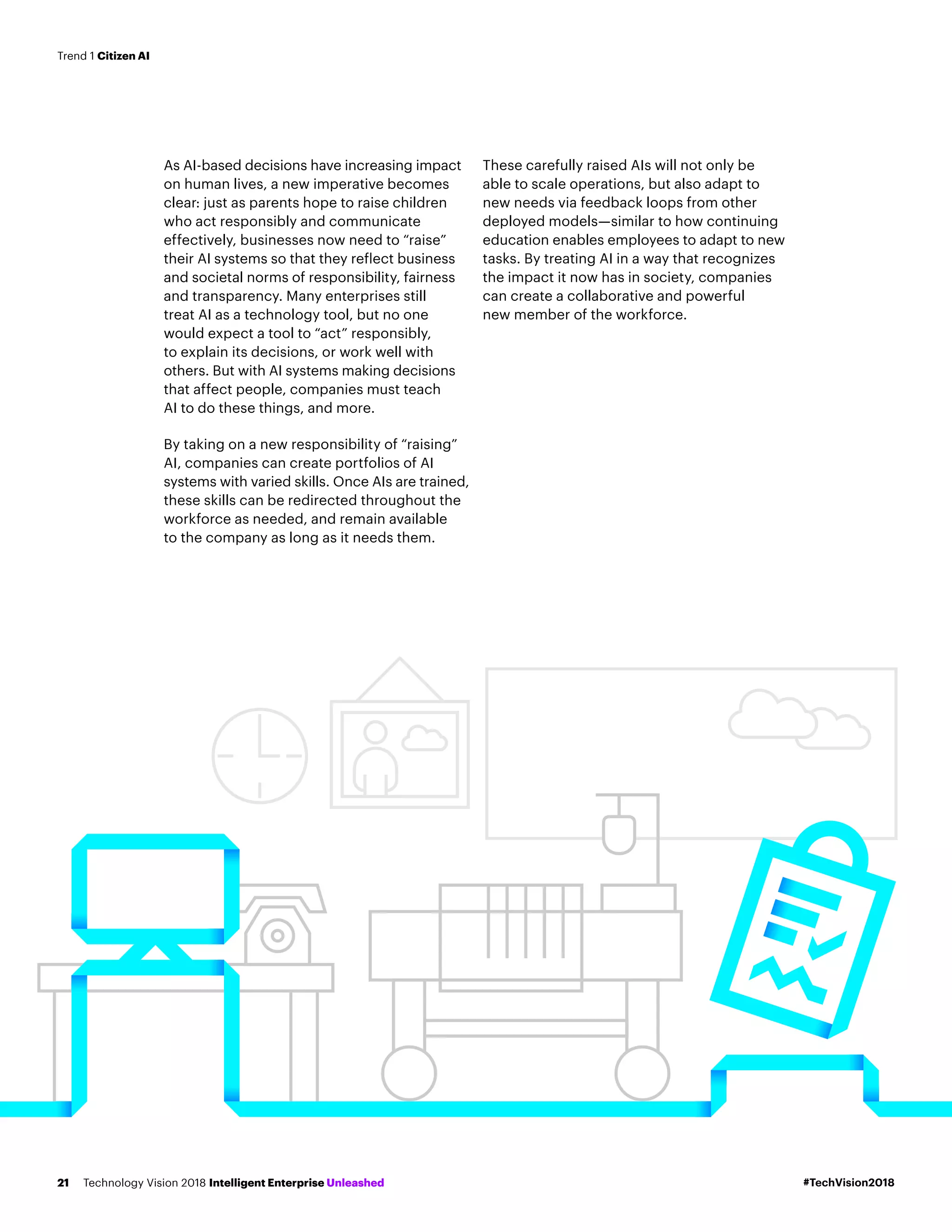
By taking on a new responsibility of “raising”
AI, companies can create portfolios of AI
systems with varied skills. Once AIs are trained,
these skills can be redirected throughout the
workforce as needed, and remain available
to the company as long as it needs them.
These carefully raised AIs will not only be
able to scale operations, but also adapt to
new needs via feedback loops from other
deployed models—similar to how continuing
education enables employees to adapt to new
tasks. By treating AI in a way that recognizes
the impact it now has in society, companies
can create a collaborative and powerful
new member of the workforce.
#TechVision2018Technology Vision 2018 Intelligent Enterprise Unleashed21
Trend 1 Citizen AI
AI is a collection of advanced technologies that allows
machines to sense, comprehend, act, and learn.
In the past, this kind of performance
was driven by rules-based data analytics
programs, statistical regressions, and early
“expert systems.” But the explosion of
powerful deep neural networks now gives
AIs something a mere program doesn’t
have: the ability to do the unexpected.
For businesses, this means changing the
way they view AI, from systems that are
programmed, to systems that learn. Education
isn’t about teaching someone to do one task,
but about learning how to approach and solve
problems. Researchers at Carnegie Mellon
University developed a training method that
lets an aerial drone teach itself to recognize
and track a specific car; however, the same
method can also be applied to other tasks,
like remote pipeline inspection.6
This is the approach businesses must now
take with AI. AIs built as programs are useful
for a finite set of tasks; learning-based
AIs have a much wider repertoire and are
more likely to grow into collaborators and
colleagues—ones that remain a constant
member of the workforce.
Raising AI requires addressing many of the
same challenges faced in human education
and growth: fostering an understanding
of right and wrong, and what it means to
behave responsibly; imparting knowledge
without bias; and building self-reliance while
emphasizing the importance of collaborating
and communicating with others. To meet this
new responsibility of raising AI, companies
can look to milestones of human development
for guidance: first, people learn how to learn,
then they rationalize or explain their thoughts
and actions, and eventually they accept
responsibility for their decisions.
TEACHING
SOFTWARE
TOLEARN
#TechVision2018Technology Vision 2018 Intelligent Enterprise Unleashed22
Trend 1 Citizen AI
To meet this new responsibility
of raising AI, companies can
look to milestones of human
development for guidance.
#TechVision2018Technology Vision 2018 Intelligent Enterprise Unleashed23
Trend 1 Citizen AI
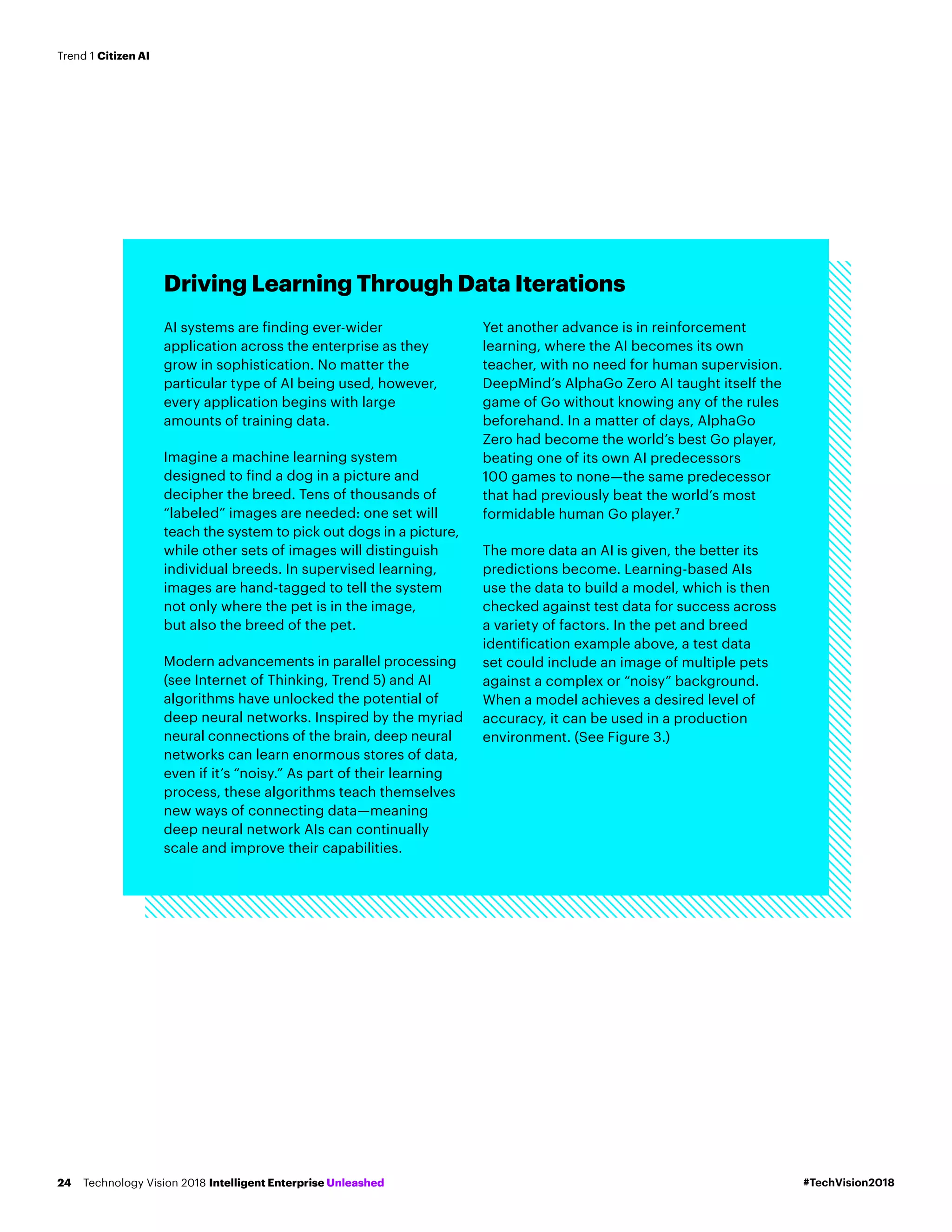
Driving Learning Through Data Iterations
AI systems are finding ever-wider
application across the enterprise as they
grow in sophistication. No matter the
particular type of AI being used, however,
every application begins with large
amounts of training data.
Imagine a machine learning system
designed to find a dog in a picture and
decipher the breed. Tens of thousands of
“labeled” images are needed: one set will
teach the system to pick out dogs in a picture,
while other sets of images will distinguish
individual breeds. In supervised learning,
images are hand-tagged to tell the system
not only where the pet is in the image,
but also the breed of the pet.
Modern advancements in parallel processing
(see Internet of Thinking, Trend 5) and AI
algorithms have unlocked the potential of
deep neural networks. Inspired by the myriad
neural connections of the brain, deep neural
networks can learn enormous stores of data,
even if it’s “noisy.” As part of their learning
process, these algorithms teach themselves
new ways of connecting data—meaning
deep neural network AIs can continually
scale and improve their capabilities.
Yet another advance is in reinforcement
learning, where the AI becomes its own
teacher, with no need for human supervision.
DeepMind’s AlphaGo Zero AI taught itself the
game of Go without knowing any of the rules
beforehand. In a matter of days, AlphaGo
Zero had become the world’s best Go player,
beating one of its own AI predecessors
100 games to none—the same predecessor
that had previously beat the world’s most
formidable human Go player.7
The more data an AI is given, the better its
predictions become. Learning-based AIs
use the data to build a model, which is then
checked against test data for success across
a variety of factors. In the pet and breed
identification example above, a test data
set could include an image of multiple pets
against a complex or “noisy” background.
When a model achieves a desired level of
accuracy, it can be used in a production
environment. (See Figure 3.)
#TechVision2018Technology Vision 2018 Intelligent Enterprise Unleashed24
Trend 1 Citizen AI
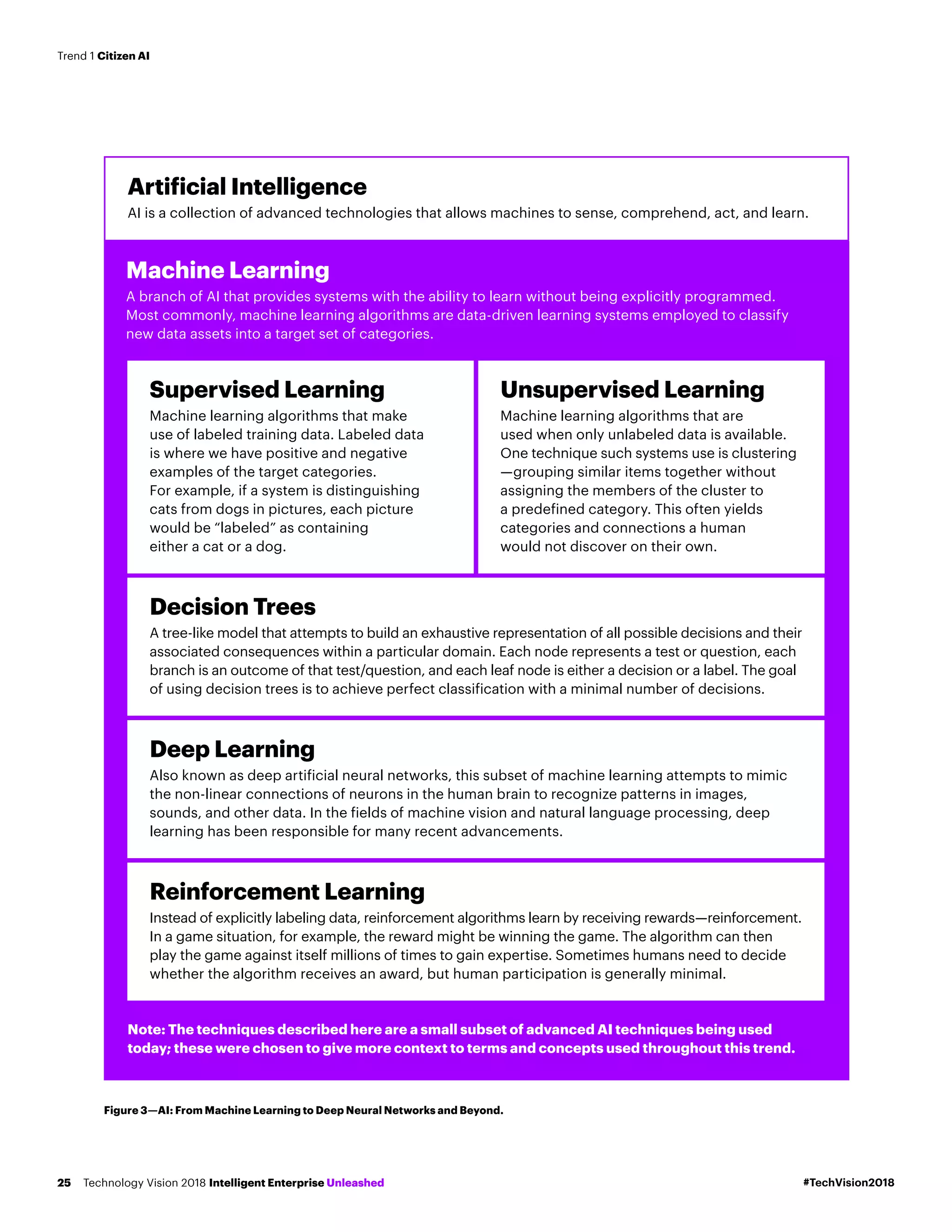
Figure 3­­—AI: From Machine Learning to Deep Neural Networks and Beyond.
Artificial Intelligence
AI is a collection of advanced technologies that allows machines to sense, comprehend, act, and learn.
Machine Learning
A branch of AI that provides systems with the ability to learn without being explicitly programmed.
Most commonly, machine learning algorithms are data-driven learning systems employed to classify
new data assets into a target set of categories.
Supervised Learning
Machine learning algorithms that make
use of labeled training data. Labeled data
is where we have positive and negative
examples of the target categories.
For example, if a system is distinguishing
cats from dogs in pictures, each picture
would be “labeled” as containing
either a cat or a dog.
Unsupervised Learning
Machine learning algorithms that are
used when only unlabeled data is available.
One technique such systems use is clustering
—grouping similar items together without
assigning the members of the cluster to
a predefined category. This often yields
categories and connections a human
would not discover on their own.
Decision Trees
A tree-like model that attempts to build an exhaustive representation of all possible decisions and their
associated consequences within a particular domain. Each node represents a test or question, each
branch is an outcome of that test/question, and each leaf node is either a decision or a label. The goal
of using decision trees is to achieve perfect classification with a minimal number of decisions.
Deep Learning
Also known as deep artificial neural networks, this subset of machine learning attempts to mimic
the non-linear connections of neurons in the human brain to recognize patterns in images,
sounds, and other data. In the fields of machine vision and natural language processing, deep
learning has been responsible for many recent advancements.
Reinforcement Learning
Instead of explicitly labeling data, reinforcement algorithms learn by receiving rewards—reinforcement.
In a game situation, for example, the reward might be winning the game. The algorithm can then
play the game against itself millions of times to gain expertise. Sometimes humans need to decide
whether the algorithm receives an award, but human participation is generally minimal.
Note: The techniques described here are a small subset of advanced AI techniques being used
today; these were chosen to give more context to terms and concepts used throughout this trend.
#TechVision2018Technology Vision 2018 Intelligent Enterprise Unleashed25
Trend 1 Citizen AI
Creating the AI Curriculum
With a successfully trained and raised AI,
a company essentially creates a new worker
—one that can be scaled across operations.
But where to begin? With data—the right
data, and a lot of it.
As children learn to communicate,
they often use symbols and signs before
words—but ultimately, they must achieve
the taxonomy of a language to scale their
understanding of the world. Similarly, a
company’s AI starts from basic principles,
but progressively builds its skills from set
taxonomical structures. The companies
with the best data available to teach
an AI how to do its job will create the
most capable AI systems.
Google recently released an open source
data set that helps companies teach their
AI to understand how people speak. To create
a data set that would adequately prepare an
AI to understand just 30 words in a single
language, Google recorded 65,000 clips of
those words being spoken, from thousands
of different people.8
This is the scale of
training data that has enabled Google’s voice
recognition to reach 95 percent accuracy.9
Companies must also ensure there is an
accepted background of understanding for
the AI and others it will be communicating
with, whether customers and employees,
or other artificially intelligent systems.
A business’s data scientists must use care
when selecting taxonomies and training
data—it’s not just about scale, but about
actively minimizing bias in the data.
Researchers at the University of Virginia
trained an AI on a widely used photo data
set. They discovered that the AI amplified
predictable gender biases found in the
photos—going so far as to categorize a
man standing next to a stove as a woman.10
Companies must also build provenance into
the library of models they are assembling and
sharing—keeping a link between a portable
model and the data used to train the model.
When data inputs are curated to minimize
bias, and well documented, organized,
and properly labeled, companies will build
a strong library of AI models ready for reuse.
#TechVision2018Technology Vision 2018 Intelligent Enterprise Unleashed26
Trend 1 Citizen AI
Explainable AI
In business and society, being able to
explain the process used to arrive at a
decision can be critical. Given that an
AI system is fundamentally designed to
collaborate with people, companies must
build and train their AIs to provide clear
explanations for the actions the AI systems
decide to take, in a format that people
understand. Executives realize this:
88 percent of those we surveyed agree
that it is important for employees and
customers to understand the general
principles used to make AI-based
decisions by their organizations.
Drive PX, NVIDIA's AI-infused self-driving
car platform, can “teach” itself to drive—
but until recently, the way it did so was a
mystery.11
In an effort to improve the system,
NVIDIA engineers prioritized opening the
AI black box, and developed a way to get a
Drive PX vehicle to visually explain its driving
style. The platform does so by displaying a
video of a recently driven streetscape, over
which it then highlights areas that it gave the
most weight to during navigation. In another
example, Capital One is researching ways to
make AI more explainable, hoping to use it to
review credit card applications since banking
regulations require that financial companies
furnish an explanation to customers when
their applications are denied.12
Government policymakers are considering
rules to govern the decision-making aspect
of AIs, too. The spirit of the European Union’s
General Data Protection Regulations, which
take effect in 2018, gives individuals a
“right to explanation” for decisions made
by AIs and other algorithms.13
Responsible AI
Finally, businesses must raise AI systems to
act responsibly. Regardless of the exact role
an AI ends up playing in society, it represents
its company in every action that it takes.
What happens if an AI-powered mortgage
lender denies a loan to a qualified prospective
homebuyer, or if an AI-guided shelf-stocking
robot runs into a worker in a warehouse?
The companies using the technology
must think carefully about apportioning
responsibility and liability for its actions.
Audi has announced that the company will
assume liability for accidents involving its
2019 A8 model when its “Traffic Jam Pilot”
automated system is in use.14
And the German
federal government has adopted ahead-of-
the-curve rules around the way autonomous
cars should act in an unavoidable accident:
the cars must choose material damage over
hurting people, and cannot discriminate
on the basis of gender, age, or race.15
88 percent of
executives agree
that it is important
for employees
and customers
to understand the
general principles
used to make AI-
based decisions by
their organizations.
#TechVision2018Technology Vision 2018 Intelligent Enterprise Unleashed27
Trend 1 Citizen AI
As AI becomes more firmly and widely integrated
into society, it will have direct influence and impact
on everything from financial decisions, to health,
to criminal justice, and beyond.
As these impacts expand, the business
responsibilities around raising an AI will only
grow. The European Parliament is already
considering giving machines or robots
with AI capabilities a limited “e-personality,”
comparable to the “corporate personality”
that is used to assess liabilities or damages.16
Businesses that hesitate to consider their
AIs as something that must be “raised” to
maturity will be left struggling to catch up
with new regulations and public demands
—or worse, have strict regulatory controls
placed upon the entire AI industry for failure
of the group to take responsibility.
Leaders will take on the challenge of raising
an AI in a way that acknowledges its new
roles and impact in society. In doing so,
they’ll set the standards for what it means to
create a responsible, explainable AI system.
Moreover, they’ll build trust with customers
and employees, who are understandably
wary of intelligent but opaque systems
making decisions that directly affect their
lives. Responding to our survey, 72 percent
of executives report that their organizations
seek to gain customer trust and confidence
by being transparent in their AI-based
decisions and actions. This will be a
crucial step in the integration of AI into
society. We call it “Citizen AI.”
PREPARING
FORMORE
Conclusion
of executives report that their
organizations seek to gain
customer trust and confidence
by being transparent in their
AI-based decisions and actions.
72%
#TechVision2018Technology Vision 2018 Intelligent Enterprise Unleashed28
Trend 1 Citizen AI
EXTENDED
REALITY
The End of Distance
Trend 2
#TechVision2018Technology Vision 2018 Intelligent Enterprise Unleashed29
Immersive experiences are changing the way people
connect with information, experiences, and each other.
Through virtual and augmented reality, extended reality
is the first technology to “relocate” people in time and
space—and it’s bringing about the end of distance.
Real estate company Redfin made its name
by embracing technology, so it’s no surprise
that the company has adopted virtual reality
(VR) to sell homes. Powered by technology
from Matterport, Redfin’s 3D, real-world
listings can be “toured” without ever setting
foot on the property.1
Meanwhile, startup
roOomy helps sellers stage homes virtually,
and lets buyers create their own designs
using furniture and décor from retailers
like Wayfair and Pottery Barn, offering
immediate purchases through the roOomy
app.2
For properties under development,
VR startup Virtual Xperience lets builders show
and sell “pre-construction” projects, inviting
potential buyers to experience the completed
space from anywhere­—even if all that exists
today is an empty lot.3
As these virtual sales
techniques take off, the traditional Sunday
open house may soon become a relic.
These and other forays into extended reality
(XR) are solving a tactical pain point that
customers and businesses share: distance.
Companies across industries, and even entire
industries, have been built around the most
basic and intractable principle of “needed
here, but exists there.” This challenge impacts
everyone, from people with busy schedules
trying to buy groceries, to companies
struggling with talent shortages because
the locally available skills don’t match their
needs. Results from our Technology Vision
2018 survey show 36 percent of executives
identify removing distance barriers as
a driver in their adoption of XR solutions.
Companies are increasingly turning to XR
as a new way to address problems around
distance. Immersive experience provider
Matterport experienced a 186 percent
compound annual growth rate (CAGR) from
2014 to 2016; similarly, VR education-focused
firm zSpace saw a 128 percent CAGR during
this timeframe.4,5
This early growth portends
a much larger impact for these technologies.
From VR real estate to virtualized education,
the fundamental changes to the enterprise
and society are clear: the importance of place
is disappearing. XR is removing the hurdle
of distance, increasing access to people,
information, and experiences.
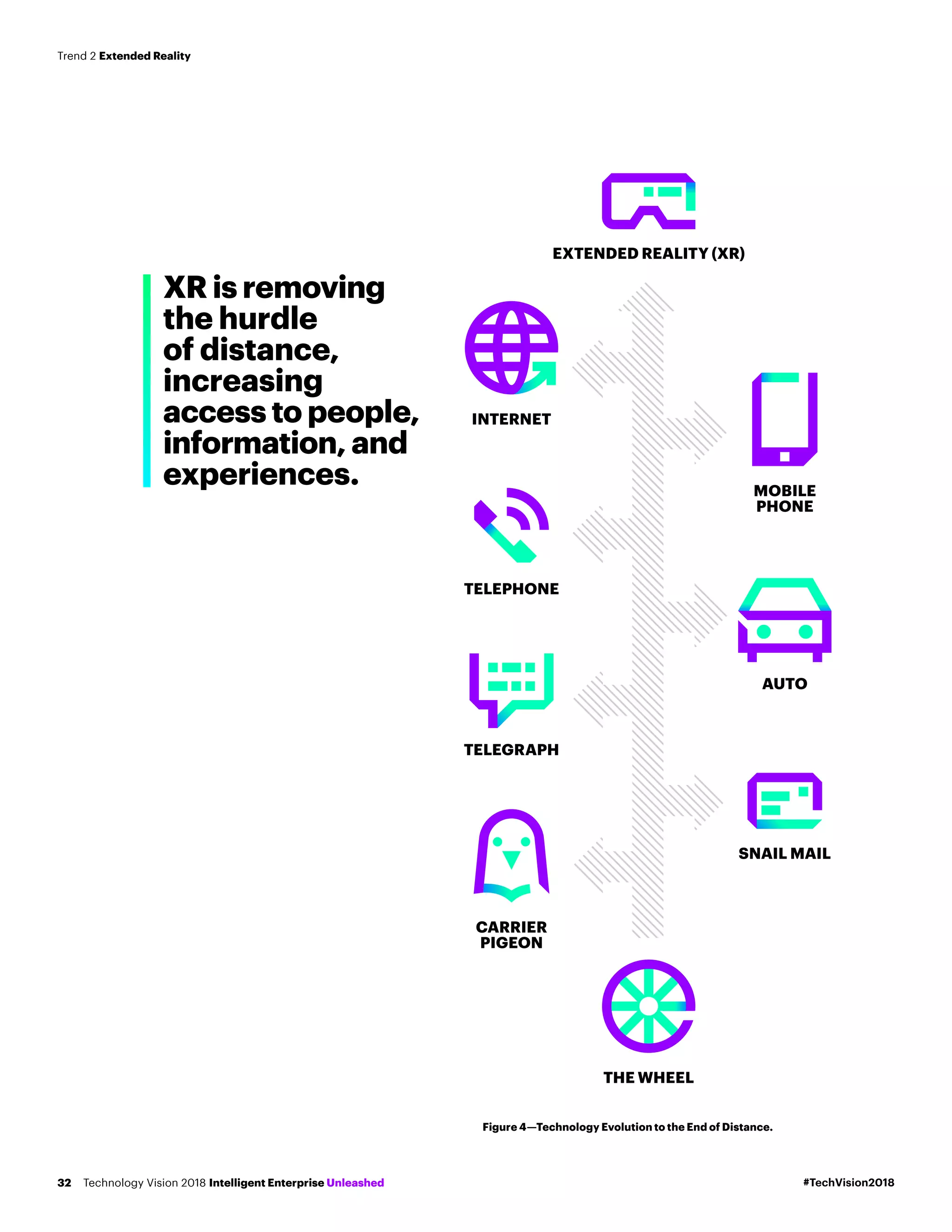
(See Figure 4, page 34.)
#TechVision2018Technology Vision 2018 Intelligent Enterprise Unleashed30
Trend 2 Extended Reality
FOR SALE
Virtual
Reality (VR)
VR visually takes the
user out of their real-world
environment and into a
virtual environment, typically
using a headset for viewing
coupled with hand-held
controllers to navigate
the virtual space.
Augmented
Reality (AR)
AR overlays digital
objects (information,
graphics, sounds) on
the real world, allowing
the user to experience
the relationship between
digital and physical worlds.
Extended
Reality (XR)
XR refers to the spectrum
of experiences that blurs the
line between the real world
and the simulated world.
The technology immerses the
user through visuals, audio,
and potentially olfactory and
haptic cues. The two major
types of XR are virtual reality
and augmented reality.
#TechVision2018Technology Vision 2018 Intelligent Enterprise Unleashed31
Trend 2 Extended Reality
Figure 4­­—Technology Evolution to the End of Distance.
XR is removing
the hurdle
of distance,
increasing
access to people,
information, and
experiences.
EXTENDED REALITY (XR)
THE WHEEL
MOBILE
PHONE
AUTO
SNAIL MAIL
INTERNET
TELEPHONE
TELEGRAPH
CARRIER
PIGEON
#TechVision2018Technology Vision 2018 Intelligent Enterprise Unleashed32
Trend 2 Extended Reality
Distance to People
Companies are already using XR to
erase the distance between people. With
immersive environments making it possible
for employees to “be” anywhere, XR-based
solutions and innovations are growing across
the workforce and throughout customer-
facing products and services.
Following years of relative stagnation,
the corporate training industry is expected
to grow at 10 percent CAGR from 2017
through 2020.6
Its growth is driven by the
need to train or reskill increasingly distributed
and far-flung workers for a decidedly digital
future, making employee training ripe for
transformation with XR. Companies can
bring trainers “offsite” from anywhere,
or have students virtually “travel” to an
instructor; training scenarios can be set up
anywhere, then run, re-run, and adjusted
to give a firsthand experience of different
situations. XR eliminates the distance
not just between student and teacher,
but also concept and practice.
By placing people directly into whatever
setting that trainers can dream up, XR delivers
firsthand experience with challenging or
potentially dangerous situations without
real-world risk. Walmart used VR to prepare
store managers for the chaos of Black
Friday, America’s biggest shopping day.7
And Komatsu, a heavy machine manufacturer,
has expanded its value proposition by
offering virtual training for heavy equipment
operators, in any location and regardless
of weather conditions.8
With VR, Komatsu’s
customers can ensure that its operators get
the “seat time” needed to learn, without
putting them—or multi-million-dollar
excavating equipment—at risk.
XR will also help businesses address
the largest workforce challenge they face:
the distance between themselves and the
talent they need to grow. The technology
supports an on-demand workforce approach,
which not only saves in recruitment costs,
but also helps businesses engage an
ever-growing pool of talent who desires
flexibility. Through immersive experiences,
businesses can tap expertise in thousands
of skills from anywhere in the world.
What’s more, as XR-based remote
control of physical systems becomes
common, companies will be able to hire
for manufacturing, assembly, and robotics
expertise from a global pool of the best
candidates, regardless of where they live.
The result is an opportunity to redesign
business without the limiting factor of
distance­—and for workers, to eliminate
geography-based constraints on opportunity.
Revolutionized workforce training and
expanded access to expertise are just the
beginning of what XR can accomplish for
business, and they’re actionable—and
immediately beneficial—options for the
enterprise today. Embracing immersive
technologies for training benefits companies,
from the recruiting process, to enhancing
the skills of long-time employees. In the
fight for the best talent, XR delivers
a powerful advantage.
#TechVision2018Technology Vision 2018 Intelligent Enterprise Unleashed33
Trend 2 Extended Reality
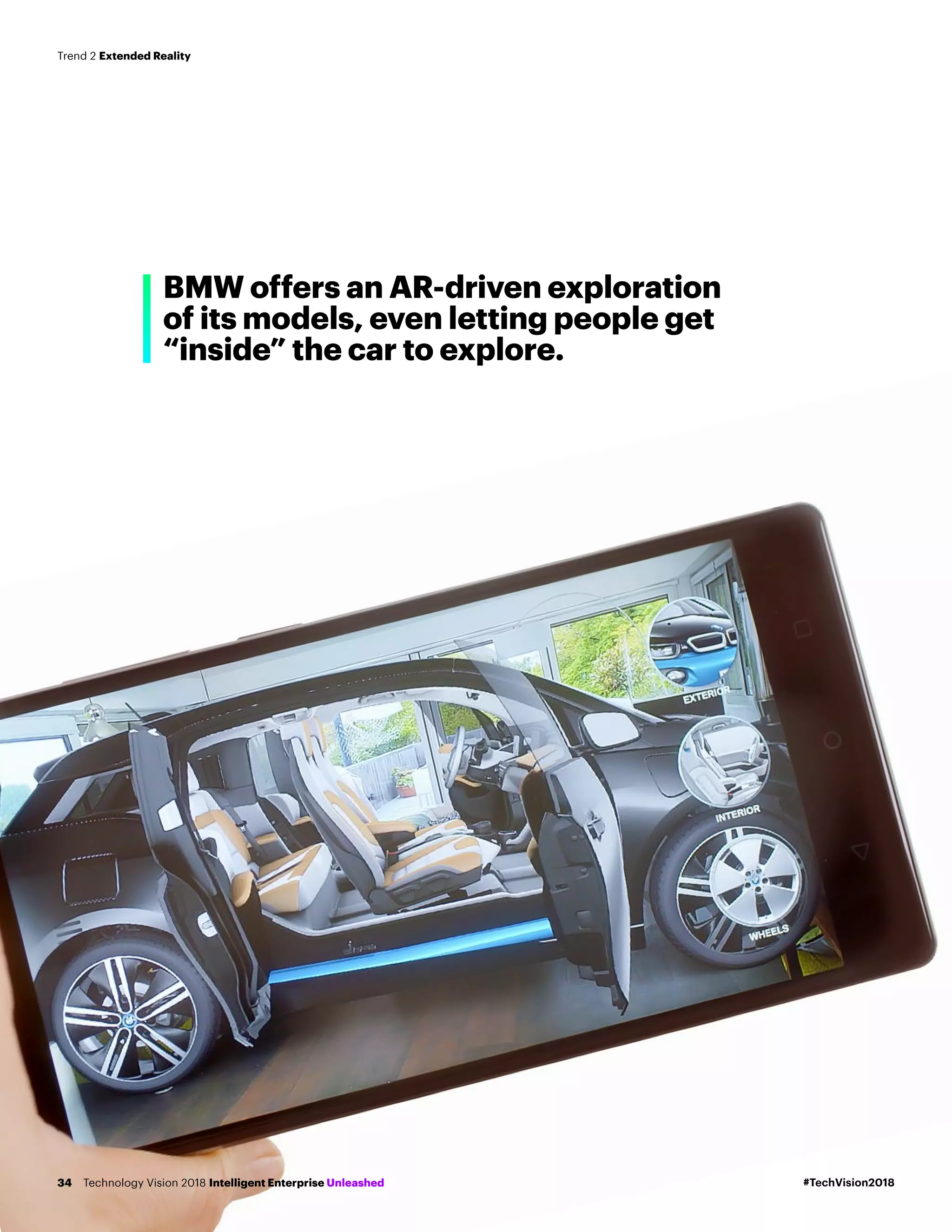
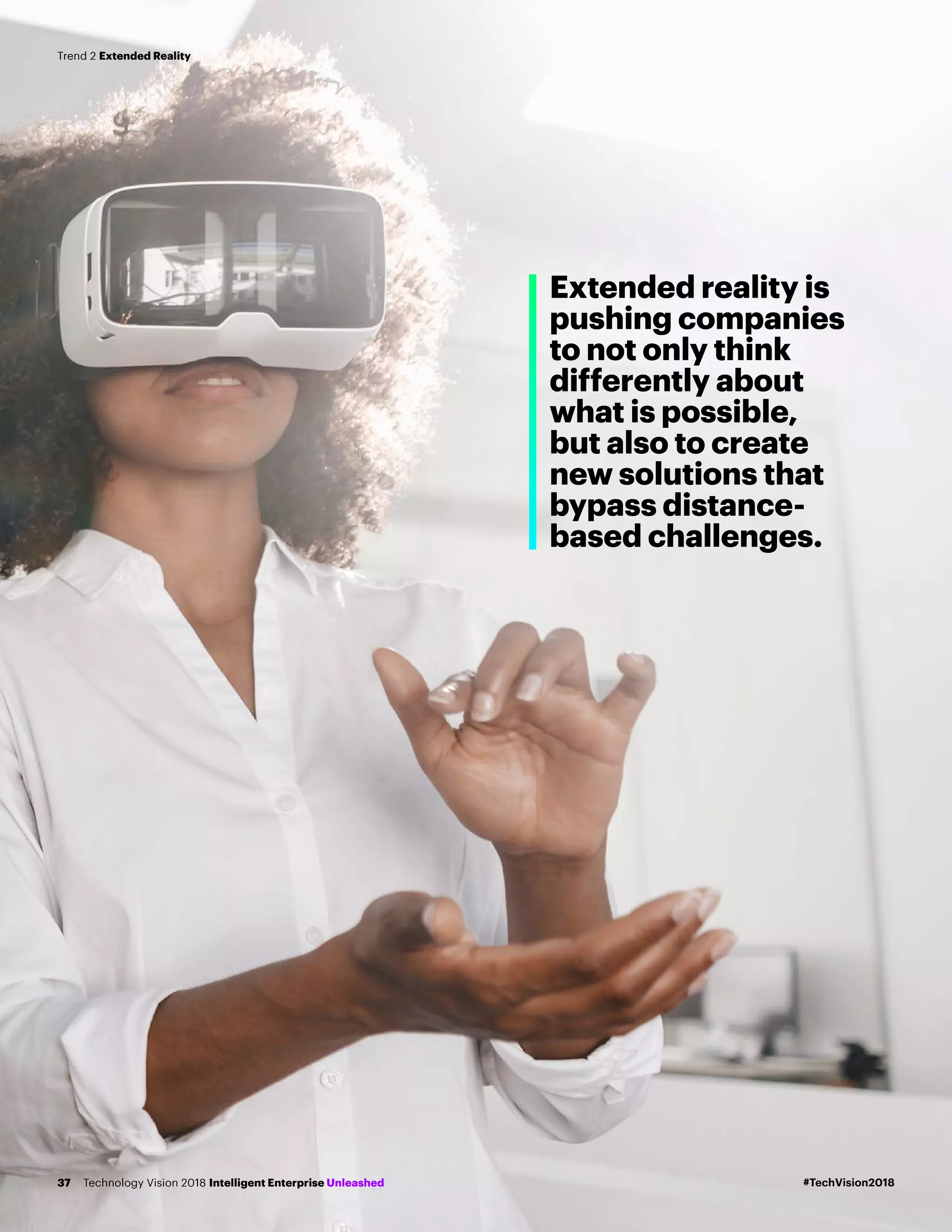
BMW offers an AR-driven exploration
of its models, even letting people get
“inside” the car to explore.
#TechVision2018Technology Vision 2018 Intelligent Enterprise Unleashed34
Trend 2 Extended Reality
Distance to Information
One of the greatest limitations in getting
work done is access to information. Whatever
material is not already stored in a worker’s
head must be pulled from a spreadsheet,
a tutorial video, or a variety of other sources
that drain a person’s attention, and siphon
time and resources from the task at hand.
XR is helping to eliminate the distance
between employees and the information
they need to get work done. On factory
floors, it’s reducing the need for written
instructions: GE Renewable Energy is using
AR to deliver assembly information, improving
worker productivity in wiring wind turbines
by 34 percent.9
DHL Supply Chain uses AR
glasses in its operations to provide visual
displays of order picking and placement
direction, freeing operators’ hands of
paper instructions and allowing them to
work more efficiently and comfortably.10
By incorporating these XR solutions,
DHL has averaged 15 percent productivity
improvements while achieving higher
accuracy rates. And L’Oréal’s Beauty Lab
cut down the launch time of products
from months to weeks by testing design,
branding, and packaging in VR, speeding
decision-making and reducing risks.11
Consumers are also making purchase
decisions from information delivered via XR
technologies. Audi uses VR to let prospective
customers design and tour their own custom
vehicle, while BMW offers an AR-driven
exploration of its models, even letting people
get “inside” the car to explore.12,13
Houzz,
a home remodeling and design company,
introduced an AR-based application that
lets customers “place” real products within
their homes, and found that people who
used it were 11 times more likely to make
a purchase.14
With rich detail so easily
accessible, companies must prepare
for a more informed customer, providing
ways to eliminate decision barriers.
Finally, XR is not only closing the distance
to information, but also the distance to new
insights. Emerging XR tools express data in
3D environments, closer to the way humans
actually see and imagine scenarios. This clears
the way for new types of visualizations—
and new discoveries. The Body VR creates
interactive 3D builds of traditionally 2D
medical imaging, like CT scans and MRIs,
to provide a more intuitive view of medical
conditions.15
Similarly, Oxford researchers
have created VR models of genetic data to
better visualize what happens within living
cells.16
XR is not just changing access to
information, but also the viewer’s relationship
to the information: how people parse,
communicate, and extract value from data.
#TechVision2018Technology Vision 2018 Intelligent Enterprise Unleashed35
Trend 2 Extended Reality
Distance to Experiences
Perhaps the greatest potential for XR-based
disruption is through delivering experiences
as a service, supporting the shift in consumer
preferences away from material goods.
Over the last 15 years, spending on durable
goods like vehicles and furniture as a
percentage of personal consumption in the
US has dropped, even as overall spending
has doubled.17
Yet spending on experiences,
like recreation and travel, has been on the
upswing for more than a decade.
Businesses are finding a competitive edge
with the design of memorable customer
experiences. The Baltimore Ravens are
the first National Football League team
to enable AR-driven “virtual face painting,”
letting fans customize and easily share their
Ravens experience.18
The Denver Museum
of Nature and Science uses AR to fuse
digital and prehistoric worlds, resulting
in an interactive anatomy lesson where
museum-goers can place skin and muscles
on dinosaur fossils.19
Even restaurants are
reinventing the dining experience, with
holographic top-of-table projections and
VR tours for unforgettable experiences
and entertainment between courses.20,21
Public spaces are also being transformed
with immersive experiences: Alamo Plaza
in San Antonio, Texas, is developing an
AR/VR “future of history” storytelling
experience through a free app, giving
Alamo visitors a new way to learn about the
fort’s past.22
And XR has also demonstrated
value in unlearning: researchers have seen
compelling results using VR therapy to
address post-traumatic stress disorder in
military veterans, letting patients confront
triggering stressors while talking through
their responses with therapists in real time.23
Across industries and applications,
XR is pushing companies to not only think
differently about what is possible, but also
to create new solutions that bypass many
of the distance-based challenges they
face today—a clear advantage for leading
companies that embrace it.
#TechVision2018Technology Vision 2018 Intelligent Enterprise Unleashed36
Trend 2 Extended Reality
Extended reality is
pushing companies
to not only think
differently about
what is possible,
but also to create
new solutions that
bypass distance-
based challenges.
#TechVision2018Technology Vision 2018 Intelligent Enterprise Unleashed37
Trend 2 Extended Reality
FROMHERETO
EVERYWHERE
Conclusion
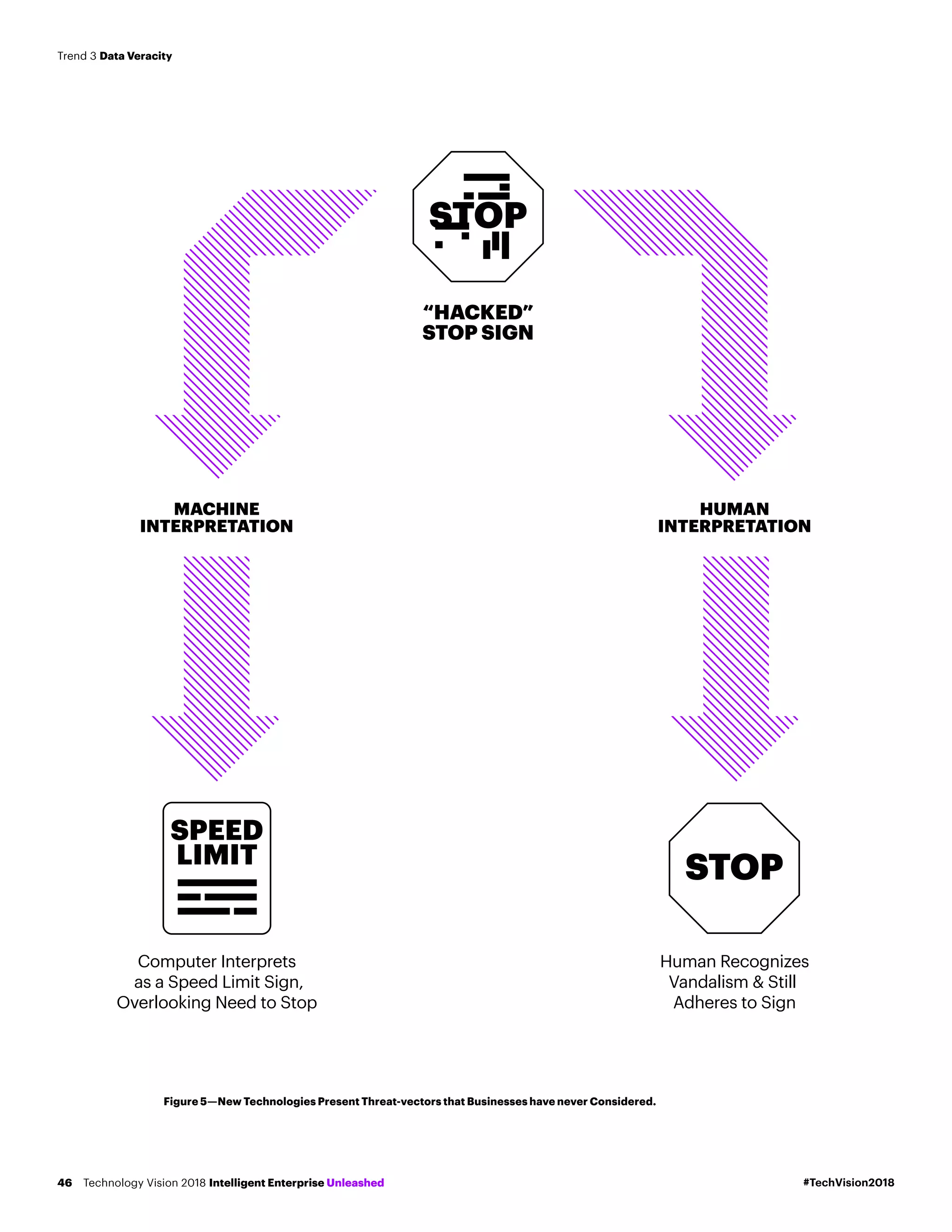
Throughout history, technologies have evolved to
minimize distance—from the wheel to the Internet,
technology closes the gap. As XR technology makes
immersive experiences commonplace, it solves for
distance, minimizing its relevance.
Today, XR is still evolving, and challenges
around processing lag and content creation
remain barriers to its full maturity. Despite
this, our survey indicates that 27 percent of
executives state it is very important for their
organizations to be a pioneer in XR solutions.
As today’s technical limitations are addressed,
XR will only grow in capability and impact.
To prepare for a world where the most powerful
experiences might be virtual, businesses
must focus on tactical uses of it today.
Making well-planned forays into immersive
experiences now will help build the
capabilities needed to transform entire
industries tomorrow. Today, real estate
is experimenting with virtual home tours;
soon, XR will transform what developers
build to include optimizations for remote
work, enabling people to do their jobs
from anywhere. In the distant future, they’ll
integrate features that let people dynamically
change rooms from an office environment at
one moment, to a retail store for shopping
the next, without physically moving an inch.
As XR becomes pervasive, immersive
experiences will eliminate the most important
distance of all: the distance between where
businesses are today and where they want
to be in the future.
of executives state it is very
important for their organizations
to be a pioneer in XR solutions.
27%
#TechVision2018Technology Vision 2018 Intelligent Enterprise Unleashed38
Trend 2 Extended Reality
DATA
VERACITY
The Importance of Trust
Trend 3
#TechVision2018Technology Vision 2018 Intelligent Enterprise Unleashed39
Business is more data driven than ever, but inaccurate
and manipulated information threatens to compromise
the insights that companies rely on to plan, operate,
and grow. Unverified data is a new type of vulnerability—
one that every business leveraging digital technologies
must address. Left unchecked, with autonomous, data-
driven decision-making increasing across industries,
the potential harm from bad data becomes an
enterprise-level existential threat.
Thirty-five years ago, Soviet watch officer
Stanislav Petrov jumped out of his chair.1
According to the satellite system he
was monitoring on September 26, 1983,
the United States had launched a nuclear
missile at the Soviet Union. Protocol dictated
that Petrov notify Soviet leaders, who would
order an immediate counterattack.2
Fortunately for the world, Petrov wasn’t
convinced that the alerts were true. He didn’t
notify his superiors, thereby preventing a
global catastrophe. In making his decision,
Petrov considered the satellite system’s
warning data within its larger context. At the
time, experts agreed that the scale of any
preemptive attack from the United States
would be massive, with additional bomber and
attack support. With no other alerts to show
such attacks were underway, Petrov knew that
the data the system was showing didn’t match
what was expected. That, combined with
his understanding of the risks if he followed
protocol, informed his ultimate decision.
The Soviets later determined that their satellites
had confused the reflection of sunlight off
clouds for a missile launch. By questioning
the validity of data, Stanislav Petrov had
saved the world from nuclear disaster.
Businesses may not make decisions
about launching nuclear missiles. However,
82 percent of executives responding to our
Technology Vision survey report that their
organizations are increasingly using data
to drive critical and automated decision-
making, at unprecedented scale. Today,
the global economy runs on live information:
IDC forecasted global revenues of nearly
$151 billion for big data and analytics practices
in 2017, up 12 percent from the year before.3
Without establishing the veracity, or accuracy,
of that data, businesses leave themselves open
to a new kind of vulnerability—a threat that’s
critically overlooked. A recent study estimated
that 97 percent of business decisions are
made using data that the company’s own
managers consider of unacceptable quality.4
The result? Business insights and decisions
that are of questionable value at best, and
corrupted at worst.
#TechVision2018Technology Vision 2018 Intelligent Enterprise Unleashed40
Trend 3 Data Veracity
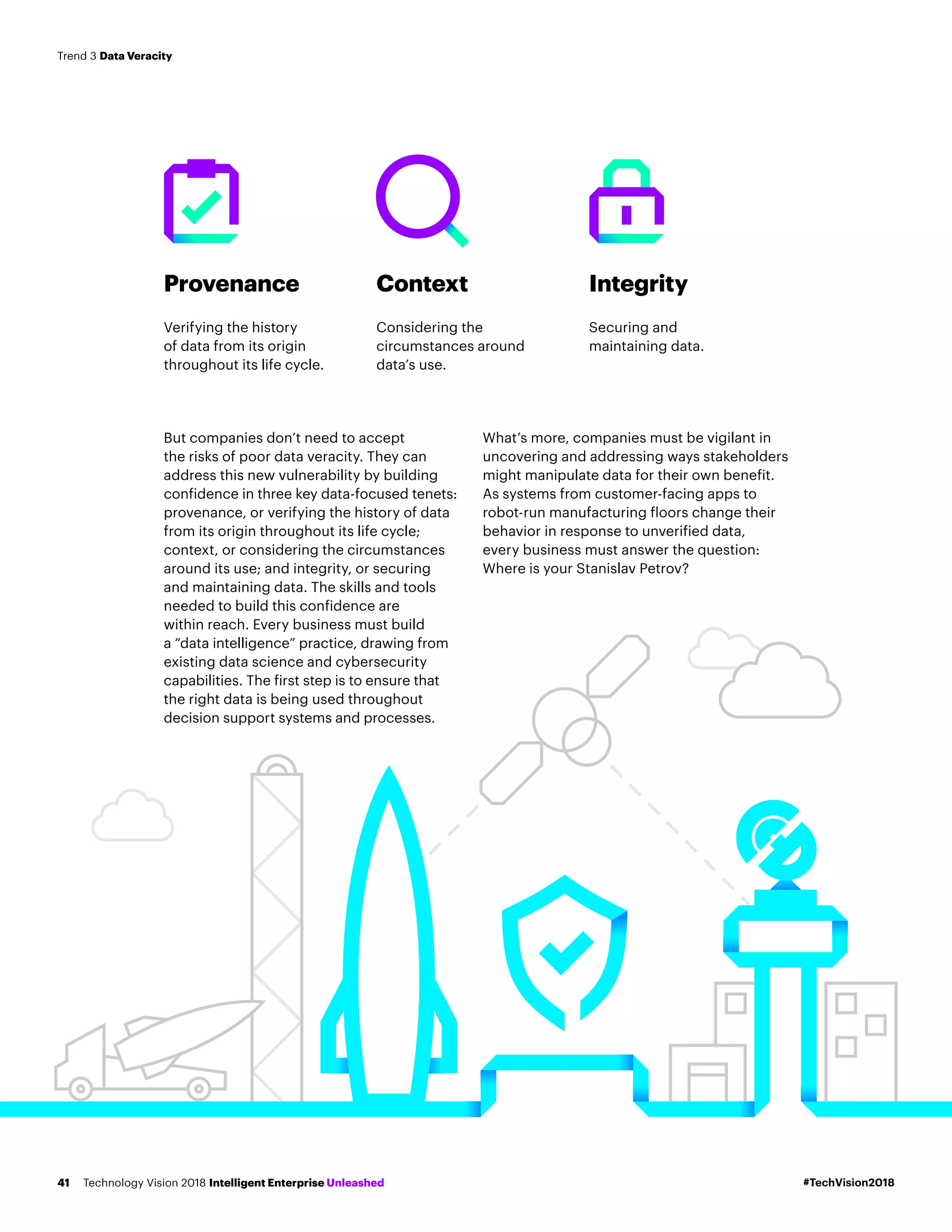
But companies don’t need to accept
the risks of poor data veracity. They can
address this new vulnerability by building
confidence in three key data-focused tenets:
provenance, or verifying the history of data
from its origin throughout its life cycle;
context, or considering the circumstances
around its use; and integrity, or securing
and maintaining data. The skills and tools
needed to build this confidence are
within reach. Every business must build
a “data intelligence” practice, drawing from
existing data science and cybersecurity
capabilities. The first step is to ensure that
the right data is being used throughout
decision support systems and processes.
What’s more, companies must be vigilant in
uncovering and addressing ways stakeholders
might manipulate data for their own benefit.
As systems from customer-facing apps to
robot-run manufacturing floors change their
behavior in response to unverified data,
every business must answer the question:
Where is your Stanislav Petrov?
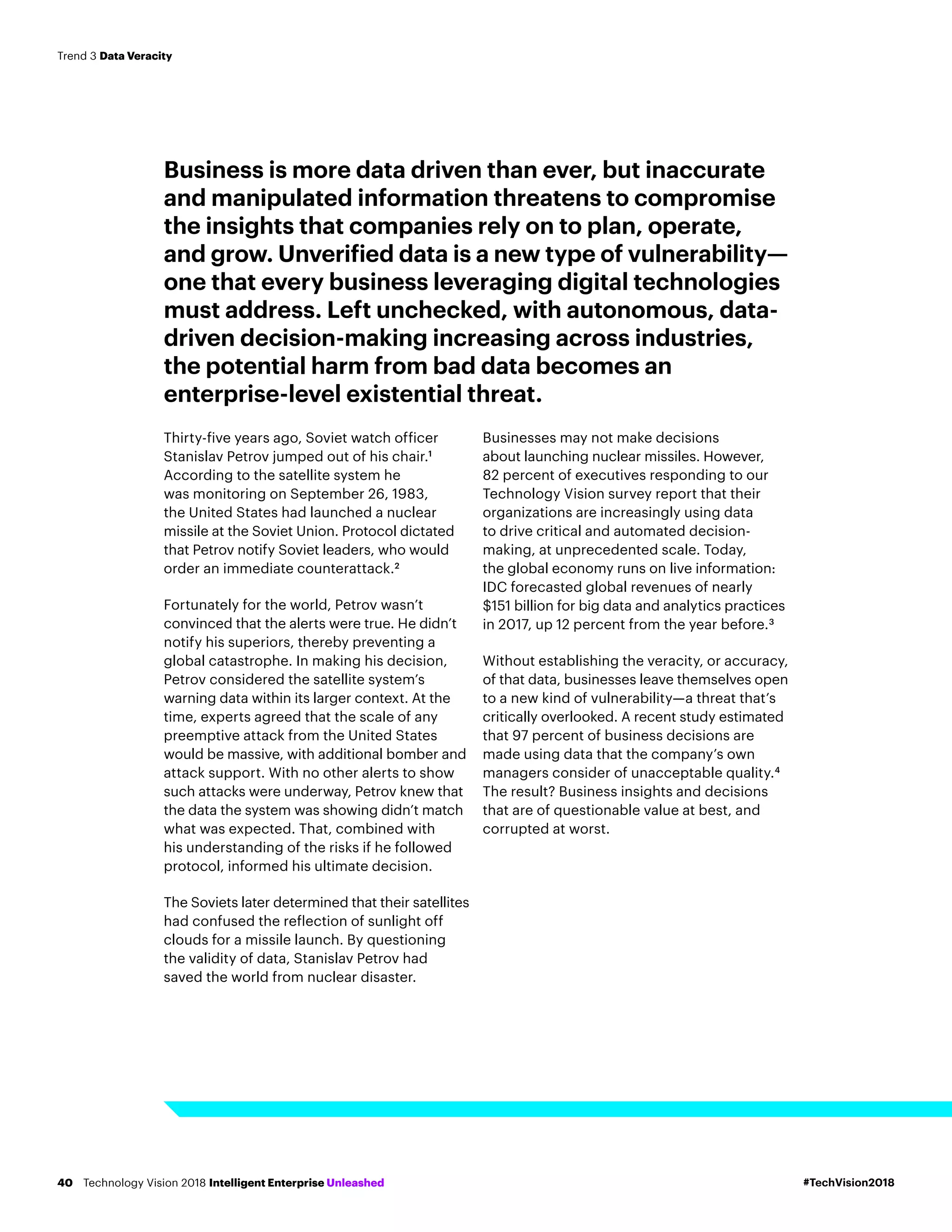
Provenance
Verifying the history
of data from its origin
throughout its life cycle.
Context
Considering the
circumstances around
data’s use.
Integrity
Securing and
maintaining data.
#TechVision2018Technology Vision 2018 Intelligent Enterprise Unleashed41
Trend 3 Data Veracity
Risks and Rewards of Data Veracity
Companies around the world are betting
big on advances in data-hungry technologies.
In 2017 alone, AI investments were projected
to reach $12.5 billion, while Internet of
Things investments were expected to
top $800 billion.5,6
Yet without an accompanying push for
data veracity, these investments could
easily become a sucker’s bet. Businesses
are spending heavily to determine what
they can get out of data-driven insights and
technologies, but they also need to invest
in what’s going into them. Even the most
advanced analytics and forecasting system is
only as good as the data it’s given to crunch:
as the saying goes, “garbage in, garbage out.”
United Airlines realized that inaccurate data
was contributing to $1 billion a year in missed
revenue. Its seating demand forecasts were
based on decades-old assumptions about
flying habits, resulting in inaccurate pricing
models.7
The airline highlighted this and other
data-driven inaccuracies as key targets for
improving operational performance. In an
increasingly data-driven world, addressing
these risks today will help United ensure that
the data underpinning its revenue can be
trusted in the future.
The risks around poor data veracity grow
as more organizations push toward fully
autonomous decision-making, with critical
implications for business and society. The US
state of Indiana uses an automated system
to flag individuals who may be registered
to vote in more than one state.8
It looks at
shared names and birthdates: if it finds a
“John Smith” born on the same day and year
who is registered in both Indiana and Maine,
it marks that record as potentially fraudulent.
Prior to 2017, these records were submitted
for additional review; however, following
legislative changes, the system immediately
removed flagged individuals from registered
voter rolls. With this process, the automated
system amplifies data veracity risks:
researchers have found that it generates
inaccurate fraud alerts 99 percent of the
time.9
The damaging result? The automated
removal of legally registered voters, some
of whom were simply unlucky enough
to have a very common name.
According to our survey, 79 percent
of executives agree that organizations
are basing their most critical systems
and strategies on data, yet many have not
invested in the capabilities to verify the
truth within it. By making these investments,
companies will generate more value from
their data, and build a strong foundation
for the success of other digital
transformation initiatives.
The new “data intelligence” practice will
make this possible. Its job will be to grade
the truth within data, by establishing,
implementing, and enforcing standards
for data provenance, context, and integrity.
#TechVision2018Technology Vision 2018 Intelligent Enterprise Unleashed42
Trend 3 Data Veracity
Creating a Data Intelligence Practice
Businesses don’t have to start from scratch
to grade the veracity of their data. Some of
the most foundational elements of a data
intelligence practice revolve around ramping
up existing efforts: embedding and enforcing
data integrity and security throughout
the organization, while adapting existing
investments in cybersecurity and data
science to address data veracity issues.
The basics, however, will only take companies
part of the way. Grading data will also require
developing an understanding of the “behavior”
around it. Whether it’s a person creating a
data trail by shopping online, or a sensor
network reporting temperature readings for
an industrial system, there’s an associated
behavior around all data origination.
Companies must build the capability to
track this behavior as data is recorded, used,
and maintained. With this understanding,
they can provide cybersecurity and risk
management systems with a baseline
of expected behavior around data.
These baselines will empower companies
to detect data tampering that predicates
poor decisions. Cutting-edge anomaly
detection systems like MIT’s AI2 identify
abnormal patterns of behavior, then
categorize them based on experience
provided by human experts. AI2 detects
85 percent of cyber-attacks, and presents
the most pressing incidents to experts
for review.10
Industrial giant Siemens is
offering anomalous behavior detection for
industrial systems to oil and gas customers,
by comparing aggregate data generated from
sensors onboard its industrial equipment
with historical norms and trends.11
To mitigate risks around data veracity, SpaceX
uses a consensus-based system: each Dragon
Capsule uses six computers, operating in
pairs, to validate calculations.12
Each pair
checks its calculations against the others’,
and the spacecraft only proceeds when
at least two pairs return the same result.13
A company’s data intelligence practice must
also consider given data within available
context—the way Petrov responded when
he realized that the attack alert didn’t fit with
accepted knowledge. Some companies are
beginning to use data science capabilities
to flag data that deviates from a known
broader context. An R&D group at Thomson
Reuters has developed an algorithm that uses
streams of real-time data from Twitter to
help journalists classify, source, fact-check,
and debunk rumors faster than before.14
Meanwhile, Google is using machine
learning to remove apps with overreaching
permissions from its Play Store. For example,
a flashlight app only needs to activate a
smartphone’s LED; if a purported flashlight
app also requests access to a person’s
contacts, it wouldn’t match the accepted
“knowledge” around the permissions needed
for a flashlight. The system could then mark
the app for further review.15
Using the right tools to monitor behavior
and context around data’s provenance will
help businesses mitigate risks that threaten
data integrity. With this knowledge in hand,
companies can begin to address issues that
might be incentivizing deceit in the first place.
#TechVision2018Technology Vision 2018 Intelligent Enterprise Unleashed43
Trend 3 Data Veracity
Incentivize the Truth
Understanding anomalous behavior will help
companies address the threat of false data
driving faulty decisions. But a data intelligence
practice must also be charged with uncovering
and addressing the factors contributing to
the creation of false data in the first place.
It’s an uncomfortable realization, but if a
business depends on data collection, they are
potentially incentivizing data manipulation.
Individual instances of manipulated data
may have minimal impact, but a bevy of
deceptions can skew business outcomes.
Researchers at the University of Warwick
have studied the way some rideshare drivers
organize simultaneous sign-offs to cause
a shortage of drivers, and trigger surge
pricing.16
Knowing that they’re participating
in systems managed by algorithms, these
drivers are trying to make the system
work in their favor—at the expense of
the ridershare company's efficiency.
Dynamic pricing algorithms, and consumer
reactions to them, also demonstrate the
growing need for companies to understand
motives for disclosing—or disguising—data.
Online retailers spend hundreds of billions
of dollars each year to advertise and price
items online to different segments of people,
based on zip code or household income.17,18
Yet this practice sometimes conflicts with
consumer preferences toward privacy.
If a large percentage of people attempt to
trick these algorithms—or perhaps more
likely, do so unknowingly while trying to
protect their privacy online—businesses
will not only lose money, but also collect
inaccurate data about their customers.
The end result: more distorted insights.
Already, online shoppers can install browser
extensions like TrackMeNot or AdNauseam to
generate random queries in the background,
or robo-click on ads. These tools obscure a
person’s real search history and misdirect ad
networks.19
On Amazon, product reviews also
became subject to data manipulation: third-
party sellers were paying people to submit
fake reviews to artificially inflate their product
and seller ratings.20
In this case, Amazon
responded by giving more weight to verified
reviews from customers who had definitively
purchased the item from Amazon. They also
established an invitation-only incentivized
review program, banning reviews from people
who received free or discounted products
outside the program’s curated process.21
These efforts reduced the incentive to
generate fake reviews on the site.
The presence of bad data in a system isn’t
always the result of malicious intent, but may
be a sign that a process isn’t working the way
it was intended. Uncovering processes that
inadvertently incentivize deceit is a key step
to improving the truth in data across a system.
Incentivizing truth will allow companies to
reduce noise in data, so that real threats
stand out. Ultimately, it will help ensure the
data is trustworthy enough to drive critical
decisions in the future.
The presence
of bad data in
a system isn’t
always the result
of malicious
intent, but may
be a sign that
a process isn’t
working the way
it was intended.
#TechVision2018Technology Vision 2018 Intelligent Enterprise Unleashed44
Trend 3 Data Veracity
CONFIDENCE
FORTHEFUTURE
Conclusion
Data is the lifeblood for digital companies, fueling
complex business decisions that drive sustained growth.
Ensuring the veracity of this data, then, becomes
a cornerstone of strong leadership.
Failure to do so can have grave
consequences—especially as companies
invest heavily in autonomous data-driven
systems. Already, researchers have
developed techniques that cause
machine vision systems from mistaking
stop signs for other road indicators, like
speed limit signs (see Figure 5, page 48);
such systems are used in autonomous
vehicles, where fraudulent data like this
could cause accidents.22
And as AI is used
to make more business-critical decisions,
biased data becomes a larger threat,
skewing decisions and corrupting
business insights.
Strong cybersecurity and data science
capabilities are prerequisites for building
a data intelligence practice to ensure data
veracity. Among other things, this group
will determine the embedded risks across
a portfolio of data supply chains, and set
standards for how much risk is acceptable
based on business priorities and implications
of automated decisions. As such, the data
intelligence practice should report up to the
Chief Digital Officer, and collaborate closely
with the Chief Information Security Officer.
Organizing in this way, with a dual mandate
to maximize veracity and minimize incentives
for data manipulation, will support a business
that can be confident in its insights, and alert
to new potential threats. Now, every company
has a new challenge: ensuring truth in the
data that powers its enterprise.
#TechVision2018Technology Vision 2018 Intelligent Enterprise Unleashed45
Trend 3 Data Veracity
“HACKED”
STOP SIGN
HUMAN
INTERPRETATION
MACHINE
INTERPRETATION
Computer Interprets
as a Speed Limit Sign,
Overlooking Need to Stop
Human Recognizes
Vandalism & Still
Adheres to Sign
STOP
STOP
SPEED
LIMIT
Figure 5­—New Technologies Present Threat-vectors that Businesses have never Considered.
#TechVision2018Technology Vision 2018 Intelligent Enterprise Unleashed46
Trend 3 Data Veracity
FRICTIONLESS
BUSINESS
Built to Partner at Scale
Trend 4
#TechVision2018Technology Vision 2018 Intelligent Enterprise Unleashed47
Companies compete through strategic partnerships,
and when these partnerships are technology-based,
they can expand partner networks faster and into more
ecosystems than ever before. But legacy business
systems weren’t built to support this kind of expansion,
and soon, outdated systems will be major hindrances
to growth. Businesses must adopt microservices
architectures, and use blockchain and smart contracts
to build a strong foundation for technology-based
partnerships. Those that invest in these changes today
will redefine how businesses transact in the future.
Today’s business partnerships are based
not only on strategy, products, and services,
but also on the merging of technology.
GE and Microsoft have integrated their
Predix and Azure platforms; SAP, Hitachi,
and JPMorgan Chase & Co.are developing
blockchain solutions as part of the Hyperledger
consortium;Ford and Lyft have made a
joint commitment to developing a fleet of
self-driving taxis by 2021.1,2,3
The collaborative
efforts of industry leaders worldwide show that
technology is now at the root of partnerships.
What’s more, extensive partnership building
is becoming key to success. Take the
competition playing out between shoe and
apparel companies. In 2017, Nike announced
a strategic partnership with Amazon, and
simultaneously became one of the first
companies to have its products sold through
Instagram—a tacit acknowledgement that
these ecosystems offer valuable inroads
to customers vital for Nike’s growth.4,5
On the manufacturing side, Adidas is
partnering with Siemens for its engineering
experience and software to build what
the shoemaker calls a “speedfactory”—
an automated manufacturing plant that can
create customized shoes at faster speeds
and lower costs than traditional methods.6,7,8
And Under Armour is working with IBM’s
Watson Analytics to improve the utility of
data generated by the athletic company’s
suite of apps and connected devices,
delivering a customer experience that
goes far beyond the shoes on their feet.9,10
#TechVision2018Technology Vision 2018 Intelligent Enterprise Unleashed48
Trend 4 Frictionless Business
Businesses must adopt
microservices architectures,
and use blockchain and smart
contracts to build a strong
foundation for technology-
based partnerships.
#TechVision2018Technology Vision 2018 Intelligent Enterprise Unleashed49
Trend 4 Frictionless Business
Expanding Beyond Legacy
Gaining an advantage over the competition means forging strong and plentiful
partnerships, built and maintained through technology. Already, our survey shows
36 percent of businesses report working with double or more partners than they
were two years ago. But it’s critical for business leaders to recognize that their
organization’s own technology will serve as the foundation for these strategic
relationships—and could also be holding them back.
The key problem facing enterprises: legacy systems that weren’t built to support
technology-based partnerships. These systems were built in silos, intended to
only operate within the business, with the assumption that change would be slow
and steady. Now, as companies expand their networks, engage in ecosystems,
and shift rapidly between them, outdated systems that can’t keep pace will be
the biggest barrier to growth.
Two technologies will play key roles in overcoming these challenges: microservices
and blockchain. Internally, each company’s technology architecture must evolve to
one that supports partnerships at scale; a microservices approach will foster agility
as applications become more modular, enabling rapid integration with many new
partners. Externally, as each company’s portfolio of partnerships grows, the scale
of connections will require reimagining the way the business transacts with others.
Blockchain will play a key role in creating, scaling, and managing those relationships
through its ability to hold partners accountable without the need to first build trust.
Technology-based partnerships are the strategic ambition of every business,
but leaders must act now to adopt the tools to empower them. In doing so,
they’ll unleash the enterprise across the economy, and redefine the way
relationships are forged for those that follow.
of businesses report working
with double or more partners
than they were two years ago.
36%
#TechVision2018Technology Vision 2018 Intelligent Enterprise Unleashed50
Trend 4 Frictionless Business
The key problem
facing enterprises:
legacy systems that
weren’t built to support
technology-based
partnerships.
#TechVision2018Technology Vision 2018 Intelligent Enterprise Unleashed51
Trend 4 Frictionless Business
Change Starts at Home
To spur a new wave of technology-based
partnerships, companies must start inside
their own walls. Microservices is not a single
piece of technology, but rather an approach
to architecture. It uses a suite of tools like
application programming interfaces (APIs),
containers, and cloud to break applications
into simple, discrete services.
Microservices delivers internal benefits
like application scalability and reliability,
but it is also vital for building technology
partnerships. A microservices architecture
provides a foundation for companies to forge
partnerships quickly and easily, seamlessly
integrating services, without hindering
partners or customers.
Consider the US pharmacy, Walgreens.
The company rebuilt their “healthy choice”
rewards program with a goal of expanding
partnerships via microservices.11
The APIs
built during their microservices transformation
were shared with third-party developers, who
could integrate Walgreens’ rewards into their
own apps, offering points to customers for
activities like running, testing blood pressure,
and even quitting tobacco.12
Walgreens reports that building these
partnerships now takes only a few hours,
as opposed to the months-long process of
the past. A microservices transformation isn’t
just an architecture evolution, but a strategic
imperative for the business: Walgreens is
using their technology and partnerships as
competitive advantage. They now work with
more than 275 partners, and their prescription
API fills one prescription per second through
multiple channels.13
APIs are at the heart of technology-based
partnerships, which is why microservices is
so critical to any business looking to build
partnerships at scale. APIs are the pathways
by which businesses make services and
data available to partners, but developing
APIs to only expose part of an application is
fraught with difficulty, from the complexity
of choosing which services to expose to
potential security risks. The Walgreens
success shows the partnership benefit of a
microservices approach: APIs are necessarily
built down to the level of individual services.
The result is a library of APIs mapped to
specific services, for every part of every
application, all of which can be made
easily available to potential partners.
With this granularity of control, businesses
have more opportunities to uncover latent
demand for services and data that may lead
to additional revenue channels. Foursquare,
the location-based discovery app, has shifted
from being an exclusively consumer-focused
company to integrating its underlying
geo-tagging services with partners including
popular apps such as Snapchat, Twitter,
Uber, Pinterest, and Apple Maps. Foursquare’s
technology has even been baked directly
into Samsung’s Galaxy S8 smartphone.14,15
A microservices
architecture
provides a
foundation for
companies to
forge partnerships
quickly and easily.
#TechVision2018Technology Vision 2018 Intelligent Enterprise Unleashed52
Trend 4 Frictionless Business
APPLICATION ARCHITECTURE SCALING & SHARING
OLD
NEW
MONOLITHIC
APPLICATION
RIGID SCALING
& SHARING
MODULAR
SCALING &
SHARING
MICROSERVICES
Leading companies have already jumped
ahead with microservices transformations,
starting the clock for those that hope to
keep up. Notable digital-born companies
such as Google and Netflix are pioneers—
every Google search calls more than
70 microservices to generate results—
but they’re increasingly being joined by
other industry leaders like Comcast and
Capital One.16,17,18
In fact, 95 percent of
IT executives we surveyed report that their
organizations’ use of microservices will
increase over the next year.The market
for tools that support microservices is
expected to reach $33 billion by 2023.19
A microservices architecture will push
organizations to clearly define the services
they offer, allow them to discover new
sources of revenue, and turn each service
into a potential enabler of technology-
based partnerships.
How does
microservices work?
As opposed to a monolithic design, where
applications are built with a single codebase,
the microservices approach breaks down
applications to their simplest component
functions. Each function is treated within the
organization as a single service, equipped
with its own team of engineers responsible for
maintaining their own code and, importantly,
API endpoint. Larger applications are then
strung together by making API calls to each
of the independent services—a boon to
partnerships as the API calls could include
services outside the organization. Strictly
internally, the benefits remain vast in that
applications become lightweight, dynamically
scalable, and more resilient as it is easier to
pinpoint issues at a granular level. (See Figure 6.)
Figure 6—Microservices Diagram.
#TechVision2018Technology Vision 2018 Intelligent Enterprise Unleashed53
Trend 4 Frictionless Business
What is Blockchain?
Blockchain is a distributed ledger system that
stores groups of transactions (the “blocks”) and
then links and sequences the list of transactions
using cryptography (the “chain”, see Figure 7).
The real innovation with blockchain though is that
no single organization owns the blockchain—
it is distributed across a peer-to-peer network,
with redundancies in the blocks and consensus
mechanisms to ensure that no one can
manipulate the transactions. Blockchains
can either be public, like Bitcoin or Ethereum,
or as in many enterprise use cases, they may
be developed privately or by consortiums.
Blockchain provides digital information,
which to date has been infinitely replicable,
with provenance—which is why it is the basis for
cryptocurrencies like Bitcoin. With blockchain,
every piece of currency is trackable, and
therefore valuable. But blockchain is now being
explored across a wide range of use cases,
from identity management, to voting, cloud
storage, and smart contracts, with successful
implementations radically transforming the
way companies do business. Essentially any
business that could stand to benefit from
an immutable database can—and will—
be disrupted by blockchain.
For example, to serve a world where its customers
rely on 24/7 access to funds, the Central Bank
of India is establishing a consortium of banks
that will use blockchain as the method of inter-
bank transactions.20
The initial pilot included
firms that are responsible for 80 percent
of financial transactions in the country.
By having institutions share a distributed
ledger, banks can maintain a more accurate
and up-to-date record of transactions, meaning
faster access to funds for customers and faster
processing for the banks, which one study
surmised may cut $15–20 billion in costs for
banks by 2022.21
Blockchain and distributed
ledger technology (the larger family of
technology) is poised to have a similar impact
across every industry—making it an important
investment area for every business.
BLOCK EDIT
CREATED
TRANSACTION
REQUEST
TRANSACTION /
BLOCK
BROADCASTED
TRANSACTION /
BLOCK
VERIFIED
TRANSACTION
COMPLETED
BLOCK ADDED
TO CHAIN
Figure 7—Blockchain Diagram.
#TechVision2018Technology Vision 2018 Intelligent Enterprise Unleashed54
Trend 4 Frictionless Business
Reinventing
Relationship Building
If microservices is the key to scaling and
integrating partnerships, blockchain will
be critical to managing and operating them.
Businesses will be challenged to maintain
a higher volume of partnerships than ever
before, and even rapidly pivot between
partners, without sacrificing the integrity
or security of their products and services.
Blockchain will address this complexity by
acting as a surrogate for trusted relationships.
Because the information stored within a
blockchain is replicated and shared among
a network of partners, participants have
no inherent need to trust each other,
or an intermediary, when they can simply
delegate trust to the system.
For companies grappling with managing
a wide network of partners, blockchain
provides a path to access irrefutable
information in real time. Take the food
industry, where supply chain complexity
is pushing large competitors like Nestlé,
Unilever, Tyson, Kroger, and Walmart to
explore blockchain in unison, in order to
improve food safety.22
These companies
and others are partnering with IBM to
develop a blockchain that will allow better
transparency and tracking of food movement
across their complex supply chains.
In an early blockchain pilot, Walmart reduced
the time it took to trace in-transit mangoes
back to their source of origin from six days
to 2.2 seconds.23
By using blockchain as the
single source of truth, any enterprise with a
vast logistics network can pinpoint sources
of potential risks—contaminated produce,
faulty parts, or fraudulent vendors—and
react, ultimately enhancing operational
speed while protecting the public and
mitigating corporate risk.
#TechVision2018Technology Vision 2018 Intelligent Enterprise Unleashed55
Trend 4 Frictionless Business
But blockchain’s partnership benefits extend
even further. Analog methods of creating
trust don’t match the speed of a business’s
technology. Delegating trust to a blockchain
means that businesses can pursue broader
networks, on-board new partners, or enter
new ecosystems with ease. With blockchain-
based smart contracts, businesses can
outline the terms of a given relationship,
and then automatically release data or
execute programs for any prospective
partner meeting those terms.
The Republic of Estonia uses a blockchain-
based smart contract system to operate
like an ecosystem of partners. All public
data, from medical records to residency
information, is exclusively stored and
maintained by local offices that create it,
rather than in a centralized database.24
When completing a task requires cross-
departmental information, whether creating
a birth certificate or filing a police report,
government employees use “X-Road,”
the country’s smart contract system.
X-Road automatically authenticates the
requestor’s identity, verifies their need
to access the information, and regulates
the time and ways in which the requestor
can use the information. The framework
enables fast, secure data-sharing between
government agencies, while giving citizens
insights into who is accessing what data
and maintaining security.
While many blockchain initiatives are still
in early stages, 49 percent of organizations
responding to our survey are planning active
research into—or piloting over the next
year—how they can leverage blockchain.
Filament is a blockchain-based network
to create secure communication between
Internet of Things devices without connecting
them to the cloud—both Amazon and SpaceX
are customers.25
ENERES, a Japanese energy
company, will be testing blockchain
as a means to re-distribute excess
energy among households in
Fukushima.26,27
Provenance,
an aptly named company, offers
businesses the ability to create
a digital record for any physical
product, ensuring authenticity
and trust across their supply
chain and with consumers.28
These early adopters are shifting the
business landscape across every geography
and every industry. In the very near future,
any company that wants to do business with
these institutions will need a framework for
doing so via blockchain—or the relationships
they’re relying on for growth won’t be
possible. For these reasons, 60 percent of
executives we surveyed report that blockchain
and smart contracts will be critical to their
organizations over the next three years.
#TechVision2018Technology Vision 2018 Intelligent Enterprise Unleashed56
Trend 4 Frictionless Business
Early adopters are shifting the
business landscape across every
geography and every industry.
#TechVision2018Technology Vision 2018 Intelligent Enterprise Unleashed57
Trend 4 Frictionless Business
THEFUTUREOF
PARTNERSHIPS
Conclusion
Tomorrow’s leading businesses will be those that enable
partnerships through technology today. Organizations
must actively reshape their business from top to bottom
to meet the challenges of creating and managing
relationships at scale.
Companies should begin to re-evaluate how they architect their applications and
services, moving toward microservices to set the foundation and quickly build the
relationships needed for growth. For many, blockchain will become the future of how
businesses transact, and leaders must begin investing in the relevant skills and tools
today. Those that empower technology-based relationships will find a clear path
to growth, and new opportunities for innovation.
of executives report
that blockchain and smart
contracts will be critical
to their organizations over
the next three years.
60%
#TechVision2018Technology Vision 2018 Intelligent Enterprise Unleashed58
Trend 4 Frictionless Business
INTERNET
OFTHINKING
Creating Intelligent
Distributed Systems
Trend 5
#TechVision2018Technology Vision 2018 Intelligent Enterprise Unleashed59
Robotics, immersive reality, artificial intelligence
and connected devices are bringing a new level of
technological sophistication to the physical world.
But businesses are assuming that their
existing technical infrastructures will support
the compute these systems require—and
doing so at their peril. Enabling intelligence for
the next generation of technology demands
an overhaul of existing infrastructures, with
a balance of cloud and edge compute, and
a renewed focus on hardware to deliver
intelligence everywhere.
Imagine a seizure patient with an implanted
device that does real-time analytics on her
brainwaves, monitoring for unusual activity.
Within milliseconds of sensing the beginning
of a seizure, the device delivers pulses
designed to stop it—without needing to
consult an external system about what
it should do, or waiting for any input from
the patient. In fact, she doesn’t even know
it’s happening. All of the action happens
on the device itself.
This isn’t a hypothetical scenario,
but a real treatment option in use today.
After NeuroPace’s neurostimulation
device is surgically implanted in a patient’s
skull, it invisibly and autonomously monitors
for and prevents seizures, reducing incidence
by 44 percent after just the first year.1
This real-time management of a critical
medical condition is an example of what’s
possible with intelligent environments:
combinations of real-time sensing and
computing that deliver instant action.
Delivering intelligence like this means
managing the complexity of unpredictable,
physical-world interactions. Of course, not
every scenario will involve an environment
as unpredictable as the human body—
or be a life-or-death matter. But the enterprise
infrastructures that are common today cannot
support the instant insights and actions
needed to create intelligent solutions at
scale. Current infrastructures are designed
around a few basic assumptions: enough
bandwidth to support any remote application,
an abundance of compute in a remote cloud,
and nearly infinite storage. But the demand
for immediate response times in physical-
world applications defies this approach.
From ICU hospital rooms that automatically
manage patient fluids, to self-maintaining
industrial equipment, more companies
are developing intelligent environments—
and in doing so, pushing enterprise
endpoints further outside of the controlled
environments they’re used to managing.2
The resulting need for real-time systems
puts hardware in focus: special-purpose
and customizable hardware is making
devices at the edge of networks more
powerful and energy efficient than ever
before. Combined with a reimagining of
enterprise infrastructure, this unleashes
a bevy of new opportunities for businesses
willing to see “the edge” as a strategic asset
in delivering intelligent environments.
#TechVision2018Technology Vision 2018 Intelligent Enterprise Unleashed60
Trend 5 Internet of Thinking
Savvy companies are already taking steps
in this direction. Land O’Lakes, for example,
has deployed semi-autonomous tractors that
make variable planting decisions on-board as
they traverse a farm, improving crop yields
by three to five times.3
Similarly, a growing
number of “conscious” surveillance cameras—
used for tasks as varied as recognizing when
a package has been delivered, to tracking a
baby’s sleep—avoid sending terabytes of data
for offsite processing, instead incorporating
analytics-focused processing power on the
actual device.4
When the camera itself can
determine the difference between a human
approaching a door and a squirrel running
past the lens, it can reduce false alarms
and provide truly intelligent, actionable
security in real time.
Delivering physical, intelligent environments
will require a serious rethinking of current
enterprise infrastructures, leveraging an
expanded network of devices and updated
methodologies. Without this approach,
companies won’t be able to deliver the
sophisticated, intelligent experiences
in robotics, immersive reality, artificial
intelligence, or the Internet of Things that
their next generation of strategies is built on.
Embedding a business into the surrounding
world begins with an architectural
transformation—building the capabilities
to power intelligent actions everywhere.
Welcome to the Internet of Thinking.
#TechVision2018Technology Vision 2018 Intelligent Enterprise Unleashed61
Trend 5 Internet of Thinking
Wanted: Intelligence Everywhere
Across industries, the next generation of
intelligent solutions is moving into physical
environments, and key company strategies
ride on pushing intelligence into the physical
world: improving traffic flows in smart cities;
telemedicine that continuously analyzes a
patient’s condition; disaster analysis that
prevents oil field catastrophes before they
start.5,6,7
Now, companies need to extend
their infrastructures to reach into the dynamic
physical environments they want to serve.
Current predictions suggest that by 2020,
smart sensors and other Internet of Things
devices will generate at least 507.5 zettabytes
of data.8
Trying to do all of the computational
heavy lifting offsite ultimately will become
a limiting factor.To fully enable real-time
intelligence, businesses must shift event-
driven analysis and decision processing closer
to points of interaction and data generation.
Delivering intelligence in the physical world
means moving closer to the edge of networks.
The cloud will continue to play a key role in
enterprise infrastructures. While intermediary
and edge devices process data to provide
instant actions, businesses will put the cloud
to use generating the larger, “meta-insights”
that improve systems over time—taking the
best of both worlds to reinvent the new.
DS Virgin Racing brought this technique to
its Formula E race team. Data from control
systems in the racecar is processed in real
time to make adjustments while the car races
at the track; after the race, the company uses
cloud resources to garner deeper insights
from larger data sets.9
Designing systems to leverage the power
of both device-driven instant insights and
meta-insights from the cloud means new
considerations around storage. Companies
must differentiate data assets that are critical
to keep versus those that can be discarded
once a decision has been made. Data assets
tagged for backhauling to the cloud should
have an explicit need for retention, such as
collecting a large body of historic data to
drive better decision-making. Meanwhile,
data intended only for short-lived decisions
at the edge can be discarded.
A national railway in Europe adopted
this approach to deliver a more intelligent
experience for its riders, while acknowledging
bandwidth constraints between stations.
Cameras in the train cars use on-board
processing capabilities to determine whether
a seat is occupied or empty, then send open
seat numbers to the upcoming station on the
line.10
Waiting passengers can then reserve
open seats using station kiosks before the
train arrives; as soon as a seat is reserved,
the previous “seat open” insight is no longer
of any value, and is discarded. Meanwhile,
overall train occupancy and sales data
can be retained for future optimization
of schedules and routes.
Businesses must find their unique balance
for dividing processing tasks among the
cloud and the edge, and everywhere in
between. This capability has been made
possible through improvements in
processing power and energy efficiency
at the edge; and now, with the push for
enabling instant actions, it’s critical.
#TechVision2018Technology Vision 2018 Intelligent Enterprise Unleashed62
Trend 5 Internet of Thinking
Across industries,
the next generation
of intelligent solutions
is moving into physical
environments.
#TechVision2018Technology Vision 2018 Intelligent Enterprise Unleashed63
Trend 5 Internet of Thinking
Leveraging Custom and Accelerated Compute
Extended infrastructures will become the
backbone of the Internet of Thinking. To then
bring it to full maturity, companies will need
to deliver sufficient computing power where
intelligent environments need it. This means
a renewed focus on hardware, at a time when
many companies have grown accustomed
to software-driven solutions as their go-to
strategies. Companies are taking note: our
Technology Vision 2018 survey indicates
63 percent of executives believe it will be
critical over the next two years to leverage
custom hardware and hardware accelerators
to meet the computing demands of intelligent
environments. Businesses must act today to
incorporate these hardware-focused skills
into their workforce—an added challenge
for those whose cloud-first mentality may
have de-emphasized this need.
For nearly every business, modernizing
infrastructures for intelligent actions
will mean taking advantage of hardware
accelerators: special-purpose hardware that
is exceptionally fast at a very specific task
(see “Hardware accelerators” on page 69).
To meet the computing and power demands
of edge-based decision-making, there is
simply no other option.
Companies have long leveraged the
multi-purpose capabilities of graphics
processing units (GPUs). These hardware
accelerators are already in widespread use
in early intelligent offerings where power
draw isn’t a primary concern. The global
leader in factory automation and industrial
robotics, FANUC, uses NVIDIA GPUs in its
Intelligent Edge Link and Drive system.11
The FANUC system helps manufacturing
robots to learn complex activities over time,
such as picking specific parts out of a bin,
detecting anomalies, and predicting failures.12
Chinese startup TuSimple is also using NVIDIA
GPUs to develop its autonomous navigation
system.13
Hardware accelerators like GPUs
help businesses deliver “thinking” at the point
of interaction, driving real-time decision-
making in the target environment.
When hardware acceleration isn’t enough,
especially demanding environments may
call for custom hardware. Extended reality
(virtual and augmented reality experiences)
requires tremendous computing power to
operate in real time; it’s also a prime example
of early success for the Internet of Thinking,
with worldwide revenues for the augmented
reality and virtual reality market forecasted
to reach nearly $215 billion by 2021.14
It’s no
surprise, then, that leaders in this industry
have a head start on building or leveraging
custom hardware solutions.
The first version of Microsoft’s HoloLens
“visor” started with the viewer tethered
to a separate computer. Incremental
improvements were made to get that
computer into a backpack, but that still
wasn’t viable for a consumer device.
By developing its own customized hardware—
the holographic processing unit—Microsoft
advanced the HoloLens to a standalone
device. The real-time processing that
once required a separate computer with
Hardware
accelerators
like GPUs help
businesses
deliver “thinking”
at the point of
interaction.
#TechVision2018Technology Vision 2018 Intelligent Enterprise Unleashed64
Trend 5 Internet of Thinking
dedicated power now sits within the portable,
rechargeable HoloLens headsets available to
developers. What’s more, it’s got compute
cycles to spare, currently operating at less
than 50 percent of its total capacity.15
Building or leveraging custom and specialized
hardware is a shift from the “one-size-fits-
all-tasks” approach that proved popular in
enterprises during the last decade. But that
shift is critical to enable the processing
speeds that drive integrated, sophisticated
experiences at the edge. Instead of doubling
its data center footprint, Google built a
computer chip specifically to run deep neural
networks: the tensor processing unit, which
outperforms standard processors by 30 to
80 times in efficiency.16
It’s among a host
of new, specialized processing units that
Facebook, Microsoft, Amazon, Baidu and
others are using to train and run AI models.
For businesses looking to lead in intelligent
environments, both custom and accelerated
hardware options are a key element of the
path to real-time insights and action.
of executives believe it will
be critical over the next two
years to leverage custom
hardware and hardware
accelerators to meet the
computing demands of
intelligent environments.
63%
#TechVision2018Technology Vision 2018 Intelligent Enterprise Unleashed65
Trend 5 Internet of Thinking
INTELLIGENCE
ACROSS
INFRASTRUCTURES
Conclusion
83 percent of executives we surveyed agree
that edge architecture will speed the maturity
of many technologies.
With key intelligent offerings poised to
graduate from early growth to explosive use,
businesses must redesign their infrastructures
to support real-time action in dynamic
environments. This means adding key skills
and workforce capabilities, and rethinking
current approaches to both infrastructures
and hardware solutions.
Creating the Internet of Thinking means
companies must extend compute beyond
the cloud, toward the edge of networks.
At the same time, companies must explore
custom hardware solutions and hardware
accelerators that let systems circumvent
latency and compute limitations. Cloud
processing remains appealing for high-value
learning, predictions, AI-model generation,
and storage in situations that are not time-
critical. But for real-time, intelligent action,
processing must happen at the edge of
networks, where the event is occurring.
To drive AI, robotics, and other revolutionary
technologies to their full potential, companies
must make a significant effort across key
areas of business processes and strategy,
from service design, to infrastructure
transformation, to hardware considerations.
The well-earned result will be truly intelligent
environments that meet people where they are.
#TechVision2018Technology Vision 2018 Intelligent Enterprise Unleashed66
Trend 5 Internet of Thinking
Figure 8­—Common Hardware Accelerators.
Hardware Accelerators
When companies need improvement in
processing power and energy consumption,
they must turn away from traditional central
processing units (CPUs) and look toward
hardware accelerators such as graphics
processing units (GPUs), field (re)programmable
gate arrays (FPGAs), and application-specific
integrated circuits (ASICs). Broadly speaking,
each of these accelerators can offer an order
of magnitude improvement over the former
in both compute and energy efficiency (See
Figure 8), though there are tradeoffs in cost.
Despite the high cost to develop and
manufacture, ASICs are being applied
to myriad uses today. Microsoft HoloLens’
holographic processing unit is an ASIC, for
example, and this is what enabled the company
to build a headset that doesn’t need to be
tethered to a computer. Google’s tensor
processing unit is also an ASIC, and developers
can gain access to its powerful AI capabilities—
the same technology that runs the machine
learning behind apps like Street View and
voice search—through Google Cloud Platform.
Other cloud providers are looking to compete
with Google’s tensor processing unit offering
with modern FPGAs. Project Brainwave at
Microsoft uses Intel’s Stratix 10 FPGAs.17
Baidu is adopting a similar approach, using
Xilinx’s FPGAs for its cloud-based AI offering,
the same FPGAs that Amazon Web Services
uses in its F1 offering. Microsoft also uses
FPGAs as dedicated encryption processors,
securing every connection to Office 365.
ASICs and FPGAs aren’t the only hardware
accelerators making an outsized impact today,
of course. Companies have long repurposed
GPUs for specific tasks, to the point that this
use has spawned an embedded acronym,
GPGPU: general purpose computing on
graphics processing units. The availability
of these processors—included in most
computers sold today—and ease of
programming frameworks (CUDA, OpenCL,
and DirectCompute) make GPGPUs the
workhorses of modern hardware acceleration.
CPU GPU FPGA ASIC
RELATIVE
EXECUTION
PERFORMANCE
Low Medium Med–High Very High
RELATIVE
TOTAL COST
$–$$ $–$$ $$–$$$ $$$$$
BREADTH OF
FUNCTIONALITY
Very High Medium Med–High Low
RELATIVE
AVAILABILITY
OF NECESSARY
TALENT
Widespread Available Limited
Highly
Specialized
KEY
PLAYERS
Intel, AMD,
ARM
NVIDIA,
Intel, AMD
Xilinx, Intel
(Altera), Actel
NEC, LSI,
Samsung
#TechVision2018Technology Vision 2018 Intelligent Enterprise Unleashed67
Trend 5 Internet of Thinking
Every year, the Technology Vision team partners
with Accenture Research to pinpoint the emerging
IT developments that will have the greatest
impact on companies, government agencies,
and other organizations in the next three to five
years. These trends have significant impact across
industries, and are actionable for businesses today.
The research process begins by gathering
input from the Technology Vision External
Advisory Board, a group of more than
two dozen experienced individuals from
the public and private sectors, academia,
venture capital, and entrepreneurial
companies. In addition, the Technology
Vision team conducts interviews with
technology luminaries and industry experts,
as well as nearly 100 Accenture business
leaders from across the organization.
Each year, the research process also
includes a global survey of thousands
of business and IT executives from around
the world, to understand their perspectives
on the impact of technology in business.
Survey responses help to identify the
technology strategies and priority
investments of companies from across
industries and geographies.
As a shortlist of themes emerges from the
research process, the Technology Vision team
reconvenes its advisory board. The board’s
workshop, a series of ‘deep-dive’ sessions
with Accenture leadership and external
subject-matter experts, validates and
further refines the themes.
These processes weigh the themes for their
relevance to real-world business challenges.
The Technology Vision team seeks ideas
that transcend the well-known drivers of
technological change, concentrating instead
on the themes that will soon start to appear
on the C-level agendas of most enterprises.
About the Technology Vision
RESEARCH
METHODOLOGY
#TechVision2018Technology Vision 2018 Intelligent Enterprise Unleashed68
Research Methodology
SURVEY
DEMOGRAPHICS
Technology Vision 2018
#TechVision2018Technology Vision 2018 Intelligent Enterprise Unleashed69
Technology Vision 2018 Survey Demographics
For the fourth year, we conducted a global survey
of thousands of business and IT executives to
understand their perspectives on the impact of
technology on their organizations, and to identify
their priority technology investments over the
next few years. More than 6,300 executives from
25 countries responded to the survey, which was
fielded from November 2017 through January 2018.
25 COUNTRIES SURVEYED
Argentina
Australia
Austria
Brazil
Canada
Chile
China
Columbia
France
Germany
India
Indonesia
Ireland
Italy
Japan
Peru
Portugal
Singapore
South Africa
Spain
Switzerland
Thailand
United Arab Emirates
United Kingdom
United States
#TechVision2018Technology Vision 2018 Intelligent Enterprise Unleashed70
Survey Demographics
Automotive
Aerospace&
Defense
Banking
Communications
Chemicals
ConsumerGoods
&Services
Energy
Healthcare
Industrial
Equipment
Insurance
LifeSciences
Metals&Mining
PublicService
Retail
Semiconductors
Software&
Platforms
Travel
Utilities
0.5%
1.6%
12.3%
8.8%
1.6%
10.8%
1.6%
1.6%
10.8%
9.8%
1.6%
1.6%
12.1%
0.6%
1.6%
1.6%
8.6%
12.9%
$50
billion or more
$20–$49.9
billion
$10–$19.9
billion
4% 7% 15%
$6–$9.9
billion
$1–$5.9
billion
$500–$999
million
27% 45% 2%
7%
CIO/Chief Mobility Officer
9%
CMO
8%
CSO
12%
CTO/Director of Technology
8%
CFO
15%
Function Head
(Non IT-related)
23%
Director, IT
12%
COO
6%
Line of Business Head
(Non IT-related)
Role
Revenue (USD)
Industry
#TechVision2018Technology Vision 2018 Intelligent Enterprise Unleashed71
Survey Demographics
INTRODUCTION
1	Kloberdanz, K. (2017, May 25). How Augmented Reality Glasses Are Being Used in Industry. GE.
https://www.ge.com/reports/looking-smart-augmented-reality-seeing-real-results-industry-today/
2	Millward, S. (2017, July 27). “AI English Teacher” Gets $100M. Tech in Asia.
https://www.techinasia.com/ai-english-teacher-100m
3	Liu, X., Nourbakhsh, A., Li, Q.,  Shah, S. (2015, October). Real-Time Rumor Debunking on Twitter.
https://dl.acm.org/citation.cfm?doid=2806416.2806651
4	Vega, N. (2017, July 28). Amazon Wants to Install Delivery Lockers in Your Apartment Building. Business Insider.
http://www.businessinsider.com/amazon-hub-delivery-locker-apartment-buildings-2017-7
5	Barrett, B. (2017, October 25). Amazon Key Puts Deliveries—and Delivery People—in Your Home. Wired.
https://www.wired.com/story/amazon-key-and-cloud-cam/
6	Dellinger, AJ. (2016, June 6). Tesla May Be Sharing Data with the Government to Help Advance Regulation on
Autopilot Vehicles. The Daily Dot. https://www.dailydot.com/debug/tesla-motors-autopilot-data-offered-to-
department-of-transportation/
7	MindSphere: Data to Knowledge. (n.d.). Siemens.
https://www.siemens.com/global/en/home/products/software/mindsphere.html
8	Malik, J. (2017, September 28). If Data Is the New Oil, Then Equifax Just Caused a Huge Environmental Disaster. CSO.
https://www.csoonline.com/article/3228887/data-breach/if-data-is-the-new-oil-then-equifax-just-caused-a-huge-
environmental-disaster.html
9	Customer Letter. (2016, February 16). Apple. http://www.apple.com/customer-letter/
10	Alvarez, C. (2017, October 27). L’Oréal Championne Mondiale du Développement Durable, Selon le CDP. Novethic.
http://www.novethic.fr/empreinte-terre/climat/isr-rse/l-oreal-championne-mondiale-du-developpement-
durable-144955.html
11	L’Oréal Named as One of the World’s Most Ethical Companies by the Ethisphere Institute for the Seventh Time.
L’Oréal Group. (2016, March 7). http://www.loreal.com/media/press-releases/2016/mar/ethispere-2016
12	Can ATT Retrain 100,000 People? (2017, March 15). Fortune.
http://fortune.com/att-hr-retrain-employees-jobs-best-companies/
References
#TechVision2018Technology Vision 2018 Intelligent Enterprise Unleashed72
TREND 1
1	Miotto, R., Li, L., Kidd, B. A.,  Dudley, J. T. (2016). Deep Patient: An Unsupervised Representation to Predict the
Future of Patients from the Electronic Health Records, Scientific Reports 6, 26094.
2	Gaudin, S. (2016, May 6). At Stitch Fix, Data Scientists and A.I. Become Personal Stylists. ComputerWorld.
https://www.computerworld.com/article/3067264/artificial-intelligence/at-stitch-fix-data-scientists-and-
ai-become-personal-stylists.html
3	Najberg, A. (2017, June 27). China Auto Insurance Claims Adjusters Get AI Boost from Ant. Alizila.
http://www.alizila.com/china-auto-insurance-claims-adjusters-get-ai-boost-ant/
4	Tieto the First Nordic Company to Appoint Artificial Intelligence to the Leadership Team of the New Data-Driven
Businesses Unit. (2016, October 17). https://www.tieto.com/news/tieto-the-first-nordic-company-to-appoint-artificial-
intelligence-to-the-leadership-team-of-the-new
5	Worldwide Semiannual Cognitive/Artificial Intelligence Systems Spending by Industry Market 2016–2020 Forecast.
(2017, June). IDC (Doc #US42749817). http://www.idc.com/getdoc.jsp?containerId=US42749817
6	Drones in the Matrix. (2017, Fall)
https://engineering.cmu.edu/news-events/magazine/fall-2017/drones-in-the-matrix.html
7	Greenemeier, L. (2017, October 18). AI versus AI: Self-Taught AlphaGo Zero Vanquishes Its Predecessor. Scientific American.
https://www.scientificamerican.com/article/ai-versus-ai-self-taught-alphago-zero-vanquishes-its-predecessor/
8	Coward, C. (2017, August 29). Google Releases a Dataset to Train Your AI on Natural Language.
https://blog.hackster.io/google-releases-a-dataset-to-train-your-ai-on-natural-language-e3cdfa43826c
9	So, C. (2017, June 2). Google Improves Voice Recognition, Hits 95% Accuracy. Android Headlines.
https://www.androidheadlines.com/2017/06/google-improves-voice-recognition-hits-95-accuracy.html
10	Zhao, J., Wang, T., Yatskar, M., Ordonez, V.,  Chang, K.-W. (2017). Men Also Like Shopping:
Reducing Gender Bias Amplification using Corpus-level Constraints. ArXiv:1707.09457 http://arxiv.org/abs/1707.09457
11	Reading an AI Car’s Mind: How NVIDIA’s Neural Net Makes Decisions. (2017, April 27).
https://blogs.nvidia.com/blog/2017/04/27/how-nvidias-neural-net-makes-decisions/
12	Knight, W. (2017, April 13). The Financial World Wants to Open AI’s Black Boxes. MIT Technology Review.
https://www.technologyreview.com/s/604122/the-financial-world-wants-to-open-ais-black-boxes/
13	Goodman, B.,  Flaxman, S. (2016). European Union Regulations on Algorithmic Decision-Making
and a “Right to Explanation.” ArXiv:1606.08813 [Cs, Stat]. http://arxiv.org/abs/1606.08813
14	Audi Takes Lead in Automated Driving, but Others Wary to Follow. (2017, September 18). Reuters.
https://www.reuters.com/article/us-autoshow-frankfurt-autonomous/audi-takes-lead-in-automated-
driving-but-others-wary-to-follow-idUSKCN1BT114
15	BMVI—Bundesregierung Beschließt Maßnahmenplan zum Automatisierten Fahren. (2017, August 23).
http://www.bmvi.de/SharedDocs/DE/Pressemitteilungen/2017/128-dobrindt-massnahmenplan-
ethikregeln-fahrcomputer.html
16	Rise of the Robots: Mady Delvaux on Why Their Use Should Be Regulated. (2017, February 15). European Parliament.
http://www.europarl.europa.eu/news/en/headlines/economy/20170109STO57505/rise-of-the-robots-mady-
delvaux-on-why-their-use-should-be-regulated
References
#TechVision2018Technology Vision 2018 Intelligent Enterprise Unleashed73
TREND 2
1	Athwal, N. (2017, June 13). The Rise of Virtual Reality in Real Estate. Forbes.
http://www.forbes.com/sites/forbesrealestatecouncil/2017/06/13/the-rise-of-virtual-reality-in-real-estate/
2	RoOomy website. https://rooomy.com/interior-design
3	Carter, G. (2017, August 17). 5 Ways VR is Making the Real Estate Business Better for Everyone. Venture Beat.
http://www.venturebeat.com/2017/08/17/5-ways-vr-is-making-the-real-estate-business-better-for-everyone/
4	Accenture Analysis based on: Downey, R. (2017, October 20). Fastest Growing Private Companies in Silicon Valley.
https://www.bizjournals.com/sanjose/subscriber-only/2017/10/20/fastest-growing-private-companies-in.html
5	Accenture Analysis based on: Downey, R. (2016, October 21) Fastest Growing Private Companies.
https://www.bizjournals.com/sanjose/subscriber-only/2016/10/21/fastest-growing-private-companies.html
6	Global Corporate Training Market, 2016-2020. (2016, November). Technavio.
https://www.technavio.com/report/global-education-technology-global-corporate-training-market-2016-2020
7	Rao, L. (2017, June 2). Walmart is Looking to VR to Prep Workers for Black Friday. Fortune.
http://fortune.com/2017/06/02/walmart-vr-black-friday/
8	ImmersiveSimulators. (2017, February 21). WorksiteVR Simulator from Immersive Technologies –
What Komatsu Training Experts are Saying. [Video File] https://youtu.be/ibIWZoBBKws/
9	 Augmented Reality Use Cases and Case Studies. (2017, January 12). Upskill. https://upskill.io/skylight/use-cases/
10	DHL Supply Chain Makes Smart Glasses New Standard in Logistics. (2017, August 2). DHL press release.
http://www.dhl.com/en/press/releases/releases_2017/all/logistics/dhl_supply_chain_makes_smart_glasses_new_
standard_in_logistics.html
11	Milnes, H. (2017, June 16). How L’Oreal Uses Virtual Reality to Make Internal Decisions at Its New York HQ. DigiDay.
https://digiday.com/marketing/loreal-uses-virtual-reality-make-internal-decisions-new-york-hq/
12	Joseph, P. (2017, September 13). Virtual Reality Lets Audi Fans Design Their Dream Car. Super Yachts.
http://www.superyachts.com/luxury/virtual-reality-lets-audi-fans-design-their-dream-car-4715.htm
13	Shead, S. (2017, January 5). BMW Hopes Google’s Augmented Reality Tango Technology Will Help It to Sell Cars. Business
Insider. http://www.businessinsider.com/bmw-google-augmented-reality-tango-2017-1
14	Lunden, I. (2017, September 19). A New ARKit App from Houzz Brings 500,000 Objects to Moveable Life. TechCrunch.
http://social.techcrunch.com/2017/09/19/a-new-arkit-app-from-houzz-brings-500000-objects-to-moveable-life/
15	The Body VR—Anatomy Viewer. http://thebodyvr.com/anatomy-viewer/
16	Jones, B.,  Bergan, B. (2017, September 22). Virtual Reality Headsets Might Help Cure Genetic Diseases. Futurism.
https://futurism.com/virtual-reality-headsets-might-help-cure-genetic-diseases/
17	Quittner, J. (2016, September 1). Why Americans Are Spending More on Experiences vs Buying Stuff. Fortune.
http://fortune.com/2016/09/01/selling-experiences/
18	Ravens Are First NFL Team to Launch Augmented Reality Face Paint. (2017, September 8).
http://baltimore.cbslocal.com/2017/09/08/ravens-are-first-nfl-team-to-launch-augmented-reality-face-paint/
19	Worthington, D. (2017, October 22). Want to Play with Virtual Reality, 3-D Printing or Video Games?
Head to a Museum. Denver Post. http://www.denverpost.com/2017/10/22/denver-museum-of-nature-
and-science-virtual-reality-3d-printing-video-games-tech/
20	Selvam, A. (2017, July 24). Chicago Restaurant Launches $95 Virtual Reality Scotch Cocktail
Using Oculus Headset. Chicago Eater. https://chicago.eater.com/2017/7/24/16020316/
chicago-vr-virtual-reality-cocktail-conrad-hotel-bapitste-bottle-macallan-scotch
21	YouTube – Garlic Pickle. Restaurant Entertain Guest with Augmented Reality (3D Projection). (2017, October 5).
https://www.youtube.com/watch?v=tFCoHBVRYZI
22	Komet, L. (2017, July 18). Imagine VirtuaTM
Secured to Develop Seven-Figure Alamo Plaza Augmented
Reality History Experience. PR Web. http://www.prweb.com/releases/2017/07/prweb14515010.htm/
23	MacBride, K. (2017, April 18). Can Virtual Reality Help Cure PTSD? Rolling Stone.
http://www.rollingstone.com/culture/features/can-virtual-reality-help-cure-ptsd-w477388/
References
#TechVision2018Technology Vision 2018 Intelligent Enterprise Unleashed74
TREND 3
1	Gallagher, S. (2017, September 18). Soviet Air Defense Officer who Saved the World Dies at age 77. Ars Technica.
https://arstechnica.com/tech-policy/2017/09/soviet-air-defense-officer-who-saved-the-world-dies-at-age-77/
2	Bennetts, M. (2017, September 18). Soviet Officer who Averted Cold War Nuclear Disaster Dies Aged 77. The Guardian.
http://www.theguardian.com/world/2017/sep/18/soviet-officer-who-averted-cold-war-nuclear-disaster-dies-aged-77
3	Goepfert, J. (2017, March 14). Big Data and Business Analytics Revenues Forecast to Reach $150.8 Billion This Year,
Led by Banking and Manufacturing Investments, According to IDC. IDC (Doc #US42371417).
https://www.idc.com/getdoc.jsp?containerId=prUS42371417
4	Nagle, T., Redman, T. C.,  Sammon, D. (2017, September 11). Only 3% of Companies’ Data Meets Basic Quality Standards.
Harvard Business Review. https://hbr.org/2017/09/only-3-of-companies-data-meets-basic-quality-standards
5	Daquila, M. (2017, June) Worldwide Semiannual Cognitive/Artificial Intelligence Systems Spending by Industry Market
2016–2020 Forecast. IDC (Doc # US42749817). http://www.idc.com/getdoc.jsp?containerId=US42749817
6	Worldwide Spending on the Internet of Things Forecast to Reach Nearly $1.4 Trillion in 2021, According to New IDC
Spending Guide. (2017, June 14). http://www.idc.com/getdoc.jsp?containerId=prUS42799917
7	Pletz, J. (2016, December 10). How Outmoded Technology Is Clipping United’s Wings. Crain’s Chicago Business.
http://www.chicagobusiness.com/article/20161210/ISSUE01/312109994/how-outmoded-technology-
is-clipping-uniteds-wings
8	Weill, K. (2017, October 29). Lawsuit: Indiana Purging Voters Using Software That’s 99% Inaccurate. The Daily Beast.
https://www.thedailybeast.com/lawsuit-indiana-purging-voters-using-software-thats-99-inaccurate
9	Goel, S., Meredith, M., Morse, M., Rothschild, D.,  Shirani-Mehr, H. (2017, October 24).
One Person, One Vote: Estimating the Presence of Double Voting in U.S. Presidential Elections.
https://www.dropbox.com/s/fokd83nn4x6wuw9/OnePersonOneVote.pdf
10	Conner-Simons, A. (2016, April 18). System Predicts 85 Percent of Cyber-Attacks Using Input from Human Experts. MIT News.
http://news.mit.edu/2016/ai-system-predicts-85-percent-cyber-attacks-using-input-human-experts-0418
11	Lo, C. (2017, August 14). How an AI-Driven Industrial Immune System Could Protect Oil  Gas from Cyber Attacks.
Offshore Technology. http://www.offshore-technology.com/features/featurehow-an-ai-driven-industrial-immune-
system-could-protect-oil-gas-from-cyber-attack-5897949/
12	Clark, S. (2015, May 4). SpaceX Preps for Test of Dragon Capsule’s Life-Saving Abort System – Spaceflight Now.
https://spaceflightnow.com/2015/05/04/spacex-preps-for-test-of-dragon-capsules-life-saving-abort-system/
13	Svitak, A. (2012, November 19). Dragon’s “Radiation-Tolerant” Design. Aviation Week.
http://aviationweek.com/blog/dragons-radiation-tolerant-design
14	Liu, X., Nourbakhsh, A., Li, Q.,  Fang, R., Shah, S. (2015, October 18). Real-Time Rumor Debunking on Twitter.
http://dx.doi.org/10.1145/2806416.2806651
15	Vincent, J. (2017, July 12). Google Is Using Machine Learning to Sort Good Apps from Bad on the Play Store. The Verge.
https://www.theverge.com/2017/7/12/15958372/google-machine-learning-ai-app-store-malware-security
16	Jones, N. (2017, August 2). Uber Drivers Are Gaming the System and Even Going Offline en Masse to Force “Surge”
Pricing. University of Warwick News. http://www2.warwick.ac.uk/newsandevents/pressreleases/uber_drivers_are/
17	Digital Advertising Spending Worldwide from 2015 to 2020. (2017).
https://www.statista.com/statistics/237974/online-advertising-spending-worldwide/
18	Useem, J. (2017, May). How Online Shopping Makes Suckers of Us All. The Atlantic.
https://www.theatlantic.com/magazine/archive/2017/05/how-online-shopping-makes-suckers-of-us-all/521448/
19	Thompson, C. (2015, November 21). How to Baffle Web Trackers by Obfuscating Your Movements Online. Wired.
https://www.wired.com/2015/11/clive-thompson-10/
20	Conger, K. (2016, June 1). Amazon Sues Sellers for Buying Fake Reviews. TechCrunch.
http://social.techcrunch.com/2016/06/01/amazon-sues-sellers-for-buying-fake-reviews/
21	Weise, E. (2017, March 20). That Review You Wrote on Amazon? Priceless. USA Today.
https://www.usatoday.com/story/tech/news/2017/03/20/review-you-wrote-amazon-priceless/99332602/
22	Evtimov, I., Eykholt, K., Fernandes, E., Kohno, T., Li, B., Prakash, A., Rahmati, A.,  Song, D. (2017).
Robust Physical-World Attacks on Deep Learning Models. http://arxiv.org/abs/1707.08945
References
#TechVision2018Technology Vision 2018 Intelligent Enterprise Unleashed75
TREND 4
1	GE and Microsoft Partner to Bring Predix to Azure, Accelerating Digital Transformation for Industrial Customers.
(2016, July 11). Microsoft press release. https://news.microsoft.com/2016/07/11/ge-and-microsoft-partner-to-bring-
predix-to-azure-accelerating-digital-transformation-for-industrial-customers/
2	Members – Hyperledger. (n.d.). https://www.hyperledger.org/members
3	Campbell, P. (2017, September 27). Ford Signs Deal with Lyft for Self-Driving Taxis by 2021. Financial Times.
https://www.ft.com/content/5599dec2-a365-11e7-9e4f-7f5e6a7c98a2
4	Amazon and Nike’s Partnership Could Mean the End of Big Brands. (2017, July 19). Forbes. https://www.forbes.com/sites/
quora/2017/07/19/amazon-and-nikes-partnership-could-mean-the-end-of-big-brands/#20f91fba3864
5	Felsted, A. (2017, July 3). Instagram and Nike Reach for Fashion’s Holy Grail. Bloomberg.com.
https://www.bloomberg.com/news/articles/2017-07-03/instagram-and-nike-want-to-show-fashionistas-how-to-shop
6	Adidas Partners with Siemens to Tailor Sporting Goods. (2017, April 24). Reuters. https://www.reuters.com/article/
us-adidas-siemens-production/adidas-partners-with-siemens-to-tailor-sporting-goods-idUSKBN17Q1U8
7	Woolf, J. (2017, October 5). Adidas Is Changing the Way It Makes Sneakers—Again. GQ.
https://www.gq.com/story/adidas-made-for-london-speedfactory
8	Glaser, A. (2016, September 27). This Is the First Adidas Shoe Made Almost Entirely by Robots. Recode.
https://www.recode.net/2016/9/27/13065822/adidas-shoe-robots-manufacturing-factory-jobs
9	Dignan, L. (2017, January 3). Under Armour at CES Highlights Digital Transformation Efforts as Clothing, Wearables,
Apps, Data Merge. ZDNet. http://www.zdnet.com/article/under-armour-at-ces-highlights-digital-transformation-efforts/
10	Kokalitcheva, K. (2016, February 6). Under Armour CEO Sees Technology As Company’s UDestiny. Fortune.
http://fortune.com/2016/02/05/under-armour-tech-company/
11	 Apigee. (2017, January 19). How Walgreens Uses Microservices. https://www.youtube.com/watch?v=8Cf-IfMfHkg
12	Balance Rewards for Healthy Choices—Walgreens. (n.d.). https://www.walgreens.com/steps/
13	Endler, M. (2017, May 5). Walgreens: Expanding Customer Loyalty with Microservices. CIO.
https://www.cio.com/article/3194344/analytics/walgreens-expanding-customer-loyalty-with-microservices.html
14	Walters, N. (2017, July 21). Foursquare Eyes Amazon Alexa Partnership As Its Tech Is Quietly
Built Into Snapchat and Apple Maps The Street. https://www.thestreet.com/story/14237363/1/
foursquare-eyes-amazon-alexa-partnership-as-its-tech-is-quietly-built-into-snapchat-and-apple-maps.html
15	Lynley, M. (2016, May 9). How Foursquare Hopes to Hit Profitability. TechCrunch.
http://social.techcrunch.com/2016/05/09/how-foursquare-hopes-to-hit-profitability/
16	Sequoia—Innovate or Die: The Rise of Microservices. (n.d.). https://www.sequoiacap.com/article/build-us-microservices/
17	Partial Failures in a Microservices Jungle: Survival Tips from Comcast. (2015, February 23). QCon New York.
https://qconnewyork.com/ny2015/presentation/partial-failures-microservices-jungle-survival-tips-comcast
18	AWS re:Invent 2015 Keynote—Rob Alexander, CIO, Capital One. (2015, October 13).
https://www.youtube.com/watch?v=0E90-ExySb8
19	Microservices Architecture Market Research Report-Global Forecast 2023. (2018, January). Market Research Future.
https://www.marketresearchfuture.com/reports/microservices-architecture-market-3149
20	Mendonca, J.,  Christopher, N. (2017, January 25). Big Banks Plan Interbank Blockchain Platform. The Economic Times.
http://economictimes.indiatimes.com/industry/banking/finance/banking/big-banks-plan-interbank-blockchain-platform/
articleshow/56770736.cms
21	What every CEO should know about blockchain—Accenture Outlook. (2016).
https://www.accenture.com/us-en/insight-outlook-executives-guide-to-blockchain
22	Nestle, Unilever, Tyson and Others Team with IBM on Blockchain. (2017, August 22). Reuters. https://www.reuters.com/
article/us-ibm-retailers-blockchain/nestle-unilever-tyson-and-others-team-with-ibm-on-blockchain-idUSKCN1B21B1
23	IBM Forges Blockchain Collaboration with Nestlé  Walmart in Global Food Safety. (2017, August 22). Forbes.
https://www.forbes.com/sites/rogeraitken/2017/08/22/ibm-forges-blockchain-collaboration-with-nestle-
walmart-for-global-food-safety/#1317eb13d361
24	X-Road. (n.d.). https://e-estonia.com/solutions/interoperability-services/x-road/
25	Filament Receives $15M in New Funding for Industrial IoT. (2017, March 30). Business Wire.
http://www.businesswire.com/news/home/20170330005189/en/Filament-Receives-15M-New-Funding-Industrial-IoT
26	17 Blockchain Disruptive Use Cases. (2016, May 31). Everis Next.
https://everisnext.com/2016/05/31/blockchain-disruptive-use-cases/
27	Kelly, L. (2017, September 6). Blockchain “Smart Grid” to Be Tested in Fukushima. BTC Manager.
https://btcmanager.com/blockchain-smart-grid-tested-fukushima/
28	Provenance—For Business. (n.d.). https://www.provenance.org/how-it-works
	
References
#TechVision2018Technology Vision 2018 Intelligent Enterprise Unleashed76
TREND 5
1	Seipel, T. (2017, April 10). Epilepsy Breakthrough: Silicon Valley Firm’s Implant Helps Stop Brain Seizures. Mercury News.
http://www.mercurynews.com/2017/04/10/epilepsy-breakthrough-silicon-valley-firms-implant-helps-stop-brain-seizures/
2	Strickland, E. (2017, March 7). In Hospital ICUs, AI Could Predict Which Patients Are Likely to Die. IEEE Spectrum.
https://spectrum.ieee.org/the-human-os/biomedical/diagnostics/in-hospital-intensive-care-units-ai-could-predict-
which-patients-are-likely-to-die
3	Microsoft’s Judson Althoff on the Promise of the Cloud. (2017, March 6). Wall Street Journal.
https://www.wsj.com/articles/microsofts-judson-althoff-on-the-promise-of-the-cloud-1488855901
4	Talluri, R. (2016, December 19). How Edge Compute Is Making Cameras “Conscious.” Network World.
https://www.networkworld.com/article/3150867/internet-of-things/how-edge-compute-is-making-cameras-conscious.html
5	Jain, S. (2017, September 19). Painting the Town Smart: NVIDIA Launches Metropolis Software Partner Program. NVIDIA Blog.
https://blogs.nvidia.com/blog/2017/09/19/metropolis-software-partner-program/
6	Daegu Gyeongbuk Institute of Science and Technology. (n.d.). “Electronic Skin” Takes Wearable Health Monitors to the
Next Level: A Soft, Stick-On Patch Collects, Analyzes and Wirelessly Transmits a Variety of Health Metrics from the Body
to a Smartphone. Science Daily. https://www.sciencedaily.com/releases/2017/08/170821094309.htm
7	Camhi, J. (2016, June 30). Edge Computing in the IoT: Forecasts, Key Benefits, and Top Industries Adopting an
Analytics Model that Improves Processing and Cuts Costs. Business Insider. https://intelligence.businessinsider.com/
edge-computing-in-the-iot-forecasts-key-benefits-and-top-industries-adopting-an-analytics-model-that-improves-
processing-and-cuts-costs-2016-6
8	Shacklett, M. (2017, July 21). Edge Computing: The Smart Person’s Guide. TechRepublic.
http://www.techrepublic.com/article/edge-computing-the-smart-persons-guide/
9	Pereira, P. (2017, February 14). Edge vs. Central IT: Where Do My Apps and Services Belong?
https://www.hpe.com/us/en/insights/articles/2017/02/edge-vs-central-it-where-do-my-apps-and-services-belong.html
10	Ferrar, B. (2017, May 3). The “New” Big Data for Manufacturing! Cisco Blog.
https://gblogs.cisco.com/ca/2017/05/03/the-new-big-data-for-manufacturing/
11	FANUC to Build Factory of the Future Using NVIDIA AI Platform. (2016, October 4). NVIDIA News.
http://nvidianews.nvidia.com/news/fanuc-to-build-factory-of-the-future-using-nvidia-ai-platform
12	How Fanuc’s FIELD Platform Is Poised to Change Automation. (2016, November 14). Manufacturing Automation.
https://www.automationmag.com/technology/robotics/6540-how-the-fanuc-intelligent-edge-link-and-drive-field-
platform-is-poised-to-change-automation
13	Bigelow, B. (2017, August 21). Nvidia Joins $20M Deal in Chinese Self-Driving Startup TuSimple. Xconomy.
http://www.xconomy.com/san-diego/2017/08/21/nvidia-joins-20m-deal-in-chinese-self-driving-startup-tusimple/
14	Worldwide Spending on Augmented and Virtual Reality Expected to Double or More Every Year Through 2021,
According to IDC. (2017, August 3). IDC (Doc #US42959717). https://www.idc.com/getdoc.jsp?containerId=prUS42959717
15	Bright, P. (2016, August 23). Microsoft Sheds Some Light on its Mysterious Holographic Processing Unit. Ars Technica.
https://arstechnica.com/information-technology/2016/08/microsoft-sheds-some-light-on-its-mysterious-
holographic-processing-unit/
16	Metz, C. (2017, April 5). Building an AI Chip Saved Google from Building a Dozen New Data Centers. Wired.
https://www.wired.com/2017/04/building-ai-chip-saved-google-building-dozen-new-data-centers/
17	Moyen, M. (2017, August 29). Microsoft’s Project Brainwave Might Be Better Than Google’s Cloud TPU. Seeking Alpha.
https://seekingalpha.com/article/4102690-microsofts-project-brainwave-might-better-googles-cloud-tpu
References
#TechVision2018Technology Vision 2018 Intelligent Enterprise Unleashed77
Copyright © 2018 Accenture
All rights reserved.
Accenture, its logo, and
High Performance Delivered
are trademarks of Accenture.
This document makes descriptive reference to trademarks that may be owned by others. The use of such
trademarks herein is not an assertion of ownership of such trademarks by Accenture and is not intended
to represent or imply the existence of an association between Accenture and the lawful owners of such
trademarks. Information regarding third-party products, services and organizations was obtained from
publicly available sources, and Accenture cannot confirm the accuracy or reliability of such sources
or information. Its inclusion does not imply an endorsement by or of any third party.
The views and opinions in this article should not be viewed as professional advice with respect
to your business.
ABOUT ACCENTURE
Accenture is a leading global professional services company, providing a broad range of
services and solutions in strategy, consulting, digital, technology and operations. Combining
unmatched experience and specialized skills across more than 40 industries and all business
functions—underpinned by the world’s largest delivery network—Accenture works at the
intersection of business and technology to help clients improve their performance and create
sustainable value for their stakeholders. With approximately 435,000 people serving clients
in more than 120 countries, Accenture drives innovation to improve the way the world works
and lives. Visit us at www.accenture.com
ABOUT ACCENTURE LABS
Accenture Labs incubate and prototype new concepts through applied RD projects that are
expected to have a significant near-term impact on clients’ businesses. Our dedicated team
of technologists and researchers work with leaders across the company to invest in, incubate
and deliver breakthrough ideas and solutions that help our clients create new sources of
business advantage. Accenture Labs is ​​located in seven key research hubs around the world:
Bangalore, India; Beijing, China; Dublin, Ireland; Silicon Valley, California; Sophia Antipolis,
France; Washington D.C.; and Israel.
ABOUT ACCENTURE RESEARCH
Accenture Research shapes trends and creates data-driven insights about the most pressing
issues global organizations face. Combining the power of innovative research techniques
with a deep understanding of our clients’ industries, our team of 250 researchers and analysts
spans 23 countries and publishes hundreds of reports, articles and points of view every year.
Our thought-provoking research—supported by proprietary data and partnerships with leading
organizations such as MIT and Singularity—guides our innovations and allows us to transform
theories and fresh ideas into real-world solutions for our clients.

Accenture tech vision-2018-tech-trends-report

  • 1.
  • 2.
    Pierre Nanterme, Chairman &CEO Paul Daugherty, Chief Technology & Innovation Officer Foreword We invite you to explore the Accenture Technology Vision 2018, our annual forecast of the technology trends unfolding in the next three years. With it, we present the important strategic shifts companies must make to unleash the unprecedented potential of the intelligent enterprise. We are working and living in a time of unparalleled technology innovation and invention. This technology revolution is marked by a series of exponential technological advances—including cloud, artificial intelligence, blockchain, augmented and virtual reality, internet of things, robotics, quantum computing, and more. Individually and collectively, these technologies represent vast potential for the future of business, and are creating the imperative to reinvent and reimagine the way we do business. This future also comes with broader responsibility. In producing this year’s report, the third in our People First series, we discovered a foundational shift in the role of enterprise, itself: It is moving closer to the center of people’s lives. As leading companies apply digital technologies and operate with ever-increasing intelligence, traditional boundaries between business and personal are dissolving. The very role of the enterprise in society is being redefined. Tomorrow’s leading companies are already moving beyond providing products and services. They are applying technology to create deeper, more meaningful relationships with people. They are creating new affiliations with businesses across industries who share their vision and mission. They are using these new partnerships to invent new products and services that meet the goals of their customers and employees and, in doing so, are achieving new levels of growth and differentiation. They are also helping their communities create new economic opportunities and develop new ways of serving and protecting citizens, benefitting society as a whole. Accenture’s year-long research into the technology trends driving this change resulted in this thought-provoking report: ”Intelligent Enterprise Unleashed: Redefine your company based on the company you keep.” Our forecast describes the widespread opportunities available to companies to use technology at each level of the enterprise—from strategy through operations—to improve performance and move closer to the center of people’s lives. Through innovation-led research, deep insights and powerful examples, the Accenture Technology Vision 2018 helps enterprises around the globe succeed and grow in this new era. We look forward to supporting your digital transformation and helping you unleash the potential of your intelligent enterprise. WELCOME #TechVision2018Technology Vision 2018 Intelligent Enterprise Unleashed2
  • 3.
    Contents Introduction 4 Trend 1 CITIZENAI 19 RaisingAI to Benefit Business and Society Trend 2 EXTENDEDREALITY 29 The End of Distance Trend 3 DATAVERACITY 39 The Importance of Trust Trend 4 FRICTIONLESSBUSINESS 47 Built to Partner at Scale Trend 5 INTERNETOFTHINKING 59 Creating Intelligent Distributed Systems Research Methodology 68 Survey Demographics 69 References 72 #TechVision2018Technology Vision 2018 Intelligent Enterprise Unleashed3
  • 4.
    Leveraging the rapidadvancements in technology to create increasingly innovative products and services, businesses are driving unprecedented changes in the way people work and live. By embedding themselves throughout society, companies are blurring the lines between business and personal—and blazing a new trail for their own future growth. Technology is now firmly embedded throughout our everyday activities, but its reach is larger than that: it’s reshaping pieces of our society. This year’s Accenture Technology Vision trends highlight the rapid advancements in technologies that, in turn, are improving the ways people work and live. HOWDO YOUIMPROVE THEWAY PEOPLEWORK ANDLIVE? Introduction There’s a new obligation— and a new opportunity— for companies to engage with people differently. Paul Daugherty | Chief Technology & Innovation Officer at Accenture #TechVision2018Technology Vision 2018 Intelligent Enterprise Unleashed4
  • 5.
    GE is equippingfield technicians with cutting-edge augmented reality glasses, changing the way workers engage with the physical world by giving them hands- free access to information, or allowing remote experts to see exactly what the technicians see as they repair wind turbines.1 The Chinese education firm Liulishuo is changing education by introducing a new actor into society: a sophisticated artificial intelligence (AI)-powered English teacher that delivers personalized, adaptive learning to millions of people.2 And responding to the critical need for accurate information to feed the 24-hour news cycle, Thomson Reuters has developed an algorithm that uses streams of real-time data from Twitter to help journalists classify, source, fact-check, and debunk rumors faster than ever before.3 Individually, each of these technology-driven efforts represents a company’s pursuit of the most creative or disruptive product or service. But their innovative efforts are part of a larger strategy: driving company growth by making technology inseparable—and indispensable—in how things get done. Businesses are using their products and services to reshape and reimagine how our society works, communicates, and even governs. According to the global Accenture Technology Vision 2018 survey, 84 percent of 6,381 business and IT executives surveyed agree that through technology, companies are weaving themselves seamlessly into the fabric of how people live today. Just look at Amazon’s efforts to embed itself into consumer households. Through the Echo and its AI assistant, Alexa, Amazon is managing not just shopping needs, but also the daily demands of busy lives. In fact, Amazon is so integrated into everyday living that new apartment complexes are building dedicated Amazon Lockers into their designs; and people now trust the company with physical access to their homes, letting couriers make deliveries when no one is around via Amazon Key and its smart lock system.4,5 These changes are reaching beyond consumer spaces, as well. Tesla and other companies involved in automated driving are embedding themselves into the regulatory course for their own industries, partnering closely with governments to accelerate the development of guidelines needed for autonomous vehicles to operate at scale.6 In enterprise ecosystems, Siemens is embedding itself into its business partners’ architectures. By offering the use of its MindSphere operating system for Internet of Things (IoT) manufacturing devices to anyone, Siemens is cementing itself as an integral part of the new IoT universe— and its tremendous societal reach.7 #TechVision2018Technology Vision 2018 Intelligent Enterprise Unleashed5 Introduction
  • 6.
    This level ofintegration is the next great societal evolution. The same way cities were built around railroads, or people rebuilt their lives around electricity, the world is reimagining itself not just around digital innovation but, by extension, around the companies that provide those services. Of course, society has rebuilt itself around technological disruption many times before, and will no doubt do so again. But this latest transformation is unique: for the first time in a technological transformation, the change is a two-way street. People aren’t just using companies’ products and services, but feeding information and access back to them. To deliver such “integrated innovation,” companies need a profound level of insight and impact into people’s lives, and their partners’ business. Savvy organizations are realizing that this level of connection— and this degree of trust—will require a new type of relationship. It’s not just business; it’s personal. And it’s how leaders will redefine their company, based on the company they keep. #TechVision2018Technology Vision 2018 Intelligent Enterprise Unleashed6 Introduction
  • 7.
    NEWEXPECTATIONS: READINGTHE LABELSOF ENTERPRISEIn a worldwhere everything is connected, the lines that have traditionally separated our society into neat little boxes of customers, employees, citizens, companies, and even governments, are blurring. Increasingly, in exchange for the access and impact they allow companies to have in their lives, people expect partnerships, based not only on a company’s products, but its goals, and its values. In short: people are “reading the labels” of enterprise—and companies must define those labels for themselves, or have the labels determined for them. These new expectations are creating a strain on businesses that have introduced innovative platforms and services. It’s a parallel to the innovative startups that sprang up during the dot-com era, only to be forced to take a step back and flesh out traditional business models: companies that have quickly innovated their way into society are now being pushed to develop clear expectations for how those societal interactions will play out. Years ago, Uber pioneered a new model for working with drivers, upending transit and transportation models. Now, as it has evolved its business model and relationships with local communities, the company is working to address corporate responsibility in its interactions with drivers, customers, and regulatory organizations. The premium that people, governments, and business partners put on these labels of enterprise stems from the responsibilities that two-way partnerships create. When those responsibilities aren’t met, the results are worse than disappointed customers: the failure creates a society disillusioned with the integrated innovation model that businesses rely on to grow. #TechVision2018Technology Vision 2018 Intelligent Enterprise Unleashed7 Introduction
  • 8.
    Security failures atEquifax resulted in a theft of personal information that will impact hundreds of millions of lives for decades to come—including individuals who had no explicit business relationship with Equifax.8 Rebuilding the trust required to sustain partnerships with consumers, governments, and the general public will be a massive undertaking. The magnitude of these challenges will only grow as additional revolutionary technologies begin to reach maturity in the coming years, and accelerate technology-driven societal change. Quantum computing has the potential to break the cryptographic standards that underpin the world’s financial systems; new workforce models and platforms are shredding the long-accepted understanding of the term “employee”; and as AI grows in capability and reach, there will be large-scale failures and scandals around improper use of the technology. It’s clear that both individuals and society as a whole will have to create new partnerships to deal with the impact of such revolutionary changes—but the role that companies will play remains an open question. How responsible is a company whose secure encryption is broken because of advances in quantum technology? How much blame should a business take if one of its partners uses AI to make decisions in a way that’s biased, or invades people’s privacy? There’s a reason why tech giants are growing more vocal and active around societal questions, like debates over access and privacy—because actions will define these enterprise labels. Apple went so far as to refuse to give the US government the capability to decrypt the data on an iPhone, and devoted significant time and resources to explaining its decision to the public.9 That level of discourse was no accident: it’s demonstrating what the company will and won’t do as part of their partnerships with customers, governments, and the public— and the first step on a path toward defining a formalized corporate social contract. #TechVision2018Technology Vision 2018 Intelligent Enterprise Unleashed8 Introduction
  • 9.
    DEFININGTHE CORPORATE SOCIAL CONTRACTWhile new expectationsdriven by a shifting technology landscape can be daunting, pioneering companies have recognized that these new societal expectations can be transformed into an enterprise strength. They’re using their increased and embedded technology interactions to lean in and build deeper partnerships with customers, employees, governments, and the public. By explicitly defining the nature of their partnerships, these leading companies are also defining the new corporate social contract. Creating a consistent set of principles around their relationships will help companies meet raised expectations. But it’s also becoming a key piece of empowering the business to innovate and grow. The commitments a company makes to partnership will become the “nutritional value” information that people are searching for; as companies build and extend their ecosystems, individuals and organizations with goals and ideals that match their own will be natural partners. Ultimately, companies will create the “terms and conditions” for their constellations of relationships within the connected society— and create a clear path for their future growth. The nature and scope of these new terms and conditions will vary with the type of partnership, whether it’s with customers, employees, governments, or the public. So, too, will the opportunities for growth from putting them in place. L’Oréal, the cosmetics company, is paving the way. To continually operate as a good partner with society, the company wrote a strict ethical charter that was drafted in collaboration with French government agencies and international ethics organizations.10 Importantly, the charter serves as a decision-making framework across nearly every aspect of L’Oréal. Guided by the charter, L’Oréal also requires that potential suppliers commit to an equally strict set of ethical standards, and guides internal buyers through steps to ensure they are purchasing from suppliers who meet that code. #TechVision2018Technology Vision 2018 Intelligent Enterprise Unleashed9 Introduction
  • 10.
    To partner withthe public, the charter established tenets around environmental responsibility: the company has reduced carbon emissions by 67 percent, only purchases palm oil from sustainably managed forests, and invested in building “dry” factories that will only use recycled water—set to appear in 2018. Jean-Paul Agon, L’Oréal’s Chairman and CEO, reiterates that these changes are mandated not merely by conscience, but also by business need. “The next 10 years will see ethics becoming no longer a ‘nice to have,’ but a fundamental prerequisite to any organization’s license to operate. For companies that are leaders in this area, it will become a competitive advantage.”11 Just as important as partnering with customers, treating employees as invested allies will define company culture, and create a sustainable foundation on which to innovate and execute. Internal research at AT&T found that nearly half of its 240,000 workers were in roles that the company would no longer need in a decade’s time.12 They also found that only half of their staff had training in science, technology, engineering, and math (STEM), while the projected need for those skills would reach 95 percent of the workforce by 2020. In response, AT&T’s billion-dollar Workforce 2020 initiative aims to retrain and prepare a quarter of its workforce for radically new jobs. In 2016, the company filled more than 40 percent of open positions with internal candidates. In defining the responsibilities it will accept with each type of partnership, the enterprise can define a new corporate social contract— setting the guideposts for its path forward. #TechVision2018Technology Vision 2018 Intelligent Enterprise Unleashed10 Introduction
  • 11.
    of executives agreethat through technology, companies are weaving themselves seamlessly into the fabric of how people live today. 84% EMBEDDING OPPORTUNITYAs companies have reached further than ever into people’s lives, they’ve shaped society around their products and services. This transformed society now provides the new foundation for each company’s future growth. Through new partnerships with customers, employees, partners, and even governments, companies are empowered to build ever-stronger access and trust. This trust will give companies the inroads to further embed themselves into society, becoming ever more indispensable—and empowering their own revolutionary growth. (See Figure 1.) #TechVision2018Technology Vision 2018 Intelligent Enterprise Unleashed11 Introduction
  • 12.
    CUSTOMERS EMPLOYEES PARTNERS GOVERNMENTS BUSINESS Empowering Future Growth Build ingAccessand Trust with Techno logy Figure 1­­—Positive Feedback Loop. #TechVision2018Technology Vision 2018 Intelligent Enterprise Unleashed12 Introduction
  • 13.
    Technology-based products andservices have a tremendous impact on the way people work and live. Through those products and services, businesses are driving unprecedented change in society. This year’s Accenture Technology Vision highlights five emerging trends shaping the way technology is increasing businesses’ impact across society. But in exchange for the unprecedented access and influence businesses enjoy today, people are demanding more responsibilities from them. In each chapter, you will see how expectations are growing, as customers, employees, business partners, governments, and more, seek formalized partnerships with businesses. INTELLIGENT ENTERPRISE UNLEASHED 2018 Tech Trends #TechVision2018Technology Vision 2018 Intelligent Enterprise Unleashed13 Introduction
  • 14.
    As artificial intelligencegrows in its capabilities—and its impact on people’s lives—businesses must move to “raise” their AIs to act as responsible, productive members of society. Trend 1 CITIZENAI Raising AI to Benefit Business and Society Virtual and augmented reality technologies are removing the distance to people, information, and experiences, transforming the ways people live and work. By transforming themselves to run on data, businesses have created a new kind of vulnerability: inaccurate, manipulated, and biased data that leads to corrupted business insights, and skewed decisions with a major impact on society. Businesses depend on technology-based partnerships for growth, but their own legacy systems aren’t designed to support partnerships at scale. To fully power the connected Intelligent Enterprise, companies must first re-architect themselves. Businesses are making big bets on intelligent environments via robotics, AI and immersive experiences. But to bring these intelligent environments to life, they must extend their infrastructures into the dynamic, real-world environments they want to reach. Trend 2 EXTENDED REALITY The End of Distance Trend 3 DATA VERACITY The Importance of Trust Trend 4 FRICTIONLESS BUSINESS Built to Partner at Scale Trend 5 INTERNET OFTHINKING Creating Intelligent Distributed Systems #TechVision2018Technology Vision 2018 Intelligent Enterprise Unleashed14 Introduction
  • 15.
    As part ofAccenture’s multi-year perspective on technology’s impact on enterprise, these trends reflect the continuously evolving digital culture that creates challenges and opportunities for organizations worldwide. Since the dawn of the digital era, businesses have been doing more with each passing year: Becoming digital themselves; growing more involved in people’s lives; embracing the “People First” view of the changing enterprise landscape. Now we’re at a point of fusion: businesses are looking to reshape society, and can’t do it alone. Partnerships with people are the clear path forward for every business, and for society as a whole. Each year’s individual Vision trends highlight new or evolving technologies and their emerging impact across enterprise. Some technologies are already playing important roles in the strategies of leading companies, while others are just beginning to emerge as difference-makers. Viewed as a whole, our Technology Vision trends provide a guidepost for the way companies must consider their resources, responsibilities, and opportunities for success in the years to come. With businesses shaping change throughout the world, being a leader isn’t just about incorporating new technologies. It’s about the ways you partner throughout everyday life with people to improve lives and shape society—and in so doing, build the foundation on which you’ll continue to grow. This new era is all about how we can use these ties and information that we have about companies—and they have about us—to change the way that we work together. Michael Biltz | Managing Director, Accenture Technology Vision—Accenture Labs #TechVision2018Technology Vision 2018 Intelligent Enterprise Unleashed15 Introduction
  • 16.
    2018 Trend 1 CITIZENAI Trend 2 EXTENDED REALITY Trend 3 DATA VERACITY Trend 4 FRICTIONLESS BUSINESS Trend 5 INTERNET OF THINKING 2017 Trend 1 AI IS THE NEW UI Trend 2 ECOSYSTEM POWER PLAYS Trend 3 WORKFORCE MARKETPLACE Trend 4 DESIGN FOR HUMANS Trend 5 THE UNCHARTED 2016 Trend 1 INTELLIGENT AUTOMATION Trend 2 LIQUID WORKFORCE Trend 3 PLATFORM ECONOMY Trend 4 PREDICTABLE DISRUPTION Trend 5 DIGITAL TRUST The current three-year set of technology trends relating to Accenture’s Technology Vision includes these reports from 2017 and 2016: Accenture’s Technology Vision comprises a three-year set of technology trends, and it’s important to recognize that this year’s trends are part of a bigger picture. As companies continue to grow as digital businesses, they will need to keep up with the latest technologies, as well as continue to master those that have been maturing. These technologies will collectively inform how enterprises build the next generation of business, and create paths toward future growth. To reference the papers behind the full set of trends below (See Figure 2), please go to the 2016, 2017 and 2018 Technology Vision webpages. Completing the Picture Figure 2­­—Evolution Chart. #TechVision2018Technology Vision 2018 Intelligent Enterprise Unleashed16 Introduction
  • 17.
    Artificial intelligence (AI)is about to become your company’s digital spokesperson. Moving beyond a backend tool for the enterprise, AI is taking on more sophisticated roles within technology interfaces. From autonomous driving vehicles that use computer vision, to live translations made possible by artificial neural networks, AI is making every interface both simple and smart—and setting a high bar for how future interactions will work. It will act as the face of a company’s digital brand and a key differentiator—and become a core competency demanding of C-level investment and strategy. Companies are increasingly integrating their core business functionalities with third parties and their platforms. But rather than treat them like partnerships of old, forward-thinking leaders leverage these relationships to build their role in new digital ecosystems—instrumental to unlocking their next waves of strategic growth. As they do, they’re designing future value chains that will transform their businesses, products, and even the market itself. The future of work has already arrived, and digital leaders are fundamentally reinventing their workforces. Driven by a surge of on-demand labor platforms and online work management solutions, legacy models and hierarchies are being dissolved and replaced with open talent marketplaces. This resulting on-demand enterprise will be key to the rapid innovation and organizational changes that companies need to transform themselves into truly digital businesses. What if technology adapted to you? The new frontier of digital experiences is technology designed specifically for individual human behavior. This shift is transforming traditional personalized relationships into something much more valuable: partnerships. Business leaders recognize that as technology shrinks the gap between effective human and machine cooperation, accounting for unique human behavior expands not only the quality of experience, but also the effectiveness of technology solutions. Businesses are not just creating new products and services; they are shaping new digital industries. To fulfill their digital ambitions, companies must take on a leadership role to help shape the new rules of the game. Those who take the lead will find a place at or near the center of their new ecosystem, while those that don’t risk being left behind. From technology standards to ethical norms to government mandates, in an ecosystem-driven digital economy, one thing is clear: a wide scope of rules still needs to be defined. 2017 Trend 1 AIISTHE NEWUI Experience Above All Trend 2 ECOSYSTEM POWERPLAYS Beyond Platforms Trend 3 WORKFORCE MARKETPLACE Invent Your Future Trend 4 DESIGNFOR HUMANS Inspiring New Behaviors Trend 5 THE UNCHARTED Invent New Industries, Set New Standards #TechVision2018Technology Vision 2018 Intelligent Enterprise Unleashed17 Introduction
  • 18.
    Leaders will embraceautomation not just to take advantage of the breakneck pace of digital change, but also to create a new digital world where they hold competitive advantage. Machines and artificial intelligence will be the newest recruits to the workforce, bringing new skills to help people do new jobs, and reinventing what’s possible. Companies are investing in the tools and technologies they need to keep pace with constant change in the digital era. But to achieve their ambitious goals, leaders are refocusing on an often overlooked factor: the workforce. They are looking at technology as not just a disrupter, but also an enabler to transform their people, projects, and entire organizations into a highly adaptable and change-ready enterprise. In short, business leaders are realizing their new liquid workforce can become their new competitive advantage. Industry leaders are unleashing technology’s power by developing not only new technology platforms, but also the platform-based business models and strategies they enable. But the technology changes are only the beginning. Fast-emerging digital ecosystems—think precision agriculture, the industrial Internet or smart cities—create the foundation for the next big wave of enterprise disruption. Digital ecosystems like these, and the businesses that power them, are straddling markets and blurring industry boundaries. To gain the trust of individuals, ecosystems, and regulators in the digital economy, businesses must possess strong security and ethics at each stage of the customer journey. And new products and services must be ethical—and secure-by-design. Businesses that get this right will enjoy such high levels of trust that their customers will look to them as guides for the digital future. 2016 Trend 1 INTELLIGENT AUTOMATION The Essential New Coworker for the Digital Age Trend 2 LIQUID WORKFORCE Building the Workforce for Today’s Digital Demands Trend 3 PLATFORM ECONOMY Technology-Driven BusinessModelInnovation from the Outside In Trend 4 PREDICTABLE DISRUPTION Looking to Digital Ecosystems for the Next Waves of Change Trend 5 DIGITAL TRUST Strengthening Customer Relationships through Ethics and Security #TechVision2018Technology Vision 2018 Intelligent Enterprise Unleashed18 Introduction
  • 19.
    CITIZENAI Raising AI toBenefit Business and Society Trend 1 #TechVision2018Technology Vision 2018 Intelligent Enterprise Unleashed19
  • 20.
    With artificial intelligence(AI) growing in its reach throughout society, any business looking to capitalize on AI’s potential must also acknowledge its impact. Much more than just a technological tool, AI has grown to the point where it often has as much influence as the people putting it to use, both within and outside the company. For businesses, this means deploying AI is no longer just about training it to perform a given task. It’s about “raising” it to act as a responsible representative of the business, and a contributing member of society. Researchers at New York’s Icahn School of Medicine at Mt. Sinai have a unique collaborator in the hospital: their in-house AI system, affectionately known as Deep Patient. Armed with an analysis of electronic health records from 700,000 patients, Deep Patient taught itself to predict risk factors for 78 different diseases—and doctors now turn to the system to aid in diagnoses.1 Deep Patient may not be a person, but it’s more than just a program. Artificially intelligent systems learn, make autonomous decisions, and have grown from a technological tool to a partner among people, coordinating and collaborating with humans in the workforce and society. With increasing autonomy and sophisticated capabilities, AI now often has as much influence as the people putting it to use. According to our survey, four out of five executives (81 percent) believe within the next two years, AI will work next to humans in their organizations, as a co-worker, collaborator and trusted advisor. Already, AI-based solutions help fashion stylists at San Francisco-based Stitch Fix curate customers’ outfits, and assist claims adjustors at Ant Financial Insurance in China in making insurance payout decisions.2,3 An AI system even has a position on the leadership team at the Nordic software maker, Tieto, where the company looks to its AI, called “Alicia T,” to help the team become more data driven.4 For some organizations, AI is already the public face of the business, handling everything from initial interactions via chat, voice, and email, through to filling vital customer service roles. And these roles will only grow: IDC forecasts that global corporate spending on cognitive/ AI systems will increase at a 54 percent compound annual growth rate (CAGR) between 2015 and 2020.5 Deep Patient taught itself to predict risk factors for 78 diseases. #TechVision2018Technology Vision 2018 Intelligent Enterprise Unleashed20 Trend 1 Citizen AI
  • 21.
    As AI-based decisionshave increasing impact on human lives, a new imperative becomes clear: just as parents hope to raise children who act responsibly and communicate effectively, businesses now need to “raise” their AI systems so that they reflect business and societal norms of responsibility, fairness and transparency. Many enterprises still treat AI as a technology tool, but no one would expect a tool to “act” responsibly, to explain its decisions, or work well with others. But with AI systems making decisions that affect people, companies must teach AI to do these things, and more. By taking on a new responsibility of “raising” AI, companies can create portfolios of AI systems with varied skills. Once AIs are trained, these skills can be redirected throughout the workforce as needed, and remain available to the company as long as it needs them. These carefully raised AIs will not only be able to scale operations, but also adapt to new needs via feedback loops from other deployed models—similar to how continuing education enables employees to adapt to new tasks. By treating AI in a way that recognizes the impact it now has in society, companies can create a collaborative and powerful new member of the workforce. #TechVision2018Technology Vision 2018 Intelligent Enterprise Unleashed21 Trend 1 Citizen AI
  • 22.
    AI is acollection of advanced technologies that allows machines to sense, comprehend, act, and learn. In the past, this kind of performance was driven by rules-based data analytics programs, statistical regressions, and early “expert systems.” But the explosion of powerful deep neural networks now gives AIs something a mere program doesn’t have: the ability to do the unexpected. For businesses, this means changing the way they view AI, from systems that are programmed, to systems that learn. Education isn’t about teaching someone to do one task, but about learning how to approach and solve problems. Researchers at Carnegie Mellon University developed a training method that lets an aerial drone teach itself to recognize and track a specific car; however, the same method can also be applied to other tasks, like remote pipeline inspection.6 This is the approach businesses must now take with AI. AIs built as programs are useful for a finite set of tasks; learning-based AIs have a much wider repertoire and are more likely to grow into collaborators and colleagues—ones that remain a constant member of the workforce. Raising AI requires addressing many of the same challenges faced in human education and growth: fostering an understanding of right and wrong, and what it means to behave responsibly; imparting knowledge without bias; and building self-reliance while emphasizing the importance of collaborating and communicating with others. To meet this new responsibility of raising AI, companies can look to milestones of human development for guidance: first, people learn how to learn, then they rationalize or explain their thoughts and actions, and eventually they accept responsibility for their decisions. TEACHING SOFTWARE TOLEARN #TechVision2018Technology Vision 2018 Intelligent Enterprise Unleashed22 Trend 1 Citizen AI
  • 23.
    To meet thisnew responsibility of raising AI, companies can look to milestones of human development for guidance. #TechVision2018Technology Vision 2018 Intelligent Enterprise Unleashed23 Trend 1 Citizen AI
  • 24.
    Driving Learning ThroughData Iterations AI systems are finding ever-wider application across the enterprise as they grow in sophistication. No matter the particular type of AI being used, however, every application begins with large amounts of training data. Imagine a machine learning system designed to find a dog in a picture and decipher the breed. Tens of thousands of “labeled” images are needed: one set will teach the system to pick out dogs in a picture, while other sets of images will distinguish individual breeds. In supervised learning, images are hand-tagged to tell the system not only where the pet is in the image, but also the breed of the pet. Modern advancements in parallel processing (see Internet of Thinking, Trend 5) and AI algorithms have unlocked the potential of deep neural networks. Inspired by the myriad neural connections of the brain, deep neural networks can learn enormous stores of data, even if it’s “noisy.” As part of their learning process, these algorithms teach themselves new ways of connecting data—meaning deep neural network AIs can continually scale and improve their capabilities. Yet another advance is in reinforcement learning, where the AI becomes its own teacher, with no need for human supervision. DeepMind’s AlphaGo Zero AI taught itself the game of Go without knowing any of the rules beforehand. In a matter of days, AlphaGo Zero had become the world’s best Go player, beating one of its own AI predecessors 100 games to none—the same predecessor that had previously beat the world’s most formidable human Go player.7 The more data an AI is given, the better its predictions become. Learning-based AIs use the data to build a model, which is then checked against test data for success across a variety of factors. In the pet and breed identification example above, a test data set could include an image of multiple pets against a complex or “noisy” background. When a model achieves a desired level of accuracy, it can be used in a production environment. (See Figure 3.) #TechVision2018Technology Vision 2018 Intelligent Enterprise Unleashed24 Trend 1 Citizen AI
  • 25.
    Figure 3­­—AI: FromMachine Learning to Deep Neural Networks and Beyond. Artificial Intelligence AI is a collection of advanced technologies that allows machines to sense, comprehend, act, and learn. Machine Learning A branch of AI that provides systems with the ability to learn without being explicitly programmed. Most commonly, machine learning algorithms are data-driven learning systems employed to classify new data assets into a target set of categories. Supervised Learning Machine learning algorithms that make use of labeled training data. Labeled data is where we have positive and negative examples of the target categories. For example, if a system is distinguishing cats from dogs in pictures, each picture would be “labeled” as containing either a cat or a dog. Unsupervised Learning Machine learning algorithms that are used when only unlabeled data is available. One technique such systems use is clustering —grouping similar items together without assigning the members of the cluster to a predefined category. This often yields categories and connections a human would not discover on their own. Decision Trees A tree-like model that attempts to build an exhaustive representation of all possible decisions and their associated consequences within a particular domain. Each node represents a test or question, each branch is an outcome of that test/question, and each leaf node is either a decision or a label. The goal of using decision trees is to achieve perfect classification with a minimal number of decisions. Deep Learning Also known as deep artificial neural networks, this subset of machine learning attempts to mimic the non-linear connections of neurons in the human brain to recognize patterns in images, sounds, and other data. In the fields of machine vision and natural language processing, deep learning has been responsible for many recent advancements. Reinforcement Learning Instead of explicitly labeling data, reinforcement algorithms learn by receiving rewards—reinforcement. In a game situation, for example, the reward might be winning the game. The algorithm can then play the game against itself millions of times to gain expertise. Sometimes humans need to decide whether the algorithm receives an award, but human participation is generally minimal. Note: The techniques described here are a small subset of advanced AI techniques being used today; these were chosen to give more context to terms and concepts used throughout this trend. #TechVision2018Technology Vision 2018 Intelligent Enterprise Unleashed25 Trend 1 Citizen AI
  • 26.
    Creating the AICurriculum With a successfully trained and raised AI, a company essentially creates a new worker —one that can be scaled across operations. But where to begin? With data—the right data, and a lot of it. As children learn to communicate, they often use symbols and signs before words—but ultimately, they must achieve the taxonomy of a language to scale their understanding of the world. Similarly, a company’s AI starts from basic principles, but progressively builds its skills from set taxonomical structures. The companies with the best data available to teach an AI how to do its job will create the most capable AI systems. Google recently released an open source data set that helps companies teach their AI to understand how people speak. To create a data set that would adequately prepare an AI to understand just 30 words in a single language, Google recorded 65,000 clips of those words being spoken, from thousands of different people.8 This is the scale of training data that has enabled Google’s voice recognition to reach 95 percent accuracy.9 Companies must also ensure there is an accepted background of understanding for the AI and others it will be communicating with, whether customers and employees, or other artificially intelligent systems. A business’s data scientists must use care when selecting taxonomies and training data—it’s not just about scale, but about actively minimizing bias in the data. Researchers at the University of Virginia trained an AI on a widely used photo data set. They discovered that the AI amplified predictable gender biases found in the photos—going so far as to categorize a man standing next to a stove as a woman.10 Companies must also build provenance into the library of models they are assembling and sharing—keeping a link between a portable model and the data used to train the model. When data inputs are curated to minimize bias, and well documented, organized, and properly labeled, companies will build a strong library of AI models ready for reuse. #TechVision2018Technology Vision 2018 Intelligent Enterprise Unleashed26 Trend 1 Citizen AI
  • 27.
    Explainable AI In businessand society, being able to explain the process used to arrive at a decision can be critical. Given that an AI system is fundamentally designed to collaborate with people, companies must build and train their AIs to provide clear explanations for the actions the AI systems decide to take, in a format that people understand. Executives realize this: 88 percent of those we surveyed agree that it is important for employees and customers to understand the general principles used to make AI-based decisions by their organizations. Drive PX, NVIDIA's AI-infused self-driving car platform, can “teach” itself to drive— but until recently, the way it did so was a mystery.11 In an effort to improve the system, NVIDIA engineers prioritized opening the AI black box, and developed a way to get a Drive PX vehicle to visually explain its driving style. The platform does so by displaying a video of a recently driven streetscape, over which it then highlights areas that it gave the most weight to during navigation. In another example, Capital One is researching ways to make AI more explainable, hoping to use it to review credit card applications since banking regulations require that financial companies furnish an explanation to customers when their applications are denied.12 Government policymakers are considering rules to govern the decision-making aspect of AIs, too. The spirit of the European Union’s General Data Protection Regulations, which take effect in 2018, gives individuals a “right to explanation” for decisions made by AIs and other algorithms.13 Responsible AI Finally, businesses must raise AI systems to act responsibly. Regardless of the exact role an AI ends up playing in society, it represents its company in every action that it takes. What happens if an AI-powered mortgage lender denies a loan to a qualified prospective homebuyer, or if an AI-guided shelf-stocking robot runs into a worker in a warehouse? The companies using the technology must think carefully about apportioning responsibility and liability for its actions. Audi has announced that the company will assume liability for accidents involving its 2019 A8 model when its “Traffic Jam Pilot” automated system is in use.14 And the German federal government has adopted ahead-of- the-curve rules around the way autonomous cars should act in an unavoidable accident: the cars must choose material damage over hurting people, and cannot discriminate on the basis of gender, age, or race.15 88 percent of executives agree that it is important for employees and customers to understand the general principles used to make AI- based decisions by their organizations. #TechVision2018Technology Vision 2018 Intelligent Enterprise Unleashed27 Trend 1 Citizen AI
  • 28.
    As AI becomesmore firmly and widely integrated into society, it will have direct influence and impact on everything from financial decisions, to health, to criminal justice, and beyond. As these impacts expand, the business responsibilities around raising an AI will only grow. The European Parliament is already considering giving machines or robots with AI capabilities a limited “e-personality,” comparable to the “corporate personality” that is used to assess liabilities or damages.16 Businesses that hesitate to consider their AIs as something that must be “raised” to maturity will be left struggling to catch up with new regulations and public demands —or worse, have strict regulatory controls placed upon the entire AI industry for failure of the group to take responsibility. Leaders will take on the challenge of raising an AI in a way that acknowledges its new roles and impact in society. In doing so, they’ll set the standards for what it means to create a responsible, explainable AI system. Moreover, they’ll build trust with customers and employees, who are understandably wary of intelligent but opaque systems making decisions that directly affect their lives. Responding to our survey, 72 percent of executives report that their organizations seek to gain customer trust and confidence by being transparent in their AI-based decisions and actions. This will be a crucial step in the integration of AI into society. We call it “Citizen AI.” PREPARING FORMORE Conclusion of executives report that their organizations seek to gain customer trust and confidence by being transparent in their AI-based decisions and actions. 72% #TechVision2018Technology Vision 2018 Intelligent Enterprise Unleashed28 Trend 1 Citizen AI
  • 29.
    EXTENDED REALITY The End ofDistance Trend 2 #TechVision2018Technology Vision 2018 Intelligent Enterprise Unleashed29
  • 30.
    Immersive experiences arechanging the way people connect with information, experiences, and each other. Through virtual and augmented reality, extended reality is the first technology to “relocate” people in time and space—and it’s bringing about the end of distance. Real estate company Redfin made its name by embracing technology, so it’s no surprise that the company has adopted virtual reality (VR) to sell homes. Powered by technology from Matterport, Redfin’s 3D, real-world listings can be “toured” without ever setting foot on the property.1 Meanwhile, startup roOomy helps sellers stage homes virtually, and lets buyers create their own designs using furniture and décor from retailers like Wayfair and Pottery Barn, offering immediate purchases through the roOomy app.2 For properties under development, VR startup Virtual Xperience lets builders show and sell “pre-construction” projects, inviting potential buyers to experience the completed space from anywhere­—even if all that exists today is an empty lot.3 As these virtual sales techniques take off, the traditional Sunday open house may soon become a relic. These and other forays into extended reality (XR) are solving a tactical pain point that customers and businesses share: distance. Companies across industries, and even entire industries, have been built around the most basic and intractable principle of “needed here, but exists there.” This challenge impacts everyone, from people with busy schedules trying to buy groceries, to companies struggling with talent shortages because the locally available skills don’t match their needs. Results from our Technology Vision 2018 survey show 36 percent of executives identify removing distance barriers as a driver in their adoption of XR solutions. Companies are increasingly turning to XR as a new way to address problems around distance. Immersive experience provider Matterport experienced a 186 percent compound annual growth rate (CAGR) from 2014 to 2016; similarly, VR education-focused firm zSpace saw a 128 percent CAGR during this timeframe.4,5 This early growth portends a much larger impact for these technologies. From VR real estate to virtualized education, the fundamental changes to the enterprise and society are clear: the importance of place is disappearing. XR is removing the hurdle of distance, increasing access to people, information, and experiences. (See Figure 4, page 34.) #TechVision2018Technology Vision 2018 Intelligent Enterprise Unleashed30 Trend 2 Extended Reality
  • 31.
    FOR SALE Virtual Reality (VR) VRvisually takes the user out of their real-world environment and into a virtual environment, typically using a headset for viewing coupled with hand-held controllers to navigate the virtual space. Augmented Reality (AR) AR overlays digital objects (information, graphics, sounds) on the real world, allowing the user to experience the relationship between digital and physical worlds. Extended Reality (XR) XR refers to the spectrum of experiences that blurs the line between the real world and the simulated world. The technology immerses the user through visuals, audio, and potentially olfactory and haptic cues. The two major types of XR are virtual reality and augmented reality. #TechVision2018Technology Vision 2018 Intelligent Enterprise Unleashed31 Trend 2 Extended Reality
  • 32.
    Figure 4­­—Technology Evolutionto the End of Distance. XR is removing the hurdle of distance, increasing access to people, information, and experiences. EXTENDED REALITY (XR) THE WHEEL MOBILE PHONE AUTO SNAIL MAIL INTERNET TELEPHONE TELEGRAPH CARRIER PIGEON #TechVision2018Technology Vision 2018 Intelligent Enterprise Unleashed32 Trend 2 Extended Reality
  • 33.
    Distance to People Companiesare already using XR to erase the distance between people. With immersive environments making it possible for employees to “be” anywhere, XR-based solutions and innovations are growing across the workforce and throughout customer- facing products and services. Following years of relative stagnation, the corporate training industry is expected to grow at 10 percent CAGR from 2017 through 2020.6 Its growth is driven by the need to train or reskill increasingly distributed and far-flung workers for a decidedly digital future, making employee training ripe for transformation with XR. Companies can bring trainers “offsite” from anywhere, or have students virtually “travel” to an instructor; training scenarios can be set up anywhere, then run, re-run, and adjusted to give a firsthand experience of different situations. XR eliminates the distance not just between student and teacher, but also concept and practice. By placing people directly into whatever setting that trainers can dream up, XR delivers firsthand experience with challenging or potentially dangerous situations without real-world risk. Walmart used VR to prepare store managers for the chaos of Black Friday, America’s biggest shopping day.7 And Komatsu, a heavy machine manufacturer, has expanded its value proposition by offering virtual training for heavy equipment operators, in any location and regardless of weather conditions.8 With VR, Komatsu’s customers can ensure that its operators get the “seat time” needed to learn, without putting them—or multi-million-dollar excavating equipment—at risk. XR will also help businesses address the largest workforce challenge they face: the distance between themselves and the talent they need to grow. The technology supports an on-demand workforce approach, which not only saves in recruitment costs, but also helps businesses engage an ever-growing pool of talent who desires flexibility. Through immersive experiences, businesses can tap expertise in thousands of skills from anywhere in the world. What’s more, as XR-based remote control of physical systems becomes common, companies will be able to hire for manufacturing, assembly, and robotics expertise from a global pool of the best candidates, regardless of where they live. The result is an opportunity to redesign business without the limiting factor of distance­—and for workers, to eliminate geography-based constraints on opportunity. Revolutionized workforce training and expanded access to expertise are just the beginning of what XR can accomplish for business, and they’re actionable—and immediately beneficial—options for the enterprise today. Embracing immersive technologies for training benefits companies, from the recruiting process, to enhancing the skills of long-time employees. In the fight for the best talent, XR delivers a powerful advantage. #TechVision2018Technology Vision 2018 Intelligent Enterprise Unleashed33 Trend 2 Extended Reality
  • 34.
    BMW offers anAR-driven exploration of its models, even letting people get “inside” the car to explore. #TechVision2018Technology Vision 2018 Intelligent Enterprise Unleashed34 Trend 2 Extended Reality
  • 35.
    Distance to Information Oneof the greatest limitations in getting work done is access to information. Whatever material is not already stored in a worker’s head must be pulled from a spreadsheet, a tutorial video, or a variety of other sources that drain a person’s attention, and siphon time and resources from the task at hand. XR is helping to eliminate the distance between employees and the information they need to get work done. On factory floors, it’s reducing the need for written instructions: GE Renewable Energy is using AR to deliver assembly information, improving worker productivity in wiring wind turbines by 34 percent.9 DHL Supply Chain uses AR glasses in its operations to provide visual displays of order picking and placement direction, freeing operators’ hands of paper instructions and allowing them to work more efficiently and comfortably.10 By incorporating these XR solutions, DHL has averaged 15 percent productivity improvements while achieving higher accuracy rates. And L’Oréal’s Beauty Lab cut down the launch time of products from months to weeks by testing design, branding, and packaging in VR, speeding decision-making and reducing risks.11 Consumers are also making purchase decisions from information delivered via XR technologies. Audi uses VR to let prospective customers design and tour their own custom vehicle, while BMW offers an AR-driven exploration of its models, even letting people get “inside” the car to explore.12,13 Houzz, a home remodeling and design company, introduced an AR-based application that lets customers “place” real products within their homes, and found that people who used it were 11 times more likely to make a purchase.14 With rich detail so easily accessible, companies must prepare for a more informed customer, providing ways to eliminate decision barriers. Finally, XR is not only closing the distance to information, but also the distance to new insights. Emerging XR tools express data in 3D environments, closer to the way humans actually see and imagine scenarios. This clears the way for new types of visualizations— and new discoveries. The Body VR creates interactive 3D builds of traditionally 2D medical imaging, like CT scans and MRIs, to provide a more intuitive view of medical conditions.15 Similarly, Oxford researchers have created VR models of genetic data to better visualize what happens within living cells.16 XR is not just changing access to information, but also the viewer’s relationship to the information: how people parse, communicate, and extract value from data. #TechVision2018Technology Vision 2018 Intelligent Enterprise Unleashed35 Trend 2 Extended Reality
  • 36.
    Distance to Experiences Perhapsthe greatest potential for XR-based disruption is through delivering experiences as a service, supporting the shift in consumer preferences away from material goods. Over the last 15 years, spending on durable goods like vehicles and furniture as a percentage of personal consumption in the US has dropped, even as overall spending has doubled.17 Yet spending on experiences, like recreation and travel, has been on the upswing for more than a decade. Businesses are finding a competitive edge with the design of memorable customer experiences. The Baltimore Ravens are the first National Football League team to enable AR-driven “virtual face painting,” letting fans customize and easily share their Ravens experience.18 The Denver Museum of Nature and Science uses AR to fuse digital and prehistoric worlds, resulting in an interactive anatomy lesson where museum-goers can place skin and muscles on dinosaur fossils.19 Even restaurants are reinventing the dining experience, with holographic top-of-table projections and VR tours for unforgettable experiences and entertainment between courses.20,21 Public spaces are also being transformed with immersive experiences: Alamo Plaza in San Antonio, Texas, is developing an AR/VR “future of history” storytelling experience through a free app, giving Alamo visitors a new way to learn about the fort’s past.22 And XR has also demonstrated value in unlearning: researchers have seen compelling results using VR therapy to address post-traumatic stress disorder in military veterans, letting patients confront triggering stressors while talking through their responses with therapists in real time.23 Across industries and applications, XR is pushing companies to not only think differently about what is possible, but also to create new solutions that bypass many of the distance-based challenges they face today—a clear advantage for leading companies that embrace it. #TechVision2018Technology Vision 2018 Intelligent Enterprise Unleashed36 Trend 2 Extended Reality
  • 37.
    Extended reality is pushingcompanies to not only think differently about what is possible, but also to create new solutions that bypass distance- based challenges. #TechVision2018Technology Vision 2018 Intelligent Enterprise Unleashed37 Trend 2 Extended Reality
  • 38.
    FROMHERETO EVERYWHERE Conclusion Throughout history, technologieshave evolved to minimize distance—from the wheel to the Internet, technology closes the gap. As XR technology makes immersive experiences commonplace, it solves for distance, minimizing its relevance. Today, XR is still evolving, and challenges around processing lag and content creation remain barriers to its full maturity. Despite this, our survey indicates that 27 percent of executives state it is very important for their organizations to be a pioneer in XR solutions. As today’s technical limitations are addressed, XR will only grow in capability and impact. To prepare for a world where the most powerful experiences might be virtual, businesses must focus on tactical uses of it today. Making well-planned forays into immersive experiences now will help build the capabilities needed to transform entire industries tomorrow. Today, real estate is experimenting with virtual home tours; soon, XR will transform what developers build to include optimizations for remote work, enabling people to do their jobs from anywhere. In the distant future, they’ll integrate features that let people dynamically change rooms from an office environment at one moment, to a retail store for shopping the next, without physically moving an inch. As XR becomes pervasive, immersive experiences will eliminate the most important distance of all: the distance between where businesses are today and where they want to be in the future. of executives state it is very important for their organizations to be a pioneer in XR solutions. 27% #TechVision2018Technology Vision 2018 Intelligent Enterprise Unleashed38 Trend 2 Extended Reality
  • 39.
    DATA VERACITY The Importance ofTrust Trend 3 #TechVision2018Technology Vision 2018 Intelligent Enterprise Unleashed39
  • 40.
    Business is moredata driven than ever, but inaccurate and manipulated information threatens to compromise the insights that companies rely on to plan, operate, and grow. Unverified data is a new type of vulnerability— one that every business leveraging digital technologies must address. Left unchecked, with autonomous, data- driven decision-making increasing across industries, the potential harm from bad data becomes an enterprise-level existential threat. Thirty-five years ago, Soviet watch officer Stanislav Petrov jumped out of his chair.1 According to the satellite system he was monitoring on September 26, 1983, the United States had launched a nuclear missile at the Soviet Union. Protocol dictated that Petrov notify Soviet leaders, who would order an immediate counterattack.2 Fortunately for the world, Petrov wasn’t convinced that the alerts were true. He didn’t notify his superiors, thereby preventing a global catastrophe. In making his decision, Petrov considered the satellite system’s warning data within its larger context. At the time, experts agreed that the scale of any preemptive attack from the United States would be massive, with additional bomber and attack support. With no other alerts to show such attacks were underway, Petrov knew that the data the system was showing didn’t match what was expected. That, combined with his understanding of the risks if he followed protocol, informed his ultimate decision. The Soviets later determined that their satellites had confused the reflection of sunlight off clouds for a missile launch. By questioning the validity of data, Stanislav Petrov had saved the world from nuclear disaster. Businesses may not make decisions about launching nuclear missiles. However, 82 percent of executives responding to our Technology Vision survey report that their organizations are increasingly using data to drive critical and automated decision- making, at unprecedented scale. Today, the global economy runs on live information: IDC forecasted global revenues of nearly $151 billion for big data and analytics practices in 2017, up 12 percent from the year before.3 Without establishing the veracity, or accuracy, of that data, businesses leave themselves open to a new kind of vulnerability—a threat that’s critically overlooked. A recent study estimated that 97 percent of business decisions are made using data that the company’s own managers consider of unacceptable quality.4 The result? Business insights and decisions that are of questionable value at best, and corrupted at worst. #TechVision2018Technology Vision 2018 Intelligent Enterprise Unleashed40 Trend 3 Data Veracity
  • 41.
    But companies don’tneed to accept the risks of poor data veracity. They can address this new vulnerability by building confidence in three key data-focused tenets: provenance, or verifying the history of data from its origin throughout its life cycle; context, or considering the circumstances around its use; and integrity, or securing and maintaining data. The skills and tools needed to build this confidence are within reach. Every business must build a “data intelligence” practice, drawing from existing data science and cybersecurity capabilities. The first step is to ensure that the right data is being used throughout decision support systems and processes. What’s more, companies must be vigilant in uncovering and addressing ways stakeholders might manipulate data for their own benefit. As systems from customer-facing apps to robot-run manufacturing floors change their behavior in response to unverified data, every business must answer the question: Where is your Stanislav Petrov? Provenance Verifying the history of data from its origin throughout its life cycle. Context Considering the circumstances around data’s use. Integrity Securing and maintaining data. #TechVision2018Technology Vision 2018 Intelligent Enterprise Unleashed41 Trend 3 Data Veracity
  • 42.
    Risks and Rewardsof Data Veracity Companies around the world are betting big on advances in data-hungry technologies. In 2017 alone, AI investments were projected to reach $12.5 billion, while Internet of Things investments were expected to top $800 billion.5,6 Yet without an accompanying push for data veracity, these investments could easily become a sucker’s bet. Businesses are spending heavily to determine what they can get out of data-driven insights and technologies, but they also need to invest in what’s going into them. Even the most advanced analytics and forecasting system is only as good as the data it’s given to crunch: as the saying goes, “garbage in, garbage out.” United Airlines realized that inaccurate data was contributing to $1 billion a year in missed revenue. Its seating demand forecasts were based on decades-old assumptions about flying habits, resulting in inaccurate pricing models.7 The airline highlighted this and other data-driven inaccuracies as key targets for improving operational performance. In an increasingly data-driven world, addressing these risks today will help United ensure that the data underpinning its revenue can be trusted in the future. The risks around poor data veracity grow as more organizations push toward fully autonomous decision-making, with critical implications for business and society. The US state of Indiana uses an automated system to flag individuals who may be registered to vote in more than one state.8 It looks at shared names and birthdates: if it finds a “John Smith” born on the same day and year who is registered in both Indiana and Maine, it marks that record as potentially fraudulent. Prior to 2017, these records were submitted for additional review; however, following legislative changes, the system immediately removed flagged individuals from registered voter rolls. With this process, the automated system amplifies data veracity risks: researchers have found that it generates inaccurate fraud alerts 99 percent of the time.9 The damaging result? The automated removal of legally registered voters, some of whom were simply unlucky enough to have a very common name. According to our survey, 79 percent of executives agree that organizations are basing their most critical systems and strategies on data, yet many have not invested in the capabilities to verify the truth within it. By making these investments, companies will generate more value from their data, and build a strong foundation for the success of other digital transformation initiatives. The new “data intelligence” practice will make this possible. Its job will be to grade the truth within data, by establishing, implementing, and enforcing standards for data provenance, context, and integrity. #TechVision2018Technology Vision 2018 Intelligent Enterprise Unleashed42 Trend 3 Data Veracity
  • 43.
    Creating a DataIntelligence Practice Businesses don’t have to start from scratch to grade the veracity of their data. Some of the most foundational elements of a data intelligence practice revolve around ramping up existing efforts: embedding and enforcing data integrity and security throughout the organization, while adapting existing investments in cybersecurity and data science to address data veracity issues. The basics, however, will only take companies part of the way. Grading data will also require developing an understanding of the “behavior” around it. Whether it’s a person creating a data trail by shopping online, or a sensor network reporting temperature readings for an industrial system, there’s an associated behavior around all data origination. Companies must build the capability to track this behavior as data is recorded, used, and maintained. With this understanding, they can provide cybersecurity and risk management systems with a baseline of expected behavior around data. These baselines will empower companies to detect data tampering that predicates poor decisions. Cutting-edge anomaly detection systems like MIT’s AI2 identify abnormal patterns of behavior, then categorize them based on experience provided by human experts. AI2 detects 85 percent of cyber-attacks, and presents the most pressing incidents to experts for review.10 Industrial giant Siemens is offering anomalous behavior detection for industrial systems to oil and gas customers, by comparing aggregate data generated from sensors onboard its industrial equipment with historical norms and trends.11 To mitigate risks around data veracity, SpaceX uses a consensus-based system: each Dragon Capsule uses six computers, operating in pairs, to validate calculations.12 Each pair checks its calculations against the others’, and the spacecraft only proceeds when at least two pairs return the same result.13 A company’s data intelligence practice must also consider given data within available context—the way Petrov responded when he realized that the attack alert didn’t fit with accepted knowledge. Some companies are beginning to use data science capabilities to flag data that deviates from a known broader context. An R&D group at Thomson Reuters has developed an algorithm that uses streams of real-time data from Twitter to help journalists classify, source, fact-check, and debunk rumors faster than before.14 Meanwhile, Google is using machine learning to remove apps with overreaching permissions from its Play Store. For example, a flashlight app only needs to activate a smartphone’s LED; if a purported flashlight app also requests access to a person’s contacts, it wouldn’t match the accepted “knowledge” around the permissions needed for a flashlight. The system could then mark the app for further review.15 Using the right tools to monitor behavior and context around data’s provenance will help businesses mitigate risks that threaten data integrity. With this knowledge in hand, companies can begin to address issues that might be incentivizing deceit in the first place. #TechVision2018Technology Vision 2018 Intelligent Enterprise Unleashed43 Trend 3 Data Veracity
  • 44.
    Incentivize the Truth Understandinganomalous behavior will help companies address the threat of false data driving faulty decisions. But a data intelligence practice must also be charged with uncovering and addressing the factors contributing to the creation of false data in the first place. It’s an uncomfortable realization, but if a business depends on data collection, they are potentially incentivizing data manipulation. Individual instances of manipulated data may have minimal impact, but a bevy of deceptions can skew business outcomes. Researchers at the University of Warwick have studied the way some rideshare drivers organize simultaneous sign-offs to cause a shortage of drivers, and trigger surge pricing.16 Knowing that they’re participating in systems managed by algorithms, these drivers are trying to make the system work in their favor—at the expense of the ridershare company's efficiency. Dynamic pricing algorithms, and consumer reactions to them, also demonstrate the growing need for companies to understand motives for disclosing—or disguising—data. Online retailers spend hundreds of billions of dollars each year to advertise and price items online to different segments of people, based on zip code or household income.17,18 Yet this practice sometimes conflicts with consumer preferences toward privacy. If a large percentage of people attempt to trick these algorithms—or perhaps more likely, do so unknowingly while trying to protect their privacy online—businesses will not only lose money, but also collect inaccurate data about their customers. The end result: more distorted insights. Already, online shoppers can install browser extensions like TrackMeNot or AdNauseam to generate random queries in the background, or robo-click on ads. These tools obscure a person’s real search history and misdirect ad networks.19 On Amazon, product reviews also became subject to data manipulation: third- party sellers were paying people to submit fake reviews to artificially inflate their product and seller ratings.20 In this case, Amazon responded by giving more weight to verified reviews from customers who had definitively purchased the item from Amazon. They also established an invitation-only incentivized review program, banning reviews from people who received free or discounted products outside the program’s curated process.21 These efforts reduced the incentive to generate fake reviews on the site. The presence of bad data in a system isn’t always the result of malicious intent, but may be a sign that a process isn’t working the way it was intended. Uncovering processes that inadvertently incentivize deceit is a key step to improving the truth in data across a system. Incentivizing truth will allow companies to reduce noise in data, so that real threats stand out. Ultimately, it will help ensure the data is trustworthy enough to drive critical decisions in the future. The presence of bad data in a system isn’t always the result of malicious intent, but may be a sign that a process isn’t working the way it was intended. #TechVision2018Technology Vision 2018 Intelligent Enterprise Unleashed44 Trend 3 Data Veracity
  • 45.
    CONFIDENCE FORTHEFUTURE Conclusion Data is thelifeblood for digital companies, fueling complex business decisions that drive sustained growth. Ensuring the veracity of this data, then, becomes a cornerstone of strong leadership. Failure to do so can have grave consequences—especially as companies invest heavily in autonomous data-driven systems. Already, researchers have developed techniques that cause machine vision systems from mistaking stop signs for other road indicators, like speed limit signs (see Figure 5, page 48); such systems are used in autonomous vehicles, where fraudulent data like this could cause accidents.22 And as AI is used to make more business-critical decisions, biased data becomes a larger threat, skewing decisions and corrupting business insights. Strong cybersecurity and data science capabilities are prerequisites for building a data intelligence practice to ensure data veracity. Among other things, this group will determine the embedded risks across a portfolio of data supply chains, and set standards for how much risk is acceptable based on business priorities and implications of automated decisions. As such, the data intelligence practice should report up to the Chief Digital Officer, and collaborate closely with the Chief Information Security Officer. Organizing in this way, with a dual mandate to maximize veracity and minimize incentives for data manipulation, will support a business that can be confident in its insights, and alert to new potential threats. Now, every company has a new challenge: ensuring truth in the data that powers its enterprise. #TechVision2018Technology Vision 2018 Intelligent Enterprise Unleashed45 Trend 3 Data Veracity
  • 46.
    “HACKED” STOP SIGN HUMAN INTERPRETATION MACHINE INTERPRETATION Computer Interprets asa Speed Limit Sign, Overlooking Need to Stop Human Recognizes Vandalism & Still Adheres to Sign STOP STOP SPEED LIMIT Figure 5­—New Technologies Present Threat-vectors that Businesses have never Considered. #TechVision2018Technology Vision 2018 Intelligent Enterprise Unleashed46 Trend 3 Data Veracity
  • 47.
    FRICTIONLESS BUSINESS Built to Partnerat Scale Trend 4 #TechVision2018Technology Vision 2018 Intelligent Enterprise Unleashed47
  • 48.
    Companies compete throughstrategic partnerships, and when these partnerships are technology-based, they can expand partner networks faster and into more ecosystems than ever before. But legacy business systems weren’t built to support this kind of expansion, and soon, outdated systems will be major hindrances to growth. Businesses must adopt microservices architectures, and use blockchain and smart contracts to build a strong foundation for technology-based partnerships. Those that invest in these changes today will redefine how businesses transact in the future. Today’s business partnerships are based not only on strategy, products, and services, but also on the merging of technology. GE and Microsoft have integrated their Predix and Azure platforms; SAP, Hitachi, and JPMorgan Chase & Co.are developing blockchain solutions as part of the Hyperledger consortium;Ford and Lyft have made a joint commitment to developing a fleet of self-driving taxis by 2021.1,2,3 The collaborative efforts of industry leaders worldwide show that technology is now at the root of partnerships. What’s more, extensive partnership building is becoming key to success. Take the competition playing out between shoe and apparel companies. In 2017, Nike announced a strategic partnership with Amazon, and simultaneously became one of the first companies to have its products sold through Instagram—a tacit acknowledgement that these ecosystems offer valuable inroads to customers vital for Nike’s growth.4,5 On the manufacturing side, Adidas is partnering with Siemens for its engineering experience and software to build what the shoemaker calls a “speedfactory”— an automated manufacturing plant that can create customized shoes at faster speeds and lower costs than traditional methods.6,7,8 And Under Armour is working with IBM’s Watson Analytics to improve the utility of data generated by the athletic company’s suite of apps and connected devices, delivering a customer experience that goes far beyond the shoes on their feet.9,10 #TechVision2018Technology Vision 2018 Intelligent Enterprise Unleashed48 Trend 4 Frictionless Business
  • 49.
    Businesses must adopt microservicesarchitectures, and use blockchain and smart contracts to build a strong foundation for technology- based partnerships. #TechVision2018Technology Vision 2018 Intelligent Enterprise Unleashed49 Trend 4 Frictionless Business
  • 50.
    Expanding Beyond Legacy Gainingan advantage over the competition means forging strong and plentiful partnerships, built and maintained through technology. Already, our survey shows 36 percent of businesses report working with double or more partners than they were two years ago. But it’s critical for business leaders to recognize that their organization’s own technology will serve as the foundation for these strategic relationships—and could also be holding them back. The key problem facing enterprises: legacy systems that weren’t built to support technology-based partnerships. These systems were built in silos, intended to only operate within the business, with the assumption that change would be slow and steady. Now, as companies expand their networks, engage in ecosystems, and shift rapidly between them, outdated systems that can’t keep pace will be the biggest barrier to growth. Two technologies will play key roles in overcoming these challenges: microservices and blockchain. Internally, each company’s technology architecture must evolve to one that supports partnerships at scale; a microservices approach will foster agility as applications become more modular, enabling rapid integration with many new partners. Externally, as each company’s portfolio of partnerships grows, the scale of connections will require reimagining the way the business transacts with others. Blockchain will play a key role in creating, scaling, and managing those relationships through its ability to hold partners accountable without the need to first build trust. Technology-based partnerships are the strategic ambition of every business, but leaders must act now to adopt the tools to empower them. In doing so, they’ll unleash the enterprise across the economy, and redefine the way relationships are forged for those that follow. of businesses report working with double or more partners than they were two years ago. 36% #TechVision2018Technology Vision 2018 Intelligent Enterprise Unleashed50 Trend 4 Frictionless Business
  • 51.
    The key problem facingenterprises: legacy systems that weren’t built to support technology-based partnerships. #TechVision2018Technology Vision 2018 Intelligent Enterprise Unleashed51 Trend 4 Frictionless Business
  • 52.
    Change Starts atHome To spur a new wave of technology-based partnerships, companies must start inside their own walls. Microservices is not a single piece of technology, but rather an approach to architecture. It uses a suite of tools like application programming interfaces (APIs), containers, and cloud to break applications into simple, discrete services. Microservices delivers internal benefits like application scalability and reliability, but it is also vital for building technology partnerships. A microservices architecture provides a foundation for companies to forge partnerships quickly and easily, seamlessly integrating services, without hindering partners or customers. Consider the US pharmacy, Walgreens. The company rebuilt their “healthy choice” rewards program with a goal of expanding partnerships via microservices.11 The APIs built during their microservices transformation were shared with third-party developers, who could integrate Walgreens’ rewards into their own apps, offering points to customers for activities like running, testing blood pressure, and even quitting tobacco.12 Walgreens reports that building these partnerships now takes only a few hours, as opposed to the months-long process of the past. A microservices transformation isn’t just an architecture evolution, but a strategic imperative for the business: Walgreens is using their technology and partnerships as competitive advantage. They now work with more than 275 partners, and their prescription API fills one prescription per second through multiple channels.13 APIs are at the heart of technology-based partnerships, which is why microservices is so critical to any business looking to build partnerships at scale. APIs are the pathways by which businesses make services and data available to partners, but developing APIs to only expose part of an application is fraught with difficulty, from the complexity of choosing which services to expose to potential security risks. The Walgreens success shows the partnership benefit of a microservices approach: APIs are necessarily built down to the level of individual services. The result is a library of APIs mapped to specific services, for every part of every application, all of which can be made easily available to potential partners. With this granularity of control, businesses have more opportunities to uncover latent demand for services and data that may lead to additional revenue channels. Foursquare, the location-based discovery app, has shifted from being an exclusively consumer-focused company to integrating its underlying geo-tagging services with partners including popular apps such as Snapchat, Twitter, Uber, Pinterest, and Apple Maps. Foursquare’s technology has even been baked directly into Samsung’s Galaxy S8 smartphone.14,15 A microservices architecture provides a foundation for companies to forge partnerships quickly and easily. #TechVision2018Technology Vision 2018 Intelligent Enterprise Unleashed52 Trend 4 Frictionless Business
  • 53.
    APPLICATION ARCHITECTURE SCALING& SHARING OLD NEW MONOLITHIC APPLICATION RIGID SCALING & SHARING MODULAR SCALING & SHARING MICROSERVICES Leading companies have already jumped ahead with microservices transformations, starting the clock for those that hope to keep up. Notable digital-born companies such as Google and Netflix are pioneers— every Google search calls more than 70 microservices to generate results— but they’re increasingly being joined by other industry leaders like Comcast and Capital One.16,17,18 In fact, 95 percent of IT executives we surveyed report that their organizations’ use of microservices will increase over the next year.The market for tools that support microservices is expected to reach $33 billion by 2023.19 A microservices architecture will push organizations to clearly define the services they offer, allow them to discover new sources of revenue, and turn each service into a potential enabler of technology- based partnerships. How does microservices work? As opposed to a monolithic design, where applications are built with a single codebase, the microservices approach breaks down applications to their simplest component functions. Each function is treated within the organization as a single service, equipped with its own team of engineers responsible for maintaining their own code and, importantly, API endpoint. Larger applications are then strung together by making API calls to each of the independent services—a boon to partnerships as the API calls could include services outside the organization. Strictly internally, the benefits remain vast in that applications become lightweight, dynamically scalable, and more resilient as it is easier to pinpoint issues at a granular level. (See Figure 6.) Figure 6—Microservices Diagram. #TechVision2018Technology Vision 2018 Intelligent Enterprise Unleashed53 Trend 4 Frictionless Business
  • 54.
    What is Blockchain? Blockchainis a distributed ledger system that stores groups of transactions (the “blocks”) and then links and sequences the list of transactions using cryptography (the “chain”, see Figure 7). The real innovation with blockchain though is that no single organization owns the blockchain— it is distributed across a peer-to-peer network, with redundancies in the blocks and consensus mechanisms to ensure that no one can manipulate the transactions. Blockchains can either be public, like Bitcoin or Ethereum, or as in many enterprise use cases, they may be developed privately or by consortiums. Blockchain provides digital information, which to date has been infinitely replicable, with provenance—which is why it is the basis for cryptocurrencies like Bitcoin. With blockchain, every piece of currency is trackable, and therefore valuable. But blockchain is now being explored across a wide range of use cases, from identity management, to voting, cloud storage, and smart contracts, with successful implementations radically transforming the way companies do business. Essentially any business that could stand to benefit from an immutable database can—and will— be disrupted by blockchain. For example, to serve a world where its customers rely on 24/7 access to funds, the Central Bank of India is establishing a consortium of banks that will use blockchain as the method of inter- bank transactions.20 The initial pilot included firms that are responsible for 80 percent of financial transactions in the country. By having institutions share a distributed ledger, banks can maintain a more accurate and up-to-date record of transactions, meaning faster access to funds for customers and faster processing for the banks, which one study surmised may cut $15–20 billion in costs for banks by 2022.21 Blockchain and distributed ledger technology (the larger family of technology) is poised to have a similar impact across every industry—making it an important investment area for every business. BLOCK EDIT CREATED TRANSACTION REQUEST TRANSACTION / BLOCK BROADCASTED TRANSACTION / BLOCK VERIFIED TRANSACTION COMPLETED BLOCK ADDED TO CHAIN Figure 7—Blockchain Diagram. #TechVision2018Technology Vision 2018 Intelligent Enterprise Unleashed54 Trend 4 Frictionless Business
  • 55.
    Reinventing Relationship Building If microservicesis the key to scaling and integrating partnerships, blockchain will be critical to managing and operating them. Businesses will be challenged to maintain a higher volume of partnerships than ever before, and even rapidly pivot between partners, without sacrificing the integrity or security of their products and services. Blockchain will address this complexity by acting as a surrogate for trusted relationships. Because the information stored within a blockchain is replicated and shared among a network of partners, participants have no inherent need to trust each other, or an intermediary, when they can simply delegate trust to the system. For companies grappling with managing a wide network of partners, blockchain provides a path to access irrefutable information in real time. Take the food industry, where supply chain complexity is pushing large competitors like Nestlé, Unilever, Tyson, Kroger, and Walmart to explore blockchain in unison, in order to improve food safety.22 These companies and others are partnering with IBM to develop a blockchain that will allow better transparency and tracking of food movement across their complex supply chains. In an early blockchain pilot, Walmart reduced the time it took to trace in-transit mangoes back to their source of origin from six days to 2.2 seconds.23 By using blockchain as the single source of truth, any enterprise with a vast logistics network can pinpoint sources of potential risks—contaminated produce, faulty parts, or fraudulent vendors—and react, ultimately enhancing operational speed while protecting the public and mitigating corporate risk. #TechVision2018Technology Vision 2018 Intelligent Enterprise Unleashed55 Trend 4 Frictionless Business
  • 56.
    But blockchain’s partnershipbenefits extend even further. Analog methods of creating trust don’t match the speed of a business’s technology. Delegating trust to a blockchain means that businesses can pursue broader networks, on-board new partners, or enter new ecosystems with ease. With blockchain- based smart contracts, businesses can outline the terms of a given relationship, and then automatically release data or execute programs for any prospective partner meeting those terms. The Republic of Estonia uses a blockchain- based smart contract system to operate like an ecosystem of partners. All public data, from medical records to residency information, is exclusively stored and maintained by local offices that create it, rather than in a centralized database.24 When completing a task requires cross- departmental information, whether creating a birth certificate or filing a police report, government employees use “X-Road,” the country’s smart contract system. X-Road automatically authenticates the requestor’s identity, verifies their need to access the information, and regulates the time and ways in which the requestor can use the information. The framework enables fast, secure data-sharing between government agencies, while giving citizens insights into who is accessing what data and maintaining security. While many blockchain initiatives are still in early stages, 49 percent of organizations responding to our survey are planning active research into—or piloting over the next year—how they can leverage blockchain. Filament is a blockchain-based network to create secure communication between Internet of Things devices without connecting them to the cloud—both Amazon and SpaceX are customers.25 ENERES, a Japanese energy company, will be testing blockchain as a means to re-distribute excess energy among households in Fukushima.26,27 Provenance, an aptly named company, offers businesses the ability to create a digital record for any physical product, ensuring authenticity and trust across their supply chain and with consumers.28 These early adopters are shifting the business landscape across every geography and every industry. In the very near future, any company that wants to do business with these institutions will need a framework for doing so via blockchain—or the relationships they’re relying on for growth won’t be possible. For these reasons, 60 percent of executives we surveyed report that blockchain and smart contracts will be critical to their organizations over the next three years. #TechVision2018Technology Vision 2018 Intelligent Enterprise Unleashed56 Trend 4 Frictionless Business
  • 57.
    Early adopters areshifting the business landscape across every geography and every industry. #TechVision2018Technology Vision 2018 Intelligent Enterprise Unleashed57 Trend 4 Frictionless Business
  • 58.
    THEFUTUREOF PARTNERSHIPS Conclusion Tomorrow’s leading businesseswill be those that enable partnerships through technology today. Organizations must actively reshape their business from top to bottom to meet the challenges of creating and managing relationships at scale. Companies should begin to re-evaluate how they architect their applications and services, moving toward microservices to set the foundation and quickly build the relationships needed for growth. For many, blockchain will become the future of how businesses transact, and leaders must begin investing in the relevant skills and tools today. Those that empower technology-based relationships will find a clear path to growth, and new opportunities for innovation. of executives report that blockchain and smart contracts will be critical to their organizations over the next three years. 60% #TechVision2018Technology Vision 2018 Intelligent Enterprise Unleashed58 Trend 4 Frictionless Business
  • 59.
    INTERNET OFTHINKING Creating Intelligent Distributed Systems Trend5 #TechVision2018Technology Vision 2018 Intelligent Enterprise Unleashed59
  • 60.
    Robotics, immersive reality,artificial intelligence and connected devices are bringing a new level of technological sophistication to the physical world. But businesses are assuming that their existing technical infrastructures will support the compute these systems require—and doing so at their peril. Enabling intelligence for the next generation of technology demands an overhaul of existing infrastructures, with a balance of cloud and edge compute, and a renewed focus on hardware to deliver intelligence everywhere. Imagine a seizure patient with an implanted device that does real-time analytics on her brainwaves, monitoring for unusual activity. Within milliseconds of sensing the beginning of a seizure, the device delivers pulses designed to stop it—without needing to consult an external system about what it should do, or waiting for any input from the patient. In fact, she doesn’t even know it’s happening. All of the action happens on the device itself. This isn’t a hypothetical scenario, but a real treatment option in use today. After NeuroPace’s neurostimulation device is surgically implanted in a patient’s skull, it invisibly and autonomously monitors for and prevents seizures, reducing incidence by 44 percent after just the first year.1 This real-time management of a critical medical condition is an example of what’s possible with intelligent environments: combinations of real-time sensing and computing that deliver instant action. Delivering intelligence like this means managing the complexity of unpredictable, physical-world interactions. Of course, not every scenario will involve an environment as unpredictable as the human body— or be a life-or-death matter. But the enterprise infrastructures that are common today cannot support the instant insights and actions needed to create intelligent solutions at scale. Current infrastructures are designed around a few basic assumptions: enough bandwidth to support any remote application, an abundance of compute in a remote cloud, and nearly infinite storage. But the demand for immediate response times in physical- world applications defies this approach. From ICU hospital rooms that automatically manage patient fluids, to self-maintaining industrial equipment, more companies are developing intelligent environments— and in doing so, pushing enterprise endpoints further outside of the controlled environments they’re used to managing.2 The resulting need for real-time systems puts hardware in focus: special-purpose and customizable hardware is making devices at the edge of networks more powerful and energy efficient than ever before. Combined with a reimagining of enterprise infrastructure, this unleashes a bevy of new opportunities for businesses willing to see “the edge” as a strategic asset in delivering intelligent environments. #TechVision2018Technology Vision 2018 Intelligent Enterprise Unleashed60 Trend 5 Internet of Thinking
  • 61.
    Savvy companies arealready taking steps in this direction. Land O’Lakes, for example, has deployed semi-autonomous tractors that make variable planting decisions on-board as they traverse a farm, improving crop yields by three to five times.3 Similarly, a growing number of “conscious” surveillance cameras— used for tasks as varied as recognizing when a package has been delivered, to tracking a baby’s sleep—avoid sending terabytes of data for offsite processing, instead incorporating analytics-focused processing power on the actual device.4 When the camera itself can determine the difference between a human approaching a door and a squirrel running past the lens, it can reduce false alarms and provide truly intelligent, actionable security in real time. Delivering physical, intelligent environments will require a serious rethinking of current enterprise infrastructures, leveraging an expanded network of devices and updated methodologies. Without this approach, companies won’t be able to deliver the sophisticated, intelligent experiences in robotics, immersive reality, artificial intelligence, or the Internet of Things that their next generation of strategies is built on. Embedding a business into the surrounding world begins with an architectural transformation—building the capabilities to power intelligent actions everywhere. Welcome to the Internet of Thinking. #TechVision2018Technology Vision 2018 Intelligent Enterprise Unleashed61 Trend 5 Internet of Thinking
  • 62.
    Wanted: Intelligence Everywhere Acrossindustries, the next generation of intelligent solutions is moving into physical environments, and key company strategies ride on pushing intelligence into the physical world: improving traffic flows in smart cities; telemedicine that continuously analyzes a patient’s condition; disaster analysis that prevents oil field catastrophes before they start.5,6,7 Now, companies need to extend their infrastructures to reach into the dynamic physical environments they want to serve. Current predictions suggest that by 2020, smart sensors and other Internet of Things devices will generate at least 507.5 zettabytes of data.8 Trying to do all of the computational heavy lifting offsite ultimately will become a limiting factor.To fully enable real-time intelligence, businesses must shift event- driven analysis and decision processing closer to points of interaction and data generation. Delivering intelligence in the physical world means moving closer to the edge of networks. The cloud will continue to play a key role in enterprise infrastructures. While intermediary and edge devices process data to provide instant actions, businesses will put the cloud to use generating the larger, “meta-insights” that improve systems over time—taking the best of both worlds to reinvent the new. DS Virgin Racing brought this technique to its Formula E race team. Data from control systems in the racecar is processed in real time to make adjustments while the car races at the track; after the race, the company uses cloud resources to garner deeper insights from larger data sets.9 Designing systems to leverage the power of both device-driven instant insights and meta-insights from the cloud means new considerations around storage. Companies must differentiate data assets that are critical to keep versus those that can be discarded once a decision has been made. Data assets tagged for backhauling to the cloud should have an explicit need for retention, such as collecting a large body of historic data to drive better decision-making. Meanwhile, data intended only for short-lived decisions at the edge can be discarded. A national railway in Europe adopted this approach to deliver a more intelligent experience for its riders, while acknowledging bandwidth constraints between stations. Cameras in the train cars use on-board processing capabilities to determine whether a seat is occupied or empty, then send open seat numbers to the upcoming station on the line.10 Waiting passengers can then reserve open seats using station kiosks before the train arrives; as soon as a seat is reserved, the previous “seat open” insight is no longer of any value, and is discarded. Meanwhile, overall train occupancy and sales data can be retained for future optimization of schedules and routes. Businesses must find their unique balance for dividing processing tasks among the cloud and the edge, and everywhere in between. This capability has been made possible through improvements in processing power and energy efficiency at the edge; and now, with the push for enabling instant actions, it’s critical. #TechVision2018Technology Vision 2018 Intelligent Enterprise Unleashed62 Trend 5 Internet of Thinking
  • 63.
    Across industries, the nextgeneration of intelligent solutions is moving into physical environments. #TechVision2018Technology Vision 2018 Intelligent Enterprise Unleashed63 Trend 5 Internet of Thinking
  • 64.
    Leveraging Custom andAccelerated Compute Extended infrastructures will become the backbone of the Internet of Thinking. To then bring it to full maturity, companies will need to deliver sufficient computing power where intelligent environments need it. This means a renewed focus on hardware, at a time when many companies have grown accustomed to software-driven solutions as their go-to strategies. Companies are taking note: our Technology Vision 2018 survey indicates 63 percent of executives believe it will be critical over the next two years to leverage custom hardware and hardware accelerators to meet the computing demands of intelligent environments. Businesses must act today to incorporate these hardware-focused skills into their workforce—an added challenge for those whose cloud-first mentality may have de-emphasized this need. For nearly every business, modernizing infrastructures for intelligent actions will mean taking advantage of hardware accelerators: special-purpose hardware that is exceptionally fast at a very specific task (see “Hardware accelerators” on page 69). To meet the computing and power demands of edge-based decision-making, there is simply no other option. Companies have long leveraged the multi-purpose capabilities of graphics processing units (GPUs). These hardware accelerators are already in widespread use in early intelligent offerings where power draw isn’t a primary concern. The global leader in factory automation and industrial robotics, FANUC, uses NVIDIA GPUs in its Intelligent Edge Link and Drive system.11 The FANUC system helps manufacturing robots to learn complex activities over time, such as picking specific parts out of a bin, detecting anomalies, and predicting failures.12 Chinese startup TuSimple is also using NVIDIA GPUs to develop its autonomous navigation system.13 Hardware accelerators like GPUs help businesses deliver “thinking” at the point of interaction, driving real-time decision- making in the target environment. When hardware acceleration isn’t enough, especially demanding environments may call for custom hardware. Extended reality (virtual and augmented reality experiences) requires tremendous computing power to operate in real time; it’s also a prime example of early success for the Internet of Thinking, with worldwide revenues for the augmented reality and virtual reality market forecasted to reach nearly $215 billion by 2021.14 It’s no surprise, then, that leaders in this industry have a head start on building or leveraging custom hardware solutions. The first version of Microsoft’s HoloLens “visor” started with the viewer tethered to a separate computer. Incremental improvements were made to get that computer into a backpack, but that still wasn’t viable for a consumer device. By developing its own customized hardware— the holographic processing unit—Microsoft advanced the HoloLens to a standalone device. The real-time processing that once required a separate computer with Hardware accelerators like GPUs help businesses deliver “thinking” at the point of interaction. #TechVision2018Technology Vision 2018 Intelligent Enterprise Unleashed64 Trend 5 Internet of Thinking
  • 65.
    dedicated power nowsits within the portable, rechargeable HoloLens headsets available to developers. What’s more, it’s got compute cycles to spare, currently operating at less than 50 percent of its total capacity.15 Building or leveraging custom and specialized hardware is a shift from the “one-size-fits- all-tasks” approach that proved popular in enterprises during the last decade. But that shift is critical to enable the processing speeds that drive integrated, sophisticated experiences at the edge. Instead of doubling its data center footprint, Google built a computer chip specifically to run deep neural networks: the tensor processing unit, which outperforms standard processors by 30 to 80 times in efficiency.16 It’s among a host of new, specialized processing units that Facebook, Microsoft, Amazon, Baidu and others are using to train and run AI models. For businesses looking to lead in intelligent environments, both custom and accelerated hardware options are a key element of the path to real-time insights and action. of executives believe it will be critical over the next two years to leverage custom hardware and hardware accelerators to meet the computing demands of intelligent environments. 63% #TechVision2018Technology Vision 2018 Intelligent Enterprise Unleashed65 Trend 5 Internet of Thinking
  • 66.
    INTELLIGENCE ACROSS INFRASTRUCTURES Conclusion 83 percent ofexecutives we surveyed agree that edge architecture will speed the maturity of many technologies. With key intelligent offerings poised to graduate from early growth to explosive use, businesses must redesign their infrastructures to support real-time action in dynamic environments. This means adding key skills and workforce capabilities, and rethinking current approaches to both infrastructures and hardware solutions. Creating the Internet of Thinking means companies must extend compute beyond the cloud, toward the edge of networks. At the same time, companies must explore custom hardware solutions and hardware accelerators that let systems circumvent latency and compute limitations. Cloud processing remains appealing for high-value learning, predictions, AI-model generation, and storage in situations that are not time- critical. But for real-time, intelligent action, processing must happen at the edge of networks, where the event is occurring. To drive AI, robotics, and other revolutionary technologies to their full potential, companies must make a significant effort across key areas of business processes and strategy, from service design, to infrastructure transformation, to hardware considerations. The well-earned result will be truly intelligent environments that meet people where they are. #TechVision2018Technology Vision 2018 Intelligent Enterprise Unleashed66 Trend 5 Internet of Thinking
  • 67.
    Figure 8­—Common HardwareAccelerators. Hardware Accelerators When companies need improvement in processing power and energy consumption, they must turn away from traditional central processing units (CPUs) and look toward hardware accelerators such as graphics processing units (GPUs), field (re)programmable gate arrays (FPGAs), and application-specific integrated circuits (ASICs). Broadly speaking, each of these accelerators can offer an order of magnitude improvement over the former in both compute and energy efficiency (See Figure 8), though there are tradeoffs in cost. Despite the high cost to develop and manufacture, ASICs are being applied to myriad uses today. Microsoft HoloLens’ holographic processing unit is an ASIC, for example, and this is what enabled the company to build a headset that doesn’t need to be tethered to a computer. Google’s tensor processing unit is also an ASIC, and developers can gain access to its powerful AI capabilities— the same technology that runs the machine learning behind apps like Street View and voice search—through Google Cloud Platform. Other cloud providers are looking to compete with Google’s tensor processing unit offering with modern FPGAs. Project Brainwave at Microsoft uses Intel’s Stratix 10 FPGAs.17 Baidu is adopting a similar approach, using Xilinx’s FPGAs for its cloud-based AI offering, the same FPGAs that Amazon Web Services uses in its F1 offering. Microsoft also uses FPGAs as dedicated encryption processors, securing every connection to Office 365. ASICs and FPGAs aren’t the only hardware accelerators making an outsized impact today, of course. Companies have long repurposed GPUs for specific tasks, to the point that this use has spawned an embedded acronym, GPGPU: general purpose computing on graphics processing units. The availability of these processors—included in most computers sold today—and ease of programming frameworks (CUDA, OpenCL, and DirectCompute) make GPGPUs the workhorses of modern hardware acceleration. CPU GPU FPGA ASIC RELATIVE EXECUTION PERFORMANCE Low Medium Med–High Very High RELATIVE TOTAL COST $–$$ $–$$ $$–$$$ $$$$$ BREADTH OF FUNCTIONALITY Very High Medium Med–High Low RELATIVE AVAILABILITY OF NECESSARY TALENT Widespread Available Limited Highly Specialized KEY PLAYERS Intel, AMD, ARM NVIDIA, Intel, AMD Xilinx, Intel (Altera), Actel NEC, LSI, Samsung #TechVision2018Technology Vision 2018 Intelligent Enterprise Unleashed67 Trend 5 Internet of Thinking
  • 68.
    Every year, theTechnology Vision team partners with Accenture Research to pinpoint the emerging IT developments that will have the greatest impact on companies, government agencies, and other organizations in the next three to five years. These trends have significant impact across industries, and are actionable for businesses today. The research process begins by gathering input from the Technology Vision External Advisory Board, a group of more than two dozen experienced individuals from the public and private sectors, academia, venture capital, and entrepreneurial companies. In addition, the Technology Vision team conducts interviews with technology luminaries and industry experts, as well as nearly 100 Accenture business leaders from across the organization. Each year, the research process also includes a global survey of thousands of business and IT executives from around the world, to understand their perspectives on the impact of technology in business. Survey responses help to identify the technology strategies and priority investments of companies from across industries and geographies. As a shortlist of themes emerges from the research process, the Technology Vision team reconvenes its advisory board. The board’s workshop, a series of ‘deep-dive’ sessions with Accenture leadership and external subject-matter experts, validates and further refines the themes. These processes weigh the themes for their relevance to real-world business challenges. The Technology Vision team seeks ideas that transcend the well-known drivers of technological change, concentrating instead on the themes that will soon start to appear on the C-level agendas of most enterprises. About the Technology Vision RESEARCH METHODOLOGY #TechVision2018Technology Vision 2018 Intelligent Enterprise Unleashed68 Research Methodology
  • 69.
    SURVEY DEMOGRAPHICS Technology Vision 2018 #TechVision2018TechnologyVision 2018 Intelligent Enterprise Unleashed69
  • 70.
    Technology Vision 2018Survey Demographics For the fourth year, we conducted a global survey of thousands of business and IT executives to understand their perspectives on the impact of technology on their organizations, and to identify their priority technology investments over the next few years. More than 6,300 executives from 25 countries responded to the survey, which was fielded from November 2017 through January 2018. 25 COUNTRIES SURVEYED Argentina Australia Austria Brazil Canada Chile China Columbia France Germany India Indonesia Ireland Italy Japan Peru Portugal Singapore South Africa Spain Switzerland Thailand United Arab Emirates United Kingdom United States #TechVision2018Technology Vision 2018 Intelligent Enterprise Unleashed70 Survey Demographics
  • 71.
    Automotive Aerospace& Defense Banking Communications Chemicals ConsumerGoods &Services Energy Healthcare Industrial Equipment Insurance LifeSciences Metals&Mining PublicService Retail Semiconductors Software& Platforms Travel Utilities 0.5% 1.6% 12.3% 8.8% 1.6% 10.8% 1.6% 1.6% 10.8% 9.8% 1.6% 1.6% 12.1% 0.6% 1.6% 1.6% 8.6% 12.9% $50 billion or more $20–$49.9 billion $10–$19.9 billion 4%7% 15% $6–$9.9 billion $1–$5.9 billion $500–$999 million 27% 45% 2% 7% CIO/Chief Mobility Officer 9% CMO 8% CSO 12% CTO/Director of Technology 8% CFO 15% Function Head (Non IT-related) 23% Director, IT 12% COO 6% Line of Business Head (Non IT-related) Role Revenue (USD) Industry #TechVision2018Technology Vision 2018 Intelligent Enterprise Unleashed71 Survey Demographics
  • 72.
    INTRODUCTION 1 Kloberdanz, K. (2017,May 25). How Augmented Reality Glasses Are Being Used in Industry. GE. https://www.ge.com/reports/looking-smart-augmented-reality-seeing-real-results-industry-today/ 2 Millward, S. (2017, July 27). “AI English Teacher” Gets $100M. Tech in Asia. https://www.techinasia.com/ai-english-teacher-100m 3 Liu, X., Nourbakhsh, A., Li, Q., Shah, S. (2015, October). Real-Time Rumor Debunking on Twitter. https://dl.acm.org/citation.cfm?doid=2806416.2806651 4 Vega, N. (2017, July 28). Amazon Wants to Install Delivery Lockers in Your Apartment Building. Business Insider. http://www.businessinsider.com/amazon-hub-delivery-locker-apartment-buildings-2017-7 5 Barrett, B. (2017, October 25). Amazon Key Puts Deliveries—and Delivery People—in Your Home. Wired. https://www.wired.com/story/amazon-key-and-cloud-cam/ 6 Dellinger, AJ. (2016, June 6). Tesla May Be Sharing Data with the Government to Help Advance Regulation on Autopilot Vehicles. The Daily Dot. https://www.dailydot.com/debug/tesla-motors-autopilot-data-offered-to- department-of-transportation/ 7 MindSphere: Data to Knowledge. (n.d.). Siemens. https://www.siemens.com/global/en/home/products/software/mindsphere.html 8 Malik, J. (2017, September 28). If Data Is the New Oil, Then Equifax Just Caused a Huge Environmental Disaster. CSO. https://www.csoonline.com/article/3228887/data-breach/if-data-is-the-new-oil-then-equifax-just-caused-a-huge- environmental-disaster.html 9 Customer Letter. (2016, February 16). Apple. http://www.apple.com/customer-letter/ 10 Alvarez, C. (2017, October 27). L’Oréal Championne Mondiale du Développement Durable, Selon le CDP. Novethic. http://www.novethic.fr/empreinte-terre/climat/isr-rse/l-oreal-championne-mondiale-du-developpement- durable-144955.html 11 L’Oréal Named as One of the World’s Most Ethical Companies by the Ethisphere Institute for the Seventh Time. L’Oréal Group. (2016, March 7). http://www.loreal.com/media/press-releases/2016/mar/ethispere-2016 12 Can ATT Retrain 100,000 People? (2017, March 15). Fortune. http://fortune.com/att-hr-retrain-employees-jobs-best-companies/ References #TechVision2018Technology Vision 2018 Intelligent Enterprise Unleashed72
  • 73.
    TREND 1 1 Miotto, R.,Li, L., Kidd, B. A., Dudley, J. T. (2016). Deep Patient: An Unsupervised Representation to Predict the Future of Patients from the Electronic Health Records, Scientific Reports 6, 26094. 2 Gaudin, S. (2016, May 6). At Stitch Fix, Data Scientists and A.I. Become Personal Stylists. ComputerWorld. https://www.computerworld.com/article/3067264/artificial-intelligence/at-stitch-fix-data-scientists-and- ai-become-personal-stylists.html 3 Najberg, A. (2017, June 27). China Auto Insurance Claims Adjusters Get AI Boost from Ant. Alizila. http://www.alizila.com/china-auto-insurance-claims-adjusters-get-ai-boost-ant/ 4 Tieto the First Nordic Company to Appoint Artificial Intelligence to the Leadership Team of the New Data-Driven Businesses Unit. (2016, October 17). https://www.tieto.com/news/tieto-the-first-nordic-company-to-appoint-artificial- intelligence-to-the-leadership-team-of-the-new 5 Worldwide Semiannual Cognitive/Artificial Intelligence Systems Spending by Industry Market 2016–2020 Forecast. (2017, June). IDC (Doc #US42749817). http://www.idc.com/getdoc.jsp?containerId=US42749817 6 Drones in the Matrix. (2017, Fall) https://engineering.cmu.edu/news-events/magazine/fall-2017/drones-in-the-matrix.html 7 Greenemeier, L. (2017, October 18). AI versus AI: Self-Taught AlphaGo Zero Vanquishes Its Predecessor. Scientific American. https://www.scientificamerican.com/article/ai-versus-ai-self-taught-alphago-zero-vanquishes-its-predecessor/ 8 Coward, C. (2017, August 29). Google Releases a Dataset to Train Your AI on Natural Language. https://blog.hackster.io/google-releases-a-dataset-to-train-your-ai-on-natural-language-e3cdfa43826c 9 So, C. (2017, June 2). Google Improves Voice Recognition, Hits 95% Accuracy. Android Headlines. https://www.androidheadlines.com/2017/06/google-improves-voice-recognition-hits-95-accuracy.html 10 Zhao, J., Wang, T., Yatskar, M., Ordonez, V., Chang, K.-W. (2017). Men Also Like Shopping: Reducing Gender Bias Amplification using Corpus-level Constraints. ArXiv:1707.09457 http://arxiv.org/abs/1707.09457 11 Reading an AI Car’s Mind: How NVIDIA’s Neural Net Makes Decisions. (2017, April 27). https://blogs.nvidia.com/blog/2017/04/27/how-nvidias-neural-net-makes-decisions/ 12 Knight, W. (2017, April 13). The Financial World Wants to Open AI’s Black Boxes. MIT Technology Review. https://www.technologyreview.com/s/604122/the-financial-world-wants-to-open-ais-black-boxes/ 13 Goodman, B., Flaxman, S. (2016). European Union Regulations on Algorithmic Decision-Making and a “Right to Explanation.” ArXiv:1606.08813 [Cs, Stat]. http://arxiv.org/abs/1606.08813 14 Audi Takes Lead in Automated Driving, but Others Wary to Follow. (2017, September 18). Reuters. https://www.reuters.com/article/us-autoshow-frankfurt-autonomous/audi-takes-lead-in-automated- driving-but-others-wary-to-follow-idUSKCN1BT114 15 BMVI—Bundesregierung Beschließt Maßnahmenplan zum Automatisierten Fahren. (2017, August 23). http://www.bmvi.de/SharedDocs/DE/Pressemitteilungen/2017/128-dobrindt-massnahmenplan- ethikregeln-fahrcomputer.html 16 Rise of the Robots: Mady Delvaux on Why Their Use Should Be Regulated. (2017, February 15). European Parliament. http://www.europarl.europa.eu/news/en/headlines/economy/20170109STO57505/rise-of-the-robots-mady- delvaux-on-why-their-use-should-be-regulated References #TechVision2018Technology Vision 2018 Intelligent Enterprise Unleashed73
  • 74.
    TREND 2 1 Athwal, N.(2017, June 13). The Rise of Virtual Reality in Real Estate. Forbes. http://www.forbes.com/sites/forbesrealestatecouncil/2017/06/13/the-rise-of-virtual-reality-in-real-estate/ 2 RoOomy website. https://rooomy.com/interior-design 3 Carter, G. (2017, August 17). 5 Ways VR is Making the Real Estate Business Better for Everyone. Venture Beat. http://www.venturebeat.com/2017/08/17/5-ways-vr-is-making-the-real-estate-business-better-for-everyone/ 4 Accenture Analysis based on: Downey, R. (2017, October 20). Fastest Growing Private Companies in Silicon Valley. https://www.bizjournals.com/sanjose/subscriber-only/2017/10/20/fastest-growing-private-companies-in.html 5 Accenture Analysis based on: Downey, R. (2016, October 21) Fastest Growing Private Companies. https://www.bizjournals.com/sanjose/subscriber-only/2016/10/21/fastest-growing-private-companies.html 6 Global Corporate Training Market, 2016-2020. (2016, November). Technavio. https://www.technavio.com/report/global-education-technology-global-corporate-training-market-2016-2020 7 Rao, L. (2017, June 2). Walmart is Looking to VR to Prep Workers for Black Friday. Fortune. http://fortune.com/2017/06/02/walmart-vr-black-friday/ 8 ImmersiveSimulators. (2017, February 21). WorksiteVR Simulator from Immersive Technologies – What Komatsu Training Experts are Saying. [Video File] https://youtu.be/ibIWZoBBKws/ 9 Augmented Reality Use Cases and Case Studies. (2017, January 12). Upskill. https://upskill.io/skylight/use-cases/ 10 DHL Supply Chain Makes Smart Glasses New Standard in Logistics. (2017, August 2). DHL press release. http://www.dhl.com/en/press/releases/releases_2017/all/logistics/dhl_supply_chain_makes_smart_glasses_new_ standard_in_logistics.html 11 Milnes, H. (2017, June 16). How L’Oreal Uses Virtual Reality to Make Internal Decisions at Its New York HQ. DigiDay. https://digiday.com/marketing/loreal-uses-virtual-reality-make-internal-decisions-new-york-hq/ 12 Joseph, P. (2017, September 13). Virtual Reality Lets Audi Fans Design Their Dream Car. Super Yachts. http://www.superyachts.com/luxury/virtual-reality-lets-audi-fans-design-their-dream-car-4715.htm 13 Shead, S. (2017, January 5). BMW Hopes Google’s Augmented Reality Tango Technology Will Help It to Sell Cars. Business Insider. http://www.businessinsider.com/bmw-google-augmented-reality-tango-2017-1 14 Lunden, I. (2017, September 19). A New ARKit App from Houzz Brings 500,000 Objects to Moveable Life. TechCrunch. http://social.techcrunch.com/2017/09/19/a-new-arkit-app-from-houzz-brings-500000-objects-to-moveable-life/ 15 The Body VR—Anatomy Viewer. http://thebodyvr.com/anatomy-viewer/ 16 Jones, B., Bergan, B. (2017, September 22). Virtual Reality Headsets Might Help Cure Genetic Diseases. Futurism. https://futurism.com/virtual-reality-headsets-might-help-cure-genetic-diseases/ 17 Quittner, J. (2016, September 1). Why Americans Are Spending More on Experiences vs Buying Stuff. Fortune. http://fortune.com/2016/09/01/selling-experiences/ 18 Ravens Are First NFL Team to Launch Augmented Reality Face Paint. (2017, September 8). http://baltimore.cbslocal.com/2017/09/08/ravens-are-first-nfl-team-to-launch-augmented-reality-face-paint/ 19 Worthington, D. (2017, October 22). Want to Play with Virtual Reality, 3-D Printing or Video Games? Head to a Museum. Denver Post. http://www.denverpost.com/2017/10/22/denver-museum-of-nature- and-science-virtual-reality-3d-printing-video-games-tech/ 20 Selvam, A. (2017, July 24). Chicago Restaurant Launches $95 Virtual Reality Scotch Cocktail Using Oculus Headset. Chicago Eater. https://chicago.eater.com/2017/7/24/16020316/ chicago-vr-virtual-reality-cocktail-conrad-hotel-bapitste-bottle-macallan-scotch 21 YouTube – Garlic Pickle. Restaurant Entertain Guest with Augmented Reality (3D Projection). (2017, October 5). https://www.youtube.com/watch?v=tFCoHBVRYZI 22 Komet, L. (2017, July 18). Imagine VirtuaTM Secured to Develop Seven-Figure Alamo Plaza Augmented Reality History Experience. PR Web. http://www.prweb.com/releases/2017/07/prweb14515010.htm/ 23 MacBride, K. (2017, April 18). Can Virtual Reality Help Cure PTSD? Rolling Stone. http://www.rollingstone.com/culture/features/can-virtual-reality-help-cure-ptsd-w477388/ References #TechVision2018Technology Vision 2018 Intelligent Enterprise Unleashed74
  • 75.
    TREND 3 1 Gallagher, S.(2017, September 18). Soviet Air Defense Officer who Saved the World Dies at age 77. Ars Technica. https://arstechnica.com/tech-policy/2017/09/soviet-air-defense-officer-who-saved-the-world-dies-at-age-77/ 2 Bennetts, M. (2017, September 18). Soviet Officer who Averted Cold War Nuclear Disaster Dies Aged 77. The Guardian. http://www.theguardian.com/world/2017/sep/18/soviet-officer-who-averted-cold-war-nuclear-disaster-dies-aged-77 3 Goepfert, J. (2017, March 14). Big Data and Business Analytics Revenues Forecast to Reach $150.8 Billion This Year, Led by Banking and Manufacturing Investments, According to IDC. IDC (Doc #US42371417). https://www.idc.com/getdoc.jsp?containerId=prUS42371417 4 Nagle, T., Redman, T. C., Sammon, D. (2017, September 11). Only 3% of Companies’ Data Meets Basic Quality Standards. Harvard Business Review. https://hbr.org/2017/09/only-3-of-companies-data-meets-basic-quality-standards 5 Daquila, M. (2017, June) Worldwide Semiannual Cognitive/Artificial Intelligence Systems Spending by Industry Market 2016–2020 Forecast. IDC (Doc # US42749817). http://www.idc.com/getdoc.jsp?containerId=US42749817 6 Worldwide Spending on the Internet of Things Forecast to Reach Nearly $1.4 Trillion in 2021, According to New IDC Spending Guide. (2017, June 14). http://www.idc.com/getdoc.jsp?containerId=prUS42799917 7 Pletz, J. (2016, December 10). How Outmoded Technology Is Clipping United’s Wings. Crain’s Chicago Business. http://www.chicagobusiness.com/article/20161210/ISSUE01/312109994/how-outmoded-technology- is-clipping-uniteds-wings 8 Weill, K. (2017, October 29). Lawsuit: Indiana Purging Voters Using Software That’s 99% Inaccurate. The Daily Beast. https://www.thedailybeast.com/lawsuit-indiana-purging-voters-using-software-thats-99-inaccurate 9 Goel, S., Meredith, M., Morse, M., Rothschild, D., Shirani-Mehr, H. (2017, October 24). One Person, One Vote: Estimating the Presence of Double Voting in U.S. Presidential Elections. https://www.dropbox.com/s/fokd83nn4x6wuw9/OnePersonOneVote.pdf 10 Conner-Simons, A. (2016, April 18). System Predicts 85 Percent of Cyber-Attacks Using Input from Human Experts. MIT News. http://news.mit.edu/2016/ai-system-predicts-85-percent-cyber-attacks-using-input-human-experts-0418 11 Lo, C. (2017, August 14). How an AI-Driven Industrial Immune System Could Protect Oil Gas from Cyber Attacks. Offshore Technology. http://www.offshore-technology.com/features/featurehow-an-ai-driven-industrial-immune- system-could-protect-oil-gas-from-cyber-attack-5897949/ 12 Clark, S. (2015, May 4). SpaceX Preps for Test of Dragon Capsule’s Life-Saving Abort System – Spaceflight Now. https://spaceflightnow.com/2015/05/04/spacex-preps-for-test-of-dragon-capsules-life-saving-abort-system/ 13 Svitak, A. (2012, November 19). Dragon’s “Radiation-Tolerant” Design. Aviation Week. http://aviationweek.com/blog/dragons-radiation-tolerant-design 14 Liu, X., Nourbakhsh, A., Li, Q., Fang, R., Shah, S. (2015, October 18). Real-Time Rumor Debunking on Twitter. http://dx.doi.org/10.1145/2806416.2806651 15 Vincent, J. (2017, July 12). Google Is Using Machine Learning to Sort Good Apps from Bad on the Play Store. The Verge. https://www.theverge.com/2017/7/12/15958372/google-machine-learning-ai-app-store-malware-security 16 Jones, N. (2017, August 2). Uber Drivers Are Gaming the System and Even Going Offline en Masse to Force “Surge” Pricing. University of Warwick News. http://www2.warwick.ac.uk/newsandevents/pressreleases/uber_drivers_are/ 17 Digital Advertising Spending Worldwide from 2015 to 2020. (2017). https://www.statista.com/statistics/237974/online-advertising-spending-worldwide/ 18 Useem, J. (2017, May). How Online Shopping Makes Suckers of Us All. The Atlantic. https://www.theatlantic.com/magazine/archive/2017/05/how-online-shopping-makes-suckers-of-us-all/521448/ 19 Thompson, C. (2015, November 21). How to Baffle Web Trackers by Obfuscating Your Movements Online. Wired. https://www.wired.com/2015/11/clive-thompson-10/ 20 Conger, K. (2016, June 1). Amazon Sues Sellers for Buying Fake Reviews. TechCrunch. http://social.techcrunch.com/2016/06/01/amazon-sues-sellers-for-buying-fake-reviews/ 21 Weise, E. (2017, March 20). That Review You Wrote on Amazon? Priceless. USA Today. https://www.usatoday.com/story/tech/news/2017/03/20/review-you-wrote-amazon-priceless/99332602/ 22 Evtimov, I., Eykholt, K., Fernandes, E., Kohno, T., Li, B., Prakash, A., Rahmati, A., Song, D. (2017). Robust Physical-World Attacks on Deep Learning Models. http://arxiv.org/abs/1707.08945 References #TechVision2018Technology Vision 2018 Intelligent Enterprise Unleashed75
  • 76.
    TREND 4 1 GE andMicrosoft Partner to Bring Predix to Azure, Accelerating Digital Transformation for Industrial Customers. (2016, July 11). Microsoft press release. https://news.microsoft.com/2016/07/11/ge-and-microsoft-partner-to-bring- predix-to-azure-accelerating-digital-transformation-for-industrial-customers/ 2 Members – Hyperledger. (n.d.). https://www.hyperledger.org/members 3 Campbell, P. (2017, September 27). Ford Signs Deal with Lyft for Self-Driving Taxis by 2021. Financial Times. https://www.ft.com/content/5599dec2-a365-11e7-9e4f-7f5e6a7c98a2 4 Amazon and Nike’s Partnership Could Mean the End of Big Brands. (2017, July 19). Forbes. https://www.forbes.com/sites/ quora/2017/07/19/amazon-and-nikes-partnership-could-mean-the-end-of-big-brands/#20f91fba3864 5 Felsted, A. (2017, July 3). Instagram and Nike Reach for Fashion’s Holy Grail. Bloomberg.com. https://www.bloomberg.com/news/articles/2017-07-03/instagram-and-nike-want-to-show-fashionistas-how-to-shop 6 Adidas Partners with Siemens to Tailor Sporting Goods. (2017, April 24). Reuters. https://www.reuters.com/article/ us-adidas-siemens-production/adidas-partners-with-siemens-to-tailor-sporting-goods-idUSKBN17Q1U8 7 Woolf, J. (2017, October 5). Adidas Is Changing the Way It Makes Sneakers—Again. GQ. https://www.gq.com/story/adidas-made-for-london-speedfactory 8 Glaser, A. (2016, September 27). This Is the First Adidas Shoe Made Almost Entirely by Robots. Recode. https://www.recode.net/2016/9/27/13065822/adidas-shoe-robots-manufacturing-factory-jobs 9 Dignan, L. (2017, January 3). Under Armour at CES Highlights Digital Transformation Efforts as Clothing, Wearables, Apps, Data Merge. ZDNet. http://www.zdnet.com/article/under-armour-at-ces-highlights-digital-transformation-efforts/ 10 Kokalitcheva, K. (2016, February 6). Under Armour CEO Sees Technology As Company’s UDestiny. Fortune. http://fortune.com/2016/02/05/under-armour-tech-company/ 11 Apigee. (2017, January 19). How Walgreens Uses Microservices. https://www.youtube.com/watch?v=8Cf-IfMfHkg 12 Balance Rewards for Healthy Choices—Walgreens. (n.d.). https://www.walgreens.com/steps/ 13 Endler, M. (2017, May 5). Walgreens: Expanding Customer Loyalty with Microservices. CIO. https://www.cio.com/article/3194344/analytics/walgreens-expanding-customer-loyalty-with-microservices.html 14 Walters, N. (2017, July 21). Foursquare Eyes Amazon Alexa Partnership As Its Tech Is Quietly Built Into Snapchat and Apple Maps The Street. https://www.thestreet.com/story/14237363/1/ foursquare-eyes-amazon-alexa-partnership-as-its-tech-is-quietly-built-into-snapchat-and-apple-maps.html 15 Lynley, M. (2016, May 9). How Foursquare Hopes to Hit Profitability. TechCrunch. http://social.techcrunch.com/2016/05/09/how-foursquare-hopes-to-hit-profitability/ 16 Sequoia—Innovate or Die: The Rise of Microservices. (n.d.). https://www.sequoiacap.com/article/build-us-microservices/ 17 Partial Failures in a Microservices Jungle: Survival Tips from Comcast. (2015, February 23). QCon New York. https://qconnewyork.com/ny2015/presentation/partial-failures-microservices-jungle-survival-tips-comcast 18 AWS re:Invent 2015 Keynote—Rob Alexander, CIO, Capital One. (2015, October 13). https://www.youtube.com/watch?v=0E90-ExySb8 19 Microservices Architecture Market Research Report-Global Forecast 2023. (2018, January). Market Research Future. https://www.marketresearchfuture.com/reports/microservices-architecture-market-3149 20 Mendonca, J., Christopher, N. (2017, January 25). Big Banks Plan Interbank Blockchain Platform. The Economic Times. http://economictimes.indiatimes.com/industry/banking/finance/banking/big-banks-plan-interbank-blockchain-platform/ articleshow/56770736.cms 21 What every CEO should know about blockchain—Accenture Outlook. (2016). https://www.accenture.com/us-en/insight-outlook-executives-guide-to-blockchain 22 Nestle, Unilever, Tyson and Others Team with IBM on Blockchain. (2017, August 22). Reuters. https://www.reuters.com/ article/us-ibm-retailers-blockchain/nestle-unilever-tyson-and-others-team-with-ibm-on-blockchain-idUSKCN1B21B1 23 IBM Forges Blockchain Collaboration with Nestlé Walmart in Global Food Safety. (2017, August 22). Forbes. https://www.forbes.com/sites/rogeraitken/2017/08/22/ibm-forges-blockchain-collaboration-with-nestle- walmart-for-global-food-safety/#1317eb13d361 24 X-Road. (n.d.). https://e-estonia.com/solutions/interoperability-services/x-road/ 25 Filament Receives $15M in New Funding for Industrial IoT. (2017, March 30). Business Wire. http://www.businesswire.com/news/home/20170330005189/en/Filament-Receives-15M-New-Funding-Industrial-IoT 26 17 Blockchain Disruptive Use Cases. (2016, May 31). Everis Next. https://everisnext.com/2016/05/31/blockchain-disruptive-use-cases/ 27 Kelly, L. (2017, September 6). Blockchain “Smart Grid” to Be Tested in Fukushima. BTC Manager. https://btcmanager.com/blockchain-smart-grid-tested-fukushima/ 28 Provenance—For Business. (n.d.). https://www.provenance.org/how-it-works References #TechVision2018Technology Vision 2018 Intelligent Enterprise Unleashed76
  • 77.
    TREND 5 1 Seipel, T.(2017, April 10). Epilepsy Breakthrough: Silicon Valley Firm’s Implant Helps Stop Brain Seizures. Mercury News. http://www.mercurynews.com/2017/04/10/epilepsy-breakthrough-silicon-valley-firms-implant-helps-stop-brain-seizures/ 2 Strickland, E. (2017, March 7). In Hospital ICUs, AI Could Predict Which Patients Are Likely to Die. IEEE Spectrum. https://spectrum.ieee.org/the-human-os/biomedical/diagnostics/in-hospital-intensive-care-units-ai-could-predict- which-patients-are-likely-to-die 3 Microsoft’s Judson Althoff on the Promise of the Cloud. (2017, March 6). Wall Street Journal. https://www.wsj.com/articles/microsofts-judson-althoff-on-the-promise-of-the-cloud-1488855901 4 Talluri, R. (2016, December 19). How Edge Compute Is Making Cameras “Conscious.” Network World. https://www.networkworld.com/article/3150867/internet-of-things/how-edge-compute-is-making-cameras-conscious.html 5 Jain, S. (2017, September 19). Painting the Town Smart: NVIDIA Launches Metropolis Software Partner Program. NVIDIA Blog. https://blogs.nvidia.com/blog/2017/09/19/metropolis-software-partner-program/ 6 Daegu Gyeongbuk Institute of Science and Technology. (n.d.). “Electronic Skin” Takes Wearable Health Monitors to the Next Level: A Soft, Stick-On Patch Collects, Analyzes and Wirelessly Transmits a Variety of Health Metrics from the Body to a Smartphone. Science Daily. https://www.sciencedaily.com/releases/2017/08/170821094309.htm 7 Camhi, J. (2016, June 30). Edge Computing in the IoT: Forecasts, Key Benefits, and Top Industries Adopting an Analytics Model that Improves Processing and Cuts Costs. Business Insider. https://intelligence.businessinsider.com/ edge-computing-in-the-iot-forecasts-key-benefits-and-top-industries-adopting-an-analytics-model-that-improves- processing-and-cuts-costs-2016-6 8 Shacklett, M. (2017, July 21). Edge Computing: The Smart Person’s Guide. TechRepublic. http://www.techrepublic.com/article/edge-computing-the-smart-persons-guide/ 9 Pereira, P. (2017, February 14). Edge vs. Central IT: Where Do My Apps and Services Belong? https://www.hpe.com/us/en/insights/articles/2017/02/edge-vs-central-it-where-do-my-apps-and-services-belong.html 10 Ferrar, B. (2017, May 3). The “New” Big Data for Manufacturing! Cisco Blog. https://gblogs.cisco.com/ca/2017/05/03/the-new-big-data-for-manufacturing/ 11 FANUC to Build Factory of the Future Using NVIDIA AI Platform. (2016, October 4). NVIDIA News. http://nvidianews.nvidia.com/news/fanuc-to-build-factory-of-the-future-using-nvidia-ai-platform 12 How Fanuc’s FIELD Platform Is Poised to Change Automation. (2016, November 14). Manufacturing Automation. https://www.automationmag.com/technology/robotics/6540-how-the-fanuc-intelligent-edge-link-and-drive-field- platform-is-poised-to-change-automation 13 Bigelow, B. (2017, August 21). Nvidia Joins $20M Deal in Chinese Self-Driving Startup TuSimple. Xconomy. http://www.xconomy.com/san-diego/2017/08/21/nvidia-joins-20m-deal-in-chinese-self-driving-startup-tusimple/ 14 Worldwide Spending on Augmented and Virtual Reality Expected to Double or More Every Year Through 2021, According to IDC. (2017, August 3). IDC (Doc #US42959717). https://www.idc.com/getdoc.jsp?containerId=prUS42959717 15 Bright, P. (2016, August 23). Microsoft Sheds Some Light on its Mysterious Holographic Processing Unit. Ars Technica. https://arstechnica.com/information-technology/2016/08/microsoft-sheds-some-light-on-its-mysterious- holographic-processing-unit/ 16 Metz, C. (2017, April 5). Building an AI Chip Saved Google from Building a Dozen New Data Centers. Wired. https://www.wired.com/2017/04/building-ai-chip-saved-google-building-dozen-new-data-centers/ 17 Moyen, M. (2017, August 29). Microsoft’s Project Brainwave Might Be Better Than Google’s Cloud TPU. Seeking Alpha. https://seekingalpha.com/article/4102690-microsofts-project-brainwave-might-better-googles-cloud-tpu References #TechVision2018Technology Vision 2018 Intelligent Enterprise Unleashed77
  • 78.
    Copyright © 2018Accenture All rights reserved. Accenture, its logo, and High Performance Delivered are trademarks of Accenture. This document makes descriptive reference to trademarks that may be owned by others. The use of such trademarks herein is not an assertion of ownership of such trademarks by Accenture and is not intended to represent or imply the existence of an association between Accenture and the lawful owners of such trademarks. Information regarding third-party products, services and organizations was obtained from publicly available sources, and Accenture cannot confirm the accuracy or reliability of such sources or information. Its inclusion does not imply an endorsement by or of any third party. The views and opinions in this article should not be viewed as professional advice with respect to your business. ABOUT ACCENTURE Accenture is a leading global professional services company, providing a broad range of services and solutions in strategy, consulting, digital, technology and operations. Combining unmatched experience and specialized skills across more than 40 industries and all business functions—underpinned by the world’s largest delivery network—Accenture works at the intersection of business and technology to help clients improve their performance and create sustainable value for their stakeholders. With approximately 435,000 people serving clients in more than 120 countries, Accenture drives innovation to improve the way the world works and lives. Visit us at www.accenture.com ABOUT ACCENTURE LABS Accenture Labs incubate and prototype new concepts through applied RD projects that are expected to have a significant near-term impact on clients’ businesses. Our dedicated team of technologists and researchers work with leaders across the company to invest in, incubate and deliver breakthrough ideas and solutions that help our clients create new sources of business advantage. Accenture Labs is ​​located in seven key research hubs around the world: Bangalore, India; Beijing, China; Dublin, Ireland; Silicon Valley, California; Sophia Antipolis, France; Washington D.C.; and Israel. ABOUT ACCENTURE RESEARCH Accenture Research shapes trends and creates data-driven insights about the most pressing issues global organizations face. Combining the power of innovative research techniques with a deep understanding of our clients’ industries, our team of 250 researchers and analysts spans 23 countries and publishes hundreds of reports, articles and points of view every year. Our thought-provoking research—supported by proprietary data and partnerships with leading organizations such as MIT and Singularity—guides our innovations and allows us to transform theories and fresh ideas into real-world solutions for our clients.