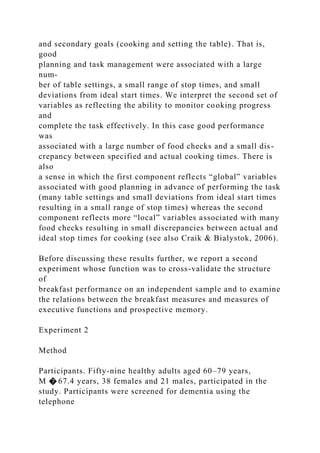
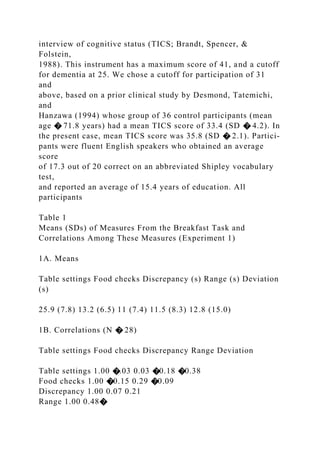
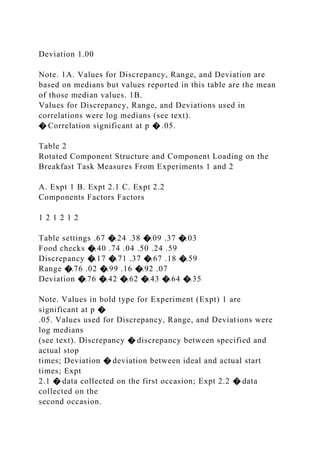
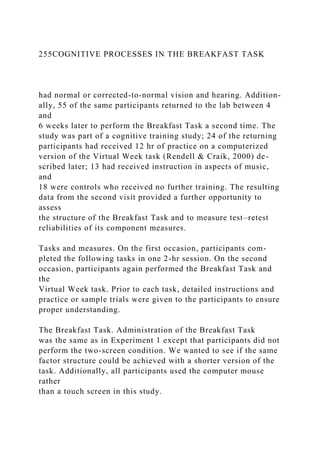
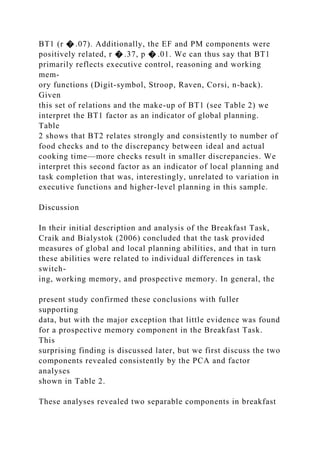
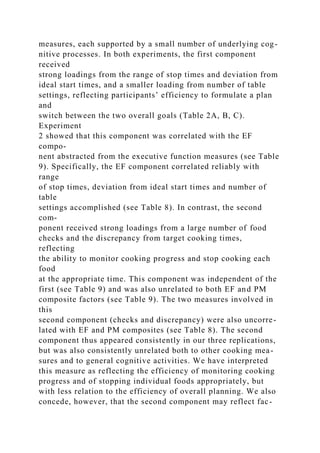
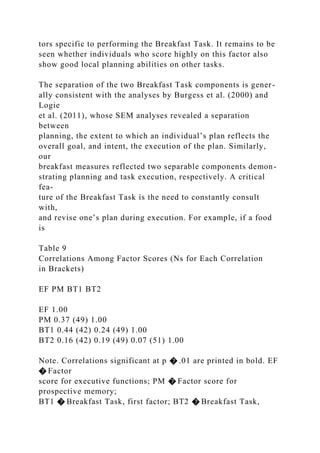
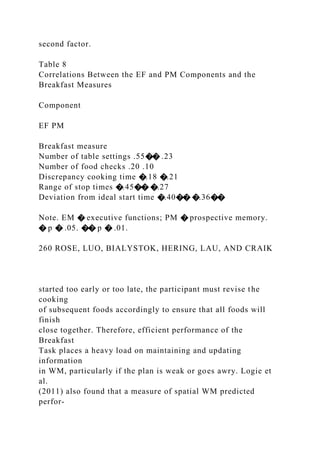
The study examines cognitive processes involved in the breakfast task, a computerized activity simulating the planning and monitoring required to prepare breakfast. Two experiments were conducted with adults to analyze performance structure using principal component analysis, leading to the identification of a two-component model reflecting global planning and local monitoring abilities. Results suggest that while global planning is linked to executive functions, local monitoring operates independently, highlighting the complexity of cognitive processes in everyday tasks.
![Nathan S. Rose, Rotman Research Institute at Baycrest,
Toronto, Can-
ada; Lin Luo and Ellen Bialystok, Department of Psychology,
York Uni-
versity; Alexandra Hering, Karen Lau, and Fergus I. M. Craik,
Rotman
Research Institute at Baycrest.
None of the authors has any financial interest or will receive
any
financial benefit from the work reported in this article. This
work was
supported by Grant 8261-03 to Fergus I. M. Craik from the
Natural
Sciences and Engineering Research Council of Canada, Grant
MOP57482
to Ellen Bialystok and Fergus I. M. Craik from the Canadian
Institutes of
Health Research, and a Kickstart Grant from the Centre for
Brain Fitness
to Nathan S. Rose and Fergus I. M. Craik. We thank Sharyn
Kreuger, Jane
Logan, Ashley Morgan, Evelyn Zastepa, Karen Lau, Yunjo Lee,
Jenna
Ware, and Brittany Murphy for their help with data collection
and scoring.
Correspondence concerning this article should be addressed to
Fergus
I. M. Craik, Rotman Research Institute at Baycrest, 3560
Bathurst Street,
Toronto, Ontario M6A 2E1, Canada. E-mail: [email protected]
Canadian Journal of Experimental Psychology / Revue
canadienne de psychologie expérimentale © 2015 Canadian
Psychological Association](https://image.slidesharecdn.com/cognitiveprocessesinthebreakfasttaskplanningandmonito-230116125139-1a44516e/85/Cognitive-Processes-in-the-Breakfast-Task-Planning-and-Monito-docx-4-320.jpg)