RESEARCH POSTER PRESENTATION DESIGN © 2015
www.PosterPresentations.com
•  The most critical and intensive period of
neural development occurs in children
from zero to five years of age resulting in
rapid development in cognition, language,
and socio-emotional skills.
•  Physical activity, ‘any bodily movement
produced by the skeletal muscles that
results in energy expenditure’ (Caspersen
et al., 1985), is being increasingly
recognized as an important determinant
of cognitive development in middle
childhood and adulthood.
•  Only a few emerging studies on younger
children exist due to challenges with
assessing physical activity levels of
toddlers <3 years of age.
•  Existing studies have shown that at least
one cognitive outcome was improved with
an increased duration and/or frequency
activity (Carson et al., 2015).
•  As early childhood is the most active
period for the establishing of neural
connections, research into factors that
may alter cognitive development may
result in possible interventions to promote
healthy early development
INTRODUCTION
•  To examine the relationship between
physical activity and cognitive
development (language acquisition,
social-emotional development, and
adaptive behaviour) in 18-30 month old
children.
OBJECTIVE
MATERIALS & METHODS
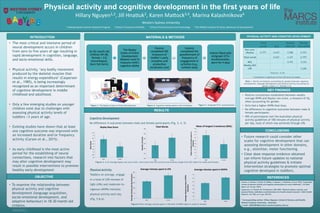
Physical Activity
Toddlers on average, engage
in a total of 230 minutes of
light (LPA) and moderate-to-
vigorous (MVPA) intensity
physical activity each day
(Fig. 5 & 6).
Cognitive Development
No difference in outcomes between male and female participants (Fig. 3, 4, 5)
RESULTS
KEY FINDINGS
PHYSICAL ACTIVITY AND COGNITIVE DEVELOPMENT
•  Positive correlations established between weekly
average MVPA and Bayley raw score, a measure of IQ,
when accounting for gender.
•  Girls had a higher MVPA than boys.
•  No difference in cognitive outcomes between male &
female participants .
•  90% of participants met the Australian physical
activity guidelines of 180 minutes of physical activity
per day, most of which was achieved through LPA.
1	
  Undergraduate	
  Summer	
  Research	
  Program	


  2	
  School	
  of	
  Science	
  and	
  Health	


  3	
  School	
  of	
  Social	
  Science	
  and	
  Psychology	


  4	
  The	
  MARCS	
  Ins/tute	
  for	
  Brain,	
  Behaviour	
  &	
  Development	


Hillary	
  Nguyen1,2,	
  Jill	
  Hna/uk2,	
  Karen	
  MaUock3,4,	
  Marina	
  Kalashnikova4	
  
Physical activity and cognitive development in the first years of life
24-­‐30	
  month	
  old	
  
children	
  (N=28,	
  
female	
  =	
  13)	
  
(monolingual,	
  
born	
  full-­‐term)	
  
The	
  Bayley	
  
Scales	
  of	
  Infant	
  
Development	
  
(Bayley)	
  used	
  to	
  
measure	
  child’s	
  
cogni/ve	
  ability	
  	
  
Parents	
  
completed	
  OZI	
  
(measure	
  of	
  
toddler’s	
  early	
  
recep/ve	
  and	
  
produc/ve	
  
vocabulary	
  size)	
  	
  
Parents	
  
completed	
  the	
  
ques/onnaire	
  of	
  
frequency	
  of	
  
engagement	
  in	
  
ac/vi/es	
  (e.g.,	
  
outdoor	
  play)	
  
Infants	
  fiUed	
  with	
  
Ac/graph	
  GT3+	
  
Accelerometer,	
  
worn	
  for	
  4	
  days	
  
Total
words M3L
Weekly
AVG LPA
Weekly
AVG MVPA
Raw score
(Bayley) 0.777* 0.634^ 0.588 0.755*
Total words 0.652^ 0.347 0.779*
M3L 0.476 0.324
Weekly AVG
LPA 0.208
^ Trend (p < 0.10)
* Correlation is significant at the 0.05 level (2-tailed).
69	
  
69.5	
  
70	
  
70.5	
  
71	
  
71.5	
  
72	
  
72.5	
  
73	
  
73.5	
  
Male	
   Female	
  
Raw	
  Score	
  
Bayley	
  Raw	
  Score	
  
310	
  
315	
  
320	
  
325	
  
330	
  
335	
  
340	
  
Male	
   Female	
  
Number	
  of	
  words	
  	
  
Total	
  Words	
  
3.9	
  
4	
  
4.1	
  
4.2	
  
4.3	
  
4.4	
  
4.5	
  
4.6	
  
4.7	
  
4.8	
  
4.9	
  
Male	
   Female	
  
Mean	
  number	
  of	
  words	
  used	
  in	
  a	
  
sentence	
  
Mean	
  of	
  longest	
  3	
  sentences	
  (M3L)	
  
0	
  
50	
  
100	
  
150	
  
200	
  
250	
  
Male	
   Female	
  
Average	
  minutes	
  per	
  day	
  (minutes)	
  
Average	
  minutes	
  spent	
  in	
  LPA	
  
0	
  
10	
  
20	
  
30	
  
40	
  
50	
  
60	
  
70	
  
Male	
   Female	
  
Average	
  minutes	
  per	
  day	
  in	
  MVPA	
  
(minutes)	


Average	
  minutes	
  spent	
  in	
  MVPA	
  
Figures 5 & 6: Average minutes spent in LPA (left) & MVPA (right) in males & females
Figures 3, 4, 5: Average Bayley raw score (left), word count from OZI (centre) and sentence length from OZI (right) for males and females
RESULTS
Table 1. Partial correlations (controlling for gender) between cognitive
development, language development and physical activity accounting for
gender (males n=7, females n=3)
CONCLUSIONS
Figure 1. The Bayley Scales of Infant Development Figure 2. Cognitive testing session with the Bayley Figure 3. Actigraph GT3+ accelerometer
REFERENCES
•  Future research could consider other
scales for cognitive development that can
assessing development in other domains,
e.g., attention, motor functioning.
•  Clear dose-response evidence obtained
can inform future updates to national
physical activity guidelines & initiate
intervention strategies to promote optimal
cognitive developed in toddlers.
Carson,	
  V,	
  Hunter,	
  S,	
  Kuzik,	
  N,	
  Wiebe,	
  S,	
  Spence,	
  J,	
  Friedman,	
  A	
  et	
  al.	
  2015,	
  ‘SystemaXc	
  
review	
  of	
  physical	
  acXvity	
  and	
  cogniXve	
  development	
  in	
  early	
  childhood’,	
  J	
  Sci	
  Med	
  
Sport,	
  vol.	
  15,	
  pp.	
  146-­‐8	
  
Caspersen,	
  CJ,	
  Powell,	
  KE,	
  Christenson,	
  GM	
  1985,	
  ‘Physical	
  acXvity,	
  exercise,	
  and	
  
physical	
  fitness:	
  definiXons	
  and	
  disXncXons	
  for	
  health-­‐related	
  research’,	
  Public	
  Health	
  
Reports’,	
  vol.	
  100,	
  no.	
  2,	
  pp.	
  126-­‐131	


1	
  Corresponding	
  author:	
  Hillary	
  Nguyen,	
  School	
  of	
  Science	
  and	
  Health,	
  
Western	
  Sydney	
  University	
  ,	
  Australia.	
  
	
  E-­‐mail:	
  18065884@student.westernsydney.edu.au	
  
Western	
  Sydney	
  University	
  

Poster2_Hillary_PhysAct+Cogn (1)

  • 1.
    RESEARCH POSTER PRESENTATIONDESIGN © 2015 www.PosterPresentations.com •  The most critical and intensive period of neural development occurs in children from zero to five years of age resulting in rapid development in cognition, language, and socio-emotional skills. •  Physical activity, ‘any bodily movement produced by the skeletal muscles that results in energy expenditure’ (Caspersen et al., 1985), is being increasingly recognized as an important determinant of cognitive development in middle childhood and adulthood. •  Only a few emerging studies on younger children exist due to challenges with assessing physical activity levels of toddlers <3 years of age. •  Existing studies have shown that at least one cognitive outcome was improved with an increased duration and/or frequency activity (Carson et al., 2015). •  As early childhood is the most active period for the establishing of neural connections, research into factors that may alter cognitive development may result in possible interventions to promote healthy early development INTRODUCTION •  To examine the relationship between physical activity and cognitive development (language acquisition, social-emotional development, and adaptive behaviour) in 18-30 month old children. OBJECTIVE MATERIALS & METHODS Physical Activity Toddlers on average, engage in a total of 230 minutes of light (LPA) and moderate-to- vigorous (MVPA) intensity physical activity each day (Fig. 5 & 6). Cognitive Development No difference in outcomes between male and female participants (Fig. 3, 4, 5) RESULTS KEY FINDINGS PHYSICAL ACTIVITY AND COGNITIVE DEVELOPMENT •  Positive correlations established between weekly average MVPA and Bayley raw score, a measure of IQ, when accounting for gender. •  Girls had a higher MVPA than boys. •  No difference in cognitive outcomes between male & female participants . •  90% of participants met the Australian physical activity guidelines of 180 minutes of physical activity per day, most of which was achieved through LPA. 1  Undergraduate  Summer  Research  Program              2  School  of  Science  and  Health                3  School  of  Social  Science  and  Psychology              4  The  MARCS  Ins/tute  for  Brain,  Behaviour  &  Development       Hillary  Nguyen1,2,  Jill  Hna/uk2,  Karen  MaUock3,4,  Marina  Kalashnikova4   Physical activity and cognitive development in the first years of life 24-­‐30  month  old   children  (N=28,   female  =  13)   (monolingual,   born  full-­‐term)   The  Bayley   Scales  of  Infant   Development   (Bayley)  used  to   measure  child’s   cogni/ve  ability     Parents   completed  OZI   (measure  of   toddler’s  early   recep/ve  and   produc/ve   vocabulary  size)     Parents   completed  the   ques/onnaire  of   frequency  of   engagement  in   ac/vi/es  (e.g.,   outdoor  play)   Infants  fiUed  with   Ac/graph  GT3+   Accelerometer,   worn  for  4  days   Total words M3L Weekly AVG LPA Weekly AVG MVPA Raw score (Bayley) 0.777* 0.634^ 0.588 0.755* Total words 0.652^ 0.347 0.779* M3L 0.476 0.324 Weekly AVG LPA 0.208 ^ Trend (p < 0.10) * Correlation is significant at the 0.05 level (2-tailed). 69   69.5   70   70.5   71   71.5   72   72.5   73   73.5   Male   Female   Raw  Score   Bayley  Raw  Score   310   315   320   325   330   335   340   Male   Female   Number  of  words     Total  Words   3.9   4   4.1   4.2   4.3   4.4   4.5   4.6   4.7   4.8   4.9   Male   Female   Mean  number  of  words  used  in  a   sentence   Mean  of  longest  3  sentences  (M3L)   0   50   100   150   200   250   Male   Female   Average  minutes  per  day  (minutes)   Average  minutes  spent  in  LPA   0   10   20   30   40   50   60   70   Male   Female   Average  minutes  per  day  in  MVPA   (minutes)     Average  minutes  spent  in  MVPA   Figures 5 & 6: Average minutes spent in LPA (left) & MVPA (right) in males & females Figures 3, 4, 5: Average Bayley raw score (left), word count from OZI (centre) and sentence length from OZI (right) for males and females RESULTS Table 1. Partial correlations (controlling for gender) between cognitive development, language development and physical activity accounting for gender (males n=7, females n=3) CONCLUSIONS Figure 1. The Bayley Scales of Infant Development Figure 2. Cognitive testing session with the Bayley Figure 3. Actigraph GT3+ accelerometer REFERENCES •  Future research could consider other scales for cognitive development that can assessing development in other domains, e.g., attention, motor functioning. •  Clear dose-response evidence obtained can inform future updates to national physical activity guidelines & initiate intervention strategies to promote optimal cognitive developed in toddlers. Carson,  V,  Hunter,  S,  Kuzik,  N,  Wiebe,  S,  Spence,  J,  Friedman,  A  et  al.  2015,  ‘SystemaXc   review  of  physical  acXvity  and  cogniXve  development  in  early  childhood’,  J  Sci  Med   Sport,  vol.  15,  pp.  146-­‐8   Caspersen,  CJ,  Powell,  KE,  Christenson,  GM  1985,  ‘Physical  acXvity,  exercise,  and   physical  fitness:  definiXons  and  disXncXons  for  health-­‐related  research’,  Public  Health   Reports’,  vol.  100,  no.  2,  pp.  126-­‐131     1  Corresponding  author:  Hillary  Nguyen,  School  of  Science  and  Health,   Western  Sydney  University  ,  Australia.    E-­‐mail:  18065884@student.westernsydney.edu.au   Western  Sydney  University