© 2015 Tech3Lab 1
Using a Cognitive Analysis
Grid to Inform Information
Systems Design
LAURENCE DUMONT, GABRIELLE CHÉNIER-LEDUC,
ÉLAINE DE GUISE, ANA ORTIZ DE GUINEA,
SYLVAIN SÉNÉCAL AND PIERRE-MAJORIQUE LÉGER
Gmunden Retreat on NeuroIS 2015
June 2nd 2015, Gmunden, Austria
© 2015 Tech3Lab 2
© 2015 Tech3Lab 3
John is an IS user
© 2015 Tech3Lab 4
John lives in a
wonderful world
© 2015 Tech3Lab 5
Everyone is John
© 2015 Tech3Lab 6
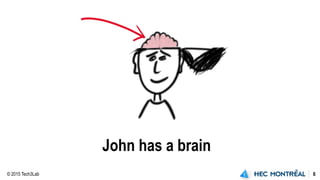
John has a brain
© 2015 Tech3Lab 7
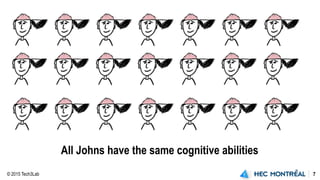
All Johns have the same cognitive abilities
© 2015 Tech3Lab 8
John lives in the IS
literature
© 2015 Tech3Lab 9
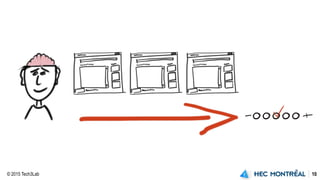
John is doing an IS task
© 2015 Tech3Lab 10
© 2015 Tech3Lab 11
Constant Linear Averaged Normal
© 2015 Tech3Lab 12
John lives in the real world
© 2015 Tech3Lab 13
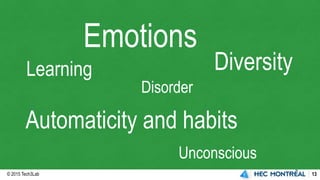
Learning
Automaticity and habits
Emotions
Disorder
Diversity
Unconscious
© 2015 Tech3Lab 14
© 2015 Tech3Lab 15
We are all differentJohn
© 2015 Tech3Lab 16
Objective :
Provide a pilot study of the
cognitive analysis grid with
in a task that involves
multiple steps
© 2015 Tech3Lab 17
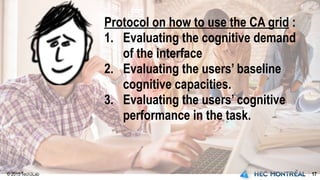
Protocol on how to use the CA grid :
1. Evaluating the cognitive demand
of the interface
2. Evaluating the users’ baseline
cognitive capacities.
3. Evaluating the users’ cognitive
performance in the task.
© 2015 Tech3Lab 18
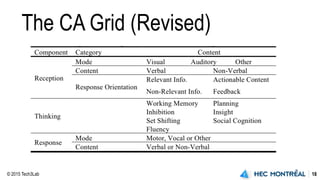
The CA Grid (Revised)
© 2015 Tech3Lab 19
Journal of the International Neuropsychological Society (2014), 20, 11–19.
Copyright E INS. Published by Cambridge University Press, 2013.
doi:10.1017/S1355617713001094
SPECIAL SERIES
NIH EXAMINER: Conceptualization and Development of
an Executive Function Battery
Joel H. Kramer,1
Dan Mungas,2
Katherine L. Possin,1
Katherine P. Rankin,1
Adam L. Boxer,1
Howard J. Rosen,1
Alan Bostrom,1
Lena Sinha,1
Ashley Berhel,1
AND Mary Widmeyer3
1Department of Neurology, University of California, San Francisco, California
2Department of Neurology, University of California, Davis, California
3Rosalind Franklin University of Medicine and Science, Chicago, Illinois
(RECEIVED March 18, 2013; FINAL REVISION August 23, 2013; ACCEPTED August 30, 2013; FIRST PUBLISHED ONLINE October 8, 2013)
Abstract
Executive functioning is widely targeted when human cognition is assessed, but there is little consensus on how
it should be operationalized and measured. Recognizing the difficulties associated with establishing standard operational
definitions of executive functioning, the National Institute of Neurological Disorders and Stroke entered into a contract
with the University of California-San Francisco to develop psychometrically robust executive measurement tools that
would be accepted by the neurology clinical trials and clinical research communities. This effort, entitled Executive
Abilities: Measures and Instruments for Neurobehavioral Evaluation and Research (EXAMINER), resulted in a series
of tasks targeting working memory, inhibition, set shifting, fluency, insight, planning, social cognition and behavior.
We describe battery conceptualization and development, data collection, scale construction based on item response
theory, and lay the foundation for studying the battery’s utility and validity for specific assessment and research goals.
(JINS, 2014, 20, 11–19)
Keywords: working memory, cognitive control, fluency, planning, social cognition, item response theory
INTRODUCTION
Executive deficits are reported in numerous neurobehavioral
conditions, and may be the primary locus of cognitive
impairment in attention-deficit/hyperactivity disorder (Barkley,
2010), behavioral variant frontotemporal dementia (Boone
et al., 1999; Hutchinson & Mathias, 2007; Slachevsky et al.,
2004), subcortical ischemic vascular disease (Moorhouse
et al., 2010; Reed et al., 2004), traumatic brain injury
(Caeyenberghs et al., 2012; Levin & Hanten, 2005; Stuss,
2011), multiple sclerosis (Arnett et al., 1997; Chiaravalloti &
DeLuca, 2003; Foong et al., 1997), Huntington’s disease
(Aron et al., 2003; Paulsen, 2011), progressive supranuclear
palsy (Gerstenecker, Mast, Duff, Ferman, & Litvan, 2013),
Parkinson’s disease (Ravizza & Ciranni, 2002), and
even normal aging (Amieva, Phillips, & Della Sala, 2003;
Buckner, 2004).
Neuroscientists and cognitive psychologists have begun to
parse executive functioning into subcomponents and identify
relevant anatomical regions and networks. Clinical assess-
ment of executive control, however, has fallen behind these
basic science advances. This gap is particularly evident in
clinical trials, where despite the importance of executive
abilities for daily living (Asimakopulos et al., 2012; Cahn-
Weiner, Boyle, & Malloy, 2002), measures of executive
ability are often omitted or underrepresented in clinical trial
batteries. When executive functioning is targeted in research,
there is considerable variability in how it is operationally
defined. Tasks purportedly measuring fluency, working
memory, concept formation, set shifting, inhibition, organiza-
tion, abstract reasoning, and novel problem solving, either
individually or in various combinations, are all used as
markers of executive functioning, with the implicit assumption
that these tasks measure the same construct.
Recognizing the challenges associated with conceptualizing
and measuring executive functioning, the National Institute of
Neurological Disorders and Stroke (NINDS) awarded a
contract to the University of California-San Francisco
(UCSF) to develop psychometrically robust executive mea-
surement tools that would be accepted by the neurology
clinical trials and clinical research communities. Initial goals
Correspondence and reprint requests to: Joel H. Kramer, 675 Nelson
Rising Lane, Suite 190, MC 1207, San Francisco, CA 94158. E-mail:
jkramer@memory.ucsf.edu
11
© 2015 Tech3Lab 20
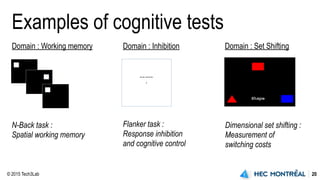
Examples of cognitive tests
Domain : Working memory
N-Back task :
Spatial working memory
Domain : Inhibition
Flanker task :
Response inhibition
and cognitive control
Domain : Set Shifting
Dimensional set shifting :
Measurement of
switching costs
© 2015 Tech3Lab 21
Experimental task
© 2015 Tech3Lab 22
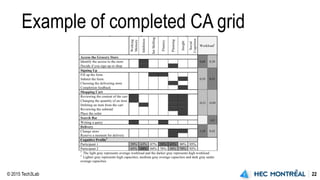
Example of completed CA grid
© 2015 Tech3Lab 23

Using A Cognitive Analysis Grid to Inform Information Systems Design

  • 1.
    © 2015 Tech3Lab1 Using a Cognitive Analysis Grid to Inform Information Systems Design LAURENCE DUMONT, GABRIELLE CHÉNIER-LEDUC, ÉLAINE DE GUISE, ANA ORTIZ DE GUINEA, SYLVAIN SÉNÉCAL AND PIERRE-MAJORIQUE LÉGER Gmunden Retreat on NeuroIS 2015 June 2nd 2015, Gmunden, Austria
  • 2.
  • 3.
    © 2015 Tech3Lab3 John is an IS user
  • 4.
    © 2015 Tech3Lab4 John lives in a wonderful world
  • 5.
    © 2015 Tech3Lab5 Everyone is John
  • 6.
    © 2015 Tech3Lab6 John has a brain
  • 7.
    © 2015 Tech3Lab7 All Johns have the same cognitive abilities
  • 8.
    © 2015 Tech3Lab8 John lives in the IS literature
  • 9.
    © 2015 Tech3Lab9 John is doing an IS task
  • 10.
  • 11.
    © 2015 Tech3Lab11 Constant Linear Averaged Normal
  • 12.
    © 2015 Tech3Lab12 John lives in the real world
  • 13.
    © 2015 Tech3Lab13 Learning Automaticity and habits Emotions Disorder Diversity Unconscious
  • 14.
  • 15.
    © 2015 Tech3Lab15 We are all differentJohn
  • 16.
    © 2015 Tech3Lab16 Objective : Provide a pilot study of the cognitive analysis grid with in a task that involves multiple steps
  • 17.
    © 2015 Tech3Lab17 Protocol on how to use the CA grid : 1. Evaluating the cognitive demand of the interface 2. Evaluating the users’ baseline cognitive capacities. 3. Evaluating the users’ cognitive performance in the task.
  • 18.
    © 2015 Tech3Lab18 The CA Grid (Revised)
  • 19.
    © 2015 Tech3Lab19 Journal of the International Neuropsychological Society (2014), 20, 11–19. Copyright E INS. Published by Cambridge University Press, 2013. doi:10.1017/S1355617713001094 SPECIAL SERIES NIH EXAMINER: Conceptualization and Development of an Executive Function Battery Joel H. Kramer,1 Dan Mungas,2 Katherine L. Possin,1 Katherine P. Rankin,1 Adam L. Boxer,1 Howard J. Rosen,1 Alan Bostrom,1 Lena Sinha,1 Ashley Berhel,1 AND Mary Widmeyer3 1Department of Neurology, University of California, San Francisco, California 2Department of Neurology, University of California, Davis, California 3Rosalind Franklin University of Medicine and Science, Chicago, Illinois (RECEIVED March 18, 2013; FINAL REVISION August 23, 2013; ACCEPTED August 30, 2013; FIRST PUBLISHED ONLINE October 8, 2013) Abstract Executive functioning is widely targeted when human cognition is assessed, but there is little consensus on how it should be operationalized and measured. Recognizing the difficulties associated with establishing standard operational definitions of executive functioning, the National Institute of Neurological Disorders and Stroke entered into a contract with the University of California-San Francisco to develop psychometrically robust executive measurement tools that would be accepted by the neurology clinical trials and clinical research communities. This effort, entitled Executive Abilities: Measures and Instruments for Neurobehavioral Evaluation and Research (EXAMINER), resulted in a series of tasks targeting working memory, inhibition, set shifting, fluency, insight, planning, social cognition and behavior. We describe battery conceptualization and development, data collection, scale construction based on item response theory, and lay the foundation for studying the battery’s utility and validity for specific assessment and research goals. (JINS, 2014, 20, 11–19) Keywords: working memory, cognitive control, fluency, planning, social cognition, item response theory INTRODUCTION Executive deficits are reported in numerous neurobehavioral conditions, and may be the primary locus of cognitive impairment in attention-deficit/hyperactivity disorder (Barkley, 2010), behavioral variant frontotemporal dementia (Boone et al., 1999; Hutchinson & Mathias, 2007; Slachevsky et al., 2004), subcortical ischemic vascular disease (Moorhouse et al., 2010; Reed et al., 2004), traumatic brain injury (Caeyenberghs et al., 2012; Levin & Hanten, 2005; Stuss, 2011), multiple sclerosis (Arnett et al., 1997; Chiaravalloti & DeLuca, 2003; Foong et al., 1997), Huntington’s disease (Aron et al., 2003; Paulsen, 2011), progressive supranuclear palsy (Gerstenecker, Mast, Duff, Ferman, & Litvan, 2013), Parkinson’s disease (Ravizza & Ciranni, 2002), and even normal aging (Amieva, Phillips, & Della Sala, 2003; Buckner, 2004). Neuroscientists and cognitive psychologists have begun to parse executive functioning into subcomponents and identify relevant anatomical regions and networks. Clinical assess- ment of executive control, however, has fallen behind these basic science advances. This gap is particularly evident in clinical trials, where despite the importance of executive abilities for daily living (Asimakopulos et al., 2012; Cahn- Weiner, Boyle, & Malloy, 2002), measures of executive ability are often omitted or underrepresented in clinical trial batteries. When executive functioning is targeted in research, there is considerable variability in how it is operationally defined. Tasks purportedly measuring fluency, working memory, concept formation, set shifting, inhibition, organiza- tion, abstract reasoning, and novel problem solving, either individually or in various combinations, are all used as markers of executive functioning, with the implicit assumption that these tasks measure the same construct. Recognizing the challenges associated with conceptualizing and measuring executive functioning, the National Institute of Neurological Disorders and Stroke (NINDS) awarded a contract to the University of California-San Francisco (UCSF) to develop psychometrically robust executive mea- surement tools that would be accepted by the neurology clinical trials and clinical research communities. Initial goals Correspondence and reprint requests to: Joel H. Kramer, 675 Nelson Rising Lane, Suite 190, MC 1207, San Francisco, CA 94158. E-mail: jkramer@memory.ucsf.edu 11
  • 20.
    © 2015 Tech3Lab20 Examples of cognitive tests Domain : Working memory N-Back task : Spatial working memory Domain : Inhibition Flanker task : Response inhibition and cognitive control Domain : Set Shifting Dimensional set shifting : Measurement of switching costs
  • 21.
    © 2015 Tech3Lab21 Experimental task
  • 22.
    © 2015 Tech3Lab22 Example of completed CA grid
  • 23.